“My son was killed in the war. He doesn’t feel any honor.” — Matthias Erzberger
A clean uniform can hide a terrible history. In Edward Berger’s All Quiet on the Western Front (2022), clothing stripped from a dead soldier is repaired and handed to a new recruit, turning an ordinary military supply process into something chilling. That image captures the film’s outlook before its young protagonist understands what awaits him: the army needs another body, and his will do. This German anti-war film, adapted from Erich Maria Remarque’s 1929 novel of the same name, is the book’s third film adaptation. Berger makes it a harsh, absorbing experience that dismantles the comforting idea that battlefield suffering automatically produces honor. The uniform might look ready for a fresh beginning, but the audience already knows it belongs to a cycle.
The new recruit is Paul Bäumer, played by Felix Kammerer, a teenager who joins the German army alongside his friends during World War I. They are swept up in patriotic excitement and the promise that military service will transform them into men worth admiring. Their eagerness is uncomfortable because it feels so ordinary. They want adventure, acceptance, and a chance to prove themselves. Going together also makes the decision seem less frightening: each boy’s enthusiasm validates the others. Berger treats those desires with sympathy while showing how easily authority figures exploit them. The boys are encouraged to imagine their triumphant return, not the possibility that someone else might eventually wear their uniforms. The recruitment rhetoric works by giving them a flattering picture of themselves and leaving the actual experience of fighting conveniently out of view.
Once they reach the front, the gap between those promises and reality becomes impossible to ignore. There is no graceful transition from innocence to experience, just a violent introduction to mud, shellfire, hunger, and panic. The young men who dreamed of glory and honor quickly become disillusioned with both. Fighting for their country becomes less immediate than finding shelter or keeping a friend alive. This is the foundation of the film’s anti-war message: the grand ideas that make war appealing from a distance become useless to the people forced to endure it up close. What makes that change especially upsetting is that their disillusionment offers no escape. Realizing they have been misled does not release them from service or restore their safety. They must keep participating in something they can no longer understand in the terms they were taught.
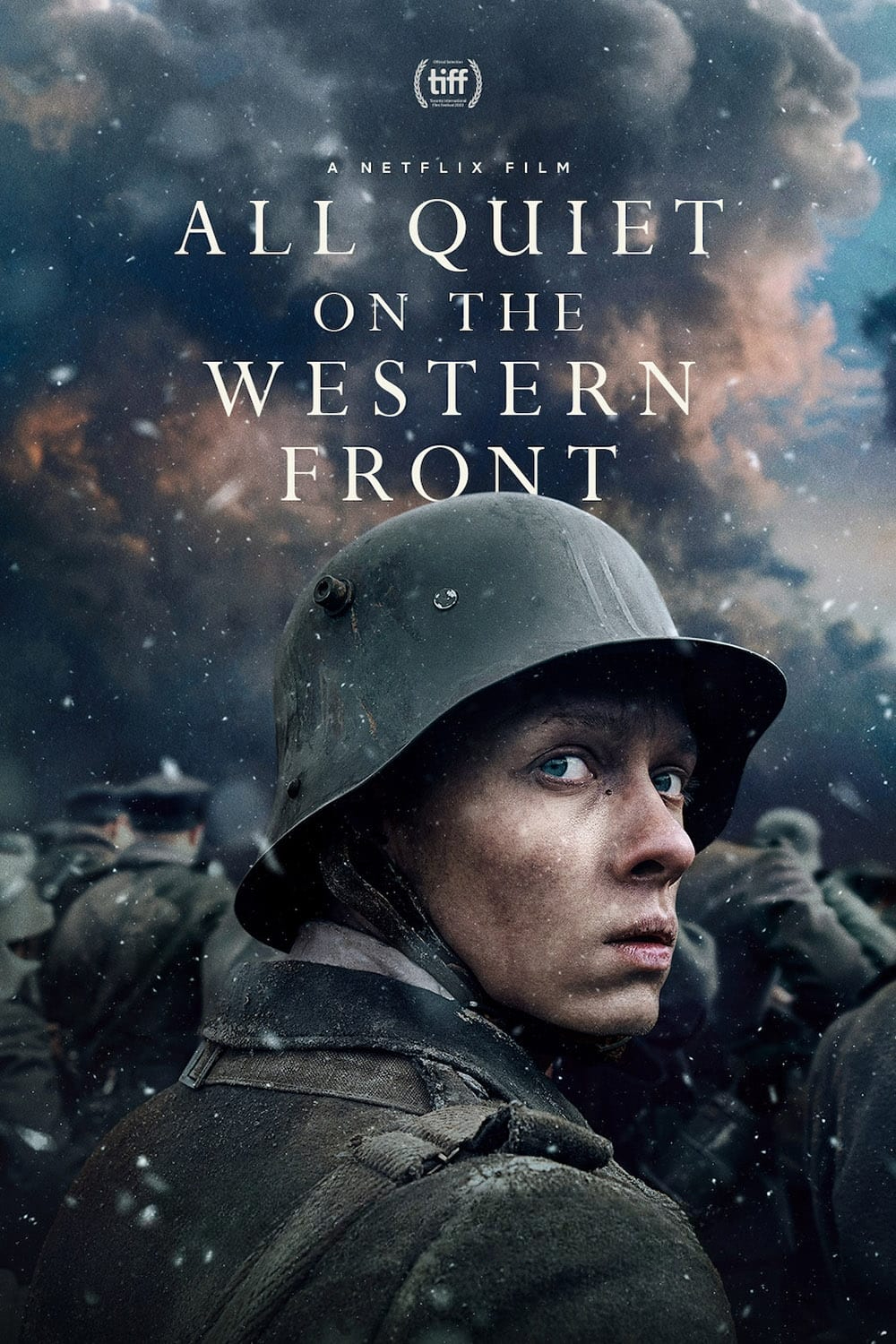
Kammerer makes Paul’s changing state of mind visible without relying on long speeches. At first, his face has the openness of someone expecting the world to reward his enthusiasm. Gradually, that expression gives way to shock, exhaustion, and a stare that seems unable to absorb another terrible sight. What works especially well is that Paul never becomes a polished action hero. Learning to survive does not look empowering. It looks like a frightened person adjusting to conditions nobody should have to accept. His growing ability to function in battle comes with a disturbing emotional cost, and the film refuses to present that cost as a badge of maturity. When his fear or compassion breaks through, we see the distance between the soldier he must become and the young man he might otherwise have remained.
The friendship between Paul and the older soldier Stanislaus “Kat” Katczinsky gives that struggle emotional weight. Played by Albrecht Schuch, Kat offers practical knowledge and companionship rather than reassuring speeches. He understands the front better than Paul, but experience does not make him immune to its dangers. Their shared efforts to find food and enjoy brief moments of normality are among the film’s most affecting scenes. These passages show that the soldiers still have appetites, humor, and a need for company; they are not simply faces waiting for the next catastrophe. Kat’s care also provides a revealing contrast with the authority figures who encouraged Paul to enlist. Where those men offered abstract promises about duty, Kat responds to immediate human needs. His loyalty means something because it involves helping an actual person rather than praising an idea.
Those quieter moments are also essential to the film’s rhythm. Relentless violence can eventually become numbing, especially when each sequence seems determined to surpass the last in brutality. By allowing the characters to eat, talk, and briefly relax, Berger gives the audience something beyond suffering to hold onto. We understand what the soldiers are trying to preserve, even when their hopes have become very small. A meal matters because hunger is constant; companionship matters because isolation would make the fear harder to bear. The film is most emotionally convincing when it recognizes that ordinary comforts do not become trivial during a catastrophe. They become more precious.
Berger’s handling of combat is forceful and often terrifying. Soldiers appear painfully exposed against artillery, tanks, and weapons that kill on a scale individual bravery cannot overcome. The battlefield rarely feels like a place where determination guarantees success. More often, survival seems arbitrary. That choice matters because war films can condemn violence in dialogue while making it exhilarating to watch. Here, the confusion and physical ugliness usually overwhelm any excitement. You might admire how a sequence is constructed, but the film gives you little reason to wish you were inside it. Courage does not make the machinery less merciless, and one person’s resolve cannot turn an overwhelming assault into a fair contest. The imbalance between vulnerable bodies and industrial weapons makes the earlier promises of individual glory seem particularly dishonest.
The visual polish does create a complication, though. Some images are so striking that their beauty briefly competes with the horror they contain. Ruined landscapes and carefully composed shots can pull attention toward the filmmaking itself. That does not cancel the film’s message, but it raises a question about how to show war without making it visually seductive. Berger does not completely solve that problem. At times, the scale and precision invite admiration when the emotional situation seems to demand revulsion. Still, the overall effect is exhausting rather than glamorous. The images may be impressive, but the lives within them look miserable, precarious, and increasingly stripped of choice. There is little sense that participating in this spectacle would offer the excitement that watching its construction might briefly suggest.
The film becomes most devastating when it narrows its focus to Paul and a French soldier he has stabbed in a crater. Suddenly, the enemy is not a distant shape or a threatening uniform. He is a suffering person Paul cannot escape looking at. Kammerer’s panic and remorse make the scene difficult to sit through, precisely because the violence has already happened and cannot be undone. Paul’s attempts to help are heartbreaking because they expose a contradiction he cannot resolve: the person he was expected to attack is also someone he desperately wants to save. The scene brings the film’s argument out of the realm of mass destruction and into an intimate encounter. One man’s suffering becomes enough to reveal the moral damage that enormous casualty figures can leave strangely abstract.
It also complicates any easy division between innocent victim and violent participant. Paul has been manipulated and traumatized, but he is still capable of inflicting terrible harm. The film does not need to deny either truth to make him sympathetic. Instead, it shows how war places people in situations where survival and conscience can pull in opposite directions. The patriotic language that brought Paul here has nothing useful to say about the man dying beside him. There is no satisfying victory in the encounter, no emotional reward for having overcome an enemy. There is only the awful discovery that doing what the battlefield demands can leave a person unable to live comfortably with himself.
A separate storyline involving armistice negotiations expands the perspective beyond Paul’s experience. Daniel Brühl plays German representative Matthias Erzberger, and these scenes emphasize the distance between discussions about ending the war and the continuing deaths on the battlefield. The contrast is effective because peace is not merely a historical outcome for the soldiers; its timing determines whether they survive. Every delay has a different meaning for someone under fire than it does for someone seated at a negotiating table. Still, the shifts sometimes interrupt the intense connection with Paul. The film gains a broader view of power and responsibility, but loses some of the confinement that makes the trench scenes so immediate.
A commander’s obsession with glory near the ceasefire is similarly blunt. His decisions sharpen the criticism of military authority, but he can feel more like the embodiment of an argument than a fully developed person. By this point, the audience hardly needs another demonstration that prestige matters more to some leaders than their soldiers’ lives. Even so, his role completes a bitter connection with the recruitment scenes. The young men have abandoned their fantasies of honor because experience has exposed those fantasies as empty. The authority figure can continue believing in them because others bear the consequences. What sounded inspiring at the beginning becomes openly grotesque when used to justify further deaths.
Even with those weaknesses, All Quiet on the Western Front leaves a powerful impression because it never offers suffering as adequate compensation for lost youth. Paul’s experience is not an inspiring journey toward greatness; it is the destruction of possibilities he barely had time to imagine. By the end, that recycled uniform feels like more than an effective opening image. It represents a system capable of replacing a soldier without confronting the person it has erased. Berger’s film is angry, sometimes overly emphatic, and deeply upsetting. Its strongest accusation is also its simplest: the people selling war’s rewards are rarely the ones required to discover how empty those rewards can be.