I like this video because of the wonderful creepiness of it all. Who knows what could be lurking in those shadows?
Enjoy!
I like this video because of the wonderful creepiness of it all. Who knows what could be lurking in those shadows?
Enjoy!

Today’s song of the day comes to use Ennio Morricone’s score for the 1972 giallo, Who Saw Her Die? This may not be one Morricone’s best-known soundtracks but it’s still one of his best. The movie’s pretty good as well.
From Who Saw Her Die:
Previous Entries In Our Tribute To Morricone:
‘And here in the bar, the piano man’s found another nail for my heart.
Like so many music videos from the early 80s, the most notable thing about the video for Squeeze’s Another Nail In My Heart is how simple it is. The band performs and hangs out at a bar, which goes along with the theme of the song. The most complicated thing about the video is Jools Holland, pushing his piano down the streets of London so that he can arrive in time to put another nail in Glenn Tilbrook’s heart. In other words, this is from the era when the videos were about the music instead of the music being about the video.
Enjoy!
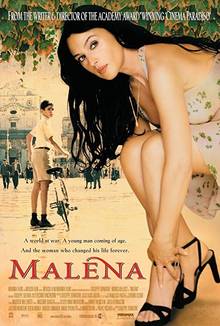
Today’s song of the day comes from Ennio Morricone’s score for the 2000 Italian film, Malena!
Here, from a performance in Chile, is Morricone’s Malena:
Previous Entries In Our Tribute To Morricone:
A song about drug abuse that features a children’s chorus?
Not creepy at all!
Aeroplane makes a lot more sense if you know that it’s based on a traditional blues song called Jesus is my Areoplane. In their version of the song, the Chili Peppers are saying that music has saved them and taken them to a higher plane of existence. Whenever Anthony Kiedis struggled with his addictions and was tempted to turn to dust in his kitchen, it was music that kept him from destroying himself. The original song was about people flying away with Jesus. The Chili Peppers are flying away with songs like this one. The Chili Peppers might be going to Hell but at least they got to make some music and shoot his video with a group of smoking hot models and synchronized swimmers.
The children’s chorus, which shows up at the end and changes the entire feel of the video, were reportedly all friends of Flea’s daughter. Flea’s daughter is among the children singing. At the end of the song, when you hear one girl outsinging all the rest with “You’re my areoplane!,” that’s her.
Enjoy!

Today’s song of the day comes from Ennio Morricone’s score for Sergio Leone’s 1971 film, Duck, You Sucker! Also known as A Fistful of Dynamite, this is probably Leone’s most underrated film and Morricone’s excellent score seems to be a bit underrated as well.
Though it may have been dismissed when originally released, many critics have recently discovered that the film actually holds up surprisingly well. So does Morricone’s score.
From Duck, You Sucker!:
Previous Entries In Our Tribute To Morricone:
I may be going to Hell in a bucket but at least I’m enjoying the ride
The members of the Grateful Dead didn’t do many music videos. I think Hell In A Bucket was their second video, following the surprise hit that they had with A Touch of Grey. From what I’ve read, it was the band’s record label that insisted that the band make some videos to help promote their 12th studio album, In the Dark. Some members of the band were concerned that agreeing to do music videos would mean that they were “selling out.”
The video for Hell In A Bucket feels like it could be a parody of the type of videos that were popular on MTV. With his Miami Vice-Style outfit and the way he mugs for the camera, Bob Weir almost seems like he could be Huey Lewis’s coked-out older brother. The video opens in a biker bar, populated with the type of rough characters who most bands would never dream of featuring in a video. While Jerry Garcia keeps his distance, Bob Weir sings a song of rock and roll decadence that seems to be saying, “This is what it’s all really about.”
No, I don’t know why there’s a duck at the bar. It’s just there. Jerry daughter’s Trixie is also in the video. She plays one of the dancing devils.
Enjoy!

Continuing our tribute to Ennio Morricone, today’s song of the day is the main theme from 1965’s For A Few Dollars More. If Sergio Leone’s version of the old west was as a mythological landscape, Morricone’s music was always the perfect soundtrack.
Previous Entries In Our Tribute To Morricone:
“We were trying to do Motown with this one. Lee Thompson’s sister had a baby with a black man and it caused consternation in his family. It’s a great lyric – really sensational. You couldn’t believe such sensitivity could come from such a rough diamond, but Lee is one of the best lyricists of his time. We were having trouble with people associating us with the NF, so it was nice to establish once and for all that we weren’t.”
— Suggs on Embarrassment
The NF that Madness’s frontman refers to was the National Front, a fascist British political party that was at the height of its prominence when Embarrassment was recorded. Because Madness was a ska band and because many of the skinheads who supported the National Front were also into ska music, Madness had to spend a good deal of their early career just assuring people that they were not themselves supporters of the National Front. (Today, of course, it’s hard to imagine how anyone could listen to any of Madness’s songs and mistake them for supporters of the NF.) This song, which sympathetically tells the story of a woman who has been rejected by her racist family because she’s having a black man’s baby, is not only a repudiation of everything the NF stood for but it’s also one of Madness’s rare “serious” songs.
Enjoy!

Our tribute to Ennio Morricone will be coming to a close at the end of this week. We’ve shared a lot of unforgettable music from Morricone and hopefully, we’ve encouraged you to track down a few of the films that he scored. Obviously, there’s no way that we could do a tribute to Morricone without including the main theme from Sergio Leone’s first Spaghetti western, A Fistful of Dollars.
Though it may not be as well known as Morricone’s scores for The Good, The Bad, and the Ugly and Once Upon A Time In The West, it’s just as epic. The real old west may not have featured Morricone’s music playing in the background but it definitely should have.
Here is the main theme from A Fistful of Dollars!
Previous Entries In Our Tribute To Morricone:

