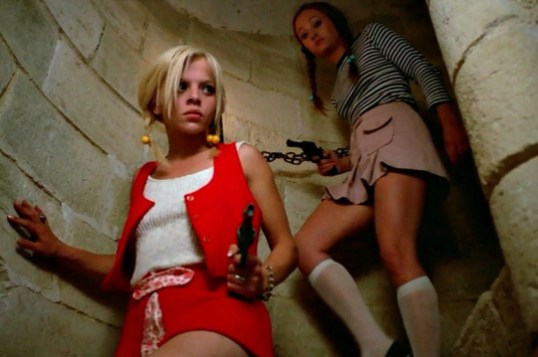
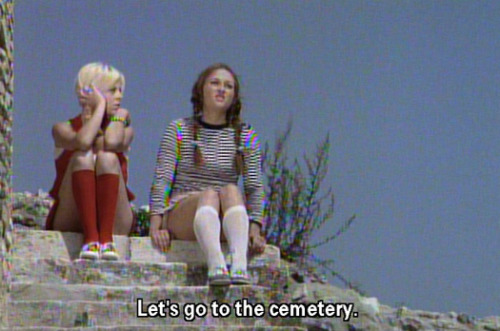
Today’s horror on the lens is a 1972 made-for-TV movie, Haunts of the Very Rich!
What happens when a bunch of rich people find themselves on an airplane with no memory of how they got there? Well, first off, they land at a luxury resort! But what happens when the resort suddenly turns out to be deserted and the guests discover that there’s no apparent way out!?
On tonight’s episode of One Step Beyond, a man suspects that his best friend is having an affair with his fiancee. What better way to take care of the problem than by leaving his friend to die on the side of a mountain?
It seems like the perfect crime and the man might get away with it …. but only if he can do something about the ghost who seems to be stalking him in the days leading up to his wedding!
As always, this is supposedly based on a true story.
In the 1989 horror film, I, Madman, Jenny Wright stars as Virginia. Virginia’s an aspiring actress who makes ends meet by working in a used bookstore. (I’m not sure how much money the typical used bookstore employee makes but I have to say that Virginia’s apartment is absolutely to die for.) Virginia is also dating a police detective named Richard (Clayton Rohner), who is handsome and sweet and looks good in a suit. In fact, the only problem with Richard is that he thinks that Virginia spends too much time reading trashy horror novels. According to him, they give her nightmares and they cause her imagination to run wild.
Richard’s not going to be happy to discover that Virginia has a new favorite author. His name is Malcolm Brand and, despite the fact that Virginia says that he’s better than Stephen King, he’s a mysteriously obscure author. In fact, no one but Virginia seems to have ever heard of him. Virginia has just finished reading Brand’s first book, Much of Madness, More of Sin. Now, she simply has to find his second book, which was called I, Madman.
(Personally, I think Much of Madness, More of Sin is a brilliant title. I, Madman on the other hand is a little bit bland, as far as titles go.)
When Virginia finally tracks down a copy of the book, she discovers that it is all about this mad scientist who falls in love with an actress. Because the scientist is horribly disfigured, the actress rejects him. So, the scientist starts killing people and stealing pieces of their faces, all so he can patch together a new face for himself.
It’s while she’s reading the book the strange things start to happen in Virginia’s life. For instance, the people around her start dying. When she witnesses one of her neighbors being murdered, she swears that the murder was committed by a man who had no nose …. just like in the book! Richard thinks that she’s letting her imagination run wild but Virginia soon comes to wonder if maybe she’s being stalked by the real Malcolm Brand….
I, Madman is an entertaining little horror film, one that sometimes comes across as being an extended episode of something like Tales From The Crypt. From the minute the movie started with Virginia curled up on her couch in her underwear, reading a trashy novel with her oversized reading glasses on and a storm raging outside, I was like, “Oh my God, they made a movie out of my life!” And really, this is one of the reasons why I, Madman makes such a good impression. As played by Jenny Wright, Virginia serves as a stand-in for every horror fan who has ever read a scary novel and immediately imagined themselves as either the protagonist or the victim. If you’ve ever had a nightmare after reading Stephen King or watching a horror movie, you’ll be able to relate to Virginia. Both Jenny Wright and Clayton Rohner give likable and quirky performances in the lead role and they’re surrounded by capable of character actors.
The film itself is a bit of an homage to the suspense classics of the past. It’s easy to compare Malcolm Brand’s novel to The Phantom of the Opera while a scene in which Virginia watches her neighbor play piano brings to mind Hitchcock’s Rear Window. When Virginia imagines herself as a character in one of Brand’s stories, the film even manages to work in some stop-motion animation. All in all, I, Madman is an entertaining horror film, perfect for October and any other season.
Q stands for Quetzalcoatl, a winged-serpent that was once worshiped by the Aztecs. In New York someone has been performing ritual sacrifices, flaying victims of their skin. As a result, Q has flown all the way to New York City and has taken residence in the Chrysler Building. She’s also laid an egg, from which a baby Q will soon emerge.
Now, I’ve always heard that it’s next to impossible to surprise a New Yorker. Apparently, living in New York City means that you’ve seen it all. And that certainly seems to be the case with this film because no one in New York seems to notice that there’s a winged serpent flying over the city. Somehow, Q manages to snatch up all sorts of people without anyone noticing. When Q beheads a window washer, Detectives Shepard (David Carradine) and Powell (Richard Roundtree) aren’t particularly concerned by the fact that they can’t find the man’s head. Shepard just shrugs and says the head will turn up eventually.
Q is really two films in one. One of the films deals with a winged serpent flying over New York and killing people. This film is a throwback to the old monster movies of the 50s and 60s, complete with some charmingly cheesy stop motion animation. The film is silly but undeniably fun. Director Cohen is both paying homage to and poking fun at the classic monster movies of the past and both Carradine and Roundtree gamely go through the motions as the two cops determined to take down a flying monster.
But then there’s also an entirely different film going on, a film that feels like it belongs in a totally different universe from the stop-motion monster and David Carradine. This second film stars Michael Moriarty as Jimmy Quinn, a cowardly but charming criminal who would rather be a jazz pianist. Quinn may be a habitual lawbreaker but he always makes the point that he’s never carried a gun. He does what he has to do to survive but he’s never intentionally hurt anyone. In Quinn’s eyes, he’s a victim of a society that has no room for a free-thinker like him.
However, when Quinn stumbles across Q’s nest, he suddenly has an opportunity to make his mark. As he explains it to the police, he’ll tell them where to find the serpent and her eggs. But they’re going to have to pay him first….
In the role of Quinn, Michael Moriarty is a jittery marvel. Whenever Moriarty is on screen, he literally grabs the film away from not only his co-stars but even his director and makes it his own. Suddenly, Q is no longer a film about a monster flying over New York City. Instead, Q becomes a portrait of an outsider determined to make the world acknowledge not only his existence but also his importance. After spending his entire life on the fringes, Jimmy Quinn is suddenly the most important man in New York and he’s not going to let the moment pass without getting what he wants. Thanks to Moriarty’s bravura, method-tinged performance, Jimmy Quinn becomes a fascinating character and Q becomes far more than just another monster movie.
It makes for a somewhat disjointed viewing experience but the film still works. With its charmingly dated special effects and it’s surprisingly great central performance, Q is definitely a film that deserves to be better-known.
Ben (Sam Bottoms) is a gullible college student working at a gas station in the Mojave desert. Horton Madec (Andy Griffith) is a wealthy attorney from Los Angeles who walks with a limp and who fancies himself a big game hunter. Madec hires Ben to serve as his guide through the desert. Madec says that he’s hunting a ram but instead, he ends up shooting and killing an old prospector. Even after Madec offers to pay him off, Ben wants to go to the police. Madec gives it some thought and decides to hunt Ben himself.
After forcing Ben to strip down to his shorts, Madec sets him loose in the desert. As Ben tries to make his way back to civilization, Madec follows close behind and uses his rifle not to kill Ben but instead to keep him from drinking water or taking shelter from the sun.
Savages deserves to better known than it is. The film does a good job of making you feel as if you’re trapped out in the desert with Ben, trying your damndest to survive while some maniac follows close behind, taunting you and refusing to allow you to get any relief. Horton Madec is pure evil, a maniac who brags about how he can do anything he wants because he has money and he knows people. That he’s played by Andy Griffith makes him even more dangerous because you know there’s no way anyone would believe that Andy Griffith took you out to the desert tried to kill you.
After playing the folksy and friendly Andy Taylor for nine seasons on The Andy Griffith Show, Griffith tried to leave Mayberry behind by taking on villainous roles in made-for-TV movies like this one and Pray For The Wildcats. Though he actually started off his film career by playing a villain in A Face In The Crowd, it was still probably a shock for audiences in 1974 to turn on Savages and see Andy Griffith cruelly drinking a martini while another man nearly died of dehydration in front of him. Griffith goes full psycho in the role of Horton Madec and is totally convincing. (Of course, audiences preferred the folksy side of Griffith which is why, even after ten years straight of playing bad guys, Griffith still ended up starring in Matlock.)
Even though it’s Griffith’s show, Sam Bottom does okay in the role of Ben. He has the right look for the character and that’s really all that the part requires. For the majority of the movie, it’s just Griffith and Bottoms but eventually, James Best shows up as Sheriff Bert Williams. Five years later, Best would achieve a certain immortality when he was cast as Sheriff Roscoe P. Coltrane on The Dukes of Hazzard.
Savages has never gotten an official DVD release but it can be viewed on YouTube, along with Griffith’s other villainous turn from 1974, Pray for the Wildcats.
Horror films took a hiatus from Hollywood from 1937 to 1939. The British Horror Ban forbid monster movies from being screened without an X rating, curtailing the export of terror-inducing tales. The Production Code was in full effect, with Joseph Breen and his censorship minions clamping down on what they considered wasn’t suitable for the public. Lastly, Carl Laemmle Sr. (and his son) were ousted from Universal Studios, the company he founded, with J. Cheever Cowdin taking over as Chairman. Cowdin was a money man with a tight hold on the bottom line for the cash-strapped Universal.
Then in 1938, a Los Angeles theater desperate for business featured a triple-bill consisting of FRANKENSTEIN , DRACULA , and KING KONG , playing to sold-out crowds, and a nationwide rerelease saw similar box-office success. The Universal Monsters were back in business, and a third sequel to their profitable series based on Mary…
Wow, look at all of those creepy kids on the cover of this book!
They really do look like an insufferable pack of brats, don’t they? If nothing else, this cover confirms that children can be creepy, especially when they all go to the same private school and they all have the same grim expression on their face.
First published in 1982, The Children opens with a series of mysterious deaths. The richest man in the world dies on an airplane. His lawyer is killed on another airplane. A network anchorman and his one night stand are gunned down in his apartment, by an 11 year-old. A private investigator is pushed off of a subway platform while a bunch of children watch. There’s something weird about those kids.
The covers describes The Children as being “a novel of terror” but, unfortunately, after a strong opening, it gets bogged down with two characters — glamorous anchorwoman Shelley James and hard-boiled columnist Mark Chandler — investigating the murders and rather inevitably falling in love. I think a part of the problem is that we know that the children are evil before Shelley and Chandler and it takes the two of them so long to figure out what we already know that it’s difficult not to get annoyed with them. In fact, after the initial murders, it’s another 200 pages or so before the book actually returns to the involvement of the children and, even then, the payoff is nowhere as exciting as you may have hoped.
Like 666 and The Rapture, The Children is another book that I ended up reading because I came across it in Grady Hendrix’s Paperbacks from Hell. While I can’t really recommend The Children to anyone else, I will definitely recommend that, if you haven’t already read Paperback from Hell, that you order a copy today!
Way back at the end of August, in anticipation of the TSL’s Horrorthon, I went down to my local Half-Price Books and I explored their collection of old horror paperbacks. Among the books that I pulled off the shelf was The Dead Man’s Kiss by Robert Weinberg.
I randomly opened the book and I found myself reading about a woman named Sarah having sex with a resurrected Egypitan sorcerer. I flipped to another part of the book and suddenly, I was reading about a bunch of Neo-Nazis working with a resurrected Egyptian sorcerer to overthrow the U.S. government. I flipped through the book again and suddenly, I was reading about two wisecracking cops discussing how weird it was that they had gone from chasing Neo-Nazis to chasing a resurrected Egyptian sorcerer.
In short, it sounded like a weird book so I bought it and I read it.
And you know what? It is a strange book. Published in 1992, it tells the story of Jambres, a priest in ancient Egypt who was punished for a crime that he didn’t commit. Somehow, this led to his soul being split in half and, now that he’s convinced a bunch of Neo-Nazis to resurrect him, he’s determined to bring the two halves together and then rule the world. Unfortunately, the only way that Jambres can walk around the modern world is by entering someone’s body through their mouth. This may kill the host but it gives Jambres a body and a set of memories to use. The only problem is that the body starts decaying as soon as Jambres enters it, so he and the white supremacists are constantly having to search for a new body for him to inhabit.
While Jambres and the Nazis are wondering around Chicago, they’re being pursued by two unflappable cops. Also on the case is a former MOSSAD agent, who has been assigned to protect the mild-mannered museum worker that Jambres has targeted for death. It all leads to love, of course. Love and death.
The plot of Dead Man’s Kiss has a make-it-up-as-you-go-along feel to it. It’s ludicrous but likable, complete with bizarre dialogue and improbable plot twists. The book may not make too much sense but it does make for an entertaining 250 pages.
David Lynch reportedly once described Eraserhead as being a “dream of dark and disturbing things” and the same description can easily be applied to Lucio Fulci’s 1981 masterpiece, The Beyond.
The second part of Fulci’s Beyond trilogy, The Beyond sits between City of the Living Dead and The House By The Cemetery. With its portrayal of naive humans getting an unwanted look at the inexplicable reality that hides just a little beyond ours, it’s a film that very much calls to the mind the work of H.P. Lovecraft. While insanity was often the punishment for gaining knowledge of Cthulhu and the Great Old Ones, the punishment for discovering the Beyond often seems to be blindness.
(Ocular damage was one of Fulci’s trademarks. Starting withZombi 2, almost every Fulci film seemed to feature someone losing an eye. In The Beyond, a plumber played by Giovanni De Nova loses an eye while wandering about a flooded basement and, over the course of the narrative, several character are rendered blind, making them incapable of seeing the true horror of what they’re experiencing. Fulci struggled with diabetes and the threat of blindness runs through almost all of his horror films.)
The Beyond starts with a striking, sepia-toned sequence that’s set in the year 1927. While a young woman named Emily (played Cinzia Monreale) reads from a book, a mob attacks a painter named Schweik. They believe Schweik to be a warlock and they view his grotesque paintings as being proof. (In many ways, the mob is comparable to the critics who insisted on judging Fulci solely based on the subject matter of his films while ignoring the skill with which Fulci directed them.) Schweik is tortured and left crucified in the basement of the Seven Doors Hotel in New Orleans, Louisiana.
Jump forward 54 years. A woman named Liza (Catriona MacColl, who appeared in different roles in all three of the Beyond films) has inherited the long-closed Seven Doors Hotel and she’s moved down to New Orleans to reopen it. Unfortunately, her efforts to renovate the place aren’t going smoothly. It’s been one disaster after another, almost as if someone or something is trying to keep her from reopening the place. The latest was the flooded basement and the plumber who lost both his eye and his life. Of course, Liza would probably be even more concerned if she knew just what exactly it was that attacked the plumber in the first place.
While driving down one of Louisiana’s many bridges to nowhere, Liza is forced to come to a stop when she sees a blind woman and her guide dog standing in front of her car. The woman is Emily, who doesn’t appear to have aged at all since we last saw her. Emily is now blind. She tells Liza that her hotel was once home to an evil warlock and she warns her to stay out Room 36.
Meanwhile, the plumber’s wife and his daughter visit the plumber’s corpse in the morgue. This not only leads to the plumber and several other dead people coming to life but it also leads to an accident with a beaker of acid that was, for some reason, sitting on a desk. Soon, the daughter is blind herself. On the plus side, all of the drama at the hospital does give Liza a chance to meet Dr. John McCabe (played by the always welcome David Warbeck).
Fulci never got much credit for his work with actors. (Some of that, of course, is due to the fact that most of Fulci’s film were atrociously dubbed for overseas release.) However, The Beyond is definitely one of the best-acted of all of his films. In fact, one reason why we stick with the film even when things start to get really, really weird is because we genuinely like Liza and John. Warbeck and MacColl had a lot of chemistry and, in the midst of all the mayhem, they created two very real characters. Cinzia Monreale is also impressive in the role of Emily. Fulci made good use of her other-worldly beauty and Monreale keeps us wondering whether Emily is trying to help of Liza or if she has a secret agenda of her own.
(Towards the end of the film, during a zombie siege, there’s a scene where John and Liza get in an elevator and, as the doors close, Warbeck tries to reload a gun by forcing a bullet down the gun’s barrel. MacColl sees what he’s doing and breaks character, laughing as the doors close. The Italian crew apparently did not realize that Warbeck was playing a joke because this was the take that they used in the film. Needless to say, it temporarily takes you out of the film and yet it’s such a charming moment that you can’t help but love it. It’s nice to see that with all the grotesque insanity going on around them, Warbeck and MacColl were having fun.)
The Beyond gets progressively more bizarre as it continues. It doesn’t take long for Fulci to abandon any pretense of traditional narrative and the film soon becomes a collection of vaguely connected, increasingly surreal set pieces. A man goes to a library and ends up getting eaten by an army of spiders. Ghouls suddenly roam through the hallways of the hospital. Yet another person loses an eye, this time to a loose nail. Another relatively minor character suddenly has a hole in her head. A chase through the hospital’s basement leads to the characters somehow finding themselves back in the hotel. And finally, we go to the Beyond….
This is going to be heresy to some but, as much as I appreciate it, The Beyond is actually not my favorite Fulci film. Overall, Zombi 2 is my favorite and, as far as the trilogy goes, I actually prefer The House By The Cemetery. That said, The Beyond is the film that best exemplifies Fulci’s cinematic philosophy. Fulci called it pure cinema, the idea that if your visuals are strong and properly edited together, the audience will use them to supply their own narrative. That’s certainly the case in The Beyond. A lot happens in The Beyond and it’s not always clear how everything’s related. But since every scene is full of Fulci’s trademark style, the viewers builds the necessary connections in their own mind. The end result is a film that, perhaps more than any other Fulci film, capture the feel of having a dream. It’s not a film that will be appreciated by everyone. Fulci’s work rarely is. Still, for fans of Italian horror, The Beyond is one of the key films.
Fulci followed The Beyond with one of his best-known movies, The House By The Cemetery. I’ll look at that film tomorrow.
In New York City, a group of people sit around a table, holding a seance. One of them, a woman named Mary (Catriona MacColl) has a vision. She sees a sickly, hollow-cheeked priest walking through a cemetery. She watches as he hangs himself and, as the priest dangles from a tree branch, Mary lets out a piercing scream and collapses to the floor. The police are called and they promptly declare that Mary has died. Later, while a hard-boiled reporter named Peter Bell (Christopher George) watches as two grave-diggers walk away from her half-buried coffin, he hears something coming from the grave. From insider her coffin, Mary is screaming and struggling to get out!
Peter grabs a pickax and smashes it down into the coffin. Peter may be trying to free her but what he doesn’t realize is that, with each blow of the pickax, he comes dangerously close to hitting Mary in the face. Somehow, Peter manages to avoid killing Mary. Once he gets her out of the coffin, Peter and Mary go and see a medium to try to figure out the meaning behind Mary’s previous vision.
What they don’t discuss is why or, for that matter, how everyone was convinced that Mary was dead for at least a day or two. Mary doesn’t mention that Peter nearly killed her with the pickax. In fact, for two people who have just met under the strangest and most disturbing of circumstances, Peter and Mary seem to be getting along famously. For that matter, they don’t appear to be too surprised when the medium informs them Mary’s vision indicated that the dead will soon be entering the world of the living.
And so begins Lucio Fulci’s wonderfully odd and surreal City of the Living Dead. Reading the paragraphs above, you might think that I was criticizing City of the Living Dead but nothing could be further from the truth. From the start, Fulci establishes that City of the Living Dead is going to fully embrace its own unique aesthetic.
The majority of City of the Living Dead takes place in a small town with the name of Dunwich, a name that immediately (and, I believe, intentionally) brings to mind the writing of H.P. Lovecraft. Dunwich is a town that always seems to be covered in fog. At the local bar, men talk about the recent suicide of Father Thomas and they discuss what to do about Bob (Giovanni Lombardo Radice), who the majority of them believe to be a a pervert. Meanwhile, Bob comes across an inflatable sex doll in a deserted warehouse and, for the most part, just tries to stay out of everyone’s way.
Even without the presence of the living dead, Dunwich doesn’t seem like the ideal place to live. A greedy morgue attendant attempts to steal a dead woman’s jewelry. A psychiatrist named Gerry (Carlo de Mejo) struggles to calm the nerves of his patient, Sandra (Janet Agren). At one point, one man gets so angry with another that he drills a hole in his head. That’s Dunwich, for you. Who needs the dead when you’re surrounded by the worst of the living?
Speaking of the dead, that dead priest is still wandering around town. When he comes across two teenagers making out in a jeep, he rips open the boy’s head while the girl bleeds from her eyes and proceeds to vomit up her intestines. (Somewhat inevitably, the boy is played by Michele Soavi who, before launching his own acclaimed directing career, always seemed to die in films like this. Even more inevitably, the girl is played Daniela Doria, who appeared in four Fulci films and suffered a terrible fate in every single one of them.)
By the time that Peter and Mary actually reach the town, the dead are already moving through the fog while storms of maggots crash through windows. Even the sight of a seemingly innocent child running towards the camera leads to the sound of people screaming off-screen….
Even though it’s actually one of Fulci’s more straight-forward films (i.e., a character says that Dunwich is going to be overrun by zombies and then Dunwich actually is overrun by zombies), it still plays out like a particularly intense dream. From the fog-shrouded visuals to the often odd dialogue, City of the Living Dead is a film that plays out according to its own unique logic. The film’s surreal atmosphere may have partially been the result of a rushed production schedule but it also serves to suggest that, as a result of the priest’s suicide, the nature of reality itself has changed.
City of the Living Dead is not a film for everyone. If I was introducing someone to Fulci for the first time, I would probably have them watch Zombi 2, The Black Cat andLizard In A Woman’s Skin long before I even suggested they take a look at City of the Living Dead. That City of the Living Dead is a gory film should come as no surprise. That was one of Fulci’s trademarks, after all. Instead, what makes City of the Living Dead a difficult viewing experience for some is just how bleak the film truly is. Even before the living dead arrive, Dunwich is a town the seems to epitomize the worst instincts of humanity. There’s a darkness at the heart of the City of the Living Dead and it has nothing to do with zombies.
First released in 1980, City of the Living Dead is generally considered to be the first part of Fulci’s Beyond trilogy. Catriona MacColl, who gives such a good performance here, appeared in the film’s two follow-ups, The Beyond and The House By The Cemetery. (MacColl played a different character in each film.) With each film, Fulci’s vision grew more and more surreal until eventually, he seemed fully prepared to reject the idea of narrative coherence all together.
Though initially dismissed by critics, The Beyond trilogy is today celebrated as one of the greatest achievements in the history of Italian horror. City of the Living Dead is probably the most narratively coherent film in the trilogy, even if its ending raises more questions than it answers. Personally, I love the ending of City of the Living Dead, even though it was apparently a last-minute decision. (According to Wikipedia — so take this with a grain of salt — someone spilled coffee on the original work print of the ending, which led to Fulci having to improvise.) It’s an ending that suggests that not only has the film broken apart but that the world is shattering right along with it. In the end, the world falls apart not with a bang but with one long scream.