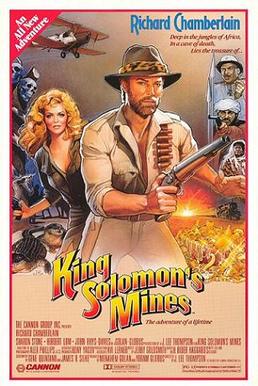
Allan Quatermain and The Lost City Of Gold (1987, directed by Gary Nelson)


Having previously discovered and escaped King Solomon’s mines, Allan Quatermain (Richard Chamberlain) and Jesse Huston (Sharon Stone) are now living in a domestic bliss in Africa.  They’re planning on eventually returning to America so that they can get married but it turns out that Allan has one more quest that he has to complete before he can truly settle down.

When Allan receives information that his long last brother is not only still alive but has also discovered a fabled Lost City of Gold, Allan sets out to discover the city for himself.  Traveling with Jesse and an old friend named Umslopogaas (James Earl Jones!), Allan makes his way across the Sahara, survives a battle with a group of native, and manages to find both the city and his brother!

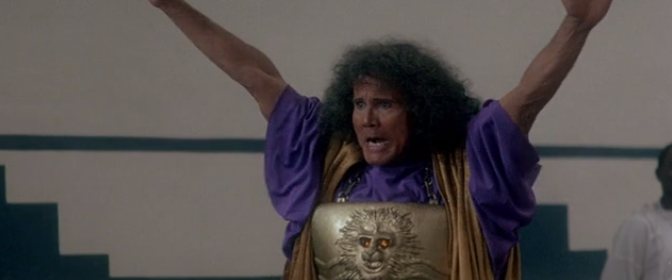
However, all is not well in the City of Gold.  Queen Nyelptha (Aileen Marson) is on the verge of going to war with Queen Sorais (Cassandra Peterson, a.k.a Elvira, Mistress of the Dark!!).  Manipulating both of the queens is the evil high priest, Agon (Henry Silva!!!!).  To save the City of Gold and his future marriage, Allan will first have to figure out a way to defeat Agon.

Allan Quatermain and the Lost City Of Gold was filmed back-to-back with King Solomon’s Mines.  The two films were released within a year of each other and, while King Solomon’s Mines was a minor box office success, Allan Quatermain and the Lost City of Gold was not.  I wasn’t expecting much when I watched the film but, believe it or not, Allan Quatermain and the Lost City of Gold is not that bad.  It’s a definite improvement on King Solomon’s Mines.  Richard Chamberlain is more believable as Quatermain in the sequel and he and Sharon Stone share the minimum amount of chemistry to be somewhat believable as a couple in love.  If that sounds like I’m damning with faint praise, it’s still an improvement over King Solomon’s Mines, where the two of them often seemed as if they couldn’t stand to be anywhere near each other.  Best of all, Allan Quatermain and the Lost City of Gold has Henry Silva in a ridiculous costume and that automatically makes the film worth watching.
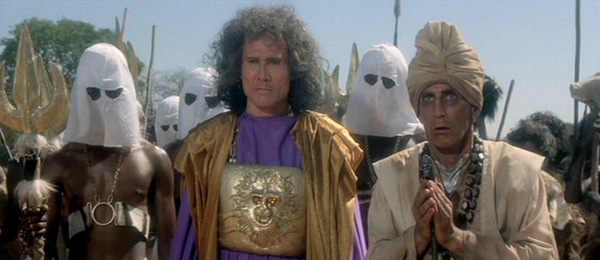
Henry Silva, everyone.

Like King Solomon’s Mines, Allan Quatermain and The Lost City of Gold adds a large dose of intentional humor to its adventure story.  Fortunately, the comedy here is better executed than in the previous film.  There’s less mugging on Chamberlain’s part and some of the dialogue is genuinely amusing.

Of course, Allan Quatermain and The Lost City of Gold is not without its flaws.  This is a low-budget Cannon film that often tries too hard to duplicate the success of the Indiana Jones films without ever showing much understanding of what made those films successful in the first place.  Allan Quatermain and the Lost City of Gold can’t hold a candle to the classic adventure films of the past.  But, for a low-budget Cannon film starring Richard Chamberlain as a rugged, jungle explorer, it’s actually a lot of fun.

Plus, did I mention Henry Silva?
The International Lens: Signs of Life (dir by Werner Herzog)


The 1968 German film, Signs of Life, is a deceptively simple film.

In fact, the story that it tells is so simple and so seemingly straight-forward that I’m sure some people would be surprised to discover that this was Werner Herzog’s first film.  When most people think of Herzog, they think of Klaus Kinski ranting against the Amazon and maybe Herzog himself talking about how he feels that chaos is the only governing principle of the universe.  Signs of Life, on the other hand, is a rather low-key and almost gentle film.  That said, the film does contain several of the themes that would show up in Herzog’s later film.  Even with his first feature film, Herzog already had a fairly good grasp on what he wanted to use cinema to express.

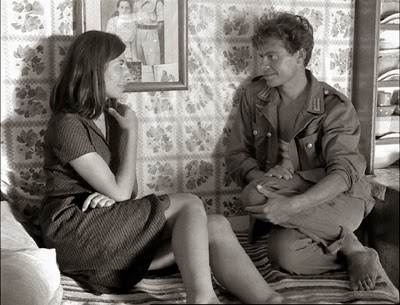
The film takes place in World War II and it deals with three German soldiers who have suffered from minor injuries in the war.  Deemed unfit for combat, they’ve been assigned to guard the munitions that are being stored at an ancient fortress on the Greek island of Kos.  It’s not demanding work.  The villagers are largely passive and, for the most part, seem to be just waiting out the war.  The leader of the soldiers, Stroszek (Peter Brogle), has recently married a Greek woman named Nora (Athina Zacharopoulou) and she is living with him at the fortress.

The film celebrates the beauty of Kos.  Herzog’s camera finds poetry in the simple sight of white linens hanging out to dry.  One of the soldiers explores the local cemetery and Herzog encourages us to ponder the long history of both the island and the people who live there.  In perhaps the film’s best known scene, Stroszek and Nora look down on a valley full of windmills and the beauty of it is a bit overwhelming.

As would often happen in later Herzog films, the soldiers never quite appreciate the beauty of the world around them.  While the audience is taking in scenes of breath-taking beauty, the soldiers are going a bit stir crazy.  Could it be that, as men of war, they’re incapable of appreciating the peaceful surrounding?  Perhaps but, then again, it could just be the fact that there’s not much to do on Kos other than ponder the mysteries of life and, in Herzog’s films, that often leads to insanity.  Stroszek ends up threatening to blow up the munitions dump but it must be said that, as far as Herzog lunatics are concerned, he’s no Klaus Kinski.

The plot of Signs of Life is largely secondary to the images that Herzog captures.  Watching Signs of Life, you get the feeling that Herzog simply fell in love with the island and that the film’s storyline is just something that he came up with so he’d have an excuse to share that love with the rest of the world.  Signs of Life is an exercise in pure cinema.  It’s not a perfect debut film but, at its best, it shows tantalizing hints of the great filmmaker that Werner Herzog would soon become.

Scenes That I Love: Gregory Peck and Audrey Hepburn at The Mouth of Truth in Roman Holiday


Given how much I love the 1953 film, Roman Holiday, I’ve probably shared this scene before but that’s okay.  It’s an incredibly charming scene and hey, it’s Gregory Peck’s birthday!

A Blast From The Past: Bette Davis Sells General Electric


Today is not only Roger Corman’s birthday!

And it’s not just Albert Broccoli’s birthday!

It’s also Bette Davis’s birthday and there’s absolutely no way that we here at the Shattered Lens, as lovers of both classic and modern films, could let the day pass without acknowledging it.

Here’s Bette Davis in a General Election commercial from 1933.  This commercial would have been shown in theaters, in between a double feature.

Song of the Day: The James Bond Theme, performed by The BBC Concert Orchestra under Keith Lockhart


One hundred and eleven years ago today, Albert R. Broccoli was born in New Your City.

Broccoli would eventually enter the film business, going from working as an assistant director with Howard Hughes to eventually become a very successful and highly respected film producer.  Today, Broccoli is best-known for producing the James Bond films.  Though Broccoli passed away in 1996, his daughter, Barbara, has continued to co-produce the films in the years since his death.  In short, if not for Albert Broccoli, James Bond probably never would have become a film icon and that would have been a tragedy.

In honor of his birthday, we present to you a song of the day!  In the clip below, The BBC Concert Orchestra performs Monty Norman’s iconic James Bond theme music.

Enjoy!

4 Shots From 4 Roger Corman Films: Not of this Earth, Masque of the Red Death, The Wild Angels, The Trip


4 Shots From 4 Films is just what it says it is, 4 shots from 4 of our favorite films. As opposed to the reviews and recaps that we usually post, 4 Shots From 4 Films lets the visuals do the talking!

Today, we wish a happy birthday to the one and only Roger Corman!  The godfather of indie cinema is 94 years old today.  It’s hard to know what’s left to be said about Roger Corman.  Corman was the producer who discovered some of the most important filmmakers in the history of American cinema.  He’s also the director who had the guts to tackle the important issues that the major Hollywood studios were afraid to acknowledge.  When all is said and done, Roger Corman is one of the most important figures in film history.  He’s also one of our favorite filmmakers, here at the Shattered Lens.

It’s impossible to do justice to this man’s career with just 4 shots from 4 films but it’s a start.

4 Shots From 4 Films

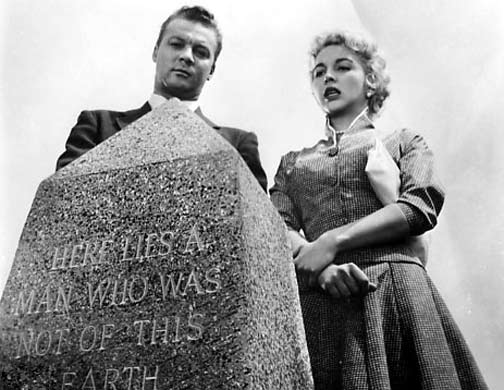
Not Of This Earth (1957, dir by Roger Corman)

The Masque of the Red Death (1964, dir by Roger Corman)

The Wild Angels (1966, dir by Roger Corman)

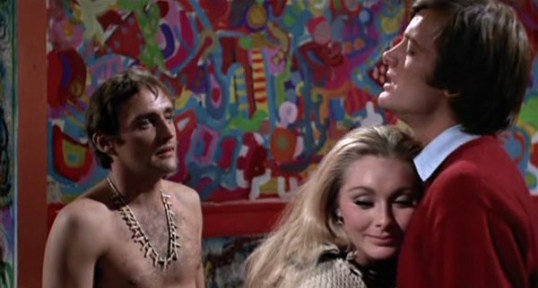
The Trip (1967, dir by Roger Corman)

King Solomon’s Mines (1985, directed by J. Lee Thompson)


After her archaeologist father disappears while searching for the fabled mines of King Solomon, Jesse Houston (Sharon Stone) hires famed explorer Allan Quartermain (Richard Chamberlain) to help her find him.  After walking around in the jungle and exploring a nearby village, Allan and Jesse discover that her father has been kidnapped by a German military expedition who want to use King Solomon’s treasure to fund their war effort.  Working with the Germans is Allan’s old enemy, Dogati (John Rhys-Davies).  Allan and Jesse find themselves in a race against time to find the mines before the Germans.  Along the way, they steal an airplane, fight German soldiers on a train, and nearly get cooked alive in a giant cauldron.

Because this is a Cannon film and it was made at the height of Indiana Jones’s popularity and it stars John Rhys-Davies and it has a score that sounds like it was written by someone trying too hard to be John Williams, you might be tempted to think that King Solomon’s Mines is a rip-off of Raiders of the Lost Ark.  However, there are some crucial differences between Raiders and King Solomon’s Mines.  For instance, Raiders of the Lost Ark took place during World War II.  King Solomon’s Mines takes place during World War I.  Raiders of the Lost Ark had angels that melted a man’s face.  King Solomon’s Mines has a lava pit that makes you explode if you fall into it.  Raiders of the Lost Ark has a big fight in an airfield while King Solomon’s Mines has a big fight at an airfield …. well, wait, I guess they do have a few things in common.

Probably the biggest difference between Raiders of the Lost Ark and King Solomon’s Mines is that Raiders had Harrison Ford and Karen Allen while King Solomon’s Mines has to make due with Richard Chamberlain and Sharon Stone.  (If the imdb trivia section is to be believed, Sharon Stone was cast because Menahem Golan mistook her for Kathleen Turner.)  Along with generating zero romantic sparks, neither Chamberlain nor Stone come across as if they’ve ever even seen a jungle, much less explored one.  The only time that the two of them are credible as anything other than actors slumming on Cannon’s dime is when they’re yelling at each other.  There’s also a scene where they’re trying to steal an airplane and Chamberlain tells Stone to “reach between your legs and grab it.”  That was funny, I guess.

Along with trying to be an adventure, King Solomon’s Mines also tries to be a comedy.  As a general rule, Cannon films are great when they’re unintentionally funny but not so much when they actually try to be funny.  The film’s idea of comedy is Richard Chamberlain having to do an impromptu jig while someone shoots at his feet.  Add in a healthy dose of casual racism as Allan and Jesse run into a tribe in Africa who want to cook them in a giant stew pot and you’ve got a film so bad that you’ll hardly believe it could have been produced by the same people who gave us Delta Force, which is, of course, the greatest film ever made.

Golan and Globus had enough confidence in King Solomon’s Mines that they shot a sequel before the first film was even released.  Tomorrow, I will force myself to watch and review Allan Quartermain and The Lost City of Gold.  And, after that, I’ll probably go sit in a corner and think about what I’ve done.

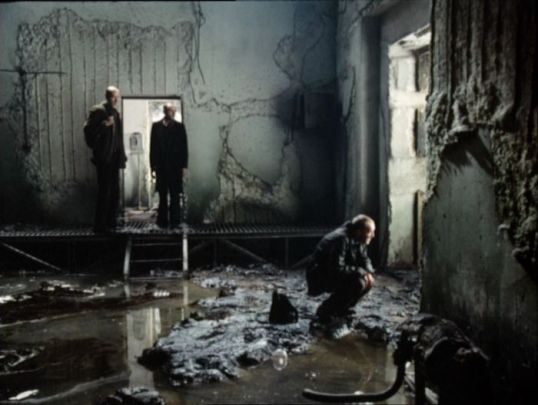
The International Lens: Stalker (dir by Andrei Tarkovsky)


The 1979 Russian film, Stalker, takes place in a world that might be our own.

In the middle of a wilderness that we assume, just because of the language that’s spoken in the film, to be in Russia, there is an area known as the Zone.  The Zone is a place where the normal laws of physics don’t seem to apply.  It’s not an easy place to enter and it’s almost impossible to exit but it’s rumored that there’s a very special room located in one of the Zone’s deserted buildings.  If you can find the Room, you’re innermost desires will be granted.  It’s said, for instance, that a semi-legendary man known as Porcupine found the Room and became wealthy as a result.  Of course, Porcupine also hung himself just a few days later.

Legally, no one is allowed to enter the Zone.  Soldiers patrol the perimeter and the gate that leads into the Zone is only opened to allow a train to make it’s way through.  However, there are outlaws who specialize in leading expeditions through the Zone.  They can get people in and, as long as everyone does as instructed, they can hopefully lead people out.  One of these outlaws is known as The Stalker (Alexander Kaidanovsky).  The Stalker, a former student of Porcupine, lives in a drab village where everything is filmed in Sepia.  (By contrast, the Zone is filmed in color.)  The Stalker is married to a woman (Alisa Freindlich) who continually begs him to stop leading expeditions into the Zone but who also says that she married the Stalker because his illegal activities bring a little bit of life to an otherwise drab existence.  They have a daughter (Natasha Abramova) who is described as being a “child of the zone.”  She may have a physical disability, though we’re never quite sure what the exact details of it may be.  The final enigmatic shot of the film belongs to her and it’s a shot that makes us wonder about everything that we’ve just previously seen.

The Stalker’s latest clients are the Writer (Anatoly Solonitsyn) and the Professor (Nikolai Grinko).  Both the Writer and the Professor have their own reasons for wanting to see the Zone.  The Writer is an alcoholic who has lost his inspiration and hopes to find it again.  The Professor says that he’s interest in the Zone is a scientific one, though it turns out that his actual intentions are a bit more complex.  The Stalker leads them into the Zone but it’s not an easy journey.  The Stalker grows annoyed as he comes to realize that the Writer does not share his nearly spiritual reverence for the powers and the mysteries of the Zone.  Meanwhile, the Professor obsesses over his backpack, even when the Stalker tells him to leave it behind.  There’s something in that backpack that the Professor definitely doesn’t want to lose.

Stalker is a science fiction film but it’s one that has no elaborate special effects.  There are hints that the Zone may have been visited by extraterrestrials but the film deliberately leave ambiguous the true origin of the Zone.  Director Andrei Tarkovsky instead emphasizes the barren landscape and the discussions between the three men, each one of whom is desperate in his own way.  Though the Zone may be filmed in vibrant color while the village is filmed in Sepia tones, both locations are equally desolate.

Watching this film today, it’s impossible not to compare the film’s Zone to the real-life forbidden zone surrounding Chernobyl.  However, Stalker was made 7 years before the disaster at Chernobyl.  The film’s Zone probably has more in common with the 1908 Tunguska event, which was when something (an asteroid, a comet, or maybe something else depending on how conspiracy-minded one is willing to be) either crashed into or exploded above Siberia.  The explosion was the equivalent of 30 megatons of TNT and, needless to say, you can find all sorts of fanciful stories about strange things happening in the area in the years after the explosion.  That said, it’s definitely not a coincidence that the modern-day guides who lead unauthorized tours of the Chernobyl area have taken to calling themselves stalkers.

The film itself is a fascinating one, though definitely not one for everyone.  As a director, Tarkovsky’s trademark was the long take and the camera often lingers over each scene, inviting the viewer to look for a deeper meaning that may or may not be there.  It’s a film that invites the viewer to think and to wonder who is right and who is wrong about the Zone.  It’s a film that asks a lot of questions but never claims to have all the answers.  The true meaning of it all is left the individual viewer to determine.  It really is a film that probably could have only been made by an artist trying to subtly rebel against a totalitarian society.  The Writer has lost his inspiration because society has become so drab and corrupt.  The intellectual Professor is forced to be deceptive about his true intentions.  And the Stalker looks for a deeper meaning that goes beyond what the State has to offer.  For that, he’s willing to risk everything.

Tragically, it’s possible that filming Stalker may have contributed to Tarkovsky’s death in 1986.  (Interestingly, he died just a few months after the Chernobyl disaster.)  Much of Stalker was filmed near a chemical plant and it’s felt that filming in such a toxic condition may have eventually led to the illnesses that not only killed Tarkovsky but several other members of the film’s cast and crew.  By the time of his death, Tarkovsky had escaped from Russia and was living in Paris.  Today, incidentally, is his birthday.  He would have been 88 years old.

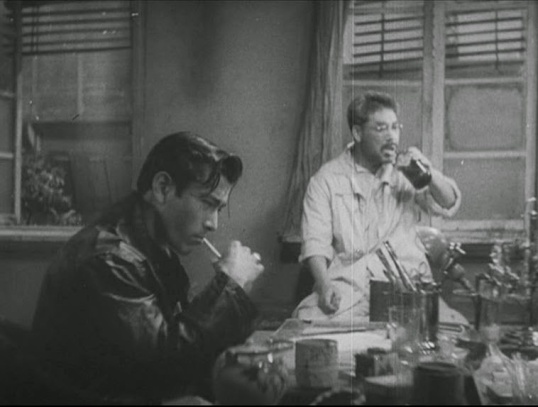
The International Lens: Drunken Angel (dir by Akira Kurosawa)


The 1948 Japanese film, Drunken Angel, tells the story of two seemingly different men living in a burned-out neighborhood in postwar Tokyo.

Sanada (Takashi Shimura) is an aging and world-weary doctor.  Though he may drink too much and he is occasionally too quick to snap at his patients, he truly cares about the people who live near his clinic.  He worries about the spread of tuberculosis, which was a very real concern in postwar Japan and which remains a concern to this day.  He continually tells his patients that they need to stop drinking and take better care of themselves, even though he does not seem to be capable of taking his own advice.

Matsunaga (Toshiro Mifune) is a young Japanese gangster, a member of the yakuza.  Matsunaga does everything with a swagger, one that he appears to have largely adapted from Hollywood gangster movies.  He not only dresses like an idealized version of an American gangster but he also smokes his cigarettes like one.  Everything about Matsunaga gives the impression that he’s desperate to prove that he’s something more than just a small-time hood living in a bombed-out neighborhood that’s centered around a poisonous bog.

One night, Matsunaga shows up at Sanada’s clinic.  He’s got a bloody hole in his hand.  Mastunaga claims that he walked into a door.  When Sanada responds with skepticism, Matsunaga adds that the door had a nail sticking out of it.  Sanada may not believe Matsunaga but he’s a doctor so he treats Matsunaga’s wound.  Sanada also diagnosis Matsunaga as suffering from tuberculosis and tells him that he has to stop drinking and womanizing.  Needless to say, Matsunaga is not pleased with this diagnosis.

Though they start out as antagonists, a weary friendship grows between the doctor and the gangster.  Matsunaga even starts to follow the doctor’s advice or, at least, he does until his boss, Okada (Reisaburo Yamamoto), is released from prison.  Under Okada’s influence, Matsunaga falls back into his own habits, drinking and going to nightclubs where the musicians perform Americanized music.  Okada is also the ex-boyfriend of Sanada’s nurse and, when he threatens to murder Sanada unless the doctor lead him to her, Matsunaga is finally forced to decide which of his two potential mentors will have his loyalty.

Taken on its own, Drunken Angel is an entertaining gangster film that features two memorable lead performances.  Takashi Shimura is likable as Sanada while Toshiro Mifune is dangerously charismatic as Matsunaga.  Director Akira Kurosawa originally planned for the film to focus solely on Sanada, with Matsunaga only playing a minor role.  Mifune, however, so impressed him that he ended up expanding Matsunaga’s role until Mifune was eventually the film’s co-lead.  (Following Drunken Angel, Kurosawa would go on to make 15 other films with Mifune.)  Kurosawa keeps the action moving at an exciting pace and he frames the story with haunting images of the dilapidated neighborhood that the two men call home.

However, Drunken Angel is even more fascinated with one consider that it was made at a time when Japan, having been defeated in World War II and still traumatized by the nuclear attacks on Nagasaki and Hiroshima, was still occupied by American forces.  The film was made at a time when it was still very much an open question as to what role Japan would play in a postwar world.  Would Japan become dominated by American culture (which, in this film, is represented by gangsters like Okada) or would it remain true to itself?  When Sanada warns Matsunaga that he is surrounded by toxic germs that are making him ill and threatening his future, he could very well have been talking about what Kurosawa perceived as being the threat of Americans transforming Japan into a westernized playground.

In the end, it’s a film that works on many levels, as a gangster film, as a portrait of a friendship, and as a metaphor for a people and a culture trying to find their place in a new and imperfect world.  If you haven’t seen it yet, now is the perfect time to do so.

Cinemax Friday: Stranger By Night (1994, directed by Gregory Brown a.k.a. Gregory Hippolyte a.k.a. Gregory Dark)


Detective Bobby Corcoran (Steven Bauer!) is a cop with an anger problem.  Whenever he and his parter, Troy Rooney (William Katt!!), catch a criminal, Bobby just loses control.  Since, for some reason, they seem to catch a lot of criminals on rooftops, this often leads to Bobby threatening to throw someone over the edge.  Even when his boss, Detective Larson (Michael Parks!!!) tells Bobby to stop trying to kill all of the suspects, Bobby still struggles to control his rage.  He’s seeing a Dr. Anne Richmond (Jennifer Rubin!!!!), a psychiatrist, about his anger issues but since their sessions usually get interrupted by bouts of soft-core, saxophone-scored sex, it is debatable how much time they actually spend digging into the roots of Bobby’s problems.

Bobby also suffers from frequent blackouts.  While he’s unconscious, he’s haunted by black-and-white memories of his abusive father (J.J. Johnston) beating up his mother.  When he wakes up, he’s often in a different room from where he blacked out.  Anne says that Bobby must be sleep-walking.  Bobby says that he’s not sleep walking because he’s stubborn and doesn’t feel safe letting anyone into his mind.  Lately, whenever Bobby passes out, a prostitute ends up dead.  An unknown killer is stalking them and chopping off their ears.  Bobby, with his anger issues and his dislike of prostitutes, is an obvious suspect.  Is Bobby the killer or is he being framed?

Stranger By Night‘s credited director is Gregory Brown, who is better known as Gregory Dark.  Dark is one of the best-known of the directors who specialized in erotic thrillers in the 90s.  Dark was responsible for some of the classics of the genre but, unfortunately, Stranger By Night is not one of his better efforts.  The action frequently drags and, with the exception of Bobby’s black-and-white flashbacks, Stranger By Night has none of Dark’s usual visual style.  The film looks and feels flat and the plot is never feels as involving as it should.  The discovery of the killer’s identity inspires not shock but an indifferent shrug.

On the positive side, it’s got a cast of skilled genre vets and all of them do what they can to elevate the material.  William Katt is jittery and frequently funny while Jennifer Rubin, who deserved to have a much bigger career, is as sultry as ever.  (Rubin brought both intelligence and sex appeal to almost every role that she played and it made her one of the best genre actresses around.)  Steven Bauer, another actor who probably deserves a bigger career than he’s had, does a good job in the lead role.  Bobby isn’t always a likable character and Bauer doesn’t try to make him one.  On the other hand, it’s frustrating that Michael Parks does not get to do much, other than frown.  There’s nothing more frustrating than watching a film that doesn’t take full advantage of the casting of Michael Parks.

Stranger By Night does seem to have a serious subtext.  It tries to deal seriously with how Bobby’s abusive childhood has scarred him and there’s a lengthy scene where Bobby finally talks to his aged father.  The scene is played straight and it’s not the sort of thing that you’d normally expect to see in a direct-to-video erotic thriller.  (It’s a good example of what set Gregory Dark apart from some of the other directors churning out these type of films in the 90s.)  For the most part, though, Stranger By Night is a forgettable trip to the world of late night Cinemax.