Film Review: Denounced: Rise of the Horsemen (dir by Stephen C. Bortsalas)


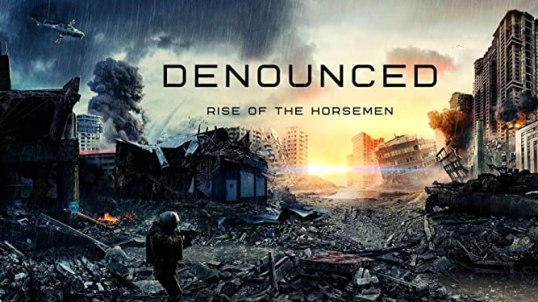
The 2017 film, Denounced, opens with a man named Paul (Sean Hart) in the wilderness.

Just one look at Paul is all you need to know that he’s seen some stuff.  He’s tall and physically imposing with a haunted stare and a scarred face.  He’s wearing a dark uniform, one that identifies him as being a member of some sort of paramilitary force.  Because Paul is now alone, it’s easy to guess that he must be a deserter of some sort.  But what did he desert and why?

Paul eventually meets two other people in the wilderness, a man and a woman.  They’re all trying to escape from something.  The man talks about how, on the night of an event that’s referred to as being “the vanishing,” he was on the verge of committing suicide.  The woman talks about how she was a drug addict. And finally, Paul starts to open up about his past life….

And, at this point, you’ve probably already guesses what this movie is about, haven’t you?  Yes, “the vanishing” was the Rapture and yes, Paul was a part of a paramilitary force that was working for the Antichrist.  Motivated by the anger of losing his entire family (they all vanished while he didn’t), Paul joined the Horsemen and spent months killing believers and other dissidents.  After finally coming to realize that he had surrendered himself to his hate, Paul refused to continue killing.  Now, Paul is hiding in the wilderness and obsessing on whether or not someone who has done the evil things that he’s done can ever truly be redeemed.

I know that at least a few of our readers are probably rolling their eyes already but Denounced is actually a surprisingly well-made film.  While the low-budget is evident in nearly every frame, director Stephen C. Bortsalas is still able to create a properly ominous and paranoid atmosphere throughout the film.  He gets a lot of help from Sean Hart, who comes across as being genuinely haunted in the lead role.  Including this film, Hart only has two credits on the imdb so I don’t know if he’s a trained actor or if he’s just a talented amateur but, in the role of Paul, he has the haunted eyes of someone who has lost everything that he once cared about.  He’s sympathetic in the present-day scenes and intimidating in the past scenes and you do hope for the best for his character.

Denounced is also a surprisingly brutal film, though every act of violence is justified by the film’s storyline.  One lengthy scene features more dismemberment than you would probably ever expect to see in a low-budget, faith-based film.  Heads and hands are graphically chopped off and it’s far more effective than I would have expected it to be.  So many films would have just had Paul say that he had done some terrible things and left it that.  This film shows you in details just what exactly those things were but it’s not gratuitous violence.  Instead, it’s very necessary to our understanding of who Paul is and why he’s now so haunted by his actions.

Though I imagine it will be best appreciated by people who already share its world-view, Denounced is a surprisingly effective apocalyptic film.
Film Review: The Freedom of Silence (dir by Richard Robertson)


If there’s anything that I’ve learned from watching several politically-themed films over the past few weeks, it’s the easiest way to win an argument is to have the screenwriter on your side.  Seriously, as long as you can control what the opposition says, it’s very easy to stump them with your arguments.

The other thing that I’ve learned is that apparently no one ever disagrees solely because they have a different opinion or way of looking at the world.  Instead, there’s an ulterior motive to every disagreement.  If a businessperson says that we need to keep taxes low, it’s never because they sincerely believes that lower taxes will encourage economic growth.  No, in the movies, it’s always because they’re just greedy and not willing to pay their fair share.  Of course, it’s never really explored as to what exactly “paying your fair share” means but that’s not important.  Not when there’s someone who would rather see people die than pay their taxes.

By that same token, any military leader who argues for more defense spending isn’t doing so because they sincerely believe that a strong defense will keep America safe from its enemies.  Instead, it’s always a case where they just want a war because ….. well, why not?

If the film is religious in nature, you can rest assured that no skeptic will be a skeptic just because they happen to have a different set of beliefs or because they were maybe just raised in a nonreligous environment.  Instead, in the movies, every skeptic is a skeptic because something traumatic happened to them in the past and it led to them getting so angry with God that they renounced their faith.  This, of course, always leads to the question of, “How can you be angry at a God that you don’t believe in?” and a moment of awkward silence as the skeptic realizes that he doesn’t have an answer.

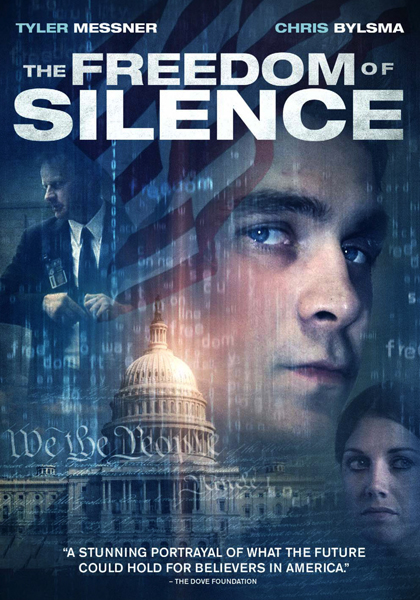
The 2011 film, The Freedom of Silence, is built around scenes of a man named Zack Thompson (Tyler Messner) being tortured by one such skeptic.  The skeptic is Captain Johansen (Jeffrey Staab) and it’s not enough that he’s a fascistic authoritarian who uses his position to legally indulge in his own sadistic impulses.  He also has to be a Hollywood atheist, a man whose disdain of religion is all linked back to a past tragedy in his own life.  To a certain extent, I think he would have been a more believable character if he had just been motivated by his own need to create pain.  There’s been enough real-life examples of sadists-in-power that I think that no one would have doubted that a character like Captain Johansen could exist in the real world.  After all, a world that gave us Klaus Barbie, Lavrentiy Beria, Joseph Mengele, and Pol Pot could certainly give us as a Captain Johansen.  By making him a Hollywood atheist, the film reminds us that Captain Johansen is just a fictional strawman, a character created specifically to be outargued by the story’s hero.  It makes him less effective as a character, despite the fact that Staab does a good job playing the role.

The Freedom of Silence takes place in 2030 and imagines an America where the first amendment has, for all intents and purposes, been outlawed.  Since this is a faith-based film, the film focuses on the idea of Christianity being banned (or, as the government argues, replaced by a new unified, national religion) and bibles being forbidden.  Have other religions also have banned?  Can having a copy of the Koran get you thrown in prison?  The Freedom of Silence doesn’t say but I think it might have been a stronger film if it had.

Anyway, Zack has a plan to broadcast the word of God despite the government’s rules.  He’s going to need the help of Aaron (Chris Bylsma) but Aaron has a new girlfriend named Trisha (Lauren Alfano) and Trisha is secretly working for the government and you can tell where this is going already, can’t you?

And the thing is — I’m a bit of a free speech absolutist and I’m certainly no fan of government regulation and I do believe that free speech is under attack, by both the Left and the Right, in this country.  And yes, I did enjoy the scenes of brainwashed American citizens blandly talking about how they had to follow the law no matter what.  Unfortunately, the film itself has some serious pacing issues and, with the exceptions of Staab and Lauren Alfano, the acting is a bit inconsistent.  I think we’re supposed to excuse the filmmaking deficiencies because of the self-declared righteousness of the film’s message but the film is so disjointed that, at times, it’s nearly impossible to follow the plot.  That’s not something you can just ignore.

This is one of those films where, if you’re on the film’s side, you’ll enjoy it because you know it’s the type of thing that would annoy people who disagree with you.  But if you’re not already predisposed to agree with the film’s point, The Freedom of Silence is not going to convince you to change your mind.  This is a film that solely exists to own the other side.  And sometimes, that’s enough.  Audiences do tend to like films and books and songs and shows that confirm their already held beliefs.  But I don’t know.  Sometimes, when it comes to important issues like free speech, you want and the issue demands something more than jut a heavy hand and strawman arguments.

Anyway, if you just want to own the other side, you might get a kick out of certain parts of The Freedom of Silence.  If you’re looking for more, look elsewhere.

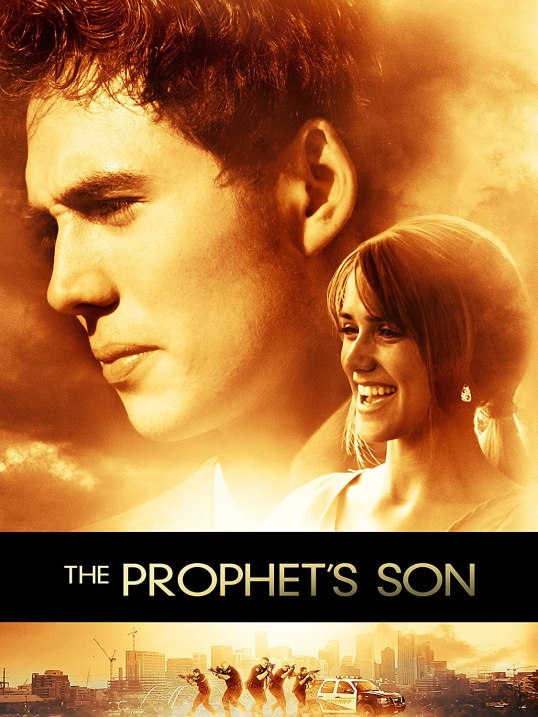
Film Review: The Prophet’s Son (dir by Paul Anthony McClean, Maurice Sparks, and Josiah David Warren)


As I’ve mentioned on this site in the past, I’ve always been fascinated by amateur feature films.  These are films that were made totally outside of the Hollywood system.  For the most part, they’re made by filmmakers with little to no formal training and they feature a cast of nonprofessionals.  Many of these films are passion projects for the people involved.  It’s not uncommon to hear about them being made by an all-volunteer cast and crew.  Sometimes, these films are surprisingly effective and sometimes — well, most times — they’re just really bad.

The 2012 film, The Prophet’s Son, is one of those largely amateur films and sad to say, it’s not a particularly good film.  If Tommy Wiseau decided to follow up The Room with an evangelical film that attempted to deal with almost every single issue facing the world today, the end result might be something like The Prophet’s Son.

It’s an odd film.  I have to admit that one of the main reasons that I watched it was because I had seen the film described as being about the end of the world and I have a weakness for cheaply made apocalypse films.  While The Prophet’s Son does feature a very brief nuclear attack on the city of Denver, it’s not really an apocalypse film because 1) the world doesn’t end, 2) the rapture doesn’t occur, and 3) the Antichrist never makes an appearance.  Instead, the nuclear attack just kind of comes out of nowhere and I will admit that it’s impossible for me not to have just a little admiration for a film that would toss a random nuclear war into an already cluttered storyline.  One minute, writer Juliet Oscar (played by Alexandra Harris) is sitting outside and the next minute, there’s missiles raining down on Denver.  Juliet and her boyfriend, musician and movie star Abel Benjamin (Josiah David Warren), get to safety and pray and the newly elected President of the United States appears on television and announces that America has survived.

Abel, incidentally, is the prophet’s son of the title.  Or, at least, I think he is.  He also has brother named Obadiah (Taurean Cavins-Flores), who I guess could just as easily be the prophet’s son.  Their father is the pastor of a church and he keeps saying that dark times are ahead, which I guess makes him a prophet, though he could just be one of those people who spends too much time on social media.  The film is a bit difficult to follow, to be honest.  At one point, Obadiah foils a robbery at a coffeeshop by telling the thief that he needs to get right with God.  The thief responds by shooting Obadiah in the leg.  Obadiah survives and Abel later learns that the thief loved Abel’s last movie so Abel visits him in jail, forgives him, and then performs an impromptu exorcism on him.  (It’s a super quick exorcism, too.  I’m used to longer exorcisms.)

Meanwhile, Juliet’s brother, Jason (Peter Lugo), says that he’s not going to waste his time with church until he turns 18.  Unfortunately, he then gets caught up in the middle of a surprisingly graphic school shooting rampage.  This leads to Jason’s twin brother, Isaac (Brad Spiotta), running away and getting lost in Denver.  Juliet and Abel search for him with the help of a some gang members.  When Juliet spots Isaac, she runs to him.  Abel, meanwhile, stays behind to give some money to a homeless woman.

Eventually, Abel ends up in Manila, where he witnesses people being kidnapped off the streets.  He tells the maid at his hotel that she needs to pay more.  While this is going on, Juliet is being pursued by Caleb (Jared Haley), who is a loud and proud atheist.  “Get me a beer and hamburger!” he shouts at one point.

What does all of this have to with the nuclear attack on Denver?  It’s hard to say.  The Prophet’s Son covers a lot of ground but the script and the direction are so disjointed that it’s basically impossible to follow the film’s story.  In fact, the film is such a disorganized mess that it becomes oddly fascinating to try to keep track of what’s actually happening.  For whatever reason, it took me forever to figure out that Abel and Obadiah were supposed to be brothers.  When Isaac mentioned that he and Jason were twins, I literally shouted at the TV, “No, you’re not!” because, seriously, there’s nothing about them that would lead you to suspect that they were even related, not to mention twins.  Characters come and go throughout the film.  The school shooters appear out of nowhere.  The coffeeshop bandit disappears after the jailhouse exorcism.  Abel has a manager who appears to be in love with him but who he treat rather coldly.  Despite being the biggest superstar in the world, Abel can wander around Denver without anyone recognizing him.  Denver, itself, is remarkably undamaged after being nuked.  It’s a strange, strange film, even if the world doesn’t actually end.

And you can watch it on Prime if you want!

Flesh and the Spur (1956, directed by Edward L. Cahn)


When farmer Matt Ransom (John Agar) is murdered for his horse and his gun, his twin brother Luke (also John Agar) sets out to get revenge.  He knows that his brother’s murderer was a member of the infamous Checkers Gang.  Because the gun that the killer stole was one of two identical pairs specially made for the twins by their father, Luke knows that all he has to do is find the outlaw who is carrying a gun that looks just like his.  During Luke’s search, he meets several others who have their own reasons for wanting to destroy the Checkers Gang.  Luke teams up with a beautiful Native American woman named Willow (Marla English), a snake oil salesman named Windy (Raymond Hatton), and a mysterious but deadly gunman named Stacy Doggett (Mike “Touch” Connors).

This B-level Western is best known for a scene where a group of rogue Indians tie Willow to an anthill in order to punish her for “traveling” with the white man.  The scene was not originally in the script.  It was added after a poster was designed that featured Willow bound to a stake.  While the scene was undoubtedly enjoyed by the teenage boys who the film was marketed towards, it feels out-of-place in the movie.  Some of the problem is that, while shooting the scene, the ants refused to go anywhere near Marla English and would instead run away whenever they were dropped on English’s feet.  After spending several minutes tied to a stake and having ants poured on her, English said, “Look, you’ve got six ants there.  Isn’t that enough?”  Marla English retired from acting shortly after appearing in this film.

Flesh and the Spur is a B-western through and through but it has a few good moments, like the scene where Luke and Stacy check out a saloon’s gun rack to see if anyone has hung up Matt’s gun.  Touch Connors is convincingly deadly as Stacy and there’s a good twist with his character at the end of the film. Marla English gives such a good performance as Willow that it’s too bad that the ants may have played a part in her early retirement from acting.  Unfortunately, John Agar is just as dull and colourless as always and he was obviously too old to be playing someone like Luke, who is meant to be a naive neophyte.

Flesh and the Spur may not be a classic but there’s enough there to keep western fans entertained.

Film Review: Threads (dir by Mick Jackson)


Yesterday, after I watched the 1984 film, Threads, I sat on my couch for about ten minutes trying to catch my breath and trying to vanquish a sudden wave of anxiety.  I then watched old episodes of The Office and King of the Hill because I desperately needed to laugh.  I needed to get my mind off what I had just seen.

Threads is one of the most depressing films that I’ve ever seen.  It’s also one of the most disturbing.  The film opens a few days before a nuclear attack on the UK and it ends thirteen years later.  We meet two families, the Kemps and the Becketts.  The two families live in Sheffield, the fourth largest city in England.  The Kemps are working class while the Becketts are middle class.  They both seems like nice enough families.  Due to an unplanned pregnant, Ruth Beckett (Karen Meagher) and Jimmy Kemp (Reece Dinsdale) are planning on getting married.

While the two families get to know each other, we hear news stories in the background.  Russia has invaded Iran.  America has said that this act of aggression will not stand.  The world is heading towards war but hardly anyone seems to notice.  People are used to bad news and besides, what can be done about it?  The best assurance that the British government can offer its citizens is a series of out-dated public service announcements.  The Kemps build a makeshift bomb shelter out of a door and a mattress.  The Becketts prepare to head into the basement.  Over the radios and the television, an official voice informs listeners that, in case of a bombing, the safest thing to do is to lie down and be perfectly still.  The Sheffield emergency management board sets up operations in an underground bomb shelter, located underneath the city hall.  The members of the board chain smoke and argue.  No one really seems to know who is in charge.

Though the war starts with America and Russia launching missiles at each other, it’s not long before the UK is hit.  Sheffield is bombed because of its steel and chemical factories and the fact that a nearby airfield would probably be used to house American forces.  When we last see Jimmy, he’s running down a road, trying to get to Ruth.  The city becomes an inferno.  Those who aren’t killed in the fires are left to try to survive the nuclear winter, the radioactive fallout, the looters, and the heavily armed policemen who attempt to maintain order through fear, intimidation, and executions.

Ruth is the first to explore the remains of the city and her exploration becomes a literal walk through Hell.  Charred corpses and dead animals litter the rubble.  A woman sits in a corner, holding a dead baby.  A trip to the infirmary reveals people screaming agony as limbs are amputated with anesthetic.  Angry survivors demands to be given food, just to have tear gas fired at them by scarred policemen.  Every minute of the film, society collapses just a little bit more until soon, Ruth has gone from being a hopeful soon-to-be bride to being just another person desperate for a piece of bread.  Indeed, for me, one of the most disturbing parts of the film was that, after the bomb dropped, Ruth largely stopped speaking.  It makes sense, though.  What’s the point of talking when there’s nothing left to say?

But it doesn’t just end with Sheffield.  We follow Ruth as she leaves the city and then we watch over the next 13 years as the UK is reduced back to medieval levels.  Ruth gives birth to a daughter named Jane (Victoria O’Keefe), who grows up in a world where there is no structure or education.  How bad do things get?  At one point, we see Ruth prostituting herself in exchange for three dead rats, just so she and her daughter can eat.  Jane, for her part, is so poorly educated that she can barely speak in coherent sentences.

And the thing is, it just keeps going.  Every moment when you think that things can’t possible get any worse, Threads keeps going and shows you that things can and do get worse.  It’s a relentlessly grim film, a vision of a future that offers up zero hope.  It’s a thoroughly bleak film, one that’s made all the more powerful by the fact that all of the characters just seem like ordinary people who you could meet on any street corner.  As opposed to something like The Day After, in which the main characters included a doctor and a soldier, the characters in Threads have no idea what’s happening to them or what the future might hold.  (One character talks himself into eating a dead sheep despite the fact that it probably died due to radiation poisoning by pointing out that it’s possible that it died of something else.  The Day After at least had John Lithgow around to explain to everyone how radioactivity works.)  Instead, the Becketts and the Kemps simply have to try to survive day-to-day.  Most of them don’t make it.

Threads left me drained and exhausted.  It’s one of those incredibly powerful and grim films that I’ll probably never be able to bring myself to watch again.

Trapped (1973, directed by Frank De Felitta)


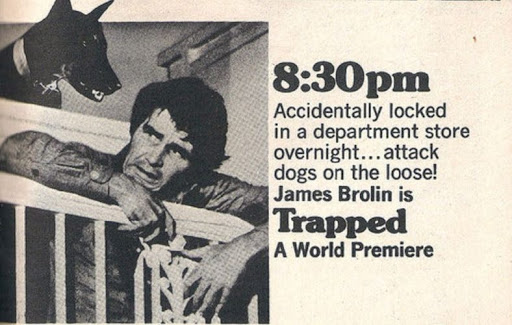
Chuck Brenner (James Brolin) is out shopping when he’s mugged and left unconscious in a men’s room stall.  By the time Chuck wakes up, the store is closed for the weekend and the place is deserted except for him and six doberman guard dogs.  The dogs are trained to hunt down and attack anyone who shouldn’t be in the store and, as far as they’re concerned, that includes Chuck.  Chuck now has to survive the night and try to figure out a way to get out of the store.  Not helping is that Chuck still hasn’t recovered from taking a blow to the head and he’s been bitten by one of the dogs, leaving a blood trail for them to follow.

This made-for-TV movie is a simple but effective thriller about an ordinary man trapped in an extremely dangerous situation.  Frank De Felitta (who would later direct one of my favorite made-for-tv horror film, The Dark Night of the Scarecrow) does a good job of creating suspense as Chuck tries to make it from one area of the department store to the next without getting attacked.  (One of the best scenes involves Chuck, dizzy because he has a concussion, jumping from one cabinet to another while the dogs wait below him.)  Even dog lovers will become nervous as the dobermans prowl the aisles, looking for their prey.  James Brolin gives a good everyman performance and he’s ably supported by Susan Clark as his ex-wife and Earl Holliman as Clark’s new husband.  The film is so well-executed that it was only after it ended that I started to wonder why any store would leave six dog unsupervised in their store overnight.  Just the effort that would have to be made to clean up after them would cancel out whatever money was being saved by not using a human security guard.

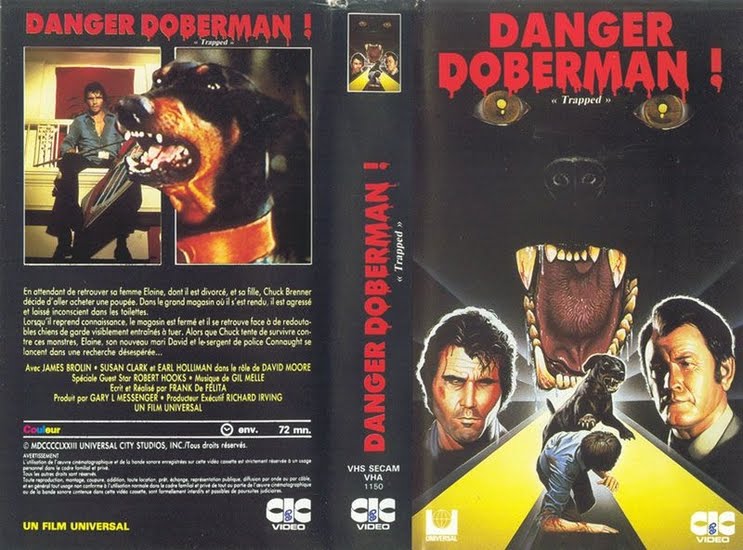
Trapped has been released under several titles, the best known of which is The Dobermn Patrol.  My personal favorite, though, is Danger Doberman!

Here’s the Trailer for The Suicide Squad!


“Hmmmm …. I don’t know.  Suicide Squad wasn’t that good.  I don’t know if I want to see a sequel….”

“But this isn’t Suicide Squad 2!  This is …. THE Suicide Squad!”

“Oh.  Well, that’s different.  Take my money.”

Actually, another reason to see this film is because it was directed by James Gunn.  I’ll watch anything that James Gunn directs.

Here’s the trailer:

Here’s The Trailer for Zack Snyder’s Justice League!


Another trailer that premiered this weekend was the trailer for Zack Snyder’s cut of Justice League.

Since hardly anyone wants to be associated with Joss Whedon anymore, I assume that this will be the new, official version of Justice League.  I never saw the original release version so I can’t really tell you if this trailer looks like an improvement or not.  (Seriously, I was so annoyed with Batman v Superman that I pretty much just looked at Justice League and said, “No way.”  Not even the presence of Gal Gadot could change my mind)

That said, a lot of people online are really excited about the Snyder cut so here’s the trailer:


Here’s The Trailer For The Batman!


This weekend, several trailers were dropped for the upcoming installments in the DC Extended universe.  People on twitter certainly were excited, though I have to admit that, with the exception of Wonder Woman, I’ve never cared much about the DC films.

Then again, that could change.  To be honest, I haven’t been that enthusiastic for the new MCU films.  I’m even kind of dreading Black Widow because the way the character was killed off in Infinity War still bothers me.  Speaking of which, with the exception of killing off Natasha, I loved Infinity War but I have to admit that it kind of felt almost like to perfect an ending for the entire MCU.  All the films that follow will be in its shadow.  Meanwhile, the DC films are still finding themselves and that could potentially be interesting to watch.  Or not.  We all remember Man of Steel.

Then again — and yes, I know, I’m indecisive — it’s hard for me to get excited for yet another Batman film.  “This Batman is dark and serious!”  Oh, you mean as opposed to all the other recent Batman films?  Y’know why people loved LEGO Batman?  Because it was willing to poke fun at itself and the character.

Anyway, here’s the trailer for The Batman, with Robert Pattinson in the lead role.  I think Robert Pattinson is an excellent actor who has more than proven that he deserves to be known for more than just playing Edward Cullen.  For the record, though this is a DC film, it’s apparently not considered to be a part of the DCEU.  So, I guess maybe it’s taking place in the same cinematic universe as Joker.

(Seriously, it’s kind of hard to keep all these universes straight….)