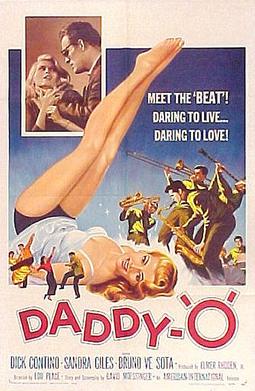
Daddy-O (1958, directed by Lou Place)


Like Elvis before him, Phil Sandifer (Dick Contino, who played a mean accordion back in the day) is a truck driver who wants to be a rock and roll star.  He’s also a street racer who has just fallen in love with Jana (Sandra Giles), the one woman fast enough to run him off the road.  However, before Phil can pursue either Jana or rock and roll fame, he has to investigate the mysterious death of his friend, Sonny.  Someone drove Sonny off the side of the road and the police aren’t willing to investigate.  Instead, they’re more interested in giving Phil a hard time, taking away his license and making it impossible for him to do his thing.

Working with Jana, Phil goes undercover as Daddy-O, the world’s greatest rock and roller.  He gets a job singing at a club owned by the shady Sidney Chillas (Bruno VeSota), the man who Phil believes was responsible for the death of Sonny.  Phil investigates and also finds time to sing a deathless song called Rock Candy Baby.

Today, Daddy-O is probably best known for being featured on Mystery Science Theater 3000.  In fact, I didn’t even mention Phil’s strange habit of hiking his pants nearly halfway up his chest just because Joel and the Bots pretty much said everything that needed to be said about that when they watched the show.  The same can be said of the song Rock Candy Baby, which is both terrible and insanely catchy.

Beyond the pants and Contino’s performance of Rock Candy Baby, Daddy-O is a typical delinquent youth B-movie.  Contino was best known as an accordionist but this film tries to rebrand him as a rock and roller.  He was 28 when he starred in Daddy-O but Contino looked closer to 40 and his discomfort in obvious in every scene.  Far more convincing are Sandra Giles and Bruno VeSota.  Sandra Giles has the right look to be convincing as a 50s bad girl who actually isn’t that bad while Bruno VeSota specialized in playing crooked club owners.

Daddy-O is mostly interesting as an example of how filmmakers tried to reach teenagers in the early days of rock and roll.  Contino was not a rock and roller and he looks plainly uncomfortable trying to be one but it was 1958 and Elvis was everywhere.  Of course, Elvis would have known better than to have called himself Daddy-O.  That’s totally squaresville.

Cinemax Friday: Young Nurses In Love (1987, directed by Chuck Vincent)


Chuck Vincent was widely considered to be one of the best directors to work in the adult film industry during the Golden Age of Porn.  As a director, he put as much emphasis on characterization and plot as he did on getting the so-called money shots.  One of his adult films, Roommates, even got a favorable write-up in The New York Times.

Unfortunately, Vincent was less successful when he tried to move over into mainstream filmmaking.  Vincent directed B-movies, most of which went straight to video.  The majority of them were either dumb sex comedies or erotic thrillers and they often featured porn stars in “straight” roles.  Though the majority of Vincent’s mainstream films were adequately put together, they never got the attention that his adult films did.  In the adult film industry, Vincent was an artist but, when it came to mainstream films, he was viewed as just being another competent director who churned out B-movies.  One of the few places where Vincent’s movies were appreciated was on late night Cinemax.

Young Nurses In Love is  typical example of Vincent’s mainstream work.  It takes place at Hoover Hospital, where the doctors are all rich and strange and the nurses all wear the tightest uniforms around.  The plot, as it is, involves a sperm bank where sperm from some of the most brilliant people in history is being stored.  Nurse Ellis Smith (Jeanne Marie) is an agent of the KGB who has gotten a job at the hospital so she can steal that sperm and the Russians can use it to create supercommunists.  Dr. Reilly (Alan Fisler) is also a CIA agent and he hopes to use his “bedside” manner to convince Nurse Smith to turn against her employers.  Can he do the trick?

Young Nurses In Love is meant to be a satire of medical soap operas.  (It was advertised as being a sequel to Garry Marshall’s Young Doctors In Love, though Marshall himself was in no way involved with the production.)  While Dr. Reilly is trying to save the super sperm, the rest of the hospital staff get caught up in their own softcore dramas.  There’s a mafia subplot.  There’s plenty of nurses trying to land a rich doctor husband subplots.  Jamie Gillis, Annie Sprinkle, and Veronica Hart all have small roles.  The humor is frequently forced.  Instead of letting the jokes develop naturally, Young Nurses In Love just piles one incident on top or another without much comedic rhyme or reason.  With the exception of Jamie Gillis, none of the actors seem to have a natural talent for comedy and the stiff delivery of their “funny” lines will probably inspire more groans than laughs.  For all the attempts to be racy, this R-rated film is mild enough to qualify as a PG-13 today.

This was one of Chuck Vincent’s lesser mainstream films.  For a better Chuck Vincent-directed comedy, check out Student Affairs.

The Lonesome Trail (1955, directed by Richard Bartlett)


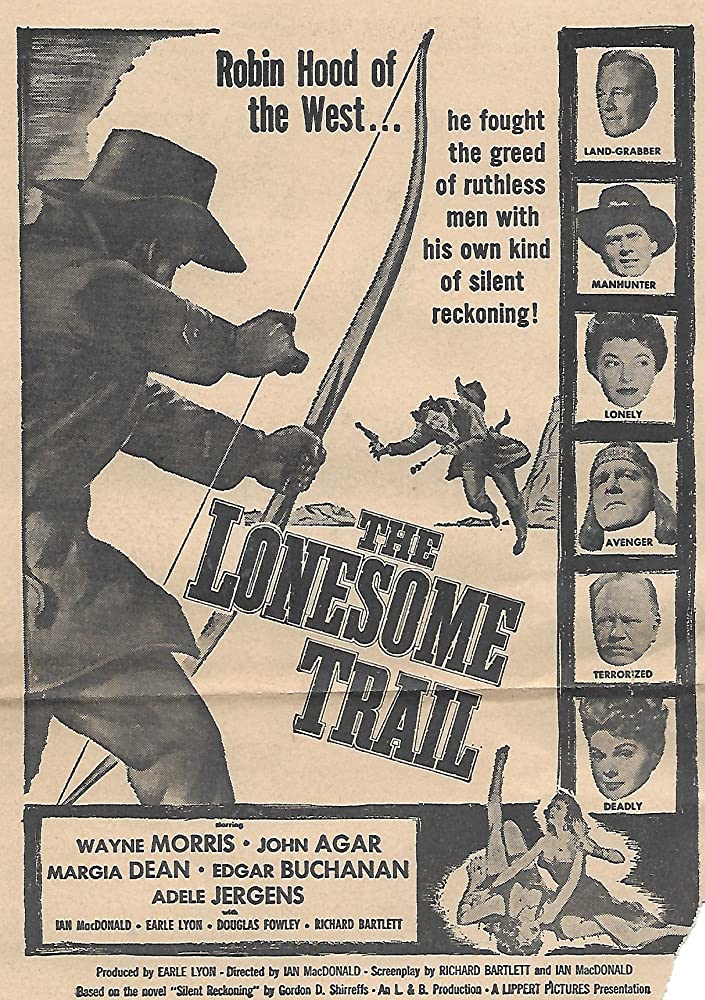
Returning home from the Civil War, Johnny Rush (John Agar) discovers that his family’s land has been confiscated by corrupt rancher Hal Brecker (Earle Lyon, who co-wrote the script).  With the aid of corrupt Sheriff Baker (played by Richard Bartlett, who also directed the film), Brecker has taken over the entire town.  Honest ranchers like Charley Bonesteel (Douglas Fowley) are giving up their land and heading out of town.  Meanwhile, Dan Wells (Edgar Buchanan) has managed to hold onto his land by offering up his daughter, Pat (Margia Dean), as Brecker’s bride.  Since Johnny’s in love with Pat, he’s not happy about this development.

Johnny wants to take on Brecker but the local bartender, Dandy Don (Wayne Morris), talks him out of it.  Realizing that there’s nothing he can do alone, Johnny tries to leave town but, as he rides out, he’s ambushed by Baker.  Though Johnny survives the ambush, his shooting hand is injured.  Fortunately, Indian Chief Gonaga (Ian MacDonald, the script’s other writer) and Charley are on hand to teach Johnny how to fight with a bow and arrow.  Johnny goes on to become an old west Robin Hood, using his newly learned archery skills to fight the greedy land grabbers and protect the poor land-owners.

The Lonesome Trail is a low-budget, grade Z western that is slightly saved by the novelty of seeing John Agar fighting off the bad guys with a bow and arrow.  The film is clearly set up to be a western version of the Robin Hood saga, complete with a corrupt sheriff, a greedy landlord, and an archer who has just returned from war.  Errol Flynn and Olivia de Havilland could have really made something out of this story back in 1938.  Unfortunately, to say that John Agar is no Errol Flynn is putting it lightly.  There’s nothing “merry” about John Agar’s performance.  He looks genuinely miserable in the majority of this scenes.  Agar is just as stiff as usual but the bow and arrow is just enough of a twist to make his confrontations with Brecker’s men more interesting than the typical gunfights that usually wrapped these films up.  Otherwise, this is another forgettable Robert Lippert-produced western, though old pro Edgar Buchanan does give a good performance as a man desperate enough to offer up his daughter in order to keep his land.


A Town Called Bastard (1971, directed by Robert Parrish)


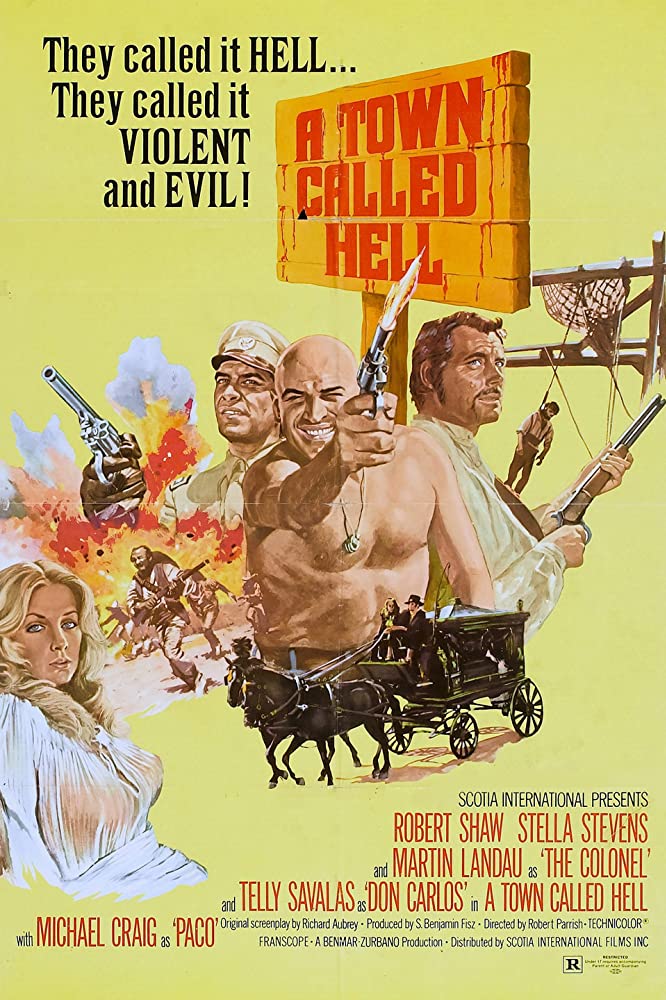
A Town Called Bastard is a British-produced Western that was shot in Spain and which was obviously designed to capitalize on the popularity of the Spaghetti westerns of the two Sergios, Leone and Corbucci.  When the movie was released in the United States, the title was changed to A Town Called Hell because it was felt that Americans would find the word “bastard” to be too offensive.  I’m not sure how naming your town Hell is somehow an improvement on naming a town Bastard but apparently, that was the thinking.  Actually, the town is called Bastardo is both versions of the film so the American title makes less and less sense the more you think about it.

Of course, how you can expect a film to make sense when the opening scenes feature Martin Landau and the very British Robert Shaw as two Mexican revolutionaries who, in the year 1895, ride into the town town of Bastardo and murder almost everyone that they see.  Ten years later, Robert Shaw is still living in the town but he’s now a priest and he’s renounced his formerly evil ways.  The town itself is ruled by a ruthless outlaw played by Telly Savalas, who doesn’t bother to hide his New York accent despite playing a Mexican outlaw.

One day, a black carriage arrives in town.  Inside the carriage is a glass coffin and inside the coffin in Stella Stevens, who is very much alive.  Stevens’s husband was among those killed by Shaw and Landau back in the day and she offers gold to anyone who can avenge his death.  Savalas is interested in the gold but then his character literally disappears from the film.  Instead, Martin Landau rides back into town.  He’s now a colonel in the Mexican army and is searching for a fugitive.

A Town Called Bastard has potential but it’s done in by poor casting and Robert Parrish’s inconsistent direction.  The story is told so messily and the editing is so sloppy that it often feels like major scenes were left on the cutting room floor.  (Just try to figure out what’s going on with Telly Savalas’s character, for example.)  Stella Stevens has one or two good moments as the vengeful widow and her entrance into the town is one of the few interesting moments in the movie but both Savalas and Shaw overact in an attempt to hide just how miscast they are while Martin Landau’s main concern seems to be to get his paycheck and move on to the next movie.

In the end, A Town Called Bastard goes straight to Hell.

High Noon, Part II: The Return of Will Kane (1980, directed by Jerry Jameson)


One year after throwing his tin star to the ground and riding out of town in disgust at the cowardice of the citizens who he once served, former Marshal Will Kane (Lee Majors, stepping into the role that won Gary Cooper an Oscar) returns to Hadleyville with his bride, Amy (Katherine Cannon).

Hadleyville has a new sheriff.  When Kane angrily left, he was replaced by J.D. Ward (Pernell Roberts), a corrupt tyrant who runs the town with an iron fist and who is more interested in making money than upholding the law.  Ward is determined to collect the bounty on Ben Irons (David Carradine), a reformed outlaw who swears that he’s innocent.  Kane decides to try to help Ben escape from Ward and his posse, which leads to potentially disastrous consequences for him.  Will the town finally show the courage necessary to stand behind Kane or will he once again be forced to go it alone?

High Noon, Part II is a made-for-TV movie.  It was obviously designed to be a pilot for a potential television series, one that would have featured the weekly adventures of Will Kane in Hadleyville.  As far as made-for-TV westerns are concerned, it’s about average, neither particularly good nor bad.  Lee Majors may not have been a great actor but he was believable in western roles and both Pernell Roberts and David Carradine give good performances as well.  Jerry Jameson directs in a workmanlike manner.  The story’s predictable but it’s a western so what do you expect?

The main problem with the film is that it’s set up to be a sequel to a film that never needed one.  When Gary Cooper threw that star in the dust and climbed up on that wagon with Grace Kelly in High Noon, the whole point of the story was that Will Kane was never going to return to Hadleyville because the citizens of Hadleyville deserted him when he most needed them.  Hadleyville didn’t deserve Will Kane.  That’s what set High Noon apart from other westerns.  Having Kane return to Hadleyville and once again pick up the tin star negates everything that made High Noon so effective.  The whole point of the ending was that Will Kane was never going to return but, according to this movie, he did and forgave the town for the unforgivable.  It’s impossible to watch High Noon II without thinking about how it goes against everything that the first High Noon was all about.

Oddly enough, the film’s forgettable screenplay was written by the great Elmore Leonard.  Leonard did better work before this film and he would do better work afterwards.


Lifetime Film Review: The Secret Life of a Celebrity Surrogate (dir by Mark Gantt)


So, put yourself in this situation.

You’re an aspiring writer, which is a really nice way of saying that you don’t have much money.  Because you haven’t paid your rent in four months, you’ve just gotten kicked out of your apartment.  As bad as that is, you can take some comfort from the fact that your incredibly hot boyfriend owns a really nice and really big apartment and he probably won’t have any issue with letting you live there.  I mean, he’s always eager for you to sleep over so why not just move in?  So, you head over to his place to give him the news and….

….some blonde that you’ve never seen before opens the door and asks you who you are!

Okay, now you’re in trouble.  Not only do you not have an apartment but you also don’t have a boyfriend.  You have no money and you have no family to fall back on.  While many writers wrote some of their best work while living in boxcars and drifting across the country, you’re not sure that’s what you want to do with the next few years of your life.  So, you get on social media and you let the world know that you need a job.  ANY JOB!

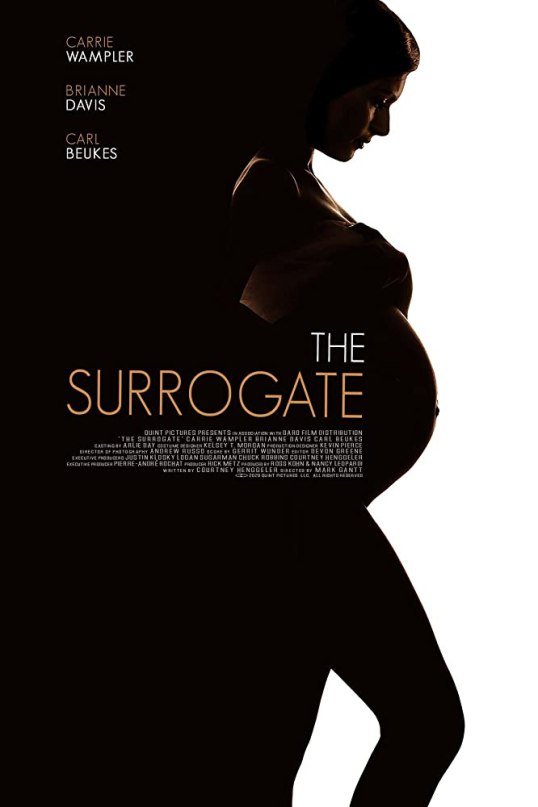
That’s what happens to Olivia (Carrie Wampler), the character at the center of The Secret Life of a Celebrity Surrogate.  It all happens during the first 10 minutes or so of this movie and it does make Olivia into an instantly likable character.  There’s no way that you can’t sympathize with her because everything that could go wrong in her life has gone wrong in just the course of a few hours.  When Olivia is contacted by Cassidy (Jordyn Aurora Aquino) and told that there is a job opportunity for her but that it requires Olivia to be discreet, you can’t blame Olivia for jumping at the opportunity.  What else is Olivia going to do?  Starve?

It turns out that Cassidy works for Ava (Brianne Davis) and Hayden (Carl Beukes) von Richter, a celebrity couple who, after Ava’s last few films flopped at the box office, are now mostly famous for being famous.  Ava and Hayden hire Olivia to act as a surrogate to carry their child.  Olivia will get $150,000 once the baby is born and she’ll get to stay at Ava and Hayden’s fabulous mansion.  The main conditions seem reasonable: Olivia will have to be discreet and she’ll also have to stay healthy and be regularly checked out by Ava’s army of doctors.  Olivia agrees.

And, at first, everything seems okay.  Ava and Hayden are charming, even if Ava is a bit high-strung and Hayden often seems like he’s lost in thought.  Olivia bonds with Cassidy and chef Peter (Kenneth Miller).  Ava can be demanding but that makes sense and …. wait, a minute, did Ava just do cocaine in a public restaurant?   And what exactly is Hayden doing with that hypodermic needle?

Needless to say, Ava and Hayden are not as perfect as they initially seem and Olivia soon starts to have doubts about whether or not they should even be parents.  Hayden, especially, seems to get creepier (and more and more gropey) with each passing day.  Soon, that fabulous mansion starts to feel like a prison and Olivia comes to realize that her employers are even more dangerous than she originally suspected….

The Secret Life of a Celebrity Surrogate is a film that’s very much of the moment.  We live in a society that is obsessed with celebrities, even faded ones like Ava and Hayden.  We also live in a world where ordinary people — like Olivia — can actually connect with celebrities via social media.  At the same time, though people may not always be quick to admit it, we all secretly suspect that most celebrities are actually crazy and probably have a dungeon underneath their mansion.  Even our favorites are often suspected of harboring dark secrets, as seen by the eagerness of the twitter mob to cancel their former heroes.  As such, we can all relate to Olivia’s willingness to be a part of Ava and Hayden’s seemingly glamorous life while, at the time, Ava and Hayden’s “quirks” serve to confirm what we’ve always suspected about what goes on behind closed doors in Beverly Hills and on Park Avenue.

The Secret Life of a Celebrity Surrogate strikes a good balance between thriller and satire.  It embraces the melodrama while also retaining enough self-awarness to be fun.  Brianne Davis and Carl Beukes are both entertainingly sleazy as the celebrity couple from Hell while Carrie Wampler is sympathetic and likable in the role of Olivia.  This is an entertaining Lifetime movie that will be enjoyed by anyone who has ever looked at a celebrity tweet and thought to themselves, “What a weirdo.”

Four Rode Out (1970, directed by John Peyser)


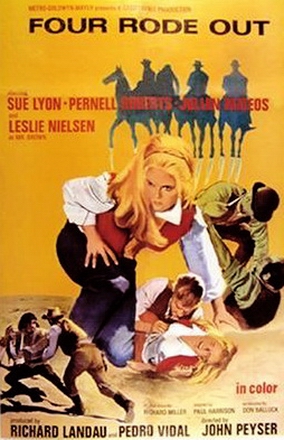
In this self-conciously hip western, former Lolita Sue Lyon stars as Myra Polsen.  Myra has a reputation for being the town tramp and, when her father discovers Myra in bed with wanted outlaw Frenando Nunez (Julian Mateos), it leads to her father having a violent breakdown which ends with him shooting himself and Frenando escaping into the desert.  (Before anyone comments, that’s not a misspelling.  The outlaw’s name actually is Frenando.)  World-weary U.S. Marshall Ross (Pernell Roberts) heads into the desert to try to capture Frenando.  Accompanying him are Myra (who still loves Frenando) and the mysterious Mr. Brown (Leslie Nielsen!), a detective who is obsessed with Frenando and who says that he’ll kill the outlaw as soon as he sees him.

Also accompanying them is a ghostly folksinger played by Janis Ian, of At Seventeen fame.  Ian sings songs that comment upon the story and they’re just as empty-headed and bad as you would expect them to be.  Janis Ian’s presence marks this as being one of the handful of new wave westerns that were released in the wake of Easy Rider, The Wild Bunch, and the films of Sergio Leone.  These westerns attempted to appeal to the counter-culture by sympathizing with the outlaws and featuring crooked lawmen.  The addition of Janis Ian and her songs is Four Rode Out‘s way of saying, “This may be a western but this is a western that gets it.” Instead, it just comes across as artificial and forced.  There’s a lot of room for both moral ambiguity and political subtext in the western genre, which was something that Leone and Sam Peckinpah proved.  There’s less room for a hippie folksinger, as Four Rode Out demonstrates.

Other than Janis Ian’s songs and some dialogue that tries too hard to be profound, Four Rode Out isn’t bad.  Sue Lyon really digs into the role of Myra and even Pernell Roberts gives a good performance.  Of course, if you’re watching this movie in 2020, it’s probably going to be because of Leslie Nielsen.  This movie was made before Nielsen recreated himself as a comedic actor and it’s interesting to see how the same things that made Nielsen so funny — the deadpan delivery, the overly serious facial expressions — also made him a good villain.  For modern audiences, it can be difficult to look at Leslie Nielsen without laughing.  That’s how much we associate him with comedy.  But once you accept the fact that this is Leslie Nielsen playing a bad guy, he’s very convincing in the role.

One final note of interest: Four Rode Out was based on a story idea from the actor Dick Miller.  Yes, that Dick Miller.  Unfortunately, Miller himself is not in the movie.

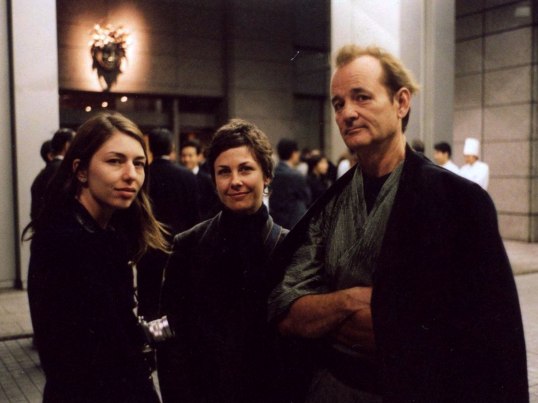
4 Shots From 4 Films: Special Bill Murray Edition


4 Shots From 4 Films is just what it says it is, 4 shots from 4 of our favorite films. As opposed to the reviews and recaps that we usually post, 4 Shots From 4 Films lets the visuals do the talking!

Today, we wish a happy 70th birthday to everyone’s favorite actor, Bill Murray!

That means, of course, that it’s time for….

4 Shots From 4 Films

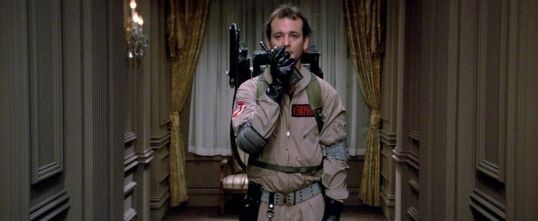
Ghostbusters (1984, dir by Ivan Reitman)

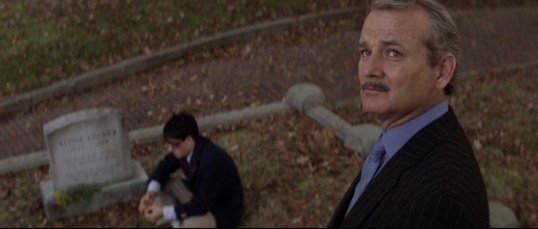
Rushmore (1998, dir by Wes Anderson)

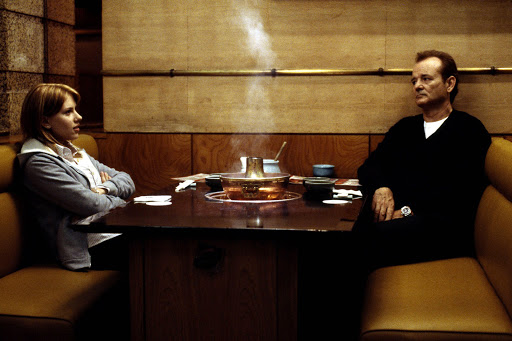
Lost In Translation (2003, dir by Sofia Coppola)

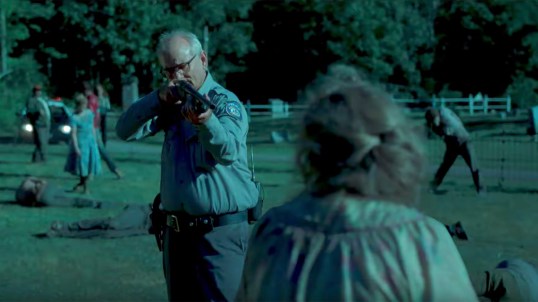
The Dead Don’t Die (2019, dir by Jim Jarmusch)

Here Are The Emmy Winners!


I skipped watching the Emmys this year because …. well, do I need a reason?  When it comes to award shows, my heart has always belonged to the Oscars.  The Emmys have never done much for me.

That said, I do want to say Congrats! to all the winners.  Bad Education won and I am excited about that, though it still bugs me that if only the film had been purchased by Netflix rather than HBO, it would be Oscar eligible as opposed to having to settle for an Emmy.  I’m also happy to see that Zendaya won for Euphoria and …. well, to be honest, there’s not a single winner that I really disagree with.  I don’t watch Succession but I know a lot of people love it.  Schitt’s Creek doesn’t do much for me but it’s nice that Pop! got some recognition.

I mean, at this point, I’m just happy that the Emmys — which were done with an audience and featured all of the winners accepting either from their home or a hotel room — were even held.  If they can do the Emmy, there’s no reason why they can’t do the Oscars, right?

Here are the winners!

Winners

Outstanding Drama Series

Better Call Saul
The Crown
The Handmaid’s Tale
Killing Eve
The Mandalorian
Ozark
Stranger Things
Succession — winner

Outstanding Supporting Actress in a Drama Series

Helena Bonham Carter, The Crown
Laura Dern, Big Little Lies
Julia Garner, Ozark — winner
Thandie Newton, Westworld
Fiona Shaw, Killing Eve
Sarah Snook, Succession
Meryl Streep, Big Little Lies
Samira Wiley, The Handmaid’s Tale

Outstanding Supporting Actor in a Drama Series

Nicholas Braun, Succession
Billy Crudup, The Morning Show — winner
Kieran Culkin, Succession
Mark Duplass, The Morning Show
Giancarlo Esposito, Better Call Saul
Matthew Macfadyen, Succession
Bradley Whitford, The Handmaid’s Tale
Jeffrey Wright, Westworld

Outstanding Directing for a Drama Series

Andrij Parekh, Succession — winner

Outstanding Writing for a Drama Series

Jesse Armstrong, Succession — winner

Outstanding Lead Actress in a Drama Series

Jennifer Aniston, The Morning Show
Olivia Colman, The Crown
Jodie Comer, Killing Eve
Laura Linney, Ozark
Sandra Oh, Killing Eve
Zendaya, Euphoria — winner

Outstanding Lead Actor in a Drama Series

Jason Bateman, Ozark
Sterling K. Brown, This Is Us
Steve Carell, The Morning Show
Brian Cox, Succession
Billy Porter, Pose
Jeremy Strong, Succession — winner

Outstanding Competition Program

The Masked Singer
Nailed It!
RuPaul’s Drag Race — winner
Top Chef
The Voice

Outstanding Limited Series

Little Fires Everywhere
Mrs. America
Unbelievable
Unorthodox
Watchmen — winner

Outstanding Film — Bad Education (winner!)

Outstanding Supporting Actress in a Limited Series or Movie

Uzo Aduba, Mrs. America — winner
Toni Collette, Unbelievable
Margo Martindale, Mrs. America
Jean Smart, Watchmen
Holland Taylor, Hollywood
Tracey Ullman, Mrs. America

Outstanding Supporting Actor in a Limited Series or Movie

Yahya Abdul-Mateen II, Watchmen — winner
Jovan Adepo, Watchmen
Tituss Burgess, Unbreakable Kimmy Schmidt: Kimmy vs. The Reverend
Louis Gossett Jr., Watchmen
Dylan McDermott, Hollywood
Jim Parsons, Hollywood

Outstanding Directing for a Limited Series or Movie

Maria Schrader, Unorthodox — winner

Outstanding Writing for a Limited Series or Movie

Damon Lindelof, Cord Jefferson, Watchmen — winner

Outstanding Lead Actor in a Limited Series or Movie

Jeremy Irons, Watchmen
Hugh Jackman, Bad Education
Paul Mescal, Normal People
Jeremy Pope, Hollywood
Mark Ruffalo, I Know This Much Is True — winner

Outstanding Lead Actress in a Limited Series or Movie

Cate Blanchett, Mrs. America
Shira Haas, Unorthodox
Regina King, Watchmen — winner
Octavia Spencer, Self Made
Kerry Washington, Little Fires Everywhere

Outstanding Variety Talk Series

The Daily Show with Trevor Noah
Full Frontal with Samantha Bee
Jimmy Kimmel Live
Last Week Tonight with John Oliver — winner
The Late Show with Stephen Colbert

Outstanding Comedy Series

Curb Your Enthusiasm
Dead to Me
The Good Place
Insecure
The Kominsky Method
The Marvelous Mrs. Maisel
Schitt’s Creek — winner
What We Do In the Shadows

Outstanding Supporting Actress in a Comedy Series

Alex Borstein, The Marvelous Mrs. Maisel
D’Arcy Carden, The Good Place
Betty Gilpin, GLOW
Marin Hinkle, The Marvelous Mrs. Maisel
Kate McKinnon, Saturday Night Live
Annie Murphy, Schitt’s Creek — winner
Yvonne Orji, Insecure
Cecily Strong, Saturday Night Live

Outstanding Supporting Actor in a Comedy Series

Mahershala Ali, Ramy
Alan Arkin, The Kominsky Method
Andre Braugher, Brooklyn Nine-Nine
Sterling K. Brown, The Marvelous Mrs. Maisel
William Jackson Harper, The Good Place
Daniel Levy, Schitt’s Creek — winner
Tony Shalhoub, The Marvelous Mrs. Maisel
Kenan Thompson, Saturday Night Live

Outstanding Directing for a Comedy Series

Daniel Levy and Andrew Cividino, Schitt’s Creek — winner

Outstanding Writing for a Comedy Series

Daniel Levy, Schitt’s Creek — winner

Outstanding Lead Actor in a Comedy Series

Anthony Anderson, Black-ish
Don Cheadle, Black Monday
Ted Danson, The Good Place
Michael Douglas, The Kominsky Method
Eugene Levy, Schitt’s Creek — winner
Ramy Youssef, Ramy

Outstanding Lead Actress in a Comedy Series

Christina Applegate, Dead to Me
Rachel Brosnahan, The Marvelous Mrs. Maisel
Linda Cardellini, Dead to Me
Catherine O’Hara, Schitt’s Creek — winner
Issa Rae, Insecure
Tracee Ellis Ross, Black-ish
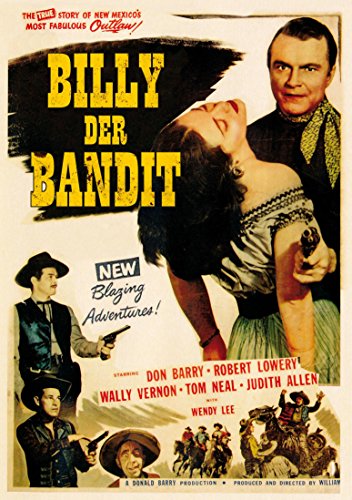
I Shot Billy The Kid (1950, directed by William Berke)


Sheriff Pat Garrett (Robert Lowery) tells the story of his friendship and later pursuit of Billy the Kid (Don “Red” Berry). As Garrett explains it, Billy could be a charming and likable outlaw but he just refused to go straight.  After Billy rescued Garrett from an Indian attack, Garrett even tried to arrange for Billy to get a pardon from New Mexico’s governor, Lew Wallace (Claude Stroud), but when the pardon didn’t arrive in time, Billy felt had been betrayed and continued his life as an outlaw.  Eventually, it fell upon Garrett to track down and put his old friend out of commission.

This film really should have been called I Shot Billy The Man because Don Berry was nearly 40 when he played Billy and he looked like he was closer to 50.  Berry makes the mistake of wearing  hair piece, which just makes it seem as if George Constanza somehow got cast as a notorious western outlaw.  As was true in even his worst westerns, Berry is a convincing gunslinger but he’s just not a very convincing kid.  Meanwhile, Robert Lowery is a boringly upright Pat Garrett.  There’s none of the moral ambiguity that’s present in some of the better retellings of the life of Billy the Kid.

Tom Neal, an authentic tough guy who is best remembered for starring in Detour and for sabotaging his own career by nearly beating actor Franchot Tone to death, appears as a member of Billy’s gang.  Neal was almost as old as Berry but it still seems like the film would have worked better if Neal has played Billy, Berry had played Pat, and Lowery would have taken the less important role of Charlie.  Neal would have brought some authentic toughness to the role while Berry’s onscreen charisma would have countered how boring the film’s version of Pat Garrett comes across as being.  As it is, with Berry miscast and Lowery giving a bland peformance and the entire movie limited by its low budget (it was produced by Robert Lippert, who made Roger Corman seem extravagant by comparison), I Shot Billy The Kid is one of the more forgettable films about the life of William Bonney.