For today’s horror on the lens, we have a low-budget apocalypse film from 1962. The film follows Deputy Colter (Seamon Glass), a deputy who tries to take charge of the formation of a shelter and who quickly reveals himself to be a mentally unstable fascist. Though this film undoubtedly gets off to a rough start, it soon develops a convincingly ominous and almost dream-like atmosphere.
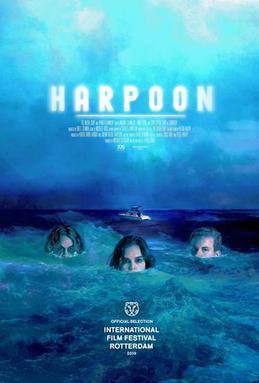
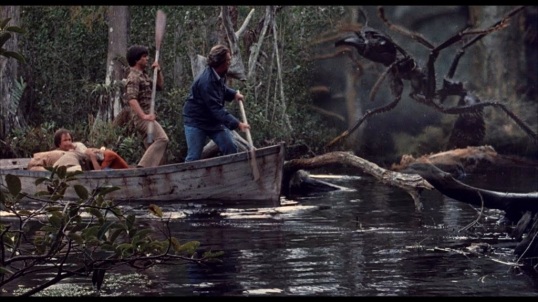
The 2019 Canadian film, Harpoon, tells the friends of three friends and a boat.
The three friends are Jonah (Munro Chambers), Richard (Christopher Gray), and Sacha (Emily Tyra). Jonah is a perhaps overly sensitive young man who is struggling to come to terms with not only the death of his parents but also the mountain of debt that they left for him. Richard is wealthy, has an anger problem, and it is suggested that his father might have murdered at least one person. Sacha is a nurse who is going out with Richard. Richard claims to love Sacha but that still doesn’t stop him from cheating on her. Jonah is obviously in love with Sacha but, just as obviously, he would never betray his best friend …. or would he?
The boat is a yacht known as the Naughty Bouy. It’s a really nice yacht. Richard owns it, though he doesn’t appear to be much of a sailor. The film’s rather sardonic narrator (voice of Brett Gelman) lists a number of superstitious beliefs that Richard, Jonah, and Sacha overlooked when they boarded the yacht for the day.
Here’s just a few of them:
It’s never safe to have someone named Jonah on a boat.
It’s not safe to take your first step onto a boat with your left foot.
Apparently, it’s bad luck to have a redhead (like Sacha and, for that matter, me) on a boat.
Never kill a sea gull. “That’s a big one,” the narrator tells us, right after Jonah and Richard kill a sea gull.
Now, I really can’t go into too many specifics about what happens on the boat without spoiling the film. And this is a film that you really should watch without any knowledge of what’s about to happen. However, I will say that the friends eventually end up stranded out in the middle of the ocean. Some of it’s because of bad luck. Some of it’s because the friends all seem to secretly hate each other. Two of them may have teamed up to try to kill the other one …. or maybe someone’s just being paranoid. One of the friends ends up with hole in their hand, courtesy of a spear gun. The important thing is that they eventually find themselves trapped out in the middle of the ocean, forced to depend on one another even while possibly thinking about killing each other. Secrets and lies are revealed and hard decision are made. It would all be really dark, if not for the sardonic commentary of the narrator, who not only tells us who these three are but who also keeps informed as to what they’re doing wrong.
It’s a good movie, one that immediately captured my attention and kept me guessing as to what was going to happen. If I’ve been vague about the film’s plot, it’s because this film earned the right to not be spoiled. It’s an occasionally grisly thriller with a wonderfully dark sense of humor. The three actors all did a wonderful job bringing their three less-than-lucky characters to life. Fans of Degrassi will especially be interested to see Munro Chambers, giving an excellent performance as a character who might initially remind them of Eli Goldsworthy but who eventually turns to be someone else altogether.
Harpoon really surprised me. Keep an eye out for it and, for the love of God, don’t kill any seagulls.
This, the final of the three Spider-Man “feature films” that were basically edited episodes of the Spider-Man TV series, finds Peter Parker (Nicholas Hammond) in Hong Kong. Spider-Man having adventures in Hong Kong sounds like it should be fun and the 2nd half of this “movie” was filmed on location but, even with all those elements (and a young Ted Danson in a small role), Spider-Man: The Dragon’s Challenge is just dull.
Min (Benson Fong) is a rich Chinese businessman who stands to be appointed to a position in the Chinese government but only if he can prove that he didn’t sell secrets to the U.S. during World War II. Min needs to find three Marines who can clear his name. Because Min is an old friend, J. Jonah Jameson (Robert F. Simon) assigns photographer Peter Parker to help Min track the men down. Why would Jameson give that responsibility to Pater Parker? I don’t know.
Min’s granddaughter, Emily (Rosalind Chao), thinks that Peter is a coward because he always disappears whenever Min is attacked. It’s a good thing that Spider-Man always mysteriously shows up whenever Peter isn’t around because otherwise, Min would be in a lot of trouble. It turns out that a steel baron named Mr. Zeider (Richard Erdman) wants to stop Min from clearing his name because Min would stop Zeider from getting a big construction contract.
Eventually, Peter, Min, Emily, and a former marine who can clear Min all end up in Hong Kong, where Spider-Man gets to fight kung fu masters and hopefully save the day.
Spider-Man: The Dragon’s Challenge has all the elements to be an enjoyably cheesy 70s adventure film but it fails because it’s not really a movie. It’s just two episodes of a TV show that have been edited together and, with the exception of a few of the fight scenes in Hong Kong, there’s nothing cinematic about it. As opposed to the previous two Spider-Man “films,” Nicholas Hammond just seems bored in this outing and the scenes with Rosalind Chao scolding Peter for being a coward are too much like Lois Lane complaining about Clark Kent never being in the same place as Superman.
Spider-Man: The Dragon’s Challenge also misses the opportunity to bring in any members of Spider-Man’s gallery of wonderful villains. How hard would it have been to replace Mr. Zeider with Wilson Fisk? The Silver Samurai could have at least made an appearance. Instead, Spider-Man’s just fighting another corporate villain. It’s a wasted opportunity.
The two episodes that make up this film were also the final two episodes of the Spider-Man TV show. Despite the fact that CBS was constantly moving the show around on the schedule and that the second season only featured 7 episodes, the series still got good ratings. However, CBS apparently feared that, by airing not only Spider-Man but also The Incredible Hulk and Wonder Woman, it would run the risk of becoming known as a “comic book” network. Since the Hulk and Wonder Woman both got good ratings and, unlike Spider-Man, had the support of the critics, they were allowed to remain while Spider-Man was given the boot and canceled in 1979. That’s a strong contrast to today, when most exec would probably sell their first born to get a chance at some of the Marvel action.
After this, it would be another 23 years before Spider-Man again appeared on a movie screen, this time in the form of Tobey Maguire. While Nicholas Hammond would never again play Spider-Man, one fan of his time on the show was director Quentin Tarantino, who later cast Hammond as director Sam Wanamaker in Once Upon A Time In Hollywood.
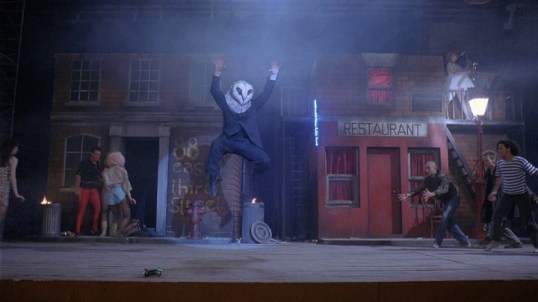
The opening on Michele Soavi’s 1987 masterpiece, StageFright, is one of the most brilliant ever filmed. Not only does it send up the conventions of the slasher genre but is also sends up musical theater. Seriously, how can you not love a horror film that features Marilyn Monroe playing the saxophone?
Of course, the opening of the film only begins to hint at the violence that’s going to follow. When a real killer manages to get into the theater, fantasy and reality blend together.
Interestingly enough, I think a real-life Broadway adaptation of StageFright would be a hit.
Sitting in the middle of the forest, there’s a camp ground. Rumor has it that the camp was built on the site of an ancient Native American burial ground and that’s why grouchy Robert Ritchie (David Hess) and his wife Julia (Mismy Farmer) were able to afford it as such as reasonable price. I guess that could be true and maybe the part about the curse is true, too…. Well, no matter! People love to camp and the forest is lovely and there’s no way that this camp ground won’t be a success!
In fact, the only thing that could stop it from being a popular vacation location would be if two teenagers were mysteriously murdered one night….
Which, of course, is exactly what happens! The daughter of a local doctor (played by John Steiner, of all people) goes off with her boyfriend and both of them are murdered! (Though we’re told that the two of them are high school students and, when we first see them, they’re at basketball practice, both victims appear to be in their early 30s. When the actress playing the doctor’s daughter first approached him, I immediately assumed that she was playing his wife. I was actually a little bit stunned when she said, “Bye, Daddy.”)
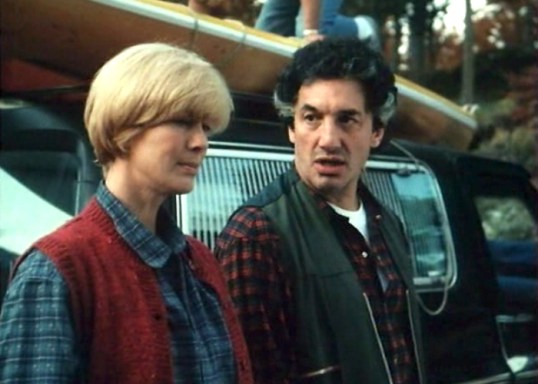
Anyway, the unsolved murder pretty much ruins any hope of the camp ground being successful. 15 years later, Robert is paranoid and convinced that a Native shaman is sneaking around the forest and looking for campers to kill. Meanwhile, Julia is so frustrated with her increasingly unstable husband that she’s having an affair with the sheriff (Charles Napier). The sheriff is so busy shtupping Julia that it often falls upon Deputy Ted (Ivan Rassimov, who had the best hair of all the Italian horror actors) to actually enforce the law. Meanwhile, the doctor is still mourning the death of his daughter and wandering around the forest.
Eventually, a bunch of obnoxious 30-something teenagers arrive, looking for a place to park their camper and ride their dirt bikes. Despite the history of murder and the general grouchiness of Robert Ritchie, they decide to say at the campground. Soon, a masked killer is carving people up. Is it the spirit of the Native shaman or is it something else? Who will survive and what will be left of them?
This 1986 Italian film was directed by none other than Ruggero Deodato, the man behind films like Cannibal Holocaust and The House On The Edge of the Park (which starred Body Count’s David Hess). As one might expect from a Deodato film, the emphasis is on blood and atmosphere. Deodato, who always had a good eye for properly ominous locations, gets a lot of mileage out of that spooky forest, which really does look like exactly the place where a masked killer would chose to hang out. While the kills are tame by Deodato standards, they’re still icky enough to make you cringe. I’m sorry but if the scene involving the body hanging from the hook doesn’t freak you out, then you’ve obviously become dangerously desensitized and you probably should probably take a break from watching movies like this.
Of course, the main appeal of Body Count is to see a cast of Italian horror and exploitation veterans going through the motions of starring in an American-style slasher film. David Hess, Ivan Rassimov, John Steiner, Charles Napier, and Mimsy Farmer are all such wonderfully eccentric performers that they’re worth watching even when they’re stuck in one-dimensional roles. David Hess, especially, does a good job as the unhinged Robert Ritchie and the film makes good use of Hess’s image. The film understand that we’re so used to watching David Hess kill people on screen that our natural instinct is to suspect the worst when we see him in Body Count. I also liked the performance of John Steiner, largely because Steiner always came across like he couldn’t believe that, after a distinguished theatrical education, he somehow ended up an Italian horror mainstay. And, of course, Ivan Rassimov had the best hair in the Italian horror genre.
Body Count is on Prime. The story’s not great but it’s worth watching just for the horror vets in attendance.
Yesterday, I didn’t get to watch or review any horror films because the air conditioner at the house stopped working. While I know that a lot of people up north think that AC is a luxury that’s going to destroy the world, I live in Texas and an air conditioner is a necessity down here. So, if that leads to glaciers melting and me getting a lecture from some obnoxious little brat …. well, fine.
Anyway, we were able to get the air conditioner fixed. It took a while but it’s now working again. Once the AC was again blowing cool air into the house, I started to think about how it could be worse. I mean, the house could be haunted. We always tend to assume that ghosts are going to be nice but really, there are some nasty ghosts out there.
Take the 1986 film, House, for instance. House stars William Katt as Roger Cobb, a horror author who needs a best seller. Cobb is dealing with a lot. He’s wife (Kay Lenz) has left him. His son has vanished. His aunt has recently committed suicide, leaving behind her house. On top of all that, Cobb is still haunted by his experiences during the Vietnam War, when he was forced to leave behind a gravely wounded soldier named Big Ben (Richard Moll). Cobb wants to write about his Vietnam experiences but his agent is aghast. No one wants to talk about the war!
So, Roger moves into his aunt’s old house. He was originally planning on selling it but, for whatever reason, he thinks living in an abandoned house that drove its last owner to suicide will be a good idea. Roger thinks that living in the house will help him finish his book. The House has different ideas.
Soon, Roger finds himself dealing with a series of incidents that feel as if they were lifted from other, more cohesive horror movies. In a scene that feels like it was inspired by the Evil Dead, his wife turns into an otherworldly creature and tries to attack him. Weird gremlin creatures, which could have come from Troll or Ghoulies, keep showing up and trying to kidnap an obnoxious neighbor child. Roger’s neighbor (George Wendt) thinks that it’s possible that Roger is a murderer and that he’s buying his victims out in the backyard. Even worse, a decaying and pissed off Big Ben starts to show up.
House is an occasionally likable attempt to mix horror and comedy. Most of the comedy comes from Roger’s attempts to keep anyone else from noticing just how crazy things have gotten in the house. (Disposing of a demon’s body turns out to be not as easy as one might imagine.) William Katt does a good job with selling the comedy, though he never quite convinces you that he’s a best-selling horror author. That said, the horror aspect is far more interesting, if just as a metaphor for Roger’s PTSD. At its best, the film suggests that the house is feeding off of the lingering trauma of Roger’s war experiences. It’s an interesting idea but not one that’s really explored as much as you might like. Unfortunately, the film struggles to balance the horror and the comedy. Just when it really starts to scare you, it remembers that it’s supposed to be a comedy. Sam Raimi would have been the ideal director for House.
That said, House is entertaining, if a little bland. If nothing else, watching it made me feel better about my own house. My air conditioner may have gone down for a few hours yesterday but at least it didn’t open a portal to Hell.
For today’s horror on the lens, how about 1963’s The Yesterday Machine? This film opens with some impressive baton twirling and then segues into telling a story about time travel, mad scientists, and …. well, that’s about it. Still, what else do you need? Have you ever wondered what would happen if a sane scientist discovered time travel? For some reason, it’s always the insane ones who figure it out.
This film was shot in North Texas! That’s right, this is one of those low-budget regional productions, the one’s where the film might not be great but you kind of have to admire the determination of the filmmakers to try to make a real movie. Even if you didn’t recognize the landscape, the accents of the actors would have given it away immediately. Russ Marker was an independent filmmaker, based in Texas. The Yesterday Machine is one of two films that Marker directed. He also had an uncredited role as a bank guard in 1967’s Bonnie and Clyde.
Finally, the film stars Tim Holt who also appeared in The Magnificent Ambersons and Treasure of the Sierra Madre. How Does The Yesterday Machine rank when compared to those two films? Watch and find out! (And, after you watch it, read my review from last year.)
When three college students decide to prove the folly of the nuclear arms race by stealing enough plutonium to make a nuclear bomb of their own, it’s up to Spider-Man (Nicholas Hammond) to sort them out! He better do it quickly, too, because the police suspect that the plutonium may have been stolen by a grad student named Peter Parker.
However, Spider-Man is not the only person who wants that bomb. The evil Mr. White (Robert Alda) also wants the bomb, though he’s not planning on using it to make the case for world peace. Instead, he plans to blackmail the government into giving him a fortune in gold. Now, Parker not only has to clear his own name but he has to keep Mr. White from blowing up Los Angles while, at the same time, preventing a nosy reporter (Joanna Cameron) from figuring out that he’s really Spider-Man.
Spider-Man Strikes Back was released as a feature film in Europe and was advertised as being a sequel to Spider-Man. Gullible audiences who paid money to see it ended up sitting through a two-part episode of the Amazing Spider-Man TV show, albeit one that was edited into a 90-minute movie and which didn’t have stop for commercial interruption.
Spider-Man Strikes Back highlights exactly what went wrong with the first attempt to do a live action version of Spider-Man. There were several members of Spider-Man’s regular rogues’ gallery who could have stolen that bomb and threatened Los Angeles. It sounds like a typical Sinister Six plot. Even the Kingpin, on a bad day, might be tempted to get in on that action. Instead, the villain is a bland arms dealer named Mr. White. CBS reportedly refused to use any classic Spider-Man villains because they wanted to keep the show grounded in reality but the minute Spider-Man crawled up a skyscraper for the first time, the network should have forgotten about trying to keep it real.
To repeat what I said in my review of Spider-Man, Nicholas Hammond is miscast as everyone’s favorite webcrawler. Hammond is likable but he doesn’t come across as being at all insecure and it’s Spider-Man’s insecurities that distinguished him from other comic book heroes. Spider-Man Strikes Back also suffers because it’s clear that much of the Spider-Man footage was reused from the pilot film.
I still enjoyed watching Spider-Man Strikes Back, though. When I was a kid, Spider-Man was my favorite and, even in something like this, it’s still fun to watch him climbing up buildings and webbing up crooks. Though there’s nothing cinematic about Spider-Man Strikes Back and it’s clearly just an extended episode of a TV show, I still liked that the climax took place in an preserved old west ghost town. That was just strange enough to work.
Though Spider-Man Strikes Back was not as successful at the European box office as Spider-Man, it still did well enough that one more feature film would be crafted from the Spider-Man TV show, Spider-Man: The Dragon’s Challenge.
From 1958’s Attack of the 50 Foot Woman, Harry discovers that cheaters never get away with it. Especially when they’re cheating on someone who is 50 feet tell….
4 Shots From 4 Films is just what it says it is, 4 shots from 4 of our favorite films. As opposed to the reviews and recaps that we usually post, 4 Shots From 4 Films lets the visuals do the talking!
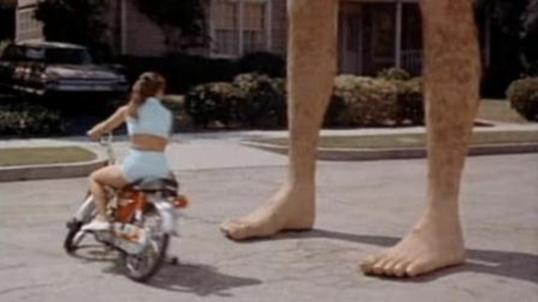
This October, we’ve been using 4 Shots From 4 Films to pay tribute to some of our favorite horror directors! Today, we celebrate Mr. Big himself, Bert I. Gordon!
4 Shots From 4 Films
The Amazing Colossal Man (1957, dir by Bert I. Gordon)
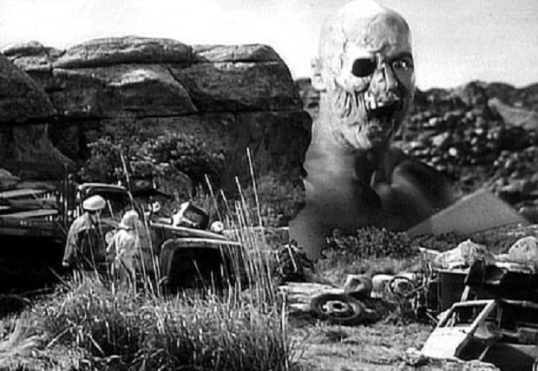
War of the Colossal Beast (1958, dir by Bert I. Gordon)
Village of the Giants (1965, dir by Bert I. Gordon)






 Through the Shattered Lens