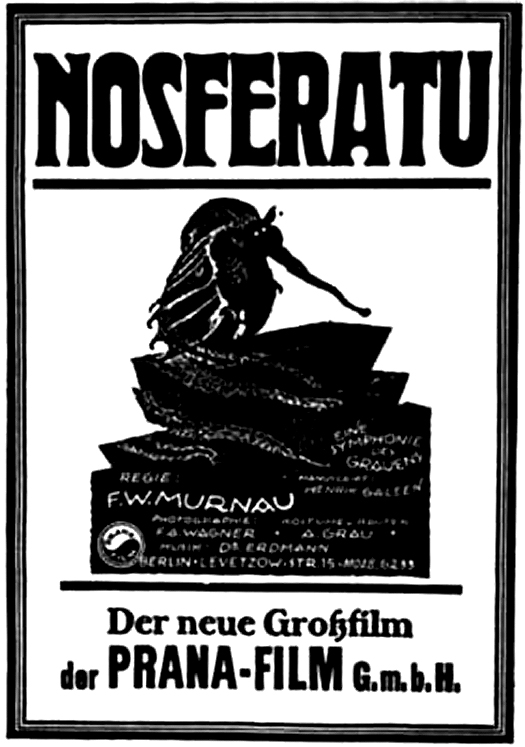
Today’s Horror on the Lens is a classic film that really needs no introduction! Released in 1922, the German silent film Nosferatu remains one of the greatest vampire films ever made. It’s a film that we share every October and I’m happy to do so again this year!
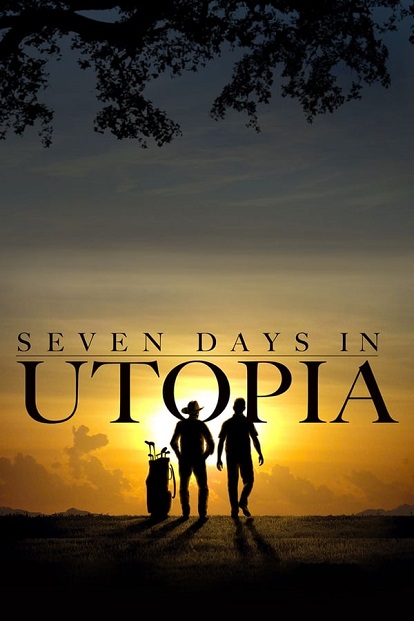
Last night, as a part of our attempt to make some space on the DVR so that I can record every upcoming episode of The Bachelorette and she can record the World Series, Erin and I watched the 2011 film, Seven Days In Utopia.
Seven Days In Utopia is a Texas-set (and Texas-filmed) movie about a young pro golfer named Luke Chisholm (played by Lucas Black) who has a very public meltdown while in the middle of a tournament. Feeling that his career is pretty much over, Luke jumps in his car and goes speeding around Southwest Texas. Because he’s not pay attention to the road (which, I’ll be honest, occasionally happens when you’re driving through rural Texas.), he almost doesn’t notice the cow standing in front of his car. Fortunately, Luke swerves and avoids the cow. Unfortunately, he crashes through a fence.
The fence belongs to Johnny Crawford (Robert Duvall), a friendly rancher who — coincidence of coincidences — also happens to be a former pro golfer! With Luke’s car temporarily out-of-commission, he’s stuck in Utopia for at least seven days. Johnny offers to spend those days teaching Luke everything that he needs to know about golf and about life. Luke agrees, because what else are you going to do when you’re stranded in Uvalde County?
Seven Days In Utopia is one of the few films in my lifetime to have been released with G rating and it pretty much earns that G-rating by being the most inoffensive film ever made. Seven Days in Utopia is almost aggressive in its pleasantness. Johnny is very nice. Luke is very nice. Just about everyone that Luke plays against is pretty nice. Everyone in town is pretty nice, even if they do give Luke a hard time about being a “city boy.” Deborah Ann Woll plays the nice waitress at the local diner, with whom Luke has a very pleasant romance. Woll and Black make for a cute couple and they have a nice chemistry. They’re all very pleasant.
Seven Days In Utopia is one of those films that you end up watching when you need something to watch with an older relative who doesn’t understand why “all the movies nowadays have to use all that language!” It’s an old-fashioned movie. That, in itself, is hardly a problem for me. I like old movies and, despite my love of horror as a genre, I can also appreciate movies that are not meant to traumatize the audience. For that matter, I like Lucas Black and I like Deborah Ann Woll. As for Robert Duvall — I mean, My God, he’s one of the last of the great character actors. He’s Boo Radley and Tom Hagen, for God’s sake! Of course, I love Robert Duvall and Duvall really is probably the only actor who could make an idealized character like Johnny Crawford into a real human being. That said, Seven Days In Utopia is also a rather slow film. The pacing will make you feel all seven of those days and the lessons that Johnny teaches to Lucas aren’t particularly profound once you look beyond the fact that they’re being taught by legitimate great actor Robert Duvall. It’s an nice film and the scenery is pretty but, while watching it, it’s hard not to miss the anarchistic spirit of golfers like Shooter McGavin and Happy Gilmore.
In fact, just yesterday, a trailer dropped for a horror film that will be coming out in February! So, happy Valentine’s Day, I guess.
Anyway, the trailer is for The Black Phone, which is the latest film from Scott Derrickson. It’s a return to his horror roots after his detour into the MCU. It appears to be about a kidnapping and the kidnapper is Willy Wonka! Oh, wait a minute …. that’s Ethan Hawke.
The trailer looks kind of creepy. Derrickson’s Sinister is still one of the scariest films of the past ten years. Plus, Ethan Hawke should get all the roles that seem like they were originally written for Johnny Depp. So, I’ll give this one a shot when it comes out next year.
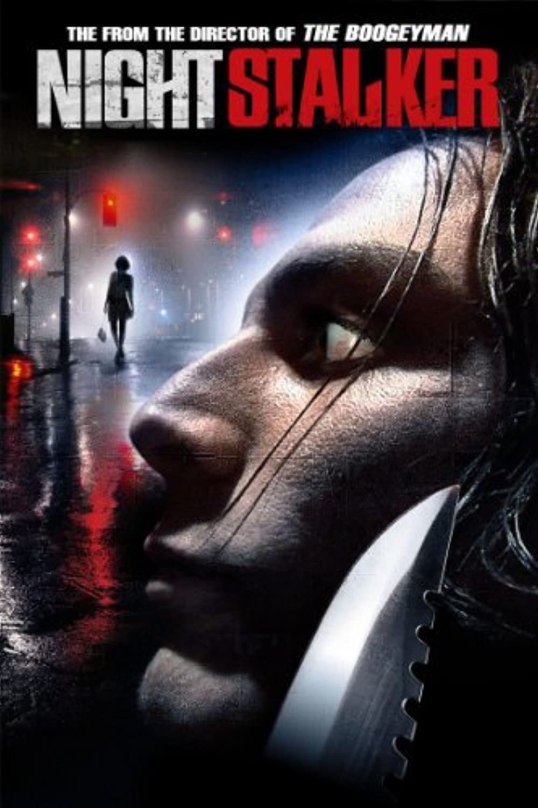
The 2009 film, Nightstalker, opens with a drifter named Richard Ramirez (Adolph Cortez) lying on his back in what appears to be an alley. He’s obviously been beaten. He appears to be only half-conscious. As he lays there in that filthy alley, we’re treated to several negative-filtered flashbacks of Ramirez shooting people. This is followed by a series of blurry shot that were apparently filmed by someone driving down a street in Los Angeles. Discordant music plays on the soundtrack. If you listen carefully, you can hear someone mumbling in the background but good luck figuring out what they’re actually saying. This is a low-budge film and sound quality was not a concern.
Of course, none of this should come as a surprise to anyone who is familiar with the unique aesthetic of director Ulli Lommel. As I wrote in my review of Son of Sam, Lommel started his career as an association of Rainer Werner Fassbinder’s before he eventually came to America, got involved in the New York art scene, and made a handful of decent films. Unfortunately, after he divorced the heiress who was responsible for funding the majority of his early films, Lommel spent the rest of his career making zero-budget, direct-to-video films about serial killers, like Richard “Night Stalker” Ramirez. Lommel always claimed that there was a political subtext to his serial killer films and I don’t doubt that he was being honest. You have to be sincerely committed to make a film as inept as Nightstalker. At the same time, it’s not easy to figure out just what exactly it was that Lommel thought he was trying to say.
Nightstalker is undoubtedly one of the worst of Lommel’s serial killer films. Usually, I try to make sure that all of my reviews include at least 500 words but it’s really difficult to think of much to say about Nightstalker. The film is frequently out-of-focus. The sound quality is atrocious. The actor who plays the Nightstalker comes across more like a male model than a homeless serial killer who was known for having bad teeth and disagreeable odor. Because there’s already been multiple films and documentaries made about Richard Ramirez, the Lommel version fails to add anything new to the story. Instead, the film is a collection of scenes of Ramirez aimlessly wandering around Los Angeles, sucking on a lollipop and occasionally flashing back to his abusive El Paso childhood. The film moves slowly and Ramirez’s inner monologue is vacuous. The real Ramirez’s thoughts were probably pretty vacuous as well so give Lommel some credit for not trying make the the guy more interesting than he actually was.
Watching the film, you do get the feeling that Lommel was sincrely trying to say something about being on the fringes of society in America. Lommel’s true crime films often implied that American serial killers were the direct result of American culture and its obsession with violence and wealth. As I said, I think Lommel did think that he was making an artistic and political statement with these films, in much the same way that Lucio Fulci insisted that The New York Ripper was actually a critique of capitalism. (Oh, if only Lommel had possessed just an ounce of Fulci’s talent….) Son of Sam, for instance, actually does have a few moments where Lommel’s hallucinatory approach is somewhat effective. But Nightstalker shows the limits of Lommel’s zero budget, semi-improvised approach. It’s a chore to sit through and it’s a shame that, due to the continuing infamy of the mercifully late Richard Ramirez (Netflix aired a documentary about him earlier this year that had him trending on twitter), this is probably one of Lommel’s most-viewed films. Hell, I watched it. But I think this is going to be my last Lommel true crime film for a while.
Halloween, after all, is meant to be a joyous time.
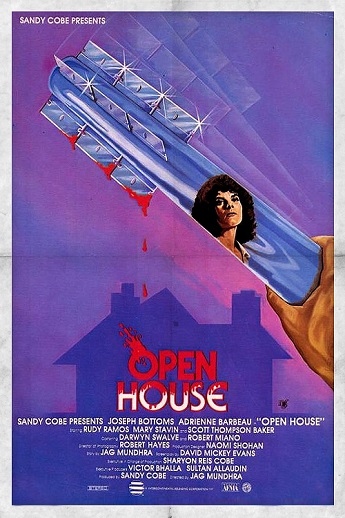
A disturbed man named Harry starts calling Dr. David Kelly (Joseph Bottoms), a radio psychiatrist who is already being sued as a result of one of his patients killing herself on the air. Harry eats dog food and hates real estate agents because they keep trying to sell the houses in which he’s illegally squatting. The police even suspect that Harry may in fact be responsible for several recent realtor murders. When David mentions that his girlfriend, Lisa (Adrienne Barbeau), just happens to be a real estate agent, it looks like she might be Harry might have a new target!
Open House is from the same group of producers who gave the world Terror on Tour. Like Terror on Tour, it’s a pretty lousy film but at least Terror on Tour had a killer clown and a loud soundtrack. Open House has a bland synth soundtrack and a killer who could just as easily been a generic criminal of the week on an 80s cop show. Rick Hunter would have just blown this psycho away and said, “Works for me.” Because David needs to be redeemed for that patient who killed herself as a result of his bad advice, he gets a chance to encourage Harry to talk about his feelings. It leads to a very long monologue.
The main appeal of the film is that it features the beautiful Adrienne Barbeau but she doesn’t get to do much other than get menaced by Harry. Barbeau supposedly only accepted the roll so that she could use her paycheck to pay for her son’s tuition fees so at least something good came out of this film.
Open House is one of those films that I can remember being displayed prominently at the local video store that we used to visit when I was a kid. It was a popular rental, because it had a cool cover and the back of the box promised much more blood and gore than the film delivered. I can’t remember how old I was when I rented it but I do remember worrying about my mother figuring out what type of movie I had selected. I need not have worried because Open House was about as tame as they come.
Open House has never gotten anything more than a VHS release but it’s there on YouTube for anyone who wants to track it down. I rewatched it knowing that it was a boring film but I had forgotten just how boring. When it comes to this Open House, lock the door and throw away the key.
Kier is 77 years old. This German actor has over 260 film credits to his name, having worked with everyone from Dario Argento to Paul Morrissey to Gus Van Sant to Alexander Payne to Rob Zombie to Lars von Trier. Though he’s appeared in every genre of film, he’s best remembered for his horror appearances. In fact, his career got a major boost when he was cast in two horror films that were produced by Andy Warhol. (As with all things Warhol, there’s more than a little debate as to how much Andy was actually involved.) In 1973, Kier played Baron Von Frankenstein in Flesh For Frankenstein. In 1974, he played Dracula in Blood for Dracula. Both films were deliberately over-the-top in both their gore and their performances and they helped launch Udo Kier on the path to cult stardom. Take, for example, the scene below. This is from Flesh for Frankentein. Kier’s Baron meets his end but not before giving a lengthy monologue. One thing to keep in mind is that this film was originally released in 3D so, while Kier was giving his speech, the Baron’s organs were hanging out over the audiences.
(If you have a hard time with gore, I would not suggest watching this scene.)
Happy birthday, Udo Kier! Thank you for putting your heart into ever role!
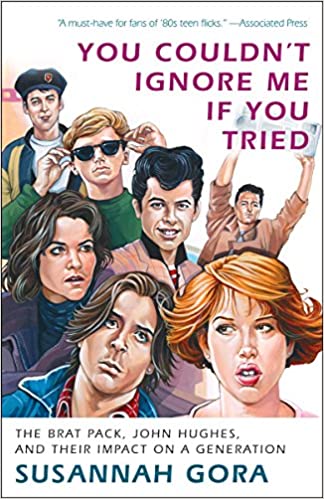
I’m going to take a brief break from recommending books about the horror genre so that I might take some time to recommend a book about another underappreciated genre of film, the 80s teen film.
I read You Couldn’t Ignore Me If You Tried back in September and I thoroughly enjoyed it. It definitely contributed to my later enjoyment of Andrew McCarthy’s autobiography, Brat. At the same time, reading Brat also caused me to think even more about You Couldn’t Ignore Me If You Tried. So, as you can see, it’s all just a circle of good film books.
You Couldn’t Ignore Me If You Tried takes a look at the classic teen films of the 80s — Pretty in Pink, The Breakfast Club, Ferris Bueller’s Day Off, Sixteen Candles, and Say Anything. It also takes a look at two films that are a bit less interesting, St. Elmo’s Fire and Some Kind of Wonderful. (Sadly, Fast Times At Ridgemont High is pretty much left unexamined, except for a few references to it in the chapter about Say Anything.) The book explores how John Hughes revolutionized Hollywood by making films that took teenagers and their problems seriously, how he helped to launch a group of talented young actors to stardom while also inspiring directors like Cameron Crowe, and how one reporter managed to end it all by writing an article about the Brat Pack.
The film is full of not just reviews about and thoughts concerning the films but also the stories of how they came to be made. Did you know that Nicolas Cage and John Cusack both had a shot at being cast as Bender in The Breakfast Club? Did you know that Ferris Bueller’s Day Off was originally envisioned as a vehicle for Anthony Michael Hall? Did you know that John Hughes came close to firing Judd Nelson from The Breakfast Club and that it was Paul Gleason (who played Bender’s nemesis, Mr. Vernon) who talked him out of it? It’s all in there and it makes for an entertaining read. There’s something very sweet about discovering that the cast of the Breakfast Club were as close while filming as the characters were while serving detention. And, just as in Andrew McCarthy’s book, it’s very infuriating to learn how one reporter’s night out with Judd Nelson, Rob Lowe, and Emilio Estevez led to not only the creation of the Brat Pack label but also the tarring of any actor who was associated with the Brat Pack.
At times, it’s a bit of sad book. Not only did the Brat Pack label unfairly derail several promising careers but John Hughes himself turned his back on Hollywood. Sadly, no one in the book seems to be quite sure what inspired Hughes to abandon directing and become something of a recluse later in life. There is a lot of talk about how he lost his two early muses, Molly Ringwald and Anthony Michael Hall, to adulthood. Sadly, it appears that he didn’t have as much fun directing Ferris Bueller’s Day Off as one might assume, largely because Matthew Broderick and Alan Ruck were already established actors and didn’t need his mentorship in the way that Hall and Ringwald had. Hughes comes across as being a talented and sensitive man who was most comfortable expressing himself through the movies he made. When he stopped making those movies, he closed himself off from the world. One wonders how he would have reacted to the outpouring of grief that was inspired by his untimely death. Would he be touched? Would be embarrassed? One hopes that he would realize that his films touched the souls of viewers of all ages and, when he passed, it was the end of an era.
You Couldn’t Ignore Me If You Tried captures that era in poignant and entertaining detail.
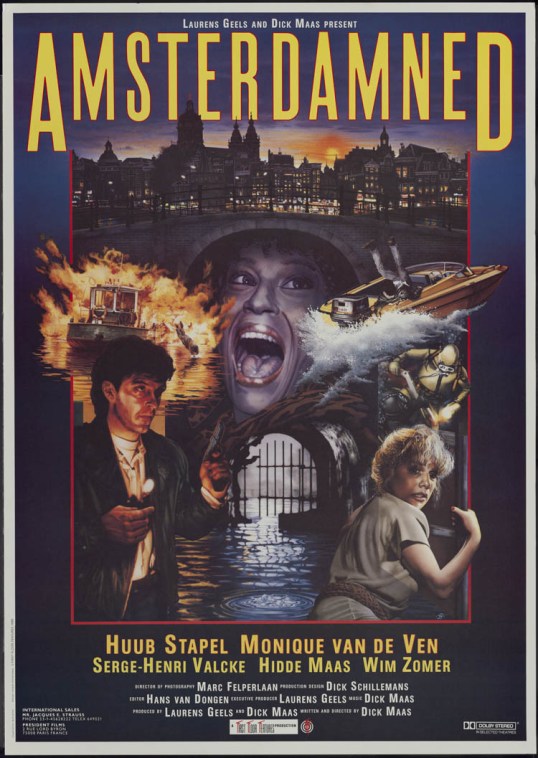
Okay, no one actually says that in the 1988 Dutch film, Amsterdamned. However, I will admit that, while I was watching the movie on Shudder, I said it after every single murder. Seriously, it’s just too good to resist. Whatever else you might want to say about this movie, you can not deny the power of that title. How many people have watched this movie just because it’s called Amsterdamned? I would guess a few thousand at least.
As for the film itself, it deals with a murderous diver who swims through the famous canals of Amsterdam and kills just about anyone they come across. Our diver is not one to discriminate when it comes to selecting their victims. They may start out killing a prostitute but soon, they’re targeting environmentalists, boat captains, cops, and perhaps even the girlfriend of Amsterdam’s top cop, Eric Visser (Huub Stapel). Visser is one of those cops who drinks too much, doesn’t spend enough time with his daughter, and who is still bitter about his divorce. It’s nice to see that “Cops Who Play By Their Own Set Of Rules” are not a uniquely American phenomenon. Of course, since Eric is Dutch, his partner is named Vermeer (Serge-Henri Valcke). It doesn’t take Eric and Vermeer long to figure out that Amsterdam has a serial killer haunting the canals.
Amsterdamned is a mix of a slasher film and an action film. The highpoint of the film is a pretty exciting speedboat chase between Eric and the Killer, which features some truly spectacular stunts and which definitely shows that director Dick Maas can handle directing action. At the same time, though, the film is also full of point-of-view shots of the diver emerging from the canals and stalking their next victim. The diver is an effectively creepy villain and the film makes good use of the idea that practically anybody or anything could be hiding under the water. I haven’t been to Amsterdam but I have been to Venice and I can tell you, canals are both beautiful and frightening at the same time. It’s had not to look down at the water and to consider all of the secrets that could be hidden under that murky surface. The comparison between the canals of Amsterdam and the canals of Venice is an apt one, if just because Amsterdamned is pretty much a Dutch version of an Italian giallo films. While it’s not as mean-spirited as the infamous Giallo in Venice, it’s just as much a whodunit as it is a standard slasher film.
It’s a film that has its effective moments, though it’s also a film that has some pretty glaring flaws. With a nearly two-hour running time, it’s at least 30 minutes too long and the film occasionally seems to get bogged down with the details of Eric’s personal life, as if the filmmakers didn’t understand that all they had to do was tell us that Eric was a hard-drinking, independent-minded detective and we, as experienced film watchers, would be able to fill in the rest of the details for ourselves. When the killer’s identity is revealed, it’s a bit of a let down and it’s hard not to feel that the movie didn’t exactly play fair with its audience. Even with all that in mind, though, there’s enough creepy moments to make Amsterdamned worth visiting.
We are rapidly reaching the halfway mark of our October horrorthon here at the Shattered Lens. By the time we reach the end of the first half at midnight on Saturday, we will have published over 200 posts. During the second half, we’ll publish …. well, let’s not speculate. You never know. The world could end tomorrow and, as a result, we might never post again. What’s important is that I’m proud of what we’ve accomplished so far and I look forward to seeing what we accomplish during the rest of the month!
(That said, I’m hoping for another 250 to 300 or so posts. 500 FOR OCTOBER! It seems like a reasonable go. We’ll see!)
Anyway, today seems like a good time for another edition of Lisa Marie’s Favorite Grindhouse Trailers! And, since today is Jack Arnold’s birthday, it only seems appropriate that today’s edition deals with giant creature features!
Q: The Winged Serpent (1982)
From director Larry Cohen, it’s Q The Winged Serpent! I’ve seen this movie and it’s undeniably entertaining. On the one hand, you’ve got the serpent flying around and looking all dangerous. Then you’ve got David Carradine and Richard Roundtree kind of sleepwalking through their roles. And then, suddenly, Michael Moriarty shows up and gives this brilliant, method-influenced performance. It’s an odd film but it’s hard not to like that Claymation flying serpent.
2. The Giant Spider Invasion (1975)
From Wisconsin’s own Bill Rebane, here’s the trailer for The Giant Spider Invasion! This is probably Rebane’s best film. If you’re trying to frighten your audience, you can’t go wrong with a giant spider.
3. Empire of the Ants (1977)
What’s the only thing scarier than a giant spider? A giant ant, of course! This film is from Bert I. Gordon, a director so obsessed with films about giant monsters that he was actually nicknamed Mr. BIG. (Of course, it also helped that those were his initials.)
4. Food of the Gods (1976)
Speaking of Bert I. Gordon, he was also responsible for this film, Food of the Gods. Like Empire of the Ants, it was based (however loosely) on a novel by H.G. Wells. Two old farmers feed the food of the Gods to the local animals and things do not go well. For some reason, a football player played by Marjoe Gortner decides to investigate. Shouldn’t he be practicing for the big game? Gordon missed an opportunity here by not having a giant-sized Marjoe Gortner.
5. Night of the Lepus (1972)
As frightening as those previous trailers were, can anything prepare you for the terror of killer rabbits!? This movie is proof positive that rabbits look cute no matter who they’re killing.
6. Village of the Giants (1965)
In the end, though, the greatest monster will always be man. By the way, this is another Bert I. Gordon film. Beau Bridges turns into a giant and plots to conquer the world. Only a young Ron Howard can stop him.
I hope you’re having a wonderful October! Never stop watching the shadows!
4 Shots From 4 Films is just what it says it is, 4 shots from 4 of our favorite films. As opposed to the reviews and recaps that we usually post, 4 Shots From 4 Films lets the visuals do the talking!
105 years ago today, future director Jack Arnold was born in Connecticut. Arnold started his film career making documentaries and he ended it directing episode of The Brady Bunch and The Love Boat. In between all of that, he directed some of the best-remembered “creature” films of the 1950s. Anytime you see a movie featuring giant monsters, you’re seeing a film that owes a debt to the work of Jack Arnold. Arnold also directed the classic Creature of the Black Lagoon.
Today, in honor of Jack Arnold, TSL is proud to present….
4 Shots From 4 Jack Arnold Films
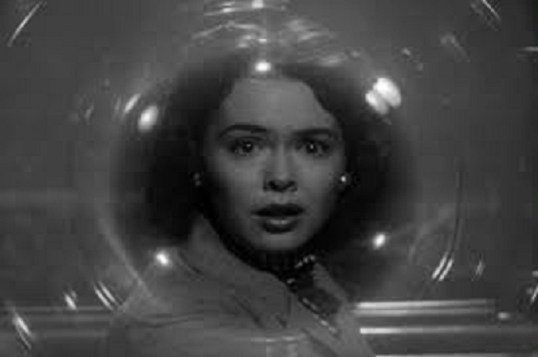
It Came From Outer Space (1953, dir by Jack Arnold, DP: Clifford Stine)
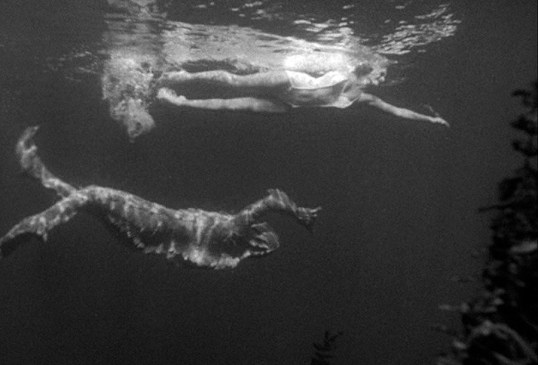
Creature From The Black Lagoon (1954, dir by Jack Arnold, DP: William E. Snyder)
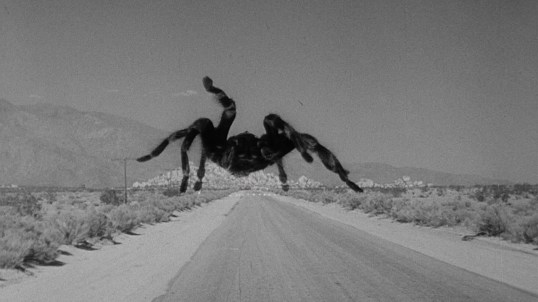
Tarantula (1955, dir by Jack Arnold, DP: George Robinson)
The Incredible Shrinking Man (1957, dir by Jack Arnold, DP: Ellis W. Carter)



 Through the Shattered Lens