Sandra Bullock and Channing Tatum just seem like they belong together.
Here’s the 30-second TV spot:
And here’s the full Super Bowl trailer:
Sandra Bullock and Channing Tatum just seem like they belong together.
Here’s the 30-second TV spot:
And here’s the full Super Bowl trailer:
It’s Super Bowl Sunday, and that means we should be seeing a lot of ads for a lot of films. I’ll do my best to keep up with them here at the site!
Here is the new trailer for Doctor Strange: Multiverse of Madness!
4 Or More Shots From 4 Or More Films is just what it says it is, 4 shots from 4 of our favorite films. As opposed to the reviews and recaps that we usually post, 4 Shots From 4 Films lets the visuals do the talking!
I have to admit that I don’t know much about football but I do know quite a bit about football movies. Since today is Super Bowl Sunday, it seems appropriate to pay tribute to America’s unofficial holiday with….
4 Shots From 4 Football Films
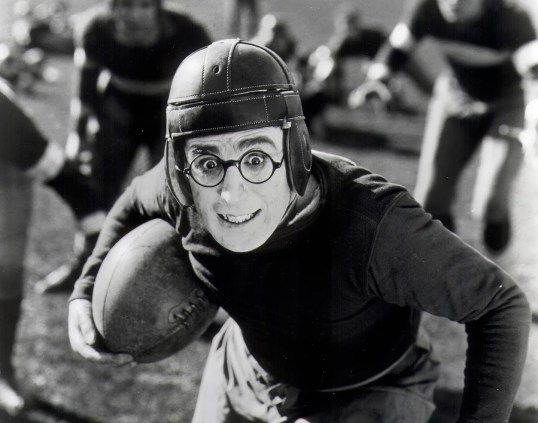
The Freshman (1925, dir by Fred C. Newmeyer and Sam Taylor, DP: Walter Lundin)
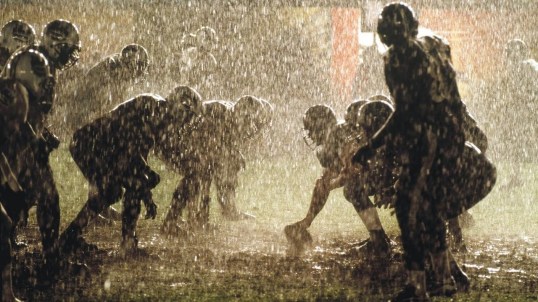
Any Given Sunday (1999, dir by Oliver Stone, DP: Salvatore Totino)
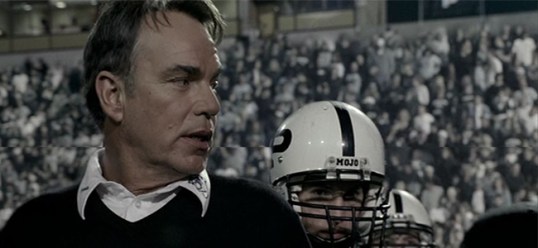
Friday Night Lights (2004, dir by Peter Berg, DP: Tobias Schliessler)

Carter High (2015, dir by Arthur Muhammad, DP: Ron Gonzalez)
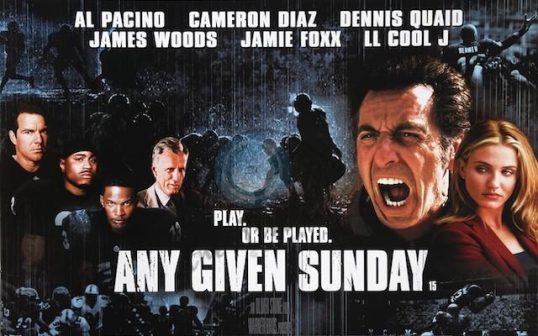
I once read an article where Al Pacino’s lock room speech in Oliver’s Stone 1999 football film, Any Given Sunday, was described as being the most inspirational locker room speech ever.
I don’t really know if I agree with that.
I mean, to be honest, Al Pacino’s Tony D’Amato kind of looks really beaten down in this scene. It looks like, instead of spending the previous night studying game film and coming up with plays, the coach spent the previous night out drinking. If I was one of his players, I would be wondering if the coach was hungover and I might reset that. I might be like, “Hey, I’ve been staying off cocaine all week for this game and then coach shows up looking like he’s just killed Frank Lopez. Someone get Aaron Eckhart in here — he’s the coach we need!” Also, for the most part, his speech seems to be more about him than the team. It’s like, “I’ve got failed marriages, I’ve got this, I’ve got that …. life is a game of inches!” Well, that’s great, Tony, but how are we going to win the game? “I got problems!” Well, we’ve all got problems, coach! I mean, he’s talking to a room full of people who probably can’t stand up without hearing a hundred different things going snap in their knees.
Do locker room speeches really make that much of a difference? I’ve seen enough sports films that I often wondered this. Is it a requirement that a coach give a speech? If the coach refused to give a speech, the team would still be obligated to go out there and play hard, right? As I’ve said many a time, I really don’t get the point of long speeches but some of that is because of the ADD. There’s no way that I could listen to anyone talk about life being a game of inches for four minutes. I would just zone out.
What if a coach filibustered and just kept going and going in his speech? Would the team have to forfeit?
Would it have been more effective to show the team the Willie Beamon music video as opposed to forcing them to listen to a speech from hung over Tony D? Well, probably not. If I remember correctly, the team did win the big game and they did it even after Dennis Quaid got injured for like the 100th time. So, I guess the speech did work. That shows you everything I know about football.
Anyway, I know a lot of people love this speech. I mean, there’s a reason why it showed up in that car commercial. And, to be honest, it worked pretty well in that commercial. Certainly, it made more sense to use Tony’s “life is a game of inches” speech as opposed to Robin Williams’s poetry speech from Dead Poets Society. (Car commercials are weird.) So, in honor of those people and Super Bowl Sunday, here is the Tony D’Amato Any Given Sunday locker room speech:

The 1963 educational short film, Big Man on Campus, tells the story of Jerry, a 13 year-old with the attitude of a 16 year-old.
Jerry thought he was the coolest kid at his middle school. He thought throwing a milk carton was no big deal. He thought not studying for his classes wasn’t the worst thing in the world. He thought all of his classmates would like him if he rode his bicycle into traffic. He thought starting fights was no biggie. He thought everyone wanted to listen to another chorus of Grease Lightning. He thought Sandy was just a summer fling and that having the Ramones play at the local high school wouldn’t be a big deal. Jerry thought a lot of things.
Jerry was wrong.
Fortunately, the Vice Principal was there to set Jerry straight. That’s right, the vice principal. Jerry may thing he’s a big man on campus but he’s not even important enough to rate a meeting with the principal. Instead, he has to make due with the guy who teaches Chemistry. It takes a while for the vice principal to step out of his office but when he does, it’s obvious that the vice principal, with his navy haricut and his eyeglasses, isn’t going to stand for any nonconformity. Most afternoons, the vice principal would be busy tracking down and tearing up flyers for the Fair Play for Cuba Committee. Instead, on this day in November of 1963, the vice principal is having to discipline Jerry. Not only has Jerry caused a disruption at the school but he’s also allowed for the proliferation of pro-Castro propaganda. Can Jerry be saved or is he destined to become a pinball wizard with his own holiday camp?
You probably already know the answer. This educational film comes to us from Sid Davis, whose films were best known for their use of an extremely judgmental and rather dramatic narrator. The Sid Davis narrators were the ones who wouldn’t only explain what had happened but who would also offer up questions like, “You never thought one little action could ruin your life and the lives of so many others, did you?” That narrator is heard in Big Man on Campus but we also hear the voice of Jerry, trying to convince himself that his actions were no big deal and that everyone is totally overreacting.
Of course, deep down, Jerry knows that he’s no good. He knows that his mother is setting him up for a life of crime by arguing that “boys will be boys.” He knows that he’s destined to end up at juvenile hall and, after that, a life of unemployment. He knows all of this but he needs the help of a seriously annoyed adult to help him truly understand it. He needs the hard-earned, war-scarred, and apparently nearsighted wisdom of the vice principal.
Can Jerry be saved or is he destined to end up working a prop comic in Wichita Falls? Watch and find out!
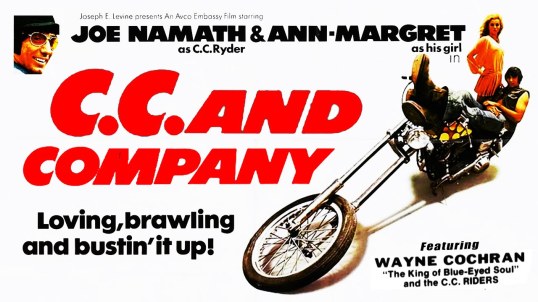
As our long-time readers know, I’ve seen my share of bad movies but it’s been a while since I’ve seen one as bad as 1970’s C.C. and Company.
C.C. and Company is about a drifter named C.C. Ryder (played by Joe Namath, who was a pro football quarterback at the time). Ryder rides through the desert on his dorky motorcycle. He doesn’t have a job. He doesn’t have much money. He does have a lot of hair and he also has a lot of teeth. We know that because it’s rare that there’s ever moment when C.C. isn’t smiling. C.C. is perhaps the most cheerful amateur criminal that I’ve ever seen. Even when C.C. really shouldn’t be smiling, he’s smiling. There are moments when people try to kill C.C. and he responds with a smile. This could be a sign of C.C.’s devil-may-care-attitude but I think it has more to do with Joe Namath being a really bad actor.
C.C. is apparently a member of a motorcycle gang. I say apparently because no one in the gang seems to like him and they’re constantly beating up on him. The leader of the gang is Moon (William Smith) and among the members of the gang is an intimidating figure named Crow (Sid Haig). Smith and Haig were both professional actors and genuine tough guys. They not only knew how to act on camera but they also knew how to throw a punch without faking it. Having them act opposite Namath doesn’t really accomplish much beyond emphasizing just how terrible an actor Namath was. Even though Moon is a Mansonesque creep, you still find yourself rooting for him whenever he and C.C. get into a fight because Smith creates an actual character whereas Namath…. well, he doesn’t. I sat through this entire film and never once did I find myself wondering what C.C.’s initials stood for. That’s how uninterested I was in C.C.’s life.
Anyway, C.C. meets the wealthy and chic Ann McCalley (Ann-Margaret) after Ann’s limo breaks down in the middle of the desert. C.C. not only fixes the limo but he also saves Ann from Crow and Lizard (Greg Mullaney). It’s love at first sight but, unfortunately, Ann has places to go so she drives off and C.C. returns to the biker camp and watches as Moon sends his girlfriend, Pom Pom (Jennifer Billingsley), out to make money on the highway. As I watched all of this, I found myself wondering how everyone else in the gang got stuck with names like Moon, Lizard, Crow, Rabbit, Pom Pom, and Zit-Zit (my favorite) but somehow C.C. was able to keep his innocent initials. The movie never explained the ritual behind receiving motorcycle gang names and I think that was a missed opportunity.
Eventually, C.C. trades in his dorky motorcycle for a Kawasaki, largely because Kawasaki apparently paid the film’s producers a lot of money. C.C. enters a race and wins. Ann sees him win and falls even more in love with him. C.C. gets into a fight with the gang and then he and Ann head to …. well, it looked a lot like Reno but honestly, who knows for sure? Eventually, Moon and the gang track C.C. and Ann down and it all leads to one last fight. We never do find out if the “company” of the title referred to Ann and her rich friends or Moon and the gang. Not even C.C. seems to know for sure.
So, there’s a lot of reasons why C.C. and Company doesn’t really work but mostly it all comes down to the lead non-performance of Joe Namath as C.C. There’s nothing tough or intimidating or rebellious about Namath. C.C. is the biker you can bring home to meet your parents. William Smith and Sid Haig are a lot more fun but they’re playing totally disreputable characters. Namath and Ann-Margaret have zero romantic chemistry and the entire film has the look of a cheap made-for-TV movie. Between C.C. and Company and Altamont, 1970 was not a good year to be a biker groupie.
That said, there is one good scene in C.C. and Company, where C.C. and Ann go out dancing. While Joe Namath awkwardly shakes his shoulders while flashing that ever-present grin, Ann-Margaret dances as if the fate of the world depended upon her. One year after the release of this movie, she would prove herself as dramatic actress and receive her first Oscar nomination for Carnal Knowledge.

KIMI, the latest addition to Steven Soderbergh’s interesting but frustratingly inconsistent filmography, stars Zoe Kravitz as Angela Childs. Angela is an agoraphobic tech worker who is living in Seattle during the COVID pandemic. A sexual assault survivor, Angela spends her days and nights safely locked away in her apartment. She works from home. She always keeps her mask some place near. Occasionally, she’ll have a video session with her therapist. Her mom calls and scolds her for not going outside. She exchanges texts and occasionally more with Terry Hughes (Byron Bowers), an attorney who lives across the street.
And, she’s watched by Kevin (Devin Ratray). Kevin also lives across the street and, throughout the film, he’s occasionally seen watching her from his top floor apartment. It’s creepy but it’s not surprising. KIMI is a film in which everyone is being watched by someone else. Sometimes, they realize it and often they don’t. Welcome to the Surveillance State, where privacy is the ultimate illusion.
Angela works for the Amygdala Corporation. Under the leadership of CEO Bradley Hasling (Derek DelGuado), Amygdala has created KIMI, the virtual assistant that is superior to Alexa because all of KIMI’s errors are corrected not by a pre-programmed algorithm but instead by human workers who are constantly listening to KIMI’s data stream and correcting errors. Angela is one of those engineers. Usually, her job consists of programming KIMIs to play individual Taylor Swift songs as opposed to building Taylor Swift playlists. When one owner calls KIMI a peckerwood, Angela programs the KIMI to understand that peckerwood is an “insult; vulgar.” However, one data stream contains the sounds of what Angela believes to be a sexual assault and a subsequent murder.
Uniquely, for a film like this, Angela’s struggle is not to get people to believe that she heard what she heard. Instead, her struggle is to get the evidence to the people who need to hear it for themselves. Angela is terrified of leaving her apartment and, once she finally does, the outside world confirms all of her fears. KIMI is a film about paranoia, a portrait of a world where everyone can be tracked and no one — from Angela’s too-helpful boss (Rita Wilson) to the man who casually walks by with an umbrella — can be trusted.
As I’ve said in the past, Steven Soderbergh has always been hit and miss for me. It’s remarkable how many Soderbergh films that I love but it’s equally remarkable just how many Soderbergh films I absolutely loathe. At his best, he can be a clever stylist and, at his worst, he can be painfully pretentious. And yet, regardless of anything else, you do have to respect Soderbergh’s willingness to experiment with different genres and styles. Soderbergh never stops working, despite the fact that he announced his retirement years ago. Despite getting off to a slow start, KIMI is one of Soderbergh’s more entertaining thrillers, one that does a great job creating an atmosphere of paranoia and one that is also blessed with excellent performances from Zoe Kravitz and Rita Wilson, who makes good use of her limited screen time. KIMI is a well-made Hitchcockian thriller and, along with No Sudden Move, it’s a return to form for Soderbergh after the two terrible movies that he made with Meryl Streep, The Laundromat and Let Them All Talk. Yes, Soderbergh can be inconsistent but when he’s good …. he’s very, very good. (Sometimes, he’s even brilliant.) Narratively, KIMI may be a relatively simple film by Soderbergh standards but it’s undeniably effective.
Along with being a portrait of our paranoid age, KIMI is very much a pandemic thriller. Angela mentions that her relationship with Terry started during the lockdowns, a time when no one found it strange that someone would be unwilling to leave their apartment. When Angela does finally step out of her apartment, she is, of course, fully masked up and her paranoia about being followed severs as a metaphor for the paranoia that many people felt (and continue to feel) during the pandemic. KIMI is not the first pandemic thriller and it certainly won’t be the last. Still, what’s interesting to me that the pandemic subtext will probably be more noticeable to those who lived in states with mask mandates and aggressively regulated lockdowns than it will be for those of us who live in states that never had mandates and which, for lack of a better term, re-opened last year. Half the people viewing KIMI will nod in recognition as Angela grabs her mask before walking up to her front door and as she quickly dashes down the street, careful not get too close to anyone else. The other half will feel as if they’re watching some sort of dystopian science fiction film. It all depends on where you’ve lived for the past two years.
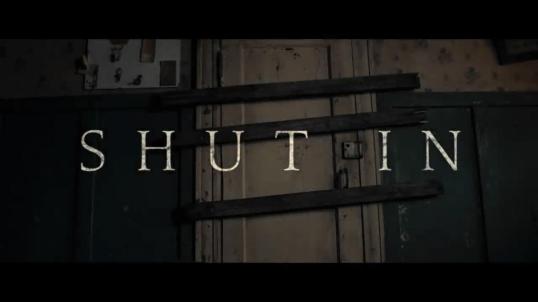
Shut In is not a political movie.
It’s important to point that out because much of the online reaction to Shut In will be totally political. That’s because it’s the second film to have been produced by The Daily Wire. And yes, Ben Shapiro is listed as one of the film’s producers. For many, it doesn’t matter that the film’s script appeared on The Black List of the best unproduced scripts in Hollywood. (Of course, some notoriously terrible movies have been made out of the scripts that appeared on The Blacklist — remember Cedar Rapids? — so maybe it’d be best not to call too much attention to that.) It won’t matter that the script was initially purchased by a major studio or that Jason Bateman (who is hardly a right-wing media figure) was originally set to direct it before the project was delayed by the pandemic. All that will matter is that the film was produced by the Daily Wire and therefore, it will be judged as being some sort of political statement.
Indeed, when the film’s premiere was streamed on YouTube earlier tonight, I kept one eye on the movie and another eye on the chat comments. About 80% of them were from people saying, “Let’s go Brandon!” 18% were from people saying, “Biden 2024 Harris 2028.” And 2% of the comments were from some group of weirdoes who were obsessed with Liz Cheney. The film itself might not be political but the film’s audience definitely was and probably will continue to be so. I imagine most hardcore online liberals will automatically hate the film because of who produced it while most hardcore online conservatives will be tempted to overpraise it and cite it as proof that a good film can be made outside of the Hollywood system. It’s tempting to say that’s just the way of the world nowadays but, to be honest, it’s really just the way of the extremely online world. Most people won’t care one way or the other. They’ll just view it as a being an effective thriller.
And, make not doubt about it, Shut In is not a bad film. It’s an effectively tense thriller, one that has plenty of suspense and which makes good use of its limited budget. If it’s never quite a great film, that’s because there’s a few pacing and plausibility issues, especially early on in the film.
Shut In stars Rainey Qualley as Jessica, a former dug addict who has escaped from her abusive ex and who is now trying to start a new life, with her young daughter and her newborn son, in an isolated farmhouse. Unfortunately, when her ex, Rob (Jake Horowitz), and his scummy friend, Sammy (Indie film legend Vincent Gallo, making his first film appearance in ten years), show up at the house, Jessica ends up getting locked in the pantry while Rob and Sammy ransack the house and, most importantly, steal her phone so she can’t call for help. Trapped in the pantry, Jessica tries to figure out a way to escape while also trying to instruct her young daughter on how to take care of her baby brother. The whole time, of course, she’s aware that Sammy and Rob could return at any minute.
Director D.J. Caruso does a good job of building and maintaining tension throughout the film. The majority of the film’s action takes place in that pantry and, just like Jessica, we find ourselves forced to try to interpret the sometimes random footsteps and snippets of conversation that we hear throughout the house. Rainey Qualley, who is the daughter of Andie MacDowell and who has a Southern accent that is almost as prominent as her mother’s, is sympathetic in the role of Jessica and does a good job of playing up not only her fear but her strength. Jessica is a survivor and it’s difficult not to admire her as she searches for a way to escape. Vincent Gallo is older but still as uniquely photogenic as he was during his indie heyday. He’s memorably creepy as Sammy.
As I said, it’s not a flawless film. It takes a while for things to really get going and, towards the end of the film, a few of the characters behave in ways that defy logic. One key moment depends on a character surviving something that, by all logic, should have easily killed them. It may not be a political film but there are a few bits of heavy-handed religious symbolism, including an injury that deliberately calls to mind stigmata. That said, when Jessica finally begins to fight back, it’s an enjoyably cathartic moment.
Shut In is an effective thriller and a determinedly non-political one. If nothing else, it’ll keep you out of the pantry.
Ania (Sonia Mietielica) is the privileged daughter of a wealthy doctor. She’s graduated from an exclusive high school in Warsaw and now, she’s about to start studying medicine in London. The plan is that she’ll eventually take over her father’s medical practice and that she will, of course, marry someone from her upper class social circle. Ania is haunted by the death of her artist mother and still struggles to get along with her stepmother (Sonia Bohosiewicz).
Michal (Jakub Sasak) is a handsome but poor athlete who works at the local beach resort. At night, he’s a waiter. During the day, he’s a kitesurfing instructor. He may not have money or an education but he’s sensitive and artistic. He likes good music, good weed, and hanging out good people. He’s laid back but he cares about his friends and he’s got a romantic soul.
Together …. they solve crimes!
No, actually, they don’t. There are no crimes to be solved in Into The Wind. Instead, they meet when Ania accompanies her father, her stepmother, and her new baby brother to the resort for the summer. While Ania listens to her father talk about how the pandemic has not really effected his practice (this is a 2022 film so, of course, there is talk of COVID in the background), Michal serves food and wine and is largely unseen by the other guests. (The wait staff, as he explains it, is meant to be invisible.) However, Ania sees him and he sees her. And soon, they’re in love, they’re hanging out on the beach, they’re listening to music, and they’re kitesurfing! But they’re also from two different worlds. Ania’s father does not want his daughter to end up with a waiter. And Michal’s friends are convinced that Ania will eventually return to her safe, upper class existence and Michal will be left heart-broken.
This Polish film is narratively predictable but visually stylish. The plot should be familiar to anyone who has ever seen Dirty Dancing but then again, it’s not exactly as if Dirty Dancing was the most original film ever made. That said, though the plot may be predictable, the film has enough lovely shots of the beach and the two leads have more than enough romantic chemistry to keep things watchable. This is a good film to watch after a long and exhausting day, when you just want a simple story, a happy ending, and some nice pictures to go along with it. Speaking for myself, as someone who spent last week dealing with below freezing temperatures and ice on the ground, the beach and the ocean looked very inviting and, for that matter, so did Jakub Sasak. The beach and the cast are pretty and that’s pretty much all that a film like this really needs to work.
That said, I did really like the Kitesurfing scenes. Kitesurfing is something that I personally would never do, seeing as how it would mean confronting not only my fear of drowning but also, potentially, my fear of heights but, even with that in mind, the film still made it a look like something that everyone should try at least once. The scenes of people skimming across and occasionally floating above the water take on an almost religious grandeur as the surfer becomes onr with the forces of nature and fate. Those scenes are exciting to watch, even if the story taking place around them is thoroughly predictable.

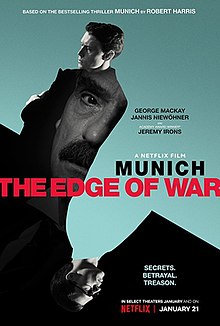
Munich — The Edge of War opens in 1932, at Oxford University, where three graduating students are toasting their futures as a part of the “mad generation” that’s come to age in the aftermath of World War I. Six years later, two of them will reunite as the world appears to be on the verge of another great war.
One of them, Hugh Legat (George McKay), is a secretary to the English Prime Minister, Neville Chamberlain (Jeremy Irons). Chamberlain, haunted by the death and destruction of the Great War, is convinced that Europe can have “peace in our time,” through a policy of negotiation and appeasement. He is aware of the men who have come to power in Italy and Germany and he’s certainly heard the rumors that they are planning on conquering Europe themselves. However, Chamberlain is almost in denial about the reality of the situation, at one point suggesting that Hugh write a polite letter to Mussolini requesting that Mussolini tell Hitler to tone down his rhetoric.
Hugh’s classmate, Paul von Hartmann (Jannis Niewöhner), returned to Germany after graduating from Oxford. At first, he was an enthusiastic backer of Hitler and the Nazi party. He was rewarded with a position as a translator in the Foreign Office. However, Paul has since become disillusioned with Hitler and is painfully aware of the anti-Semitism that has become a part of everyday life in Berlin. Paul regularly meets with a group of generals who are plotting a coup against Hitler. The generals believe that, if they allow Hitler to invade Czechoslovakia, the German people will rise up in order to avoid being led into another war and that they will cheer as the generals march into Hitler’s office and place him under arrest. Paul worries that the generals are being naïve. Adding to Paul’s problems is a former childhood friend named Franz Sauer (August Diehl). Sauer is a new member of the SS and he has a disconcerting habit of showing up anywhere that Paul happens to be, almost as if he is aware that Paul is not the dedicated civil servant that he pretends to be. When Paul receives a stolen document that reveals the details of Hitler’s true plans for Europe, he and Hugh team up to try to keep Chamberlain from singing the Munich Agreement.
Looking over the events that led to World War II, one question that historians frequently ask is why did Neville Chamberlain consistently refuse to stand up to Hitler despite Hitler’s growing acts of aggression. Why did Chamberlain knowingly turn a blind eye to every treaty and agreement that Hitler broke or ignored? Why, with Hitler openly declaring his plans to conquer Europe, did Chamberlain and so many others insist that Hitler’s actions would somehow be different from his words? Was Chamberlain just naïve or was he, like so many others who had been traumatized by the Great War, in willful denial about the inevitability of conflict with Hitler? Was Chamberlain just a politician trying to keep a war-weary public happy or did he truly believe that signing an agreement with Hitler would somehow lead to “peace in our time?” Munich — The Edge of War suggests that all of the above may be true, with Jeremy Irons playing Chamberlain as being an old school establishmentarian, one with sincere intentions but also one who is incapable of truly understanding the new reality that has been brought about by the desolation of World War I. As played by Irons, Chamberlain is occasionally sympathetic but, even more frequently, he’s obstinate in his short-sightedness and his insistence that he alone understands how to deal with Hitler. He’s not necessarily a bad man but he’s definitely not the right man for the times.
Of course, the majority of the film focuses not on Chamberlain but instead on Paul and Hugh. George McKay and Jannis Niewöhner both give good performances as two civil servants who know the truth but find it impossible to get anyone to listen to them. Niewöhner is especially effective as Paul, capturing not only his disillusionment with Germany but also his disgust for himself for having been previously fooled by Hitler’s rhetoric. Like Chamberlain, Paul was also in denial about Hitler’s true beliefs. The difference is that Paul has learned from his mistake and is now desperately trying to reveal the truth, even if no one else wants to hear it.
It’s a good and effective film, one that works both as a historical drama and an espionage thriller. The film is at its best when it focuses on what daily life is like when a nation is living in the shadow of the possibility of war. Hugh comes home to discover his son wearing a gas mask and he has to convince his wife to leave London for the weekend, even though he can’t specifically tell her why. Meanwhile, Paul lives in a Berlin that’s full of imposing architecture and seemingly happy people but with a shadow of menace hanging over every street corner. The city’s new buildings, built to celebrate Hitler’s vision of a new Germany, are all disturbingly pristine, as if they only exist so that evil can hide behind their impressive facades. And in the background of every scene in Berlin, there are the uniformed men with their red armbands and their haughty glares.
It’s said that hindsight is 20/20 and, indeed, it’s easy to look at someone like Neville Chamberlain and dismiss him as just being a tragically failed and foolish politician. And there is definitely an argument to be made that he was. (That’s certainly how I tend to view him.) Still, Munich — The Edge of War does a good job of capturing not only the feeling of a world on the verge of war but also the motivations of those who closed their eyes to what was coming and also to those who did not. That we know that Paul and Hugh’s efforts are ultimately to be for naught adds a poignant sadness to the scenes of them trying to get someone to listen to them but it also makes for a powerful viewing experience. How many eyes were open in the 30s? How many eyes are closed today?
 Through the Shattered Lens