106 years ago today, actor Robert Stack was born in Los Angeles, California.
Though Stack found his greatest success on television and as the original host of Unsolved Mysteries, he also had an active film career. Here he is in 1980’s Airplane!, demonstrating how to provide encouragement and build up confidence.
4 Shots From 4 Films is just what it says it is, 4 shots from 4 of our favorite films. As opposed to the reviews and recaps that we usually post, 4 Shots From 4 Films is all about letting the visuals do the talking.
Today is the birthday of director John McNaughton! It’s time for….
4 Shots From 4 John McNaughton Films
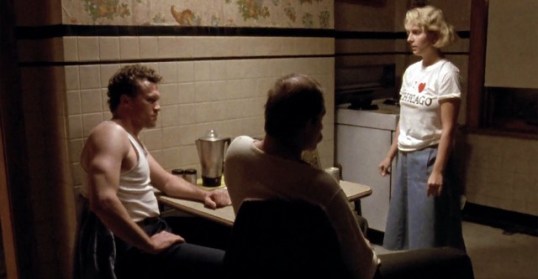
Henry: Portrait of a Serial Killer (1986, dir by John McNaughton, DP: Charles Lieberman)
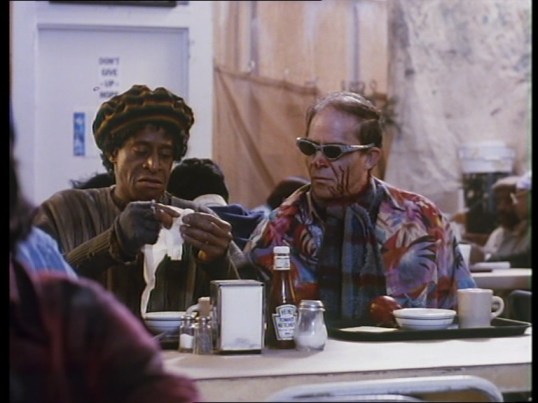
The Borrower (1991, dir by John McNaughton, DP: Julio Mucat and Robert C. New)
Normal Life (1996, dir by John McNaughton, DP: Jean de Segonzac)
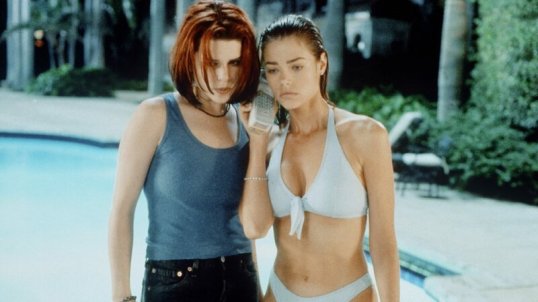
Wild Things (1998, dir by John McNaughton, DP: Jeffrey L. Kimball)
When it Rains In LA features Eric Roberts as Nate.
Nate is a happy man who lives in a big house and who obviously has a lot of money. He’s even got a much younger trophy wife, a Russian named Sasha (Monroe Cline). One day, Nate receives an odd package, a box that contains a rather hideous mask. Nate looks at the mask and then takes a sip of tea. He promptly drops dead.
After Nate’s funeral, the suddenly widowed Sasha flies to Los Angeles to see her friends from college. (Or, at least, that’s how I assume she met these people. At times, it’s difficult to really keep track of how anyone in this film actually knows anyone else.) Though she’s just buried her husband, she still flirts with the pilot of her airplane, the likably dorky Harry (Tom Gipson). She also meets a mysterious woman named Anna (Leslie Stratton) and doesn’t seem to notice that she’s being watched by a mysterious, bearded man (Mike Ferguson) who continually hides his face inside of his hoodie.
From the minute that Sasha lands in Los Angeles, it starts to rain. Everyone that Sasha meets mentions how strange it is that it’s raining in Los Angeles. Some people say the rain is probably no big deal. Other people act as if the rain has some sort of secret meaning. Sasha keeps her opinions to herself.
Her friends seem to be curiously unconcerned with Sasha suddenly being a widow. One of them won’t stop talking about the death of his former lover. They go to a club, where the bartender gives out free drinks and the owner seems to be strangely hostile. Sasha meets Harry. Characters appear and then disappear without anyone seeming to notice. Everyone comments on the strangeness of rain in Los Angeles. People start to die in brutal ways but again no one seems to really care. It’s a slasher film where societal detachment is the biggest threat.
It’s an odd film. The budget was obviously low and the majority of the performances are a bit amateurish but, whether it was intentional on the part of the filmmakers or not, the film often plays out like a surreal dream. Sometimes, the film moved at an almost rushed pace and then other times, a heavy sense of ennui seems to descend over the action and the characters. Characters repeatedly do things that don’t make any sense but they do it with such determination that it becomes rather fascinating to watch. The film’s final moments are surprisingly effective, certainly more effective than you might expect from all the moments that came before them. Visually, this low-budget film has moments of almost ghostly beauty. The scenes of the rain falling in Los Angeles are effectively atmospheric and ominous. In the end, the film qualifies almost as a work of outsider art.
And, let’s not forget, Eric Roberts is in it! This was the first Eric Roberts film to be released in 2025. Nate dies before the opening credits and Eric still gets top billing. I imagine it will be the first of many.
Previous Eric Roberts Films That We Have Reviewed:
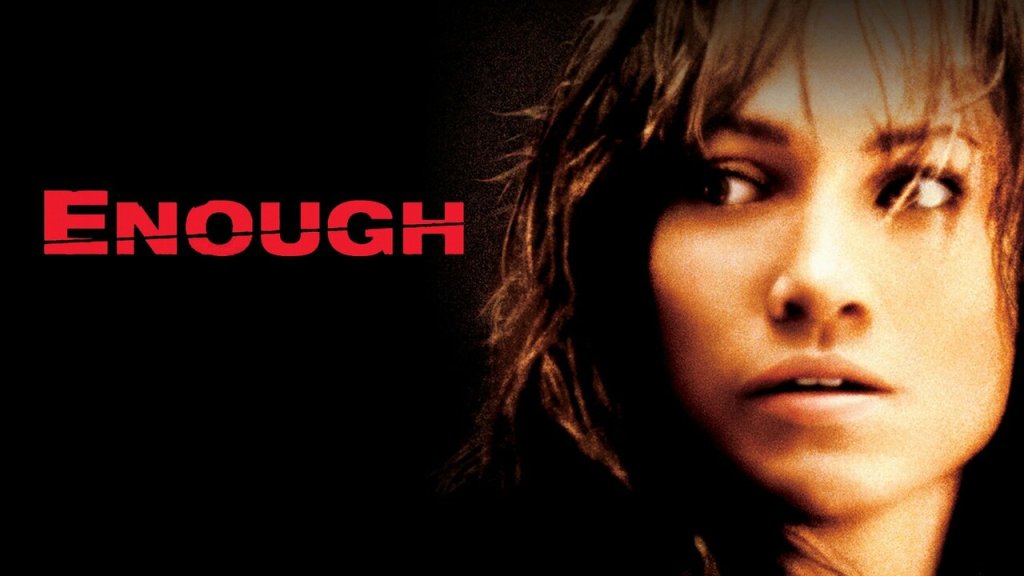
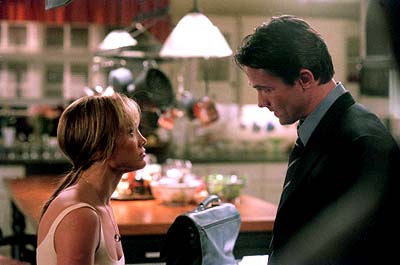
This morning I got up to make coffee for me and my wife. When I came back to our room, she had started the movie ENOUGH (2002) with Jennifer Lopez on the new projector that she bought me for Christmas. I’m not that big of a fan of Lopez, but I decided I’d go ahead and sit down to sip on my coffee prior to starting my day. I ended up watching the whole movie!
Jennifer Lopez plays Slim, a waitress in a diner in L.A., who meets a rich guy named Mitch Hiller (Billy Campbell) who impresses her when he gets rid of this rude jerk (Noah Wyle) trying to hit on her. Mitch and Slim get along famously, eventually getting married and having a cute little girl named Gracie. Everything seems perfect in their little world. Unfortunately, things aren’t what they seem, and one night Slim checks her husband’s pager. She calls the number and discovers Mitch has been cheating on her. When she confronts him about the affair, his entire countenance changes, and he begins beating the crap out of her. After the altercation, and before heading out to continue his affair, Mitch warns Slim not to leave because he refuses to live without her. With the help of her friend Ginny (Juliette Lewis) and a couple of others, Slim takes Gracie and they escape from Mitch. With all his money and connections, Mitch is able to track her down no matter where she goes. Feeling like she has no other options, Slim turns to her wealthy, estranged father, Jupiter (Fred Ward). He provides her the funds she needs to set up a new life and identity. Unfortunately, that damn Mitch tracks her down again. Narrowly escaping, Slim decides that she’s done running. She sends Gracie away with Ginny and begins training rigorously in self defense techniques. This time she’s taking the fight to Mitch with plans to end this shit once and for all.
If you’re looking for a realistic drama about the effects of spousal abuse on the family unit and then across the larger society, ENOUGH is not the movie for you. This movie is more for the Charles Bronson crowd, where the bad guys are truly evil and the audience is in complete agreement with their need to perish. This is a formula that continues to work even if you have to completely suspend your disbelief. For example:
-Is it realistic that Mitch would be able to conceal what a complete and total asshole he is for many years from Slim, but then one night turn out to practically be the sidekick of Satan?
-Is it realistic that Mitch would be able track Slim and Gracie down time and time again, no matter where she goes across the country, even after she uses her Dad’s resources to change her identity?
-Is it realistic that Slim would be able to get enough self defense training in a short period of time to be able to confront the extremely fit Mitch at the end and kick his ass?
While the setup is probably not the most realistic, we have to see images of Mitch beating up Slim on multiple occasions, even trying to kill her at one point. We also see him knock little Gracie to the ground and hurt her. We see him terrorizing her and anyone who tries to help her. This audience member just wanted to see Mitch pay.
I don’t really have any close connections to the main actors in ENOUGH, but they all do their jobs well enough to keep me involved. I have always been a fan of its director, Michael Apted. He’s made a few movies that I really like in CLASS ACTION (1991) with Gene Hackman, THUNDERHEART (1992) with Val Kilmer, and BLINK (1993) with Madeleine Stowe. He’s a more than competent director who knows how to get a reaction from his audience. This certainly may not reflect his best work, but he still handles the material in a professional manner.
My final word on ENOUGH… I enjoyed the film in the same way I like the 3 piece combo at KFC, which I really do enjoy. I know it’s probably not the best stuff out there, but the classic formula still works, and I’m satisfied when it’s all gone!
First released in 1954 and based on a play by Clifford Odets, The Country Girl is centered around the production of a believably terrible stage musical called The Land Around Us.
Director Bernie Dodd (William Holden) is known for his willingness to take risks. One of his previous plays was about a punk-drunk boxer so he cast an actual punch-drunk boxer in the role. For The Land Around Us, Bernie wants to cast Frank Elgin (Bing Crosby), a former singing star who has fallen on hard times. Frank was once a hitmaker but, after the tragic death of his son, his career went downhill. He’s now lucky if he can get a job singing a commercial jingle. Though Frank aces his audition, the show’s producer (Anthony Ross) insists that Frank is just too unreliable and that everyone know that he’s now a drunk. Bernie, however, insists on casting Frank and Bernie, as always, gets his way.
Bernie grew up looking up to Frank and it’s hard for him to see that his idol is now struggling. Bernie squarely puts the blame on Frank’s wife, Georgie (Grace Kelly, wearing glasses and her hair tied back). Whenever Bernie sees Georgie, she seems to be criticizing Frank and micromanaging his life. Bernie tells Frank that Georgie is holding back his career but Frank explains that Georgie is unstable and that, whenever he’s tried to leave her, she’s responded by attempting to commit suicide. Bernie, who seems to have issues with women in general, believes everything that Frank says. Whenever Frank makes a demand during the rehearsal process, Bernie blames Georgie. Whenever Frank seems to be insecure about whether or not he can still be a star, Bernie blames Georgie.
Of course, Bernie’s wrong. As is obvious to everyone watching the film (and as should have been obvious to Bernie from the moment he first saw Frank and Georgie together), Georgie is the the only person who is keeping Frank from totally falling apart. If she seems to be demanding, she knows that it’s because Frank is so desperate to be a star again that he tends to let people walk all over him. If she’s overprotective of Frank, that’s because she knows that Frank is an alcoholic who blames himself for the death of their son. Frank is the one who tried to commit suicide, not Georgie. Georgie has dedicated her life to taking care of Frank and, if she is sometimes overly critical with him, it’s because she alone understands that Frank is throwing his life away.
It’s a sad film. Both Georgie and Bernie are almost fanatically loyal to Frank but it’s hard not to feel that the self-centered and self-destructive Frank doesn’t really deserve their loyalty. That we have any sympathy at all for Frank is due to the performance of Bing Crosby, who plays the role with just enough self-awareness that the audience gets a hint of the man Frank was before he turned to alcohol and self-pity. As usual, William Holden is well-cast as a cynical but ultimately kind-hearted character and he does a good job of hinting at what lies underneath Bernie’s rough exterior. Grace Kelly won her only Oscar for playing Georgie and she does a fairly good job, even if she does seem to be miscast. Georgie is far cry from the glamorous characters that Kelly usually played. Personally, I think she was far more Oscar-worthy in Rear Window, which was released the same year and featured Kelly in a far more interesting role. George Seaton directs the film as if it were a film noir, with Holden, Crosby, and Kelly often acting in the shadows. The Country Girl works best when it contrasts the artificiality of Bernie’s show with the real-life human drama taking place backstage.
The Country Girl was nominated for Best Picture, Director, Actor, and Actress. While Grace Kelly was named Best Actress, the rest of the awards were won by On The Waterfront, with Bing Crosby losing to Marlon Brando.
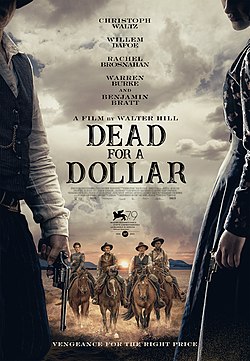
In 1897, bounty hunter Max Borlund (Christoph Waltz) is hired by wealthy Martin Kidd (Hamish Linklater) to track down Elijah Jones (Brandon Scott), the man who Martin says has kidnapped his wife. Accompanying Max is Alonzo Poe (Warren Burke), who served with Elijah in the Army.
From the start, Max suspects that Martin is not being completely forthright about the kidnapping and it does turn out that Rachel Kidd (Rachel Brosnahan) voluntarily left with Elijah and is planning on traveling to Cuba with him. Martin has hired crime baron Tiberio Vargas (Benjamin Bratt) to have Rachel raped and murdered because Martin thinks that the tragedy will help him launch his political career. Because Martin suspects that Max might not be trustworthy, he has hired Max’s rival, Joe Cribbens (Willem DaFoe), to track down Rachel as well.
This film has a cast that is full of talented people and it’s a western directed by someone who has proven himself to be one of the masters of genre, Walter Hill. I wanted to like Dead For A Dollar but the movie just didn’t work. Waltz and DaFoe are great actors but they just seem to be going through the motions and Rachel Bsonahan is miscast. Benjamin Bratt and Hamish Linklater are forgettable villains. Even worse, Dead For A Dollar has a washed-out visual style that you would never expect from a director like Walter Hill.
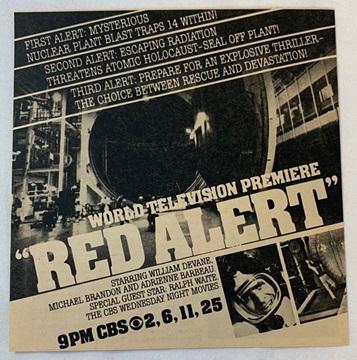
The 1977 made-for-television movie, Red Alert, opens with a man walking through a cemetery on a rainy day. As we watch Howard Ives (Jim Siedow) move amongst the tombstones, we hear his thoughts. He’s a sad and bitter man, wondering why he’s wasted so many years of his life at work. He thinks about someone close to him who has died. He’s obviously very troubled.
(Of course, any horror fans in the audience will immediately recognize Jim Siedow from his role as the Drayton Sawyer in the the original Texas Chainsaw Massacre. He was troubled in that film as well!)
Howard works at the local nuclear power plant. Ominously, when the film cuts to the plant, the first thing we see is a leak of very hot water. I don’t know much about nuclear power plants but I imagine any type of leak is not a good thing. The water leak causes the computer that runs the plant assuming that a nuclear disaster is minutes away from happening. The compound is automatically sealed off, trapping fourteen men (including Howard), inside the reactor. As Commander Stone (Ralph Waite) tries to keep a possible nuclear disaster from occurring, two investigators (played by William Devane and Michael Brandon) try to determined whether the accident was the result of a malfunction or of deliberate sabotage. When the local sheriff (M. Emmet Walsh) informs them that Howard Ives’s wife has committed suicide, the investigators look into the troubled man’s history. Eventually, the two investigators realize that the only way to prevent a nuclear disaster is by risking their lives by entering the sealed-off power plant. The two investigators attempt to do their work under the cover of night and without causing a panic. Needless to say, it doesn’t work. One of them calls his wife (Adrienne Barbeau) and tells her that she needs to leave the area. She tells her mother, who then tells her neighbor and soon the airport is crowded with people looking to get out of town.
Red Alert contrasts the intuitive approach of the two inspector with Commander Stone’s insistence that every bit of a data be fed to his computer before any decisions are made. Stone’s hands are so tied by protocol and red tape that he stands by while the fourteen men who are trapped in the nuclear power plant die. Wisely, though, the film doesn’t turn Stone into a cardboard villain. He’s very much aware of what will happen if the plant suffers a core meltdown. When one of his assistants mentions that he hasn’t been given any instructions on how to evacuate the town in case the plant does explode, Stone tells him that no plans have ever been drawn up because the plans would be useless. There would be no way to evacuate everyone in time.
In the end, Red Alert is scary not because it deals with nuclear power but because it presents us with a world where no one — not even Devane and Brandon’s heroic investigators — seems to know what to do. Everyone is slowed down by a combination of red tape and their own personal angst. Devane is a strong investigator because, as a widower whose only son died in Vietnam, he has no family to worry about. Unlike everyone else in Red Alert, he has nothing left to lose. In the end, the film suggests that the only way to save the world is to cut yourself off from it.
Red Alert is a compelling and intelligent thriller, one that is well-acted by the entire cast and which builds up to strong conclusion. The film’s anti-nuclear message is a bit heavy-handed but I imagine it was an accurate reflection of the fears that people were feeling at the time. Today, the film works best as a warning about bureaucracy and depending too much on AI to make important, life-or-death decisions. In the end, it’s human ingenuity that saves the day and that message is timeless.
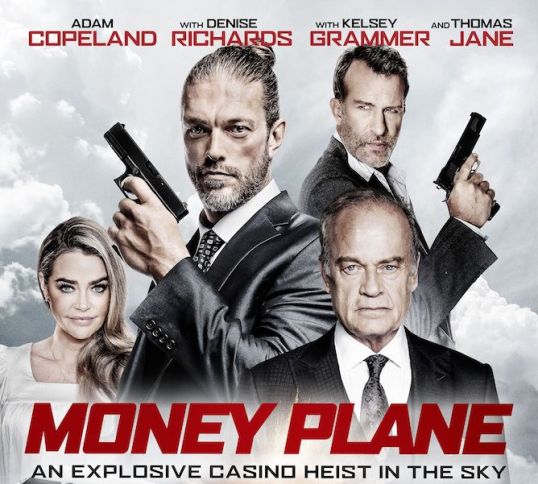
Who is Andrew Lawrence? He is the director of the greatest film ever made, Money Plane!Today’s scene that I love comes from that 2020 masterpiece. In this scene, Adam Copeland learns that it’s not as easy to take over a plane as one might think. I just love this super-powered co-pilot!
4 Shots From 4 Films is just what it says it is, 4 shots from 4 of our favorite films. As opposed to the reviews and recaps that we usually post, 4 Shots From 4 Films is all about letting the visuals do the talking.
Today, the Shattered Lens wishes a happy birthday to Rob Zombie! It’s time for….
4 Shots From 4 Rob Zombie Films
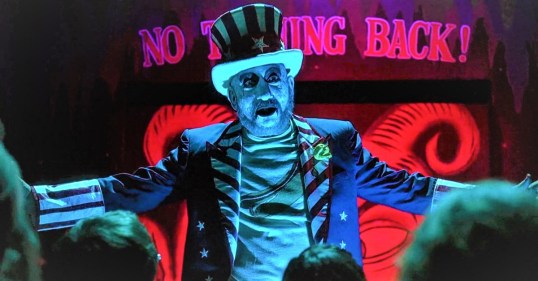
House of 1,000 Corpses (2003, dir by Rob Zombie, DP: Alex Poppos and Tom Richmond)
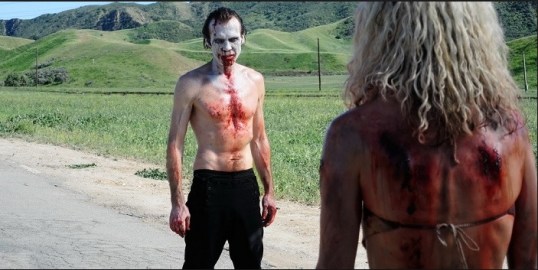
Halloween II (2009, dir by Rob Zombie, DP: Brandon Trost)
The Lords of Salem (2012, dir by Rob Zombie, DP: Brandon Trost)
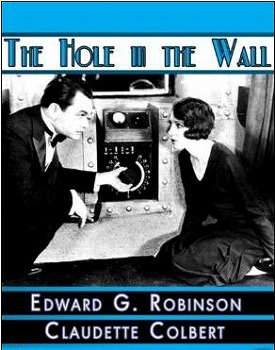
Released in 1929, at the dawn of the sound era, The Hole In The Wall tells the story of The Fox (Edward G. Robinson) and two women known as Madame Mysteria.
The Fox is a con artist, a veteran criminal who takes care of the people working for him. He may not be an upstanding citizen but he seems to truly care about his sidekick Goofy (Donald Meek) and his partner-in-crime, Madame Mysteria (Nellie Savage). Madame Mysteria is a fake psychic. She sits in a chair and does readings while The Fox sends her a series of electric shocks in morse code to let her know what she should say about each victim of their con. They’ve got a pretty good thing going until Madame Mysteria is killed in a train accident.
(Since this film is from 1929, the train accident is recreated with a miniature train that falls off a track in what appears to be a plastic city. Basically, it looks like a primitive YouTube video made by an enthusiastic toy train hobbyist. It may not be convincing but there’s something charming about just how cheap it all is.)
Shortly after Mysteria is killed, Jean Oliver (Claudette Colbert) wanders into The Fox’s shop. Jean is looking for a job and for revenge. As she explains it, she used to have a good job in a department store until her manager accused her of stealing. Though Jean was innocent, she still spent some time in jail. Her life was ruined. Now, she wants to be the new Madame Mysteria and she wants to kidnap the daughter of the woman who accused her. She doesn’t want to get any ransom or anything like that. Instead, she wants to raise the little girl to become a criminal. Fox and Goofy agree, which leads me to wonder if the Fox is really as clever as he thinks he is. Is Jean really the only person they could find to be the new Madame Mysteria? Surely they could find a Madame Mysteria who doesn’t demand they commit a major felony just for her services. Still, kidnap the little girl they do and strangely enough, she never seems to be upset over being taken from her parents. (Even more strangely, we don’t actually see or learn the details of how she was kidnapped. She just suddenly shows up at the Fox’s home.) Goofy becomes a babysitter and Jean becomes Madame Mysteria.
By an amazing coincidence, the reporter (boring David Newell) who decides to write a story on the amazing psychic Made Mysteria just happens to be Jean’s ex-boyfriend! While the Fox falls in love with Jean and the police search for the abducted child, Jean herself starts talking to the dead….
In many ways, The Hole In The Wall is typical of the melodramas that came out during the early sound era. The majority of the supporting actors are still adjusting to acting with sound and the action often feels rather stagey. That said, it’s an entertaining film, largely due to the performance of Claudette Colbert and Edward G. Robinson, both of whom were just starting their careers and on the cusp of stardom. This was Robinson’s first role as a gangster and he snarls with style while Colbert actually keeps the audience guessing at her motivations. The Hole In The Wall is definitely a film from a different era but, for a film that was made nearly 100 years ago, it holds up remarkably well.