Chuck Norris was there for me at the very beginning. When I fell in love with action movies, it was primarily because of three men, first Charles Bronson, followed by Clint Eastwood and Chuck Norris. Back in the 80’s when I was too young to drive, I couldn’t just pull a movie up on my phone or TV anytime I wanted. I had to rely on certain TV channels, like Fox 16 out of Little Rock, and the occasional trip to the video store. Chuck Norris was a megastar on Fox 16 and on the shelves of the video store. Fox 16 would have movie weeks filled with movies like SILENT RAGE, LONE WOLF MCQUADE, MISSING IN ACTION, and CODE OF SILENCE. These movies are just a part of who I am, and Chuck Norris always came across as a fundamentally decent and courageous man on screen.
Chuck may not have been a critical darling, but he had a presence and charisma about him that drew me in from the very beginning. Even today, Norris has his own unique section in my massive collection of physical media. Up to this point, only the loss of my hero Charles Bronson back in 2003 has stirred up these same kinds of feelings that I’m feeling today. I remember when my son discovered the “Chuck Norris Facts” when he was about 10 years old or so. He loved them so much and would tell me his favorites constantly. It made me happy that my own son knew who Chuck Norris was, even if it was through extreme comedic myth making! I was so happy when Norris cameo’d in THE EXPENDABLES 2 and even told one of this Chuck Norris facts. We loved it and it’s definitely my favorite EXPENDABLES movie.
A little part of me is gone tonight knowing that Norris has passed away. From this point forward, anytime I think of Norris or watch his movies, it will be from a perspective that he’s know longer alive. But one of the great things about movies is that whenever I want to see a young, vibrant Norris, I just have to go to my movie shelves and I can be watching THE DELTA FORCE in a matter of moments. I had to learn how to deal with it for Charles Bronson. Now I’ll do the same with Chuck Norris.
What really nudges Interspecies Reviewers into “guilty pleasure” territory is the production’s split personality. On one hand, it’s shamelessly explicit for a late‑night TV anime; on the other, it’s structurally tight and surprisingly imaginative with its worldbuilding. The fantasy ecosystem is treated almost like a handbook of interspecies compatibility: differences in mana, lifespan, physiology, and even perception of age all factor into how each reviewer scores their night out. You’ll get a gag about the dragon girl’s overwhelming presence right next to a mini‑lecture on why fairies have extremely strict size limitations for their patrons. That blend of horny premise and nerdy specificity makes it feel like your group chat’s “what if” jokes got adapted into a full production.
There’s also the whole meta layer: Interspecies Reviewers was so out there that major distributors and broadcasters backed away from it, dropping or canceling its run because of how far it pushed explicit content for television. For a modern TV anime to get pulled partway through its broadcast is rare, and that notoriety quickly became part of the show’s identity. Just knowing that multiple networks balked at it adds to the sense that you’re watching something you’re not “supposed” to be watching—always a potent ingredient in guilty pleasure status.
The humor, crucially, is broader than just “look, boobs.” A lot of the jokes revolve around how absurdly bureaucratic and normalized sex work is in this world, from porter guilds hauling review sheets across the land to rival reviewers trying to torpedo or inflate ratings. There’s even an incubus critic who takes offense at the main crew’s negative scores and starts leaving his own glowing reviews, only for his swagger to be cut short by a vengeful lover. Moments like that reframe the series as a raunchy workplace comedy disguised as fantasy porn: everyone has opinions, everyone’s hustling, and nobody’s as objective as they pretend.
None of this magically elevates Interspecies Reviewers into high art, but it does make the show a lot more watchable than its reputation suggests. The episodic structure gives it a breezy, “one more episode” pacing; you always want to see what weird race or gimmick they’ll tackle next. The scoring boards at the end of each brothel visit become their own running joke, with wildly varying ratings, petty commentary, and the occasional self‑own when a character realizes their kink is not shared by anyone else in the party. It’s almost like a fantasy version of Anthony Bourdain crossed with late‑night cable: travel to a new spot, experience the local flavor, then sit around and compare notes over drinks.
All that said, this is exactly the sort of series most people will feel weird admitting they enjoyed. The explicit content isn’t a light garnish; it’s the central axis of every single episode. There’s no serious emotional through‑line to hide behind, no grand plot twist, no lofty theme you can trot out to justify the time investment. It’s just well‑executed trash: unapologetically focused on sex, gleefully juvenile in its punchlines, and willing to go places that many “edgy” shows only flirt with. Even fans who praise it often do so with qualifiers, acknowledging that it’s “kind of weird” while admitting it’s hot, funny, or unexpectedly creative.
That tension—between embarrassment and enjoyment—is the core of why Interspecies Reviewers works as a guilty pleasure. One side of you rolls your eyes at how lowbrow the premise is, yet the other side recognizes that the show is actually doing some clever things with subjectivity, fantasy biology, and the review culture we live in. You can’t really defend it in polite company, and you probably won’t see it on anyone’s “Top 10 Must‑Watch Anime for Beginners” list, but you also might find yourself remembering specific gags, species breakdowns, or character reactions long after you’ve finished it.
So, is Interspecies Reviewers good? In a conventional sense, maybe not. In the “I had more fun with this than with half the safe, respectable shows in its season” sense, absolutely. It’s crude, controversial, and brazenly fixated on its own niche, but it’s also surprisingly consistent, inventive with its setups, and genuinely funny if you’re on its wavelength. That combination of shame and amusement, of “I really shouldn’t be enjoying this” tangled up with “but I kind of am,” is exactly what makes Interspecies Reviewers one of anime’s purest modern guilty pleasures.
I honestly never thought I’d write those words. Chuck Norris has passed away at the age of 86. Chuck inspired generation of martial artists. He won the respect of Bruce Lee. He choreographed some of the best fight scenes of the early 70s. He never claimed to be a great actor but he still starred in some of the most entertaining films ever made. He is survived by five children and 13 grandchildren. By all accounts, he was a genuinely good guy who took his position as a role model seriously. He will be missed. It’s hard to know what else to say right now so I’ll let Chuck do the talking:
Today is Spike Lee’s birthday so today’s scene that I love is the rather random ending of Lee’s 1991 film, Jungle Fever. I’ve seen this referred to as being the best worst ending of a movie and I don’t now if I’d go quite that far but it’s definitely in contention.
4 Or More Shots From 4 Or More Films is just what it says it is, 4 shots from 4 of our favorite films. As opposed to the reviews and recaps that we usually post, 4 Shots From 4 Films lets the visuals do the talking!
Today, we pay tribute to Hollywood with 4 shots from 4 films!
4 Shots From 4 Films About Hollywood
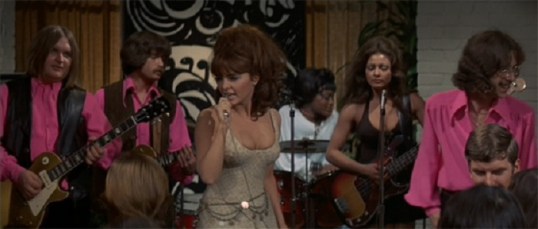
Beyond The Valley Of The Dolls (1970, dir by Russ Meyer, DP: Fred J. Koenekamp)
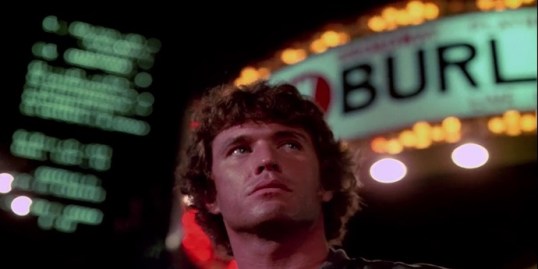
Hollywood Boulevard (1976, dir by Allan Arkush and Joe Dante, DP: Jamie Anderson)
Mulholland Drive (2001, dir by David Lynch, DP: Peter Deming)
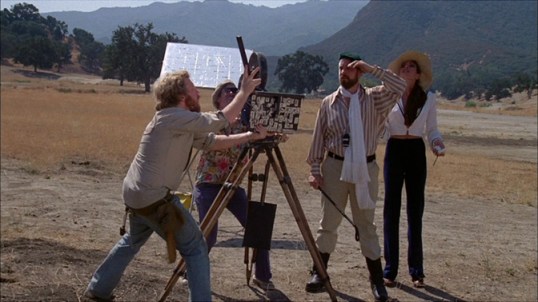
Once Upon A Time In Hollywood (2019, dir by Quentin Tarantino, DP: Robert Richardson)
As some of our regular readers undoubtedly know, I am involved in a few weekly watch parties. On Twitter, I host #FridayNightFlix every Friday and I co-host #ScarySocial on Saturday. On Mastodon, I am one of the five hosts of #MondayActionMovie! Every week, we get together. We watch a movie. We tweet our way through it.
Tonight, at 10 pm et, I will be hosting #FridayNightFlix! The movie? 1984’s Fear City!
If you want to join us this Friday, just hop onto twitter, find Fear City on Prime or Tubi, start the movie at 10 pm et, and use the #FridayNightFlix hashtag! I’ll be there happily tweeting. It’s a friendly group and welcoming of newcomers so don’t be shy.
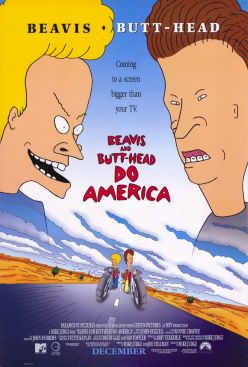
While having a dream about being a giant who can destroy a city and almost score, Butt-Head is woken up by his friend Beavis. Beavis points out that their TV has disappeared. Muddy footprints lead away from the television’s former location and out the front door. Anyone who is familiar with MTV’s Beavis and Butt-Head will immediately realize that this is a crisis. Animated and voiced by Mike Judge, the moronic teenage duo of Beavis and Butt-Head really don’t have anything in their lives beyond television and heavy metal. Beavis and Butt-Head set off to find their television, a quest that will see them traveling all the way from Highland, Texas to Las Vegas and eventually Washington D.C. Along the way, they’ll be pursued by ATF Agent Fleming (Robert Stack), they’ll get hired by alcoholic Muddy Grimes (Bruce Willis) to kill his wife, Dallas (Demi Moore), and Dallas will set them up as the perfect patsies for a terrorist attack on Washington D.C. Chelsea Clinton will beat up Butt-Head. President Clinton will declares the boys to be heroes. They’ll even meet their fathers, though everyone involved will be too dumb to realize it. But will Beavis and Butt-Head ever find their TV?
Beavis and Butt-Head Do America was the first movie to star Beavis and Butt-Head and I can still remember when it first came out in 1996. No one expected much from it but it turned out to be one of the funniest movies of the year, a triumph of animation, social satire, and jokes about wood. A lot of the film’s humor comes from just how stupid Beavis and Butt-Head are but even more of the humor comes from everyone’s inability to understand just how stupid they are. Agent Fleming may think he’s saving America but he’s actually just chasing two teenagers who don’t even know how to read their own names. Muddy may think that he’s hired two experienced hitmen to “do” his wife but instead, he’s promised to pay two idiots to do his wife. (With the money, “we could buy a TV,” Butt-Head tells Beavis.) Everyone, from Fleming to Muddy Grimes, assumes that there must be some sort of grand scheme behind Beavis and Butt-Head’s journey across America. There isn’t. They just want to find a television.
Beavis and Butt-Head were and still are two wonderfully comedic creations. Watching them, I’m always surprised to remember that Mike Judge provided both of their voices. When they argue with each other about where their TV has gone or if it’s a good idea to jump out of a speeding car, Judge is arguing with himself. Butt-Head may be the leader but the heart of the duo is definitely Beavis and maybe Cornholio. The non-stop laughing, the inability to read, the obsessively crude humor, Beavis and Butt-Head were the future and they didn’t even realize it. Voicing the boys and their neighbor Mr. Anderson, Mike Judge generates most of the laughs in the movie but he still gets first-class help from Bruce Willis, Demi Moore, and especially Robert Stack.
Beavis and Butt-Head Do America was considered to be a surprise commercial and critical success but the only people who were really surprised were those who hadn’t previously experienced Mike Judge’s sense of humor and satirical viewpoint. Beavis and Butt-Head Do America is smart comedy about some very dumb people.
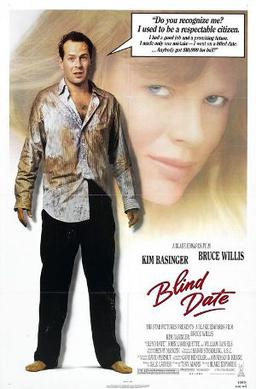
Walter Davis (Bruce Willis) is a workaholic who, in typical 80s fashion, is trying to secure a deal to manage the assets of a Japanese industrialist. When he needs a date to a business dinner, his brother (Phil Hartman) sets him up with his wife’s cousin, Nadia (Kim Basinger). Walter is warned to not let Nadia take a single sip of alcohol. Of course, Walter lets Nadia drink some champagne. It turns out that Nadia loses all of her inhibitions when she drinks and she says exactly what’s on her mind. The dinner turns into a disaster as Nadia convinces the industrialist’s wife to file for divorce. Walter not only loses his job but he now has to get the intoxicated Nadia back home. Making that difficult is that Nadia’s ex, David (John Larroquette), is still obsessed with her. David is also crazy and spends almost the entire night chasing Nadia and Walter.
Blind Date is historically significant because it was both Bruce Willis’s first credited film role (he had previously appeared, uncredited, in The First Deadly Sin and The Verdict) and also Willis’s first starring role. Willis received the role after becoming a sudden star due to his role on Moonlighting and the entire movie is full of television actors. John Larroquette was best-known for Night Court. Phil Hartman had just started on Saturday Night Live. William Daniels appears as Larroquette’s father. At the time Blind Date came out, Kim Basinger was the closest thing that the cast had to a legitimate movie star.
Watching Blind Date today, it’s strange to see Willis playing a nebbish. He’s likable but miscast as a straight-laced executive who needs his sister-in-law to set him up on a date. It’s a role that would have been best-served by someone like John Ritter, who starred in director Blake Edwards’s Skin Deep just two years after Blind Date. As David, John Larroquette is cartoonish but entertaining and he gets most of the best lines. Kim Basinger is beautiful as Nadia but doesn’t always seem to be comfortable performing comedy. There are funny moments but, as with so many of Blake Edwards’s later films, it’s uneven.
Blind Date was a box office hit. (It was the last big hit of Blake Edwards’s career.) The film found its real success on HBO, where it was a mainstay for several years. Luckily, a more appropriate starring vehicle for Bruce Willis was released just a year later. In Die Hard, Bruce Willis brought John McClaine to life and made film history.
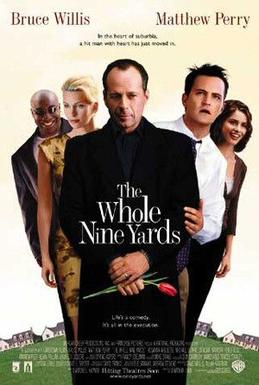
Oz (Matthew Perry) is an unhappily married dentist who discovers that his new neighbor, Jimmy (Bruce Willis), is a notorious contract killer who has a bounty on his head. Oz’s wife, Sophie (Rosanna Arquette), wants Oz to rat Jimmy out to the local mob boss (Kevin Pollack) and collect the bounty. Oz is deeply in debt and has a hard time saying no to his wife but he and Jimmy have actually become friends. Also, Oz is falling in love with his dental assistant, Jill (Amanda Peet) despite the fact that Jill is also a contract killer, though she’s still a “virgin” because she’s falling in love with the man that she was hired to kill.
The Whole Nine Yards is an amusing comedy that works because of the chemistry between Matthew Perry and Bruce Willis. When it came to his movie career, Perry was always Chandler Bing no matter who he was playing but that didn’t matter because everyone loved Chandler. I know I loved Chandler, even if Joey would have been the Friend that I probably would have ended up flirting with. Perry was a naturally funny actor and he and Willis made for a good team in The Whole Nine Yards. I also really liked Amanda Peet’s energetic performance as Jill and Kevin Pollack as the crime boss. The Whole Nine Yards is basically a violent sitcom. It may not be a great movie but Perry and Willis will make you laugh.
It’s a little hard to rewatch now. Matthew Perry is gone. Bruce Willis is retired for health reasons. They’re both having so much fun in this movie and are so entertaining to watch that it’s impossible not feel a little sad watching them. But the movie also shows what Perry and Willis could do, even with so-so material. Watching the movie made me laugh and it made me sad but mostly it just made me appreciate their talent. We can mourn what we’ve lost while still appreciating what we had.
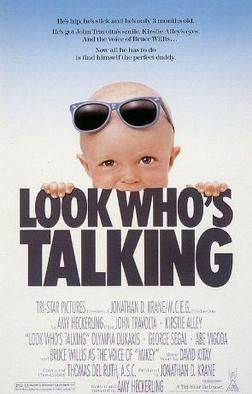
Mollie Jensen (Kirstie Alley) is an accountant who has an affair with a married client, Albert (George Segal) and ends up getting pregnant. At first, Albert has no interest in being a father but luckily, when Mollie goes into labor, she’s driven to the hospital by a down-on-his-luck taxi driver named James (John Travolta). After little Mikey is born, James agrees to be Mikey’s babysitter in return for Mollie letting James use her address so he can set up nursing care for his grandfather (Abe Vigoda). Mollie and James are falling in love but then Albert reenters the picture. Will Mollie choose rich Albert or goofy James?
As if there’s any doubt!
The important this is not the story but that the story is narrated by Mikey and Mikey sounds just like Bruce Willis!
I will admit it. I like Look Who’s Talking.
Hey, it’s cute! It’s a movie that opens with a point of view shot of a herd of sperm heading for an egg. Little sperm Mikey is so excited! Even before Mikey is born, he’s giving us his opinions. When he is born and they cut the umbilical cord, he says, “Hey, I need that!” What newborn wouldn’t say that? You’re comfortable and suddenly, you’re getting dragged into the real world.
What I really like about Look Who’s Talking is that we just hear Mikey’s narration and thoughts but Mikey himself doesn’t actually talk. It’s not like those creepy commercials where they use cheap CGI to make it look like the babies are actually talking. I hate those commercials. Instead, we’re just hearing Mikey’s thoughts and his thoughts are probably the ones that most babies would have. He just sounds like Bruce Willis. John Travolta is adorable in this. Kirstie Alley is neurotic and relatable. The babies are all cute. But the true star of the film is Bruce Willis’s voice. Supposedly, Willis ad-libbed most of his lines. Mikey’s crude but most babies are.
No, I haven’t seen the sequels. I won’t ever see the sequels. I get the feeling this is one of those movies that could only work once. Didn’t the third movie feature talking animals and no Bruce Willis? There’s no need for that.



 Through the Shattered Lens