Film Review: Free Fire (dir by Ben Wheatley)


Last night, I saw Free Fire, the latest film from the visionary British directing-and-screenwriting team of Ben Wheatley and Amy Jump.

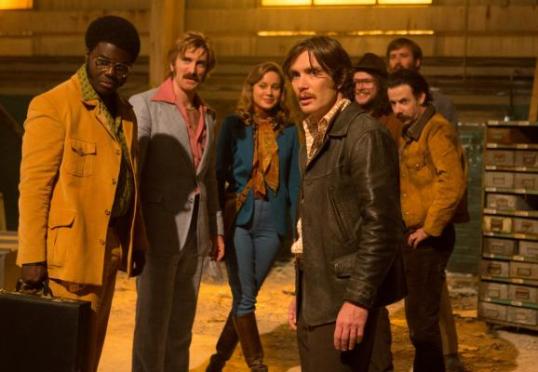
Free Fire takes place in Boston in the 1970s.  We know it’s the 70s because of all the wide lapels, the flared jeans, and the impressive facial hair.  In short, everyone looks like an extra from Thank God, It’s Friday.  Note that I said Thank God, It’s Friday and not Saturday Night Fever.  None of the characters in Free Fire could pull off John Travolta’s white suit.  As much as they try to pretend otherwise, everyone in this film is low rent.  No one is as clever or street smart as they believe themselves to be.  Even more importantly, no one is as good a shot as they think.

The film takes place in a decrepit warehouse, the type of place that is strewn with rats and hypodermic needles.  Chris (Cillian Murphy), Frank (Michael Smiley), Steve-O (Sam Riley), and Bernie (Enzo Cilenti) are members of the Irish Republican Army and they’ve come to the U.S. to purchases weapons.  Chris and Frank are no-nonsense professionals.  Bernie is a well-meaning moron.  Steve-O is a drug addict who, the previous night, got beaten up after he smashed a bottle across the face of a 17 year-old girl.

Working as intermediaries are Justine (Brie Larson) and Ord (Armie Hammer).  Justine specializes in keeping jumpy people calm.  She and Chris flirt as they wait for the guns to arrive.  As for Ord — well, let’s just say that Ord was my favorite character in the film.  He’s always calm.  He looks really good in a suit.  And, whenever things get intense, he’s always quick to light up a joint and make a sarcastic comment.  This is probably the best performance of Armie Hammer’s career so far.  (Or, at the very least, it’s the best performance of his that I’ve seen.  I hear that he gives an excellent performance in the upcoming Call Me By Your Name.)  Certainly, this is the first film that I’ve seen, since The Social Network, in which Hammer seemed to be truly worthy of the hype that has surrounded his career.

Finally, there’s the gun dealers themselves.  There’s Martin (Babou Ceesay), who seems to be fairly low-key professional.  There’s Gordon (Noah Taylor), who is a henchman who looks disconcertingly similar to Chris.  And then there’s Vernon, who is from South Africa and who is constantly talking and smiling.  Not surprisingly, Vernon is played by Sharlto Copley.  Finally, Harry (Jack Reynor) is a driver who desperately wants to impress Ord.  Harry loves John Denver and he also loves his cousin.  In fact, he loves his cousin so much that, when he recognizes Steve-O as the junkie who smashed a bottle across her face, Harry pulls a gun and starts firing.

The rest of the film deals with the resulting gun fight, which is complicated with two mysterious snipers (Patrick Bergin and Mark Monero) suddenly open fire on both of the groups.  Who hired them and why?  That’s a mystery that could be solved if everyone stops shooting and yelling at each other.  Of course, that’s not going to happen because 1) no one is a good enough shot to actually get the upper hand and 2) almost everyone in the warehouse is an idiot.

At it’s best, Free Fire mercilessly parodies the excessive violence of modern crime cinema.  When it comes to crime films, most people just remember the shoot outs so Free Fire takes things to their logical extreme by just being a 90-minute gun fight.  At its weakest, Free Fire occasionally becomes exactly what it’s parodying.  The film’s structure — one night in one location — proves to be limiting.  At times, you find yourself really wishing for a flashback or at least a little exposition to explain who everyone is outside of that warehouse.  The cast is full of good actors and they all give good performances but the characters are, at best, thinly drawn.  At times, it was difficult to keep track who was who.  I especially found myself mixing up Michel Smiley and Sharlto Copely.  It was all the facial hair.

About 30 minutes into Free Fire, I was already composing a bad review in my head but, by the final shot (and yes, the double meaning is totally intentional), Free Fire had won me over.  It’s an experiment that doesn’t really work but it’s so relentless and dedicated to seeing its story to its conclusion that I couldn’t help but appreciate the film’s efforts.  When the guns finally did stop firing and the end credits started, I was shocked to discover that, without even realizing it, I actually had gotten just a little caught up in the film’s story.

Ben Wheatley and Amy Jump previously gave us one of the most memorable films of the decade (so far), A Field in England.  Free Fire might not quite work but I’ll always make the time to see the latest from Wheatley and Jump.


A Movie A Day #104: True Blood (1989, directed by Richard Kerr)


Ten years after being wrongly accused of murdering a cop, Raymond Trueblood (Jeff Fahey) returns to the old neighborhood.  Ray has just finished a stint with the Marines and he is no longer the irresponsible hoodlum that he once was.  He wants to rescue his younger brother, Donny (Chad Lowe), from making the same mistakes that he made.  But Donny now hates Ray and is running with Ray’s former friend, Spider Masters (Billy Drago).  Spider is also responsible for framing Ray for killing the cop.  When he is not trying to save his brother, Ray falls in love with Jennifer Scott (Sherilyn Fenn), a tough waitress who is soon being menaced by Spider.
Like Crime Zone, True Blood is typical of the type of B-movies that Sherilyn Fenn was stuck in before being cast as Audrey Horne in Twin Peaks.  It’s a nothing part but Fenn is authentic and sincere in the part and, as usual, Fenn’s performance is one of the best things about the movie.

Overall, True Blood is predictable but it is still better than the typical late 80s B-movie.  Chad Lowe is never believable as a member of a street gang but Jeff Fahey does a good Clint Eastwood impersonation as Ray and Billy Drago is, as always, a great villain.  Fans of Dawn of the Dead will want to keep an eye out for Ken Foree as one of the detectives investigating Ray.

A Movie A Day #103: Mobsters (1991, directed by Michael Karbelnikoff)


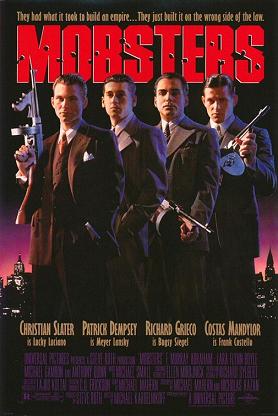
The place is New York City.  The time is the prohibition era.  The rackets are controlled by powerful but out of touch gangsters like Arnold Rothstein (F. Murray Abraham), Joe Masseria (Anthony Quinn), and Salvatore Faranzano (Michael Gambon).  However, four young gangsters — Lucky Luciano (Christian Slater), Meyer Lansky (Patrick Dempsey), Frank Costello (Costas Mandylor), and Bugsy Siegel (Richard Greico) — have an ambitious plan.  They want to form a commission that will bring together all of the Mafia families as a national force.  To do it, they will have to push aside and eliminate the old-fashioned mob bosses and take over the rackets themselves.  When Masseria and Faranzano go to war over who will be the new Boss of all Bosses, Luciano and Lansky seen their opportunity to strike.

I love a good gangster movie, which is one reason that I have never cared much for Mobsters. Mobsters was made in the wake of the success of Young Guns and, like that film, it attempted to breathe new life into an old genre by casting teen heartthrobs in the lead roles.  There was nothing inherently wrong with that because Luciano, Lansky, and Seigel were all still young men, in their 20s and early 30s, when they took over the Mafia.  (Costello was 39 but Mobsters presents him as being the same age as they other three.)  The problem was that none of the four main actors were in the least bit convincing as 1920s mobsters.  Christian Slater was the least convincing Sicilian since Alex Cord in The Brotherhood.  As for the supporting cast, actors like Chris Penn and F. Murray Abraham did the best that they could with the material but Anthony Quinn’s performance in Mobsters was the worst of his long and distinguished career.

Fans of Twin Peaks will note that Lara Flynn Boyle had a small role in Mobsters.  She played Luciano’s girlfriend.  Unfortunately, other than looking pretty and dying tragically, she was not given much to do in this disappointing gangster film.

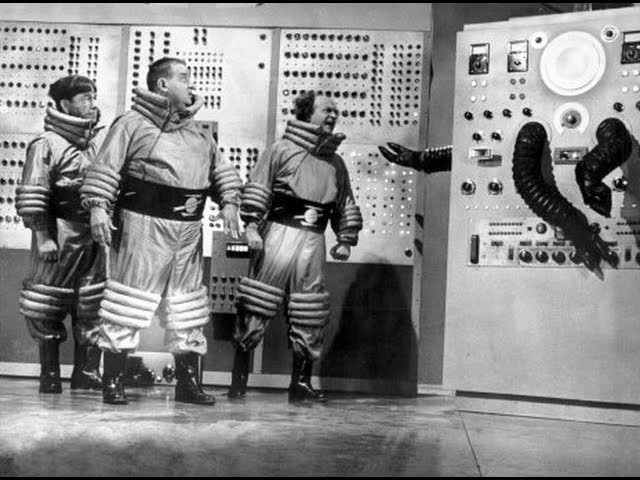
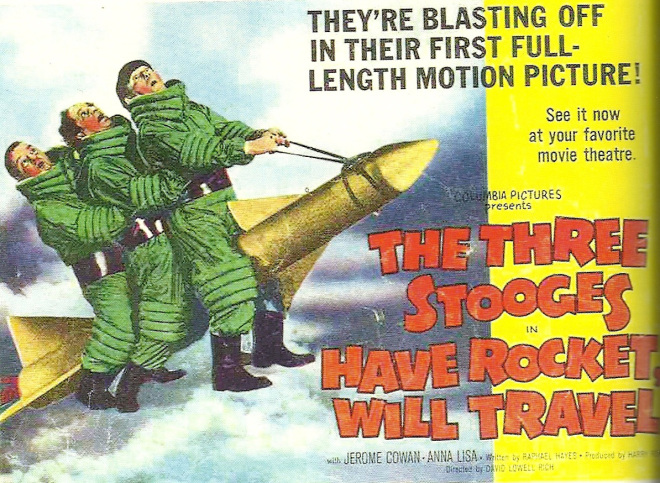
From the VHS Vault: The Three Stooges in HAVE ROCKET, WILL TRAVEL (Columbia 1959)


gary loggins's avatarcracked rear viewer

My DirecTV receiver decided to fry itself the other day. A new one won’t be shipped for another five days – no TCM, no DVR’d movies, no Red Sox, no nothin’! What’s a film blogger to do? Since my DVD player isn’t working either, I thought I’d reach into my collection of VHS tapes and see what I could come up with for viewing. Hmm, let’s see… wait a sec, what’s this? An unopened copy of HAVE ROCKET, WILL TRAVEL, the Three Stooges  comeback starring feature! Good Lord, I haven’t seen this movie in years! The Stooges it is!

A little background first: after making shorts for Columbia since 1934, the studio dumped the trio when their contract ended in 1957. Television had killed the short subject market, and the boys were thrown out on their collective keisters. Ironically, it was television that revived their career when the Stooges shorts were released to…

View original post 331 more words

Lifetime Film Review: Mommy, I Didn’t Do It (dir by Richard Gabai)


If there’s an Eye Rolling Hall of Fame, the recent Lifetime film Mommy, I Didn’t Do It definitely has earned inclusion.

Seriously, this film was full of some championship-level eye rolling.  It’s a courtroom drama and a murder mystery.  Ellen Plainview (Danica McKellar) is an attorney whose teenager daughter, Julie (Paige Searcy) is on trail for murdering one of her former teachers.  When Julie is first arrested, Ellen rolls her eyes.  When Ellen visits Julie in jail and explains that they don’t have the money to bail her out, Julie rolls her eyes and sighs.  You can just tell she’s thinking, “My God, mom, you’re so lame!”  When Detective Hamer (Jaleel White) explains why all the evidence points to Julie, Ellen again rolls her eyes and Detective Hamer counters her by rolling his own eyes.  When Ellen approaches the dead man’s wife (Jamie-Lynn Sigler), the wife not only rolls her eyes but narrows them as well.

It gets even better once the trial begins.  The prosecutor, Kimberly Bains (Jen Lilley), rolls her eyes whenever Ellen makes an objection.  Whenever a witness testifies that Julie was obsessed with the victim, Ellen rolls her eyes and then Julie rolls her eyes at her mother rolling her eyes and then Kimberly rolls her eyes at both of them.  When the weird boy who is obsessed with her tries to save Julie by confessing to the murder, the amount of eye rolling probably sets a world record.  In the real world, of course, this type of courtroom behavior gets people cited for contempt but, in the world of Lifetime, it’s just the way that people communicate.

Don’t get me wrong.  The film itself did not make me roll my eyes.  Yes, it was totally implausible and it was full of silly scenes but it’s a Lifetime film.  That’s what we expect Lifetime.  Even more importantly, that’s what we want from Lifetime.  When it comes to a quality Lifetime film, there’s really only two rules: 1) the more ludicrous, the better and 2) the more melodramatic, the more entertaining.

While the film’s story might be ludicrous, the mother-daughter relationship between Ellen and Julie felt very real and both Danica McKellar and Paige Searcy gave sincere and believable performances as mother and daughter, which went a long way towards explaining all the eye rolling.  Seriously, when I was Julie Plainview’s age, I rolled my eyes for 24 hours a day and I wasn’t even accused of murder.

Mommy, I Didn’t Do It is actually a sequel to a previous Lifetime movie, The Wrong Woman.  In that one, Ellen was wrongly accused of murder and was arrested by the same idiot detective who arrests her daughter in Mommy, I Didn’t Do It.  (If nothing else, these two films show how vindictive authority figures can be.)  As long as this is going to be a franchise, I’d like to suggest that the next installment could feature Eric Roberts, recreating his role from Stalked By My Doctor and its sequel. Maybe he could treat Julie while Ellen defend him in court.

Seriously, it sounds like a great idea to me.


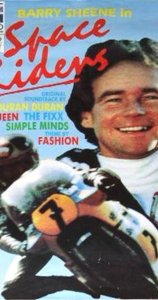
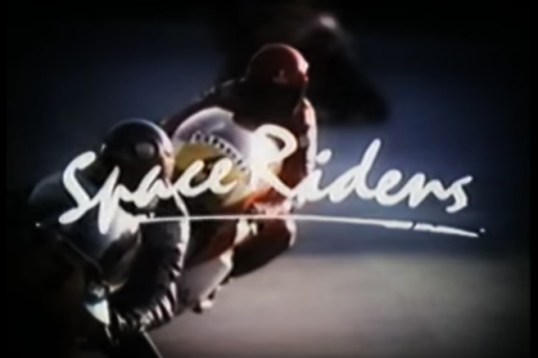
A Movie A Day #102: Space Riders (1984, directed by Joe Massot)


Since today’s episode of Twin Peaks featured Gavan O’Herlihy, I decided that today’s Movie A Day would also feature him.  I nearly reviewed O’Herlihy’s best known film, Death Wish 3, but then I remembered that, at some point in the future, I am going to review all of the Death Wish films together.  Instead of reviewing Death Wish 3, I watched Space Riders on YouTube.

In Space Riders, Gavan O’Herlihy plays Ron Harris, a Grand Prix motorcycle racer who is lured out of retirement (and away from Marina Sirtis, who also appeared with O’Herlihy in Death Wish 3) to join a racing team sponsored by a Japanese motorcycle company.  Also on the team are Japanese racer Masao Yamashta (played by Toshiya Ito) and 2-time Grand Prix champion, Barry Sheene.  Sheene plays himself and Space Riders even opens with a recreation of an accident that nearly cost Sheene his life in 1982.  (In the movie, Sheene is trying to make a comeback after the accident.  In real life, the accident eventually led to Sheene’s retirement from the sport.)

There is no real plot to Space Riders.  It’s just one race after another, with the emphasis on the motorcycles and less on the men riding them.  The racing scenes are occasionally exciting and there’s some spectacular stunt work but it is nearly impossible to tell who is on each motorcycle until the race is over and everyone takes off their helmets.  There is an interesting scene where Yamashta imagines that he is being chased by a samurai on a motorcycle but that is pretty much it as far as character development is concerned.  O’Herlihy does okay with the role Ron, playing one of his few good guy roles.  (Even on Happy Days, the main thing that stuck out about O’Herlihy’s Chuck Cunningham was that no one liked him.  After O’Herlihy left the show, Chuck was never mentioned again, leading everyone to wonder what terrible fate has befallen Richie’s older brother.)

One thing that does distinguish Space Riders is the classic 80s soundtrack.  Who would have guessed that Hungry Like The Wolf would turn out to be perfect racing music?  Even though it’s no On Any Sunday, Space Riders will be enjoyed by motorcycle racing enthusiasts.

Cleaning Out the DVR Pt 12: Too Much Crime On My Hands


gary loggins's avatarcracked rear viewer

And too many crime films in my DVR, so it’s time for another housecleaning! This edition of “Cleaning Out the DVR” features bank robbers, thieves, murderers, and other assorted no-goodniks in films from the 30’s to the 70’s. Here we go:

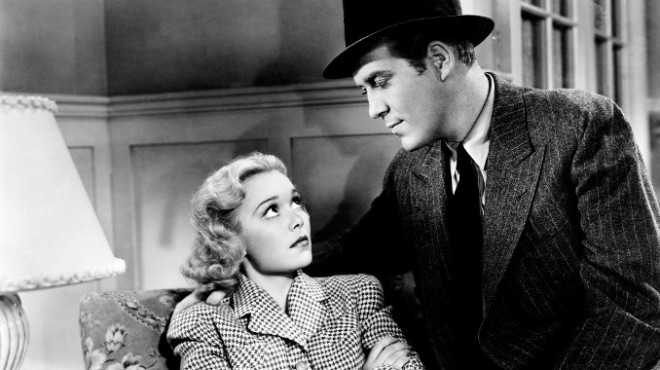
PRIVATE DETECTIVE (Warner Bros 1939; D: Noel Smith) Girl gumshoe Jane Wyman (named “Jinx”!) solves the murder of a divorced socialite embroiled in a child custody case, to the consternation of her cop fiancé Dick Foran. Maxie Rosenbloom plays his usual good-natured lug role as Foran’s partner. The kind of movie for which the term “programmer” was coined, furiously paced and clocking in at a swift 55 minutes. No wonder they talk so fast! Fun Fact: The Warner Brothers Stock Company is well represented with Familiar Faces Willie Best, Morgan Conway, Joseph Crehan, Gloria Dickson, John Eldredge, Leo Gorcey , John Ridgley, and Maris Wrixon all packed into it…

View original post 604 more words

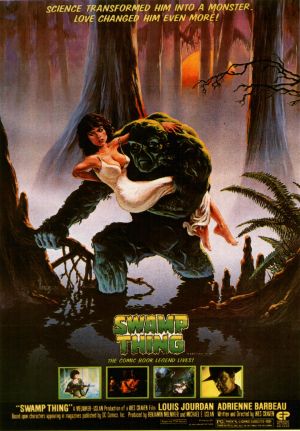
A Movie A Day #101: Swamp Thing (1982, directed by Wes Craven)


I have been dreading this moment for a while.
Ever since I decided that, while we are reviewing every episode of Twin Peaks, that every entry in Movie A Day would have a connection with the show, I knew that I would have to eventually review Swamp Thing.  I didn’t want to because I hate Swamp Thing but, outside of his work as Leland Palmer, it is also Ray Wise’s most famous role.  One of the good things about Twin Peaks is that it saved Ray Wise from being forever known as Swamp Thing.

Of course, Ray Wise does not really play Swamp Thing.  He plays Alec Holland, the human scientist who is working on a formula that will allow animals and plants to thrive in extreme environments.  When the evil Dr. Arcane (Louis Jourdan) sends his henchmen (including veteran bad guys David Hess and Nicholas Worth) to steal the formula, Alec gets set on fire and runs into the Louisiana bayou.  When Alec emerges, he has become Swamp Thing, half-human and half-plant.  He is also now played by Dick Durock.  Swamp Thing must protect both bodacious Alice Cable (Adrienne Barbeau) and streetwise swamp kid Jude (Reggie Batts) while trying to prevent Arcane from using the formula to turn himself into a werewolf and conquer the world.

Despite the easily mocked name, Swamp Thing has often been one of the best characters in the DC universe.  The movie does not being to do the character justice.  At the time, Wes Craven was best known for movies like Last House on the Left and The Hills Have Eyes.  Swamp Thing was an attempt to show that he could direct a big-budget, studio production.  Unfortunately, Craven takes a deliberately campy approach to the material, to the extent that, if not for a handful of scenes like Swamp Thing crushing David Hess’s skull, Swamp Thing could have easily been directed by Joel Schumacher during his Batman years.  Just the name Swamp Thing is campy enough.  There’s no need to toss in Louis Jourdan turning into a werewolf.  Fans of Adrienne Barbeau will do better to rewatch Escape from New York than sit through Swamp Thing.

Fortunately, for Ray Wise, Twin Peaks came along and saved him from forever being known as Swamp Thing.

A Movie A Day #100: Satan’s Touch (1984, directed by John D. Goodell)


She is not in this movie.

Bill Parrish (James Lawless) is an honest, midwestern grocery store owner who admonishes one of his regular customers about her shoplifting habits.  When she attempts to blame the devil, Bill reminds her that we all have a duty to resist the devil’s temptations.  What Bill does not realize is that not only is the Devil (Paul Davies) listening in but he also looks like a member of the Bee Gees.  The Devil gets offended and decides to tempt Bill with a trip to Las Vegas.  The Devil gives Bill unlimited luck when it comes to placing his bets, something that gets Bill in trouble when he hits the jackpot on a slot machine that is specifically programmed to never pay off.

This month, I am reviewing films that have a Twin Peaks connection and that is the only reason why I am reviewing this low-budget oddity.  In Satan’s Touch, the casino manager is played by Doctor Hayward himself, Warren Frost.  What is interesting is that, for once, management is the hero.  The manager does not hire a private detective to investigate Parrish out of spite or a desire for revenge.  Instead, he is just worried that this man’s luck will cause Vegas to go bankrupt and put a lot of good people out of work.

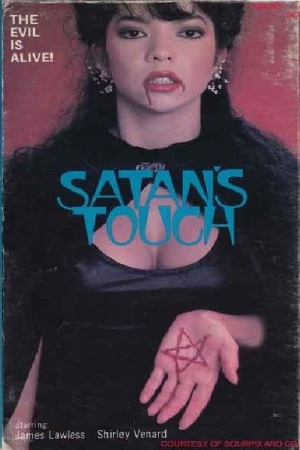
Originally called Jackpot and made to play on the church circuit, the movie was retitled and released as a horror film in 1984.  I rented a copy when I was 12 because there was a picture of an evil-looking woman with ample cleavage on the cover.  As long as it has been since I saw the film, I do remember that she was nowhere in it.  What I do remember is that Satan’s Touch was slow, not very interesting, and, whenever the Devil got bored, he would say, “I’m getting the Hell out of here.”

A few final notes about Warren Frost: Frost was married to the same woman from 1949 until his death earlier this year.  He had three children, actress Lindsay Frost and writes Mark and Scott Frost.  Mark, of course, co-created Twin Peaks while Scott also wrote for the show.  If you don’t know Warren Frost from Twin Peaks, you probably know him as Mr. Ross on Seinfeld.  On that show, his wife was played by his Twin Peaks co-star, Grace Zabriskie.

A Movie A Day #99: A Regular Bouquet: Mississippi Summer (1964, directed by Richard Beymer)


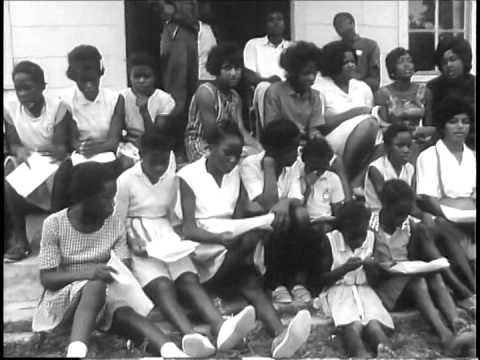
In 1964, having starred in several movies, including West Side Story, Richard Beymer put his acting career on hold and spent the summer in Mississippi, where he was one of several activists who worked to register blacks to vote and who taught at Freedom Schools.  He brought a Bolex camera with him, filmed what he saw, and later edited that footage into a 30-minute documentary called A Regular Bouquet: Mississippi Summer.

Set to a soundtrack that is a mix of rock and roll and the blues, A Regular Bouquet is a heartfelt and often angry portrait of day-to-day life in the Jim Crow era.  Over footage of black women and children working in a cotton field, a woman explains how, every year, she picks more cotton and gets paid less money for her work.  There is positive and hopeful footage of young black children learning at a Freedom School but, at the same time, the murders of James Chaney, Andrew Goodman, and Michael Schwerner hang over the documentary.  One of the documentary’s most strongest moments is a montage of still photographs that illustrate how far the authorities were willing to go to try to stop the civil right movement from reaching Mississippi.

A Regular Bouquet is available on YouTube.  If some of the footage looks familiar, that is because it has regularly been reused in other documentaries about the civil rights movement.  If you only know Richard Beymer as the evil Ben Horne on Twin Peaks, A Regular Bouquet is an eye-opening movie.