Film Review: The Outlaw Josey Wales (dir by Clint Eastwood)


Towards the end of 1976’s The Outlaw Josey Wales, Josey (played by Clint Eastwood) says, “I guess we all died a little in that damned war.”

He’s referring to the American Civil War and the film leaves you with no doubt that Wales knew what he was talking about.  A farmer living in Missouri, Josey Wales wasn’t involved in the Civil War until a group of guerillas, the Redlegs, raided his home and killed his family.  Seeking vengeance, Wales joined the Bushwackers, a group of Confederate guerillas that were led by the infamous “Bloody Bill” Anderson.  After Anderson’s death and the South’s surrender, Senator James H. Lane (Frank Schofield) offers amnesty to any of the Bushwackers willing to surrender and declare their loyalty to the United States.  Fletcher (John Vernon), the leader of the surviving Bushwackers, thinks it’s a good idea and his men eventually agree to surrender.

Everyone except for Josey Wales.

Fletcher tells Josey that he’ll be an outlaw and that Lane will send his men to capture and execute him.  “I reckon so,” Josey Wales replies.  It’s not that Josey was particularly a fan of the Confederate cause.  Instead, having lost his family and his home and having seen hundreds of men killed, Josey no longer cares.  He’s got a death wish, something that becomes apparent when he later sneaks over to Lane’s camp and discovers that the leader of the Redlegs, Terrill (Bill McKinney), has been made a captain in the Union Army.  The surrendering Bushwackers, with the exception of Fletcher and a young man named Jamie (Sam Bottoms), are gunned down as they swear allegiance to the United States.  Joey springs into action, hijacking a Gatling gun and mowing down soldiers.  It’s a suicidal move and Josey appears to be willing to die, until he sees that Jamie has been wounded.  Josey and Jamie go on the run, pursued by soldiers and bounty hunters.

It sounds like the start of typical Clint Eastwood film and, make no mistake about it, The Outlaw Josey Wales features everything that most people have come to expect from Eastwood.  Josey Wales is an expert shot, often firing two guns while charging forward on his horse.  Josey has a way of words, explaining the purpose of getting “plain man dog mean” and telling a bounty hunter that there are better ways to make a living.  The main difference, though, is that Josey is no longer seeking revenge.  He’s lost his family and his home and he knows nothing is going to bring them back.  He sought revenge during the Civil War and saw so many people killed that, much like Jimmy Stewart in Broken Arrow, he just wants to disappear from civilization.

The problem is that men like Lane and Terrill have no intention of letting Josey Wales disappear.  The sociopathic Terrill sees it as almost being his God-given duty to kill Josey Wales and anyone else that he dislikes.  The bounty hunters are also after Josey Wales.  As Fletcher explains it, bounty hunting is the only way that many former soldiers can make money and feed their families.  As Josey moves through the southwest, his legend grows.  Every town that Josey stops in, he hears stories about the growing number of men that he has supposedly killed.

Josey also discovers that he can’t do it all alone.  He soon finds himself as a part of a new family, a collection of misfits that don’t have a home in Senator Lane’s America.  Lone Waite (Chief Dan George) is an elderly Cherokee man who suggests that Josey head for Mexico.  Little Moonlight (Geraldine Keams) is a Navajo woman who Josey rescues from two bounty hunters.  Sarah Turner (Paula Trueman) and her granddaughter, Laura Lee (Sondra Locke), are rescued from Comancheros.  Josey negotiates the release of two of Sarah’s ranch hands and befriends Chief Ten Bears (Will Sampson) while doing so.  Slowly, Josey comes out of his shell and starts to embrace life once again.  Josey goes from searching for death to searching for peace.

It’s one of Eastwood’s best films, ending on a note of not violence but instead sad regret.  It’s not only a portrait of a man learning to embrace life but it’s also a portrait of a country trying to figure out how to come back together after the bloody savagery of the Civil War.  Some, like Fletcher and Josey, want to move on.  Others, like Terrill, don’t have an identity beyond fighting and killing.  Eastwood gives a good performance but, as a director, he gives every member of the cast a chance to shine.  If you only know John Vernon as Dean Wormer from Animal House, his sad-eyed performance here will be a revelation.

Originally, The Outlaw Josey Wales was meant to be directed by Phillip L. Kaufman but Eastwood felt that Kaufman was taking too long to set up his shots and worrying about details that really didn’t matter.  Reportedly, while Kaufman was away from the set, spending hours searching for a historically-correct beer bottle to be used in a bar scene, Eastwood directed the scene himself and then convinced producer Robert Daley to fire Kaufman and allow Eastwood to direct the film.  (Kaufman also objected to the script’s anti-government subtext but seriously, that’s pretty much the subtext of every film that Eastwood has ever been involved with.)  The DGA later instituted a rule that, on productions in which the director was fired,  the replacement could not be a member of his crew or an actor in the cast but that was too late to help out Kaufman.

(Rumor has it that another reason Kaufman was fired was because he and Eastwood both “liked” Sondra Locke.  This was the first of six films that Eastwood and Locke would do together.)

To be honest, I think it worked out in the film’s favor.  It’s a little surprising that someone other than Eastwood was ever considered as director to be begin with, so perfectly does the story and the lead character fit with Eastwood’s persona.  Eastwood captures both the beauty of the untouched land and also the bloody violence of combat.  In many ways, this film almost feels like a prequel to UnforgivenThe Outlaw Josey Wales is Eastwood at his best.
Film Review: Thunderbolt and Lightfoot (dir by Michael Cimino)


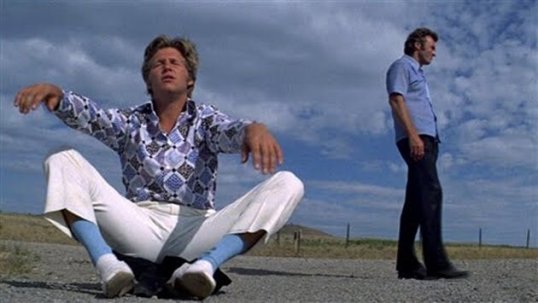
1974’s Thunderbolt and Lightfoot opens with two men, one young and one middle-aged, facing a moment of truth.

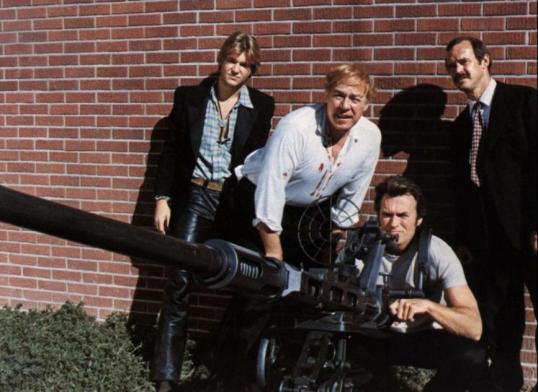
The younger of the two is Lightfoot (Jeff Bridges), a wild and hyperactive rich kid who is in his 20s and who steals a corvette right off of a used car lot.  The other man is simply known by his nickname, Thunderbolt (Clint Eastwood).  When we first see Thunderbolt, he’s giving a sermon in a small Montana church.  When a gun-wielding man steps into the church and promptly starts firing at Thunderbolt, he takes off running.  Pursued by his attacker, Thunderbolt runs through a field and just happens to jump onto Lightfoot’s speeding corvette.  Lightfoot runs over the Thunderbolt’s pursuer.  Thunderbolt slips into the car and Lightfoot drives on for a bit.  Lightfoot is excited and talkative.  Thunderbolt is more concerned with popping his shoulder back into its socket.  A stop at a gas station leads to the men stealing someone else’s car.

And so it goes for a good deal of the movie.  Thunderbolt and Lightfoot is a road movie, the majority of which is taken up with scenes of the two men just hanging out.  Thunderbolt and Lightfoot take an instant liking to each other.  When Lightfoot picks up a prostitute (Catherine Bach), he makes sure to ask that she bring along a friend for Thunderbolt.  When a criminal punches Lightfoot, Thunderbolt is quick to punch back.  “That’s for the kid,” Thunderbolt says.  That’s the type of friendship that they have.  Jeff Bridges is handsome and full of energy as Lightfoot and Clint Eastwood smiles more in this film than I think I’ve seen him smile in any other film.  For once, Eastwood is not playing a perpetually grumpy stranger or a supercop.  Instead, he’s just a blue collar guy who enjoys having a friend to travel with.

Eventually, Thunderbolt and Lightfoot meet up with two of Thunderbolt’s former associates.  Red (George Kennedy) is a brutal brawler who, it is suggested, served with Thunderbolt in the Korean War.  Goody (Geoffrey Lewis) is a gentle soul who takes orders from Red but still can’t bring himself to shoot anyone, no matter how much Red demands that he pull the trigger.  Red and Goody have always assumed that Thunderbolt stole the loot from a bank robbery that they pulled off.  Thunderbolt explains that he didn’t steal the money.  He just got arrested after hiding it.  Lightfoot suggests that maybe the four of them could pull off another bank heist….

Kennedy and Lewis are perfectly cast as the two criminals who end up working with Thunderbolt and Lightfoot.  In many ways, the relationship between Red and Goody mirrors the relationship between our lead characters.  The main difference is that Red is sadistic and quick to loose his temper, whereas Thunderbolt controls his emotions and tries not to hurt anyone while committing his crimes.  Lightfoot looks up to Thunderbolt and Goody looks up to Red.  Again, the difference is that Thunderbolt actually cares about Lightfoot, whereas Red is incapable of truly caring about anyone but himself.  Eastwood, Bridges, Kennedy, and Lewis make quite a team and it’s hard not to worry about all four of them, especially when the film takes an unexpectedly dramatic turn during its third act.

I really wasn’t expecting Thunderbolt and Lightfoot to make me cry but the final thirty minutes of the film brought tears to my eyes as what started out as a buddy comedy turned into a tragedy.  (I shouldn’t have been surprised.  I’ve seen enough 70s movies that I really should have known better than to have expected a happy ending.)  Thanks to the perceptive script by Michael Cimino (who would go on to make The Deer Hunter and Heaven’s Gate) and the performances of Eastwood and Bridges, the movie’s final moments carry quite a punch and they leave you wondering if Thunderbolt and Lightfoot’s road trip was worth the price that was ultimately paid.  The film works as not only a tribute to friendship but also as a fatalistic portrait of life on the backroads of America.

Thunderbolt and Lightfoot was the first Eastwood film to receive an Oscar nomination, with Jeff Bridges competing for Best Supporting Actor.  (He lost to Robert De Niro’s star turn in The Godfather, Part II.)  Eastwood, reportedly, felt that he deserved a nomination for his performance as Thunderbolt and, considering that that Oscar itself was won by Art Carney for his pleasant but hardly revelatory work in Harry and Tonto, Eastwood was correct.  Instead, Eastwood would have to wait for another 18 years before he finally received Academy recognition for starring in, producing, and directing Unforgiven.

Film Review: High Plains Drifter (dir by Clint Eastwood)


In 1973’s High Plans Drifter, Clint Eastwood plays …. The Stranger.

No, not the Man With No Name.  The Stranger has a name but he chooses not to share it.  That said, when one person says that he doesn’t even know the Stranger’s real name, the Stranger replies, “Yes, you do.”  The Stranger appears to emerge from the heat of the desert, riding into the small mining town of Lago and gunning down the three bullies that the townspeople hired to protect them after the murder of their town marshal.  With no other option, the townspeople accept the Stranger as the town’s new protector.

The Stranger is drawn to the town and the townspeople but he doesn’t seem to particularly like any of them, with the exception of Mordecai (Billy Curtis), the dwarf that the Stranger appoints as the town’s new sheriff.  The townspeople, the majority of whom are cowardly and motivated by greed, aren’t particularly likable themselves.  The Stranger rules the town like a dictator, kicking everyone out of the hotel so that he can have it for himself and ordering that every building in the town be painted red.  Over the town’s welcome sign, he paints one word: “Hell.”  When the townspeople see how well the Stranger can shoot, they celebrate in the belief that they’ll always be safe.  The Stranger responds by leaving town just as three sadistic outlaws, led by Stacey Bridges (Geoffrey Lewis), approach.  The Stranger may be looking for revenge on Bridges but he also seems as if he wants to make the town suffer for its sins as well.

Much as with the case of The Man With No Name, the Stranger is not motivated by kindness or any sort of concern for the safety of the townspeople.  He often shows a cruel-streak when it comes to dealing with the cowardly townspeople.  He doesn’t attack unless he’s attacked first but once you’re on his bad side, he’ll gun you down without a hint of emotion.  When the Stranger sleeps, he is haunted by nightmares of the previous marshal (played by Buddy Van Horn, Clint Eastwood’s stunt double) being murdered by Bridges and his men while the townspeople stood by and did nothing.  We learn that the townspeople, worried that it might be bad for their business interests, didn’t even give the late marshal a decent headstone after his death.  One woman mentions that spirits can’t rest unless they have a proper marker….

Getting the idea?

High Plains Drifter is probably the closest that Eastwood has ever come to making a supernatural horror film.  The Stranger may or may not be a vengeful ghost (the movie leaves that for you to decide) but he turns the small town of Lago into his own personal version of Hell and, when he attacks the men who killed the marshal, he moves with the ruthless determination of a slasher villain.  The scene where Bridges and his men ride into the town is like a filmed nightmare.  This is a dark film, one in which Eastwood’s Stranger is not the hero because he’s particular heroic but just because everyone else in the film is so bad.

This was also Eastwood’s second film as a director (following Play Misty For Me) and also the first of many westerns that Eastwood would direct.  The imagery is often haunting, all the more so because some of the most violent scenes take place in broad daylight.  The scenes where the Stranger seems to materialize out of the desert’s heatwaves perfectly capture the mythology of the old west and its “heroes.”  Eastwood gets good performances out of his ensemble cast and, even more importantly, he shows that Eastwood the director had a perfect understanding of Eastwood the actor.  As the Stranger, Eastwood says more with a snarl or a half-smile than most actors could say with a multi-page monologue.

High Plains Drifter is violent, often disturbing, and ultimately unforgettable.

Film Review: Joe Kidd (dir by John Sturges)


1972’s Joe Kidd opens with the title character (played by Clint Eastwood) in jail.  Joe is a New Mexico rancher and apparently, someone with a long history of getting in trouble with the law.  This time, he’s been arrested for poaching and disturbing the peace.  Given a choice between a fine and ten days in jail, Joe goes for the ten days.  Cowardly Sheriff Mitchell (Gregory Walcott) says he’s going to put Joe to work.  Joe Kidd snarls in response.

However, that’s before Luis Chama (John Saxon), a Mexican revolutionary, raids the courthouse and demands that all of his people’s ancestral land be returned to them.  Local landowner Frank Harlan (Robert Duvall) forms a posse to track Chama down.  Joe says that he has nothing against Chama but that changes once he discovers that Chama raided his ranch and beat up one of his ranchhands.  Joe joins the posse but he soon discovers that Harlan and his men are sadists who are more interested in killing Mexicans than actually capturing Chama.

I was actually pretty excited about watching Joe Kidd.  Clint Eastwood, Robert Duvall, and John Saxon, three of my favorite actors in the same movie!  How couldn’t I be excited?  Unfortunately, neither Duvall nor Saxon are at their best in this film.  Frank Harlan is a one-dimensional villain and Duvall doesn’t make much of an effort to bring any sort of unexpected nuance to the character.  Duvall doesn’t give a bad performance but it’s hard not to feel that Harlan is a character who could have been played by any forty-something actor.  It feels like waste to cast such a good actor in such a thin role.  (Add to that, I prefer Duvall when he plays a good guy as opposed to when he plays a bad guy.)  As for Saxon, this is probably one of his worst performances but his character is also rather underwritten and the film can’t seem to decide if it wants the viewer to be on his side or not.  Saxon delivers his lines in an exaggerated Mexican accent that makes it difficult to take Louis Chama seriously.  Gregory Sierra would have made a good Louis Chama but Saxon just seems miscast.

Fortunately, Clint Eastwood is always a badass, even in an uneven film like this.  Eastwood is at his best in the early scenes, when he’s grouchy and hungover and annoyed at finding himself in the jail.  He is believably outraged by Harlan’s tactics and, in typical Eastwood fashion, he delivers every pithy one-liner with just enough style to keep things interesting.  That said, Eastwood is let down by a script that never really makes it clear why Joe Kidd stays with the posse once it becomes clear that he’s traveling with a bunch of sociopaths.  Joe’s motivations are never really clear.  In the end, he seems like he goes through a lot of trouble to protect his farmland and get revenge for one of his ranch hands (who is just beaten up), just to then desert it all once all the shooting is over.

That said, Joe Kidd is a gorgeous film to look at and Joe makes creative use of a steam engine.  This isn’t the film to show anyone who isn’t already an Eastwood fan.  But, for those of us who are already fans of Clint, it’s enjoyable to watch him snarl, even if it is in a lesser film.

Film Review: Kelly’s Heroes (dir by Brian G. Hutton)


1970’s Kelly’s Heroes takes place in France during the Second World War.  The American army is moving through the country, liberating it town-by-town.  Private Kelly (Clint Eastwood) is a former lieutenant who was busted down in rank after leading a disastrous raid on the wrong hill.  (It was the fault of the generals but Lt. Kelly was set up as a scapegoat.)  When Kelly learns that the Germans are hiding a huge amount of gold in an occupied town, he gathers together a team of weary soldiers, misfits all, and plans to go AWOL to steal the gold for themselves.

Kelly’s Heroes was one of the big budget studio films that Eastwood made after finding stardom in Europe with Sergio Leone’s Spaghetti westerns.  This is very much an ensemble film, in the vein of The Dirty Dozen.  Indeed, Eastwood’s co-star, Telly Savalas, was in The Dirty Dozen.  Here, Savalas plays Big Joe, the sergeant who isn’t sure that he wants to put his men in danger for gold that may or may not exist.  Don Rickles plays Crapshoot who is …. well, imagine Don Rickles in the middle of World War II and you have a pretty good idea of who Crapshoot is.  Stuart Margolin, Harry Dean Stanton, Perry Lopez, Gavin MacLeod shows up as soldiers.  Carroll O’Connor plays the bombastic general who mistakes Kelly’s attempts to go AWOL for a brilliant tactical maneuver,  Like all of the senior officers in this film, O’Connor’s general is a buffoon.  Kelly’s Heroes was made during the Vietnam War and, much like Patton (released the same year), it attempts to appeal to both the establishment and the counterculture by making the heroes soldiers but their bosses jerks.

And that brings us to Donald Sutherland, who plays a tank commander named Oddball.  You may not have know this but apparently, there were hippies in the 40s!  Actually, I don’t think that’s true but there’s really no other way to describe Oddball than as a Hollywood hippie.  He’s a blissed-out, spacey guy who thinks nothing of accidnetally driving his tank through a building.  The films ask us to believe that the long-haired and bearded Oddball is a World War II tank commander and Sutherland is such a likable presence that it’s temping to just go with it.  Oddball was obviously included to bring in “the kids” but he does generate some needed laughs.  This is a very long movie and the comedic moments are appreciated.

Kelly’s Heroes is two-and-a-half hours long and it definitely could have been shorter.  Director Brian Hutton allows some scenes to drag on for a bit too long and he sometimes struggles to balance the moments of comedy with the moments of violent drama (quite a few character dies) but he does get good performances from his ensemble.  Eastwood’s taciturn acting style is nicely matched with Savalas’s more expressive style and it’s hard not smile at Don Rickles, insulting everyone as if they were guests at Joe Gallo’s birthday party.  The film, at times, doesn’t seem to know if it wants to be a satire or a straight heist film but the cast keep things watchable.  Eastwood even gets to show a few hints of the dry sense of humor that always hid behind the perpetually bad mood that often seemed to hang over him in his early films.  Whatever flaws the film may have, it was a box office success.  One year after this release of Kelly’s Heroes, Eastwood would make history as Dirty Harry.

Film Review: Two Mules For Sister Sara (dir by Don Seigel)


In 1970’s Two Mules For Sister Sara, Clint Eastwood and Shirley MacClaine take on the French!

It’s an often forgotten piece of history that, during the American Civil War, the French invaded Mexico and tried to turn it into a colony, one that was ruled by the hapless Archduke Maximillian.  The French were then led by Napoleon III, a rather enigmatic figure who spent his entire reign trying to live up to his namesake (and failing).  While the Americans would never have tolerated a French invasion of Mexico under normal circumstances, the Civil War provided enough of a distraction for Napoleon III to make his move in 1861.  Of course, as soon as the Civil War ended, America turned its attention to getting the French out of Mexico and, by the end of 1867, Maximillian had been executed and Napoleon III had withdrawn his forces.

Two Mules For Sister Sara takes place shortly after the end of the American Civil War, when the latest Mexican Revolution was in full swing.  Clint Eastwood plays Hogan, a former union officer who is now in Mexico working as a mercenary.  He’s been hired to help the revolutionaries attack a French garrison, in return for being given half of whatever is found inside.  Traveling through the desert, he comes across a group of bandits who are about to rape a woman named Sara (Shirley MacClaine).  Hogan guns down the bandits and is then shocked when Sara dons a habit and introduces herself as a nun who has been helping the revolutionaries.  She requests that Hogan travel with her and continue to protect her.  Hogan is reluctant, saying that he doesn’t want to become Sara’s mule when she already has one.  (That would be two mules for Sister Sara …. get it?)  But since Sara is a nun and claims to have no idea how to defend herself in the wilderness, Hogan agrees.  Sara and Hogan become unlikely allies as they get further and further involved in the Mexican Revolution.

Two Mules For Sister Sara owes a good deal to the Spaghetti westerns that were then coming out of Italy.  (Eastwood, of course, owed much of his stardom to his appearances in Sergio Leone’s Dollars trilogy.)  The Mexican Revolution was always a popular subject amongst the writers and directors of the Italian Spaghetti westerns.  Of course, Two Mules For Sister Sara is lacking in the political subtext that appeared in many of the Italian films.  Director Don Siegel may have been a liberal but, unlike many of his Italian contemporaries, he wasn’t a Marxist.  Instead, Two Mules For Sister Sara shows its Spaghetti influence in its panoramic visuals, it’s somewhat cynical sense of humor, and the casting of Eastwood as a taciturn mercenary whose main concern is using the revolution to make some money.  Eastwood plays a slightly more humorous version of his Man With No Name.  Hogan may be a cynic who doesn’t speak unless it’s absolutely necessary but he also possesses a good enough heart that there’s no way he’s going to abandon Sister Sara to fend for herself.  (The Man With No Name, on the other hand, would probably not have been so generous.)  Of course, Sister Sara has a secret of her own….

Supposedly, Eastwood and MacClaine didn’t get along particularly well while making Two Mules For Sister Sara.  (During preproduction, the film was envisioned as starring Eastwood and Elizabeth Taylor.)  If there was hostility between the two leads, it worked in the film’s favor because both Eastwood and MacClaine do a good job of playing off of each other.  MacClaine, at first, seems too contemporary for the role but, as the film progresses, she becomes more convincing.  There’s a revelation towards the end of the film that reveals that many of the moments that made MacClaine seem miscast were actually deliberate.  As for Eastwood, there’s a subtle humor running through his performance, as if he’s poking fun at his own tight-lipped persona. His performance here shows hints of the actor that he would become.

Two Mules For Sister Sara is an entertaining western, one that features Eastwood and Seigel celebrating and, at the same time, poking fun at the genre.  A year after this film, Eastwood and Seigel would make film history with Dirty Harry.

So, I Watched Paint Your Wagon (1969, Dir. by Joshua Logan)


Lisa Marie asked me to review Paint Your Wagon for Clint Eastwood’s birthday and, being a good sister, I agreed.  I have to learn to stop doing that.

Paint Your Wagon is a musical western starring a bunch of people who have done a lot of westerns but who still have no business singing, at least not in a movie.  If they want to sing in private, that’s fine.  Ben Rumson (Lee Marvin) and “Pardner” (Clint Eastwood) discover gold in a muddy creek and soon, the incredibly ugly town of No Name City springs up.  Because everyone in the town is a dude, everyone’s really lonely.  Then a Mormon shows up with two wives and the miners convince him to sell his youngest wife, Elizabeth (Jean Seberg) to the highest bidder.  Ben is always drunk but he still manages to buy Elizabeth.  Elizabeth says that she’s not going to marry Ben unless he builds her a cabin and also lets her marry Pardner as well.   Hello, polyamory. Eventually, a bull gets loose in the mines underneath No Name City and the entire town collapses but that’s okay because it was an ugly town and no one’s going to miss it.  Ben sings about how he was born under a wandering star so that means he can’t stay very long in once place, even if he does have a polyamorous marriage to look forward to.  Pardner sings that he likes to talk to the trees so he doesn’t need a town to live in.

My first thought on Paint Your Wagon is that it was really, really long.  It had a two and a half hour running time but it felt more like five or six.  My second thought is that movie looked really bad, like it was filmed through a mud filter.  It wasn’t just the buildings in the town that looked bad.  The entire movie looked dirty, oppressive, and depressing.  I like my musicals to have more color to them.  This movie looked like it needed an antibiotic.  My third thought was that, for a musical, none of the songs made much of an impression.  After the movie was over, I didn’t find myself humming any of them.  I can’t even remember what most of them were about.  Even if they had been better, Lee Marvin and Clint Eastwood shouldn’t have been singing them.  Lee Marvin’s singing voice sounded like whiskey being poured out over cement.  Clint Eastwood’s voice was thin and he got stuck with all the sappy songs.  I’ll take old and grumpy Clint Eastwood over singing and sappy Clint Eastwood any day.  This was like watching a community theater production where you’re not supposed to care about how bad the performance is because you know everyone in the cast.  Finally, I thought that there wasn’t enough wagon painting.  The entire town was unpainted.  It wasn’t just the wagon that was being neglected.

The funniest thing about this movie is that was advertised as being “the comedy goldmine of 69.”  Nice.

I didn’t like Paint Your Wagon but don’t worry.  I’ll be watching Trouble With The Curve later today.  Now that one, I do like!


Hang ‘Em High (1968, directed by Ted Post)


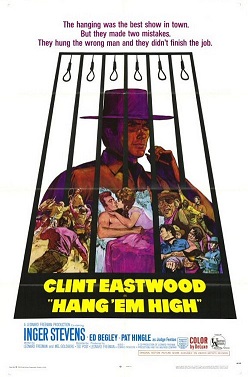
1889.  The Oklahoma Territory.  A former lawman-turned-cattleman named Jed Cooper (Clint Eastwood) is falsely accused of working with a cattle thief.  A group of men, led by Captain Wilson (Ed Begley) lynch him and leave Cooper hanging at the end of a rope.  Marshal Dave Bliss (Ben Johnson) saves Cooper, cutting him down and then taking him to the courthouse of Judge Adam Fenton (Pat Hingle).  Fenton, a notorious hanging judge, is the law in the Oklahoma territory.  Fenton makes Cooper a marshal, on the condition that he not seek violent revenge on those who lynched him but that he instead bring them to trial.  Cooper agrees.

An American attempt to capture the style of the Italian spaghetti westerns that made Eastwood an international star, HangEm High gives Eastwood a chance to play a character who is not quite as cynical and certainly not as indestructible as The Man With No Name.  Cooper starts the film nearly getting lynched and later, he’s shot and is slowly nursed back to health by a widow (Inger Stevens).  Cooper is not a mythical figure like The Man With No Name.  He’s an ordinary man who gets a lesson in frontier justice as he discovers that, until Oklahoma becomes a state, Judge Fenton feels that he has no choice but to hang nearly every man convicted of a crime.  (Judge Fenton was based on the real-life hanging judge, Isaac Parker.)  Over the course of this episodic film, Cooper becomes disgusted with frontier justice.

HangEm High is a little on the long side but it’s still a good revisionist western, featuring a fine leading performance from Clint Eastwood and an excellent supporting turn from Pat Hingle.  The film’s episodic structure allows for Eastwood to interact with a motley crew of memorable character actors, including Bruce Dern, Dennis Hopper, L.Q. Jones, Alan Hale (yes, the Skipper), and Bob Steele.  HangEm High has a rough-hewn authenticity to it, with every scene in Fenton’s courtroom featuring the sound of the gallows in the background, a reminder that justice in the west was often not tempered with mercy.

Historically, Hang ‘Em High is important as both the first film to be produced by Eastwood’s production company, Malpaso, and also the first to feature Eastwood acting opposite his soon-to-be frequent co-star, Pat Hingle.  Ted Post would go on to direct Magnum Force.

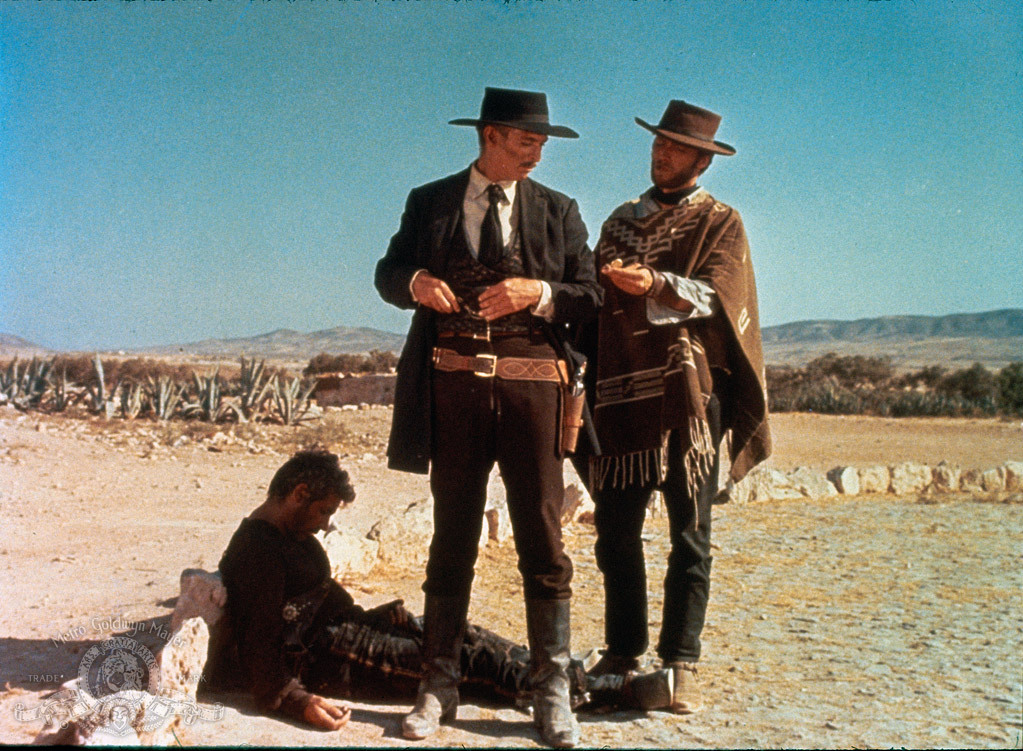
The Adventures of the Man With No Name: A Fistful Of Dollars, For A Few Dollars, The Good, The Bad, and the Ugly


Originally, Sergio Leone envisioned none other than Henry Fond as The Man With No Name.

The year was 1964 and Sergio Leone was searching for the right actor to star in the movie that would become A Fistful Of Dollars.  The film, which reimagined Akira Kurosawas’s Yojimbo as a western, centered around a mysterious, amoral gunslinger whose name was unknown.  Leone needed an American or a British name to star in the film so that it could get distribution outside of Italy.  Leone had grown up watching Henry Fonda movies, all dubbed into Italian.  He later said he wanted to cast Fonda because he always wondered what Fonda’s voice actually sounded like.

After realizing that a major Hollywood star would never agree to star in a low-budget Italian western, Leone then offered the role to Charles Bronson.  Bronson read the script and said it didn’t make sense to him.  Leone went on to offer the role to Henry Silva, Rory Calhoun, Tony Russel, Steve Reeves, Ty Hardin, and James Coburn.  Everyone was either too expensive or just not interested.  Finally, it was actor Richard Harrison who, after tuning down the part himself, suggested that Leone offer the role to Clint Eastwood.  Eastwood, then starring on the American western Rawhide, could play a convincing cowboy.  Leone followed Harrison’s advice and Eastwood, eager to break free of his nice guy typecasting and hoping to restart his film career, accepted.  The rest is history.

Eastwood would only play The Man With No Name in three films but, in doing so, he changed the movies and the popular conception of the action hero forever.

All three of the Man With No Name movies have been reviewed on this site.  But, since today is Clint’s birthday, I thought I’d take a look at how these classic films are holding up, over 60 years since the Man With No Name made his first appearance.

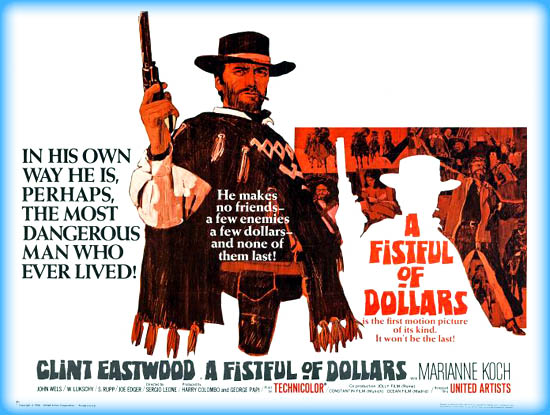
A Fistful Of Dollars (1964)

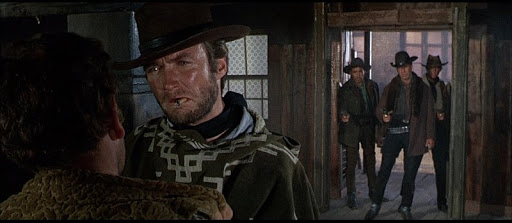
Having now seen both this film and Yojimbo, it’s remarkable how closely A Fistful of Dollars sticks to Kurosawa’s original film.  Interestingly, it’s clear that Eastwood patterned his performance of Toshiro Mifune’s in Yojimbo and yet, at the same time, he still managed to make the role his own.  The Man With No Name rides into a western town, discovers that there are two groups fighting for control of the area, and he coolly plays everyone against each other.  Whether it’s planting the seeds of distrust, exploiting an enemy’s greed, or being the quickest on the draw, the Man With No Name instinctively knows everything that he has to do.  Even when he’s getting beaten up by the bad guys, The Man With No Name always seems to be one step ahead.  Today, a western in which everyone is greedy and looking out for themselves isn’t going to take anyone by surprise.  But if you’ve watched enough westerns from the 40s and 50s, you’ll understand how unique of a viewpoint Leone brought to the genre.  Eastwood’s amoral gunslinger was such a surprise that, when the film aired on television, a scene was shot by the network in which Harry Dean Stanton played a prison warden who released The Man With No Name (seen only from behind) on the condition that he clean up the town.

For A Few Dollars More (1965)

For A Few Dollars More finds The Man With No Name working as a bounty hunter and teaming up with Colonel Mortimer (Lee Van Cleef) to take down El Indio (Gian Maria Volonte) and his gang (including Klaus Kinski as a hunchback.)  This is my least favorite of the trilogy but that doesn’t mean that For A Few Dollars More is a bad film.  Being the least of three masterpieces is nothing to be ashamed of.  Eastwood and Van Cleef were two of the best and it’s interesting to see them working together.  El Indo is a truly loathsome villain and the members of his gang are all memorably horrid.  If it’s my least favorite, it’s just because I prefer the wit of A Fistful of Dollars and the epic storytelling of The Good, The Bad, and The Ugly.  Speaking of which…

The Good, The Bad, and The Ugly (1966)

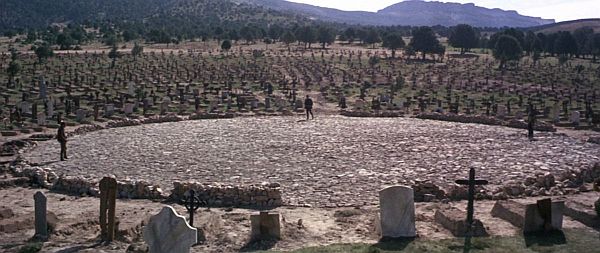
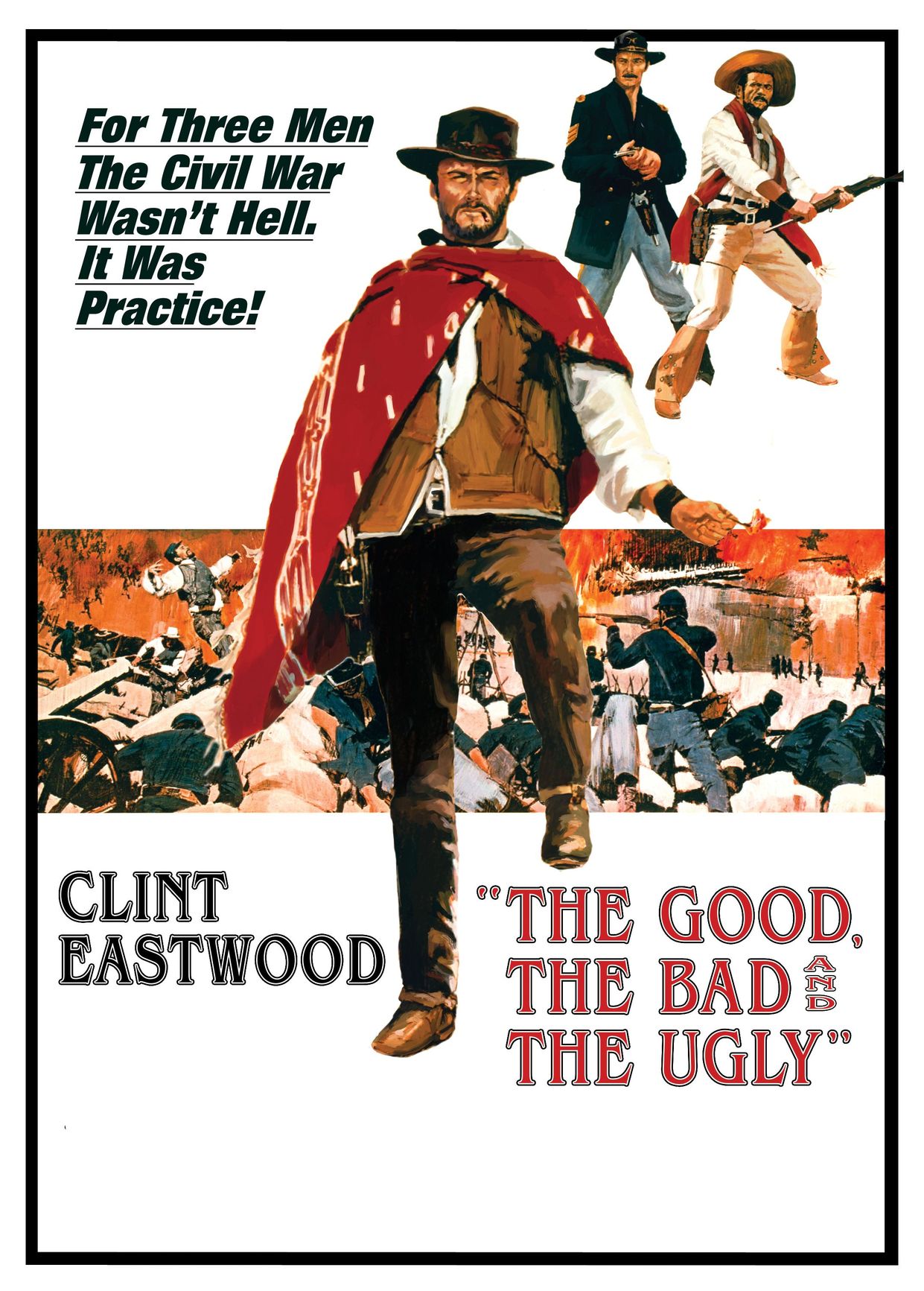
This is it.  The greatest western ever made, an epic film that features Leone’s best direction, Ennio Morricone’s greatest score, and brilliant performances from Eastwood, Van Cleef, and especially Eli Wallach.  It’s hard to know where to start when it comes to praising The Good, The Bad, and The Ugly.  It’s a nearly three-hour film that doesn’t have a single slow spot and it has some of the most iconic gunfights ever filmed.  Leone truly found his aesthetic voice in this film and that it still works, after countless parodies, is evidence of how great it is.  I appreciate that this film added a historical context to the adventures of The Man With No Name.  (Personally, I think this film is meant to be a prequel to A Fistful of Dollars, just because The Man With No Name is considerably kinder in this film than he was in the first two movies.  The Man With No Name that we meet in A Fistful of Dollars would never have gotten Tuco off that tombstone.)  The Good, The Bad, and The Ugly takes place during the Civil War and, along with everything else, it’s an epic war film.  While America fights to determine its future, three men search for gold.  The cemetery scene will never be topped.

American critics did not initially appreciate these films but audiences did.  Clint Eastwood may have been a television actor when he left for Italy but he returned as an international star.  And, to think, it all started with Sergio Leone not being able to afford Henry Fonda.

Film Review: Francis In The Navy (dir by Arthur Lubin)


In 1955’s Francis In The Navy, Donald O’Connor plays Lt. Peter Sterling, an officer in the U.S. Army who gets word that his best friend, a talking mule named Francis (voice of Chill Wills), is about to be auctioned off by the U.S. Navy.  Sterling rushes to the Naval base but, along the way, his wallet gets stolen, he gets mistaken for an AWOL soldier, and Francis gets sold to a laboratory.

Hold on, I’m re-reading that last paragraph to make sure that I didn’t hallucinating typing all that…

Peter argues that he’s not the AWOL soldier, he’s just someone who looks just like him.  Peter gets tossed into the psychiatric ward.  Francis advices Peter …. yes, the mule that can talk gives Peter advice on how to get out of the mental ward …. to pretend to be the AWOL sailor.  Unfortunately, the sailor is a champion boxer so that means Peter will have to enter the ring.  Peter, needless to say, is not a boxer.  Peter also falls for a nurse (Martha Hyer) but — uh oh! — she’s the sister of the AWOL soldier.  Well, that’s kind of awkward.  I don’t have a brother but if I did, I doubt I would ever want to make out with anyone who looked like him.  Like seriously….

Hold on, I’m re-reading that last paragraph to see if there’s anything that I need to add.

Like, seriously, what the Hell?  This movie has a talking mule, an oddly incestuous subtext, and Donald O’Connor playing two roles.  Doing some research, I discovered that this was the sixth film to deal with the adventures of Peter Sterling and Francis.  This was the last one of them to star Donald O’Connor, who apparently resented getting upstaged by a mule.  There was one more Francis movie after this one and it starred Mickey Rooney.  It was called Francis In The Haunted House so who knows?  Maybe I’ll review it for our October horrorthon.  (Don’t count on it.)

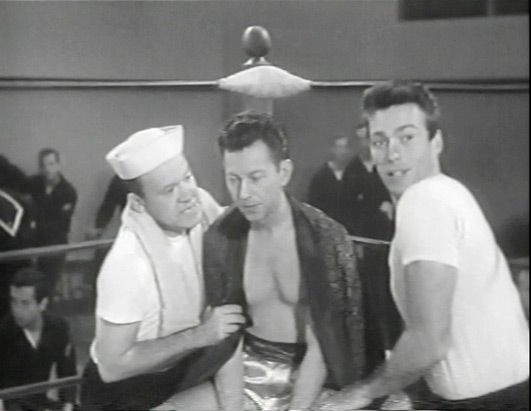
As weird as this film is, it’s kind of likable.  Donald O’Connor is a favorite of mine and this one featured O’Connor in two roles, as both the hapless Peter and also the sailor who goes AWOL and repeatedly refuses to help Peter out.  And, while I’m not really sure why he’s talking, Francis was actually cute.  I enjoyed the boxing scene where he attempted to help Peter out.  Unfortunately, there’s only so much a mule can do.

As for why I’m reviewing this movie, it’s because Clint Eastwood is in the cast.  He plays Jonesy, a friend of the AWOL sailor who becomes a friend of Peter’s.  Now, to be clear, Clint doesn’t do a lot in the movie.  He works Peter’s corner during the boxing match.  Otherwise, he spends most of the time in the background and he has a few scenes where he hangs out with the rest of the AWOL sailor’s friends.  That said, Clint does make an impression.  Even in this very early role, he had an impressive screen presence.  He’s the tallest guy there and he’s got the best hair.  Once you spot him in a scene, it’s hard to look away.

Francis In The Navy is historically significant because it’s the first film for which Clint Eastwood received on-screen credit.  (Eastwood previously appeared in films like Revenge of the Creature and Tarantula but his name wasn’t included in the credits.)  It’s an odd film, one that’s likable if you’re in an undemanding mood and you enjoy goof — extremely goofy — humor.  It would be forgotten if not for Eastwood’s appearance.  Seen today, this film, like Eastwood’s other early appearances, reminds us that everyone started somewhere.