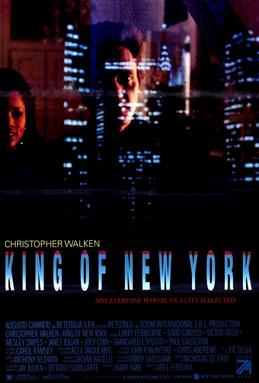
King of New York (1990, directed by Abel Ferrara)


Drug kingpin Frank White (Christopher Walken) has been released from prison and is again on the streets of New York City.  Frank might say that he’s gone straight but, as soon as he’s free, he’s  partying with his old crew (including Laurene Fishburne, Steve Buscemi, Giancarlo Esposito, and others).   While Frank’s agent (Paul Calderon) goes to all of the other city’s gangsters and explains that they can either get out of Frank’s way or die, three detectives (Victor Argo, David Caruso, and Wesley Snipes) make plans to take Frank out by any means necessary.  Meanwhile, Frank is donating money to politicians, building hospitals, and presenting himself as New York’s savior.

King of New York is the epitome of a cult film.  Directed by Abel Ferrara, the dark and violent King of New York was originally dismissed by critics and struggled to find an audience during its initial theatrical run.  (It was lumped in with and overshadowed by other 1990 gangster films like Goodfellas and Godfather Part III.)  But it was later rediscovered on both cable and home video and now it’s rightly considered to be a stone cold crime classic.  Walken gives one of his best performances as Frank White and that’s not a surprise.  The film was clearly made to give Walken a chance to show off what he could do with a lead role and Walken captures Frank’s charisma and humor without forgetting that he’s essentially a sociopath.  Walken gives a performance that feels like James Cagney updated for the end of the 80s.  What’s even more impressive is that all of the supporting characters are just as memorable as Walken’s Frank White.  From Laurence Fishburne’s flamboyant killer to David Caruso’s hotheaded cop to Paul Calderon’s slippery agent to Janet Julian’s morally compromised attorney, everyone gives a strong performance.  (I’m usually not a Caruso fan but he’s legitimately great here.)  They come together to bring the film’s world to life.  Everyone has their own reason for obsessing on Frank White and his return to power.  I’ve always especially appreciated Victor Argo as the weary, veteran detective who finds himself trapped by Caruso and Wesley Snipes’s impulsive plan to take down Frank White.  Frank White and the cops go to war and it’s sometimes hard to know whose side to be on.

Director Abel Ferrara has had a long and storied career, directing films about morally ambiguous people who are often pushed to extremes.  Personally, I think King of New York is his best film, a portrait of not just a criminal but also of a city that combines the best and the worst of human nature.  The action is exciting, the cast is superb, and Frank’s justifications for his behavior sometimes make a surprising amount of sense.  Thought there’s occasionally been speculation that it could happen, there’s never been a sequel to King of New York and it doesn’t need one.  King of New York is a film that tell you all that you need to know about Frank White and the city that he calls home.
 

Retro Television Review: The American Short Story Episode 7: The Displaced Person


Welcome to Retro Television Reviews, a feature where we review some of our favorite and least favorite shows of the past!  On Saturdays, I will be reviewing The American Short Story, which ran semi-regularly on PBS in 1974 to 1981.  The entire show can be purchased on Prime and found on YouTube and Tubi.

This week, we have an adaptation of Flannery O’Connor’s longest short story.

Episode #7: “The Displaced Person”

(Dir by Glenn Jordan, originally aired in 1977)

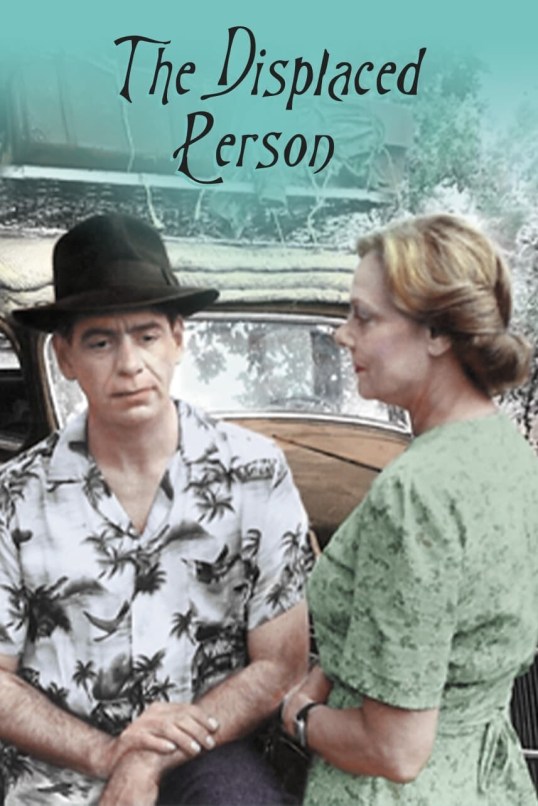
Life at a Georgia farm is thrown into turmoil when the farm’s owner, widow Mrs. McIntyre (Irene Worth), agrees to give a job to a Polish refugee named Mr. Guizac (Noam Yerushalmi).  As World War II has just ended and Father Flynn (John Houseman) has assured Mrs. McIntyre that Guizac can drive a tractor, Mrs. McIntyre is happy to give Guizac a home in America.  Less happy are the people who already work at the farm, most of whom see the hard-working Guizac as being a threat.  Mrs. Shortley (Shirley Stoler) worries that her husband (Lane Smith) is going to lose his job to Guizac.  Meanwhile, a young farmhand named Sulk (Samuel L. Jackson) enters into a business arrangement with Guizac, one that causes Mrs. McIntyre to change her opinion of Guizac.  Needless to say, it all ends in tragedy.

This adaptation is based on a short story that Flannery O’Connor wrote after her own mother hired a family of Polish refugees to work at their family farm, Andalusia.  This adaptation was actually filmed at Andalusia, only a few months after Flannery O’Connor’s death.  The furniture seen in the house was O’Connor’s own furniture.  The peacocks the drive Mrs. McIntyre crazy and which cause Father Flynn to have a religious epiphany are the same peacocks that roamed the farm when Flanney O’Connor lived there.  The cemetery that Mrs. McIntyre visits is the O’Connor family cemetery.  It brings a sense of authenticity to the film, one that is often missing from films made about the South.

The adaptation moves at a deliberate pace but it’s well-acted and it stays true to O’Connor’s aesthetic.  Those who might complain that there are only two likable characters in the film — Mr. Guizac and Father Flynn — are missing the point of O’Connor’s story.  Even Mrs. McIntyre, who initially seems to be trying to do the right thing, is blinded by the prejudices of race and class.  Father Flynn never gives up on trying to redeem both Mrs. McIntyre and the rest of the world but one gets the feeling that he might be too late.

The cast is what truly makes this adaptation stand-out.  Irene Worth, John Houseman, Lane Smith, Robert Earl Jones, they all give excellent performances.  Samuel L. Jackson was very young when he appeared in The Displaced Person but he already had the screen presence that has since made him famous.  The best performance comes from Shirley Stoler, who plays Mrs. Shortley as being a master manipulator who, unfortunately, happens to be married to a worthless man.  Mrs. Shortley does what she does to protect her husband.  Mr. Shortley does what he does because he’s a loud mouth bigot.  Everyone has their own reasons, to paraphrase Jean Renoir’s The Rules of the Game.  In this story, those reasons lead to tragedy.

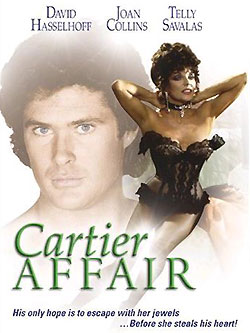
Made-For-TV Movie Review: The Cartier Affair (dir by Rod Holcomb)


In 1984’s The Cartier Affair, David Hasselhoff plays Curt Taylor.  He has spent the last few years in prison, having been convicted of selling deeds to fake oil wells.  He has passed the time by watching a soap opera that stars actress Cartier Rand (Joan Collins).  He has also managed to get in debt to the local prison mob boss, Phil Drexler (Telly Savalas).

When Curt learns that he’s being released from prison, Drexler informs him that he’s still expected to find a way to pay off his debt.  On the outside, Curt discovers that even his parole officer (Ed Lauter) works for Drexler!  Curt is assigned to become the private secretary of Cartier Rand and to steal her jewelry.  In order to get the job, Curt has to pretend to be gay.  That’s the only way that Cartier’s boyfriend (Charles Napier) would be willing to accept the idea of a male private secretary.

(Wouldn’t it just be simpler for Curt to rob a bank or something?)

Once he’s a part of the household staff, Curt discovers that Cartier is more than just the star of his favorite soap opera.  She’s someone who is tired of reciting melodramatic dialogue and kissing her co-stars.  She has serious ambitions.  Curt is immediately attracted to her and soon, Cartier is attracted to Curt.  But, of course, Curt is pretending to be gay and, to his horror, Cartier sets Curt up with one of her gay friends.

Meanwhile, the bad guys want their money….

The first half of the film is taken up by scenes of people mistaking Curt for being gay and there are more than a few moments and jokes that a film wouldn’t be allowed to get away with today.  A scene where Curt finds himself in a gay bar is cringey because, rather than asking us to laugh at Curt for panicking about finding himself in the rather innocuous location, the film asks us to instead laugh at the sight of men slow-dancing with other men.  Early on in the film, there’s a few scene where Hasselhoff overplays his attempts to come across as being gay.  Fortunately, Hasselhoff soon stops doing that and his performance improves as the film goes on.

The film gets slightly better during the second half, when Cartier learns the truth about Curt and the two of them somewhat implausibly go on the run from the bad guys.  They end up getting chased out to the desert, trading one-liners all the way, and I do have to admit that Collins and Hasselhoff displayed a surprising amount of chemistry during those scenes.

The film is tonal mishmash that doesn’t really work.  It tries to parody the type of soap operas that made Cartier Rand a star and it also tries to be a relatively exciting chase film but it keeps getting bogged down in plot points that ultimately feel rather superfluous.  My main issue that, if Drexler really wanted to get him money from Curt, it seems like he would have come up with a less complicated scheme, like robbing a bank or fencing stolen goods or something like that.  Instead, Curt is supposed to go undercover, pretend to be gay, and rob one of the most famous women on the planet.  I mean, Hell, he could have just broken into a jewelry store and gotten it all done in one night.  That said, Hasselhoff and Collins have a bit of charm to them.  It’s a shame they didn’t co-star in a better film.

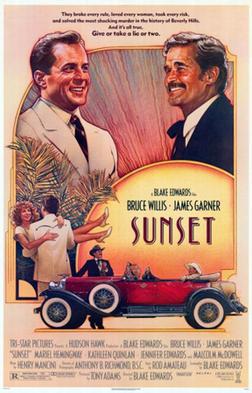
Sunset (1988, directed by Blake Edwards)


In 1920s Hollywood, famed comedian Alfie Alperin (Malcolm McDowell) has made the transition from screen stardom to working behind the scenes as a producer and studio head.  With the coming of the talkies and the death of silent cinema, Alfie plans to make his mark with an epic western starring Tom Mix (Bruce Willis) as Wyatt Earp.  The real Wyatt (James Garner) is hired to act as an on-set consultant.  Wyatt’s former girlfriend, Christina (Patricia Hodge), is now married to Alfie.

What Mix and Earp discover is that, despite his beloved public image, Alfie is actually a monster who is involved with organized crime and sex trafficking and who has the police on his payroll.  While searching for Christina’s missing son (Dermot Mulroney), Mix and Earp get caught up in a murder involving Alife’s sister (Jennifer Edwards) and a gangster named Dutch (Joe Dallesandro).  At the first Academy Awards are handed out in Beverly Hills, Tom Mix and Wyatt Earp prepare for the final showdown with their producer.

The idea behind Sunset was promising.  Wyatt Earp, a real cowboy who survived the end of the West, teams up with Tom Mix, a movie cowboy who is trying to survive the end of the silent era.  (Earp and Mix were friend in real life, as well.)  Bruce Willis comes across as being too contemporary in the role of Tom Mix but James Garner plays Wyatt Earp with a weary dignity and Malcolm McDowell does a convincing Charlie Chaplin impersonation.  Unfortunately, Blake Edwards’s direction allows the story to meander and the mystery itself is so full of red herrings that it’s impossible to follow.  Edwards didn’t seem to know if he wanted this movie to be a buddy comedy, an elegiac tribute to the end of the silent era, or a satire of Hollywood.  He tried to include elements of all three but the movie itself just doesn’t come together.  Only Garner and McDowell emerge from the film relatively unscathed.

Fortunately, for Bruce Willis, Die Hard was released just two months after Sunset.

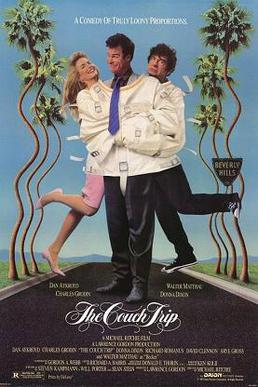
The Couch Trip (1988, directed by Michael Ritchie)


When renowned radio psychiatrist George Matlin (Charles Grodin) has a nervous breakdown, he takes a trip to Europe with his wife (Mary Gross) to both recover and also work on his marriage.  (Matlin’s breakdown was the result of an extramarital affair.)  Needing someone to host Dr. Matlin’s radio show, his producers call Dr. Lawrence Baird (David Clennon), who oversees a mental facility in Chicago.  They assume that Dr. Baird is just dumb enough that they won’t have to worry about him overshadowing Dr. Matlin while he’s guest-hosting.  However, when they call, Dr. Baird is out of his office and the phone is answered by John Burns (Dan Aykroyd), a con artist who has been pretending to be insane so that he can avoid serving time in prison.  Pretending to be Baird, Burns accepts their offer and then escapes from the asylum and heads to Beverly Hills.  The real Dr. Baird, not knowing about the offer, goes on vacation in Europe.  Though Burns had originally only been planning on doing the radio job long enough to get paid enough money to head to Mexico, he soon becomes a celebrity with his non-nonsense, blunt advice.

There’s a lot of talented people in The Couch Trip, including Walter Matthau as a former priest-turned-kleptomaniac and Aykryod’s wife, Donna Dixon, as Matlin’s colleague and Burns’s eventual love interest.  Director Michael Ritchie was responsible for some of the best films of the 70s and radio psychiatry is certainly a ripe subject for satire.  Why, then does, The Couch Trip fall flat?  Some of it is because the movie never seems to know if it wants to be wacky farce or a dramedy about a criminal who finds a new life helping people.  The other big problem is that the talented Dan Aykroyd is miscast as the type of unapologetic smartass that Bill Murray could play in his sleep.  (In a version where Murray played John Burns, Aykroyd would have been perfect casting as George Matlin.)

Aykroyd was one of the most talented members of the original Not Ready For Prime Time Players.  (His impersonations of Nixon and Jimmy Carter were second-to-none.)  Sadly, Hollywood has never figured out what to do with his off-center talent.  The Couch Trip is a prime example of that.


Brad reviews VIGILANTE FORCE (1976), starring Kris Kristofferson and Jan-Michael Vincent! 


I’ve been a fan of actor Jan-Michael Vincent for about as long as I can remember. I was a grade schooler in the mid-80’s when AIRWOLF was playing on network TV. I loved the show and Vincent’s character, Stringfellow Hawke. It was also around that time that I began my obsession with Charles Bronson, and Vincent co-starred in the iconic 1972 Bronson film THE MECHANIC (1972). Fox 16 out of Little Rock played the movie often, further cementing my appreciation for his work. And I specifically remember renting his 1980 movie DEFIANCE where his character takes on a ruthless gang in New York. It was my kind of movie, and I still watch it every few years. There’s just something I’ve always liked about Jan-Michael Vincent. July 15th, 2025 would have been his 80th birthday so I decided to watch one of his movies that I’ve never seen, VIGILANTE FORCE from 1976. It was playing on Amazon Prime, so I fired it up for my initial viewing. 

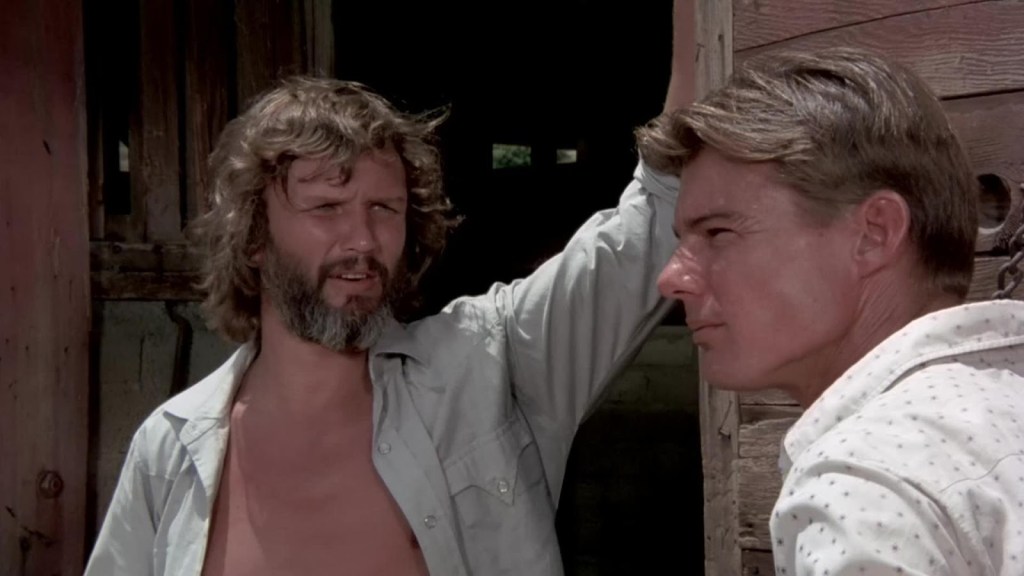
In VIGILANTE FORCE, Jan-Michael Vincent plays Ben Arnold, a guy from the small town of Elk Hills, California. It seems that the discovery of oil in the area has brought about a financial boom, but it’s also brought in a lot of rowdy out-of-towners and a surge in violent crime. Ben convinces the local community leaders to allow him to bring in his brother Aaron (Kris Kristofferson), a Vietnam war hero, to help restore order in town. Aaron assembles a group of ex-military types, friends of his, to help the local police restore order in town. Successful in cleaning out the riffraff at first, Aaron and his team of vigilantes eventually become the riffraff and use their law enforcement powers for their own corrupt, get-rich-quick schemes. Realizing that he made a horrible mistake in bringing in his brother, Ben is forced to confront Aaron and his team of murderous mercenaries in order to reclaim Elk Hills for its citizens.

I had not read anything beyond the title VIGILANTE FORCE and the basic cast list when I sat down to watch this film. I guess that’s a good thing, because I wasn’t expecting this movie to pit the brothers played by Vincent and Kristofferson against each other. I thought the two guys would be working together to get rid of a bunch of rednecks, and we do get that for the first half of the film, but when Kris goes bad, he really goes bad! And nobody is safe. This is one of those movies where he just kills whoever gets in his way, no matter how important or attractive they are. Writer-Director George Armitage, who would direct the excellent MIAMI BLUES (1990) fourteen years later, has said that he was trying to make a point about America’s involvement in the Viet Nam war with the Kristofferson character. Armitage apparently enjoys his references, as the film was made during the USA’s bicentennial year, but his two main characters are named after Benedict Arnold and Aaron Burr. While these ideas may have amused the director, his heavy-handed approach is not good for Kristofferson’s character in this film. His Viet Nam vet basically turns into an evil cartoon about halfway through the film and is no longer interesting, which is a shame because he gives a good performance.

Allegories aside, at its heart VIGILANTE FORCE is B-movie, drive-in fodder, and it’s pretty good at being that. It’s got that unpolished look and raw, energetic feel that I like in my low budget 70’s action movies. As you would expect in a film at this time, Jan-Michael Vincent is impressive and believable as the tough, good guy of the flick. Highly motivated due to the actions of our evil, out of control villain, Vincent handles the action scenes well in the film’s explosive finale. And I mean that literally, it seems that everything blows up big time at the end! Besides Kristofferson and Vincent, the film has a very recognizable supporting cast, which is one of the things I love about 70’s movies. Producer Gene Corman put together a cast that also includes Brad Dexter, Andrew Stevens, Victoria Principal, Bernadette Peters, Paul Gleason, Charles Cyphers, Loni Anderson and a host of other familiar voices and faces who add their unique talents to the proceedings. Principal, still a couple of years away from her career defining role as Pamela Ewing in the DALLAS TV series, is especially beautiful as Vincent’s girlfriend. 

Overall, while VIGILANTE FORCE is not required viewing, I can definitely recommend it to anyone who likes 70’s redneck action cinema, or to fans of the main stars. I enjoyed it! 

Film Review: Battlefield Earth (dir by Roger Christian)


After avoiding it for 25 years, I finally watched the infamous 2000 fiasco, Battlefield Earth, last night.

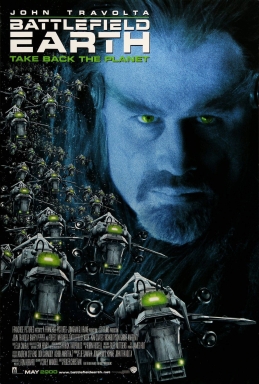
Battlefield Earth, based on a superlong novel by creepy cult guru L. Ron Hubbard, was a longtime passion project of John Travolta’s.  Travolta, a Scientologist, had long wanted to make a movie out of Hubbard’s science fiction epic and, on a hot streak following films like Pulp Fiction and Get Shorty, he finally did so in 2000.  He played Terl, a member of a giant alien race called the Psychlos.  The Psychlos have conquered Earth and humanity has regressed back to an almost prehistoric standard of living.  When a brave human, Johnnie Goodboy Tyler (Barry Pepper), defies his elders and proceeds to venture out into the ruins of Denver, he’s captured by Terl.  Eventually, Johnnie is shown a copy of the Declaration of Independence and it inspires him to lead a revolution against the Psychlos.

Battlefield Earth turned out to be just as bad as I had heard, a charmless wannabe epic that used far too many Dutch angles and relied on slow motion to try to create a heroic (or, in some cases, tragic) feel to the action.  The plot of the film felt like something recycled from an old 1930s serial, which makes sense when you consider that L. Ron Hubbard was a pulp writer before he decided to become a guru.  What I was not prepared for was just how mind-numbingly dull Battlefield Earth is.  Most bad movies can at least make the claim of being entertaining in their badness.  If nothing else, you can often admire them for their ambition.  Take a film like Plan 9 From Outer Space.  Plan 9 From Outer Space is often derided as being the worst film of all time but it’s still terrifically entertaining and there’s a likable earnestness at the heart of it.  Director Ed Wood may not have had a budget and his main star may have been present only through stock footage but, dammit, Wood was determined to make a science fiction epic that would double as a plea for world peace and he did just that.  There’s a heart at the center of Plan 9 From Outer Space and that makes it a film that you can mock but you never quite dislike.  For all the talk of Battlefield Earth being a passion project for Travolta, the end result is an empty and rather soulless film.

(I nearly listed Battlefield Earth as being one of our Icarus Files but then I remembered that Icarus at least managed to get close to the sun.  Battlefield Earth can’t even get out of Denver.)

Travolta’s career has never really recovered from Battlefield Earth.  He is an actor who can claim to have appeared in two of the biggest, most influential films of all time — Pulp Fiction and Saturday Night Fever — but his legacy appears to be walking around on stilts in Battlefield Earth.  As for Barry Pepper, he does probably about as well as anyone could with the role of Johnnie Goodboy Tyler but still, it’s sad to see a good actor wasted in such a bad movie.  (In fact, there’s quite a few good actors — Forest Whitaker, Kim Coates, Richard Tyson — wasted in this movie.)  From what I understand, the movie only covered the first 400 pages of Hubbard’s 1100-page novel.  Travolta had hopes to do a sequel but that’s not going to happen.

It’s for the best.  If people need to see a movie about L. Ron Hubbard’s belief system, they can always rewatch The Master.


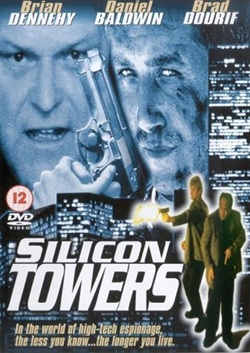
Silicon Towers (1999, directed by Serge Rodnunsky)


Charlie (Jonathan Quint) gets a promotion to an executive job at Silicon Towers.  After his promotion, he is sent an encrypted email that reveals that the company is manufacturing computer chips that it can use to drain money from the banks and to control the world.  Charlie goes on the run, jumping from roof to roof as he tries to avoid the company’s security team and reveal the truth.  Brian Dennehy plays the evil CEO.  Daniel Baldwin plays another executive.  Brad Dourif plays a paranoid tech expert and steals the movie.  Robert Guillaume is the police detective who is investigating the strange things that are happening around the company.  Be sure to hum the Benson theme song while watching.

There was a lot of movies like Silicon Towers in the late 90s.  The internet was still exotic and people were still convinced that technology was going to destroy us all on Y2K.  Silicon Towers was not the only paranoid tech thriller to come out in 1999 but it might have been the most inept.  Serge Rodnunsky made a lot of movies back in the day and never let a lack of a budget stand in his way but he also never seemed to understand the importance of being able to hear dialogue or smooth editing.  There are some good actors in Silicon Towers.  Good luck understanding what any of them are saying.

This film is mostly memorable for the scenes of Charlie “hacking.” Charlie writes his hacking code in HTML.  That’s  pretty much all you need to know.

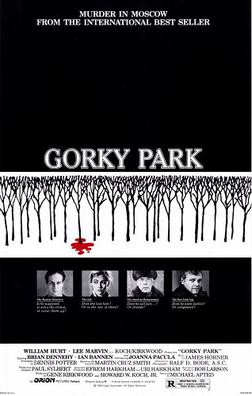
Gorky Park (1983, directed by Michael Apted)


Earlier today, I saw that the writer Martin Cruz Smith has died.  He was 82 years old and was best known for a series of detective novels about Arkady Renko, a Russian police detective.  Starting with 1981’s Gorky Park, Smith’s novels not only dealt with Renko’s adventures but also provided a look at contemporary Russia, as it went from being controlled by the communists to being controlled by Putin.  Renko was a cynical observer whose cases often exposed the corruption of the Russian elite, regardless of who was in charge.

The first of Smith’s Renko novels was turned into a movie in 1983.  Gorky Park stars William Hurt as Renko.  Renko investigates the discovery of three dead bodies at a ice skating rink in Moscow.  One of the victims in an American whose brother (Brian Dennehy) is a tough New York cop who has come to Russia to investigate his disappearance.  Renko’s investigation leads him to an American businessman (Lee Marvin) who is smuggling sables out of Russia and who is also a KGB asset.  Joanna Pacula plays a woman whose hope to escape from Russia leads to her getting caught up in the murders and the subsequent investigation.

Gorky Park‘s mystery is easily solved.  Just by casting Lee Marvin in the role, it is automatically clear who is responsible for the murders and it doesn’t take long for Renko to figure it out either.  Instead, the movie is about how Renko’s investigation exposes the corruption of the Russian state, with the KGB first protecting Lee Marvin’s businessman when he’s considered to be an asset and then expecting Renko to assassinate him once it becomes obvious that his activities are becoming a liability.  The subdued William Hurt and the brash Brian Dennehy make for an compelling investigative team while the underappreciated Joanna Pacula gives an outstanding performance as a woman who is so desperate to escape the oppression of the Soviet Union that she’ll risk everything.  (Even though the murderer is an American businessman, the Soviet Union still banned Gorky Park as both a book and a film.)  Gorky Park’s snowy cinematography and Michael Apted’s measured direction captures the chilly paranoia of Smith’s story and the bleak depiction of a society where national pride mixes with healthy a dose of fear.

Upon release, Gorky Park was a box office disappointment, which meant that there would be no further adventures of William Hurt’s Renko on the big screen.  Martin Cruz Smith continued to write, ultimately publishing ten novels about his unconventional hero.

Presumed Innocent (1990, directed by Alan J. Pakula)


Harrison Ford stars as Rusty Sabich, a smart and ambitious prosecutor who is accused of murdering his former mistress, Carolyn Polhemus (Greta Scacchi).

A lot of people were taken by surprise when Presumed Innocent first came out in 1990.  After a career of always being the hero and the type of person who took his fate into his own hands, Presumed Innocent featured a passive Harrison Ford whose fate was in the hands of his lawyer, Sandy Stern (Raul Julia) and in the prosecutors who are trying to send him to prison.  For most of the movie, the audience doesn’t know if Rusty is innocent and a lot of what Rusty does makes him seem to be guilty.  Just the fact that Harrison Ford was playing someone who would cheat on his wife (played by Bonnie Bedelia, who everyone had last seen sticking up for Bruce Willis in Die Hard) was considered to be shocking at the time.  It says a lot about Ford’s appeal as an actor that he remains sympathetic even though he’s playing a character who does a lot of bad things.  He remains compelling, even though Rusty is forced to spend a good deal of the movie as a passive spectator.  To anyone who underrates Harrison Ford an actor, this is the film to show them.

Presumed Innocent is a murder mystery but it’s also a sad-eyed look at a corrupt judicial system.  Rusty is accused of murder largely due to the whims of fate.  If Raymond Horgan (Brian Dennehy), Rusty’s former patron, had been reelected as district attorney, Rusty would never have been charged.  When the trial moves to the courtroom, the Judge (Paul Winfield) himself is revealed to have been compromised by his own relationship with Carolyn, something that Sandy is willing to use to the defense’s advantage.  John Spencer plays a detective who is willing to hide evidence to protect Rusty.  Joe Grifasi plays a former detective who is motivated less by the evidence in the case and more by a personal grudge against Rusty.  The idea of getting justice for Carolyn is pushed to the side by everyone’s personal drama.  The ending challenges all of our preconceived notions about Rusty and the meaning of guilt and innocence.

Intelligently directed by Alan J. Pakula and featuring an excellent cast, Presumed Innocent is a top-notch legal thriller and also one of Harrison Ford’s best films.