Film Review: The Wall (dir by Doug Liman)


The Wall tells a very simple story.

Opening with a title card that informs us that “President Bush has declared victory,” The Wall takes place in Iraq in 2007.  Two soldiers — a sniper named Matthews (John Cena) and a spotter named Isaac (Aaron Taylor-Johnson) — have responded to a call for help that came from a pipeline construction site.  When they arrive, they see only dead contractors.  Matthews and Isaac spend a day watching the site, finally determining that it is safe to investigate.

Of course, as soon as Matthews approaches the site, shots ring out as a sniper opens fire on him.  Matthews falls while Isaac finds himself trapped behind a crumbling wall, shot in the right knee and slowly bleeding out.  As Isaac tends to his wound and tries to determine whether Matthews is alive or dead, his radio comes to life.  The voice, on the other end, initially claims to be an American soldier but Isaac eventually figures out that the voice actually belongs to the man who just shot him.  The sniper is an Iraqi who calls himself Juba.  He may or may not be a legendary and feared sniper that Matthews and Isaac were discussing mere minutes before being attacked.

And that’s pretty much the entire film right there.  For 81 minutes, Isaac tries not to die while Juba alternates between taunting him and demanding to know why he and the American forces have yet to leave Iraq.  Isaac claims that America is rebuilding Iraq.  Juba claims that the wall that Isaac is hiding behind used to be a part of a school.  Isaac tells Juba to fuck off.  Juba replies, “We are not so different, you and me,” revealing that, if nothing else, Al Qaeda snipers apparently appreciate a good cliché.  If anything, it reminded me a bit of The Shallows, except Blake Lively was now a soldier and the shark refused to stop talking.

I have to admit that I have mixed feelings about The Wall.

On the one hand, it’s a very well-made film.  Visually, the film captures the deadly heat of the desert and it makes good use of its limited setting.  It’s far more watchable than any movie that exclusively takes place behind a crumbling wall has any right to be.  From what I’ve read, it appears that The Wall‘s depiction of both combat and dying is fairly accurate and the film does a good job of putting you in Isaac’s boots, forcing you to try to desperately figure out where Juba could be hiding.

Also, Aaron Taylor-Johnson actually gives a good performance.  Since, with a few notable exceptions, Aaron Taylor-Johnon usually bores me to tears, I was shocked to see how good of a performance he gave as the country-accented Isaac.  It’s especially impressive since he’s on screen for almost the entire film.  It was hard for me to believe that the same actor who was so unbearably dull in Savages was suddenly so watchable in The Wall.  However, he definitely was.

And yet, The Wall is also one of the most thoroughly unpleasant films that I’ve ever sat through.  Admittedly, that’s probably the way it should be.  War films shouldn’t be pleasant and I don’t think anyone could ever accuse The Wall of romanticizing combat.  At the same time, the film itself doesn’t seem to be quite sure what it wants to say about war.  Juba and Isaac do briefly debate America’s role in the Middle East but their discussion has all the depth of a twitter fight between Bernie Sanders supporter and a Donald Trump voter.  Neither Isaac nor Juba are particularly deep thinkers.  They’re both fighting and potentially dying for the benefit of others.  Maybe that’s the point.  The problem is that the film itself doesn’t seem to be quite sure.

The Wall is one of those films where I respect the craftsmanship behind it while, at the same time, having no desire to ever sit through it again.
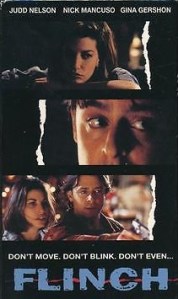
A Movie A Day #248: Flinch (1994, directed by George Erschbamer)


Harry (Judd Nelson) is a law student who has failed the bar exam three times.  Daphne (Gina Gershon) is an aspiring actress who has an unfaithful boyfriend.  With neither of them making much headway in their chosen careers, they end up working as living mannequins in a department store display window.  If they flinch even the least little bit, they will lose their jobs.  At first, it does not seem that there is much of a romantic future for Harry and Daphne.  But when Daphne breaks up with her boyfriend, Harry invites her to join him in breaking into the store after hours and partying.  But while Harry and Daphne are celebrating, they witness a crazed artist (Nick Mancuso) strangling one of his models.

If the name of the director, George Erschbamer, seems familiar, you may be familiar with the Snake Eater films that he made with Lorenzo Lamas.  Fortunately, Flinch is far superior to Snake Eater III.  Starting out like a romantic comedy before turning into a thriller, Flinch is actually one of the better direct-to-video Judd Nelson films to come out in the 90s.  Of course, considering that the competition comes from Entangled and Conflict of Interest, Flinch doesn’t have that high of a bar to clear.  Though the thriller aspect is predictable, The first half of the movie, which is almost entirely Gershon and Nelson trying to talk to each other without anyone noticing their lips moving, is actually enjoyable.  Gina Gershon is as sexy as ever and she brings out the best in Judd Nelson, who is almost likable in this movie.

Still, there is one thing that could have improved Flinch.  Like almost any other Judd Nelson film, it really could have used a Burt Reynolds cameo.

Right, Burt?

Sweet Land of Liberty: Alfred Hitchcock’s SABOTEUR (Universal 1942)


gary loggins's avatarcracked rear viewer

The Master of Suspense puts the pedal to the metal once again in SABOTEUR, another “double chase” spy thriller that doesn’t get the attention some of Alfred Hitchcock’s other films do, but should. I’ve always enjoyed the performance of Robert Cummings as the “ordinary man caught in an extraordinary situation”; his naturally laid-back, easygoing charm makes him perfect playing Barry Kane, accused of sabotaging a wartime aircraft plant and killing his best friend in the process, who winds up on a cross-country chase alongside reluctant heroine Priscilla Lane . SABOTEUR is certainly an  important film in Hitchcock’s body of work for one important reason: it’s the director’s first film for Universal Pictures, a studio he’d have a long and profitable association with, and where he’d later create some of his finest movies.

SABOTEUR is in many respects a loose remake of Hitchcock’s THE 39 STEPS , transplanted to America and…

View original post 701 more words

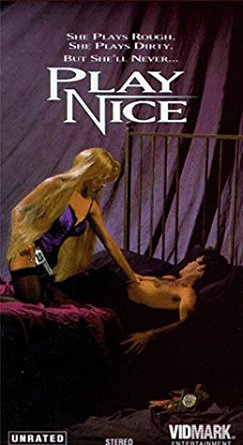
A Movie A Day #247: Play Nice (1992, directed by Terri Treas)


Homicide Detective Jake “Mouth” Penucci (Ed O’Ross) is the most hated man on the police force.  His partners hate him.  His ex-wife hates him.  His daughter will hate him once she is old enough.  Penucci is obnoxious, tells terrible jokes, and is haunted by his abusive childhood.  The only person that does not hate Penucci is Jill (Robey), who works in the records office.  Jill and Penucci are soon an item but it turns out that Jill has some kinky tastes, which make even Penucci nervous.  She wants him to beat her during sex and sometimes ask him to pretend that she’s a little girl.  At the same time that Penucci is trying to figure out how to have a normal relationship with Jill, he has been assigned to catch Rapunzel, a female serial killer who only targets men who have been accused of sexually abusing their daughters.  Could it all be connected?
Play Nice is a standard 1990s Skinemax neo-noir, distinguished by a few surreal dream sequences and performances that are better than what’s typically found in films like this.  The mystery would be interesting except that there is only one possible suspect so it is not at all surprising when that suspect is eventually revealed to be Rapunzel.  For many Skinemax watchers, the film’s main appeal was probably the beautiful Robey appearing in several nude scenes but Play Nice is also memorable for giving character actor Ed O’Ross a rare starring role.  O’Ross has spent almost his entire movie career playing corrupt cops and psychotic gangster but he does a pretty good job as Penucci, even if Penucci is not a typical hero.  Every good character actor should get at least one chance to play a lead and O’Ross makes the most of it in Play Nice.

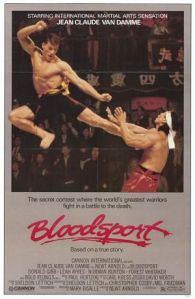
A Movie A Day #246: Bloodsport (1988, directed by Newt Arnold)


Bloodsport is one of Jean-Claude Van Damme’s earliest films and it is Damme good!
Forgive the terrible opening line but that is how they actually used to advertise Jean-Claude Van Damme films.  Everything was either Damme exciting or Damme amazing or Damme spectacular.  Though it was made by Cannon and had a much lower budget than the films Van Damme made during his 90s heyday, Bloodsport is still a Damme quintessential Van Damme movie.

Bloodsport claims that the story it tells is true.  Frank Dux (Van Damme) is a U.S. Army captain who goes AWOL so he can compete in Kumite, an illegal martial arts tournament that is held in Hong Kong.  Kumite is the only martial arts tournament where it is legal to kill your opponent.  Chong Li (Bolo Yeung) became champion by killing anyone who lasts more than a minute with him.  At first, no one believes that an American like Frank Dux has a chance of winning the Kumite.  What they do not know is that Frank was trained by the legendary Senzo Tanaka.  Frank is not just competing for personal glory.  He is also competing in honor of Tanaka’s dead son.

Bloodsport is both Van Damme and Cannon Films at their best.  Shot on location in Hong Kong, Bloodsport not only features Van Damme doing his thing but also gives him a memorable sidekick, Ray Jackson (Donald Gibb), who talks like a professional wrestler and gets all of the best lines.  When Ray and Frank first meet, they bond over a video game that appears to be an extremely early version of Street Fighter.  Also keep an eye out for Forest Whitaker (!), playing one of the CID officers who is assigned to track down Frank and arrest him for desertion.

Like any good Van Damme film, Bloodsport lives and dies on the strength of its fights and it does not skimp on the blood, the chokeholds, or the high kicks.  Bolo Yeung is a great opponent for Van Damme but everyone know better than to try to beat Jean-Claude Van Damme.  When it comes to fighting Van Damme, Duke put it best:

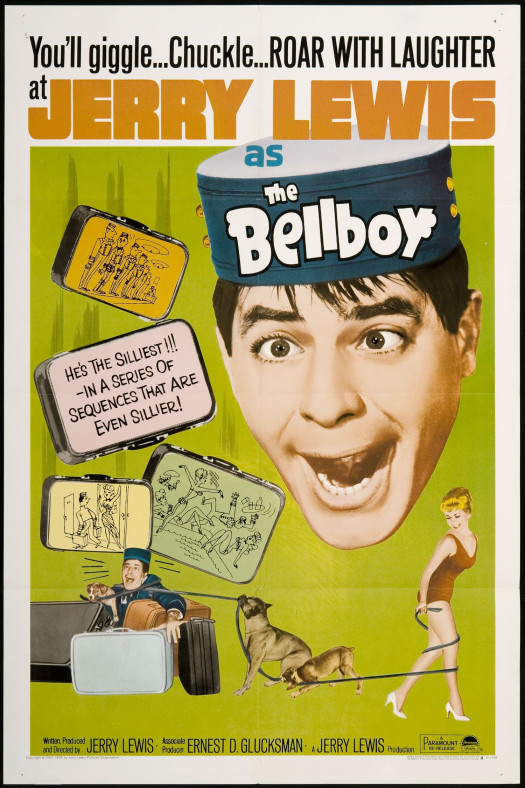
Quirky Jerky: Jerry Lewis in THE BELLBOY (Paramount 1960)


gary loggins's avatarcracked rear viewer

The late, great Jerry Lewis was not just a funny man, he was an innovative filmmaker whose talents behind the cameras matched his onscreen antics. Paramount Pictures gave him carte blanche on THE BELLBOY, his first film as producer/director/writer/star, a film with “no story, no plot, just a series of silly sequences” following the misadventures of Stanley, the world’s most inept bellboy. To the best of my knowledge it is the first of its kind… even W.C. Fields’ bizarre NEVER GIVE A SUCKER AN EVEN BREAK and Olsen & Johnson’s wacky HELLZAPOPPIN’ had some semblance of loose plot foisted on them by nervous studio execs!

Lewis was doing his nightclub act at Miami’s Fontainebleu Hotel at the time, and already had CINDERFELLA in the can. Paramount wanted a summer release, but Lewis thought the film would do better in the Christmas season, so he concocted this loose, madcap romp done…

View original post 273 more words

A Movie A Day #245: The Missouri Breaks (1976, directed by Arthur Penn)


After Tom Logan (Jack Nicholson) and his gang of rustlers (played by Randy Quaid, Frederic Forrest, and Harry Dean Stanton) rob a train, Logan uses the money to buy a small ranch.  Their new neighbor is Braxton (John McLiam), a haughty land baron who considers himself to be an ambassador of culture to the west but who is not above hanging rustlers and hiring gunmen.  One such gunman is the eccentric Robert E. Lee Clayton (Marlon Brando), a “regulator” who speaks in a possibly fake Irish brogue, is a master of disguise, and uses a variety of hand-made weapons.  Braxton hires Clayton to kill Logan and his men, despite the fact that his daughter (Kathleen Lloyd) has fallen in love with Logan.

A flop that was so notorious that it would be five years before Arthur Penn got a chance to direct another film, The Missouri Breaks is best remembered for Marlon Brando’s bizarre performance.  Brando reportedly showed up on the set late and insisted on largely improvising his part, which meant speaking in a comical Irish accent, singing an impromptu love song to his horse, and disguising himself as an old woman for one key scene.  (According to Patrick McGilligan’s Jack’s Life: A Biography of Jack Nicholson, co-star Harry Dean Stanton grew so incensed at Brando’s behavior that he actually tried to rip the dress off of Brando, saying that he simply would not be “killed’ by a man wearing a dress.)  Brando’s later reputation for being a disastrously weird performer largely started with the stories of his behavior on the set of The Missouri Breaks.

I had heard so many bad things about Brando and The Missouri Breaks that I was surprised when I finally watched it and discovered that it is actually a pretty good movie.  For all of his notoriety, Brando does not enter this leisurely paced and elegiac western until after half a hour.  The majority of the movie is just about Jack Nicholson and his gang, with Nicholson giving a low-key and surprisingly humorous performance that contrasts well with Brando’s more flamboyant work.  While Arthur Penn may not have been able to control Brando, he still deftly combines moments of comedy with moments of drama and he gets good performances from most of the supporting cast.  Quaid, Stanton, Forrest, and Nicholson are all just fun to watch and the rambling storyline provides plenty of time to get to know them.  Whenever Brando pushes the movie too close to self-parody, Nicholson pulls it back.   The Missouri Breaks may have been a flop when it was released but it has aged well.

What Lisa Watched Last Night #169: My Baby Is Gone! (dir by Steve Bacic)


Last Monday, I watched the Lifetime premiere movie, My Baby Is Gone!  I should have reviewed it on Tuesday but, to be honest, I spent all of last week trying to figure out if Carrie was actually Laura Palmer and if Dale Cooper ever actually escaped the Black Lodge or not.  So, this review is a week late and for that, I apologize even though I think anyone who would require an apology is kind of a jerk.

Why Was I Watching It?

Seriously, what’s been going on with Lifetime lately?  It used to be that every Saturday night saw the premiere of a new Lifetime film.  Live tweeters across the country would look forward to every new Lifetime film.  We transformed several of those films into trending topics.  We did our part.

But, for some reason, this year has seen a different Lifetime.  More often than not, Lifetime airs an old movie on Saturday and saves the premiere for Sunday.  Sorry, Lifetime.  I love you but if I have to choose between a new movie and Twin Peaks, Game of Thrones, The Walking Dead, The Deuce, Big Brother, and almost everything else that I can watch on Sunday night, anything that Lifetime premieres on Sunday is probably going to end up sitting on my DVR for a while before I actually watch it.

However, My Baby is Gone! did not premiere on Sunday.  It premiered on Labor Day, so, for the first time in what seemed like forever, I was actually able to watch and live tweet the movie as it aired.  Seriously, Lifetime, get it together.  Nobody wants to watch a Lifetime premiere on Sunday.

What Was It About?

Emily (Elisabeth Harnois) is 8 months pregnant.  Her husband (Ryan S Williams) seems to be a good guy but he works too hard and sometimes, he misses Emily’s checkups.  Her best friend (Nicole LaPlaca) is supportive but she also works with Emily’s husband so, of course, it’s reasonable to assume that they’re probably sleeping together.  This is a Lifetime movie, after all.  After you’ve seen enough Lifetime movies, you know there’s no way that men and women can ever just be co-workers.

(Unless, of course, they’re cops.  In that case, they’re just ineffectual and inevitably end up arresting the wrong person.)

Luckily, someone new has moved in across the street!  Kelly (Anna van Hooft) is super-friendly and helpful and — oh my God! — she’s eight months pregnant too!  Kelly says that she’s just staying in the house until her aunt returns.  What no one knows, of course, is that Kelly’s actually got her aunt tied up in the basement.

Oh, and it turns out that Kelly isn’t really pregnant, either.  She’s just wearing a fake belly.  It’s actually kind of obvious but, at first, everyone just takes Kelly at her word.

Soon, Kelly is drawing Emily away from her husband and her best friend.  She even convinces Emily to decorate the nursery with flamingos instead of butterflies!

What could Kelly’s nefarious plan be?

What Worked?

Uhmm… I’m thinking about it…

Actually, I had a lot of fun live tweeting this film.  My Baby is Gone! is one of those movies that literally brings out the best in a snarky audience.  There’s just so many implausible developments and none of the characters are likely to be mistaken for a member of Mensa.  It’s a fun movie to watch if you’re looking for an excuse to spend two hours wondering how people can be so stupid.

Anna Van Hooft did a great job as Kelly.  If you’re going to play a character who is batshit crazy in a Lifetime film, you might as well go all out.  When you’re in a movie with a title like My Baby is Gone!, the time for subtlety is over.

What Did Not Work?

Even by the standards of Lifetime, the plot was just too implausible to work.  I mean, the whole fake belly thing was a lot more convincing when it used in A Deadly Adoption.

“Oh my God!  Just like me!” Moments

My favorite character was Pam (Amelia Burstyn), who was Emily’s doctor’s administrative assistant and who showed absolutely no hesitation about sharing the details of another patient’s visit.  It may not have been the best example of professional ethics but sometimes, you have to break the rules.

Lessons Learned

Butterflies are better than flamingos.

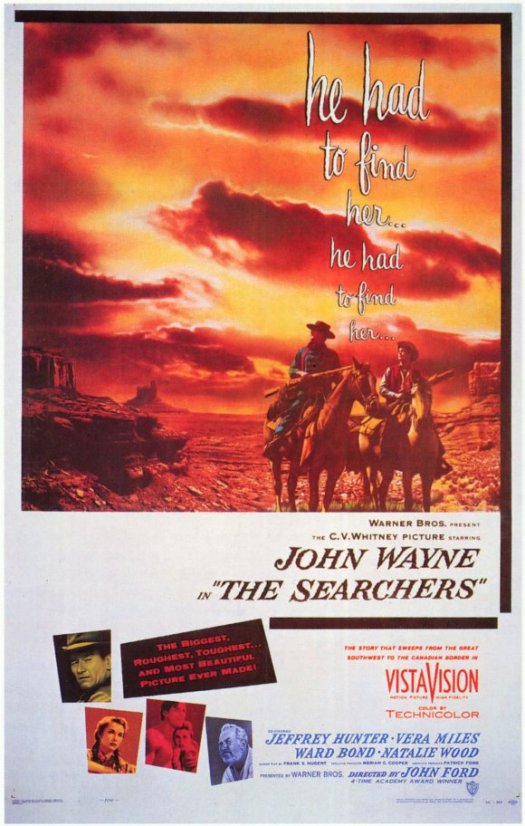
Ride Away: John Wayne in John Ford’s THE SEARCHERS (Warner Brothers 1956)


gary loggins's avatarcracked rear viewer

John Ford’s  THE SEARCHERS is without question an American Film Classic. I’d even go as far as saying it’s my second all-time favorite film, directly behind CASABLANCA. Every shot is a Remington Old West masterpiece, every actor perfect in their role, large or small, and not a minute of footage is wasted. The film has also stirred up quite a bit of controversy over time for John Wayne’s portrayal of the main character Ethan Edwards.

The plot is structured like Joseph Campbell’s “Hero’s Journey”, but let’s get it out of the way right now: Ethan Edwards is no hero. He’s a mean, bitter, unreconstructed Confederate who’s been on the shady side of the law since war’s end. When he returns to his brother Aaron’s homestead, he makes no bones about his distaste for “half-breed” Martin Pawley (really an eighth Cherokee). His hatred of Native Americans even extends to their dead, as…

View original post 1,096 more words

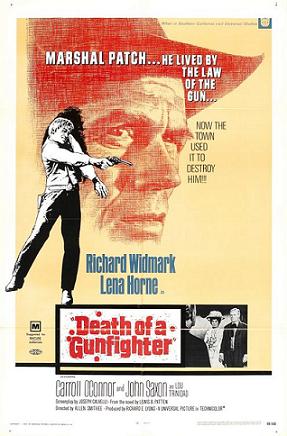
A Movie A Day #244: Death of a Gunfighter (1969, directed by Allen Smithee)


At the turn of the 20th century, the mayor and the business community of Cottonwood Springs, Texas are determined to bring their small town into the modern era.  The Mayor (Larry Gates) has even purchased one of those newfangled automobiles that have been taking the country by storm.  However, the marshal of Cottonwood Spings, Frank Patch (Richard Widmark), is considered to be an embarrassing relic of the past.  Patch has served as marshal for 20 years but now, his old west style of justice is seen as being detrimental to the town’s development.  When Patch shoots a drunk in self-defense, the town leaders use it as an excuse to demand Patch’s resignation.  When Patch refuses to quit and points out that he knows all of the secrets of what everyone did before they became respectable, the business community responds by bringing in their own gunfighters to kill the old marshal.

Death of a Gunfighter is historically significant because it was the very first film to ever be credited to Allen Smithee.  The movie was actually started by TV director Robert Totten and, after Widmark demanded that Totten be fired, completed by the legendary Don Siegel.  Since Totten worked for 25 days on the film while Siegel was only on set for 9, Siegel refused to take credit for the film.  When Widmark protested against Totten receiving credit, the Director’s Guild of America compromised by allowing the film to be credited to the fictitious Allen Smithee.

In the years after the release of Death of a Gunfighter, the Allen (or, more often, Alan) Smithee name would be used for films on which the director felt that he had not been allowed to exercise creative control over the final product.  The Smithee credit became associated with bad films like The O.J. Simpson Story and Let’s Get Harry which makes it ironic that Death of a Gunfighter is not bad at all.  It’s an elegiac and intelligent film about the death of the old west and the coming of the modern era.  It also features not only one of Richard Widmark’s best performances but an interracial love story between the marshal and a brothel madame played by Lena Horne.  The supporting cast is full of familiar western actors, with Royal Dano, Harry Carey, Jr., Larry Gates, Dub Taylor, and Kent Smith all making an impression.  Even the great John Saxon has a small role.  Though it may be best known for its “director,” Death of a Gunfighter is a film that will be enjoyed by any good western fan.