Film Review: Fahrenheit 451 (dir by Ramin Bahrani)


(Before reading this review, make sure that you’ve read my review of Ray Bradbury’s novel!)

(And then make you sure that you’ve read my review of the 1966 Truffaut film!)

The latest HBO original film, Fahrenheit 451, is bad.

For all the talent involved, for all the hype, and for all the hope that many of us had for it, it is extremely bad.  It sets up its targets and then fires at them with all the aim and success of a myopic archer.  By almost any standard, it’s a misfire of almost Vinyl proportions.

The film, of course, is based on Ray Bradbury’s novel about a future dystopia where the population is kept in line through pharmaceuticals and mind-numbing television and where firemen burn books.  Michael B. Jordan plays Montag, the fireman who develops doubts.  Michael Shannon plays Beatty, Montag’s boss. Sofia Boutella is Clarisse, who inspires Montag to question why.  And no one plays Montag’s wife because that character was apparently cut from the film.

From the minute this version starts, it’s obvious that this film was inspired less by Bradbury and more by Black Mirror, Blade Runner, and the Purge franchise.  The entire world is defined by neon and dark shadows.  Gone is Bradbury’s suggestion that a world without books would be a bland one.  Instead, a world without books is now one that looks like every single recent sci-fi film.  People may have stopped reading but apparently, they’re still watching old Ridley Scott movies.

Gone too is the idea of Montag as a middle-aged man struggling with an existential crisis.  Now, he’s Michael B. Jordan, who comes across as if he’s never had a moment of doubt in his entire life.  He’s less Montag and more Creed in an authoritarian future.  Also gone is the weary relationship with Captain Beatty.  Now, Beatty is almost a father figure to Montag.  Of course, Montag’s real father died mysteriously years ago.  Nothing indicates a lazy screenwriter quicker than a character with daddy issues.

As I mentioned earlier, in this version, Montag is not married.  Instead, he lives a bachelor lifestyle in a glitzy apartment and he spends most of his time asking questions to the future’s version of Alexa, Yuxie.  (“Yuxie, was Benjamin Franklin the first fireman?”)  Of course, in the novel, Montag’s wife stood in for every citizen who never questioned why books were being burned.  It was Montag’s dissatisfaction with his bland home life that led to him getting to know Clarisse and eventually questioning his job as a fireman.  Now, Montag starts to doubt after a random rebel says that Benjamin Franklin didn’t support burning books.  But why, if Montag has spent a lifetime refusing to question anything, would some rando rebel suddenly make him reconsider?

The Book People are still around but now they’re kind of a pain.  I love books but I wouldn’t want to hang out with any of them.  They’re a humorless group of people who live in a farm and apparently being a book person means you can’t wash your hair or something because seriously, everyone looked a bit grimy.  I mean, it’s important to rebel again authoritarianism but that doesn’t meant you can’t look good while doing it.  Each Book Person has memorized a book and you have to wonder how they decide who gets to memorize which book.  We’re told that one Book Person has memorized Chairman Mao but if you’re battling censorship, would you really want to hang out with a person who has devoted her life to the guy behind the Cultural Revolution?  Another Book Person claims to have memorized all of Proust but I think he’s a damn liar.  I mean, how is anyone going to check that?  I’m guessing he probably only memorized the first 20 pages or so of Swann’s Way.  What I want to know is who got to memorize the Twilight books?

This version of Fahrenheit 451 is a bit of a mess.  I’m not one to demand that literary adaptations stick exactly to their source material.  (For instance, the film version of The Godfather was greatly improved by ignoring 60% of what happened in Mario Puzo’s novel.  For that matter, we can all be thankful that It didn’t end with the Losers Club solidifying their bond by having group sex with Beverly.)  But, in this case, the changes don’t improve on the original.  Instead, they just turn Fahrenheit 451 into yet another shadowy dystopian film.

When it comes to Fahrenheit 451, my advice is just to read the book.

This Is What A Mountain Of Coke And A Deal With HBO Will Get You: Disco Beaver From Outer Space (dir by Joshua White)


So, this happened:

Every Saturday, I get together with my friends in the Late Night Movie Gang and we watch a movie.  I’m usually the one who picks the movie.  I usually try to pick something fun and kinda silly.  For instance, every Christmas, we watch Santa Claus Conquers The Martians.  Last week, we watched Tobor The Great.  And this week, I selected a 51-minute program from 1978.  The name of that program?

Disco Beaver From Outer Space.

Now, I have to admit that this was one of the rare instances where I didn’t actually bother to watch the entire movie before selecting it.  I did watch the first five minutes on YouTube.  It featured someone in a beaver costume walking around New York City and eating stuff while disco music played in the background.  That was all I needed to see.

An alien beaver eating New York!?  I thought, Disco music!?  How could this possibly go wrong!?

Add to that, the movie only had 51 minute run time.  Even if it’s terrible, I thought, at least it won’t be long!

However, once the film started, I discovered that 51 minutes can be a very long time indeed.  Unfortunately, it turned out that the beaver wasn’t actually in much of the film.  He showed up at the start of the movie and then he popped up in the middle and finally, he showed up again at the end.  That the beaver was cute and came with his own disco song made it all the more regretful that he wasn’t in more of the film.

Anyway, it turned out that the film itself was a collection of vaguely connected sketches.  The idea was that a husband and wife were looking for something to watch and , as a result, they kept changing the channel.  One channel featured a country western singer.  Another channel was showing Masterpiece Theater.  And then there was this movie about a vampire called Dragula.

The joke about Dragula was that he was gay and … well, that was pretty much it.  Dragula was gay and everyone he bit turned gay and eventually Lynn Redgrave showed up as Dr. Vanessa Van Helsing and she managed to destroy Dragula.  If you think this sounds homophobic … well, it was.  When the humor wasn’t homophobic, it was misogynistic.  I’ve always been proud of the fact that I’m not easily offended and I’ve never been the type to need a safe space but I have to admit that I spent the majority of Disco Beaver cringing.  Of course, the problem wasn’t that the humor was politically incorrect.  The problem was that the majority of it just wasn’t that funny.

Disco Beaver was produced, for HBO, by National Lampoon.  In fact, HBO was only 6 years old when it broadcast Diso Beaver so I’m going to assume that this may have been one of the first original programs ever specifically made for the network.  Perhaps that explains why the entire production has a sort of “look how naughty we can be on cable!” feel to it.  “We just dropped the F bomb!  Here’s a whole skit about breasts!  And now, here’s a  skit about how to spot a homosexual.  We’re so daring!”

From the minute that Disco Beaver started, I felt as if I could literally hear the coke being cut backstage.  How many lines of cocaine were snorted over the course of the making of Disco Beaver?  Remember that scene at the end of Scarface where Al Pacino had a mountain of white powder on his desk?  I imagine that’s what the Disco Beaver production office looked like.

Anyway, we survived Disco Beaver and, at the end of it, we swore that we would never speak of it again.  And I learned a very valuable lesson!  Always watch the entire movie!

Guilty Pleasure No. 36: The Legend of Billie Jean (dir by Matthew Robbins)


Two weeks ago, while I was sick in bed, I watched The Legend of Billie Jean, a deeply silly movie from 1985.

Okay, get this.  Billie Jean (Helen Slater) and her younger brother, Binx (an incredibly young Christian Slater), live in Corpus Christi, Texas.  Binx has always wanted to go to Vermont.  That right there should tell you just how silly this movie is.  Not only does it feature a character named Binx but it also features Texans wanting to go to Vermont.  I’m a native Texan who loves to travel but I can tell you right now that the last place I would ever want to go would be Vermont.  In fact, down here, we tend to assume that Vermont’s just a place that was made up by the media.  Bernie Sanders?  He’s just an actor.  Seriously, there’s no way that Vermont actually exists.

Anyway, after Binx throws a milkshake in the face of local bully, Hubie Pyatt (Barry Tubb), Hubie steals Binx’s scooter.  (If you’re stuck with a name like Hubie Pyatt, it seems kinda predestined that you’re going to grow up to be a bully.)  After getting nowhere with the police, Billie Jean returns home to discover that Binx has been beaten up and his scooter has been dismantled.  Billie Jean goes to Hubie’s father (Richard Bradford) to demand some money to get the scooter fixed.  Mr. Pyatt responds by attempting to assault Billie Jean, which leads to Binx shooting Mr. Pyatt in the shoulder.

So now, Billie Jean and Binx are on the run.

Joining them in their flight are two idiot friends (Martha Gehman and Yeardley Smith) and Lloyd (Keith Gordon), the son of the local district attorney.  Because this is a movie, Billie Jean quickly becomes a media superstar.  Everyone wants to meet Billie Jean.  Everyone wants to help Billie Jean.  A sympathetic police detective (Peter Coyote) is determined to capture Billie Jean without violence but that might be difficult with the media constantly getting in the way.

While hiding out in a motel, Billie Jean turns on the TV and watches the classic 1928 silent film, The Passion of Joan of Arc.  (I have to say that I’ve stayed in a few motels around Corpus Christi and never once did I turn on the TV and just happen to come across a classic silent movie.)  Moved by Renee Falconetti’s performance in the lead role, Billie Jean decides to cut her hair really, really short (though not as short as Falconetti’s).  I guess Billie Jean is supposed to be a 1980s version of Joan of Arc, which really doesn’t make any sense.  I mean, Joan of Arc heard the voice of God and led the French to victory over the British.  Billie Jean is just trying to get some money to get her brother’s scooter fixed and pay for a trip to the imaginary state of Vermont.

Meanwhile, Mr. Pyatt has recovered from his wounds and is now selling Billie Jean merchandise in his store.  The detective mentions how weird that is but Mr. Pyatt is just out to make some money.  Can you blame him?  The entire country is obsessed with Billie Jean!

As you might have guessed, The Legend of Billie Jean is incredibly silly but likable.   Despite having an inconsistent Texas accent, Helen Slater does a good job in the lead role of Billie Jean and it’s interesting to actually see Christian Slater before he developed the sarcastic style that, for better or worse, has come to define pretty much all of his performances.  Never for a second do you believe that Billie Jean would actually become a media superstar.  (Nor do you ever believe that she’s the type who would have the patience to watch a silent movie.)  I mean, when you get right down to it, it’s a pretty dumb movie.  But, when you’re sick in bed, The Legend of Billie Jean is a perfectly acceptable way to pass the time.

Previous Guilty Pleasures

  1. Half-Baked
  2. Save The Last Dance
  3. Every Rose Has Its Thorns
  4. The Jeremy Kyle Show
  5. Invasion USA
  6. The Golden Child
  7. Final Destination 2
  8. Paparazzi
  9. The Principal
  10. The Substitute
  11. Terror In The Family
  12. Pandorum
  13. Lambada
  14. Fear
  15. Cocktail
  16. Keep Off The Grass
  17. Girls, Girls, Girls
  18. Class
  19. Tart
  20. King Kong vs. Godzilla
  21. Hawk the Slayer
  22. Battle Beyond the Stars
  23. Meridian
  24. Walk of Shame
  25. From Justin To Kelly
  26. Project Greenlight
  27. Sex Decoy: Love Stings
  28. Swimfan
  29. On the Line
  30. Wolfen
  31. Hail Caesar!
  32. It’s So Cold In The D
  33. In the Mix
  34. Healed By Grace
  35. Valley of the Dolls

Film Review: Tobor The Great (dir by Lee Sholem)


Last week, along with my friends and fellow members of the Late Night Movie Gang, I watched the 1954 sci-fi film, Tobor The Great.

As you can probably tell by looking at the top of this review, Tobor came with a really great poster.  It’s a poster that promises all sorts of sci-fi thrills and chills.  It screams, “B-movie masterpiece!”  You look at that poster and you think to yourself, This film is probably extremely silly but I absolutely have to watch it!

Of course, if you know anything about the B-movie aesthetic of the 50s and 60s, you won’t be shocked to learn that the poster has next to nothing to do with the actual film.  True, there is a robot is featured in the film.  The poster is honest about that.  And Tobor actually looks just as good in the movie as he does on the poster.  And there is a subplot about space travel but, at no point, do we see Tobor walking across the surface of Neptune or Jupiter or wherever it is that Tobor is supposed to be in this poster.  Maybe he’s on one of the moons of Saturn.  Who knows?

Also, at no point, does Tobor carry around a woman.  In fact, Tobor is pretty much a film for kids.  The main character, other than Tobor, is an 11 year-old boy named Gadge (Billy Chapin).  I can only imagine how audiences reacted when they went into the film expecting to see the scene in the poster and instead, they were confronted with a movie about a little boy and his robot.

Tobor is one of those films that opens with several minutes of stock footage.  Rockets take off.  The stars shine in the sky.  Scientists and engineers do stuff.  It all looks pretty impressive but, of course, none of it was actually shot for this film.  In fact, the use of all that stock footage mostly serves to highlight how cheap the rest of the movie looks.

As for the film’s plot, it has apparently been determined that it’s too dangerous to send humans into space.  So, Professor Nordstrom (Taylor Holmes) and Dr. Harrison (Charles Drake) build a robot that is specifically designed to fly an interstellar craft.  They name their creation Tobor, because that’s robot spelled backwards.  (Tobor even points out that his name is robot spelled backwards.)  In order to help Tobor explore the universe, they design him to be able to simulate human emotions.  In fact, they’re so successful at it that Tobor ends up befriending Nordstrom’s grandson, the aforementioned Gadge.

The press and the military are all very impressed with Tobor.  Unfortunately, it’s the 1950s and that means that the communists are impressed by Tobor as well!  Can the scientists and their families keep Tobor from getting abducted by a bunch of Russian agents!?  Let’s hope so because there’s a lot of space that needs to be explored….

Anyway, Tobor The Great is silly but kind of fun.  It has its slow spots but it also has a really cool robot and it’s always fun to watch the commies get thwarted.  It’s a real time capsule film, one that not only reflects the decade in which it was made but which also has a somewhat charming innocence to it.  If nothing else, it’s nice to think that, in the days before CGI, the filmmakers actually had to make a Tobor of their own.  Apparently, Tobor is currently in a private collection and I hope whoever has him is treating him well.

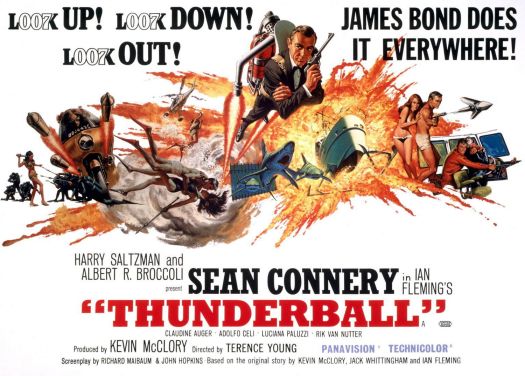
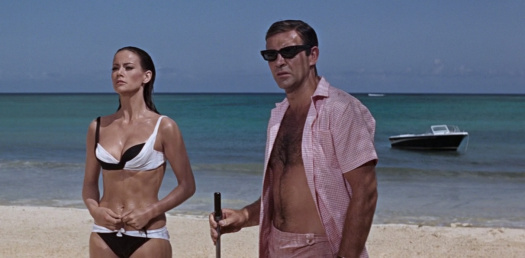
Bond Goes Deep!: THUNDERBALL (United Artists 1965)


gary loggins's avatarcracked rear viewer

THUNDERBALL, the fourth 007 adventure, will always hold a special place in my heart. It’s the first James Bond movie I saw at the theater, released at the height of the Secret Agent/Spy craze, and I was totally hooked! I even had all the toys that went with the movie, including Emilio Largo’s two-part boat the Disco Volante, with which I engaged in mighty battles in the bathtub against VOYAGE TO THE BOTTOM OF THE SEA’s Seaview (hey, I was only seven!).

SPECTRE is at it again, this time hijacking a NATO jet loaded with two nuclear bombs, and holding the world hostage. Bond, sent to recuperate at a health spa, stumbles on to trouble related to the crisis, and is sent by MI6 to investigate Domino Derval, sister of the NATO pilot. This leads 007 to Domino’s “guardian” Emilio Largo, a rich and powerful man who’s Number Two…

View original post 421 more words

Film Review: Fahrenheit 451 (dir by Francois Truffaut)


Tonight, HBO will be premiering a film version of Ray Bradbury’s Fahrenheit 451.  This version will star Michael B. Jordan as “fireman” Guy Montag and Michael Shannon as Montag’s boss, Captain Beatty.  It’s one of the more eagerly anticipated films of the current television season but it’s not the first version of Fahrenheit 451 to be filmed.

The first version was released, by Universal Pictures, in 1966.  It was the first (as well as only) English langauge film to be directed by the great French filmmaker, Francois Truffaut.  (It was also Traffaut’s first color film, allowing the flames to burn in bright yellow and red.)  Unfortunately, Truffaut would later describe the film as being his “saddest and most difficult” film making experience.

Though there are a few noticeable differences, the film sticks closely to the plot of Bradbury’s novel.  Guy Montag (Oskar Werner) is a “fireman” in the near future.  Montag lives in a society where books have been banned and the populace is kept to docile through a combination of pharmaceuticals and mindless television programming.  Montag’s wife, Linda (Julie Christie), is content to live life without questioning anything.  However, when Montag meets a school teacher named Clarisse (also played by Christie), all of his previous assumptions are challenged.  What if the government isn’t always right?  What if ignorance isn’t bliss?  What would happen if, instead of burning books, Montag actually read one?  After witnessing a woman choosing to self-immolate herself so that she can die with all of her books, Montag is finally ready to quit being a fireman.  But his captain (Cyril Cusack) tells Montag that he needs to go on one more call, this one to Montag’s own house.

Truffaut’s film leaves out most of the overly sci-fi elements of Bradbury’s original novel.  For instance, in the novel, Montag is terrified of the robots dogs that the firemen use but the dogs never appear in Truffaut’s film.  As well, Traffaut totally eliminates the character of Faber, the former English professor who uses a portable communicator to keep in contact with Montag.  (Today, of course, that hardly seems like science fiction.)  In Truffaut’s film, the setting is designed to appear as contemporary and familiar as possible, a reminder that the story may have been sent in the future but that the issues it dealt with were relevant to the present.  With this film, Truffaut asked the audience, “How different is the world today from the world of Bradbury’s novel?”

Truffaut’s other big departure from Bradbury’s text was to cast Julie Christie as both Clarisse and Linda.  In the book, Montag’s wife was named Mildred and Bradbury went of out of his way to establish her as being the exact opposite of Clarisse.  In Truffaut’s film, the double casting of Christie seems to suggest that Clarisse and Linda are two sides of the same character.  Montag loves them both, though each appeals to a different part of Montag’s psyche.  Linda appeals to the side of Montag that wants to just accept things the were they are and be happy.  Clarisse, meanwhile, represents the part of Montag that wants to be free to feel everything, even if it means occasionally being unhappy or uncertain.  When Montag finally meets the Book People, he discovers that they are just as fanatical about memorizing and reciting books as Linda was about watching her television shows.  Was this intentional on Truffaut’s part, a suggestion that both the government and the rebels are, like Clarisse and Linda, two sides of the same coin?

It’s an intriguing but uneven movie.  Truffaut apparently didn’t have a great working relationship with Oskar Werner and, at times, Werner doesn’t seem to be particularly invested in the role of Montag.  (Interestingly enough, it’s also been suggested that Jacqueline Bisset’s character in Day For Night was inspired by Truffaut’s experiences working with Julie Christie in this film.)  When the characters interact, the dialogue sometimes feel stiff and dull, as if Truffaut never got over his discomfort with having to direct a film in something other than his native French.  At the same time, the film is full of hauntingly beautiful images, from the defiant woman standing in the middle of her burning books to the Book People walking through the snow.  Truffaut makes brilliant use of color and the visuals are often strong enough to overcome even Oskar Werner at his most sullen.

Fahrenheit 451 is an imperfect movie but one worth seeing.  Will the new HBO version be able to match it?  We’ll find out soon enough.

Cleaning Out The DVR: Widsom (dir by Emilio Estevez)


(I recorded the 1986 film, Wisdom, off of Retroplex on Mary 1st.)


(SPOILER ALERT!  The ending of this film is so extremely stupid that there’s no way I’m not going to discuss it in this review.)

Meet John Wisdom (Emilio Estevez)!

He’s got one of those ironic names, as people in pretentious movies often do.  He’s extremely naive but his name is Wisdom.  He does a lot of stupid crap but his name is Wisdom.  And I guess the audience is meant to feel that Wisdom understands more than even he knows.

Or something like that.

Who knows?

Anyway, John Wisdom has got some issues.  He’s a college dropout who can’t get a good job because he has a criminal record.  He didn’t really do anything wrong, of course.  All he did was steal a car on the night of his high school graduation.  Hey, who hasn’t done that?  Anyway, Wisdom would be happy to just spend all day sitting around in his bathtub but his father (Tom Skerritt) insists that Wisdom find some sort of employment.

Eventually, Wisdom ends up working in a fast food restaurant.  It turns out that he’s not very good at it, which leads me to suspect that Wisdom probably wouldn’t be very good at any of the other jobs that he was pursuing either.  To be honest, the main reason that Wisdom works at the restaurant is so that Charlie Sheen can have a cameo as Wisdom’s boss.

(Strangely, Martin Sheen is nowhere to be found in the movie.  It wouldn’t surprise me if Emilio Estevez — who both directed and wrote the script — originally envisioned Martin playing his father.  Tom Skerritt does an extended Martin Sheen impersonation as Daddy Wisdom.)

Anyway, Wisdom decides that since the system refuses to give him a fair chance, he’s going to live the rest of his life as an outlaw.  So, Wisdom starts to rob banks.  However, instead of stealing all of the money, Wisdom is more interested in setting fire to mortgage and loan records.  Wisdom explains, via voice over, that he’s concerned about the working people who keeps getting screwed over by the banks.  That’s all good and well but I thought the whole reason that Wisdom started robbing banks was because there was no other way for him to make any money.  So, when did Wisdom go from being a greedy criminal to an altruistic rebel?

Naturally, Wisdom and his girlfriend, Karen (Demi Moore), becomes folk heroes.  Everyone wants to meet Wisdom and protect him from the police.  But eventually, Karen gets gunned down by a police helicopter.  Poor Karen.  She didn’t even want to rob banks.  Well, actually, she did want to rob banks.  And then she didn’t.  And then she did again.  Karen’s motivation and personality changes from scene-to-scene, largely because she’s a poorly written character.  But no matter.  She’s dead now.

But Wisdom’s still alive!  Except, soon, he finds himself surrounded by cops.  Standing in the middle of a football field (Oh my God!  The symbolism!), Wisdom is gunned down by law enforcement…

…except suddenly, Wisdom’s back in the bathtub.  Apparently, he was just daydreaming about his girlfriend getting gunned down in front of him.  Wait … what?  Seriously, what type of ending is that!?  At the very least, the film could have ended with Wisdom robbing a bank for real and accepting that his dream is destined to come true.  I mean, that would have been stupid but at least it would have been something.  Instead, things end with Wisdom leaving the bathroom.

So, basically, the entire film was just Wisdom daydreaming about robbing banks and eventually getting gunned down on a football field.  Oh, Wisdom.  You got some issues, sweetie!

Emilio Estevez directed this film a year after appearing in The Breakfast Club.  Like many directorial debuts, it’s incredibly dumb.  You can tell that Estevez wasn’t sure what he wanted to say but he was still damn determined to say it.  Why do so many actors end up directing such pretentious and/or boring movies?  On the plus side, there were a few attempts at deliberate humor (Wisdom is not a particularly organized bank robber) and Demi Moore did a fairly good job playing an inconsistent character.  Otherwise, Wisdom is mostly memorable for having one of the worst endings of all time.

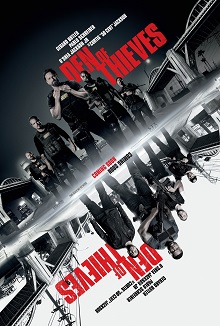
Film Review: Den of Thieves (dir by Christian Gudegast)


Den of Thieves is quite simply one of the most exhausting films that I’ve ever sat through.

It’s not just that the film itself is overly long, though that’s definitely an issue.  (Den of Thieves last 2 hours and 20 minutes.  For the sake of comparison, that’s 17 minutes longer than last year’s best picture winner, The Shape of Water.)  Instead, the real problem is that there’s really not a single unexpected moment to be found in Den of Thieves.  Every cliché imaginable shows up in Den of Thieves and, after a while, the film’s predictability becomes a bit much to take.

It’s a bank heist film.  We know that because it opens with a strangely portentous title card that informs us that more banks are robbed in Los Angeles than anywhere else in the country.  This is one of those heist films where a self-destructive police detective goes head-to-head with a ruthless yet sympathetic criminal mastermind.  If you’re thinking that this sounds a lot like Heat, you’re right.  In fact, imagine if they remade Heat without any of the stuff that made Heat more than just another crime film and you have a pretty good idea what you’re going to get with Den of Thieves.

The detective is named Big Nick O’Brien (Gerard Butler) and we know he’s a badass because he’s got a lot of tattoos and a beard and when he’s not busting criminals, he’s either getting drunk or getting served with divorce papers.  Nick’s an asshole but that’s okay because Nick … NICK GETS RESULTS, GODDAMMIT!  Nick has a crew that’s devoted to him.  Of course, a lot of them will be dead by the end of the movie.  That’s just the way things go when you’re living in a clichéd crime film.

Big Nick wants to take down Merrimen (Pablo Schreiber), who is a former marine turned bank robber.  We know that Merrimen is a badass because he’s got a beard and he’s got even more tattoos than Nick!  In fact, his entire crew is covered with tattoos!  You have to wonder how smart these criminals are, all getting body art that will make it very easy for the police to identify them.  But they’re a good crew.  In fact … THEY’RE THE BEST!  THEY GET RESULTS!  And only Nick can take them down because … ONLY THE MOTHERFUCKING BEST CAN TAKE DOWN THE MOTHERFUCKING BEST, GODDAMMIT!

Sorry, am I yelling a lot?  This is one of those films where everyone yells a lot.  Basically, this entire movie is drenched in testosterone.  This is one of those films where no one gets interrogated with getting knocked around beforehand and where every meeting is some sort of confrontation.  When the end credits rolled, I was shocked to learn that some of these people actually had names.  Just from listening to the dialogue, I assumed everyone in the film was named “Motherfucker.”

And again, it just all gets exhausting after a while.  Maybe if Den of Thieves had been a 90 minute action flick or had featured any of the self-aware humor of Baby Driver, it would have been entertainingly dumb.  But 140 minutes is a long time to spend with a bunch of thinly drawn stereotypes.

Now, there are two positive things that can be said about Den of Thieves.

First off, one of the thieves is played by O’Shea Jackson, Jr. and he’s got enough screen presence that he can overcome some clunky scenes.  (A scene where he’s interrogated by the police literally seems to go on forever.)

Secondly, the film itself looks great.  The film’s opening scenes do a good job of capturing Los Angeles’s unique mix of grit and glitz.  The opening shootout is pretty well-done and briefly suggests some promise on which the film ultimately doesn’t deliver.

Anyway, Den of Thieves came out this January and despite middling reviews, it did well enough at the box office to earn itself a sequel.  So, in 2020, look forward to more scenes of Gerard Butler … GETTING RESULTS!

Cannes Film Review: The Silent World (dir by Jacques Cousteau and Louis Malle)


In the history of Cannes Film Festival, only two documentaries have won the Palme d’Or.

The second documentary to win was Michael Moore’s Fahrenheit 9/11, which won in 2004 despite not being a particularly good film.  In fact, even by the standards of Michael Moore, it was deceptive and sloppy.  However, it was also anti-Bush at a time when the entire world was anti-Bush and that was enough for it to win.  (Hilariously, at the time, there was serious talk that Fahrenheit 9/11 would somehow keep Bush from winning reelection, as if anyone who was even thinking of voting for Bush would have ever bothered to sit through Moore’s film.)

Far more interesting than Moore’s screed is the first documentary to win the Palme, 1956’s The Silent World.  Narrated and co-directed (with Louis Malle) by the famed oceanographer, Jacques Cousteau, the film follows Cousteau and the crew of Calypso over the course of two and a half years, as they explore the Mediterranean Sea, the Persian Gulf, the Red Sea and the Indian Ocean.  The film was one of those first to make use of underwater color photography, which at the time was quite revolutionary.  Chances are that, for many audiences in 1956, The Silent World was their first chance to see what the undersea world was actually like.

Unfortunately, Jacques and his merry band of divers spend a good deal of the documentary destroying stuff.  Watching the film, it’s obvious that the divers don’t understand the potential damage of their actions and Cousteau would go on to renounce a lot of the exploration techniques used in The Silent World but still, it’s hard not to occasionally cringe.  Watching the divers as they explore the underwater depths, you immediately notice that they seem to be rather grabby, snatching everything that they can off of the ocean floor.  When Cousteau feels that a coral reef is getting in the way of his research, he solves the problem with dynamite.  Then there’s the scene where the crew of Calypso kill several sharks that are eating the carcass of a baby whale.  (Cousteau explains that the shark is the diver’s natural enemy, which may be true but doesn’t excuse the slaughter that follows.)  Making all of this even worse is that the baby whale wouldn’t have died in the first place if it hadn’t been hit by the Calypso’s propeller.  Scenes like that leave you wondering if maybe it would be better for everyone is Jacques and his crew just went home.

And yet, at the same time, this documentary features scenes of underwater beauty that remains breathtaking even after 62 years.  The underwater camera captures schools of beautiful fish ducking out-of-the-way of the human invaders and, in the films most haunting sequence, we follow a diver as he explores a sunken ship.  In these moments, the beauty of the underwater world overwhelms you and you forget about your reservations about what’s going on with the crew of the Calypso.  In these moments, you embrace the beauty of it all and the world suddenly seems as if its full of limitless possibilities.

In those moments, you can understand why The Silent World not only won an Oscar for Best Feature Documentary but the coveted Palme d’Or as well.

Cannes Film Review: Missing (dir by Costa-Gavras)


The 1982 film Missing takes place in Chile, shortly after the American-backed military coup that took out that country’s democratically elected President, Salvador Allende.

Of course, the film itself never specifically states this.  Instead, it opens with a narrator informing us that the story we’re about to see is true but that some names have been changed “to protect the innocent and the film.”  The film takes place in an unnamed in South America, where the military has just taken over the government.  Curfew is enforced by soldiers and the sound of gunfire is continually heard in the distance.  Throughout the film, dead bodies pile up in the streets.  Prisoners are held in the National Stadium, where they are tortured and eventually executed.  Women wearing pants are pulled out of crowds and told that, from now on, women will wear skirts.  The sky is full of helicopters and, when an earthquake hits, guests in a posh hotel are fired upon when they try to leave.  About the only people who seem to be happy about the coup is the collection of brash CIA agents and military men who randomly pop up throughout the film.

Again, the location is never specifically identified as Chile.  In fact, except for the picture of Richard Nixon hanging in the American embassy, the film never goes out of its way to point out that the film itself is taking place in the early 70s.  If you know history, of course, it’s obviously meant to be Chile after Allende but the film itself is set up to suggest that the story its telling is not limited to one specific place or time.

Charlie Horman (John Shea) is an American who lives in the country with his wife, Beth (Sissy Spacek).  Charlie is a writer who occasionally publishes articles in a local left-wing newspaper.  In the aftermath of the coup, Charlie is one of the many people who go missing.  All that’s known is that he was apparently arrested and then he vanished into the system.  The authorities and the American ambassador insist that Charlie probably just got lost in the confusion of the coup and that he’ll turn up any day.  Even though thousands have been executed, everyone assumes that Charlie’s status as an American would have kept him safe.  As brutal as the new government may be, they surely wouldn’t execute an American….

Or, at least, that’s what Ed Horman (Jack Lemmon) believes.  Ed is Charlie’s father, a businessman from New York who simply cannot understand what’s going on.  He can’t understand why his son and his daughter-in-law went to South America in the first place.  He can’t understand why his government is not doing more to find his son.  And, when he eventually arrives in South America himself, Ed cannot understand the violence that he sees all around him.

Working with Beth, Ed investigates what happened to his son.  At first, Ed blames Beth for Charlie’s disappearance and Beth can barely hide her annoyance with her conservative father-in-law.  But, as their search progresses, Beth and Ed come to understand each other.  Beth starts to see that, in his way, Ed is just as determined an idealist as Charlie.  And Ed learns that Charlie and Beth had good reason to distrust the American government…

Costa-Gavras is not exactly a subtle director and it would be an understatement to say that Missing is a heavy-handed film.  The Embassy staff is so villainous that you’re shocked they don’t all have mustaches to twirl while considering their evil plans.  When, in a flashback, Charlie meets a shady American, it’s not enough for the man to be a CIA agent.  Instead, he has to be a CIA agent from Texas who heartily laughs after everything he says and who brags on himself in the thickest accent imaginable.  When Charlie talks to an American military officer, it’s not enough that the officer is happy about the coup.  Instead, he has to start talking about how JFK sold everyone out during the Bay of Pigs.

As the same time, the film’s lack of subtlety also leads to its best moments.  When Beth finds herself out after curfew, the city turns into a Hellish landscape of burning books and dead bodies.  As Beth huddles in a corner, she watches as a magnificent white horse runs down a dark street, followed by a group of gun-toting soldiers in a jeep.  When Ed and Beth explore a morgue, they walk through several rooms of the “identified” dead before they find themselves in a room containing the thousands of unidentified dead.  It’s overwhelming and heavy-handed but it’s also crudely effective.  While the film itself is a bit too heavy-handed to really be successful, those scenes do capture the horror of living under an authoritarian regime.

(Interestingly, Missing was a part of a mini-genre of films about Americans trapped in right-wing South American dictatorships.  While you can’t deny the good intentions of these films, it’s hard not to notice the lack of films about life in Chavez’s Venezuela or the political dissidents who were lobotomized in Castro’s Cuba.)

Missing won the Palme d’Or at the 1982 Cannes Film Festival (an award that it shared, that year, with the Turkish film Yol) and it also received an Oscar nomination for best picture of the year.  (It lost to Gandhi.)