Horror on the Lens: The Little Shop of Horrors (dir by Roger Corman)


(It’s tradition here at the Lens that, every October, we watch the original Little Shop of Horrors.  And always, I start things off by telling this story…)

Enter singing.

Little Shop…Little Shop of Horrors…Little Shop…Little Shop of Terrors…

Hi!  Good morning and Happy October the 30th!  For today’s plunge into the world of public domain horror films, I’d like to present you with a true classic.  From 1960, it’s the original Little Shop of Horrors!

When I was 19 years old, I was in a community theater production of the musical Little Shop of Horrors.  Though I think I would have made the perfect Audrey, everybody always snickered whenever I sang so I ended up as a part of “the ensemble.”  Being in the ensemble basically meant that I spent a lot of time dancing and showing off lots of cleavage.  And you know what?  The girl who did play Audrey was screechy, off-key, and annoying and after every show, all the old people in the audience always came back stage and ignored her and went straight over to me.  So there.

Anyway, during rehearsals, our director thought it would be so funny if we all watched the original film.  Now, I’m sorry to say, much like just about everyone else in the cast, this was my first exposure to the original and I even had to be told that the masochistic dentist patient was being played by Jack Nicholson.  However, I’m also very proud to say that — out of that entire cast — I’m the only one who understood that the zero-budget film I was watching was actually better than the big spectacle we were attempting to perform on stage.  Certainly, I understood the film better than that screechy little thing that was playing Audrey.

The first Little Shop of Horrors certainly isn’t scary and there’s nobody singing about somewhere that’s green (I always tear up when I hear that song, by the way).  However, it is a very, very funny film with the just the right amount of a dark streak to make it perfect Halloween viewing.

So, if you have 72 minutes to kill, check out the original and the best Little Shop of Horrors…

Friends With Benefits: Demon Wind (1990, directed by Charles Phillip Moore)


Stupid Cory (Eric Larson) has a surprisingly large number of friends and, one weekend, he drags them all out to a burned-out farmhouse.  It used to belong to Cory’s grandparents and Cory hopes to learn why they died.  As soon as they all arrive, a thick fog rolls in and, quicker than you can say Evil Dead, the farmhouse is under siege by monsters that are definitely not Deadites and all of Cory’s friends turn into demons who spits up pancake batter whenever they die.  it turns out that the demons travel on the wind and there’s nothing this demon wind can’t do.

That’s Demon Wind, which is one of the more forgettable straight-to-video horror films to come out of the 90s.  It has a cult following because it was released with one of those 3-D covers that led to a lot of people renting it but the movie itself is a drag with bad acting, bad dialogue, and not enough gore or nudity to really qualify as even a guilty pleasure.  I did like that Cory’s friends were all given one weird personality quirk to help us keep them apart.  There’s a jock with a brainwashed girlfriend and a nerd and two karate guys who dress up like magicians and do magic tricks.  I also liked that even the nerd could get a hot girlfriend.  Though that happens all the time today, that was a bold move for 1990!  When Cory starts to run low on friends, more of them drive up from out of nowhere.  Those are some loyal friends!  Too bad Cory gets everyone killed for no good reason.

Keep an eye out for Lou Diamond Phillips, who was married to the film’s assistant director and who has a cameo as one of the demons.

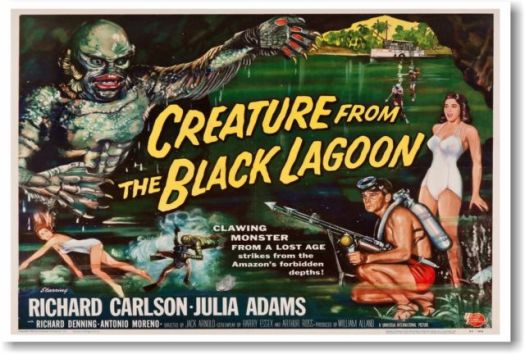
Halloween Havoc!: THE CREATURE FROM THE BLACK LAGOON (Universal-International 1954)


gary loggins's avatarcracked rear viewer

By the early 1950’s, the type of Gothic horrors Universal was famous for had become passe. It was The Atomic Age, and science fiction ruled the roost, with invaders from outer space and giant bugs unleashed by radiation were the new norm. But the studio now called Universal-International had one more ace up its collective sleeve: THE CREATURE FROM THE BLACK LAGOON, last of the iconic Universal Monsters!

Scientist Dr. Maia, exploring “the upper reaches of the Amazon” with his native guides, discovers a fossilized hand that may be the evolutionary “missing link”. Taking his finding to the Institudo de Biologia Martima, he teams with ichthyologist David Reed, David’s pretty assistant/fiancé Kay Lawrence, institute chief Dr. Mark Williams, and fellow scientist Dr. Thompson to form an expedition. They charter the steamer The Rita, skippered by Captain Lucas, and head down the river into the Black Lagoon. Maia’s Indian guides…

View original post 574 more words

I Watched The Jackie Robinson Story


Since I was pretty much indifferent to who won the World Series this year (Congratulations, Boston), I’ve been watching baseball movies instead.  I just finished watching The Jackie Robinson Story.

The Jackie Robinson Story was made in 1950, back when Robinson was still playing second base for the Brooklyn Dodgers.  The movie not only tells the story of how Jackie Robinson became the first black man to play in the major leagues but it also stars Jackie Robinson as himself!

Starting with Jackie’s childhood in Pasadena, the movie follows Jackie as he attends UCLA, serves a brief stint in the Army, and then plays baseball on an all African-American team (Jackie played for the Kansas City Monarchs but, in the movie, the team is renamed the Black Panthers!) before eventually getting signed to join the Dodgers and integrate major league baseball.  While the movie skips over a lot of Jackie’s early life, it doesn’t gloss over the prejudice that he encountered at every step of the way.  When he wins a scholarship to UCLA, people complain that the college has already recruited too many black athletes.  Even when he’s a star player in the Negro Leagues, he still has to ask permission to enter and use the washroom in a diner.  And when he joins the Dodgers, riots are threatened if he plays anywhere in the South.  During one game, his wife (Ruby Dee) overhears the whites in the stands talking about how “the Lodge” is going to visit Jackie.  Through it all, Jackie Robinson keeps his cool and refuses to give the racists the satisfaction of getting to him.  Jackie answers every bigoted comment with the crack of his bat, leaving no doubt that he belongs in the major leagues.

Jackie Robinson was a great baseball player and a great man.  He wasn’t a great actor and, in this movie, he comes across as being stiff and nervous whenever he has to play any dialogue scenes.  But then he swings a bat or catches a ball and it doesn’t matter that he can’t act.  Jackie Robinson was an amazing player and it’s still exciting to watch footage of him today.

The Jackie Robinson Story is a rousing, feel-good baseball movie and a condemnation of racism and bigotry, in all of its insidious forms.

Jackie Robinson

Horror On The Lens: The Twonky (dir by Arch Oboler)


In this 1953 satire, a philosophy professor named Kerry West (Hans Conried) buys a television.  (Remember, this was a time when televisions were still a relatively new phenomena.)  Imagine Kerry’s surprise when he discovers that his television can walk, talk, light his cigarettes, clean the house, and make money materialize out of nowhere!

Sounds great, right?

The only problem is that this TV is not only a bit possessive but it also uses its powers to brainwash people and rob them of their individuality!

Technically, The Twonky is more a comedy than a horror movie.  In fact, it’s really not scary at all.  But it is a lot of fun and it’s interesting to see how a filmmaker in the 50s dealt with television’s growing role in American society.

Enjoy!

Cold Terror: Dead of Winter (1987, directed by Arthur Penn)


Katie (Mary Steenburgen) is a struggling actress with an out-of-work husband (William Russ) and a deadbeat brother (Mark Malone).  Desperately in need of money, Kate goes to an open audition and is immediately hired by Mr. Murray (Roddy McDowall), who explains that Katie will have to meet with one of the film’s investors, the wheelchair-bound Dr. Lewis (Jan Rubes).  In the middle of a raging snowstorm, they go to Dr. Lewis’s home and, once they’ve arrived, Katie discovers that she is meant to replace an actress who looked exactly like her but who Dr. Lewis claims had a nervous breakdown.  She’s told that she must stay the night so she can meet the director in the morning and when she tries to call her husband to let him know where she is, the line is dead.  (For those born after 1996, the line being dead was the 80s equivalent of not being able to get a signal.)  Dr. Lewis says it must be due to the storm but he promises to have Mr. Murray take her into town in the morning.  Of course, the next morning, the car doesn’t start and it becomes clear that Dr. Lewis is not planning on ever letting Katie leave his home.

Dead of Winter is a throw-back to the type of gothic, damsel-in-distress films that actresses like Nina Foch, Ingrid Bergman, and Linda Darnell used to make back in the 1940s and 50s.  If you can accept that anyone could ever be as naive as Katie, it’s not that bad of a thriller.  Director Arthur Penn fills his movie with homages to Hitchcock and the scene where a drugged Katie wakes up to discover that she’s missing a finger is an effectively nasty shock.  By the end of the movie, Mary Steenburgen has played three different characters and she does a good job as all three of them.  Jan Rubes makes Dr. Lewis’s too obviously evil but Roddy McDowall is great as the polite but psychotic Mr. Murray.  When Mr. Murray sees that Katie has tried to escape by climbing out a window, he yells, “Oh dear!” and only Roddy McDowall could have pulled that off.

Dead of Winter was Arthur Penn’s second-to-last theatrical film.  After making films like Bonnie and Clyde, Little Big Man, and Alice’s Restaurant, Penn’s career went into decline as the American film industry became increasingly centered around blockbusters and Penn’s cerebral approach fell out of favor.  After Dead of Winter, Penn would direct Penn & Teller Get Killed before returning to his roots as a television director.  Penn ended his long and distinguished career as an executive producer on Law & Order.

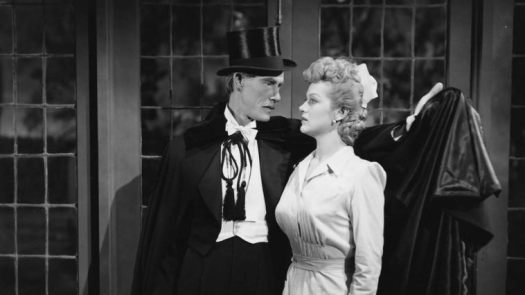
Halloween Havoc!: HOUSE OF HORRORS (Universal 1946)


gary loggins's avatarcracked rear viewer


Rondo Hatton (1894-1946) was dubbed by “The Ugliest Man in Hollywood” by Universal for his repulsive visage. Originally a Tampa-based sportswriter, Hatton began developing the disease acromegaly as a young adult, a form of gigantism which distorts the facial features and bone structure (wrestler Andre the Giant suffered from this). Rondo moved to Hollywood and got work as a film extra and some bit parts (he can be spotted in SAFE IN HELL , IN OLD CHICAGO, THE HUNCHBACK OF NOTRE DAME (’39 version), and THE OX BOW INCIDENT, among others).

1944’s “The Pearl of Death”

Hatton played “The Hoxton Creeper” in the 1944 Sherlock Holmes entry THE PEARL OF DEATH (with Universal Scream Queen Evelyn Ankers as a villainess, for a change), then proceeded to scare the daylights out of audiences in JUNGLE CAPTIVE and THE SPIDER WOMAN STRIKES BACK. While not a trained actor, his unique looks made…

View original post 409 more words

Horror on the Lens: How To Make A Monster (dir by Herbert L. Strock)


You’ve seen I Was A Teenage Werewolf….

You’ve watched I Was A Teenage Frankenstein….

Now, it’s time to watch How To Make A Monster!

Released in 1958, How To Make A Monster is a clever little horror satire from American International Pictures in which the stars of Teenage Werewolf and Teenage Frankenstein are hypnotized into believing that they actually are the monsters that they played!  The main culprit is a movie makeup artist (Robert H. Harris) who has been deemed obsolete by the new bosses at AIP.

Be sure to watch for the finale, which features cameo appearances from several other AIP monsters!  And read my full review of the film by clicking here!

Vampire Party: An American Vampire Story (1997, directed by Luis Esteban)


When his parents leave to spend the summer in Europe, Frankie (Trevor Lissauer) has the entire mansion to himself.  Frankie wants to spend the time getting closer to his girlfriend, Dee Dee (Daisy Torme), but his best friend Bogie (Danny Hitt) says that it’s time to “party hearty!”  (That’s right.  Someone in a film made after 1991 says that it’s time to party hearty.)  Bogie thinks that the best way to party would be to invite Moondoggie (Johnny Venocur) and his gang (which includes Carmen Elecrta) to hang out at the house.  But then it turns out that Moondoggie is a vampire and once he’s invited in, he refuses to leave!  Even worse, Dee Dee dumps Frankie for Moondoggie!  Luckily, there is one man on the beach who can help Frankie out of his predicament.  They call him the Big Kahuna, he wears a Hawaiian shirt and he’s played by Adam West.

This is really, really dumb but at least it’s got Adam West saying lines like, “Stop that sucking!” and “Holy wipe out!”  The movie is supposed to be a throwback to the old Frankie and Annette beach party movies from the 60s, just with vampires.  (Moondoggie’s real named is Count Erich Von Zipper.)  What the movie didn’t take into account is that there was already a perfectly good Beach Party movie with vampires and it was called The Lost Boys.  Don’t be fooled by that PG-13 rating or the way that Carmen Electra is posing on the poster.  An American Vampire Story is a tame and bloodless vampire story.  The cast is game but most of the jokes fail to land like they should and ultimately, only Adam West keeps the anemic tale alive.

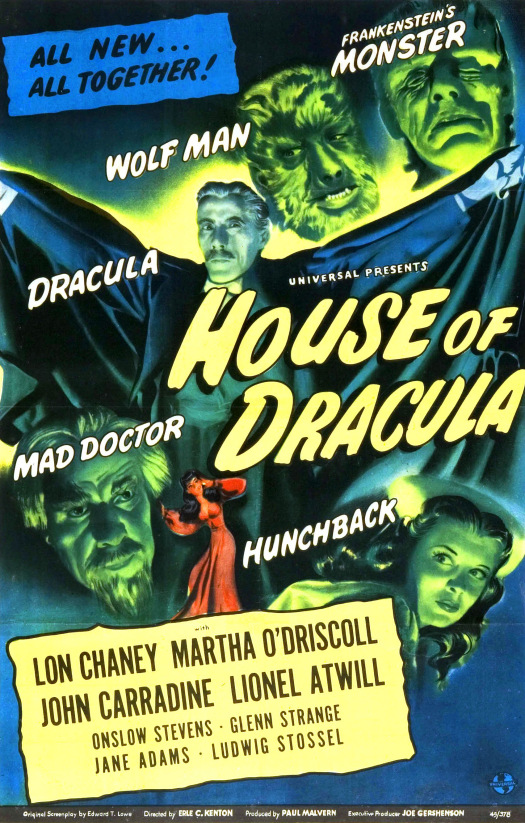
Halloween Havoc!: HOUSE OF DRACULA (Universal 1945)


gary loggins's avatarcracked rear viewer

Since I’ve already reviewed HOUSE OF FRANKENSTEIN back in 2015,  we now turn our attention to HOUSE OF DRACULA, the last “official” entry in the series (though the Universal Monsters would ‘Meet Abbott & Costello’ three years later). The film tries to put a new slant on things, using science to conquer the supernatural, but winds up being just a hodgepodge of familiar horror tropes without much cohesion. HOUSE OF DRACUA does have its fans, but I’m not one of them.

John Carradine  returns as Count Dracula, introducing himself as Baron Latos to Dr. Edlemann (Onslow Stevens ) and seeking a cure for his vampirism. Edlemann discovers a “peculiar parasite” in Dracula’s blood, and believes he can cure him through a series of transfusions. But the Count, that sneaky devil, has his fangs set for Edlemann’s pretty nurse Militza (Martha O’Driscoll),  whom he hypnotizes with those hypnotic eyes of his…

View original post 466 more words