Italian Horror Showcase: Zombi 4: After Death (dir by Claudio Fragasso)


The 1989 Italian zombie film, After Death, takes place on a Caribbean island.  I’m not sure if the island was actually given a name in the film.  If they mentioned it, I either didn’t hear it or I didn’t bother to jot it down in my notes.  But, to be honest, the island doesn’t really need a name.  If you’ve ever seen an Italian zombie film, you’ll recognize the island immediately.  It features the same lush tropical jungle that was used in Hell of the Living Dead and there’s the usual voodoo-loving island natives.  Whether it was in Zombi 2 or Zombie Holocaust, you’ve seen this island before.

Years ago, Jenny grew up on the island.  Her parents were scientists, working to discover a cure for cancer.  But, after one of them shot and killed the local voodoo priest, all of the scientists on the island ended up getting eaten by zombies.  Jenny would have been eaten as well, except for the fact that she owns a magic necklace.

Now an adult, Jenny (Candice Daly) is returning to the island with a group of mercenaries.  We know that they’re meant to be mercenaries because they have guns and grenades and headbands.  They’re not exactly the most impressive paramilitary crew that’s ever appeared in a movie.  I mean, if this was a Predator movie, it would be a contest to see which one of them ended up getting killed first.

Jenniy and the mercenaries are heading to island to discover why her parents were killed.  As soon as they arrives at the island, their boat’s engine dies, which is really rotten luck because now they’re stranded.  Of course, their luck is about to get even worse….

But first, we cut to some hikers.  They’re hiking the island and you have to wonder why Jenny and the mercenaries were acting like this island was so isolated when apparently, anyone can just hire a guide and hike it anytime they want to.  Anyway, the hikers stumble into a cave that they shouldn’t have stumbled into.  This leads to the zombies once again coming to “life” and proceeding to attack anyone who they perceive as not belonging on the island.

Only one of the hikers survives.  Fortunately Chuck (played by Jeff Stryker, a porn star who appeared in this film under the name Chuck Peyton) manages to find the mercenaries and together, they all hide out in a deserted laboratory.  Unfortunately, one of the mercenaries has been injured by the zombies and is slowly dying.  Soon, everyone is under siege as the undead surround the lab….

So, After Death is a totally ludicrous film that I can’t help but kind of like.  It doesn’t quite rise to the level of being a guilty pleasure but, for the most part, the cast fully commits to their thinly-written roles and, from the minute the dead come back to life, the action is nonstop.  These aren’t your typical mindless zombies, just wandering about and randomly eating people.  Instead, these zombies are on a mission and their determination makes them a bit more menacing than the typical decaying cannibal.  While director Claude Fragasso never creates the type of ominous atmosphere that distinguished the zombie films of Lucio Fulci, he still keeps the action moving at a steady pace.  Even the fact that the ending makes no sense adds to the film’s weird charm.

After Death is also known as Zombi 4: After Death.  When Dawn of the Dead was released in the Italy, it was called Zombi.  It’s success led to Lucio Fulci making a film called Zombi 2, which, while being a fantastic horror film, had nothing to do with George Romero’s classic.  The success of Zombi 2 led to Zombi 3, which was started by Fulci but completed by Claudio Fragasso’s frequent collaborator, Bruno Mattei.  (Fragasso also wrote the screenplay for Zombi 3.)  Beyond the undead and the island setting, After Death has nothing to do with the previous Zombi films.  It has even less to do with the subsequent Zombi 5: Killing Birds.  However, you have to give the Italian exploitation film industry some credit.  They never allowed a good title to go to waste.

Horror Film Review: The Walking Dead (dir by Michael Curtiz)


In this 1936 film (which has absolutely no relation to the AMC zombie show), Boris Karloff plays John Ellman.  John Ellman is perhaps one of the unluckiest guys ever.  Seriously check this out:

John Ellman was once an acclaimed concert pianist.  However, he was wrongly convicted of killing his wife and spent ten years in prison.  Now that he’s finally been paroled, he can’t get anyone to hire him.  Meanwhile, the judge who originally sent him to prison is in the news for having defied the mob and sentenced a well-known gangster to prison.  The mob is out for revenge but, rather than take the fall themselves, they’d rather frame a patsy.  And who could be a better patsy than a man who everyone already knows has a grudge against the judge?

Nolan (Ricardo Cortez), a crooked lawyer, arranges for Ellman to be given a job.  Ellman is told that he simply has to spy on the judge for a few nights to determine whether the judge is having an extramarital affair.  Ellman agrees and soon finds himself being set up.  The gangsters kill the judge and plant the body in Ellman’s car.  Ellman is arrested and sentenced to die.  It doesn’t matter that there are witnesses who know that Ellman’s innocent.  No one is willing to cross the mafia.

Ellman is convicted and promptly executed but his story isn’t over.  A scientist named Dr. Beaumont (Edmund Gwenn, who later played the man who might be Santa Claus in Miracle on 34th Street) knows that Ellman is innocent.  He takes Ellman’s body and, through an artificial heart and a bunch of other science-y things, he manages to revive Ellman.  John Ellman lives again!  Of course, he’s a bit of a zombie now and he doesn’t have any memory of his former life.  And yet, he instinctively knows who set him up to be executed and he sets out for revenge.

What’s interesting is that Ellman doesn’t kill anyone.  Even after he’s revived and presumably has no concept of right and wrong, John Ellman remains a rather passive zombie.  For the most part, the racketeers die because of how they react to the sight of the previously dead Ellman coming towards them.  For that matter, Beaumont isn’t the typical mad scientist that you might expect to turn up in a film like this.  He’s a benevolent man who was simply doing what he thought was the right thing.  Though the film ends with a warning about playing God, one can’t hep but get the feeling that, unlike Frankenstein, the film is overall very supportive of the idea of reviving the dead.

Directed by Michael Curtiz (who also did Casablanca, Mildred Pierce, The Adventures of Robin Hood, and countless other classic films), The Walking Dead is a combination horror/gangster film.  The film’s plot is a bit too convoluted for its own good but, overall, The Walking Dead works because of Boris Karloff’s performance.  He’s poignantly pathetic as the living John Ellman and then rather chilling as the vengeance-driven, recently revived Ellman.  The film’s most effective scenes are the ones where he just stares at his enemies, fixing them with a gaze that takes no prisoners and offers no hope.  It’s a great performance that elevates an otherwise uneven film.

Cowboys and Zombies: Ghost Town (1988, directed by Richard Governor)


When an abandoned car is found in the desert, Deputy Langely (Franc Luz) is dispatched to the scene.  While Langely investigates, a man suddenly rides by on horseback and takes a shot at him.  Searching for the man, Langely comes across an old ghost town.  After he passes out in a seemingly abandoned building, he wakes up and discovers that he’s surrounded by old-timey western folks.  There’s a barmaid and a blind gambler and a blacksmith.  They are all spirits who are being held hostage by an undead outlaw, Devlin (Jimmie Skaggs), who long ago made a pact with Satan that gave him control over the souls of all the people in the town.  Now, Devlin has kidnapped Kate (Catherine Hickland), a woman from the modern world, and it’s up to Langely to not only rescue her but also set free the spirits that are trapped in the ghost town.
There’s nothing unexpected about this hororr/western hybrid, which was produced by Charles Band’s Empire Productions.  The combination of two different genres leads to double the clichés but the film itself is still entertaining in its own cheesy way.  The town is atmospheric and spooky, Franc Luz is a passable lawman, Jimmy Skaggs is a devilish villain, and Catherine Hickland shows that she deserved to be known for more than just being David Hasselhoff’s first wife.  Despite a troubled production that went through three different directors, Ghost Town is a decent B-movie that should be enjoyed by anyone who ever played cowboys and zombies.


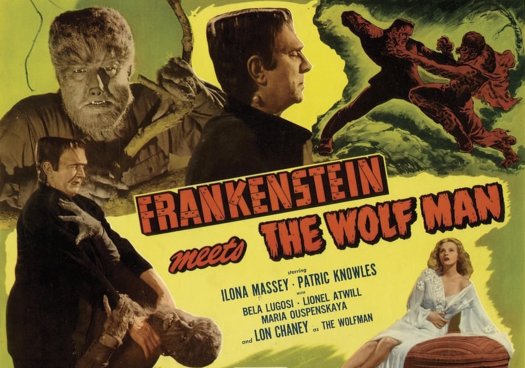
Halloween Havoc!: FRANKENSTEIN MEETS THE WOLF MAN (Universal 1943)


gary loggins's avatarcracked rear viewer

FRANKENSTEIN MEETS THE WOLF MAN was Universal’s first Monster Mash-Up, and in my opinion the best of the lot. From here, things got a little crowded, but by spotlighting just two supernatural terrors, we get a spooky, atmospheric ‘B’ film that really works. Lon Chaney Jr. returns to his signature role of Lawrence Talbot, suffering from the curse of lycanthropy, and he’s even better than in the original (which I reviewed in 2015 ). And The Monster is played by 60-year-old Bela Lugosi , in the part he rejected twelve years earlier. Bela’s interpretation is… interesting (but more on that later).

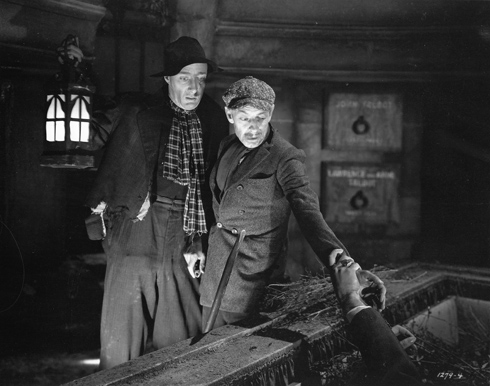
The eerie opening scene features two graverobbers under a full moon, breaking into the Talbot family crypt. Opening the lid of the late Larry Talbot’s coffin, they find the body is covered in wolfbane, and one of them recites that familiar “Even a man who’s pure in heart…” poem…

View original post 731 more words

Horror On The Lens: Pharaoh’s Curse (dir by Lee Sholem)


It’s really not Halloween without at least one mummy film!

With that in mind, here’s a 1957 film called Pharaoh’s Curse.  In this film, a team of archeologists foolishly enter a mummy’s tomb and you can probably guess the rest.  Honestly, you would think that archeologists would eventually learn that it’s never a good idea to test a curse but apparently, it never happened.

Anyway, if you’ve got an hour to kill, enjoy Pharaoh’s Curse!


The TSL’s Horror Drive-In Grindhouse: Attack of the Eye Creatures (dir by Larry Buchanan)


1965’s Attack of the Eye Creatures is an odd little movie.

It starts, as so many bad sci-fi movies do, with Peter Graves narrating about how the government has been keeping an eye on a flying saucers that’s apparently been hovering over the Earth for quite some time.  However, a quick visit to Project Visitor reveals that the soldiers assigned to protect us are more interested in using their monitoring equipment to spy on teenagers making out in their cars!

Agck!

EWWWWWW!

Total invasion of privacy!

Of course, what’s particularly sad about the whole thing is that you know that’s totally what would happen in real life as well.  Give a group of people the power to spy on anyone in the world?  Of course they’re going to end up spying on people fooling around in cars!  That’s one reason why Earth is just as doomed today as it was in 1966.

Anyway, the flying saucer does eventually land.  Unfortunately, our government is too incompetent to do anything about it.  The aliens inside turn out to be …. well, not that impressive.  For one thing, they don’t speak.  There are none of the grandiose threats to conquer the world that we’ve come to expect from aliens.  At the same time, we also don’t have to hear about how the rest of the universe is disappointed in us for polluting our planet and blowing each other up so that’s a good thing.  So often, intergalactic visitors can be so judgmental!  Anyway, these aliens are lumpy and gray and they’ve got several eyes.  They don’t really look that impressive.  Seriously, check this jerk out:

As I said, the government turns out to be pretty useless when it comes to battling the aliens and the local police are skeptical that any intergalactic visitors would bother to land in their crappy little town.  Fortunately, as always happens whenever the controlling legal authorities fail to do their job, there are teenagers and they’re willing to do what needs to be done to protect the world!

Of course, if Stan (John Ashley) and Susan (Cynthia Hull) are going to rally the troops against the aliens, they’re going to have to borrow someone’s phone.  That’s going to mean convincing the local old man to let them use his phone.  The old man, who has had enough of those crazy kids with all their kissing and the jazzy lingo, is more interested in using his shotgun to keep people off his lawn.

Meanwhile, two drunks decide that they want to get in on all this alien business.  They both later die and no one in the movie seems to care.  That’s just the type of movie that this is….

….and if it sounds familiar, that’s probably because you’ve seen the 1957 drive-in classic, Invasion of the Saucer Men!  Basically, in the mid-60s, American International Pictures commissioned Texas filmmaker Larry Buchanan to remake some of their most successful drive-in films.  Apparently, the plan was to sell them to television.  So, Buchanan took the script for Saucer Men, tossed in some scenes of the government spying on people (Buchanan was a noted conspiracy theorist who previously directed The Trial of Lee Harvey Oswald), and called his film Attack Of the Eye Creatures!

Yet, while Invasion of the Saucer Men was a genuinely clever sci-fi satire, Attack of the Eye Creatures is done in by Buchanan’s inability to keep his story moving at a steady pace and it doesn’t help that the iconic Saucer Men have been replaced by men who appear to be wearing trash bags.  Attack of the Eye Creatures is an unfortunate remake and one that should be viewed only after you’ve watched Invasion of the Saucer Men and maybe every other public domain sci-fi film that’s currently on YouTube.

Under the Sea: Goliath Awaits (1981, directed by Kevin Connor)


1939.  War is breaking out across Europe.  The British luxury liner Goliath is torpedoed by a German U-boat.  Presumed to be lost with the ship are a swashbuckling film star, Ronald Bentley (John Carradine), and U.S. Senator Oliver Barthowlemew (John McIntire), who may have been carrying a forged letter from Hitler to Roosevelt when the boat went down.

1981.  Oceanographer Peter Cabot (Mark Harmon, with a mustache) comes across the sunken wreck of the Goliath.  When he dives to check out his discovery, he is shocked to hear big band music coming from inside the ship.  He also thinks that he can hear someone tapping out an S.O.S. signal.  When he looks into a porthole, he is stunned to discover a beautiful young woman (Emma Samms) staring back at him.

Under the command of Admiral Sloan (Eddie Albert), who wants to retrieve the forged letter before it does any damage to the NATO alliance, Cabot and Command Jeff Selkirk (Robert Forster) are assigned to head an expedition to explore Goliath.  What they discover is that, for 40 years, the passengers and crew have survived within an air bubble.  Under the leadership of Captain John McKenzie (Christopher Lee), they have created a new, apparently perfect society within the sunken ship.  Cabot discovers that the woman that he saw was McKenzie’s daughter, Lea.

McKenzie is friendly to Cabot and his crew, explaining to them the scientific developments that have allowed the passengers and crew to not only survive but thrive underwater.  The only problems are a group of outcasts — the Bow People — who refuse to follow McKenzie’s orders and Palmer’s Disease, an infection that only seems to infect people who are no longer strong enough to perform the daily tasks necessary to keep McKenzie’s utopia functioning.   Even when people on the boat die, they continue to play their part by being cremated in Goliath’s engine room and helping to power the ship.

Everything seems perfect until Cabot announces that he has come to rescue the survivors of the Goliath.  Even though Goliath is starting to decay and will soon no longer be safe, McKenzie is not ready to give up the perfect society that he’s created.  McKenzie sets out to prevent anyone from escaping the Goliath.

Goliath Awaits is a massive, 3-hour production that was made for television and originally aired over two nights.  (The entire 200-minute production has been uploaded to YouTube.  Avoid the heavily edited, 91-minute version that was released on VHS in the 90s.)  It’s surprisingly good for a made-for-TV movie.  Because a large portion of the film was shot on the RMS Queen Mary, a retired cruise ship that was moored in Long Beach, California, Goliath looks luxurious enough that you understand why some of the passengers might want to stay there instead of returning to the surface.  Beyond that, Goliath Awaits takes the time to fully explore the society that McKenzie has created and what it’s like to live on the ship.  McKenzie may not be as benevolent as he first appears to be but neither is he a one-dimensional villain.

Mark Harmon is a dull lead but Robert Forster is just as cool as always and Christopher Lee is perfect for the role of misguided Capt. McKenzie.  The movie is really stolen by Frank Gorshin, who is coldly sinister as Dan Wesker, the Goliath’s head of security.  McKenzie may by Goliath’s leader but Wesker is the one who does the dirty work necessary to keep the society running.

Goliath Awaits also features several character actors in small roles, with John Carradine, Duncan Regehr, Jean Marsh, John McIntire, Jeanette Nolan, Alex Cord, Emma Samms, and John Ratzenberger all getting to make a good impression.  (Ignore, if you can, a very young Kirk Cameron as one of the children born on the Goliath.)

Goliath Awaits is far better than your average made-for-TV movie from the 80s.  With any luck, it will someday get the home video release that it deserves.


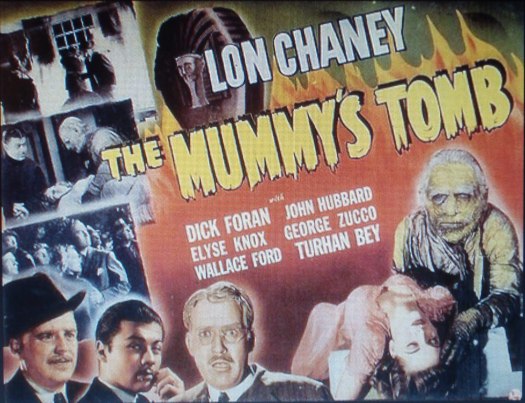
Halloween Havoc!: THE MUMMY’S TOMB (Universal 1942)


gary loggins's avatarcracked rear viewer

Universal followed up THE MUMMY’S HAND with 1942’s THE MUMMY’S TOMB, casting their new horror sensation Lon Chaney Jr. in the role of the undead Kharis. But it didn’t really matter who was under all those bandages, Karloff , Chaney, Tom Tyler, or Lou Costello (okay, maybe not Costello), the part is just a non-entity used to further the plot along, and the new film was almost completely scuttled by a bad performance from Turhan Bey as the latest High Priest of Karnak, Mehemet Bey.

THE MUMMY’S TOMB kicks off with Dick Foran under Jack Pierce’s old age makeup relating the tale of finding Princess Ananka’s tomb thirty years ago to his son John (John Hubbard), John’s fiancé Isobel (Elyse Knox, mother of NCIS star Mark Harmon), and sister Aunt Jane (Mary Gordon ). Or rather, stock footage from the previous film tells the tale, which takes up about 15…

View original post 534 more words

Italian Horror Showcase: Torso (dir by Sergio Martino)


Oh my God, this film freaks me out!

Listen, I’ve watched a lot of Italian horror films.  I know how violent they can be.  I know how gory they can be.  I know how sordid they can be.  I know how disturbing they can be.  It’s not like I sat down and watched Torso with virgin eyes.  But with all that in mind, Sergio Martino’s 1973 giallo still totally freaks me out!

Why does it freak me out?

Well, it’s going to be hard to really explain it without spoiling the movie’s biggest twist.  It occurs about halfway through the film and it totally took me by surprise when it happened.  Suddenly, Torso went from being just another film about a seemingly unstoppable murderer to becoming a tension-filled game of cat and mouse.  So, I’m going to discuss the movie but I’m going to give a spoiler alert before I talk about the twist and, if you’ve never seen Torso before, you should stop reading and you should discover what happens for yourself.

Torso takes place in Perugia, Italy.  During the day, it’s a beautiful city that’s surrounded by a beautiful countryside.  The nearby University of Perguia seemse to be exclusively populated by beautiful students, including American exchange student Jane (Suzy Kendall) and her best friend, the wealthy Daniela (Tina Aumont), and beautiful instructors, like the rather opinionated Art History teacher, Franz (John Richardson).

But at night, Perugia changes.  The countryside around the university becomes considerably less beautiful.  A masked killer stalks through the fog-covered woods, carrying with him a knife and an endless supply of red scarves.  He kills anyone that he comes across in the wilderness, including one of Jane and Daniela’s friends!

With everyone panicking about the serial killer in their midst, the ineffectual police investigate the usual sordid collection of suspects but with little success.  Daniela, meanwhile, thinks that she may have seen the killer and, for her own safety, she, Jane, and their friends all go to her family’s villa for the holiday weekend.

And then….

(SPOILER ALERT)

(SPOILER ALERT)

(SPOILER ALERT)

Jane breaks her ankle and is given a sedative by the local doctor.  This knocks Jane out for the night and when she finally wakes up, she discovers that all of her friends have been murdered and the killer is still in the villa!  Fortunately, he doesn’t realize that Jane’s in the villa as well.  Unfortunately, he’s also locked all the doors and the windows, so that he can have the privacy necessary to dispose of the bodies.  For the rest of the film, Jane has to try to get someone to notice that she’s trapped in the villa without drawing the attention of the killer.  Needless to say, this proves even more difficult than it sounds.

Torso is often dismissed as being a lesser giallo, particularly when it’s compared to some of Sergio Martino’s later contributions to the gnre.  While Torso might not feature as complex a plot as some of Martino’s other films (and you’ll probably guess the killer’s identity long before the film reveals it), it does feature a second act that is so nerve-wracking and suspenseful that I barely breathed while watching it.  Visually, Martino does an excellent job of contrasting the beauty of the outside world with the horrors inside the villa and both Suzy Kendall and Tina Aumont give good and sympathetic performances in the lead roles.

Torso totally gave me nightmares but I’d watch it again.

Horror Film Review: The Curse of the Werewolf (dir by Terence Fisher)


The 1961 Hammer film, The Curse of the Werewolf, is a good example of a film that could succeed on casting alone.

As you can probably guess from the title, this film is about a werewolf.  And there was never an actor more perfect for the role of a werewolf than Oliver Reed.  Set aside Reed’s legendary reputation for wild off-set behavior.  Set aside the fact that Reed specialized in playing men who often seemed to have a beast lurking deep within them, a beast that was constantly bursting out.  With his handsome but scarred face and his burly physique, Oliver Reed looked like a wolf.  If I had to sit down and paint a picture of how I visualized a man who transformed into a beast, the picture would probably end up looking like Oliver Reed.

In fact, Reed is so perfectly cast in this film that it’s easy to overlook the fact that he doesn’t even show up until the last quarter or so of the film.  Clocking in at a relatively leisurely-paced 91 minutes, The Curse of the Werewolf plays out more like an extremely grim fairy tale than a traditional horror film.

It begins in 18th century Spain, with a beggar stumbling across the wedding of a cruel nobleman.  When the beggar asks for food, he’s mocked.  He’s cruelly forced to beg and then, for his trouble, he’s thrown into jail.  Isolated from the world, the beggar’s only human contact comes from his kindly jailer and the jailer’s mute daughter.  When the nobleman tries to force himself on the daughter, he’s rejected.  As a result, he throws the jailer’s daughter into the cell with the now animalistic beggar.  When she’s eventually released, she promptly murders the nobleman but she’s now pregnant with the beggar’s child.

That child is named Leon Corledo and eventually, he’ll become Oliver Reed.  But first, we watch as he grows up, the adopted son of the kindly Don Alfredo (Clifford Evans).  Alfredo’s housekeeper considers Leon to be cursed because he was born on Christmas Day and his mother died in childbirth.  Alfredo may dismiss that as a silly superstition but, as Leon grows up, strange things do happen.  Goats are murdered and, even though a dog is blamed, we know that it has something to do with Leon.

Yes, Leon is a werewolf but interestingly enough, it’s not the full moon that transforms Leon into a beast.  Instead, it’s stress and depression.  When Leon grows up and goes to work in vineyard, he’s fine until he realizes that he’ll probably never be a rich man like his boss and he’ll never have enough money to marry Christina (Catherine Feller).  That’s when he loses control and transformed.

The Curse of the Werewolf is a dark and moody film, directed in an appropriately atmospheric fashion by Terence Fisher.  Leon is one of the more tragic Hammer monsters, having been born with an affliction that he can’t control and which no one else is capable of understanding.  Oliver Reed gives a wonderful performance, revealing the tortured soul that lurks underneath the fearful exterior.  This Hammer film may not be as well-known as the Dracula or Frankenstein films but it’s definitely one that deserves to be seen.