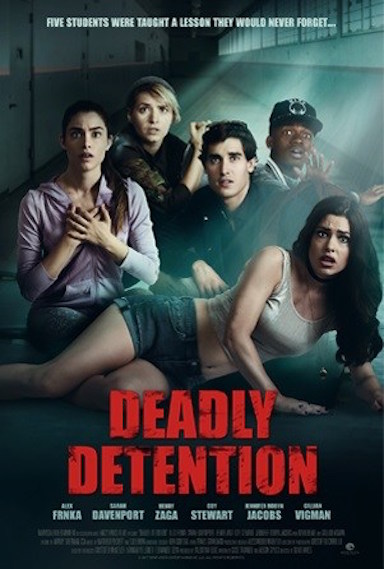
The Things You Find On Netflix: Deadly Detention (dir by Blair Hayes)


If you’re in high school and you have to do Saturday detention in an abandoned, but perhaps haunted, prison, there’s a good chance that you’re gong to die.

That’s the main lesson that can picked up from the 2017 film Deadly Detention, which I watched via Netflix a few nights ago.  Old prison.  Sex.  Detention.  It all leads to death.  Of course, you really shouldn’t need a movie to teach you that lesson.  I mean, it’s just common sense.  STAY OUT OF THE OLD PRISONS, PEOPLE!  Especially if it’s got a death row because you just know there’s going to be a lot of pissed off ghosts floating around there….

The good thing about Deadly Detention is that it realizes that abandoned prison=death should be common sense as well.  It’s an extremely self-aware movie, fully indulging in all of the slasher movie cliches while, at the same time, poking cheerful fun at them.  Deadly Detention may start out as a horror film but, after about 15 minutes or so, it turns into a full-blown comedy and it’s actually pretty fun to watch.

Why are our students attending detention?  Well, it turns out that the majority of them have been framed, which explains why even the popular school athlete is being punished.  Why are they attending detention in a prison?  Well, it seems that a pack of rabid possums were somehow released into the school.  Now, of course, being the former country girl that I am, I immediately knew something strange was happening because possums are actually immune to rabies.  So, seriously, if you see a possum in your back yard, don’t panic!  They’re harmless.

Among those spending their Saturday in detention:

Officer Pete (Kevin Blake), the quiet hall cop,

Miss Presley (Gillian Vigman), the principal who brings her very big and very pointed principal-of-the-year trophy with her,

Lexie (Alex Frnka), the rebellious school tramp who turns out to be a lot more smarter than anyone gave her credit for,

Jessica (Sarah Davenport), the school athlete who has always been driven to be the best,

Barrett (Henry Zaga), the hilariously vain and shallow rich kid whose main hope is that, if he dies, he’ll still look good,

Kevin (Coy Stewart), the gay religious kid who turns out to actually have a lot more depth than anyone originally suspected,

and Taylor (Jennifer Robyn Jacobs), the cheerfully strange girl who knows all the stories about all the ghosts.

Now, you may be thinking that this cast of characters sounds familiar and it’s true that they’re all deliberately meant to invoke various slasher movie tropes.  At the same time, I suspect that they’re also meant to remind us of the members of The Breakfast Club as well.  However, each character is so well-cast and each actor seems to be having so much fun that they all soon develop their own individual identities.  In fact, this cast is so fun to watch that it’s kind of sad once the blood starts to spill.

But spill, it does.  Soon, the detainees find themselves having to figure out how to escape the prison while an unseen stalker taunts them over the intercom.  What sets this film apart from many other Netflix slasher films is that the students all seem to know that they’re in a horror film and they tend to comment on the action accordingly.  When it comes to a horror-comedy, a film always has to decide if it’s going to be more of a horror or a comedy and, early on, Deadly Detention embraces the comedy label and it turns out that the film made the right choice.  Thanks to a likable cast and some clever dialogue, Deadly Detention is an entertaining 90 minutes.

As I said, the entire cast is good but Alex Frnka, Coy Stewart, and Jennifer Robyn Jacobs especially deserve a lot of credit for taking characters who could have been cliches and instead turning them into fairly compelling human beings.  Alex Frnka not only gets all the best lines but she makes them even better with a delivery that’s perfectly perched between sincerity and snarkiness.  The same can be said of the film as a whole.
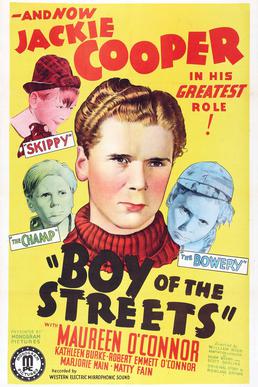
Cleaning Out The DVR: Boy of the Streets (dir by William Nigh)


Welcome to New York City, circa 1937!

It’s a place where the extremely wealthy carefully avoid the districts dominated by the extremely poor, like the Bowery.  In the Bowery, families live in tenements and worried mothers can only cry as they watch their sons join street gangs and their daughters settle for a life of abuse and loss.  Sure, there’s a few do-gooders.  Occasionally, there’s a cop who is convinced that no boy is a lost cause.  Sometimes, you’ll run into a doctor who is determined to provide adequate medical care to the inhabitants of the Bowery.  In fact, you might even see a rich person who is determined to spread about some charity.  But, for the most pat, life in the Bowery is just one hopeless day after another.

14 year-old Chuck Brennan (Jackie Cooper) lives in the Bowery.  He’s got a gang of boys who will do anything that he tells them to do and, despite the fact that Chuck is obviously smarter than almost everyone else around him, he has no interest in being a role model or decent citizen or anything else of that matter.  Chuck lives in a shabby apartment with his mother (Marjorie Main) and his father (Guy Usher).  Chuck looks up to his father who apparently knows important people and is often out of town on “business.”  However, when Chuck discovers that his father is actually a low-level hood who works for the local political machine, Chuck is not only disillusioned but also inspired to go find some gangsters to team up with himself.

The system says that Chuck is a hopeless case but not everyone agree.  Officer Rourke (Robert Emmett O’Connor) thinks that there’s hope for Chuck, he just needs something or someone to straighten him out.  (Like maybe a stint in the Navy….)  And then there’s Nora (Maureen O’Connor), the sweet Irish girl who lives in Chuck’s building and who is often heard singing to her deathly ill mother.

In the end, it’s all up to Chuck.  Will he pursue a life of crime or the life of an honest man?  Will he be a man like his father or will he end the cycle of crime and desperation?

Boy of the Streets is a low-budget, black-and-white film from 1937.  It was produced by Monogram Pictures and, much like Dead End (which came out the same year and featured a superficially similar storyline), it’s a film that mixes social commentary with a bit of gangster action.  The film’s low-budget doesn’t do it any favors and there’s nothing particularly surprising to be found in the film’s plot but child actor Jackie Cooper is convincingly cocky as the swaggering Chuck and Marjorie Main does a good job as his anguished mother.  (Interestingly, Main also played Humphrey Bogart’s mother in Dead End.)

Boy of the Streets is a good example of a film that I never would have seen if not for TCM.  (I recorded it off of TCM way back in June.)  That’s one reason why I’ll always be thankful for TCM.  At a time when so many people seem to be determined to destroy history, TCM is celebrating it.

A Blast From The Past: The Good Loser (dir by Herk Harvey)


Director Herk Harvey

What’s more important?  Being a good winner or a good loser?

Does being a good winner make it more difficult to be a good loser?

Should an individual loss matter if it contributes to a team victory?

When your child loses, is it a good idea to relentlessly taunt them about it?

These questions and more are explored in the 1953 short film, The Good Loser.  This is one of those films that they used to show in schools in order to teach students how to …. well I’m not sure what anyone learns in The Good Loser.  It tells the story of Ray, who is the best public speaker in all of Kansas or, at least, he is until he makes the mistake of agreeing to mentor Marilyn.  After Marilyn beats him at the speech and debate tournament, Ray throws a little hissy fit.  It doesn’t help that everyone — from his classmates to his own father — is making fun of him for losing to his protegee.

“What do you think?” the narrator asks and I’ll tell you.  I’ve never been a good loser so I totally think that Ray has every right to drop out of school and spend the rest of his life wandering around the country, drifting from job-to-job and refusing to trust anyone.  “Second place just means you’re the best loser.”  A teacher said that to me once and the end result was …. well, actually, I think I was kinda like, “Really?  The best?”  Anyway….

Now, if you’re wondering why I’m sharing this video in October, it’s because this film was directed by Herk Harvey.  Harvey made a career out of directing short educational films but, to horror audiences, he’s best known for directing a classic horror film called Carnival of SoulsCarnival of Souls is a film that I’ll be sharing on later in the month.  On the surface, The Good Loser may not appear to have much in common with Carnival of Souls.  However, I think you can compare Ray’s insensitive classmates to the insensitive ghosts who haunted Candace Hilligoss in Carnival.  If nothing, they’re all similarly relentless.  They’re also all jerks, if you ask me.

What do you think?

Film Review: The Wedding Chapel (dir by Vanessa Parise)


Sarah (Emmanuelle Vaughier) is a painter who is frustrated because, despite her obvious technical skills, her work still lacks the spark of passion and imagination that it needs to be truly special.  Not only is her first show panned by a snooty art critic but her boyfriend dumps her on the same night!

Jeanie (Shelley Long) is a widow who is still adjusting to life as a single woman.

They are mother and daughter and together …. THEY SOLVE CRIMES!

No, actually, they don’t.  (Though I will say that I think a film or a show or a series of books about a mother/daughter crime solving team would be great and I’m a bit shocked that there aren’t more of them out there.)  Instead, what Sarah and Jeanie do is they return to the small town where they once lived.  It turns out that greedy developers want to tear down the family home. It’s all about eminent domain, which is a totally evil thing that should be condemned more frequently in the movies.

Anyway, it turns out that it’s not just the family home that’s due to be demolished.  The developers are also planning on tearing down the nearby chapel.  While Jeanie’s busy having flashbacks to her teenage years, Sarah’s getting involved in trying to save both the chapel and the house!  Helping out Sarah is a local politician and lawyer with the unfortunate name of Roger Waters (Mark Deklin).  Not helping Sarah is the local sheriff, who keeps arresting Sarah, tossing her in jail, and forcing her to wear one of those really unflattering orange jumpsuits.  Roger bails Sarah out so many times that he soon finds himself falling in love with her.  Sarah, however, doesn’t want to get tied down in a small town.  She has an artistic career to pursue, assuming that she can get in touch with her emotions.

Speaking of love, Jeanie is haunted by memories of her ex-boyfriend, Larry.  As far as Jeanie knows, Larry left for Vietnam and never returned.  She’s always assumed that he must have died during the war but what if …. well, let’s say that he didn’t die in the war.  And what if Larry (Barclay Hope) just happens to be living in that small town?

Oh my God, love’s all around!

First released in 2013, The Wedding Chapel is an exceedingly pleasant film.  Seriously, almost everyone in the film is extremely considerate and nice.  Even the oafish sheriff doesn’t mean to be a jerk.  He’s just doing his job.  Sarah attempts an act of civil disobedience but it’s literally the most mild protest that you could imagine.  This is the type of movie where everyone lives in a nice house and every lawn is perfectly manicured.  Even the abandoned buildings are surrounded by freshly cut grass.  The chapel may be deserted but you’d never know it from looking at it.

It’s a thoroughly predictable movie but, at the same time, it’s too good-natured to be disliked.  No one curses.  No one makes any racy jokes.  This is the type of movie that you could safely recommend to your great-grandmother without having to worry about her getting mad at you afterwards.  Emmanuelle Vaughier gives a pretty good performance as Sarah and director Vanessa Parise does what she can to keep the film from drowning in sentiment.

Since the Halloween season is upon us and this site is going to be 90% horror for the rest of October, I decided that the final movie I would watch in September would be the least terrifying film I could find.  The Wedding Chapel filled that role well.

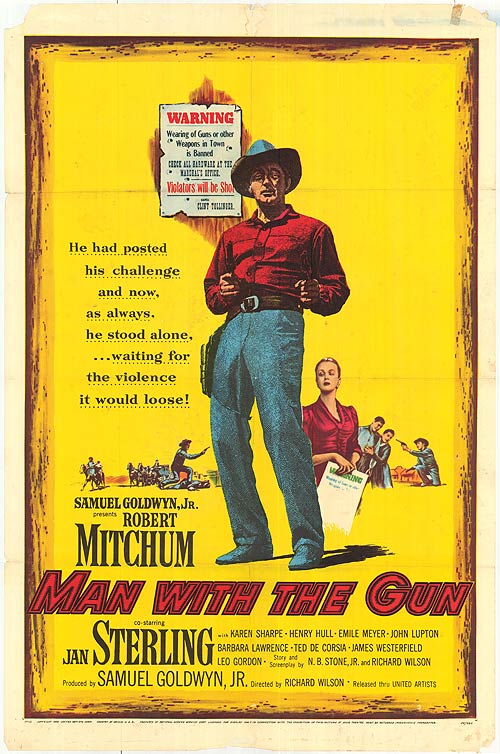
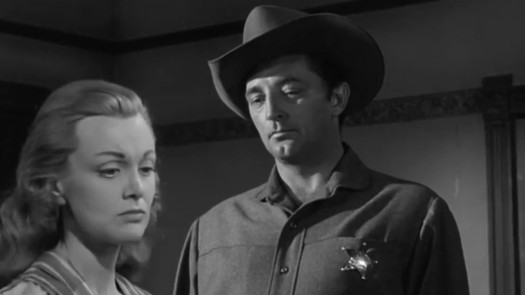
Big Bad Bob: Robert Mitchum in MAN WITH THE GUN (United Artists 1955)


gary loggins's avatarcracked rear viewer

Rugged Robert Mitchum is pretty much the whole show in MAN WITH THE GUN, a film by first  time director (and Orson Welles protege) Richard Wilson. It seems a strange choice at this juncture of Mitchum’s career. He was just coming off four big films in a row (RIVER OF NO RETURN, TRACK OF THE CAT, NOT AS A STRANGER, NIGHT OF THE HUNTER ), then makes a low budget Western that harkens back to his days making ‘B’ Zane Grey Westerns at RKO. But that was Mitchum; always the maverick who did things his way.

The film itself isn’t bad: Mitchum plays a notorious gunslinger, a “town tamer” hired by Sheridan City to clean things up from the clutches of boss ‘Dade Holman’ (who isn’t seen til the end, but whose influence is everywhere). There’s a subplot with his ex-wife Jan Sterling, now running the dance hall girls at…

View original post 354 more words

Here’s The New Trailer For The Irishman!


The second trailer for Martin Scorsese’s upcoming gangster epic, The Irishman, dropped today and …. wow.

Now, admittedly, the reaction online has been kind of mixed.  Some people are a little bit concerned that the de-aging technology is just going to be too distracting, especially considering that this is a four-hour movie.  I will admit that both Al Pacino and Joe Pesci looked a bit …. well, off.  I mean, all the CGI in the world can’t change the fact that this is a film that will feature elderly actors playing youngish gangsters.

Still, the story that The Irishman is telling is a fascinating one and, since Robert De Niro’s character claimed to be both a hitman and a participant in the JFK assassination, the film seems like it will appeal to both mafia afficianadoes and conspiracy theorists.

Add to that, is a Scorsese film and how can you not be excited about that?

That said, the main reaction to this latest trailer seems to be shock that Ray Romano is apparently holding his own opposite actors like De Niro, Pacino, Pesci, and Harvey Keitel.  But, believe it or not, Romano actually has developed into a pretty dependable character actor.  Anyone who has seen The Big Sick can attest to that.

Anyway, The Irishman is expected to be a major Oscar contender.  Of course, they said the same thing about Silence.  We’ll see what happens!

The Irishman will be released on November 1st in select theaters and will then drop on Netflix on November 27th.

Here’s the trailer!

Lifetime Film Review: Escaping the NXIVM Cult (dir by Lisa Robinson)


I have to admit that cults have always fascinated me, largely because I can never really comprehend what would lead to someone joining one.

Seriously, how is it that otherwise intelligent people end up in a position where they not only become brainwashed but they also voluntarily give up their own individual personality, all so that they can belong to something that doesn’t make much sense.  Myself, I’ve always been fortunate in that not only am I very confident in my talents and my beliefs but I’ve also never felt the need to have a mentor or any other type of life guide.  Fortunately, I value my independence above all else.  I’m also lucky enough to have ADD so severe that there’s no way I could actually spend more than 5 minutes listening to a lecture designed to brainwash me.  I did go to one self-help seminar in college that seemed to be kind of a cultish but I was so bored that I left about halfway through.  (Add to that, I was also annoyed by how much everyone else seemed to be enjoying it.)  I’m immune to brainwashing, or at least I would like to think that I am.

Unfortunately, that’s not true for everyone.  We tend to think of a cult as being a group of weird people living in a compound but the truth of the matter is that there are cults all around us.  Basically, any organization that demands that its members sacrifice their own individual thoughts in order to “serve a greater cause” or please a certain being is a cult.  Go on Twitter right now and you’ll undoubtedly be able to find several different cults fighting with each other.  Cults appeal to people who, otherwise, feel empty.  They provide a home and a group of ready-made friends but, of course, they also demand complete obedience and punish any hint of individuality.  There’s no room for dissent.  You see that a lot today and it’s a shame.  People no longer think for themselves and instead, they believe whatever they’re told to believe.  People have lost their damn minds over the past few years, both figuratively and literally.  Sadly, it seems that once someone loses the ability to think for themselves, it’s gone forever.

I found myself thinking about this last night and this morning as I watched the latest “ripped from the headlines” Lifetime film, Escape From The NXIVM Cult: A Mother’s Fight To Save Her Daughter.  NXIVM, which was founded and controlled by Keith Raniere (played, in a wonderfully creepy performance, by Peter Facinelli), presented itself as being a “personal development company” but, as everyone now knows, all of the self-help seminars and corporate doublespeak was actually a cover for a pyramid scheme that also served as a recruiting tool to supply Raniere with sex slaves.  Among those who worked with Raniere was former Smallville actress, Allison Mack (played by Sara Fletcher in the film).

The film focuses on the true story of actress and minor royal Catherine Oxenberg (Andrea Roth), who spent a year helplessly watching as the NXIVM cult brainwashed her daughter, India (Jasper Polish).  The film shows how the cult (and, more specifically, Allison Mack) preyed on and manipulated India’s own insecurities and used them to take her away from her family and her friends.  In perhaps the film’s most disturbing scene, India returns home on her birthday and spends the majority of her own birthday party trying to recruit people to join NXIVM.  It’s disturbing because we all know someone like India, someone who has become so obsessed with politics or religion or fandom that they view every occasion as just being another recruiting opportunity.

The film follows Catherine as she uncovers the truth about NXIVM, which is that it’s essentially a large-scale criminal racket that, because it’s targeted the children of the rich and famous, has also become immune to prosecution.  When Keith is informed that Catherine has been publicly denouncing NXIVM and threatening to expose them, Keith smugly just says that they’ll sue her until she’s silent, just “like the others.”  All of the sordid details are presented here — from the branding of Keith’s and Allison’s initials on their slaves to NXIVM’s casual and infuriating misogyny to the way that Keith used blackmail to manipulate both his followers and those who he considered to be a threat.  But what makes the film ultimately memorable is not just the portrait of how NXIVM operated but also the film’s celebration of Catherine Oxenberg’s refusal to give up when it came to rescuing her daughter.

All in all, it’s a well-done movie and certainly one that has an important message.  Be vigilant and beware any organization that claims that the key to happiness is sacrificing your own individual spirit.

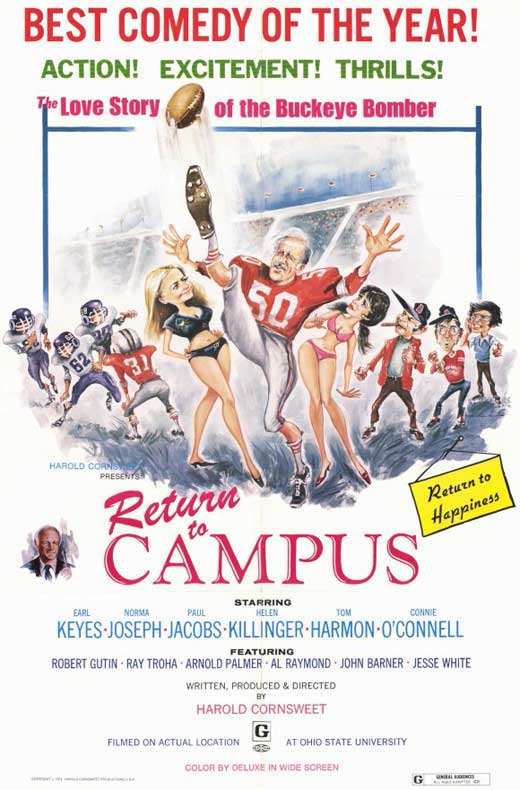
Film Review: Return To Campus (a.k.a. The World’s Greatest Kicker) (dir by Harold Cornsweet)


This little film from 1975 is a weird one.

Return to Campus aired on TCM last night.  I DVR’d it because, just judging from the title, I assumed that it was either going to be a raunchy comedy from Crown International Pictures or it was going to be some sort of ultra low-budget slasher that I could potentially review for October.  Instead, it turned out to be an odd little vanity project about a 55 year-old college football player.

Hal Norman (played by an actor named Earl Keyes, who basically looked like an old school driving instructor) is a semi-retired aviation engineer who is obsessed with football.  Back in 1939, he was a college football star but then World War II intervened and he ended up not only giving up his athletic career but dropping out of college as well.  He’s gone on to make a good life for himself but he’s still haunted by questions of what could have been.  Being at “odds and ends,” he decides to re-enroll at Ohio State.  Not only will he be finishing up his senior year but he’s also determined to try out for the football team!  Hal wants to kick field goals.

A 55 year-old kicking field goals!?  Impossible, you say?  Well, not if you’re willing to cheat.  Apparently, Hal has invited some sort of spring that, when he puts it into his shoe, allows him to kick a field goal from 80 yards away.  There’s four separate scenes in which Hal tells another character that there’s nothing in the rules books that says that he can’t use a special spring when he does his kicks.  Since I don’t know much about football, I’ll take his word on that but still, it all seems a little bit unethical.  I mean, think about it.  You’ve got actual athletes out there, risking injury and depending on their own carefully developed natural talents.  And then you’ve got some jackass having a midlife crisis overshadowing them because he’s found a loophole in the rules.  (I kept waiting for someone to point out the obvious, which is that the only reason the rules don’t mention the spring is because no one but Hal knows that it exists.)  It may not be illegal but it’s hard not to notice that Hal is very careful not to tell too many people about his magic spring.

(And really, it seems like if Hal was smart, he would patent his magic spring and make a fortune instead of using it to humiliate a bunch of college students.)

Anyway, the strange thing about Return to Campus is that very little actually happens in the movie.  Hal goes back to college.  Hal kicks a lot of field goals.  Hal starts dating his English professor.  Hal moves into the dorms and get a roommate named …. I kid you not …. Pighead.  (Even the dean of students calls him “Pighead.”)  You would think that, with a name like Pighead, he’d be some sort of wild party guy but instead, he’s just kind of dorky.  Pighead’s girlfriend, Joyce, gets angry at Hal and tries to steal his magic kicking shoes.  It leads to a extremely leisurely car chase, during which a pizza deliveryman nearly gets run over and loses all of his pizzas.  “Mamma Mia!” he shouts.  Everything plays out at a very leisurely pace.  You never have any doubt about whether everything’s going to work out in the end because it’s just that type of movie.

Return to Campus was filmed in the 70s but there’s not a hint of drugs or campus dissension to be found in the film.  Instead, it’s kind of like a kid’s film for old people.  Most of the dialogue probably would have seemed old-fashioned in the 50s.  For instance, when Hal is told that he has a meeting with a referee to discuss his kicking shoe, his girlfriend offers to go with him for support.  Hal tells her no because this is a discussion meant for men.  And his girlfriend — an English lit professor! — smiles and nods as if that’s the most sensible thing that she’s ever heard.

As I said, it’s a strange film and it was obviously very much an amateur production.  In fact, it was so weird that I actually did some research after I watched the movie and I discovered that Harold Cornsweet (who wrote, directed, and produced the film) was an actor who appeared in a few small roles before returning to his hometown of Cleveland and making this film.  He also actually was a kicker at Ohio State in 1939 so it seems probable that there’s a heavy element of wish-fulfillment in this film.  In fact, that’s one reason why I can’t be too critical of Return to Campus.  As inept as the film may be, it’s also an obvious labor of love.  According to the information that I found online, Cornsweet died just two years after this film was released so it’s actually kind of sweet that he got to film a love letter to both his college and his sport before he went.

Return to Campus is incredibly inept and it possibly made me even less interested in football than I was before I watched it but I can’t help myself.  I just have a soft spot for these amateur productions.

Lifetime Film Review: The Cheerleader Escort (dir by Alexandre Carriere)


I swear, how did I ever make it through college?

That’s a question that I often find myself wondering while watching a Lifetime movie.  In the world of Lifetime, college is always prohibitively expensive and families — regardless of how big of a house in which they’re living — always struggle to pay their daughter’s tuition.  It seems like, whenever it’s time to head off to college, there’s always either a divorce or a sudden bankruptcy or some other financial calamity designed to destroy idealistic hopes and dreams.  Inevitably, the only way to pay for college is by descending into a sordid world of scandal, infidelity, and occasionally even murder.

That’s the situation in which Cassie Talbot (played by Alexandra Beaton) finds herself in The Cheerleader Escort.  Cassie’s just started at a good college and her best friend is even her dorm roommate!  Even better, she’s just made the school’s renowned cheerleader squad!  It all sounds perfect but there’s a problem.  Cassie has to figure out a way to pay for all of this.  Her parents are divorced and, while her father originally promised to help pay for college, he has since disappeared.  Her mother, Karen (Cynthia Preston), says that he might “be gambling again.”  Well, he’s just gambled away Cassie’s future because, after Karen’s injured in an auto accident, there’s no way that Cassie’s going to be able to afford tuition!

Unless….

It turns out that there are wealthy men, most of whom are members of the college’s alumni association, who are more than willing to help the members of the cheerleading squad pay the bills.  As long as the cheerleaders agree to “spend some time” with them, they’ll donate all sorts of money.  In fact, that was one reason why Cassie was selected for the squad.  It was felt that the alumni would react well to her innocent personality and indeed, they do.  Soon, Cassie is spending all her time with the older and richer Terry Dunes (Damon Runyan).  That doesn’t leave much time for going to her classes but who goes to college just to sit in a boring classroom?

Anyway, it seems like a good arrangement until another member of the squad, Gabby (Joelle Farrow), informs Cassie that she’s pregnant and that the father is another wealthy member of the alumni association.  Gabby is super excited about having the baby.  The baby’s father is a bit less happy about the prospect.  In the real world, this would all probably lead to Dr. Phil doing a prime time special on “Sugar Daddy websites,” but this is a Lifetime movie so, of course, it all leads to murder and scandal.

And thank goodness for that!  I mean, seriously, you’re not watching this film because you’re expecting to see a serious examination of why college is so damn expensive or why so many students are graduating with a mountain of debt.  You’re watching this film for the drama and, on that front, The Cheerleader Escort delivers.  In the grand tradition of previous Lifetime films like Confessions of Go Go Girl and Babysitter’s Black Book, The Cheerleader Escort delivers all of the sordid melodrama that you could hope for.

Really, we don’t ask for a lot when it comes to a movie like this: a little sex, a little melodrama, a nice house, and big drama.  The Cheerleader Escort delivers all four.

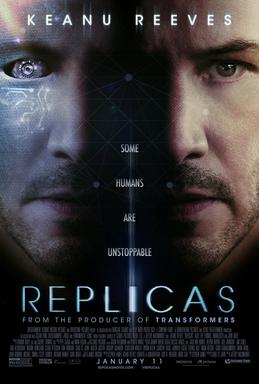
Film Review: Replicas (dir by Jeffrey Nachmanoff)


Don’t even ask me to explain what’s going on in Replicas, a sci-fi film that was released way back in January to terrible reviews and non-existent box office.

Admittedly, this film has a plot and you can kind of follow it if you force yourself to.  And really, it’s not that unusual of a plot.  It’s another one of those things where a scientist is shocked to discover that his top secret research is actually being funded by the military and everyone in the audience is supposed to be like, “OH MY GOD!  NO!  NOT THE MILITARY!”  As you can probably guess from the title, the film is also about clones.  Have you ever noticed that bad sci-fi films always seem to involve cloning?

It’s not so much that the plot can’t be followed as that the film’s storyline just feels oddly underdeveloped.  Watching Replicas, you get the feeling that the filmmakers got bored with the plot and just decided to go ahead and make the movie, without thinking everything through.  As a result, the film touches on all of the ethical and philosophical issues that come along with cloning people but that’s all it does.  Instead of actually exploring any of those issues or trying to come up with an original spin on the story, Replicas just mechanically moves from one scene to another.

Keanu Reeves plays William Foster, a scientist who, along with his longtime friend and partner, Ed Whittle (Thomas Middleditch of Silicon Valley fame), has figured out a way to transfer a dead person’s mind into a robot’s body, hence bringing the person kind of back to life.  A big evil corporation has set up a lab in Puerto Rico for Foster and Whittle to do their research.  The problem is that every time that they put a dead soldier’s mind into an android body, the dead soldier gets pissed off and destroys the body.  Evil Mr. Jones (John Ortiz) demands that they figure out a way to keep the dead soldier from getting mad.  Somehow, it doesn’t occur to Foster or Whittle that Jones wants them to put the soldier’s mind in the android’s body so that the android can then be used as a weapon of war.

(Also, if you want to use androids as soldiers, why not just do some sort of remote control thing like they do with drones?  Seriously, I don’t think Jones has thought his evil scheme through.  The less complicated the better.)

Anyway, Foster and his wife, Mona (Alice Eve), and his three children decides to spend the weekend camping and things don’t go well.  In fact, they go so badly that Foster ends up crashing the SUV and his entire family ends up dead.  Not to worry though!  Foster’s a scientist and he knows how to create clones.  So, he’ll just clone his family.  Of course, to do that, he’ll have to pretend that they’re all still alive and, because he only has room for three clones, he’ll have to pretend like his fourth child never existed.

Does Foster succeed?  Well, the movie is called Replicas.  What’s weird is that it’s obvious that Foster’s going to succeed but the movie still spends an entire hour with Foster and Whittle trying to figure out how to bring the clones to life.  I understand the movie wanted to at least pretend like there was a chance that Foster might not be able to do it but, again, the movie is called Replicas.

Anyway, Foster does eventually resurrect his family but then he discovers that Jones is actually a bad guy and soon, Foster and the Replicas are fleeing for their lives.  It really doesn’t add up too much because the film doesn’t bother to really explore any of the issues that it brings up.  Potentially big moments — like Foster deleting his youngest daughter’s existence — happen but are never really explored.  You keep waiting for some sort of twist — like the clones turning on their creator or Foster discovering that he’s a clone himself — and it never happens.  Instead, the film turns into a rather standard if not very exciting sci-fi action film.

To give credit where credit is due, Keanu Reeves does appear to be taking the film seriously and he has a few scenes that suggest that the film would have been improved if it had played up the idea of Foster being a mad scientist.  The rest of the cast seems to be either bored or miscast but Reeves does try to bring some heart to the film.  Otherwise, Replicas is pretty forgettable.