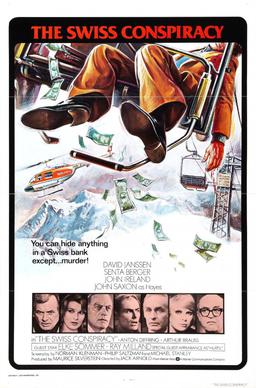
In The Swiss Conspiracy, David Janssen growls his way through another international crime thriller.
Janssen plays David Christopher, a former Treasury agent who is now living in Geneva. When a Swiss bank is contacted by blackmailers who threaten to reveal the secret account numbers of some of its most prominent and unsavory clients, the bank’s president, Johann Hurtill (Ray Milland), hires Christopher to find out who is behind the plot. Unfortunately, one of the account holders is a U.S. gangster named Robert Hayes (John Saxon, naturally) and he’s not happy about having to work with a former fed.
With The Swiss Conspiracy, you know what you’re getting into the minute that the film opens with a narrator giving a lengthy explanation about how Swiss bank accounts work. This is one of those 70s thriller where the budget is low, the plot is often nonsense, and the entire cast seems to be more interested in hitting the slopes than actually making a convincing movie. The cast is full of familiar actors who, at the time of filming, had seen better days. Along with Ray Milland, John Ireland, Anton Diffring, and Elke Sommer all have small roles while “German screen sensation” Senta Berger is cast as the woman who might be in love with David Christopher. Martin Landau is not in this movie but it certainly feels like he should have been.
David Janssen made a lot of movies like this in the 70s. Janssen was a good actor and he was especially skilled at playing grizzled tough guys but in The Swiss Conspiracy, he seems to be more interested in checking out the sights than in anything else. You can’t really blame him because the film was shot on location in Zurich and the local scenery is always more interesting than anything else that’s happening on screen.
The Swiss Conspiracy was directed by Jack Arnold, a veteran B-movie director who was also did The Creature From The Black Lagoon and The Incredible Shrinking Man. His direction in The Swiss Conspiracy is workmanlike and undistinguished but he does make great use of the locations. The Swiss Conspiracy may not be a great movie but I’ll damned if I don’t want to hop on the next plane and head to Switzerland for the week.
Once upon a time, there was this comic book company called DC. DC was fortunate enough to be owned by Warner Bros. back in 1968. I’ve always thought of this as a good thing, despite not being the best of fans. It meant that any tv show or movie would have the full backing of Warner Bros., and DC would never need to shop around for production and/or distribution rights for their work. So, when Superman finally happened in 1978, it was a watershed moment in the history of Comic Book films. It would take more than a decade for the WB to finally make a film about a second DC Hero with Tim Burton’s Batman.
But over the last 30 years, we’ve had:
7 Superman Films (5 Original, plus the Singer reboot, the Snyder Reboot and a sequel with Batman v. Superman)
4 Batman Films (4 Original, plus the Nolan Reboot and Snyder sneak-in on Batman v. Superman
Green Lantern
Wonder Woman
Aquaman
Suicide Squad
Shazam!
That’s not counting films like Steel, but generally, outside of 2011’s Green Lantern, the support for DC’s character base outside of what they needed for Justice League really wasn’t strong, in my opinion. So getting a movie that stands outside of the usual top tier is worth trying, even if it stutter steps the way Suicide Squad did.
So, Birds of Prey, fully known as Birds of Prey (and the Fantabulous Emancipation of one Harley Quinn) isn’t perfect, but I enjoyed it and give me a bit of hope for what comes next from DC/WB. The film focuses on Harleen Quinzel (Margot Robbie, reprising her role from Suicide Squad), who suffers a bad break up from The Joker. To cope, she gets herself a new place and a new pet hyena (a good throwback to the Paul Dini / Bruce Timm Batman: The Animated Series version of the character). When she runs into mobster Roman Sionis (Ewan McGregor, Doctor Sleep), he gives her a mission to recover a precious diamond from Cassandra Cain (Ella Jay Bosco), a young pickpocket. Also thrown into the hunt for the diamond is Black Canary (Jurnee Smollett-Bell, True Blood), who works for Sionis. Detective Renee Montoya (Rosie Perez, Do the Right Thing) is looking to take down Sionis and The Huntress (Mary Elizabeth Winstead, Death Proof), who has her own reasons.
The performances are nice, and it seems like everyone enjoyed themselves. No one really phones in their roles – both McGregor and Robbie excel with their parts, and there’s nothing really wrong with anyone’s work here. I haven’t much to say on that.
The story for Birds of Prey, written by Bumblebee‘s Christina Hodson, is a bit unsteady at first. It makes sense, given Harley’s madness, and makes for some fun exposition in the same way Suicide Squad did. Of particular note are the fight scenes, which feels a lot like what you’d find in John Wick. Birds of Prey has its own particular style. My only real problem with the film was the change over in Cassandra Cain’s character from the comic, who is pretty dangerous. Bosco’s Cain isn’t really written that way, but her pickpocket abilities does make up for it, somewhat. It’s not a terrible thing, but if you’re expecting the Batgirl you’ve read about, it’s not happening. Additionally, Moviegoers expecting to see either Jared Leto or Ben Affleck will probably be a little disappointed. Birds of Prey works with the inclusion of the two DC majors, but I enjoyed that.
Overall, Birds of Prey is a fun popcorn flick that may not be as strong as Shazam!, but offers quite a bit in the way of humor and action. I’m happy that DC’s taking these chances, and hope they continue to do so going forward.
New Jersey Drive takes place in Newark, New Jersey or, as it was known in the 90s, “the car theft capital of the world.”
Jason Petty (Sharron Corley) and Midget (Gabriel Casseus) are teenagers in Newark. Neither one of them is dumb but, as young African-American males living in the inner city, neither one feels that they have much to look forward to in the future. They can’t even walk down the street, without getting hassled by the police. So, they live for the present and that means stealing cars. At first, stealing cars is just something that they do for fun. It’s the challenge that attracts them. However, one night, a cop’s car gets stolen. That cop is a corrupt racist named Roscoe (Saul Stein) and he is soon going out of his way to make Jason and Midget’s life miserable.
New Jersey Drive may sound like an early version of one of the Fast and Furious films (the first F&F came out six years after New Jersey Drive) but, at heart, New Jersey Drive is less about stealing cars and more about a generation of young men who, because they have nothing to look forward to in the future, have no problem taking dangerous and sometimes stupid risks in the present. While Midget is the one who truly loves cars and Jason is the one who is mostly just along for the ride, both characters seem to be aware that it’s only a matter of time before they either get caught or get killed for stealing the wrong car. Today, we would say that Midget and Jason have no respect for authority but can you blame them when the only authority figures that they ever see are racists like Roscoe? The police in New Jersey Drive come across like an invading army, a sea of white faces driving up and down black neighborhoods and searching for people to arrest. For all the cars that Jason and Midget steal, they’re just as likely to get in trouble just for walking down the street.
Sometimes, New Jersey Drive is predictable. In the years immediately following the release of Boyz ‘N the Hood, there were a lot of films about young men growing up in poverty-stricken neighborhoods and having to deal with a combination of racist cops and dangerous gangs. New Jersey Drive‘s story hits a lot of the expected beats but there were also some scenes that took me by surprise. When one of the two main car thieve is arrested and incarcerated, the film went off in a different direction than what I was expecting. At first, Jason and Midget seem like stereotypes. Midget is the wild and crazy friend while Jason is the smart one who is always hanging out with the “wrong crowd.” By the end of the film, though, both Midget and Jason have shown some unexpected complexity and they both feel like real people instead of just plot devices in a movie.
Nick Gomez, who has done a lot of television work since the release of this film, does a good job directing New Jersey Drive. The film captures the high that Jason and Midget feel when they successfully steal a car and Gomez also does a good job of capturing the feeling of the world closing in on the two of them as the story unfolds. New Jersey Drive is an underrated piece of work that still has the power to inspire audiences to stay the Hell out of New Jersey.
1970’s Gamera vs. Monster X (a.k.a. Gamera vs Jiger) once against finds humanity doing something stupid and nearly getting destroyed as a result. This time, the trouble stats when a large statue is removed from an island and transported to Japan, where it will be the centerpiece of a gigantic expo. Gamera, who is a giant turtle that can fly and breathe fire, tries to stop the humans from doing this but, of course, they ignore him.
(Seriously, this was the 6th movie featuring Gamera. You would think that, by now, humanity would have learned to listen to the turtle’s concerns.)
Moving the statue awakens a dinosaur named either Jiger or Monster X, depending on which version of the film you’re watching. Jiger is pissed off about the statue being moved so it sets out to destroy humanity. Gamera tries to stop Jiger but Jiger stabs a quill into his chest and …, oh no! Is Gamera dead!?
No, don’t worry. Gamera may be incapacitated by he lives still. It’s just that he’s got something inside of him now and …. well, basically, Jiger inserted an egg inside of Gamera. And now, for some reason, a bunch of little children are going to have to navigate a minisub through Gamera’s blood stream so that they can get rid of the egg and the mini-Jiger waiting with within…..
What?
Yes, I know it doesn’t make any sense but it’s a Gamera movie! What you do expect? I mean, this is a movie about a world where, because Godzilla doesn’t exist, it falls to a gigantic, radioactive turtle to serve as the world’s protector. In order to watch a movie like this, you have to be able to accept the reality of a giant turtle. Once you’ve accepted that, it’s much easier to accept the idea that the future of the world depends on not just a giant turtle but also three kids in a small submarine.
(One thing that we discover, while watching this film, is that Gamera is bigger on the inside than the outside. Seriously, at one point, the kids get out of the sub and walk around inside of Gamera. And I know that Gamera’s big but he never looked like he was that big.)
Anyway, the important thing is that Gamera must be saved so that he can defeat Jiger and the expo can go on as planned. Because I don’t believe in spoilers, I won’t tell you how it ends but I will say that you should never lose faith in a giant turtle.
I was just looking over my notes and I discovered that, since 2017, I’ve actually watched Gamera vs. Monster X on three separate occasions. Despite having seen it more than once, I still have to say that I really don’t have the slightest idea what the Hell’s going on in the majority of the film. I guess it really doesn’t matter, though. You don’t watch a Gamera movie for the plot. You watch it for a giant turtle fighting other big monsters. On that front, Gamera vs Monster X delivers. It’s enjoyably incoherent.
Tonight, if you’re looking something to watch other than the Oscars, Gamera vs. Monster X is available on YouTube.
Look, I get it. Not everyone is as crazy about watching the Oscars as I am. Some of you have absolutely no interest in watching the Oscar tonights and right now, you’re saying, “If only there was something else to watch!” I hear you and I’m here for you.
And fear not!
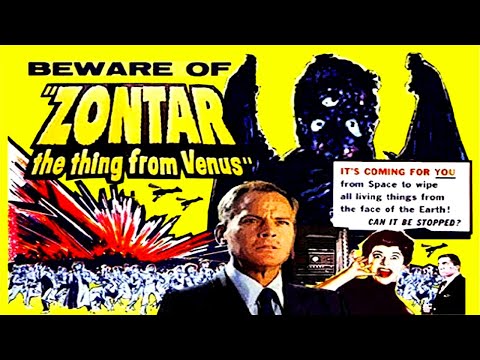
There is something else for you to watch! Just go to YouTube and look up Zontar, The Thing From Venus! You can watch the whole movie three times in a row while everyone else is watching the Oscars. Don’t ever say that I didn’t do anything for you.
What is Zontar, The Thing From Venus? It’s a film from 1966 and it was directed by Texas’s own Larry Buchanan! It tells the story of what happens when a creepy scientist named Keith (Tony Huston) manages to contact a big, three-eyed bat named Zontar. Zontar’s from Venus and it wants to rule the world. Keith thinks that humanity could benefit from being conquered by a ruthless alien warlord. So, Kieth arranges for Zontar to come to the Earth. While Zontar hides out in a cave, it manages to shut down everyone’s electricity and, using a bunch of smaller, flying bats, it also possesses almost an entire town. Keith thinks it’s great but that’s because Keith is an idiot with fascist tendencies.
You know who isn’t impressed by Zontar and all of his high-and-mighty rhetoric? Another scientist named Dr. Curt Taylor (John Agar). Dr. Taylor knows that Zontar is up to no good but how can he stop him? Well, he’s not going to do it by driving a car because Zontar’s knocked out America’s electrical systems. So, instead, he rides a bike from location to location. Seeing John Agar awkwardly trying to balance himself on a bike is more than worth the price of admission.
(Of course, since this is on YouTube, the price of admission is only your immortal soul and your internet privacy.)
Anyway, if all of this sounds familiar, that’s because Zontar is a remake of an earlier Roger Corman film called It Conquered The World. For some reason, in the 60s, American International Pictures gave Larry Buchanan a handful of money and told him, “Go direct some crappy remakes of some of our best films.” Zontar is probably the best known of Buchanan’s remakes and it’s also probably the most fun.
I mean, don’t get me wrong. It’s nowhere near as good as It Conquered The World but, at the same time, it doesn’t have the slow spots that show up in most of Buchanan’s other films. The story moves fairly briskly and Buchanan keeps the picture in focus and, considering some of Buchanan’s other movies, that’s a bit of a minor triumph. Zontar is an impressive monster. In fact, I’d say that batty Zontar is probably a more effective creation than the smiling crab that showed up in It Conquered The World. Finally, you get to see John Agar trying to ride a bicycle and that’s always an entertaining sight.
Zontar is enjoyably dumb. If you want to kill 80 minutes but you don’t want to have to do any thinking, watching Zontar is definitely one way to do it.
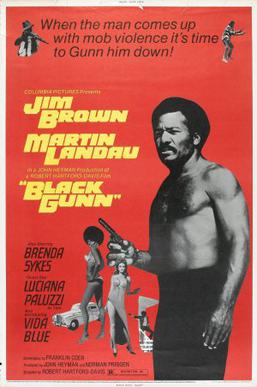
The Black Action Group (B.A.G.) has robbed a Mafia bookmaking operation. The Mafia, led by used car dealer Russ Capelli (Martin Landau, in his slumming it years), is less concerned with the money as they are with the fact that one of the militants, a Vietnam vet named Scott Gunn (Herbert Jefferson, Jr.), has also stolen a set of ledgers that could reveal every detail of their organization. Capelli sends the psychotic Ray Kriley (Bruce Glover, father of Crispin) on a mission to track down Scott and kill him.
What the Mafia didn’t count on is that Scott’s older brother, Gunn (Jim Brown), is the owner of Los Angeles’s hottest nightclub. When Scott approaches his brother, Gun tells him that he doesn’t care about the B.A.G. or any of their politics. Still, Gunn allows Scott to stash the ledgers at his club and to hide out at his place. When Scott still ends up getting murdered by Kriley, Gunn sets out to get revenge.
For the most part, Black Gunn is a standard blaxploitation movie with all of the usual elements, a cool nightclub, the mob, black militants,an anti-drug scene and a speech about why it’s important to not sell out to the man, and a hero played by an actor who may not have been able to show much emotion but who still radiated coolness. Not surprisingly, Jim Brown is the main attraction here and he delivers everything that his fans have come to expect from him. Blaxploitation regulars Bernie Case and Brenda Sykes also appear in the film. Casey plays the head of B.A.G. while Sykes is wasted in a one-note role as Gunn’s girlfriend. Among the villains, it’s fun to watch the glamorous Luciana Paluzzi plays a gangster’s niece and Bruce Glover is just weird enough to make Kriley interesting. Though Martin Landau would end his career with a deserved reputation for being one of America’s greatest character actors, he spent most of the 70s sleepwalking through roles in low-budget action and horror films and his performance in Black Gunn is no different. Having Capelli be both a car salesman and a gangster is a nice touch but otherwise, he’s just not that interesting of a character and Landau is only present to get a paycheck.
Black Gunn has some slow spots but the final shoot-out between the militants and the gangsters is exciting and so brutal that it will be probably take even the most jaded blaxploitation fan by surprise. Black Gunn is hardly a classic but, like its hero, it gets the job done.
There’s a lot of film bloggers out there who have a natural aversion to anything that Jason Reitman is associated with.
And listen, I understand. The fact of the matter is that Jason Reitman probably does owe a lot of his success to the fact that people in the industry know and like his father. And it’s also true that Jason Reitman does tend to specializes in making films that you’re either going to love or you’re going to hate. His films mix drama and comedy and sentiment and snark and sometimes, his refusal to come down firmly on the side of either one can feel like a bit of a cop out. There’s a quirkiness to many of his films and sometimes, it can come across as being a bit cutesy. And I’ll even go as far as to agree with those who say that it’s been a while since Reitman’s made a really good film. The most common complaint I hear about Reitman is that his first four films (Thank You For Smoking, Juno, Up In The Air, and Young Adult) were okay and then he let his good reviews go to his head. Of course, some people — okay, a lot of people — will tell you that, of those four films, Juno’s overrated.
I get all of that and I actually agree with some of those points. Reitman is a director who sometimes seems to have lost his way after his early successes. I think the closest that Reitman’s come to giving us a good film post-Young Adult was with Tully and even then, that felt more like a Diablo Cody film than a Jason Reitman film.
But, with all of that in mind, I still really like Jason Reitman’s early films and I think that he still has the potential to once again be an important and interesting filmmaker. Thank You For Smoking and Juno are better than many give them credit for being. Charlize Theron has never been better than she was in Young Adult. Finally, this morning, I rewatched 2009’s Up In The Air for the first time in a long time and I was pleasantly surprised to see how well it holds up.
Up In The Air features George Clooney and Anna Kendrick. Clooney plays Ryan Bingham, an obsessive traveler who boats about living a life without commitment. Ryan works for a company that hires him out to fire people. If your boss is too much of a pussy to tell you that you’ve been terminated to your face, he hires Ryan to do it for him. Ryan specializes in trying to convince people that being fired is not a tragedy but an opportunity for a new beginning. Ryan also has a side gig as a motivational speaker. His speeches are largely about avoiding commitment and personal baggage.
Anna Kendrick plays Natalie Keener. Natalie works for the same company as Ryan but, at the age of 23 and just out of college, she’s a lot less confident when it comes to destroying people’s livelihoods. (“I’ve worked here for 17 years and I’m being fired by a 7th grader,” is one person’s response to being terminated by Natalie.) Natalie has come up with a new plan where all firings will be done via Skype. That way, the person doing the firing will never have to leave their office and won’t have to deal with the people they’ve fired one-on-one. Ryan says he considers this proposal to be inhumane but mostly, he’s just worried that he’ll lose his traveling privileges if Natalie’s plan is instituted.
Ryan and Natalie travel the country. Ryan teaches Natalie how to fire people and Natalie discovers that it’s not as easy to destroy someone’s life as she thought. Everywhere they go, they deal with people who are facing economic uncertainty. Ryan meets another frequent flyer, Alex (Vera Farmiga) and, after Alex reveals that she’s even less interested in commitment than Ryan, they begin an affair. Ryan starts to fall in love with Alex and even invited her to attend his sister’s wedding with him. However, Alex has a secret of her own.
One thing that I really like about Up in the Air is that Ryan and Natalie never end up sleeping together. I remember, when I first saw the movie, I was convinced that it was going to happen. After all, Ryan is handsome and charming and Natalie is attractive and, after her boyfriend dumps her, vulnerable. I was cringing at the knowledge that there would eventually be some contrived scene where Natalie and Ryan end up getting drunk and then end up waking up in bed together and the end result would be Natalie going from being a well-rounded, multi-dimensional character to just being a plot device in Ryan’s journey to becoming a better man. Well, there is a scene where Natalie and Ryan get drunk at the same time but it doesn’t lead to Natalie and Ryan becoming lovers and I respected Up in the Air for having enough respect for its characters to not do the convenient thing.
The other thing I liked about Up In The Air is that it’s one of the few films to make proper use of George Clooney’s deceptively smooth screen presence. We all know that Clooney is handsome and charming but what makes him an appealing actor is that there’s always been hints that there’s a lot dorkiness and insecurity hiding underneath the suave facade. Ryan may seem like he’s got it all together but, as the film progresses, you come to realize that he’s a lot more insecure and neurotic than he lets on. All of his snarky comments have more to do with his own fear of failure than anything else. Much as how the real life Clooney still sometimes seems as if he hasn’t fully gotten over being dismissed as just being another pretty face in the early days of his career, Ryan has never gotten over his dysfunctional childhood. Instead of taking a risk on love, he instead obsesses on getting frequent flyer miles. (At one point, Sam Elliott pops up out of nowhere and, in a scene that you could really only expect to find in a Jason Reitman film, gives Ryan a pep talk.) There’s a sadness to Ryan, one that seems to come from deep inside of his soul. Clooney does an excellent job of bringing that sadness to the surface while still giving a likable and compelling performance.
Up In The Air was released at a time when America was stuck in what seemed like a never-ending recession. Despite the fact that the news media and the politicians were insisting that things were on the verge of getting better (or, at the very least, boasting that unemployed actors were no longer “job-locked,” whatever the Hell that meant), many people believed that their best days were officially behind them. A lot of the contemporary reviews of the film focused on what it had to say about living in a time of economic uncertainty. That was ten years ago and we’re now living in a strong economy but, even so, Up In The Air still resonates. Reitman includes scenes in which people talk about what it was like to be fired. The majority of these people were not actors but were instead people recruited from the local unemployment office and they were speaking about their own experiences. The pain and resentment on their faces and in their voices is so palpable that it’s actually a bit jarring when J.K. Simmons and Zach Galifianakis show up, playing employees who are “terminated” by Ryan. I guess I should admit that I’ve never actually been fired from a job but, after watching Up In The Air, it’s not something that I would ever want to experience.
Up In The Air holds up well. Reitman’s direction is quirky but effective and he does a good job of mixing comedy in with the drama. (Wisely, whenever he has to make a choice, he emphasizes the drama over the comedy, instead of trying to maintain some sort of mythical 50/50 balance between them.) This film features one of George Clooney’s best performances and he has a really likable chemistry with Vera Farmiga. Anna Kendrick also does a great job with a character who could have become a stereotype in less skilled hands. Finally, along with Juno and The Gift, this film is one of the reasons why I always have a hard time watching Jason Bateman in any film or show where he’s cast as hero. Bateman plays Ryan’s boss and the character is so smarmy (and Bateman does such a good job of playing him) that he’ll make your skin crawl.
It’s been a while since Up In The Air was first released and Jason Reitman’s career has had its ups and downs. Still, regardless of whatever film Reitman makes next, Up In The Air remains a classic of the aughts.
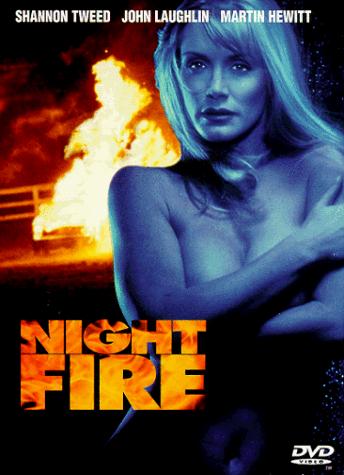
Night Fire is yet another 90s neo-noir starring Shannon Tweed.
In this one, Tweed plays Lydia. Lydia is a work-obsessed millionaire who is unhappily married to Barry (John Laughlin). Lydia and Barry’s sex life has come to a halt. Lydia wants romance. Barry wants to tie her up in bed and run a knife over her body. Even though they have retreated to an isolated ranch house to try to fix their marriage, Lydia simply cannot bring herself to leave her work behind.
One day, while Barry is attempting to drown Lydia in the hot top, two drifters suddenly show up and claim that they’re having car trouble. Cal (Martin Hewitt) and Gwen (Rochelle Swanson) are wild and uninhibited and everything that Lydia is not. Lydia is uncomfortable with the idea of them staying at the house while Barry just wants to watch the two of them have sex. Eventually, the expected mate swapping does occur but there’s a twist. Barry hired Cal and Gwen to show up at the ranch and help him turn on his wife. But it turns out that Barry has another, more sinister motive for wanting Cal and Gwen to spend the weekend.
Night Fire is typical of the type of films that used to show up on late night Cinemax. The plot is mostly just an excuse to get everyone naked and most viewers will be able to see the big twist coming from a mile away. From the very first scene, it’s obvious that Barry is not to be trusted.
On the plus side, Night Fire features one of Shannon Tweed’s best performances. Tweed, who has always been a better actress than most critics give her credit for being, gives a smart and believable performance as Lydia. The script often forces Lydia to do things that fly in the face of logic and it seems to take her forever to figure out that there’s something strange going on. Lydia would probably seem unbearably daft if she wasn’t played by Shannon Tweed, who is capable of keeping the audience on her side even when she’s playing a role that, on paper, shouldn’t make any sense. Tweed is smart enough not to play Lydia as being frigid but instead as someone who is just frustrated that her immature husband has invited two complete strangers to spend the weekend with them. Rochelle Swanson and Martin Hewitt are impressive as the two drifters while John Laughlin is sabotaged by dialogue that reveals him to be untrustworthy from the first minute that he shows up.
Night Fire may not be perfect but it should keep fans of 90s-era Shannon Tweed happy.
The 1935 adventure film, The Lives of a Bengal Lancer, is a film that probably could not be made today.
Of course, that’s true of a lot of films from the 30s. In some cases, that’s a good thing and, in some cases, that’s a bad thing. The Lives of Bengal Lancer is an entertainingly old-fashioned adventure story but it’s also a shameless celebration of the British Empire. The fact that it was made in Los Angeles and featured all-American Gary Cooper in the lead role doesn’t diminish the fact that it’s pretty much a celebration of British colonialism.
Gary Cooper plays Lt. Alan MacGregor, a Scottish-Canadian who serves in British Calvary. He’s a member of the Lancers and is currently serving in India, which, at the time that this movie was set (and made), was still under British control. When the film begins, MacGregor is greeting the new arrivals. Among those arrivals are Lt. John Fosythe (Franchot Tone) and Lt. Donald Stone (Richard Cromwell). Lt. Forsythe is an experienced officer who has been sent to India as a replacement for another officer who managed to get himself killed while out on a patrol. Meanwhile, Lt. Donald Stone is a newly commissioned officer who is desperate to win the approval of his father (and McGregor’s superior), Col. Tom Stone (Guy Standing). Unfortunately, Donald quickly discovers that winning the approval of his father isn’t going to be easy. Col. Stone, after all, has a lot to deal with.
For instance, there’s Mohammed Khan (Douglas Dumbrille). Kahn is a local prince and he boasts that he has got an Oxford education. He pretends to be an ally of the British but instead, he is plotting a revolution. The first step in that revolution is to intercept a convoy of British weapons but how can Kahn discover the convoy’s route? Maybe he could kidnap a lancer who is close to the unit’s commanding officer? With the help of a Russian femme fatale named Tania (Kathleen Burke), Khan is able to capture Donald. When MacGregor and Forsythe defy the colonel’s orders and attempt to rescue Donald on their own, they end up getting captured as well!
“We have ways to make men talk!” Khan declares and soon, the three men are having their fingernails ripped out and the skin underneath burned with fiery bamboo. It’s a shocking act of sadism, one that caught me by surprise in 2020. I can only imagine how audiences in 1935 reacted to Gary Cooper and Franchot Tone being so graphically tortured on the big screen. Though the men swear that they will not reveal the location of the convoy, how much torture can they take before they break?
As I said at the start of this review, The Lives of a Bengal Lancer is an old-fashioned film and, with its depiction of savage rebels and heroic colonizers, it would probably cause a riot if it were released today. However, if you can set aside the whole pro-imperialist theme of the film, this is a fairly entertaining film. It gets off to a slow start and, to modern eyes, some of the acting is bit creaky but Gary Cooper is, not surprisingly, well-cast as the film’s hero and he’s ably supported by Tone and Cromwell. Douglas Dumbrille and Kathleen Burke are entertainingly campy villains and the film’s final battle is well-done.
A box office success, The Lives of a Bengal Lancer was nominated for Best Picture but it lost to an even bigger hit (and a film that was a bit more critical of the British Empire), Mutiny on the Bounty.
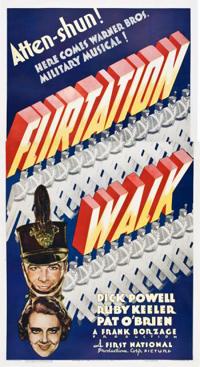
In the 1934 Best Picture nominee, Flirtation Walk, Dick Powell plays a soldier who is constantly trying to go AWOL.
It’s not that Richard “Dick” Palmer Grant Dorcy Jr. dislikes the army. In fact, he’s actually getting a pretty good deal out of his enlistment. He’s been stationed in Hawaii, where he gets to go to luaus and hang out on the beach. He has a wonderful friend and mentor in the person of Sgt. Scrapper Thornhill (Pat O’Brien). Since this film was made in 1934, he’s not going to have to worry about going to war for another 7 years. He’s known as The Canary because he loves to whistle and sing. Everyone like Pvt. Dick Dorcy and that includes Kit Fitts (Ruby Keeler).
Unfortunately, Kit’s father is General Fitts (Henry O’Neill) and he’s none too amused about his daughter having a romance with an irresponsible enlisted man. He would much rather that Kit marry his aide, Lt. Biddle (John Eldredge). After he’s told to stay away from Kitt, Dick makes plans to desert so he can run off with her. Fortunately, Scrapper finds out what Dick is planning and he goes to Kit and warns her that Dick’s about to throw away his life for her. Not wanting him to get into trouble, Kit pretends that she never felt anything for Dick. When a broken-hearted Dick wonders why Kit rejected him, Biddle smugly informs him that he’s neither “an officer nor a gentleman.”
Stung, Dick decides to fix that problem. In order to become an officer, he applies for admission to West Point and gets in. Dick leaves Hawaii for the mainland and he does very well at West Point. He’s even put in charge of producing, writing, and directing West Point’s annual theatrical production. However, things get complicated with Gen. Fitts arrives to serve as superintendent. Coming with Gen. Fitts are both Kit and Lt. Biddle.
Deciding to express his angst through art, Dick writes a show about a female general. Since Kit is the only female at West Point, guess who gets the lead role? Though Kit is still in love with Dick, she can’t get him to listen to her explanation for why she rejected him. Will a stroll along West Point’s famed Flirtation Walk help fix things?
Well, it is a Dick Powell musical….
Flirtation Walk is a pleasant but forgettable movie. Dick Powell and Ruby Keeler make for a cute couple but neither one of them gives a particularly interesting performance and the bland songs don’t make much of an impression either. Those who are into military history might enjoy the fact that the film was actually filmed on location at West Point but, for the rest of us, this is a nice but not particularly memorable musical romance. For me, the most interesting part of the film was that it didn’t even attempt to be realistic when it came to Dick’s theatrical production. It’s a huge production, if never coming close to being as much fun as the one from 42nd Street.
Why was Flirtation Walk nominated for Best Picture? I imagine it was because it was a hit at the box office. It only received one other nomination, for Best Sound Recording. Regardless of why it was nominated, it lost to the far more memorable It Happened One Night.
 In The Swiss Conspiracy, David Janssen growls his way through another international crime thriller.




 Through the Shattered Lens