An Offer You Can’t Refuse #18: The St. Valentine’s Day Massacre (dir by Roger Corman)


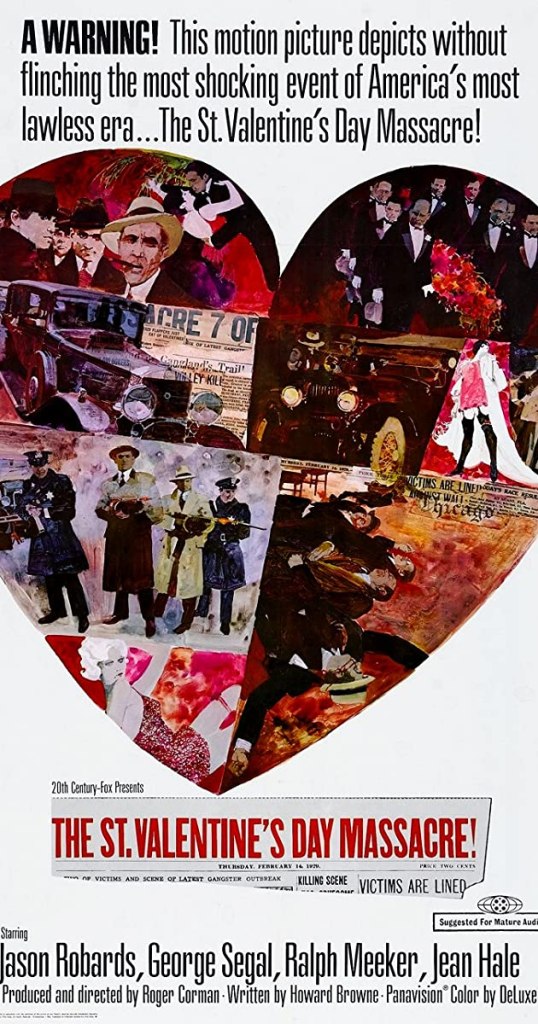
On February 14th, 1929, seven men were murdered in a garage in Chicago, Illinois.  Five of the seven men were known to be associates of gangster George “Bugs” Moran.  The other two men were considered to be innocent bystanders, a mechanic and a dry cleaner who just happened to enjoy hanging out with gangsters.  Though no one was ever convicted of the crime, it was well-known that the murders were carried out on the orders of Al Capone.

In many ways, the St. Valentine’s Day Massacre was a turning point in America’s relationship with organized crime.  Before the massacre, Capone had become a bit of a folk hero.  He knew how to talk to the press and he was viewed as merely breaking a law (in this case, prohibition) that most people opposed in the first place.  However, after the murders, public opinion soured on Capone.

Some of it was the brutality of the crime.  It’s been said that over five hundred bullets were fired in that garage, all to kill seven defenseless men who were lined up against a wall.  Grisly pictures of the victims were released to the press.  Perhaps if the seven men had been carrying weapons and had been involved in a shootout with their murderers, the public’s reaction would have been different.  But this was a cold-blooded execution.

Personally, I think the fact that the killers disguised themselves as cops also played a role in the public’s outrage.  It was a very calculated move on the part of the killers and it highlighted just how much planning went into the St. Valentine’s Day Massacre.  As well, it undoubtedly made people paranoid.  If a bunch of killer could dress up like cops, who knew who else they could dress up as?

Finally, I think that Capone’s biggest mistake was carrying out the crime on Valentine’s Day.  You don’t murder people on a holiday.  Anyone should know that.  If Capone had waited until February 20th, he probably could have gotten away with it.

The 1967 film, The St. Valentine’s Day Massacre, details the rivalry between Capone and Moran, starting with them fighting for control over the Chicago rackets and ending with the title event.  Moran is played by Ralph Meeker while Jason Robards plays Capone.

Now I know what you’re probably thinking.  Perennial WASP Jason Robards as Al Capone?  That may sound like odd casting and, let’s just be honest here, it is.  However, it actually kind of works.  Robards may not be convincingly Italian but he is convincingly ruthless.  Add to that, one of the major subplots of the St. Valentine’s Day Massacre is that, even as the head of the Chicago Outfit, Capone still feels like an outsider in the world of organized crime because, while he is Italian, he isn’t Sicilian.  Capone feels as if Lucky Luciano and all of the major New York crime bosses look down on him and one reason why he’s so ruthless about taking over Chicago is that wants to show Luciano that he can be just as effective a crime lord as any Sicilian.  Capone feeling out of place in the Mafia is reflected by Robards initially seeming to be out of place in a gangster film.  By the end of the movie, of course, Capone has proven himself and so has Jason Robards.

Robards isn’t the only familiar face to be found in The St. Valentine’s Day Massacre.  Though this film was released by 20th Century Fox, it was directed by Roger Corman and Corman fills the production with members of his stock company.  Dick Miller, Jonathan Haze, and Jack Nicholson all have small roles as gunmen.  Bruce Dern plays the unlucky mechanic who enjoys hanging out with gangsters.  Buck Taylor, Leo Gordon, and Joe Turkel all have small roles.  John Agar plays Dion O’Bannon and is gunned down in his flower store.  Though not members of the Corman stock company, George Segal and David Canary plays brothers who work for Moran.  There’s a lot of characters wandering through this film but Corman makes sure that everyone gets a chance to make an impression.

It’s a good gangster film.  Though he was working with a larger budget than usual, Corman still brought his exploitation film aesthetic to the material and the end result is a violent, melodramatic gangster film that looks really impressive.  The film’s recreation of 1920s Chicago is a visual delight and looking at the well-dressed and stylish gangsters walking and driving down the vibrant city streets, you can understand why organized crime would have such a draw for some people.

The St. Valentine’s Day Massacre is a classic gangster film and a classic Corman film.  It’s an offer you can’t refuse.
Previous Offers You Can’t (or Can) Refuse:

  1. The Public Enemy
  2. Scarface
  3. The Purple Gang
  4. The Gang That Could’t Shoot Straight
  5. The Happening
  6. King of the Roaring Twenties: The Story of Arnold Rothstein 
  7. The Roaring Twenties
  8. Force of Evil
  9. Rob the Mob
  10. Gambling House
  11. Race Street
  12. Racket Girls
  13. Hoffa
  14. Contraband
  15. Bugsy Malone
  16. Love Me or Leave Me
  17. Murder, Inc.


The Late Shift (1996, directed by Betty Thomas)


Want to relive the public battle over whether David Letterman or Jay Leno would be Johnny Carson’s successor?

Then The Late Shift is the film for you!

Though it pales when compared to the subsequent battle between Leno and Conan O’Brien, the competition between Letterman and Leno to succeed Johnny Carson as host of The Tonight Show riveted America in the early 90s.  Most media critics (and, reportedly, Carson himself) felt that Letterman had not only earned the right to host The Tonight Show but that he represented the future of late night comedy.  The NBC network execs, however, preferred Leno, who had served for years as Carson’s permanent guest host and who was viewed as being more of a team player than Letterman.  The end result, of course, was that Leno got The Tonight Show, Letterman switched networks, and for years the country was separated into Leno people and Letterman people.  (Letterman got the critical acclaim but Leno got the ratings.)

The Late Shift opens with the unexpected retirement of Johnny Carson (played, as an enigma, by Rich Little) and then follows Letterman (John Michael Higgins) and Leno (Daniel Roebuck) as they maneuver their way to become his successor.  Unfortunately, neither Higgins nor Roebuck are particularly believable in their roles, though Roebuck does get to wear a truly impressive fake chin.  Far more impressive are Kathy Bates as Leno’s manager and Treat Williams as Mike Ovitz.  Bates rips through her scenes, destroying anyone standing in the way of Jay Leno while Williams is cool, calm, and menacing as the agent who was, at the time the film was made, the most powerful man in Hollywood.

The main problem with The Late Shift is that, when it went into production, Letterman was ahead in the ratings and the film is clearly sympathetic to him.  Leno comes across as a weasel while Letterman is portrayed as being neurotic but brilliant.  But, shortly before the film made its debut on HBO, Leno landed the first interview with Hugh Grant after the latter’s arrest with a prostitute.  Leno not only won that night in the ratings but he won every subsequent night and soon, Letterman was the one who was forever stuck in second place.  A title card was added to the end of  The Late Shift, admitting that Leno was now winning the war for the late night.  Since every minute of the film was designed to make Letterman appear to the winner, it’s hard not to be let down by the ending.

Despite the disappointing ending, The Late Shift is an entertaining look at network politics.  (Seinfeld fans will note that, after playing a version of Warren Littlefield during the show’s 4th season, Bob Balaban was cast as the real thing in The Late Shift.)  After watching the movie, be sure to read the Bill Carter book on which it’s based.

Overdrawn At The Memory Bank (1983, directed by Douglas Williams)


Aram Fingal (Raul Julia) is a computer technician in the future who is caught watching Casablanca at work.  The CEO of Novicorp (Donald Moore) is the only person allowed to watch old movies so he decrees that Aram be “droppled,” which is supposed to give Aram a new outlook on life.  Aram’s mind is taken out his body and transferred into the body of a baboon.  At first, Fingal enjoys being a baboon but then he nearly gets killed by an elephant and he decides that it’s time to return to his body.  Unfortunately, his body has been misplaced.

Instead of just leaving Aram’s mind inside of the baboon, Novicorp decides to save his mind in a computer mainframe where Aram discovers how to create his own world, which he patterns after Casablanca.  (Raul Julia even takes on a second role, playing the virtual world’s version of Humphrey Bogart.)  Watching all of this is a computer technician named Apollonia (Linda Griffiths), who has been assigned to keep an eye on Aram until his body is found.  Apollonia falls in a love with Aram but unfortunately, his mind will cease to exist unless it is quickly reunited with his corporeal form.

Originally produced for PBS, Overdrawn At The Memory Bank is best-known for being featured on an episode of Mystery Science Theater 3000.  You can watch it in its original form on YouTube but I don’t recommend it.  When I first saw it MST 3K, I assumed that the film seemed incoherent because Mike and the Bots were talking over most of the action.  When I watched the movie without their commentary, I discovered that it was even more confusing without them talking over the action.  The movie seems to take place in the future and it’s insinuated that Novicorp is in charge of the government but then Novicorp’s share prices start to crash when it’s revealed that Aram’s body has been lost and that seems like that’s something that an all-powerful corporation could have avoided.  Aram is punished by being put in the body of a baboon but I’m not sure why spending a few hours as a baboon would make Aram no longer want to watch Casablanca.  At the same time that Novicorp is trying to find Aram’s body, their agents are invading Aram’s virtual world and trying to destroy his mind which seems counterproductive.  Along with featuring a plot that’s impossible to follow, the other problem with Overdrawn at the Memory Bank is that it’s just so damn disillusioning.  Raul Julia was a great actor but, judging from this film, he just wasn’t very skilled when it came to imitating Humphrey Bogart.  Overdrawn At The Memory Bank is a mix of 1984, The Matrix, and Casablanca and that sounds like it should be cool but somehow, it’s just not.

Only watch this one with Mike and the Bots.

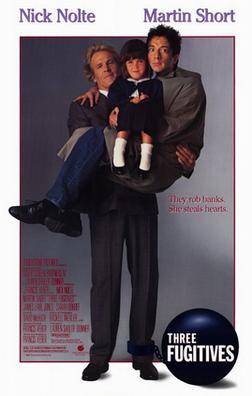
Three Fugitives (1989, directed by Francis Veber)


Daniel Lucas (Nick Nolte) is having a bad day.  He’s just gotten out on parole after spending 5 years in prison for armed robbery.  No sooner has Lucas left the prison than he’s met by Detective Dugan (James Earl) and his partner, Inspector Tenner (Alan Ruck).  Dugan says that he knows that Lucas is going to return to his life of crime and that, when he does, Dugan will be there to arrest him.

Determined to go straight, Lucas heads to the nearest bank.  Maybe he thinks that going to a bank and not robbing it will convince everyone that he’s no longer a criminal.  Unfortunately, the bank does end up getting robbed, not by Lucas but by Ned Perry (Martin Short).  Ned’s not much of a bank robber.  In fact, he’s never committed a crime in his life.  But he desperately needs the money so he can afford a special school for his young daughter, Meg (Sarah Doroff), who hasn’t spoken since her mother died.  When the bank robbery doesn’t go as planned and Lucas ends up accidentally getting shot, Lucas and Ned end up going on the run together with Dugan and Tenner in pursuit.

When I was a kid, Three Fugitives was a movie that seemed like it was on television nearly every day.  Of course, it was popular on HBO but it also used to regularly show up on the local stations, with all of Nick Nolte’s profanity awkwardly edited out.  Looking back, I can see why Three Fugitives was so popular with television programmers who needed something fill a two-hour time slot.  It’s got enough broad slapstick and just enough violence to keep the kids happy while also being so sentimental and inoffensive that parents wouldn’t complain about what their children were watching.

That Three Fugitives was such a ubiquitous presence on television is really the only memorable thing about it.  On paper, the idea of pairing Nick Nolte with Martin Short sounds like it should generate a lot of laughs and they are funny in the initial bank hold-up but after that, neither seems to be acting in the same movie.  Nolte is too serious for the comedic scenes and Short is too cartoonish for the serious scenes and their partnership is never credible.  Nick Nolte was the king of the mismatched buddy comedy in the 80s but Three Fugitives is no 48 Hours.

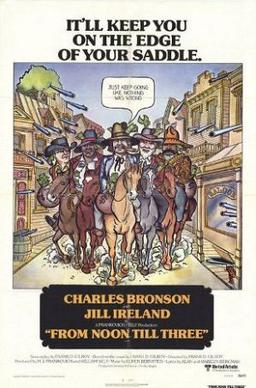
From Noon till Three (1976, directed by Frank D. Gilroy)


Graham Dorsey (played by Charles Bronson) is an outlaw in the Old West who is eager to get out of his gang’s plan to robb a bank in a small town.  He’s been having nightmares in which he and his entire gang are wiped out by the townspeople.  However, the other members of the gang insist on trying to rob the bank.  Because Graham needs a new horse, they stop off at a ranch owned by the widowed Amanda Starbuck (Jill Ireland).  Both because he doesn’t want to die and also because he wants to spend time with the beautiful Amanda, Graham lies to the gang and tells them that Amanda doesn’t have a horse.  The gang leaves Graham behind, saying that they’ll return for him in a few hours.  The gang, of course, ends up getting captured by the townspeople while Graham and Amanda make love three times over the next three hours.

When Graham learns that the other members of the gang have been arrested, he’s content to just allow them to hang so that he can spend the rest of his life with Amanda.  However, Amanda insists that Graham go into town and rescue his fellow outlaws.  Graham agrees, even though he’s planning on actually just laying low for a few hours until the others have been executed.  Through a series of events that are far too complicated to even try to recount here, Graham ends up switching clothes with a traveling dentist.  When a posse guns down the dentist, Amanda believes that Graham has been killed.  Meanwhile, Graham is arrested for practicing dentistry without a license and is put in prison for a year.

While Graham is away, Amanda writes an idealized account of the three hours that she spent with Graham.  A play is produced.  Songs are written.  Tourists flock to Amanda’s ranch.  Amanda becomes a celebrity and even she begins to believe that, instead of being a cowardly and uncouth outlaw, Graham was actually a tall, handsome, and cultured gentleman.  When Graham finally gets out of jail, he heads for the ranch.  Graham thinks that Amanda will be happy to learn that he’s alive and to see him but instead, there’s another surprise waiting for him.

Speaking of surprises, who would have though that one of Charles Bronson’s best films would be a romantic comedy?  Bronson pokes fun at his own image in From Noon Till Three, playing a laid back outlaw who would rather catch a few extra hours of sleep than spend his time robbing people and seeking vengeance.  The film’s entire third act, in which Amanda is reminded that the real-life Graham is far different from her idealized memory, feels like a commentary on Bronson’s entire film career.  Just as Graham isn’t a typical romantic hero, Charles Bronson was never a typical movie star but, like Graham, he never gave up his dream.  This is one of Bronson’s most likable and appealing performances.  From Noon Till Three also features one of Jill Ireland’s best performances.  She was, of course, Bronson’s wife at the time and their chemistry in this film goes a lot towards making the film’s complex story credible.  Ireland’s best moments come at the end of the film, when she reveals how far she’ll go to maintain the myth of what happened between noon and three.

“When the legend becomes fact, print the legend,” the newspaper editor said at the end of The Man Who Shot Liberty Valance and that also describes the main theme of From Noon Till Three, a clever romance that will be appreciated by even by those who would normally watch a Charles Bronson film.


An Offer You Can’t Refuse #17: Murder, Inc. (dir by Stuart Rosenberg and Burt Balaban)


We all know the famous line from The Godfather.  “I’m going to make him an offer he can’t refuse.”  Of course, everyone also knows that “It’s not personal.  It’s strictly business.”  There’s another line that’s almost as famous: “One lawyer with his briefcase can steal more than a hundred men with guns.”  That line comes from Mario Puzo’s novel.  It’s never actually used in the film though it’s certainly present as a theme.

The idea of organized crime essentially being a huge corporation is hardly a new one.  In fact, it’s become a bit of a cliche.  Nearly every gangster film ever made has featured at least one scene where someone specifically compares their illegal activities to the day-to-day business of politicians and CEOs.  However, just because it’s a familiar analogy, that doesn’t make it any less important.  It’s hard not to think of organized crime as being big business when you consider that, in the 30s and the 40s, the mafia’s assassination squad was actually known as Murder, Inc.

Murder, Inc. was formed in Brooklyn, in the 30s.  It was founded and initially led by a man named Lepke Buchalter.  Lepke was a gangster but, because he was Jewish, he couldn’t actually become a made man.  However, he used that to his advantage when he created Murder, Inc.  The organization was largely made up of non-Italians who couldn’t actually become official members of the Mob.  The major mafia families would hire Murder, Inc. to carry out hits because they knew that, since none of the members were made men, they wouldn’t be able to implicate any of the families if they were caught by the police.

It was a good idea and Lepke and his band of killers made a lot of money.  Of course, eventually, the police did catch on.  A member of the organization by the name Abe Reles was eventually arrested and agreed to be a rat.  Lepke went to the electric chair.  Reles ended up falling out of a window.  Did he jump or was he thrown?  It depends on who you ask.

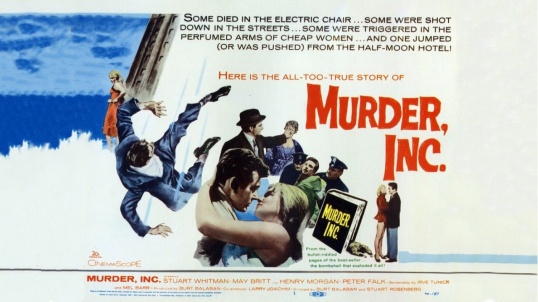
19 years after Reles plunged from that window and 16 years after Lepke was executed, their story was told in the 1960 film, Murder, Inc.  Lepke was played by David J. Stewart while Reles was played by Peter Falk.  The film is told in a documentary style, complete with a narrator who delivers his lines in a rat-a-tat-tat style.  We follow Reles as he goes to work with Lepke and as he harasses a singer (Stuart Whitman) and his wife (May Britt), forcing them help him carry out a murder and then allowing them to live in a luxury apartment on the condition that they also let Lepke hide out there.  (It’s probably not a surprise that a professional killer wouldn’t turn out to be the best houseguest.)  Eventually, a crusading DA (Henry Morgan) and an honest cop (Simon Oakland) take it upon themselves to take down Murder, Inc.

To be honest, there’s not a whole lot that’s surprising about this film but it’s still an entertaining B-movie.  The black-and-white cinematography and the on-location filming give the film an authentically gritty feel.  The action moves quickly and there’s enough tough talk and violent deaths to keep most gangster aficionados happy.  The best thing about the film is, without a doubt, Peter Falk’s portrayal of Abe Reles.  Falk is magnetically evil in the role, playing Reles as a man without a soul.  Even when Reles finally cooperates with the police, the film leaves no doubt that he’s only doing it to try to save himself.  Falk plays Reles like a tough guy who secretly knows that his days are numbered but who has convinced himself that, as long as he keeps sneering and threatening people, the rest of the world will never figure out that he’s been doomed all the time.  The more people he kills, the higher Reles moves up in the corporation and the more he tries to take on the look of a respectable member of society.  But, no mater how hard he tries, Reles always remains just another violent thug.  Falk was deservedly Oscar-nominated for his performance in this film, though he ultimately lost the award to Spartacus‘s Peter Ustinov.

Murder, Inc. may be a low-budget, B-movie but it’s also a classic of gangster cinema.  It’s an offer you can’t refuse.

Previous Offers You Can’t (or Can) Refuse:

  1. The Public Enemy
  2. Scarface
  3. The Purple Gang
  4. The Gang That Could’t Shoot Straight
  5. The Happening
  6. King of the Roaring Twenties: The Story of Arnold Rothstein 
  7. The Roaring Twenties
  8. Force of Evil
  9. Rob the Mob
  10. Gambling House
  11. Race Street
  12. Racket Girls
  13. Hoffa
  14. Contraband
  15. Bugsy Malone
  16. Love Me or Leave Me


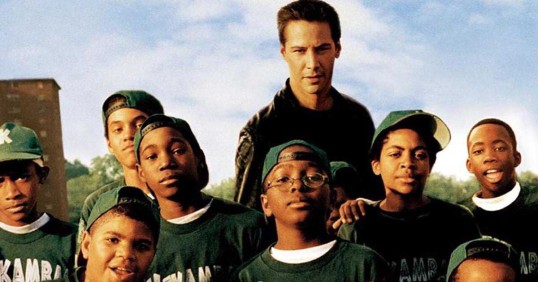
Hardball (2001, dir. by Brian Robbins)


Conor O’Neill (Keanu Reeves) is a gambler who is going to be killed by his bookies unless he can pay off a $6,000 debt.  When he finds out that he can make $500 a week just for coaching a little league team in the Chicago projects, he takes the job.  He’s not planning on caring about the team but, of course, he does.  He doesn’t expect to fall in love but when he meets his team’s 5th grade teacher (Diane Lane), he does.  No one expects him to get his team to the championship but he does.  When tragedy strikes one of his players, Conor and the team have to decide whether to keep playing or to give up.

Hardball is a movie that I wanted to like because Keanu Reeves is in it and the movie tells a good, heart-warming story.  Hardball is really predictable, though, and the movie is so focused on Conor that you never really get to know most of the players on team or what winning the championship would mean to them.  I wanted to know about the members of the team, all of whom were poor, black, and living in the most dangerous neighborhood in Chicago.  (When Conor drops one of them off from practice, he’s told to duck whenever he walks by a window, just in case someone outside is shooting a gun.)  There is one really powerful scene that drives home the reality of the danger that the kids on the team live with on a daily basis but other than that, the movie is almost all about the white coach and his problems.  The team should be the heart of the movie but instead, Hardball focuses everything on Conor and whether or not he’s going to stick with coaching the team even when things get difficult. Even Conor says he’s done, everyone knows he’s not going anywhere.

The other thing that bothered me about Hardball is that, for a baseball movie, there wasn’t enough baseball.  Conor didn’t spend any time discussing strategy with his players or doing any other coaching beyond telling his players not to trash talk each other and to always do their best.  I understand that little league is not the same as major league baseball but I still would have liked to have seen more scenes of Conor actually being a coach and his players actually learning how to play the game.

Hardball‘s not all bad.  It’s got a good heart and it’s got Keanu Reeves.  I just wish it had more baseball.

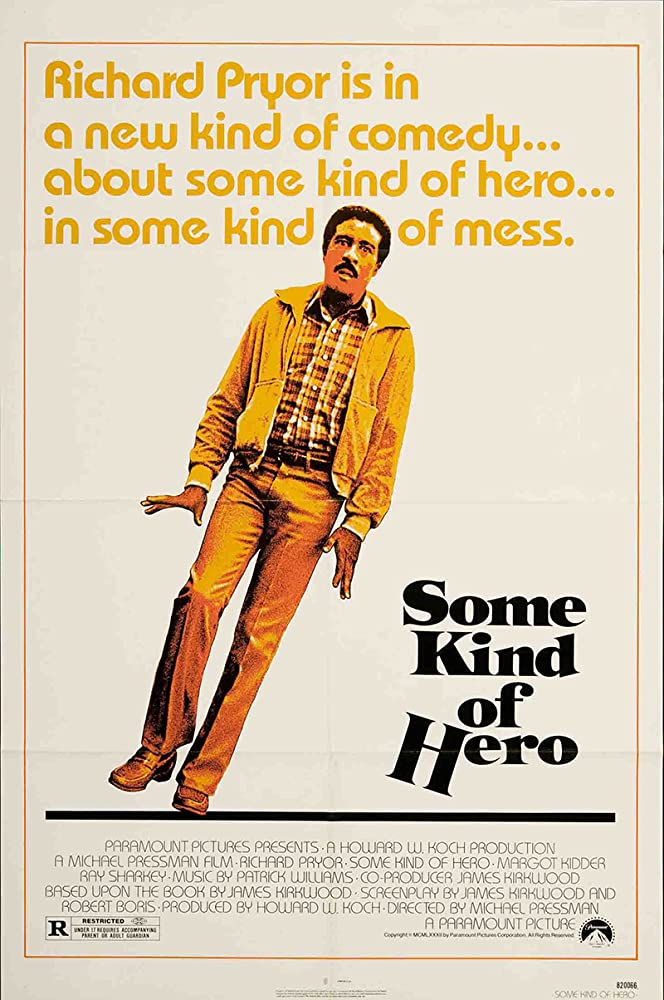
Some Kind of Hero (1982, directed by Michael Pressman)


Eddie Keller (Richard Pryor) is a member of the U.S. Army, serving in Vietnam when he gets captured by the VC and spends the next few years in a POW camp.  During that time, he befriends another POW named Vinnie (Ray Sharkey).  Though the quick-witted Eddie is often able to outsmart his captors and their attempts to turn him into a propaganda tool, he finally snaps when he’s told that Vinnie will be allowed to die unless Eddie signs a “confession” in which he renounces both America and the war.  Hoping to save his friend’s life, Eddie signs the paper.

After 5 long years in the camp, Eddie finally returns to America.  He’s given a momentary hero’s welcome and then he is quickly forgotten about.  After all, everyone wants to move on from Vietnam and Eddie, by his very existence, is a reminder of the war.  However, Eddie can’t move on.  His wife (Lynne Moody) left him for another man while he was missing.  His mother (Olivia Cole) suffered a stroke and is now in a nursing home.  Worst of all, because Eddie signed that confession, the army considers him to be a traitor and is refusing to release his backpay.

What can Eddie do?  How about a rob a bank and then run off with Toni (Margot Kidder), a hooker with a heart of gold?

Like a lot of Richard Pryor’s starring vehicles, Some Kind of Hero is an uneven film.  Pryor was a skilled dramatic actor but he was best known as a comedian and, in most of his starring roles, there was always a conflict between his serious instincts and the demand that all of his films be funny.  Some Kind of Hero starts out strong with Pryor in Vietnam.  The scenes with Pyror and Sharkey in the POW camp are strong.  (In the novel on which the film was based, Eddie and Vinnie were lovers.  In the film, they’re just friends.)  Though there are funny moments during the first half of the film, the humor arises naturally out of the situation.  During the first half of the film, Pryor may make you laugh but he also makes sure that you never forget that he’s on joking to maintain his sanity.  But once Eddie returns to the U.S., Some Kind of Hero awkwardly turns into a heist film and the comedy goes from being darkly humorous to being broadly slaptstick.  Eddie, who could survive being a prisoner of war and who could usually outsmart the VC, is suddenly transformed into a naive klutz.  Richard Pyror does his best but the two halves of the film never seem to belong together.

Unfortunately, Hollywood never really figured out what to do with Richard Pryor as an actor.  Some Kind of Hero at least shows that Richard Pryor could be a strong dramatic actor.  Unfortunately, the film doesn’t really live up to his talents.

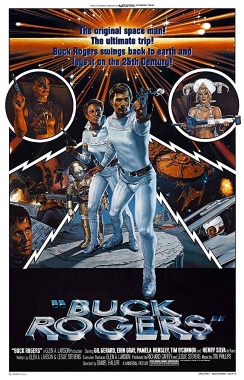
Buck Rogers in the 25th Century (1979, directed by Daniel Haller)


In the year 1987, NASA launches it’s final manned mission.  Captain Buck Rogers (Gil Gerard) is sent into space but, while he’s orbiting the Earth, he and his spacecraft fall victim to a strange space anomaly which leaves him in suspended animation.  On Earth, Buck Rogers is believed to be lost.  500 years pass.  Buck’s ship continues to orbit the Earth while, down below, mankind nearly destroys itself in a nuclear war.  Eventually, Earth is reduced to radioactive rubble and what remains of human civilization lives in the city of New Chicago.  (Old Chicago, meanwhile, has been taken over by mutants.)

Finally, in the 25th century, Buck and his ship are discovered by Draconia, a spaceship that belongs to the intergalactic Draconian Empire.  Buck is brought out of suspended animation and meets the beautiful Draconian Princess Ardala (Pamela Hensely) and her second-in-command, an Earthling named Kane (Henry Silva).  Ardala would obviously like to make Buck her prince but, after being in suspended animation for 500 years, Buck just wants to return to Earth.  The Draconians allow Buck to return home.

Upon landing in New Chicago, Buck discovers that the world is much different now.  Everyone wears skintight uniforms and a little robot named Twiki (voice by Mel Blanc) is the only person willing to be Buck’s friend.  Commander Wilma Deering (Erin Gray) is in charge of defending what’s left of human civilization and she’s immediately suspicious of Buck and his story.  When it turns out that Ardala and Kane implanted Buck with a tracking device, Deering want to execute him.  Can Buck prove his loyalty and also thwart Ardala and Kane’s plot to conquer humanity?

Buck Rogers In The 25th Century was originally a pilot for a Glen Larson-produced televisions series.  (Larson was also responsible for the original Battlestar Galactica, another sci-fi show whose pilot was given a theatrical release.)  Hoping to appeal to the same audiences who made Star Wars a monster hit, Universal spent a little extra money to upgrade the special effects, added a few suggestive scenes to prevent the pilot from getting the dreaded G-rating, and then released it in theaters a few months before the TV show premiered.  That was a good idea because the movie did become a minor hit and the TV series went on to run for two seasons.

As the movie itself, it never feels like anything more than an extended episode of a television series.  Gil Gerard is bland in the lead role and most serious sci-fi fans will probably lose interest as soon as the child-friendly robot shows up.  Buck Rogers may have been made to capitalize on the success of Star Wars but it doesn’t have any of the attention to detail or the careful world-building that went into George Lucas’s original space opera.  On the plus side, though, the Dads who took their kids to matinee showings of this film were probably happy to see Erin Gray and Pamela Hensley prominently featured in the film and Henry Silva is a great villain as always.  As with a lot of the sci-fi films that were released in the immediate wake of Star Wars, Buck Rogers In The 25th Century does have a definite camp appeal.  It’s bad but some people will enjoy it on a nostalgic level.

Probably the most memorable thing about Buck Rogers In the 25th Century was its James Bond-inspired title sequence.  Here it is, in all of its glory:

An Offer You Can’t Refuse #16: Love Me or Leave Me (dir by Charles Vidor)


The 1955 film, Love Me or Leave Me, is a biopic about singer Ruth Etting.

Don’t know who Ruth Etting is?  Well, don’t feel too bad.  I didn’t know who she was either, at least not until I watched this movie.  Judging from the trailer that I’ve embedded at the top of this review, she was apparently well-known enough in the 50s for a biopic about her to be a big deal.  Having now watched Love Me or Leave Me and having done some independent research, I know that Ruth Etting was a popular singer in the 20 and 30s and that she was, for a while, married to a gangster named Marty Snyder (played, in the film, by James Cagney).  I also know that, after her marriage to Snyder ended, she married a composer named Johnny Alderman (played by Cameron Mitchell).

I still couldn’t tell you just how closely Love Me or Leave Me actually sticks to the facts of Etting’s life.  I imagine that there was a quite a bit of liberty taken with the truth, if just because the film was made in 1955 and it’s one of those big, glossy productions where all of the sets are ornate and all of the clothes are to die for and all of the dialogue has an edge that’s somehow both tough and sentimental.  It feels less like real life and more like the way that you would imagine life to be.

The film begins in the roaring 20s, with Marty Snyder intervening when Ruth nearly gets fired for kicking an obnoxious admirer.  For Marty, it’s obsession at first sight and, even after Ruth refuses to spend a weekend in Miami with him, Marty continues to help her out in her career.  Marty uses his considerable clout (and the fact that everyone is scared to death of him and his temper) to get Ruth on the radio and then eventually a job with the Ziegfeld Follies.  Despite the fact that Ruth is in love with Johnny and Johnny is in love with her, she ends up marrying Marty because she feels that she owes her entire career to him.  Even after they get married, Marty continues to be obsessively jealous.  It all eventually leads to a shooting, an arrest, and a final song from Doris Day.

It’s very much a film of the 50s.  I imagine that audiences in 1955 thought it made perfect sense that Ruth would feel that she owed it to Marty to marry him despite the fact that she never really asked him to do anything for her.  Seen today, though, Marty comes across as being a stalker and you really want someone to sit Ruth down and have a conversation with her about it and maybe explain concepts like gaslighting and restraining orders to her.

My advise, though, would be to not think too much about it because seriously, the film’s sets are beautiful, the musical numbers are entertainingly excessive, and Doris Day gives a really good performance.  For those who only know her from the romantic comedies that she did with Rock Hudson, Love Me or Leave Me is a revelation.  She’s likable and she’s tough and she sings as if the world depended upon it and watching her in Love Me Or Leave Me, you not only understand why Ruth Etting became a star but also why Doris Day did as well.  James Cagney also gives a good performance as Marty Snyder, bringing all of his swaggering charisma to the role.  As a fan of exploitation films, the most interesting thing about Love Me or Leave Me to me was getting to see Cameron Mitchell play a nice guy for a change.  Mitchell does an okay job with the role, though Johnny is never as interesting a character as Marty.  In the end, it’s an entertaining film, an ornate visual feast that works as long as you don’t think about it too much.

Love Me or Leave Me is an offer that you can’t refuse.

Previous Offers You Can’t (or Can) Refuse:

  1. The Public Enemy
  2. Scarface
  3. The Purple Gang
  4. The Gang That Could’t Shoot Straight
  5. The Happening
  6. King of the Roaring Twenties: The Story of Arnold Rothstein 
  7. The Roaring Twenties
  8. Force of Evil
  9. Rob the Mob
  10. Gambling House
  11. Race Street
  12. Racket Girls
  13. Hoffa
  14. Contraband
  15. Bugsy Malone