Film Review: Becoming Bond (dir by Josh Greenbaum)


In 1968, after Sean Connery announced that he would no longer be playing the role, there was a worldwide search for a new actor to play the role of James Bond.

Several actors were mentioned as a replacement, some of them better known than others.  Future Bonds Timothy Dalton and Roger Moore were both considered.  Oliver Reed was considered but ultimately not chosen because he was considered to be a bit too “rough” for the refined Bond.  Another intriguing possibility was Terrence Stamp but he was ultimately rejected because it was felt he would want too much creative control over the character.  Michael Caine turned down the role because he had already played a secret agent in three films and he didn’t want to run the risk of getting typecast.  As the start date for production on On Her Majesty’s Secret Service approached, the producers needed someone who looked good, was convincing in the action scenes, and who maybe could act.

In the end, they picked George Lazenby, an Australian-born model who had never acted before.

Perhaps not surprisingly, the inexperienced Lazenby’s performance was not critically acclaimed.  After all, he was not only stepping into an iconic role but he was also replacing one of the most charismatic actors around, Sean Connery.  In retrospect, critics have come to appreciate On Her Majesty’s Secret Service and, to a certain extent, even George Lazenby’s performance as well.  Lazenby may not have had Connery’s confidence but On Her Majesty’s Secret Service would not have worked with a confident Bond.  For this film, which found Bond feeling underappreciated by M and retiring from the spy game so he could marry Tracy, a more vulnerable actor was needed and Lazenby fit the bill.

On Her Majesty’s Secret Service would be the only time that George Lazenby would play James Bond.  Despite being offered a million pound contract to portray Bond in another film, Lazenby publicly walked away from the role and Sean Connery returned for Diamonds Are Forever.

Why did Lazenby walk away from the role?  It depends on who you ask.  Some say that he was stunned by the bad reviews.  Some say that he let his fame go to his head and he decided that he was bigger than Bond.  At the time, Lazenby said that he considered Bond to be a “brute” and that he was all about peace.  A hippie Bond?  I think even Daniel Craig’s version of the character would take issue with that.

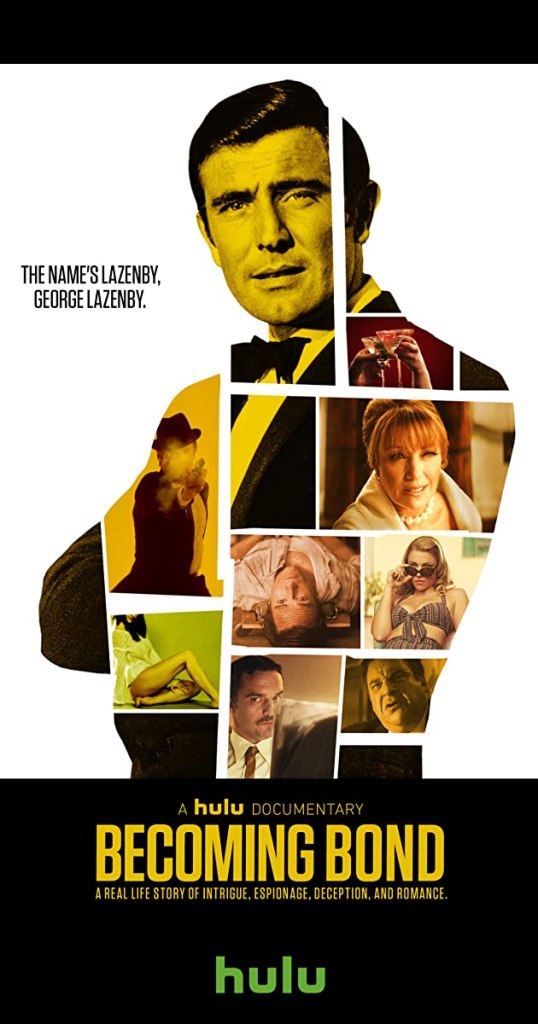
The 2017 documentary, Becoming Bond, takes a look at the events that led to George Lazenby becoming Bond.  The film is framed around a lengthy interview with Lazenby and includes several dramatized recreations of his past life.  (Live and Let Die‘s Jane Seymour appears as Maggie Abbott, the agent who encouraged Lazenby to pursue the role of Bond.)  The film opens with Lazenby’s unruly childhood in Australia and follows him as he goes from being a high school drop out to an auto mechanic to a car salesman.  Eventually, he follows his girlfriend to London and, somewhat randomly, he falls into being a model.  He finds minor fame selling candy in commercials and then, eventually, he finds bigger fame as James Bond before being reduced to being the answer to a trivia question after he walks away from the role.

The film’s biggest strength is that George Lazenby is a charmer.  Still a handsome rouge even in his late 70s, Lazenby narrates his story with the skill of a born raconteur.  Listening to him talk, it’s possible to understand how someone could have looked at the young Lazenby and viewed him as being a potential James Bond.  In fact, he’s got so much charm that it takes a while to realize that his stories occasionally contradict themselves.  At one point, the film’s unseen interviewer stops him to ask if all of his stories are actually true.  Lazenby merely smiles.

The film is full of details about Lazenby’s life before Bond and also all of the the trouble that he went through to even be considered for the role.  (Lazenby claims that he stole one of Sean Connery’s suits and wore it to the audition.)  Unfortunately, it doesn’t really tell us much about why Lazenby left the role, other than the fact that it seemed like a good idea at the time.  Lazenby does talk about the restrictions that were put on him by the film’s producers.  For instance, he was told that he couldn’t come to the film’s premiere unless he cut his hair and shaved his beard because “Bond doesn’t have a beard.”  In the end, though, Lazenby seems just as confused as any of us as to what exactly it was that he was thinking when he turned down a second Bond film.  One gets the feeling that it ultimately came down to not wanting to be told what to do, which is something I can respect even if it does seem like Lazenby was a bit short-sighted.  (Connery had similar objections but still stuck with the role long enough to make enough money to ensure that he could spend the rest of life doing what he wanted to do.)

Unfortunately, the film doesn’t go into much detail about Lazenby’s life after Bond.  He mentions that he got married and he sold real estate.  He doesn’t talk much about the films that he made after On Her Majesty’s Secret Service and that’s unfortunate because, even though none of this films were considered to be major productions, it was in those films that Lazenby proved that he actually could act and that he deserved better than to just be remembered as a cautionary tale.  Check out his grieving father in the 1972 giallo, Who Saw Her Die?  Or the blackmailed politician that Lazenby played in 1979’s Saint Jack.  If nothing else, those roles would eventually provide Lazenby with a bit of redemption as modern viewers discovered not only those films but also Lazenby’s talent.  Unfortunately, that part of Lazenby’s story goes untold.

Becoming Bond is available on Hulu.  While I wish it had gone into a bit more details about Lazenby’s post-Bond life, it’s still required viewing for any fan of 007.

Speedtrap (1977, directed by Earl Bellamy)


In a southwestern metropolis, a mysterious criminal is stealing cars and outrunning the police.  When the insurance company realizes that the cops are never going to be able to do their job, they decide to bring in an outside hire to solve the crimes.  They turn to a paisley-shirt wearing private investigator named Pete Novick (played by Joe Don Baker).  Novick’s a hard-drinking, hard-living P.I. who is going to solve the case no matter what.  Authority figures like police Captain Hogan (Morgan Woodward) hate him.  Women like cop Niffty Nolan (Tyne Daly) and psychic New Blossom (Lana Wood) want to have him.  Men like mechanic Billy (Richard Jaeckel) want to hang out with him.  You get the idea.  It’s a Joe Don Baker movie.

Speedtrap is basically one car chase after another, the majority of which are excitingly filmed and continue until almost every car involved has been destroyed.  Though the movie was directed by Earl Bellamy, it has the feel of a Hal Needham film as it keeps the characterization to a minimum and instead focuses on vehicular mayhem.  Speaking of Hal Needham, it’s also easy to imagine Burt Reynolds, in his B-movie days, playing the role of Pete Novick but not even he would have been as perfect for the role or the movie as Joe Don Baker.  Baker shambles through the movie, all the while keeping the same passive-aggressive grin on his face.  There’s nothing smooth about Joe Don Baker, which is why he was fun to watch in a movie like this.  Whether he’s having a one-night stand with a psychic (only in order to help for “totally relax” so that she can have her visions) or going out of his way to annoy almost every single person that he meets, he’s undeniably Joe Don Baker.  During one chase scene, an annoyed Novick snaps, “Beep beep my ass!”  Only Joe Don Baker could have pulled that off.

Eventually, the thief steals the wrong car.  This one has a suitcase in back that’s full of the mob’s money.  This gives Robert Loggia a chance to ham it up as a mafia don who wants Novick to capture the thief and then turn him over to the syndicate.  Novick, however, has even less respect for the mob than he does for the police.  The mafia subplot is a distraction but Timothy Carey plays Loggia’s main henchman and brings with him a few moments of genuine menace to the film.

Speedtrap has never gotten a DVD or Blu-ray release but it’s an entertaining B-movie and it deserves one.  How about it, Shout Factory?  A million Joe Don Baker fans are looking to you.

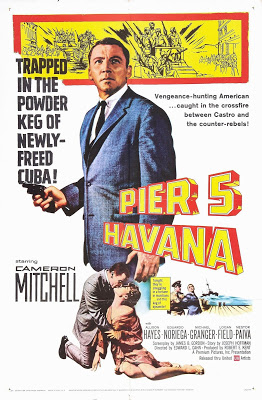
Pier 5, Havana (1959, directed by Edward L. Cahn)


Shortly after the Cuban Revolution, Steve Daggett (Cameron Mitchell) comes to Havana.  He’s searching for his friend, Hank Miller (Logan Field).  An alcoholic, Hank has been missing for several days.  When Steve arrives, he discovers that the local police are less than helpful.  He is also reunited with his former girlfriend, Monica Gray (Allison Hayes), who also happens to be Hank’s estranged wife.  Since separating from Hank, Monica has taken up with Fernando Ricardo (Eduardo Noriega), a wealthy land owner who, so far, has been spared from Castro’s revolution.

It doesn’t take long for Steve to discover that no one wants him to stay in Havana.  When he goes to meet an informant on a pier, he’s instead assaulted by two men who order him to be on the next plane to Miami.  When Steve refuses to leave, both his life and Monica’s are put in danger.  Steve’s investigation eventually leads him to a plot to overthrow Fidel Castro and return Batista to power.

Pier 5, Havana is a low-budget, B-noir that is mostly interesting due to its historical context.  The movie went into production a month after Castro took over Cuba and certain scenes were actually shot on location in Havana.  Because it was a quick shoot meant to capitalize on current events, the movie was rushed into theaters before Castro officially allied his country with the Soviet Union.  As a result, Pier 5, Havana is one of America’s few pro-Castro films.  While the film doesn’t fully embrace Castro, it does present his new government as being preferable to return of Batista’s dictatorship.

As for the film itself, it’s a fairly standard mystery.  Edward L. Cahn, who also directed Flesh and the Spur and Jet Attack, was a director who shot fast and in a workmanlike style.  (Pier 5 Havana was one of seven films that he directed in 1959 alone.)  Cameron Mitchell is surprisingly but effectively subdued as the two-fisted hero and he provides the hard-boiled narration as well.  As always, Allison Hayes is an effective femme fatale.

Pier 5, Havana is a fast-paced B-movie with some good performances and some interesting footage of Havana right after the revolution.

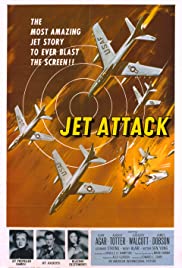
Jet Attack (1958, directed by Edward L. Cahn)


At the height of the Korean War, American scientist Dean Olmstead (Joseph Hamilton) is flying being enemy lines when he’s shot down over North Korea.  Because Olmstead had just created a new type of radar technology and he didn’t bother to leave behind any notes to explain to anyone else how the technology works, it’s imperative that he be rescued from a North Korean POW camp before the Russians brainwash him and take the technology for themselves.

Captain Tom Arnett (John Agar!), Lt. Bill Claiborn (Gregory Walcott, star of Plan 9 From Outer Space!!), and unconvincing beatnik Chick Lane (Nicky Balir) parachute behind enemy lines.  They meet up with both the local rebels and Tanya Nikova (Audrey Totter), a Russian nurse who is secretly a double agent and an anticommunist.  She’s also Arnett’s former lover and helped him escape the last time that he was being held prisoner by the communists.  (Arnett was also in charge of the flying escort that was supposed to keep Olmstead from getting shot down so, given his past history of failing and getting captured, Arnett may not be very good at his job.)  Working with Tanya and Capt. Chon (Victor Sen Young), Arnett ad Claiborn set out to rescue Olmstead from the KGB’s Col. Kuban (Robert Carricart).

Jet Attack is a z-grade war film that features a ton stock footage that you’ll probably recognize from other 50s war films.  As a result, the look of the jets often change from shot to shot and one North Korean airplane has “California Air National Guard” prominently written on its tail.  I know that some right-wingers like to refer to California as being “Commiefornia” but accusing the state of siding with the enemy during the Korean War is taking things too far.  The only thing that looks cheaper than the stock footage is the footage that was actually shot for the movie.  (The stock footage at least includes some pretty cool explosions.)

John Agar started his career co-starring with John Wayne and marrying Shirley Temple but, by the time Jet Attack was made, his star had dimmed considerably.  Whether he was appearing in a major production or a cheap film like Jet Attack, Agar was always reliably dull.  Here, he’s regularly outshined by co-star Gregory Walcott who, despite being best-known for appearing in films like Plan 9 From Outer Space, could actually act and show a hint of emotion on screen.  Probably the best thing about this film is Audrey Totter, who, despite an unfortunately attempt at a Russian accent, plays her role with more conviction than the script really deserves.  As Chick Lane, Nicky Blair also deserves some credit for telling the North Koreans that their attempts to torture him are “squaresville.”

The most surprising thing about Jet Attack is that it wasn’t produced by Howard Hughes.  With its emphasis on planes and evil commies, it feels like a Hughes film.  It’s a dull and workmanlike film but bad movie buffs will want to see it just to witness John Agar getting acted off the screen by Gregory Walcott and Audrey Totter.

Cinemax Friday: The Babysitter (1995, directed by Guy Ferland)


Teenager Jennifer (Alicia Silverstone, shortly before she starred in Clueless) is hired to babysit Jimmy (Ryan Slater), the son of Denise (Lee Garlington) and Harry Tucker (J.T. Walsh) while the Tuckers attend a party over at the the home of Bill and Bernice Holstein (played by George Segal and Lois Chiles).  Harry spends the night drinking and fantasizing about Jennifer while Denise spends the night fantasizing about Bill.  Who does Bernice fantasize about?  The movie doesn’t say.

The adults aren’t the only ones fantasizing.  Bill’s son, Mark (Nicky Katt), is also obsessed with Jennifer and, while his parents are holding their party, he hangs out with his friend Jack (Jeremy London), who also happens to be Jennifer’s bitter ex-boyfriend.  Jack and Mark both start to discuss their own fantasies about Jennifer and they make plans to head over to the Tucker House and surprise Jennifer.  (Mark has even more in mind.)  Meanwhile, even little Jimmy is having fantasies of his own.

Today, it can be easy to forget just what a big deal Alicia Silverstone was in the early to mid-90s.  Even before she landed her star-making turn in Clueless, Silverstone achieved fame as the star of three videos from Aerosmith, all of which featured her playing roles that personified male fantasies.  Her role in The Babysitter fits right in with those Aerosmith videos as the entire film is devoted to men fantasizing about her.  Not much is revealed about who The Babysitter is and her name isn’t even revealed until the end of the movie.  Instead, the movie is about how every male in town, except for George Segal, is obsessed with her.  (What makes George Segal so special?)  Fortunately, Silverstone had the right mix of innocence and sultry beauty to be believable as everyone’s object of lust.  She does a good job playing both the normal teenage girl who just wants to make some extra money babysitting and also the exaggerated caricature who appears in everyone’s fantasies.  (Some of the fantasy scenes are ridiculous but most fantasies are.)

Especially after the release of Clueless, The Babysitter was advertised as being a softcore thriller and it used to show up frequently on late night Cinemax, playing alongside films like Body Chemistry.  Actually, it’s a satire of the suburbs that follows all of the men as they have too much to drink and make fools of themselves.  Thematically, it has more in common with movies like American Beauty, The Ice Storm, and The Virgin Suicides than it does to anything that’s ever been made by Shannon Tweed.  While many viewers were undoubtedly disappointed that Silverstone remained clothed for the majority of the film (and that even the scene where she took a bath was carefully shot to suggest more than it showed), The Babysitter was not a bad movie and it provided the great J.T. Walsh with a rare leading role.  The Babysitter is a better-than-expected mix of Nabokov and Cheever.


The TSL’s Grindhouse: Slipping Into Darkness (dir by Eleanor Gaver)


Last night, Jeff and I watched the 1988 film, Slipping Into Darkness.  It’s available on Prime and we watched it because it looked like it was good, old-fashioned revenge flick.  The plot description said something about a former biker kidnapping the three women who he held responsible for the death of his brother.  It sounded trashy and fun and you know what?  It definitely is trashy and fun.

It’s also one of the most thoroughly incoherent film that I’ve ever seen.

If you were to ask me what I learned from watching Slipping Into Darkness, I would say that I was amazed to discover that it doesn’t hurt to get your fingers shot off.  Seriously, one character loses his fingers and, just a few minutes later, he’s hitching a ride out of town.  (Needless to say, he has to use his other hand to flag down a ride.)  Even though he’s with his friends, no one seems to be too concerned with the fact that he’s just had several of his fingers blown off.  No one says, “Hey, you want to go to the hospital before you bleed to death?”  I don’t think it even occurs to anyone to pick up his fingers.  They just leave them in a cornfield.

The other thing that I discovered is that some people can still do stuff for several minutes after having a switchblade thrown straight into their brain.  I mean, I guess maybe that’s true.  I’ve heard of weird stuff like that happening but it still seems like having a knife sticking out of your forehead would be a bigger deal than it appears to be in this film.

Just from reading those two paragraphs, you might think that this is like an over-the-top Evil Dead-style comedy, where the action is deliberately cartoonish.  What’s strange is that it’s not.  Instead, it’s a rather pretentious film from Nebraska that actually seems like it wants to say something about …. well, something.  I mean, it’s either trying to say something about morality or the director just randomly decided to include several nuns standing in the background of several shots.  You tell me.

Anyway, the film is about three best friends, Carlyle (Michelle Johnson), Genevieve (Anastasia Fielding), and Alex (Cristen Kaufman).  Caryle is rich and self-centered.  Genevieve is obsessed with sex.  And Alex is just kind of there.  When we first see them, they’re flirting with some bikers, who turn out to be less than ideal company.  Later, after they get away from the bikers, they accidentally hit a dog with their Mercedes.  Fortunately, the dog lives and they take it to the vet.  They also take the dog’s owner, Ebin (Neil Barry), with them as well.  Ebin is developmentally disabled so they take him to get ice cream.  One jump cut later and Ebin is getting run over by a train.  A coroner who announces that, when he died, Ebin was covered in ice cream and liquor.

Ebin’s older brother, Fritz (John D’Aquino), is convinced that Ebin’s death was no accident because Ebin didn’t drink.  Maybe the ice cream’s a clue?  After Fritz sees Carlyle returning the dog from the vet, he decides to kidnap the three friends and demand to know what happened to his brother.  Helping Carlyle out are T-Bone (David Sherrill) and Otis (Vyto Ruginis), two of the bikers who the girls met earlier but who are now apparently unrecognizable because they’ve shaved and gotten haircuts.

Following this so far?

So, Fritz and his friends kidnap Carlye and her friends.  And, at first, Carlyle and her friends don’t want to be kidnapped but then, about five minutes, the girls and their kidnappers are suddenly best friends and everyone just kind of forgets about Ebin.  Genevieve and Otis go off to the cemetery together and, when the sun rises, it turns out that Otis has accidentally killed her during a sessions of rough graveyard sex.

What’s odd is that no one — not even Genevieve’s two best friends — seems to be particularly upset about Otis having killed her.  Instead, they just bury her in a nearby grave and then they start do discuss how to best protect Otis.  So, I guess the whole kidnapping thing has been resolved and no one cares about Ebin anymore.

However, it turns out that Otis is too paranoid to be protected.  Running off to a farmhouse, he discovers an old farmer who has committed suicide.  “This is a shit world,” Otis declares.  Soon, everyone’s getting chased through a wheat field by Otis, who has commandeered a thrasher….

And the movie’s not over yet!  But I’m not going to spoil any more of it.  It’s on Prime and you can watch it for yourself.  Slipping Into Darkness is one of the most incoherent films that I’ve ever seen and yet it’s such an incomprehensible mess that it’s actually a lot of fun to watch.  The dialogue is frequently ludicrous and is filled with lines that sound like they were written by an Intro to Philosophy student trying to be profound.  The film is full of jump cuts, which makes it increasingly difficult to understand how once scene relates another.  It’s impossible to keep track of who is friends with who or who is investigating what because everyone’s motivation and mood randomly changes from scene to scene.  At one point, Fritz is obsessed with his brother’s death and then, a few minutes later, he no longer seems to care.  Otis feels guilty about killing Genevieve and then, in the next scene, he’s a giggling sociopath making crude jokes about necrophilia.  Alex hates T-Bone and then she loves T-Bone and then she hates him and then she loves him and seriously, who can keep track?  The entire movie plays out like a fever dream.

Interestingly, a lot of the film’s most important events take place off-screen.  I don’t know if the director was trying to make a statement about the randomness of life or if she just ran out of money before filming certain scenes.  “We just got arrested!” a character cries towards the end of the film before then adding that they also got bailed out.  Well, that’s good.  It would have been nice to have seen that but oh well.  As long as everything works out….

What to make of Slipping Into Darkness?  I have no idea.  It’s on Prime.  Go watch it, let me know if you can figure out what the Hell’s going on.

Film Review: Left Behind: World At War (dir by Craig R. Baxley)


With the 2005 film, Left Behind: World At War, the Left Behind series enter special guest star territory.  Kirk Cameron and Brad Johnson, while still present in the film, were largely pushed to the background and Louis Gossett, Jr. and Charles Martin Smith popped up as Nicolae Carpathia’s two main adversaries.

Gossett plays President Gerald Fitzhugh.  Smith plays Vice President John Mallory.  (Speaking as someone of Irish descent, it fills me with pride to think that America will someday be led by the presidential ticket of Fitzhugh and Mallory.)  Despite the fact that Carpathia (again played by Gordon Currie) spent the previous film talking about how, under his leadership, there would be no more borders, it appears that there still are borders.  However, Carpathia has a plan to take care of that.  Mallory has discovered the plan but, right after he tells Fitzhugh about it, they’re attacked by Carpathia’s goons.  The presidential limo is blown up and with it, John Mallory.  (Poor Charles Martin Smith.)  Fitzhugh manages to escape, thanks to the help of the Tribulation Force.

It turns out that Carpathia’s latest scheme is to steal the few remaining bibles in the world, lace them with anthrax, and then distribute them back to the believers.  Gossett gets to go full action hero as he tries to stop Carpathia and good for him.  As for the other members of the Tribulation Force, Buck (Kirk Cameron) marries Chloe Steele (Janaya Stephens) and Chloe’s father, Rayford (Brad Johnson), meets his former lover, Hatti Dunham (Chelsea Noble).  Hattie is now Carpathia’s lover and is pregnant with his child.  Some members of the Tribulation Force die over the course of the film.  Buck has a moment of anger at God, which is the best scene in the film because it at least acknowledges that one can believe and still be angry.  The majority of the film, however, is Lou Gossett, Jr. wandering around with a “How did I go from winning an Oscar to appearing in this?” look on his face.

Anyway, credit where credit is due.  World at War is the most action-packed of the Left Behind films and, while it’s still definitely an evangelical film, it’s considerably less preachy than either the first Left Behind film or Tribulation Force.  World at War is pure melodrama, with a lot of plotting and evil cackling and overdone action scenes.  If you don’t want to listen to the dialogue, you can focus on just how small the film’s version of the Oval Office is.  That’s what happens when you try to a globe-spanning epic on a low budget.  Sometimes, you have to settle for a small replica of the Oval Office instead of trying for the real thing.

That’s not to say that World At War is a particularly good film.  Brad Johnson gets even less to do than in the second film and Kirk Cameron is still Kirk Cameron.  Since he lost his job at the end of Tribulation Force, we’re no longer asked to believe that Kirk Cameron’s playing a respected journalist.  Instead, Buck is now just a self-righteous evangelist and, for obvious reasons, it’s easy to believe Kirk Cameron in that role but Kirk Cameron is one of those actors who is far more likable when he’s miscast than when he’s playing himself.  Much as with Tribulation Force, World At War can’t seem to decide just how powerful Carpathia actually is.  He’s got supernatural powers and is apparently actually immortal and yet, he is often easily deceived by the simplest of ruses and is incapable of killing anyone until their usefulness to the film’s narrative has expired.

Louis Gossett, Jr. was smart enough to play a character who dies at the end of World At War, therefore freeing him from having to appear in any more Left Behind movies.  It turned out to be a moot point, however.  This was the last Left Behind film until the recent unsuccessful attempt to reboot the franchise with Nicolas Cage as Rayford Steele.

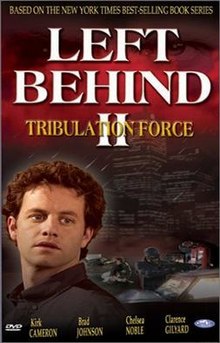
Film Review: Left Behind 2: Tribulation Force (dir by Bill Corcoran)


The 2002 film, Left Behind II: Tribulation Force, begins a week after the Rapture.  I have to admit that it took me by surprise when they mentioned that only a week had passed since the events that kicked off the first Left Behind film because the action in the original film seemed to go on for a lot longer than week.  I guess, if nothing else, that’s a lesson in the importance of keeping your film moving at a steady pace.

Speaking of pacing, Tribulation Force has a bit of quicker pace than the first film.  Now that everyone knows what happened, Rayford Steele (Brad Johnson) and Buck Williams (Kirk Cameron) can jump into action and start working to try to thwart the evil plans of Nicolae Carpathia (Gordon Currie).  Of course, at the start of the film, they’re told that it’s impossible to thwart the evil plans of Carpathia because the Bible has already predicted that he can’t be thwarted.  However, the Bible has also predicated that people will still try so I guess Rayford and Buck really don’t have that much of a choice.

Both Buck and Rayford get minor subplots that are designed to bring some humanity to all of the apocalyptic melodrama.  Rayford is still coming to terms with being left behind and struggling to forgive himself for not going to church with his wife and son.  To give some credit where credit is due, Brad Johnson is this film’s secret weapon.  He doesn’t really get to do much but Johnson brings just enough emotional reality to the role that his scenes have some depth that the rest of the film is missing.

As for Buck, he’s pursuing a tentative relationship with Rayford’s daughter, Chloe (Janaya Stephens).  Unfortunately, he’s also letting his assistant Ivy crash at his apartment and when Chloe stops by and discovers Ivy wearing a towel and an engagement ring, she assumes the worst.  Luckily, Buck’s able to say, “She’s my assistant” and that takes care of that.

Kirk Cameron is pretty much at the center of Tribulation Force, which is a problem because he’s totally miscast as a tough and respect journalist.  Carpathia, who really should have known better seeing as how he’s the son of Satan and everything, decides to turn Buck into the public face of his global news channel.  Unfortunately, there’s nothing about Kirk Cameron that suggests that any character he would play would ever have the gravitas or the charisma necessary to be the public face of any government.  As in the first film, Cameron comes across as being extremely earnest and a little bit dull.  He’s like the intern who accidentally screws up everyone’s lunch order.

Anyway, in Tribulation Force, everyone in the world loves Carpathia, even though he’s the most obviously evil dictator ever.  (The Rapture left behind not just the nonbelievers but also the extremely stupid.)  Carpathia announces the birth of a new world without borders and without religion.  Buck and Rayford plan to televise an interview with the Two Witnesses, who are waiting at the Wailing Wall.  But, to do that, they’re going to have to figure out a way to work around the fact that Carpathia controls all of the news channels….

Despite the fact that Tribulation Force is not as slow as the first film, the bulk of the film is still made up of people having long conversations about Biblical prophecy.  Like a lot of early faith-based films, Tribulation Force gets bogged down in explaining its message as opposed to showing the audience what that message means.  When Buck does finally reach the Wailing Wall, we do get to see some people get set on fire but, other than that, this is a very talky film.  As well, Tribulation Force can’t ever seem to decide just how powerful and all-knowing Carpathia is supposed to be.  At times, he has nearly supernatural powers and yet, at the same time, he’s totally incapable of seeing that Buck and Rayford are both plotting against him.  Is Carpathia a victim of his own hubris or is it just bad plotting on the part of the film?  I’ll leave it up to you decide.

Tribulation Force was followed by one more Left Behind film, World At War.  I’ll review that one in about 15 minutes!  Hope to see you then.


Film Review: Left Behind: The Movie (dir by Vic Sarin)


As I watched the 2000 film Left Behind: The Movie (not to be confused with the remake starring Nicolas Cage), I found myself thinking about names.

For instance, if your name is Rayford Steele, you really probably don’t have any choice but to become a pilot and maybe star in a low-budget action movie.  I mean, let’s just be honest.  People with names like Rayford Steele don’t end up working the night shift at 7-11.  In Left Behind, Rayford Steele is played by Bad Johnson and Johnson has just the right look to play a character named Rayford Steele.  He’s handsome in a somewhat old-fashioned, Gary Cooperish sort of way.

And yes, Rayford is a pilot.  He had a wife who resents the fact that Rayford is always flying off and abandoning his family.  She goes to church and she worries that he’s not a believer.  Rayford, meanwhile, is having an affair with flight attendant Hattie Dunham (Chelsea Noble).  That affair, however, may have to soon come to an end because Hattie has a new job with the UN.  Poor Hattie.  Nothing good ever comes from working at the UN!

Just as anyone named Rayford Steele would have to become a pilot, I imagine that anyone named Buck Williams would have to become a globe-trotting journalist.  We’re told that Buck is one of the most famous and successful journalists in the world.  Someone even mentions that Buck is so brave that he would have reported from Hiroshima while the first atomic bomb was being dropped.  (I assume that would have been a fairly short broadcast.)  Unfortunately, it’s a bit of a struggle to buy Buck Williams as a crusading journalist because he’s played by Kirk Cameron.  Buck is described as being tough and cynical.  There’s absolutely nothing tough about Kirk Cameron.  At his best, he projects an earnest blandness.  At his worst, he reminds you that he’s the guy who, years after starring in this film, would claim that a conspiracy of atheists was responsible for Saving Christmas receiving bad reviews.

Finally, if your name is Nicolae Carpathia, you’re pretty much destined to grow up to be very wealthy and also very evil.  You’re not going to end up living in the suburbs, mowing your own lawn and complaining about property taxes.  No, with a name like Nicolae Carpathia, you’re destined to end up using your position at the UN to take over the world.  When you declare that your goal is to lead the world into “seven years of peace,” everyone knows that you’re planning on doing the exact opposite.

Or, at the very least, everyone should know.  As played by Gordon Currie, Nicolae Carpathia is obviously evil from the minute he first appears.  (Even if you didn’t know his name, you would think he was evil just from the way he smirks.)  However, in the world of Left Behind, almost everyone loves Nicolae Carpathia.  When thousands of people mysteriously vanish, all at the same time, Carpathia is the person to whom humanity turns their tear-brimmed eyes.  The viewers know that it’s the Rapture and Rayford Steele and Buck Williams come to realize that it was the Rapture but Carpathia sees it as an opportunity to lead humanity into a …. dare I say it? …. new world order.

Left Behind is an odd film.  For the most part, it’s a fairly ludicrous film, a low-budget and excessively preachy attempt to create a religious epic on a Wal-Mart budget.  Kirk Cameron is miscast as a journalist and the film’s special effects are so obviously cheap that one can’t help but feel the filmmakers got a bit too ambitious for their own good.  (Just check out the scene at the start of the film when Buck Williams reports while “bombs” explode all around him.)  With a running time of one hour and 40 minutes, the film drags a bit and the characters are often frustratingly dense.  (Even non-evangelicals have, at the very least, heard that there’s a thing called the Rapture.)  And yet, occasionally, there will be moments when the film actually comes close to working.  Brad Johnson, for instance, gives about as good a performance as anyone could as Rayford Steele.  The scene where Carpathia manipulates a subordinate into committing suicide may not be terrible original but it’s still surprisingly effective.

Despite the fact that the film itself barely made a profit, Left Behind would go on to spawn two sequels.  We’ll look at the first, Tribulation Force, in 15 minutes.  Hope to see you then!

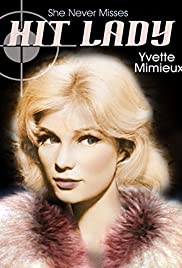
Hit Lady (1974, directed by Tracy Keenan Wynn)


Beautiful blonde Angela de Vries (Yvette Mimieux) shows up at a Texas barbecue and starts to chat up over-the-hill but very wealthy cowboy Buddy McCormick (Keenan Wynn).  Buddy thinks that he has hit the jackpot and when Angela suggests that they go off together for some alone time, he doesn’t turn her down.  Unfortunately for Buddy, the only reason Angela was talking to him was so she could get him alone and kill him with no witnesses!

(Buddy is played by Keenan Wynn because his son, screenwriter Tracy Keenan Wynn, directed this made-for-TV movie.  Angela is played by Yvette Mimieux because she got tired of only being cast in bland roles so she wrote a script with a juicy lead role for herself.)

Angela is a contract killer but she wants to get out of the business so that she can settle down with her seemingly oblivious boyfriend, a photographer named Doug (Dack Rambo).  Angela’s boss, Roarke (Clu Gulager), insists that Angela carry out one last hit.  He wants her to take down labor leader Jeffrey Baine (Joseph Campanella).  Angela really needs the money so she eventually accepts the job.  Roarke wants Baine’s death to look like an accident so that means Angela is going to have to learn everything that she can about Baine and his life.  When she learns that Baine loves Mozart, she decides to arrange an “accidental” meeting with him at a concert.  Is Angela the only contract killer in Los Angeles?  Couldn’t Roarke have found someone willing to do the job without so many preconditions?

Angela does meet Baine and, of course, the two of them start to fall in love.  Is Angela willing to both betray her boss and her boyfriend or will she carry out the hit?

Hit Lady is very much a product of the 70s, with one scene actually taking place at a disco.  Mimieux gives a good performance in a part that she wrote for herself and I’m sure many viewers will appreciate the lengthy amount of time she spends wearing just a bikini.  Mimieux gets to do most of the action movie things that, at the time, only men were usually allowed to do and she looks both good and convincing doing them.  Unfortunately, the love story with Jeffrey Baine does not work because the rough-hewn Campanella is not convincing as a Mozart-loving romantic lead and he and Mimieux never seem as if they really have any deep feelings for each other.  It’s easier to understand why Campanella would be attracted to Mimieux but than why she would be attracted to him.  That storyline probably would have worked better if Campanella had switched roles with Clu Gulager.  Hit Lady ends with an obvious twist but fans of 70s cheese and Yvette Mimieux should enjoy it.