1980’s The Final Countdown opens with a series of stunning overhead shots of Pearl Harbor. Warren Lasky (Martin Sheen), a systems analyst for Tideman Industries, is sent by his mysterious employer to observe operations on the USS Nimitz. Captain Yelland (Kirk Douglas), the commanding officer of the Nimitz, is polite to Lasky, even if he doesn’t quite understand why he’s been sent. For that matter, Lasky’s not sure what he’s supposed to do either. When the Nimitz is surrounded by a sudden storm and programs from 1941 start playing over the radio, Yelland suspects that it’s some sort of test and that Lasky has been sent to see how they react. However, when two Japanese airplanes are spotted overhead, it becomes clear that the Nimitz has somehow traveled through time. The date is December 6th, 1941 and, in just 24 hours, the Japanese are going to attack Pearl Harbor.
Commander Dick Owens (James Farentino) argues that it would be dangerous to try to change history by attacking the approaching Japanese fleet. However, it appears that the Nimitz has already changed history by saving the life of U.S. Senator Samuel Chapman (Charles Durning), who Owens believes would have been Roosevelt’s running mate in 1944 if he hadn’t been killed the day before Pearl Harbor. With Chapman demanding that Pearl Harbor be warned and Lasky arguing that the Nimitz should try to change history by preventing the attack, Captain Yelland has a decision to make.
The Final Countdown was made with the full support of the U.S. Navy. The production was allowed to film on the Nimitz and, outside of the main stars, the crew of the Nimitz played themselves. As a result, there’s a lot of awkward line deliveries amongst the minor characters but there’s also an authenticity to the film that elevates the story. Even when it becomes obvious that the Nimitz has traveled back to 1941, the crew handles things in a professional manner. One comes into the film expecting a good deal of panic and freaking out and instead, the movie offers up a ship of people who play it cool and who get the job done and it’s kind of nice to see. As for the professional actors, they all play their parts well enough. Charles Durning gets to bluster a bit as the senator and Katharine Ross (playing the senator’s secretary) looks like she’d rather be anywhere but on a aircraft carrier but Kirk Douglas, Martin Sheen, James Farentino, and Ron O’Neal all give solid, if not particularly memorable, performances.
The film asks an interesting question. Would you change history? For that matter, can history actually be changed? If the Nimitz prevented the attack on Pearl Harbor, would it have changed history for the better (as Lasky suggests) or would it have just kept America out of the war for a longer period of time? Would Japan have given up its plans to attack America or would its leaders have tried again? On a personal note, I’ve been to Pearl Harbor and it’s a moving experience. It’s hard not to look down at the remains of the USS Arizona and not feel something. I remember that, when I looked down at the Arizona, the first thing that I felt was anger that a ship that was sunk in an unprovoked attack also served as the tomb so many men who served their country. But then I felt a certain pride in the fact that, in the 1940s, America didn’t take that attack lying down. America didn’t make excuses or surrender. America stood for itself and kicked some ass and the world was and is better for it.
As for The Final Countdown, Don Taylor’s direction is fairly stolid (Taylor was no visual stylist) and there’s never really any explanation as to why the Nimitz went into the past in the first place. That said, I enjoyed the film. The premise is an intriguing one and the final twist works far better than one might expect. The Final Countdown is a good film that gets the job done.
1976’s The Cassandra Crossing opens with a shot of the headquarters of the World Health Organization in Geneva, Switzerland. Though the film (and the shot) may be from the 70s, one look at the ugly brutalism of the WHO’s headquarters is all it takes to understand the mentality that, nearly 50 years later, would lead to the organization serving as China’s mouthpiece during the COVID pandemic.
Three Swedish terrorists attack the American mission at the WHO. One of them is killed by a guard. Another immediately falls victims to an unidentified disease that is apparently a new form of the Bubonic plague. The third (Lou Castel) escapes and boards a train that is heading for Sweden. Two Americans, Col. MacKenzie (Burt Lancaster) and Major Stack (John Phillip Law), and Swedish doctor Elena Stadner (Ingrid Thulin), try to figure out how to stop the spread of the infection.
While the infected terrorist lurches around the train, the passengers go through their own personal dramas. Renowned neurologist Jonathan Chamberlain (Richard Harris) flirts with his ex-wife, writer Jennifer Rispoli (Sophia Loren). Wealthy Nicole Dressler (Ava Gardner, whose voice sounds like a cigarette ad) boards the train with her heroin-addicted younger boyfriend, Robby Navarro (a long-haired, dark glasses-wearing Martin Sheen, acting up a storm and apparently having a lot of fun for once). Herman Kaplan (Lee Strasberg) is a regular on the train, a Holocaust survivor who enjoys a good chess game with the conductor, Max (Lionel Stander). Haley (OJ Simpson) is a narcotics agent who is disguised as a priest. Susan (Ann Turkel) is the hippie who just wants to have sex with her boyfriend (Ray Lovelock) but who keeps getting interrupted by other passengers. When she complains about already having had to already deal with one “sweaty pervert” during the day, Chamberlain replies, “Which sweaty pervert?” By this point, Chamberlain knows about the infected man and is trying to track him down before he can infect anyone else on the train.
The Cassandra Crossing is several films in one. It’s an all-star disaster film. It’s medical thriller. Once Col. MacKenzie decides that the best way to deal with the train (and to cover-up the fact that America was researching germ warfare) would be to send the train over the infamous Cassandra Crossing, an unstable bridge that is on the verge of collapse, it becomes a conspiracy thriller. It’s all a bit ludicrous, though in this post-pandemic age, there is definitely a renewed power to the images of Hazmat suit-wearing soldiers carrying submachine guns and threatening to kill anyone who resists going into quarantine. When it comes to films that make Hazmat suits look menacing, The Cassandra Crossing can proudly stand with George Romero’s The Crazies and Zombi 3.
Of course, with any disaster film, the real purpose of the movie is to gather together a collection of familiar faces and then allow the viewer to spend two hours trying to guess who will survive and who will not. The cast is full of actors who all probably deserved a better script. Richard Harris, Burt Lancaster, and Ingrid Thulin all look somewhat embarrassed. Ava Gardner and Martin Sheen fully embrace the melodrama. In fact, it’s hard for me to think of any other movie where Sheen actually seemed to be having as much fun as he does while playing the drug-addicted, prone-to-histrionics mountain climber in The Cassandra Crossing. As was typical of his film career, O.J. Simpson gives a very earnest performance. He’s not exactly good but it’s obvious that he’s trying really hard and it would make him likable if not for the fact that he’s O.J. Simpson, just 20 years away from getting away with murder. Out of the ensemble cast, Lionel Stander, Lee Strasberg, and Sophia Loren are the one who probably come the closest to actually giving good performances. Loren’s husband, Carlo Ponti, produced the film with Sir Lew Grade and Loren gives a performance that is blessed with the confidence of knowing her career had survived far worse than The Cassandra Crossing.
The Cassandra Crossing is the epitome of a film that’s not necessarily good but which is definitely entertaining. Between the drama-stuffed plot and the overwritten dialogue and the performances of Gardner and Sheen, it’s campy in the way that only an overproduced 70s disaster film can be. For certain viewers, there’s undoubtedly a lot of joy to be found in the scenes in which the passengers finally start to stand up to the authoritarians trying to force them into quarantine. That said, this is one of those films where we’re not meant to get particularly upset about hundreds of innocent people dying just because the main characters managed to come through unscathed. The film’s ending is right up there with Man of Steel as far as needless destruction is concerned. Fortunately, the ending also features some terrible miniature shots, all of which remind us not to take it all too seriously.
To paraphrase another 70s film: “Forget it, Jake. It’s The Cassandra Crossing.“
In 1979’s The Concorde …. Airport ’79, Joe Patroni (George Kennedy) finally gets to fly the plane.
The plane is question is a Concorde, a supersonic airliner that can travel faster than the speed of sound. When we first see the Concorde, it’s narrowly avoiding a bunch of dumbass hippies in a hot air balloon as it lands in Washington, D.C. The recently widowed Joe Patroni joins a flight crew that includes neurotic Peter O’Neill (David Warner), who says that he has dreams in which he’s eaten by a banana, and suave co-pilot Paul Metrand (Alain Delon). Because this is an Airport film, Mertrand is dating the head flight attendant, Isabelle (Syliva Kristel). “You pilots are such men,” Isabelle says. “It ain’t called a cockpit for nothing, honey,” Patroni replies.
(One thing that is not explained is just how exactly Joe Patroni has gone from being a chief technician in the first film to an airline executive in the second to a “liaison” in the third and finally to a pilot in the fourth.)
The Concorde is flying to Moscow with a stop-over in Paris. There’s the usual collection of passengers, all of whom have their own barely-explored dramas. Cicely Tyson plays a woman who is transporting a heart for a transplant. She gets maybe four or five lines. Eddie Albert is the owner of the airline and he’s traveling with his fourth wife. (Of course, he’s old friends with Patroni.) John Davidson is an American reporter who is in love with a Russian gymnast (Andrea Marcovicci). Avery Schrieber is traveling with his deaf daughter. Monica Lewis plays a former jazz great who will be performing at the Moscow Jazz Festival. Jimmie Walker is her weed-smoking saxophonist. Charo shows up as herself and gets kicked off the plane before it takes off.
The most important of the passengers is Maggie Whelan (Susan Blakely), a journalist who has evidence that her boyfriend, Kevin Harrison (Robert Wagner), is an arms trafficker. Harrison is determined to prevent that evidence from being released so he programs a surface-to-air missile to chase the Concorde. Patroni is able to do some swift maneuvers in order to avoid the missile, which means that we get multiple shots of passengers being tossed forward, backwards, and occasionally hanging upside down as Patroni flips over the plane. Oddly no one really gets upset at Patroni about any of this and no one seems to be terribly worried about the fact that someone is obviously trying blow up their plane. Even after the stop-over in Paris, everyone gets back on the Concorde! That includes Maggie, who could have saved everyone a lot of trouble by just holding a press conference as soon as the plane landed in Paris.
A year after The Concorde came out, Airplane! pretty much ended the disaster genre. However, even if Airplane! had never been released, I imagine The Concorde would have still been the final Airport film. Everything about the film feels like the end of the line, from the terrible special effects to the nonsensical script to the Charo cameo and Martha Raye’s performance as a passenger with a weak bladder. The first Airport film was an old-fashioned studio film standing defiant against the “New Hollywood.” The second Airport film was a camp spectacular. The third Airport film was an example of changing times. The fourth Airport film is just silly.
And, really, that’s the main pleasure to be found in The Concorde. It’s such an overwhelmingly silly film that it’s hard to look away from it. For all of its weaknesses, The Concorde will always be remembered as the film that featured George Kennedy opening the cockpit window — while in flight — and shooting a flare gun at another plane. As crazy as that scene is, just wait for the follow-up where Kennedy accidentally fires a second flare in the cockpit. “Put that out,” Alain Delon says while David Warner grabs a fire extinguisher. It’s a silly moment that it also, in its way, a great moment.
The Concorde brings the Airport franchise to a close. At least George Kennedy finally got to fly a plane.
Airport ’77 is the one where the plane ends up underwater.
If the first two Airport movies emphasized the competence of the the crew in both the airplane and the airport, Airport ’77 takes the opposite approach. The first of the Airport films to be released after Watergate, Airport ’77 is a cynical film where no one seems to be particularly good at his or her job. Viewers should be concerned the minute they see that Jack Lemmon is playing Captain Don Gallagher, the pilot of the soon-to-be-submerged airplane. As opposed to Charlton Heston or even the first film’s Dean Martin, Jack Lemmon was always a very emotional actor. He excelled at playing characters who were frustrated with modern life. Just as with Heston and Martin, Lennon plays a pilot who is having an affair with a flight attendant. The big difference is that, this time, the pilot is the one who desperately wants to get married while the flight attendant (played by Brenda Vacarro) is the one who doesn’t want to get tied down. As an actor, Lemmon didn’t have the arrogance of a Heston or the unflappability of Dean Martin. Instead, Jack Lemmon was the epitome of midlife ennui. He’s disillusioned and he’s beaten down. He’s America at the tail end of the 70s.
Another sign that Airport ’77 is a product of the post-Watergate era is the character of co-pilot Bob Chambers (Robert Foxworth). Chambers might seem like a nice and friendly professional but actually, he’s the one who comes up with the plan to knock out all of the passengers with sleeping gas and fly the plane into the Bermuda Triangle so that his partners-in-crime can steal the valuable art works in the cargo hold. Chambers plans is to land the plane on an unchartered isle so that he and Banker (Monte Markham) can make their escape before the rest of the people on the plane even wake up. Instead, Chambers turns out to be as incompetent a pilot as he is a criminal. He crashes the plane into the ocean, where it promptly sinks to the bottom. The impact wakes up the passengers, all of whom can only watch in horror as the ocean envelopes their plane. With the water pressure threatening to crush the plane, Captain Gallagher and engineer Stan Buchek (Darren McGavin) try to figure out how to get everyone to the surface.
As usual, the passengers are played by a collection of familiar faces. Olivia de Havilland and Joseph Cotten play former lovers who are reunited on the flight. Christopher Lee is a businessman who is unhappily married to alcoholic Lee Grant. Grant is having an affair with Lee’s business partner, Gil Gerard. A young Kathleen Quinlan plays the girlfriend of blind pianist Tom Sullivan. Robert Hooks is the bartender who ends up with a severely broken leg. As the veterinarian who is called to doctor’s duty, M. Emmet Walsh gives the best performance in the film, if just because he’s one of the few characters who really gets to surprise us. Actors like George Furth, Michael Pataki, and Tom Rosqui all wander around in the background, though I dare anyone watching to actually remember the names of the characters that they’re playing. Airport ’77 has the largest number of fatalities of any of the Airport films, largely because even the good guys aren’t really sure about how to reach the surface.
George Kennedy returns as Joe Patroni, though his role is considerably smaller in this film than it was in the first two. He shares most of his scenes with James Stewart, who plays the owner of the plane. Fortunately, neither Stewart nor Kennedy were on the plane when it crashed. Instead, they spend most of the movie in a control room, getting updates about the search. They don’t get to do much in the film but it’s impossible not to smile whenever Jimmy Stewart is onscreen, even if he is noticeably frail.
Airport ’77 is the best-made of all of the Airport films. The crash is well-directed and the scenes of water dripping into the plane are properly ominous. There’s not much depth to the characters but Jack Lemmon and Darren McGavin are likable as the two main heroes and Christopher Lee seems to be enjoying himself in a change-of-pace role. Olivia de Havilland and Joseph Cotten, two old pros, are wonderful together. That said, Airport ’77 is never as much fun as the first two films. Even with the plane underwater, it can’t match the spectacle of Karen Black having to fly a plane until Charlton Heston can be lowered into the cockpit.
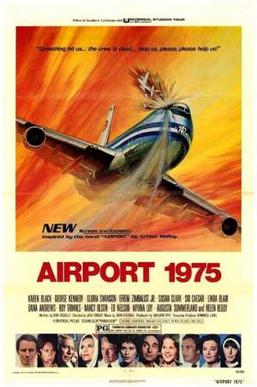
About halfway through 1974’s Airport 1975, Sid Caesar has one of the greatest lines in film history.
“The stewardess is flying the plane?”
Hell yeah, she is! After a collision with another plane takes out the crew of a Broening 747, it’s up to head flight attendant Nancy (Karen Black) to keep the plane from crashing until another pilot can somehow be lowered into the cockpit of the stricken airliner. Nancy’s never flown an airplane before but she is dating Al Murdock (Charlton Heston), who may be scared of commitment but who is still described as being one of the greatest pilots who has ever lived. None other than Joe Patroni (George Kennedy) says that no one knows more about flying than Al Murdock.
George Kennedy is the only cast member to return from the original Airport. When we previously met Patroni, he was the cigar-chewing chief mechanic for Trans World Airlines. In Airport 1975, he’s suddenly an executive with Columbia Airlines. His wife (Susan Clark) and his son (Brian Morrison) are also on the plane. Joe Patroni and Al Murdock are determined to bring that plane safely to the ground in Salt Lake City and if that means dropping a pilot into the cockpit from a helicopter, that’s what they’ll do. It’s all a question of whether or not Nancy can keep that plane from crashing while they round up a helicopter and a pilot.
Airport 1975 is so famous for being the movie where the stewardess is flying the plane that it’s often overlooked that it’s also the film where Linda Blair plays a young girl in need of a kidney transplant. When Sister Ruth (Helen Reddy) sees that the girl has a guitar with her, Ruth sings a folk song that has everyone on the airplane smiling. (If I was on a plane and someone started playing folk music, I’d probably jump out. That may seem extreme but seriously, you don’t want to test me on how much I dislike the folk sound.) This scene was, of course, parodied in Airplane! In fact, it’s pretty much impossible to watch Airport 1975 without thinking about Airplane!
It’s also overlooked that Gloria Swanson is one of the many stars to appear in this film but Swanson is the only one playing herself. Gloria Swanson starts as Gloria Swanson and I assume that this 1974 film was set in 1975 in order to generate some suspense as to whether or not Swanson was going to survive the crash. Swanson talks about how, in 1919, Cecil B. DeMille flew her over California. She does not talk about Joseph Kennedy or Sunset Boulevard and that’s a shame. As I watched Airport 1975, I found myself thinking about how different the film would have been if Gloria Swanson had been the one who had to pilot the plane instead of Karen Black.
“Gloria Swanson is piloting the plane?”
As entertaining as that would have been, it would have meant missing out on Karen Black’s intense performance as Nancy. At times, Nancy seems to be so annoyed with the situation that one gets the feeling that she’s considering intentionally crashing the plane into one of Utah’s mountains. At other times, she seems to be at a strange sort of peace with whatever happens. There’s a scene where she attempts to clear some of the clutter in the cockpit and an instrument panel falls on her head and it’s such a powerful moment because I know the exact same thing would have happened to me in that situation. There’s another moment where I’m pretty sure she accidentally kills the first pilot who attempts to drop into the cockpit and again, it’s a mistake that anyone could have made. The film doesn’t call her out on it because the film understand that none of us are perfect, except for Charlton Heston.
Speaking of which, Karen Black’s emotional performance contrasts nicely with the performance of Charlton Heston. This is perhaps the most Hestonesque performance that Charlton Heston ever gave. Al Murdock is confident, he doesn’t suffer fools, and he’s condescending as Hell. Every time he calls Nancy “honey,” you’ll want to cringe. And yet, it’s hard not to appreciate someone who can be so confident while wearing a tight yellow turtleneck. Charlton Heston watches as the first pilot to attempt to enter the cockpit plunges to his death and immediately declares that it’s his turn to try. “Get me in that monkey suit!” he snaps and it’s such a Heston moment that you have to love it.
There’s a ton of people in this movie. Norman Fell, Jerry Stiller, and Conrad Janis play three rowdy drunks. Erik Estrada, Efrem Zimbalist, and Roy Thinnes are the unfortunate members of the flight crew. Dana Andrews has a heart attack while piloting a small private plane. Myrna Loy appears not as herself but as Mrs. Delvaney, who spends almost the entire flight drinking. Christopher Norris plays Bette, who says that she may look like a teenager but she prefers to be called “Ms. Teenager” and that she’s trained in Kung Fu. Beverly Garland played Dana Andrews’s wife. Larry Storch is an obnoxious reporter. Character actor Alan Fudge plays Danton, the Salt Lake City controller who keeps Nancy calm until Charlton Heston can start snapping at people.
The first time that I watched Airport 1975, I was pretty dismissive of it but, over the years, I’ve rewatched it a few times and I have to admit that I’ve fallen in love with this wonderfully ridiculous film. There’s just so many odd details, like American Graffiti showing up as the plane’s in-flirt entertainment and Sid Caesar saying that he’s only on the flight because he has a small role in the movie and he finally wanted to see it. (It seems like it would have been cheaper to just go to a drive-in but whatever.) And there’s Karen Black, giving the performance of a lifetime and letting us all know that, in 1975, the stewardess flies the airplane!
First released in 1970, Airport is a real time capsule.
As one can guess from the title, it takes place over 12 hours at an airport. The airport in question is a fictional one, Chicago’s Lincoln International Airport. Over the course of one night, almost everything that can happen does happen.
A sudden snowstorm causes almost all of the other airports in the midwest to shut down for the night. On Lincoln’s Runway 29, one of the airplanes gets stuck in the show when it lands. No one is hurt but, until Joe Patroni (George Kennedy) and his men can dig out and move that plane, no one is going to be able to land on 29.
Runway 22 is still open but the homeowners association is currently picketing the airport to protest the amount of noise pollution that is caused whenever airplanes use Runway 22. Using 22 in the middle of the night is sure to prove their point and make trouble for the airport. Mel Bakersfield (Burt Lancaster), the airport manager, thinks that the only solution is to buy up all of the land around the airport but the Board of Commissioners disagrees. Mel says that airports have to adjust to changing times but no one is willing to put up the money.
Mel is unhappily married to the wealthy and socially ambitious Cindy (Dana Wynter), who is not happy to learn that, due to the storm, Mel is going to miss an important dinner party. Tanya Livingston (Jean Seberg), head of customer relations for Trans Global Airlines, is in love with Mel but Mel isn’t the type to cheat, even if his marriage is troubled.
On the other hand, Mel’s brother-in-law, pilot Vernon Demerest (Dean Martin, the hippest pilot in the sky), has absolutely no problem cheating on his wife (Barbara Hale). Vernon is currently having an affair with flight attendant, Gwen Meighen (Jacqueline Bisset). When Gwen tells Vernon that she’s pregnant, Vernon says that “it” can be taken care of in Sweden. Gwen says that she wants to have the baby.
Meanwhile, Ada Quonsett (Helen Hayes, who won an Oscar for her performance here) is an elderly woman who has developed an addiction to stowing away on flights. She manages to sneak onto a plane flying to Rome, the same plane on which Vernon is the co-pilot. (Technically, Vernon is on the plane to evaluate the captain, who is played by Barry Nelson. Yes, the same Barry Nelson who played Jimmy Bond in 1954’s Casino Royale and Mr. Ullman in The Shining.) Ada ends up sitting next to a nervous man named D.O. Guerrero (Van Heflin). Having failed as a businessman, Guerrero has a bomb in his briefcase and is planning on blowing himself and the airplane up so that his wife (Maureen Stapleton) can receive an insurance payment.
Seriously, that’s a lot of drama! It seems like this airport has a little bit of everything! But you know what this airport doesn’t have? It doesn’t have the TSA groping people and telling them what they can and cannot take on the plane with them. It doesn’t have the endless lines full of tired travelers who just want to be allowed to get on with their business. It doesn’t have the suspicious atmosphere that has become a part of modern air travel. Compared to the average airport experience of 2026, the movie’s airport is a paradise, full of people who are working hard, who are polite to each other, and who all seem to know what they’re doing. I’d take the drama of 1970’s Airport over the reality of a modern airport any day.
Airport is very much a celebration of competent people getting the job done. On the whole, we really don’t learn much about the characters played by Burt Lancaster, Dean Martin, Jean Seberg, Barry Nelson, and George Kennedy but we definitely learn that they’re all very good at their jobs. Even Helen Hayes’s stowaway is meant to be likable precisely because she is so good at stowing away. The only person who is portrayed as being a failure as Van Heflin’s D.O. Guerrero and he’s so upset about not being good at his job that he decides to blow himself up. Though the film is full of split screens and dialogue that was probably risqué by the standards of a 1970 studio film, one gets the feeling that Airport probably felt old-fashioned even when it was first released. One can only imagine what George Kennedy’s hard-working Joe Patroni would have thought about the characters in a film like Easy Rider. About as close as Airport gets to the counterculture is Dean Martin mockingly calling Burt Lancaster “dad” while telling him to get his favorite runway cleared. This is a film where even Dean Martin is a stickler for regulations.
Based on a best-selling novel, Airport is often listed as being one of the worst films to ever be nominated for best picture. And …. well, okay, it’s definitely not a great film, especially when compared to some of the other films of the early 70s. The film was the highest grossing film of 1970 and that, more than anything, probably explains why it was nominated. Airport moves at a very deliberate pace and and visually, it is pretty flat. It looks like a competently made television pilot. When I first did a capsule review of Airport in 2010, I was fairly harsh towards it. I have to admit, though, that when I recently rewatched the film, I actually kind of liked it. Compared to today’s world, there’s something comforting about the competence of the characters in Airport. Airport has its flaws and it definitely should not have been nominated for 11 Oscars but it presents a world that seems almost cozy compared to what we have to deal with nowadays.
Dean Martin as a pilot? Helen Hayes as a chatty stowaway? George Kennedy chewing on an unlit cigar and complaining to Burt Lancaster about how incompetent the TGA pilots are? Hey, why not? If it means not having to deal with the TSA and knowing that everyone is dedicated to getting me to where I’m going in comfort, I’m all for taking my next flight out Lincoln International.
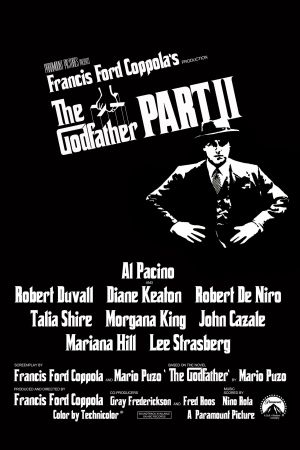
Well, the clock has now struck midnight on the West Coast and that officially means that it is 2026 in the United States! What better way to start things off than by sharing a scene that I love from one of the greatest and most important films of all time, 1974’s The Godfather Part II?
The scene below takes place on New Year’s Eve. The scene starts in 1958 and it ends in 1959. Michael Corleone (Al Pacino) and his brother Fredo (John Cazale) are in Havana at the invitation of Hyman Roth (Lee Strasberg). Roth know that Cuba could be a gold mine for the American mob but Michael, from the start, realizes that the country’s corrupt government is on the verge of collapse and that it’s about to be replaced by something even worse. (Admittedly, that’s my opinion. Director Francis Ford Coppola had a much higher opinion of Castro and the communists than I did.) Tragically, it’s also in Havana that Michael realizes that Fredo betrayed him to his enemies. On December 31st, 1958, as the new year is celebrated in Havana, the rebels ride into the city. While the President of Cuba prepares to announce that he will be fleeing the country, Michael confronts his brother and tells him that he knows the truth. Later, as they both attempt to flee the country, Michael and Fredo see each other on the streets. Fredo runs from Michael, refusing his offer to help. Though Fredo would eventually return to the family, the film’s ending revealed Fredo’s first instinct was the correct one.
Here’s a scene that I love, featuring great work from both Al Pacino and the brilliant John Cazale:
“Memories are meant to fade, Lenny. They’re designed that way for a reason.” — Lornette “Mace” Mason
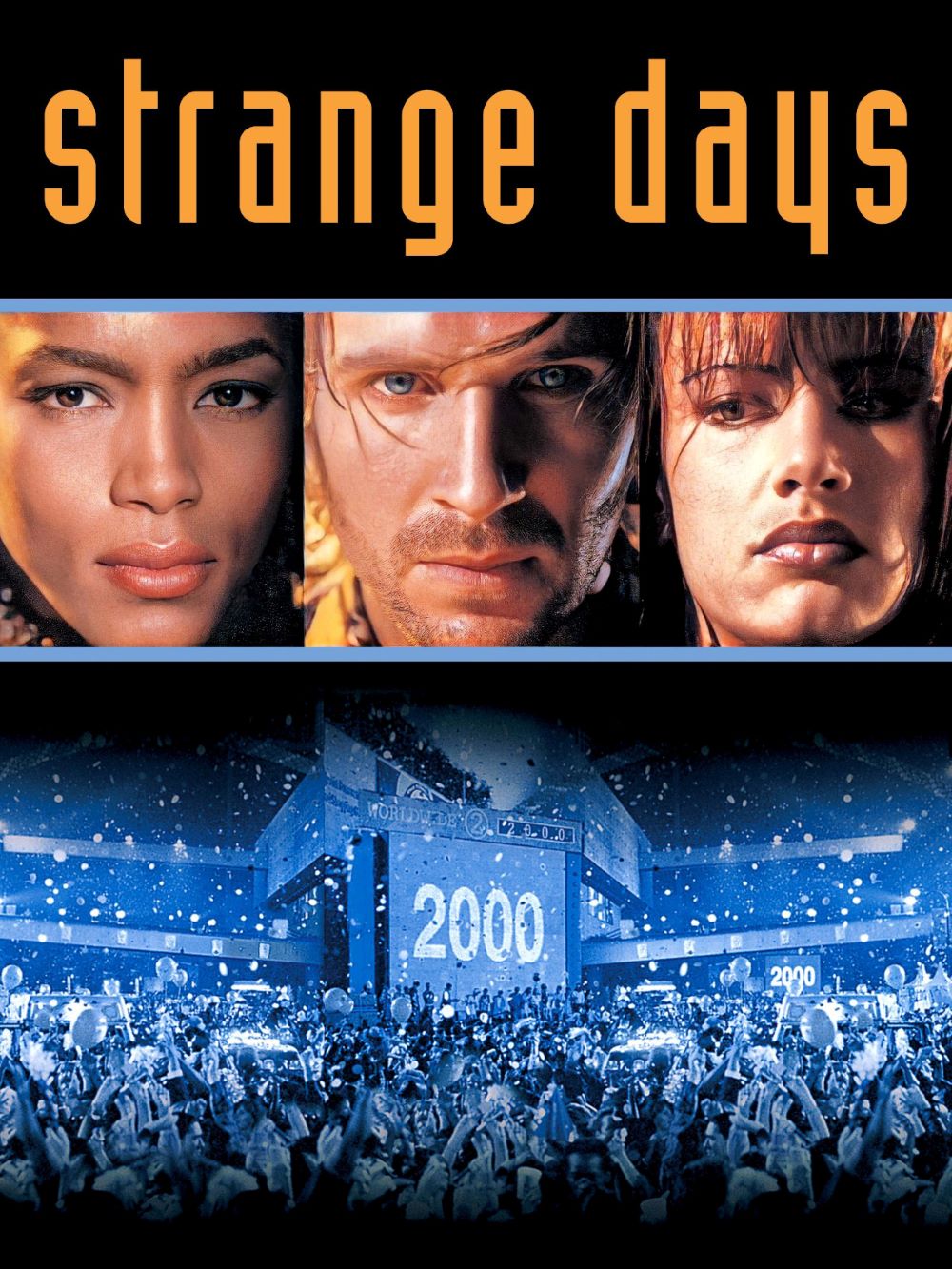
Kathryn Bigelow’s Strange Days plunges into a gritty, near-future Los Angeles teetering on the edge of the millennium, where illegal “SQUID” technology lets people hijack others’ sensory experiences, fueling a black-market addiction to raw thrills. Released in 1995 with a screenplay by James Cameron and Jay Cocks, the film stars Ralph Fiennes as Lenny Nero, a shady ex-cop dealing these clips amid escalating racial tensions and urban chaos. At over two hours, it mixes cyberpunk visuals with thriller tension, crafting an immersive world that pulses with sensory overload and moral ambiguity.
The story opens with a heart-pounding sequence—a robber’s point-of-view heist captured in one seamless, breathless shot that drops you right into the adrenaline-fueled action, setting a template for the film’s signature subjective dives into chaos. Lenny navigates this underworld, peddling clips of highs and dangers to escape his own regrets, especially over a past love, singer Faith Justin, brought to life by Juliette Lewis with vulnerable intensity that captures the pull of faded dreams. He pulls in his loyal bodyguard Mace, Angela Bassett delivering a fierce, grounded performance, as a mysterious clip hints at deeper corruption involving cops and power players in the city, drawing them into a web of intrigue that tests loyalties amid the neon haze. Bigelow leans into the tech’s seductive pull, where users feel every rush or rush of emotion, blurring lines between observer and participant in uncomfortably real ways that linger long after the credits roll.
Visually, the film explodes off the screen, with cinematographer Matthew Leonetti’s dynamic camera and Bigelow’s high-octane style painting L.A. as a neon-drenched maze of helicopters, crowds, and holographic distractions that feel alive and oppressive. That kinetic opening blends POV chaos with slick editing that amps the disorientation, making every frame pulse with urgency. The world feels authentically grimy and multicultural, alive with New Year’s Eve energy in clubs and streets, evoking millennial anxiety through thumping sound design and distorted audio bleeds that heighten the sensory assault. Bigelow channels her action roots into visceral set pieces that turn the future into something tangible and tense, rewarding close attention to the details that build immersion, from flickering holograms to rain-slicked streets buzzing with tension.
Fiennes captures Lenny’s sleazy charisma perfectly—a sweaty, chain-smoking hustler whose charm masks desperation, keeping him oddly relatable even as his flaws pile up in moments of quiet vulnerability. Bassett dominates as Mace, a tough wheelwoman with unshakeable integrity, her presence anchoring the frenzy and elevating every exchange with quiet strength that cuts through the chaos like a blade. Lewis adds raw edge to Faith, trapped in a web of influence and ambition, her scenes crackling with desperation and fire. Tom Sizemore brings twitchy noir flavor as Max, Lenny’s private investigator buddy who adds layers of unreliable grit to their partnership, his manic energy bouncing off Fiennes in tense, believable banter. The cast meshes well in the overload, though some peripheral figures lean into cyberpunk stereotypes like street dealers and digital oddities, occasionally stretching the vibe thin without fully fleshing out their roles amid the relentless pace.
At its core, Strange Days digs into tech’s grip on empathy in a numb world, where SQUID clips turn voyeurism into full-body complicity, raising tough questions about detachment, consent, and the thrill of borrowed lives. Lenny’s habit of replaying personal moments underscores the addictive pull of reliving the past, turning memory into a dangerous escape that erodes real connections. Bigelow threads in sharp commentary on racism and authority, drawing from real ’90s unrest, with Mace pushing for truth amid systemic shadows in ways that feel urgent and unflinching, her moral compass a steady force against the moral rot. The infamous rape scene stands out as a gut-wrenching pinnacle of this approach, forcing viewers into the perpetrator’s twisted perspective via SQUID playback, amplifying the victim’s terror and the assailant’s depravity to confront voyeuristic horror and power imbalances head-on without pulling punches or easy outs—its raw intensity is jarring, deliberately so, to expose the ethical rot at the tech’s heart. The female-led perspective highlights abuses thoughtfully, adding layers to the spectacle and giving the film a distinctive edge that balances exploitation with unflinching critique.
That said, the film isn’t without bumps, as the plot weaves a tangled web of alliances and betrayals that can feel convoluted under the sensory barrage, occasionally losing focus amid the noise and demanding sharper clarity to match its ambition. Its 145-minute runtime sags midway with Lenny’s brooding and repetitive demos, testing patience before ramping up to its feverish peaks, where the editing could trim some fat for tighter momentum. The climax aims for catharsis amid riots and revelations but lands unevenly, with a hopeful turn that feels rushed or tidy in spots, underplaying certain social threads post-buildup and diluting their harder-hitting potential just when they build to a roar. Some effects show their age, like glitchy clip transitions that disrupt rather than enhance the immersion at times.
Still, these rough edges can’t overshadow the film’s bold highs. Bigelow’s direction thrives on discomfort, using the SQUID concept to mirror how media desensitizes us, making every clip a window into ethical quicksand. The sound design deserves special mention—bass-heavy tracks and visceral screams that bleed from headsets create a claustrophobic intensity, amplifying the tech’s invasive allure. Action beats, from high-speed chases to brutal confrontations, showcase Bigelow’s knack for kinetic choreography, with Bassett’s physicality in the driver’s seat stealing the show. Lenny’s arc, flawed as it is, lands with pathos, his hustler’s denial cracking under pressure to reveal flickers of redemption tied to loyalty and loss.
Strange Days delivers highs that exhilarate and lows that challenge, mirroring its own addictive clips—a raw, uneven ride pulsing with Bigelow’s bold vision that thrives on discomfort and connection. Mace’s decency offers human spark amid the dystopia, balancing provocation with heart in a way that elevates the whole, her bond with Lenny grounding the spectacle in something real. It’s provocative cyberpunk for those craving immersion with bite, a film that doesn’t just show a future but makes you live it, flaws and all, leaving you wired and wary. Fire it up if you’re ready to jack in and feel the rush—just brace for the crash.
For an athlete, what does it take to become the greatest of all time?
Does it take natural talent?
Does it take determination and a willingness to keep playing and practicing through the pain?
Does it take going to an isolated desert training camp and getting regular injections of someone else’s blood?
That was the question asked by Him, a so-called “sports horror” film that came out in September of this year.
Tyriq Withers plays Cam Cade, a college football player who is on the verge of turning professional. Every one is expecting Cam to be the number one pick at the upcoming league draft …. or at least, they are up until Cam is struck in the back of the head by a man wearing a goat costume. Cam suffers a severe concussion. The doctors warn his mother that another severe brain injury could end his career but both Cam and his family are determined for him to turn pro. Even when Cam was a child, his father was grooming him to become a football star. Cam grew up idolizing Isaiah White (Marlon Wayans), a college quarterback who came back from a terrible injury, turned professional, and who has since led the San Antonio Saviors to eight championships.
In fact, Isaiah is willing to train with Cam! Isaiah is considering retirement and he thinks that Cam could be a worthy replacement. Cam travels out to the desert compound, where Isaiah lives with his staff and his wife (Julia Fox). After making his way through the groupies who are angry at the thought of anyone trying to replace Isaiah on the team, Cam begins to train with his idol. Isaiah spends a lot of time talking about Roman gladiators and how tough it is to be black quarterback. He pushes Cam to his limits, forcing him to become a more aggressive and a more arrogant player. Isaiah shows Cam that it takes more than just having talent to be the GOAT. Instead, it’s an entire lifestyle. Cam starts to have bizarre visions while getting regular shots (“for the pain”) from Isaiah’s doctor. Eventually, Cam learns the truth about how great players are created and about how success can come at the cost of one’s soul.
Him is definitely a flawed film. A major problem is that neither Marlon Wayans nor Tyriq Withers really have the screen presence to be believable in their roles. Wayans, in particular, seems miscast and he gives a rather one-note performance as a character who is supposed to be as charismatic as he is athletic. (Wayans comes across as being neither charismatic nor particularly athletic.) The script attempts to deal with just about every controversy there is about football but it often does so in the most shallow, perfunctory way possible. The whole gladiator thing? We’ve all heard it before.
That said, the film’s narrative is so over-the-top (and, I believe, intentionally so) and the direction is so excessively stylish that it does hold your attention. For all of the film’s flaws, the compound is a wonderfully ominous location and the use of X-ray shots to show us concussions and twisted limbs does rather forcefully drive home the point that football is not a gentle game. Him may not be good but it’s just ludicrous enough to be watchable.
“What kind of American are you?” — Unnamed ultranationalist militant
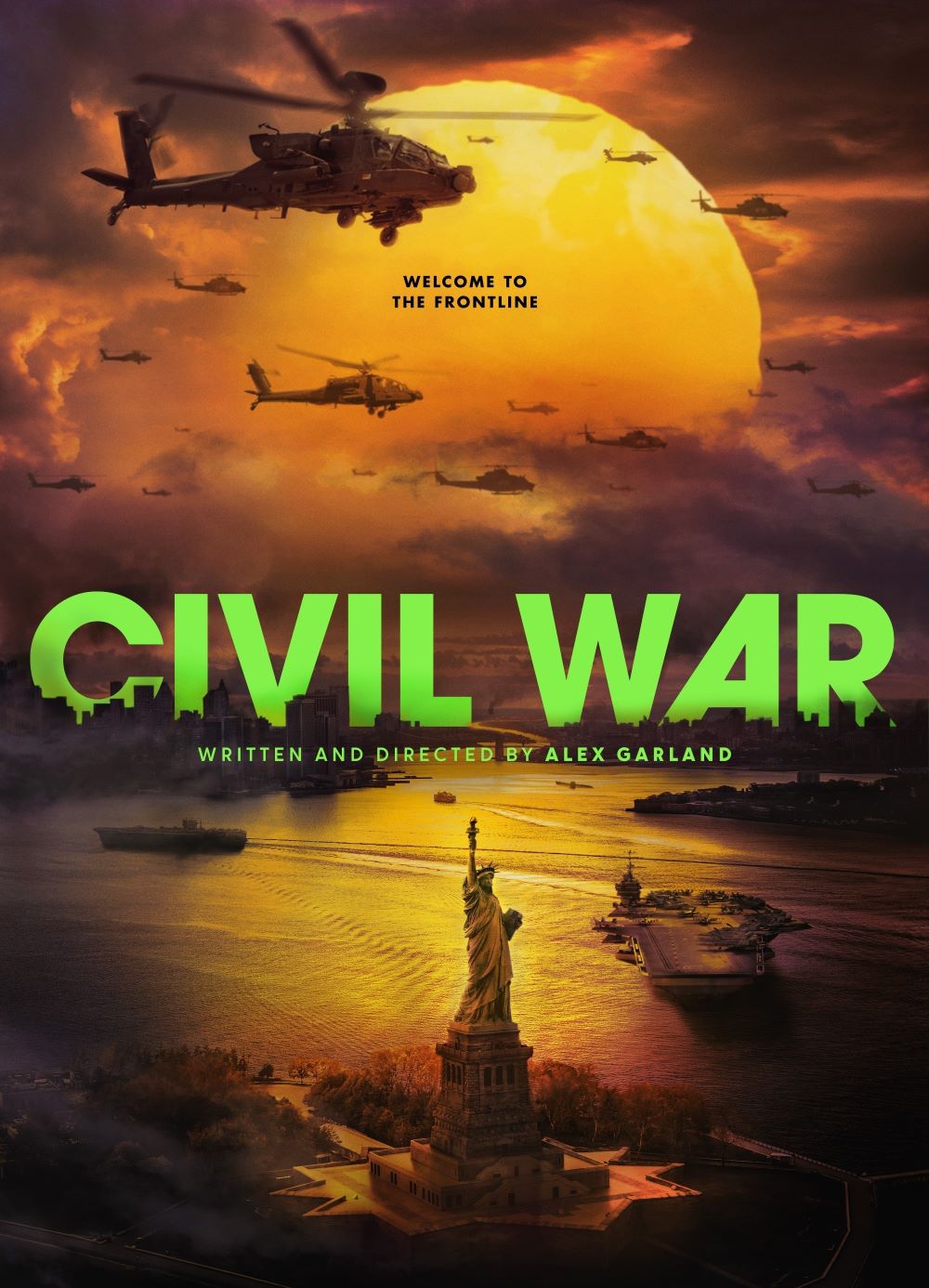
Alex Garland’s Civil War is the kind of movie that feels both uncomfortably close to reality and strangely abstract at the same time, like a nightmare built out of today’s headlines but deliberately smudged at the edges. It plays less like a political thesis and more like a road movie through a country that has already gone past the point of no return, seen through the eyes of people whose job is to look at horror and keep pressing the shutter anyway.
Garland frames the story around war journalists traveling from New York to Washington, D.C., hoping to reach the President before rebel forces do, and that simple premise gives the film a clear spine even when the politics around it stay fuzzy. Kirsten Dunst’s Lee, a veteran photographer, and Cailee Spaeny’s Jessie, a young aspiring shooter, are paired with Wagner Moura’s adrenaline-chasing reporter Joel and Stephen McKinley Henderson’s weary old-timer Sammy, forming a sort of dysfunctional road-trip family driving straight into hell. The setup is classic “last assignment” territory, but the context—an America shattered by an authoritarian third-term president and secessionist forces from places like Texas and California—is what makes the film play like speculative non-fiction rather than pure sci-fi. That Texas-California alliance as the Western Forces stands out as such strange bedfellows, two states about as diametrically opposed as you can get politically and culturally, which subtly hints at just how monstrous the president must be to drive them into the same camp against a common enemy.
The plot itself is pretty straightforward once you strip away the political expectations people bring in. The group moves from one pocket of chaos to another, crossing a patchwork United States where some areas still look almost normal while others are full-on war zones. The tension ramps as they get closer to Charlottesville and then D.C., eventually embedding with Western Forces as they push toward the capital. Along the way, the journalists encounter a series of vignettes—mass graves, roadside militias, bombed-out towns—that feel intentionally episodic, like flipping through the front page of a dozen different conflicts and realizing they all share the same language of fear and dehumanization.
Performance-wise, Dunst is the emotional anchor, playing Lee with a kind of hollowed-out professionalism that feels earned rather than performative. Her character is someone who has seen too many wars abroad and now finds herself documenting one at home, and Dunst sells that numbness without turning Lee into a complete emotional void. Spaeny’s Jessie, meanwhile, is the mirror opposite: all raw nerves and hungry ambition, constantly pushing closer to danger for the shot, until that drive becomes its own kind of addiction. Their dynamic—mentor vs. rookie, caution vs. thrill—gives the movie a human arc to track even when the bigger national stakes remain frustratingly vague.
The supporting cast makes the most of their moments. Moura brings a reckless charm to Joel, someone who clearly gets off on the chaos even as he understands the risks, while Henderson’s Sammy has that lived-in, old-school journalist vibe that makes his presence feel instantly comforting. Nick Offerman’s president shows up mostly as an image and a voice—an isolated leader giving delusional addresses about “victories” and “loyalty” while the country burns—which fits Garland’s choice to keep power distant and almost abstract. And then there’s Jesse Plemons in a late, unnerving scene as a soldier interrogating the group with the question “What kind of American are you?”, a moment that pulls the film’s subtext about nationalism and dehumanization right up to the surface.
Visually, Civil War is stunning and deeply unpleasant in the way it should be. Garland and his team lean heavily into realism: grounded battle scenes, chaotic firefights, and that disorienting sense of being in the middle of something huge and unknowable, with the camera clinging to the journalists as they scramble for cover or line up a shot. The film often uses shallow depth of field, throwing backgrounds into blur so explosions and tracers feel like ghostly streaks behind the tight focus on a face or a camera lens, which reinforces how narrow the characters’ survival focus has become. Sound design is equally aggressive—gunfire, drones, and explosions hit hard in a theater, and Garland doesn’t shy away from making violence both terrifying and, in a way, disturbingly exhilarating.
That’s one of the film’s more interesting, and arguably more uncomfortable, tensions: it’s overtly anti-war in its messaging, but it also understands that war, on a visceral level, can feel like a rush. Several characters clearly chase that feeling, and the film doesn’t let them—or the audience—off the hook for enjoying the adrenaline that comes from life-or-death stakes. There are moments where the action almost tips into “too cool” territory, but Garland usually undercuts this with the emotional fallout afterward, making it clear the cost of those images and thrills is paid in trauma and numbness.
Where Civil War is really going to divide people is in its politics—or more accurately, its refusal to spell them out. The film never fully explains how this United States got here or exactly what the sides are fighting over, beyond hints of authoritarian overreach and regional alliances like the Texas-California Western Forces. You get breadcrumbs: a third-term president who dissolved norms, references to an “Antifa massacre,” and presidential rhetoric that echoes real-world strongman language, but Garland refuses to plant a big obvious flag that says, “This is about X side being right or wrong.”
Depending on what you want from the movie, that choice either feels smartly universal or frustratingly evasive. On one hand, treating the conflict like a kind of Rorschach test lets viewers project their own anxieties onto the screen; it becomes a story about any country pushed too far by polarization, propaganda, and the normalization of violence. On the other, the vagueness around ideologies can come across as sidestepping tough specifics, especially in today’s charged climate, where audiences might crave a bolder stance on division and power.
To the film’s credit, its focus is very clearly on the experience of war, not the policy debates that preceded it. The journalists are not neutral robots; they have opinions, fears, and moments of moral conflict, but their professional instinct is to document first, analyze later, and that’s the lens the film adopts as well. You see how the job warps them: Lee’s exhaustion, Jessie’s desensitization, Joel’s thrill-seeking, Sammy’s weary sense of duty. In that sense, Civil War feels as much like an ode and a critique of war journalism as it does a warning about domestic collapse.
That said, the character work will not land equally for everyone. The emphasis on spectacle and raw incident sometimes leaves less room for layered personal depth, with figures beyond the leads feeling more archetypal than fully fleshed out. Even Lee and Jessie are shaped primarily by their roles in the chaos rather than extensive personal histories, which suits Garland’s lean, immersive style but might leave some wanting more nuance.
The last act, set during the assault on Washington and the White House, is where the film fully commits to being a war movie rather than a political allegory. The battle is staged with a mix of big, chaotic action and small, intimate beats: journalists diving behind columns, soldiers shouting directions, Jessie pushing closer to get the shot even as bullets hit inches away. It’s brutal and propulsive, driving home the film’s bleak thesis: once violence is normalized, legitimacy and process vanish, replaced by whoever has the most guns in the room.
Is Civil War perfect? No. It is at times overdetermined in its imagery and underdetermined in its world-building, and the decision to keep the “why” of the war so foggy will absolutely alienate viewers who wanted a sharper, more pointed statement about the current American moment. But it is also undeniably gripping, technically impressive, and thematically rich enough to spark real conversation about violence, media, and how far a society can bend before it breaks. As a piece of speculative near-future filmmaking, it lands somewhere between warning and reflection: not saying “this will happen,” but asking whether a country this polarized and numb to cruelty should be so confident that it won’t.

 Through the Shattered Lens