Retro Television Reviews: The Last Child (dir by John Llewellyn Moxey)


Welcome to Retro Television Reviews, a feature where we review some of our favorite and least favorite shows of the past!  On Sundays, I will be reviewing the made-for-television movies that used to be a primetime mainstay.  Today’s film is 1971’s The Last Child!  It  can be viewed on YouTube!

Welcome to the “near future.”

Panicked by hysterical claims about overpopulation and environmental catastrophe, Americans have sacrificed the majority of their civil liberties.  Smiling policeman stand on every corner and in every public hallway.  Of course, once their authority is challenged, those smiles quickly disappear.  Crude posters have been put up everywhere, demanding that everyone watch their consumption of natural resources.  The social engineers and the eugenicists are in charge.  Anyone over the age of 65 is ineligible for medical care and encouraged to consider euthanasia.  Couples are allowed to have only one child and the government requires that anyone who gets pregnant a second time have an abortion.  Anyone who questions the policy is told that they have no choice but to follow the law.  It’s their civic duty.  The media, meanwhile, runs headlines declaring that the one child policy has led to world peace.
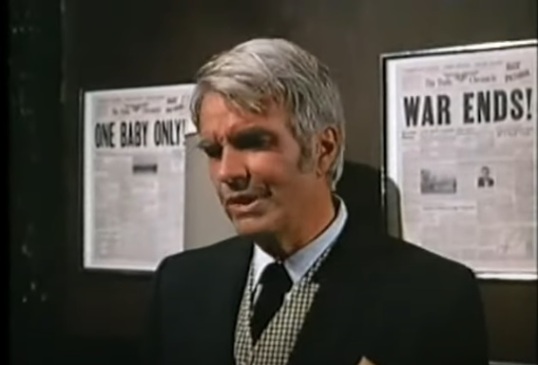
Alan and Karen Miller (played by Michael Cole and Janet Margolin) have already had their one child.  That their child died shortly after birth doesn’t matter in the eyes of Barstow (Ed Asner), the Himmleresque head of the Population Control Police.  Every couple is allowed one child and that’s it.  When Karen gets pregnant a second time, she is determined to have the baby.  She and Alan know that their only hope is to cross the border into Canada.  Helping them is a retired U.S. Senator (Van Heflin, in his final performance) who is opposed to the government’s policies.  Caught in the middle of Karen’s brother, Howard (Harry Guardino).  Howard works for the Population Control Police and he knows just how far Barstow is willing to go to keep Karen from having her baby.

The Last Child opens with a title card informing us that the film takes place in the “not-too-distant future.”  Along with all of the propaganda posters, that’s the only real sign that this film is meant to be taking place in the future.  There’s no “futuristic” technology.  Everyone dresses in the latest 1971 fashions.  Everyone drives the latest 1971 automobiles.  Though the decision may have been motivated by the film’s low-budget, the lack of the typical sci-fi trappings serves the film well.  The Last Child does not take place in a sleekly designed future and it doesn’t takes place in an apocalyptic wasteland.  Instead, it takes place in a world that is just as shabby as you would expect a world controlled and decorated by a government bureaucracy to be.  It’s a gray dystopia, populated by people who have given up their individuality.  It’s a world that’s visually boring by design and that makes it all the more disturbing.

The Last Child is an effective and well-acted film.  It probably feels more plausible today than it did when it aired back in 1971.  In many ways, with its portrait of unfeeling government officials and bland authoritarianism, it’s the perfect film for the age of COVID.  Indeed, the government’s policy of refusing to provide life-saving care for people over the age of 65 is reminiscent of what many pundits advocated for at the height of the COVID pandemic.  As for the film’s one child policy, that too is a concept that has become recently popular with many American academics.  Among many members of the so-called “elites,” there’s a definite need to try to control people and that very real need is what makes The Last Child so disturbingly plausible.  In The Last Child, sanctuary is found in Canada.  Today, of course, Canada is at the forefront of the euthanasia trend.  Of course, in 1971, the Prime Minister of Canada was Pierre Trudeau and not Justin.

Pierre Trudeau’s personal motto was “Reason before passion” and that’s certainly the philosophy that fuels the dystopian society at the center of The Last Child.  It’s a film that holds up today as both a thriller and a prophecy,

Dark Future (1994, directed by Greydon Clark)


This future is really dark.

A mysterious plague wiped out most of humanity and a group of fascist cyborgs took over.  (They actually prefer to be called Synthetics but everyone knows that they’re actually cyborgs.)  The remaining humans were exiled to an abandoned train station that was renamed the Forbidden Zone.  In the Forbidden Zone, the human survive as bartenders and sex slaves for their cyborg overlords.  If you want to enter or leave the Forbidden Zone, you have to put your hand on one of those balls of lightning that people used to buy at Spencer’s Gifts.

The humans have been told that they are all sterile, which is one reason why they are willing to accept living in such a dark future.  When a baby is born in the Forbidden Zone, it blows up the sterility myth.  Kendall (Darby Hinton, who co-wrote the script and who is best remembered for starring in Andy Sidaris’s Malibu Express) is a bartender who tries to protect the baby while rallying the other humans to rise up against the cyborgs Synthetics.  The Synthetics want that baby for their own incoherent reasons.  War breaks out between man and the half-machines.

Even by the normal standards of director Greydon Clark, this is low budget nonsense.  The action’s slow, the story is incoherent, the acting is bad, you get the idea.  There are a lot of scenes of people standing around fires that have been lit in barrels.  There’s so many barrels on fire that the Forbidden Zone should have burned down years ago.  Also, why is it called the Forbidden Zone when anyone can enter it whenever they want to?  The humans aren’t allowed to leave the train station/night club/brothel so it seems like the rest of the world should be called the Forbidden Zone.  The future is dark and not easily understood.  So is this movie.

Humanity’s only hope, Kendall

Retro Television Reviews: Quarantined (dir by Leo Penn)


Welcome to Retro Television Reviews, a feature where we review some of our favorite and least favorite shows of the past! On Sundays, I will be reviewing the made-for-television movies that used to be a primetime mainstay. Today’s film is 1970’s Quarantined! It can be viewed on YouTube!

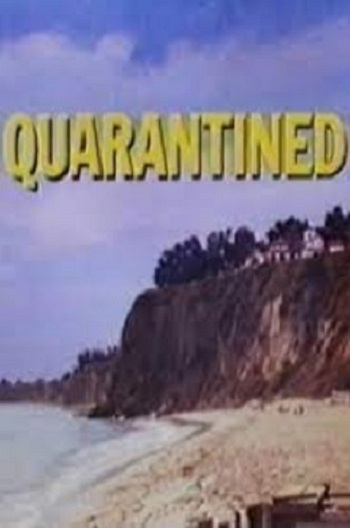
The John C. Bedford Clinic sits atop a cliff overlooking the ocean.  Though it may be a small hospital, it’s also widely respected.  The clinic was started by John Bedford (John Dehner) and the majority of its employees are related to him.  His three sons — Larry (Gary Collins), Bud (Gordon Pinset), and Tom (Dan Ferrone) — are all doctors and they all work at the clinic.  Bud’s wife, Margaret (Susan Howard), is a psychologist and she also works at the clinic, encouraging the older patients not to give up hope in their twilight years.  John Bedford is a stern taskmaster and his youngest son, Tom, resents always having his father and his older brothers staring over his shoulder.  John and Larry explain that they are simply treating Tom the way that they would treat any new doctor.  Tom isn’t so sure.

When the Bedfords aren’t hanging out in the tasteful ranch house that sits next to the clinic, they’re checking on their patients.  As Quarantined opens, they’ve got quite a few to deal with.  The most famous is Ginny Pepper (Sharon Farrell), a film star who has come to the clinic because she’s been suffering from back pain.  Larry quickly diagnoses her as suffering from kidney failure and announces that she’s going to need to get an immediate transplant.  Ginny is not happy to hear that and spends most of her time trying to make both Larry and Nurse Nelson (Virginia Gregg) miserable.  Of course, it eventually turns out that Ginny’s not so bad.

Meanwhile, Margaret attempts to cheer up a dying old man named Mr. Berryman (Sam Jaffe) and an eccentric man named Wilbur Mott (Wally Cox) hangs out in the hospital hallway.  Martha (Terry Moore) and Lloyd Atkinson (Madison Arnold) are at the hospital to visit their son, Jimmy (Mitch Vogel).  Unfortunately, while in Jimmy’s hospital room, Lloyd suddenly collapses and subsequently dies.  John takes one look at Lloyd and announces that Lloyd might have Cholera and, as a result, no one can leave or enter the hospital until the test results come back.

In other words, the John C. Bedford Clinic is …. QUARANTINED!

If you’re thinking this sounds a little bit dull …. well, you’re not wrong.  Quarantined has a 73-minute running time and a large cast but it really does just feel like an episode of a not particularly interesting medical drama.  It wouldn’t surprise me to discover that this movie was actually meant to serve as a pilot for a show that would have followed day-to-day life at the clinic.  Each member of the Bedford family is given a hint of characterization, just enough to suggest what type of situations they would get involved in on a weekly basis.  Larry was the straight shooter who was dedicated to saving lives.  Bud was the well-meaning middle child while Margaret was the one who encouraged the men to talk about their feelings.  Tom was the idealistic but impulsive youngest child.  John was the wise patriarch.  They’re all kind of boring.

The same can be said of Quarantined as a movie.  As directed by Leo “Father of Sean” Penn, the movie promises a lot of drama but it never really delivers and there’s something rather annoying about how casually John announces that no one is allowed to leave the clinic.  He even calls the police and has them set up road blocks around the clinic.  On the one hand, John is doing the right thing.  No one wants a cholera epidemic.  On the other hand, everyone’s so quick to accept that idea of John being a benign dictator that …. well, one can only imagine what a pain in the ass the Bedfords would have been during the COVID era.

As far as I know, there was never a TV show about the Bedford family and their clinic on a cliff.  Personally, I’m okay with that.  

Catching Up With The Films of 2022: She Said (dir by Maria Schrader)


To put it lightly, I had mixed feelings about She Said.

On the one hand, the downfall of Harvey Weinstein is an important story and it’s one that should never be forgotten.  It wasn’t that long ago that Weinstein was one of the most powerful people in Hollywood.  Many of the people who now regularly talk about how much they hated him had no problem working for him, taking his money, and thanking him whenever they won an award.  She Said focuses on the work of the two New York Times reporters, Jodi Kantor (Zoe Kazan) and Megan Twohey (Carey Mulligan), who wrote the initial article that detailed the allegations against Weinstein.  (Ronan Farrow’s New Yorker piece was published shortly afterwards.)  The film is not only about the article but it’s also about women working together and supporting each other.  Kazan and Mulligan both do a good job of portraying Jodi and Megan, bringing some nuance to a script that is full of dialogue that is occasionally a bit too on-the-nose.

On the other hand, it’s hard not to feel that She Said lets a lot of people off the hook.  While Jodi does originally pitch her story as dealing with systemic sexism, there’s actually very little examination of how the system enabled a monster like Harvey Weinstein.  Mention is made of Weinstein having powerful friends but few of those friends are called out by name and there’s very little discussion about how Weinstein used his money to become a player in Washington as well as Hollywood.  It leads to some odd narrative choices.  For instance, both Jodi and Megan are shocked to discover that Harvey is being represented by prominent feminist attorney Lisa Bloom, the daughter of Gloria Allred.  Jodi later talks about an off-screen conversation that she had with Bloom, in which Bloom tried to use a number of personal, political, and professional appeals to convince Jodi to drop the story.  It sounds like an interesting conversation but why don’t we get to see it?  Would it have cast Bloom in too negative of a light?  The film’s approach leaves it open to such accusations.  Indeed, it’s hard not to be reminded of the way that Rose McGowan was shunned when she (correctly) pointed out that a lot of the people celebrating Weinstein’s downfall were the same people who spent years ignoring what was an open secret in Hollywood.  The film tells us that Harvey Weinstein is a monster but we already know that.  What the film does not tell us is how he came to power and why he was protected for decades.

Thematically, She Said attempts to be a celebration of journalism, in the style of recent films like The Post, Truth, and Spotlight.  Like those films, it shares the same flat visual style.  There’s nothing particularly cinematic about it which is unfortunate as, with everyone already knowing how the story ends, She Said could have used some stylistic flair.  To a certain extent, I can understand the logic.  The emphasis is supposed to be on the reporters doing the hard work of getting the story and all of the recent films about journalism take a straight-ahead, by-the-numbers approach.  The problem with using this approach for She Said is that it leads to a lot of static, poorly framed shots of people talking on the phone, sitting at their desks, and staring at computer screens.  It may be a realistic depiction of modern journalism but it’s not particularly compelling to watch.  If anything, the film’s depiction of clean offices, supportive co-workers, and fair-minded editors makes the film feel like a testimonial about how The New York Times is the best workplace in America.  As opposed to the reporters in Spotlight, one never feels that Jodi and Megan are in danger of losing their jobs.  Unlike The Post or Shattered Glass, there’s no conversations about how the media establishment is often guilty of initially enabling the same behavior that it later condemns.  The New York Times never feels alive in the way that The New Republic did in Shattered Glass.  There’s not even a moment that’s as ludicrously over-the-top as the scene in Truth where Cate Blanchett argues that she shouldn’t be criticized for producing an obviously false story because it could have, in theory, been true.  Instead, She Said is very respectable and very dignified and a little too safe.  There’s not much going on beneath the surface. 

The film drops a lot of famous names.  Ashley Judd plays herself while Gwyneth Paltrow provides her voice for a scene in which she calls Jodi and says that Harvey has shown up at her house.  (Again, this is a scene that would probably have been more effective if we had seen it happen as opposed to just hearing about it.)  Lena Dunham is given a shout-out as someone who (off-screen) called and offered to help.  Someone casually mentions that Martin Scorsese hates Harvey Weinstein.  And yet, the film’s most powerful moments come when Jodi and Megan talk to the women who weren’t famous but who were still traumatized and victimized by Harvey Weinstein.  Samantha Morton and Jennifer Ehle play two former Miramax employees, both of whom eventually tell their stories to Jodi and Megan.  Morton and Ehle both give heart-felt performances and, during their scenes, She Said finds its reason for existing.  The performances of Samantha Morton and Jennifer Ehle both capture the real-life damage caused by men like Harvey Weinstein and the systems that enable them.

In the end, She Said is a film that I wanted to like more than I did.  It tells a compelling story in the least compelling way possible and, unlike Kitty Green’s The Assistant, it lets far too many people off the hook.


January Positivity: Without Reservation (dir by Fred Carpenter)


The 1989 film, Without Reservation, opens with a scene that should strike horror in the hearts of many viewers.

A high school basketball teams attempts to rap.  Each member of the team takes a verse, introducing themselves and struggling to come up with an appropriate rhyme to go along with their name.  I suppose that, as far as rapping goes, they’re about as skilled as you would expect any group of white, upper middle class suburban teenagers to be.  This scene goes on forever and, oddly enough, it doesn’t really have much to do with anything else that happens in the film.  One gets the feeling that it was only added to pad out the film’s 24-minute runtime.  Perhaps it was added to let the viewers know that the filmmakers weren’t stodgy old men whose knowledge of music ended with Sinatra.  No, the filmmakers were people who understood that sometimes teenagers enjoyed rap music.  They were down with the youth.

(Actually, as much as I’m making fun of the scene, it may be one of the more realistic pats of Without Reservation.  I went to an upper middle class high school in the suburbs.  The majority of my classmates were dorky white kids who thought they could rap.  Most of them were pretty bad but they were still better than the members of this film’s basketball team)

Anyway, once the rapping’s done, it’s time for six teenagers to climb into a car, drive too fast, and up getting hit by a truck.  Four of the teens suddenly find themselves apparently floating in space in the remains of their car.  They’re all dead and now, they’re waiting to find out where they’re going to go.  Do they have a reservation in Heaven or not?  Fortunately, there’s a man wearing a tuxedo (with a red bow-tie) who is working the heavenly registration desk.  He has a big, bulky, old school computer.  He asks for names and when he get them, he checks to see if they have a reservation.  He ends up telling the majority of people to step to the left, which is a polite way of saying, “Welcome to eternal damnation.”

Needless to say no one in the car has a reservation.  They all wish they could get one but it’s too late because they’re dead now.  We watch as they’re told to step to the left.  One of them ends up getting dragged over to a freight elevator and descends to the underworld.  It’s actually an oddly effective image.  If nothing else, the film does do a good job of creating an atmosphere of impending doom.  And yet, it’s hard not to feel that, like so many similar films, the main goal here is to frighten people into compliance as opposed to making a case for one belief system or another.  The emphasis is on punishment and pain and the film almost seems to encourage viewers to look down on those who don’t have reservations.  Yes, the film seems to be saying, he may be able to rap but he’s still not in the system.  Aren’t you glad that you’re not as dumb of Bill?

Anyway, Without Reservation is crudely effective, even if the ultimate message appears to be that the afterlife is a tacky resort with an out-dated computer system.

A Blast From The Past: What Made Sammy Speed?


From 1959, here’s a short film that asks the question, “What made Sammy speed?”

(I’m going to guess that the title is meant to pay homage to the novel, What Makes Sammy Run?)

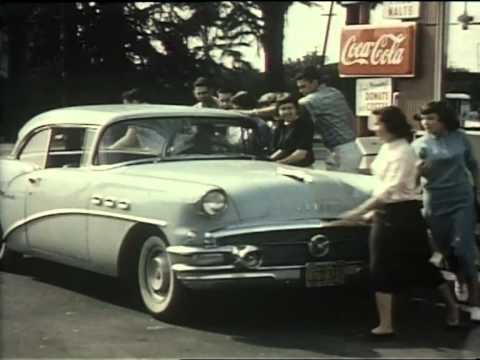
Sammy Robertson (played, in flashbacks, by David Felshaw) was a popular high school student until he was killed when his car collided with a truck.  A local detective tries to figure out what caused the accident to happen.  To be honest, I’m not really sure why there’s any question as to why it happened.  Sammy was speeding.  He ran a stop sign.  The truck crashed into his car.  It’s tragic and there’s definitely a lesson to be learned about paying attention to the road but it’s not particularly complicated.  It really doesn’t seem like the sort of thing that would require a massive criminal investigation.  It’s not like Sammy was smuggling drugs or drinking or driving or anything like that.  At most, the cops might want to ask themselves why the stop sign was at such a strange angle.

Still, since there’s apparently no other crimes being committed in this town, the detective spends a few days talking to Sammy’s relatives and his friends and trying to figure out why Sammy felt it was okay to speed.  (The driver of the truck, meanwhile, is totally let off the hook.  How fast was he going because it looks like he really messed up Sammy’s car.)  The detective learns that Sammy’s father wasn’t a particularly good driver.  He learns that Sammy’s little brother looked up to Sammy whenever he would drive fast.  He learned that Sammy’s friends were impressed by his car and his total lack of concern when it came to safety.  (That said, most of them still refused to ride with him.  They knew better than to risk their chances to attend the next sock hop.)  He learns that, shortly before the accident, Sammy’s boss couldn’t give him a raise and that Sammy failed in his attempts to join the school’s baseball team.  Broke and not destined for athletic glory, Sammy needed to feel like a man so he ignored the speed limit and the stop sign.  He had issues with authority, the detective tells us.

Yes, the detective tells us a lot.  That’s because this is a Sid Davis production and no Sid Davis production was complete without a judgmental narrator.  In this case, the narrator decides that everyone was to blame for Sammy driving too fast so I guess the message here is to let a bad player on the team and always give your employees a raise whether you can afford it or not.  If you don’t, the worst possible thing that could happen will happen.  That was another frequent Sid Davis lesson.  The worst always happens, no matter what.  That said, my main takeaway from this film was that Sammy was just naturally self-destructive.  It really doesn’t sound like anyone could have saved Sammy.  Sammy’s enemy was not the coach, his boss, his father, the cops, or even his little brother.  Sammy’s greatest enemy was himself.

Anyway, here’s a blast from the past from 1959.  Watch it the next time you’re tempted to drive too fast.

International Film Review: All Quiet On The Western Front (dir by Edward Berger)


From the first scene of Germany’s All Quiet On The Western Front, it’s made clear that there is no glamour or romance to war.

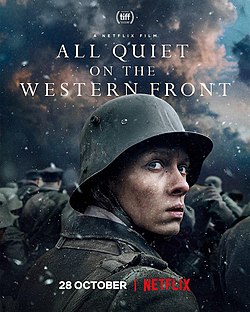
The year is 1917 and the Great War (or World War I as future historians will call it) has been underway for three years.  On the Western Front, soldiers hide in trenches and wait for the inevitable order to try to advance to the next set of trenches.  Most of the soldiers are cut down by machine gun fire and explosions as soon as they go over the top.  Many more are killed as they try to run across the killing field.    We are introduced to one soldier who has been ordered to charge.  Within a few minutes, he is dead and his uniform has been taken, washed, and sewn up so that it can be given to whoever will be the next to enlist.  The whole process plays out with a disturbing efficiency.  That several men have just died in a attack that seems to lack any strategic purpose does not matter.  What matters is that the uniform be ready to be worn by whoever follows.

The uniform is next handed to Paul (Felix Kammerer), a 17 year-old who not only enlists in the Imperial Germany Army but who plays a key role in convincing his friends to enlist as well.  Paul has been moved by the patriotic speeches that he heard from his teachers.  He expects war to be an adventure.  Upon their arrival on the Western Front, Paul and his friends are surrounded by death.  With their uniforms on and their gas masks over their faces, they are nearly unrecognizable as individuals.  Instead, they look like what they are, cogs in the war machine.  Paul spends his first night in the trenches while bombs explode all around him.  His friend, Ludwig (Adrian Grunewald), cries that he wants to return home.  By the next morning, Ludwig is one of the many who is now dead.  Only Kat (Albrecht Schuch) is willing to look after Paul and his friends.  Kat is considered to be a weathered veteran because he has managed to survive for nearly a year on the Western Front.

All Quiet On The Western Front is based on the classic anti-war novel by Erich Maria Remarque.  (A previous adaptation won the Oscar for Best Picture in 1930 and is generally considered to be the first truly “good” Best Picture winner.)  Th film takes some liberties with the book’s plot while still remaining faithful to Remarque’s theme of the futility of war.  One change is that, along with following Paul’s day-to-day life on the Western Front, the film also details the efforts of diplomat Mattias Erzberger (Daniel Bruhl) to negotiate Germany’s surrender.  It’s a fairly big departure from Remarque’s narrative but one that definitely stays true to the spirit of the book.  Despite the fact that Germany knows that it has been defeated and that it will have to surrender, Paul and his friends are still expected to fight and sacrifice their lives for a victory that is no longer attainable.  Indeed, the closer that Erzberger comes to signing a cease fire, the more determined General Friedrichs (Devid Striesow) becomes to launch one final, great offensive before the war ends.  The soldier have no idea what is going on during Erzberger’s negotiations and Erzberger has no idea that Paul has lost the majority of his friends and has been forced to do things that will forever haunt him.  They may not know about each other but Paul’s fate depends on Erzberger’s decisions and the legacy of Erzberger and all the other diplomats and commanders is to be found in what happens to soldiers like Paul.

All Quiet On The Western Front is a brutally effective anti-war film.  Director Edward Berger puts the viewer right in the middle of combat and it is absolutely terrifying.  Paul goes from being an enthusiastic patriot to a hollow-eyed cynic, one who knows that he is considered expendable by both the enemy and his commanders.  The viewer, like Paul, quickly realizes that there is no way to win this war, other than to somehow survive long enough to return home.  But even the soldiers who do survive understand that they won’t have much of a home to return to.  (In a particularly shocking scene, one solder stabs himself in the neck with a fork rather than return home crippled.)  While the the commanders negotiate in luxury, the soldiers live in mud and die almost randomly.  The commanders may talk about strategy but the soldier know that survival comes down to luck.

It’s a harrowing film but it’s also exactly what an anti-war film should be.  There’s a chance that this film could be the second adaptation of All Quiet On The Western Front to receive a nomination for Best Picture and it would certainly be deserved.

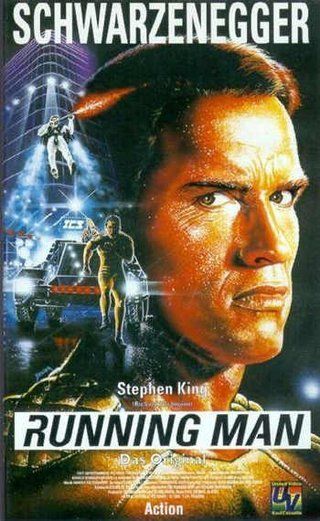
Guilty Pleasure No. 60: The Running Man (dir by Paul Michael Glaser)


“Killian, here’s your Subzero… now plain zero!”

Uhm, excuse me, Mr. Schwarzenegger, but a man just died.  He probably had a family who just watched you kill him on national television….

Oh well, it happens!  In the role of Ben Richards, Arnold Schwarzenegger kills quite a few people over the course of the 1987 film, The Running Man, but they were all bad.  In fact, when we first meet Ben Richards, he’s a cop who is trying to save lives.  His superiors want him to open fire on a bunch of protestors who simply want enough food to eat.  When Richards refuses to do it, he is framed for perpetrating “the Bakersfield Massacre” and is sent to prison.  When he is recaptured after escaping, he is given a chance to compete on America’s number one game show, The Running Man!  Hosted and produced by Damon Killian (Richard Dawson, oozing smarm in a performance that — in a fair world — would have received Oscar consideration), The Running Man is a show in which prisoners are given a chance to win prizes like a trial by jury or maybe even a pardon.  While the audience cheers and puts down bets, the prisoners are stalked by professional killers like Buzzsaw (Gus Rethwisch), Dynamo (Erland Van Lidth), Fireball (Jim Brown), and Sub-Zero (Professor Toru Tanaka).  Along with Killian, Captain Freedom (Jesse Ventura) provides commentary and analysis on how the game is going.  Ben soon finds himself joined by Amber (Maria Conchita Alonso), who proves herself to be just as tough as he is.

Seen today, The Running Man feels more than a bit prophetic.  Due to worldwide economic collapse, the poor are getting poorer while the rich are getting richer.  The American government has become both increasingly corporate and increasingly authoritarian.  The citizens are entertained and manipulated by “reality” programming.  On camera, Killian is a charismatic host who delivers his lines with faux sincerity and who loves to meet and give away prizes to the public.  (There’s something both undeniably creepy and also rather familiar about the way that Killian sniffs the hair, rubs the shoulders and holds the arms of the audience members to whom he’s speaking.  It’s all very calculated and one gets the feeling that Killian washes his hands as soon as the camera are off of him.)  Behind the scenes, he drinks, smokes, curses, and is full of contempt for everyone around him.  He may not be happy when Ben outsmarts and kills the show’s stalkers but he definitely cheers up when he hears how good the ratings are.  The film is set in 2017, which was 30 years in the future when The Running Man was first released.  Seen today, The Running Man’s 2017 feels a lot like our 2017….

That said, The Running Man is also a big, flamboyant, and undeniably entertaining film.  It’s also surprisingly funny, at times.  Living in a dystopia ahs turned everyone into a quip machine.  None of the bad guys die without Schwarzenegger making a joke about it.  (“Buzzsaw?  He had to split.”  Yes, he did.)  The show’s vapid studio audience, who go from cheering the prospect of witnessing a bloody death to crying when their favorite stalker is killed, is both disturbing and humorous.  (Also memorable is the faux somber dance number that is performed while the show memorializes all the dead stalkers.)  For all the costumed heroes and villains, the film is practically stolen by an older woman named Agnes who becomes Ben Richards’s favorite fan.  The gaming “quads” may be dark and dangerous and full of angry people but they’re also full of advertisements for Cadre Cola.  Dey Young of Rock and Roll High School and Strange Behavior fame has a cameo as Amy, who pays six dollars for a can of Cadre.  (That may seem like a lot for a can of anything but Cadre is the official cola of The Running Man!  Damon Killian endorses it!  And, of course, when The Running Man was produced, the studio was owned by Coca-Cola so the jokes about Cadre’s corporate dominance also serve as a “take that” towards the corporation who put up money for the film.  Either that or Cadre is stand-in for Pepsi.)

It’s easy to compare The Running Man to The Hunger Games films but The Running Man is infinitely more fun, if just because it doesn’t make the mistake of taking itself as seriously as The Hunger Games did.  (Add to that, The Running Man manages to wrap up its story in 90 minutes, whereas The Hunger Games needed four movies.)  Like The Hunger Game, The Running Man is based on a book, in this case a very loose adaptation of one of the pulpy novels that Stephen King wrote under the name of Richard Bachman.  While King said that he enjoyed the film, he also asked that his real name not be listed in the credits because the film had little in common with his book, which is fair enough.  The Running Man may have been inspired by a Stephen King novel but it’s an Arnold Schwarzenegger production through-and-through.

Previous Guilty Pleasures

  1. Half-Baked
  2. Save The Last Dance
  3. Every Rose Has Its Thorns
  4. The Jeremy Kyle Show
  5. Invasion USA
  6. The Golden Child
  7. Final Destination 2
  8. Paparazzi
  9. The Principal
  10. The Substitute
  11. Terror In The Family
  12. Pandorum
  13. Lambada
  14. Fear
  15. Cocktail
  16. Keep Off The Grass
  17. Girls, Girls, Girls
  18. Class
  19. Tart
  20. King Kong vs. Godzilla
  21. Hawk the Slayer
  22. Battle Beyond the Stars
  23. Meridian
  24. Walk of Shame
  25. From Justin To Kelly
  26. Project Greenlight
  27. Sex Decoy: Love Stings
  28. Swimfan
  29. On the Line
  30. Wolfen
  31. Hail Caesar!
  32. It’s So Cold In The D
  33. In the Mix
  34. Healed By Grace
  35. Valley of the Dolls
  36. The Legend of Billie Jean
  37. Death Wish
  38. Shipping Wars
  39. Ghost Whisperer
  40. Parking Wars
  41. The Dead Are After Me
  42. Harper’s Island
  43. The Resurrection of Gavin Stone
  44. Paranormal State
  45. Utopia
  46. Bar Rescue
  47. The Powers of Matthew Star
  48. Spiker
  49. Heavenly Bodies
  50. Maid in Manhattan
  51. Rage and Honor
  52. Saved By The Bell 3. 21 “No Hope With Dope”
  53. Happy Gilmore
  54. Solarbabies
  55. The Dawn of Correction
  56. Once You Understand
  57. The Voyeurs 
  58. Robot Jox
  59. Teen Wolf

January Positivity: Gold Through The Fire (dir by Edward T. McDougal)


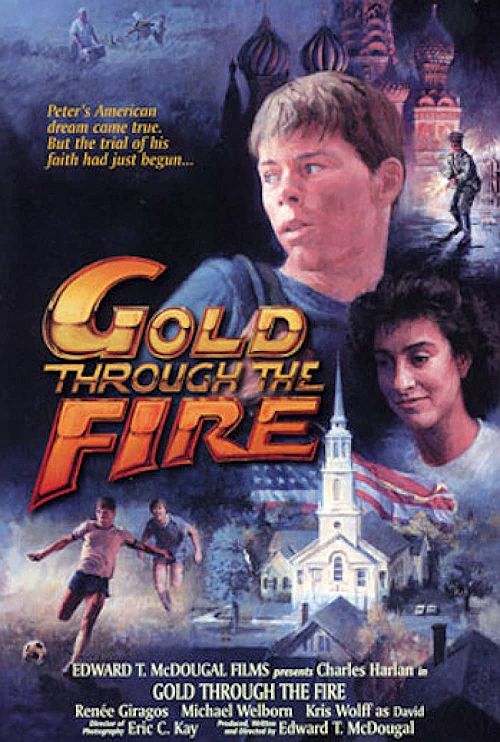
Let’s just take a look at the poster for 1987’s Gold Through The Fire.

Wow, exciting poster, right?  At the top of the poster, we’ve got the Kremlin and a sinister looking soldier firing a gun.  One thing about Russia is that it doesn’t matter when the film was made or who was in charge of the country at the time, the Russian government always makes for a good villain.

The film’s tag line reads, “Peter’s American dream came true but the trial of his faith had just begun.”  So, we now know that Peter (who we presume is the backpack wearing guy at the top of the poster) is probably going to escape Russia and come to America.  And, just to make sure that there aren’t any doubts, there’s an American flag prominently displayed on the poster.  There is also what appears to be a small town church and a few two-story houses.  Peter’s heading to the heartland and good for him.  Small town America comes under a lot of criticism but I’ve been to and lived in a few small towns and I usually had a pretty pleasant time.  Despite their reputation, small towns are often more hospitable to newcomers than big cities.

Hey, so far, so good!  The villains are Russian.  The setting is small town America.  Peter appears to be a totally decent teenager.  This poster features a lot of reasons to be optimistic.  Or, at least, it does until you look in the bottom left corner and you see that Peter appears to be playing soccer….

OH NO!  IS THIS A SOCCER MOVIE!?

Well, fear not.  Yes, the film does involve some soccer but, to be honest, the inclusion of soccer kind of makes sense.  When Peter enrolls in his new American high school, he struggles to fit in.  He can barely speak English.  He is confused by most American customs.  When someone asks him if he has any “records” from his previous school, he says that he enjoys music and this leads to the following comment from one of his classmates:

Poor Peter!  As we saw at the start of the film, Peter has not had an easy life.  He was born in Russia and when the communists discovered that his family was secretly Christian, Peter’s parents were shipped off to a reeducation camp and Peter was tossed into an orphanage.  He eventually escaped, running all the way to Finland and then on to the American embassy.  He defected and briefly became a celebrity.  After being placed with a new American family, Peter enrolled at the local high school and discovered that American teenagers can be cruel.

But, we were talking about soccer, right?

Eventually, the few friends that Peter has made encourage him to try out for the team.  Peter does start playing soccer and it turns out that he’s the best player in the school.  And again, it makes sense as he’s the only student in the school who was born in a country where soccer is more popular than American football.  (Of course, today, it seems strange that any high school would only have one student who wasn’t born in the U.S.)  Unfortunately, since Peter insists on carrying his Bible around with him everywhere that he goes and trying to lead a prayer group on school ground, the school’s principal is not sure that Peter can be allowed to continue playing.  The principal’s office is decorated with a print of Normal Rockwell’s Freedom of Speech, just in case you had any doubt that the school was being run by a Lefty version of Frasier Crane.

Not only does Peter have to deal with the school and its rules but the KGB is also after him.  And his foster brother has lost his faith!  Peter has a lot to deal with.  Fortunately, his new foster family has a station wagon that he can drive around town while he’s thinking.

The best part of Gold Through The Fire is the beginning of the film, when Peter is trying to escape from Russia.  That part of the film moves at a steady pace and, even more importantly, it captures the feel of living in a situation where you’re not allowed to think or speak for yourself.  It perfectly captures the drabness of dictatorship.  Unfortunately, once Peter gets to America, the action starts to drag, the actors are a bit less convincing in their roles, and the film gets bogged down in trying to convince us that America is just one step away from turning into Russia.  There are also few too many awkward pop cultural references, as if the filmmakers were desperate to convince us that they understood what high school students were into despite not being in high school themselves.  Today, the film works best as a time capsule.  Everything about it, from the cars to the clothes to the hair to dialogue, simply screams 80s.  Watching this film is like stepping into a time machine.

And hey, the soccer stuff isn’t actually that bad.  That said, it’s hard for me to watch anything featuring soccer without being reminded of this:

January Positivity: The Gathering (dir by Daniel Carrales)


The 1998 film, The Gathering, is about people who keep having visions.

Michael Carey (Daniel Kruse), for instance, is a successful advertising executive who suddenly sees a portal forming high in the sky and people turning into globes of light as they are transported upward.

His wife is at the playground, talking to her best friend about what a drag her husband has become ever since he got on the whole religious kick when suddenly, she has a vision in which all of the children have vanished.

Michael’s mother-in-law gets the worst of it.  She’s a professor at the local college and she’s introduced explaining to a student that the only way to pass her class is to be an atheist.  (The student needs to call a lawyer, to be honest.)  Suddenly, the professor is having all sorts of visions, that majority of which involve her betraying people to a shadowy government organization.  She betrays her best friend and colleague.  She betrays her own daughter.  She betrays everyone.

While his wife and his mother-in-law shrug off the visions and claim that there must be a normal explanation for why they’re all visualizing a similar future, Michael turns into an evangelist and starts telling everyone about what he’s seeing.  He is especially upset when he discovers that one of his clients is going to be at the forefront of encouraging everyone to get a microchip inserted under their skin.  (We already know from the professor’s visions that people who don’t have the chip will be hunted down and killed in the streets.)  People start to feel a bit uncomfortable around Michael.  He loses his job and his family but still, when the portal appears in the sky, he’s among those who vanish.  His wife and his mother-in-law are not lucky, which sounds like the start of a really sexist joke.  (“Those seven years between the rapture and the second coming were the first peace and quiet I got during my entire marriage!”)

Clocking in at 57 minutes, The Gathering was produced and released at a time when the Left Behind books were climbing the best seller charts.  It pretty much follows the same formula as those books, with the emphasis less on being a Christian and more on imagining the misery that awaits everyone who isn’t.  In this film, if you’re not a believer, you’re going to be stuck in a world where all of the color has been desaturated and everyone has to wear really ugly, communist-style clothes.  It’s a world where the government monitors everyone’s actions and where questioning those in charge can lead to you being either executed or sent to reeducation camp.  When viewed today, the film feels more like a political tract than a religious one, with the smug but bland and process-obsessed villains serving as a perfect representation of what almost everyone hates about dealing with the bureaucratic state.

Not surprisingly, the film’s budget is low.  There are a few effective shots.  I liked the way that the clouds would “speed up” whenever anyone was starting to have a vision but then the extremely cheap-looking portal appeared in the sky and ruined the illusion.  The film is quickly paced and its portrayal of life under a dictatorship feels believable.  At the same time, a lot of the acting is amateurish and the film itself seems to be more about scaring people than making a case for its beliefs.  It really does seem like the intended audience for this film were people who just wanted to imagine their atheist neighbors having to dress like Trotsky.  But, hey, at least it’s less than an hour long.