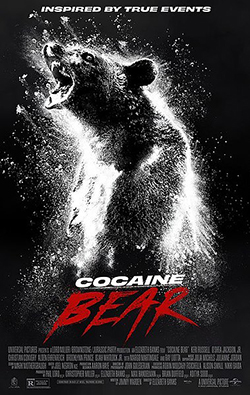
Cocaine Bear is the story of a duffel bag full of cocaine and the bear that gets into it. It’s loosely based on a true story. I say loosely because, in real life, the bear promptly overdosed and died. In the film, the bear not only survives eating a bag of cocaine but it also subsequently goes on a coke-fueled rampage.
The film opens in 1985, with a series of anti-drug commercials airing on television and a drug smuggler flying high above Georgia. The smuggler kicks his shipment of cocaine out of the plane, so that it can later be retrieved from the mountains below. Unfortunately, for him, he also manages to slip and plummets out of the plane to his death. A day later, in Georgia’s Chattahoochee–Oconee National Forest, two hikers are debating which band they should hire to play for their wedding when they happen to come across a black bear. The hikers decide to snap a picture of the bear. The bear, whose face is coved in cocaine, decides to eat the hikers.
Yep, both the bear and her two adorable cubs have discovered the joys of cocaine. It would probably be best to close down the park until someone can hold an intervention but, unfortunately, more and more people keep showing up. For instance, there’s a detective named Bob (Isiah Whitlock, Jr.) who is determined to track down the cocaine and use it to finally take down the St. Louis’s drug kingpin, Syd (Ray Liotta, in his final film role). Syd, meanwhile, has sent his son Eddie (Alden Ehrenreich) and his employee Daveed (O’Shea Jackson, Jr.) to retrieve the drugs. Daveed is determined to get the job done while Eddie, who is mourning the death of his wife, just wants to leave the family business behind. Local criminal Stache (Aaron Holliday) wants to deal the drugs himself but instead ends up bonding with Eddie. Park ranger Liz (Margo Martindale) wants to pursue her crush on animal inspector Peter (Jesse Tyler Ferguson). Finally, two kids, Dee Dee (Brooklynn Prince) and Henry (Christian Convery) have skipped school and are lost in the park. Dee Dee’s mother (Keri Russell) is determined to rescue them and then ground them for the rest of their lives.
Yes, there’s a lot of people in this film. I haven’t even mentioned Stace’s partners-in-crime or the paramedics who pick an inopportune time to show up. The majority of the people in this film end up getting ripped apart by the bear and, make no mistake about it, the bear is the true heroine of the film. All of the actors do well with their roles, though I do wish that Liotta could have ended his career playing something other than just another psycho criminal. Keri Russell, Margo Martindale, Isiah Whitlock, Jr., and Alden Ehrenreich all deserve a lot of credit for bringing their characters to life. But the bear is the true star here. The bear kills a lot of people and most of the deaths are pretty bloody but, at the same time, the bear doesn’t really mean any harm. It just really likes cocaine and the majority of the people who the bear kills are killed precisely because they either got cocaine on their clothes (or face) or they allowed themselves to become a part of the cocaine trade. The bear ultimately becomes a satirical representation of every anti-drug commercial that has ever aired. If you’re not worried about overdosing, how do you feel about getting torn apart by a bear? Not so much fun being a rebel now, is it?
Cocaine Bear is an admittedly dark comedy, one in which almost all of the human characters have at least one bizarre quirk to make them memorable. Usually, I’m not a huge fan of gory comedies but the humor in Cocaine Bear has an appealingly weird edge to it. Eddie, Stache, and an annoyed Daveed playing twenty questions while looking for a duffel bag full of drugs is amusing but it becomes hilarious when combined with scenes of the bear joyfully finding more cocaine. As well, Henry and Dee Dee’s reaction to finding a brick of cocaine is every parent’s nightmare but also one to which everyone should be able to relate and maybe even chuckle at. I laughed, even as I thought, “OH MY GOD, DON’T DO THAT!”
Finally, in a time when so many movies are full of unnecessary padding, Cocaine Bear deserves a lot of credit for telling its story in 90 quickly placed minutes. The film doesn’t waste any time getting to the point and it doesn’t overstay its welcome. A lot of filmmakers could learn a lesson from Cocaine Bear.
About as pointless as a film can get, Boxing Time is 65 minutes of a boxing promoter named Art (played by director Evan Jacobs) talking on his phone. He tries to convince his wife to allow him to talk to his daughter. He talks to the boxing commissioner, who is being a real pain about the upcoming fight. He talks to people who want to fix the fight. Art talks and talks. Usually, only his side of the conversation is shown and the movie doesn’t even show us the boxing match that everyone is so worked up about. After all the build up, the movie cheats the audience by not letting them watch the main event.
It’s set up as a found footage film with a title card explaining that Art was filming himself because he had been diagnosed as having a paranoid personality disorder and that the footage comes from the last month of Art’s life. Despite knowing that we’re watching the last days of a doomed man, it’s hard to care about Art. He’s not a sympathetic character and watching him talk on the phone for 65 minutes is about as much fun as watching anyone talk on the phone for 65 minutes. Boxing Time (also known as #boxingtime because why not?) is an extended acting exercise that ends up lying flat on the canvas.
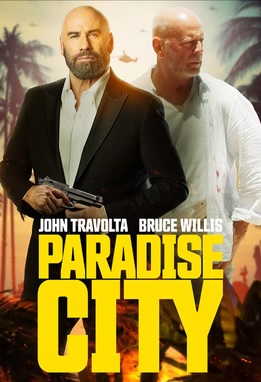
Ian Swan (Bruce Willis) is a famed bounty hunter who has spent the last ten years of his life pursuing an escaped fugitive who is wanted for the cold-blooded murder of four FBI men. Swan has tracked his prey to Hawaii but, when he’s shot and falls into the ocean, Swan is presumed dead. Swan’s long-estranged son, Ryan (Blake Jenner), comes to Hawaii to try to track down the man who killed his father. He meets up with Ian’s former partner, Robbie Cole (Stephen Dorff), and also the only cop on the island who cares about justice, Savannah (Praya Lundberg). Reluctantly, Cole works with Ryan and discovers that Ian’s shooting is somehow connected to a shady businessman named Arlene Buckley (John Travolta). A real estate developer, Buckley is working hard to elect a man named Kane (Branscombe Richmond) to the U.S. Senate. Buckley’s plan also involves taking control of a part of the Island that the natives call Paradise City. Got all that?
2022’s Paradise City has been advertised as being a John Travolta/Bruce Willis film but make no mistake. Neither Travolta nor Willis get much screen time, though they both make an impression in the limited time that they do have. Stephen Dorff manages to steal every scene in which he appears, playing Robbie as a well-meaning guy who can’t help but be kind of a screw-up. That said, Dorff really isn’t in that much of the film either. Instead, the main star of the film is Blake Jenner. Jenner has the blandly affable screen presence of a low-key frat boy. That worked for him when he was in films like Richard Linklater’s EverybodyWants Some!! but it’s not exactly ideal for an action star. Whereas the best action stars feel as if they’re always ready for a fight, Jenner comes across as the guy who would be trusted to order the keg for the next party.
Instead of taking charge of the screen, Jenner finds himself overshadowed by the gorgeous Hawaiian scenery. Hawaii is the true star of Paradise City and, even when the film itself doesn’t make a whole lot of sense, Hawaii itself is always amazing to look at. In many ways, Paradise City feels like an extra-violent episode of Baywatch Hawaii. (The film’s Baywatch aesthetic is confirmed when Savannah wears a bikini to a crime scene.) Just as with that show, the beaches and the jungles and the waterfalls and the oceans are all so stunning that it’s tempting to give the film a pass on the fact that the plot never makes much sense and any genuine emotional stakes are pretty much non-existent.
Unfortunately, it’s impossible to ignore the plot because, for a low-budget B-movie, Paradise City takes itself way too seriously. It’s one thing for Ryan to be estranged from his father. It’s another thing for the film to feature flashbacks to Ryan’s childhood, in which we discover firsthand that Ian never understood Ryan. It’s also one thing to make Buckley a family man. It’s another thing try to create a clumsy parallel between the way that Buckley is raising his son and the way that Ian raised Ryan. As opposed to films like Gasoline Alley or the DetectiveKnight films, Paradise City seems to be trying too hard to be something that it isn’t. Instead of just embracing its pulpy style and trying to entertain, the film is determined to tug at the audience’s heartstrings and make a statement about evil land developers. The film forgets that, sometimes, just being entertaining is the best thing that a film can be.
This was one of the last films that Bruce Willis made before it was announced that he would be retiring from acting. Watching the film, it’s easy to tell that a stand-in was used for most of Willis’s action scenes. When Willis delivers the majority of his lines, it’s hard not to miss the wiseguy energy that used to be his trademark. That said, when Willis is acting opposite Travolta and Dorff, he shows a bit of his old spark. The two scenes in which he confronts John Travolta are the best in the film. For a few minutes, he seems like the Bruce Willis who we all remember and it’s hard not to get a bit emotional watching two talented (if often underappreciated) actors acting opposite each other for what will probably be the last time.
Paradise City is not a particularly memorable film and the overly complicated plot is next to impossible to follow but I am happy that the cast and the crew got to hang out in Hawaii for a bit. It’s a lovely place to visit.
The Brawler is a biopic of boxer Chuck Wepner (adequately played by Zach McGowan). A resident of Bayonne, New Jersey and nicknamed “The Bleeder” because of how much he usually bled in the ring, Wepner was the first boxer to face Muhammad Ali (played by Jerrod Page, who looks and sounds like Ali but who has none of his fabled charisma) after Ali’s famous defeat of George Foreman. No one gave Wepner much of a chance. Ali barely bothered to train for the match and falsely accused Wepner of using racial slurs while talking to him. To everyone’s shock, Wepner not only went 15 rounds with the champ but he even knocked Ali off of his feet. Wepner ultimately lost the fight but he won the hearts of many of the people watching. He also inspired Sylvester Stallone to write and star in a movie called Rocky.
Though he was famous being “the Real Rocky,” Wepner initially didn’t make a dime off of Rocky or any of the sequels that followed. While Stallone became a superstar, Wepner got addicted to cocaine, fought exhibition matches against Andre the Giant and a bear, and finally ended up in prison. After getting out of prison, Wepner returned to his old job of selling liquor and made money signing memorabilia. After he nearly got arrested as a part of a fraudulent autograph scam, Wepner finally took Stallone to court and sued for the money that he felt Stallone owed him. Stallone settled, making Chuck Wepner the only man to go the distance with both Muhammad Ali and Sylvester Stallone.
If the plot of The Brawler sounds familiar, maybe you’ve seen one of the many documentaries that have been made about Chuck Wepner. Or maybe you saw Chuck, a 2016 film about Chuck Wepner that starred Liev Schrieber. The Brawler hits all of the same points as Chuck, so much so that it almost feels like an unofficial remake. (Both films even features a voice-over narration from the actor playing Chuck.) The main difference between the two films is that The Brawler spends a lot more time on Wepner’s time as a drug addict and it also portrays Stallone (played unconvincingly by Anthony Mangano) in a much more negative light. Even though Wepner screws up every opportunity that he’s offered (including a chance to appear in Rocky II), it’s Stallone who is portrayed as being a villain because he didn’t always return Wepner’s calls and Stallone’s assistants were sometimes rude. While Chuck spends all of time whining about how unfair his life is, Stallone comes across as being often clueless but hardly malicious in the way he treated Chuck. It’s not easy to make a Hollywood superstar into a more sympathetic character than the poor underdog who is suing for the money that he’s owed for inspiring one of the most successful franchises of all time but The Brawler manages to pull it off. In Chuck, Wepner is an inspiring underdog who never lets life keep him down. In The Brawler, Wepner is a self-destructive child who lets down everyone who tries to help him. When it comes to Chuck vs The Brawler, it’s Chuck by a clear knock-out.
The most interesting thing about The Brawler is that Burt Young has a cameo as a man watching the Wepner/Ali fight in a bar. You have to wonder how Stallone felt about that. Et tu, Paulie?
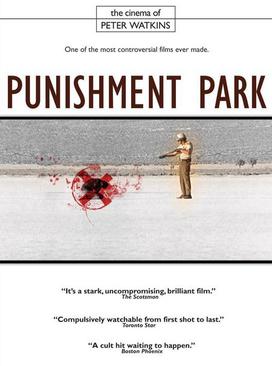
The 1971 “pseudo-documentary”, Punishment Park, imagines an alternative America that still feels very familiar.
With America paralyzed by continuing protests against racism, economic inequality, and the war in Viet Nam, President Richard Nixon declares a state of emergency and invokes the McCarran Internal Security Act of 1950. The law (which is a real law and still on the books, by the way) allows the federal government to detain anyone who is deemed a risk to national security. Anti-government activists are rounded up and put on trial before “community tribunals,” which are made up of a combination of military officers, politicians, businessmen, and housewives. Though the arrested are given a chance to defend themselves against the charges, there’s never any doubt that each trial will end with a conviction. Those convicted are given two options. They can either serve their entire sentence in federal prison. Or they can spend three days in Punishment Park.
Most of them make the mistake of picking Punishment Park.
What is Punishment Park? It’s 53 miles of California desert. Detainees have got three days to cross the desert, without food or water. If they make it to the American flag at the end of Punishment Park, they will be given their freedom. However, along with having to deal with the extreme heat, the detainees are also going to be pursued by a group of police officers and National Guardsmen. If the detainees are caught before reaching the flag, they’ll be sent to prison. The detainees are given a head start but it soon becomes apparent that the head start doesn’t count much for much when you’re in the desert without water. It also becomes apparent that Punishment Park is much more about revenge and reminding people of their place than it is about justice. The rules of Punishment Park only apply to the detainees.
As he did with the majority of his films (including the Oscar-winning The War Game), director Peter Watkins presents the film as being a documentary. Though they’re never seen onscreen, we hear the voices of the British and German film crews asking questions to both the detainees and the people pursuing them. (We also occasionally hear them protesting the brutality of what they’re witnessing, though the cops and soldiers are quick to point out that they really don’t care what a bunch of Europeans thinks about their actions.) The film cuts back and forth from one group being chased through Punishment Park and another group being put on trial and eventually convicted. Watkins cast the film with amateur actors, with the detainees being played by actual anti-war activists while many of the people pursuing them were played by actual guardsmen and police officers. Watkins has subsequently started that the attitudes and the hostilities of the people in the film were mirrored off-screen by those playing them as well. Much like the Stanford Prison Experiment, every one was more than willing to play their roles. It brings a much-needed authenticity to the film’s alternative history. (Interestingly enough, it also leads to several of the detainees coming across as being a bit annoying, as people who are convinced of their own righteousness tend to be. The important thing is that they’re authentically annoying. Even 50 years after the film was shot, both camps are full of people who still seem familiar.) Ironically, the film’s biggest weakness is that everyone seems to be so genuinely worried about whether or not they’ll survive the trek through the desert that it’s difficult to believe that they would actually stop moving so they could have a conversation with the documentary crew.
Still, whatever flaws the film may have, Punishment Park feels sickeningly plausible. In our current era of rising authoritarianism, militarization, reckless accusations of treason, and cries to set aside the Constitution so that “enemies” can be stripped of their rights, Punishment Park continues to feel frighteningly relevant today.
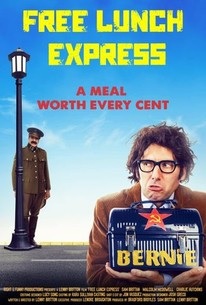
Eric Roberts appears about twenty minutes into 2020’s Free Lunch Express. He plays a man standing in line at a Vermont welfare office. He tells a youngish Bernie Sanders (played, at that point in the movie, by Sam Brittan) that the easiest way to make some extra money is to run for public office because there’s no limit on the amount of money you can raise and you can keep whatever you have left after the campaign. Having been recently kicked out of a commune and having no interest in getting a real job, Sanders is intrigued by the advice and soon embarks on his first political campaign. Roberts only appears in that one scene. It probably took an hour or two of his time to film. Roberts spends the entire scene laughing, supposedly because he’s amused over the idea of making a living as a perennial political candidate.
(For that matter, Eric Roberts is not the only familiar face to pop up in Free Lunch Express. Not surprisingly, Kevin Sorbo shows up. He plays the ghost of George Washington and I’ll admit that I chucked at his Elizabeth Warren joke. Far more surprisingly, Malcolm McDowell shows up as the narrator and epically rolls his eyes at every major moment of Sanders’s life.)
As for the rest of the film, Free Lunch Express is an attempt to do an Adam McKay-style satire about the career of Bernie Sanders. Unfortunately, the problem with trying to make fun of Bernie Sanders is that even Bernie’s most fervent supporters already realize and often acknowledge that he’s a vaguely ludicrous figure. Indeed, the very things that the film pokes fun at — like Bernie’s permanently messy hair, his thick Brooklyn accent, his habit of yelling out his comments while pointing upwards, and his apparently inability to make normal small talk — are the same things that most of his supporters find to be appealing about him. I disagree with Bernie on the majority of the issues and I would probably move to another country if he was ever elected President but, at the same time, I can’t help but kind of like him. One reason why so many people voted for him in 2016 is because he seemed to be authentic in a way that other politicians did not. It’s easy to poke fun at a slick politician but it’s far more difficult to do so at someone who looks like he just got out of bed and who tends to say whatever pops into his mind. It’s far easier to satirize the personality of a Hillary Clinton or a Mitt Romney than it is to satirize a Bernie Sanders.
Free Lunch Express follows Bernie through three stages of his life. As a child, Bernie (played by Jonah Britton) swears a blood oath while standing in front of a poster Joseph Stalin and he declares that he’ll never be bullied again. As a young man, Bernie (Sam Brittan) moves to Vermont and annoys all the other hippies to such an extent that he’s forced to take Eric Roberts’s advice and run for political office. And, as an old and ineffective Senator, Bernie (now played by Charles Hutchins) runs for the presidency and only drops out after Hillary (Cynthia Kania) promises to campaign in Wisconsin and Ohio in the general election. There were a few moments that made me chuckle, like the portrayal of Ben & Jerry as being two hippies who can’t have a conversation without shouting out the name of their latest flavor or Bernie cluelessly traveling to dreary Moscow for the worst honeymoon ever. But, for the most part, the humor falls flat and the jokes are often too repetitive to really be effective. Having a young and nerdy Bernie swear his allegiance to Stalin because he thinks that Stalin, who killed millions of his own citizens, will create a world without bullies is funny. However, having the ghost of Stalin randomly speak to Bernie throughout the years is a joke that grows tiresome and never really pays off. It’s pretty much the same issue that I had with Adam McKay’s Vice. Much as Vice did with Dick Cheney, the film tries so hard to take down Sanders with ridicule that it instead makes him seem almost likable. Indeed, by focusing on the times that Bernie was, in the film’s view, humiliated by Hillary Clinton, the hippies at the commune, and basic economic realities, the film actually portrays Bernie as someone who refuses to surrender his principles, regardless of how often the rest of the world tells him that he’s wrong. The film aims to be Tartuffe and instead turns into Candide.
Finally, on a personal note, I think anyone who ever runs for office should be ridiculed, regardless of what they believe or whether or not they’ve done a good job. It’s a good way to keep them honest and to remind theme that they’re supposed to work for us and not the other way around. If one’s beliefs can’t survive a joke or two, that says far more about the beliefs than it does about the jokes.
Previous Eric Roberts Films That We Have Reviewed:
In the late 1970s, the Rev. Jim Jones was a very powerful man.
The leader of the California-based People’s Temple, Rev. Jones had made a name for himself as a civil right activist. As a minister, he made it a point to reach out to the poor and to communities of color. (It was said, largely by Jones, that he had been forced to leave his home state of Indiana by the Ku Klux Klan.) Local politicians eagerly sought not only Jones’s endorsement but also the donations that he could easily raise from the members of the People’s Temple. Though there were rumors that he was more of a cult leader than a traditional preacher, Jones was appointed chairman of the San Francisco Housing Authority. Everyone from Governor Jerry Brown to San Francisco Mayor George Moscone appeared with Jim Jones at campaign events. Among the national figures who regularly corresponded with Jim Jones were First Lady Rosalyn Carter and Vice President Walter Mondale.
Of course, what actually went on behind the closed doors of the People’s Temple was a bit of secret. Jones was a self-proclaimed communist who claimed to have had visions of an upcoming nuclear war between the U.S. and Russia. In his sermons, he often claimed that it would be necessary for both him and the rest of the People’s Temple to eventually leave the United States. Jones spoke of enemies that were trying to destroy him, like the reporters who investigated Jones’s claim of being a faith healer and who followed up on reports that Jones was sexually exploiting both the women and the men who followed him. Jones secretly started to make plans to leave the United States in 1973 but it would be another four years before he and a thousand of his followers arrived in Guyana. The People’s Temple Agricultural Project sat in the jungle, isolated from oversight. It was informally known as Jonestown.
Over the next year, Jonestown did not exactly thrive. Rev. Jones demanded that his people work hard and he also demanded that they spend several hours a day studying socialism and listening to him preach. Jones ran his commune like a dictator, refusing to allow anyone to leave (for their own safety, of course). Anyone who questioned him was accused of being an agent of the CIA. In the U.S, the families of Jonestown’s citizens became concerned and started to petition the government to do something about what was happening in Guyana. A few people who did manage to escape from Jonestown told stories of forced labor, suicide drills, rape, and torture. The People’s Temple claimed that those people were all lying and, because Jones still had his government connections, he was largely left alone.
Finally, in 1978, Congressman Leo Ryan, a Democrat who had a history of opposing the political establishment, flew down to Guyana so that he could see Jonestown for himself and also bring back anyone who wanted to leave. Despite the efforts of Jones to disguise the truth about life in Jonestown, several people did ask to leave the colony with Rep. Ryan. Jones sent his most loyal men to meet and open fire on Rep. Ryan’s entourage at a nearby airstrip. Rep. Ryan and four others were shot and killed, making Ryan the first Congressman to be assassinated since 1868. Nine others, including future Rep. Jackie Speier, were wounded in the attack.
Back at Jonestown, Jim Jones announced that his prophecy was coming true and that the imperialists would soon descend on Jonestown. Though 85 of Jones’s followers managed to escape into the jungle, the other 909 residents of Jonestown subsequently died. Though some showed signs of having been murdered by Jones’s followers, the majority committed suicide by drinking poisoned Flavor-Aid. Jim Jones shot himself in the head.
The world was horrified and the term “drinking the Kool-Aid” entered the discourse. And, of course, many filmmakers were inspired by the horrific events that happened in Jonestown. Ivan Rassimov, for instance, played a Jim Jones-style cult leader in Umberto Lenzi’s Eaten Alive. Meanwhile, Powers Boothe would win an Emmy for playing Jim Jones in a 1980 television miniseries called Guyana Tragedy.
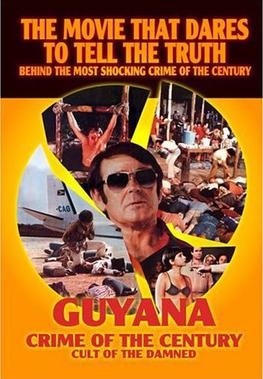
Guyana Tragedy is often described as being the definitive film about Jim Jones. However, a full year before Guyana Tragedy aired, the Mexican director, Rene Cardona Jr., was in theaters with his own version of the Jim Jones story. To anyone who is familiar with Cardona’s style of filmmaking, it’s perhaps not surprising that 1979’s Guyana: Crime of the Century did not win any awards.
Cardona’s film opens with a rather odd title card, explaining that, though the film is based on Jonestown, the names of certain characters “have been changed to protect the innocent.” But if you’re going to start the film by announcing that it’s about the biggest news story of the past year, what’s the point of changing anyone’s name? And for that matter, why is Jim Jones renamed James Johnson and his colony rechristened Johnsontown? Jones was hardly one of the innocents, not to mention that he was dead and in no position to sue when the film came was released. Why is Leo Ryan renamed Lee O’Brien, especially when the film portrays Ryan as being the type of hard-working and honest congressman that anyone would be happy to vote for?
The film opens with Rev. James “Johnson” (played by Stuart Whitman) giving a lengthy sermon about how it’s time for the congregation to move to Guyana, which he describes as being a Socialist paradise. Oddly, in the film, the People’s Temple is portrayed being largely white and upper middle class whereas, in reality, the opposite was true. Indeed, Jones specialized in exploiting communities that were largely marginalized by American society. One reason why Jones’s claim of government persecution was accepted by the members of his church is because the People’s Temple was made up of people who had very legitimate reasons for distrusting the American government.
A few scenes later, Johnson is ruling over “Johnsonville.” Since this is a Cardona film, the viewers are shown several scenes of people being tortured for displeasing Johnson. A child is covered in snakes. Another is shocked with electricity. A teenage boy and girl are forced to kneel naked in front of Johnson as he announce that their punishment for trying to run away is that they will be forced to have sex with someone of Johnson’s choosing. Once the torture and the nudity is out of the way, the film gets around to Congressman O’Brien (Gene Barry) traveling to the Johnsontown. Since the audience already knows what’s going to happen, the film becomes a rather icky game of waiting for O’Brien to announce that he’s ready to go back to the landing strip.
Because the film has been released under several different titles and with several different running times, Guyana: Crime of theCentury has gotten a reputation for being one of those films that was supposedly cut up by the censors. I’ve seen the original, uncut 108-minute version of Guyana and I can tell you that there’s nothing particularly shocking about it. Instead, it’s a painfully slow film that doesn’t really offer much insight into how Jim Jones led over 900 people to their deaths. While Gene Barry make for a convincing congressman, Stuart Whitman gives a stiff performance as the Reverend Johnson. There’s very little of the charisma that one would expect from a successful cult leader. One gets the feeling that Whitman largely made the film for the paycheck.
Of course, Whitman was hardly alone in that regard The film features a host of otherwise respectable actors, including Yvonne DeCarlo, Joseph Cotten, John Ireland, Robert DoQui, and Bradford Dillman. As well, Cardona regular Hugo Stiglitz appears as a photographer. (Stiglitz is perhaps best known for starring in Nightmare Cityand for lending his name to a character in Tarantino’s Inglourious Basterds.) Of the large cast, I appreciated the performances of Cotten and Ireland, who play Johnson’s amoral but well-connected attorneys. (The characters are based on the Temple’s real-life attornes, Charles Garry and Mark Lane. Lane also wrote the first JFK conspiracy book, Rush to Judgment.) I also liked Yvonne DeCarlo’s performance as the most devoted of Johnson’s followers. Even Bradford Dillman’s natural blandness was used to good effect as his character comes to represent the banality of evil when it comes time for him to start administering the Flavor-Aid. But those good performances still can not overcome the film’s slow pace and the fact that the film didn’t bring any new insight to the tragedy.
The film sticks fairly close to what is believed to have actually happened at Jonestown but, in the end, it barely even works as an example of shameless grindhouse filmmaking. It’s not even offensive enough to be enjoyable on a subversive level. Instead, it was just a quick attempt to make some money off of the crime of the century.
The international terrorist and casino owner known as The Baron (Curd Jurgens) has stolen a Soviet-made nuclear warhead. With the help of Prof. Nikolaeff (John Carradine), the Baron is planning on dropping the warhead on an international peace conference that is being held off the coast of Iran. American Alec Franklin (Peter Graves) and Russians Konstanine Senyonov (Michael Dante) and Galina Fedorovna (Karin Schubert) want to prevent the Baron from doing that but, in order to stop the Baron, they’re going to need the help of Leila (Pouri Baneai), a member of the Shah’s secret police.
Missile X was a German-Italian-Spanish co-production that was shot on location in Tehran with the full cooperation of the Shah of Iran. The film goes out of its way to attempt to present the Shah-era Tehran as being a modern and welcoming city, the type of place that anyone would by a fool not to choose for a vacation. The Shah’s secret police are portrayed as being friendly and heroic and the only time the name “Ayatollah Khomeini” is mentioned is when Alex and Leila are listening to a radio and a news report mentions that Khomeini is far away in Paris. Leila turns off the radio in the middle of the report, as if to say, “There’s someone will never have to think about again.” Unfortunately, for both the film and the world at large, that was the case. In an example of truly bad timing, Missile X was not released in the United States until December 10th, 1979, six days after Khomeini officially took control of Iran and a month into the Iran hostage crisis. By the time the film was released, the Shah had long-since fled Iran and was seeking asylum and medical care in the United States.
As for the film itself, imagine a Bond film with no car chases, no exciting action sequences, no creative gadgets, and no one-liners. Imagine also that the main Russian was played by an American who don’t even attempt to speak with any sort of accent. On top of that, imagine if James Bond himself came across less like a ruthless super spy and more like an insurance executive trying not to overspend on the company account while on a business trip. Curd Jurgens actually did play a memorable Bond villain in The Spy Who Loved Me but he sleepwalks his way through Missile X. Not even giving him a mute henchman with a knife-hand can make the Baron seems dangerous. Even if you can overlook all of that, the Baron’s plan never makes sense. What does he have to gain from blowing up a peace conference? Alec and Konstantine both agree that the Baron’s actions will probably start World War III and lead to the end of the world but it’s never explained why the Baron would want that. Presumably, the Baron would end up getting blown up with everyone else.
Of course, you don’t have to imagine any of this. You can just watch Missile X — The Tehran Incident.
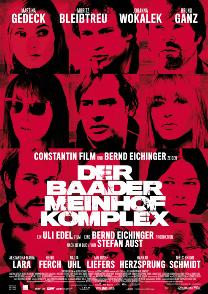
Released in 2008, Germany’s The Baader Meinhof Complex begins in 1967. The entire world appears to be in the grip of protest and revolution. The Viet Nam War is raging. Economic inequality is increasing. For neither the first nor the last time, the Middle East is consumed with conflict. All across Europe, young Leftist activists protest against what they consider to be American imperialism.
At a protest in Berlin, the police shoot and kill an unarmed student. Outraged by not only the shooting but also the lack of accountability on the part of the police, journalist Ulrike Meinhof (Martina Gedeck) announces on television that, even though the Nazis may no longer be in power, Germany is still a fascist state. Her words scandalize many viewers but they inspire two young activists named Andreas Baader (Moritz Bliebtreu) and Gudrun Ensslin (Johanna Wokalek). Baader and Ensslin protest by blowing up a department store. Their subsequent arrest and trial makes them celebrities. It also leads to them meeting with Meinhof, who finds herself drawn to the two charismatic radicals. Though convicted, both Baader and Ensslin are released pending an appeal and they soon become the leaders of the Red Army Faction. They amass a following of other young radicals, many of whom are searching for some sort of purpose for their lives. Among those who join them is Meinhof herself, who abandons her safe, middle-class liberalism and instead commits to Baader and Ensslin’s revolution. For every violent act that Baader and Ensslin mastermind, Meinhof writes the press release that justifies it by pointing out the violent acts being carried out by governments acoss the world.
At first, the revolution itself is almost fun. Baader and Ensslin both obviously enjoy their celebrity. When the RAF goes to Jordan to attend a sort of terrorist training camp, they promptly get on their host’s nerves by appearing not to take their training particularly seriously. The heads of the camp want to teach combat skills. Baader just wants to learn how to rob a bank and he and Ensslin take such delight in upsetting the stuffy heads of the camp that it’s hard not to like them. From the start, though, there are hints that the fun isn’t going to last. Baader may be charismatic but he’s also arrogant, temperamental, and lacking in self-awareness. He’s the type of revolutionary who will goad his lawyer into stealing a woman’s bag but who throws a fit when, moments later, someone else steals his car. For all their talk of how they’re willing to do whatever it takes to bring about a revolution, neither Baader nor Ensslin seem to initially understand the true risks of their activities. When a member of their group is killed in a shoot-out with the police, they are stunned and angered, as if it never occurred to them that the police would kill someone who opened fire on them. As the RAF’s action grow more violent and more people are killed as a result, Meinhof struggles to justify the violence. Eventually, not even Baader and Ensslin can control the organization that they’ve created.
It’s a familiar story. What starts off as idealism is eventually consumed by fanaticism and cynicism. The belief that’s one cause is right leaves people on both sides convinced that anything they do to promote that cause is correct. The film presents the violence of the 60s and 70s as being a never-ending cycle, with the violent response of each side merely fueling the anger on the other. At one point, a government official wonders why Baader has such a hold on his followers and the reply is that Baader has become a living myth, an activist celebrity who is idealized by his followers but who, in reality, can be just as arrogant, petty, and egotistical as those that he’s fighting. For many, he and his organization offer an escape from a pointless bourgeois existence but, in the end, he and Ensslin and Meinhof are perhaps the most bourgeois of all.
Aided by a strong cast, director Uli Edel captures the feel of a world that seems like it’s perpetually on the verge of revolution. Though the film is full of scenes of car chases, bombs exploding, and bullets being fired, Edel never allows us to forget the real costs of such actions. The film ends with the suggestion that the cycle of violence and revolution is destined never to end as one act leads to another. As the film reminds us, it’s a story that has played out many times in the past and will continue to play out in the future.
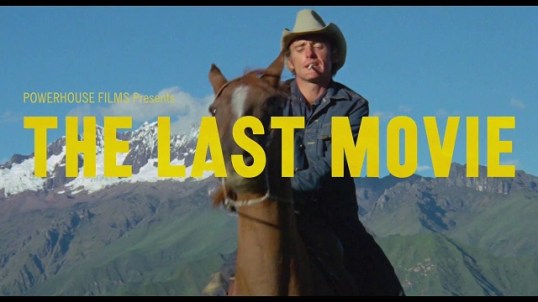
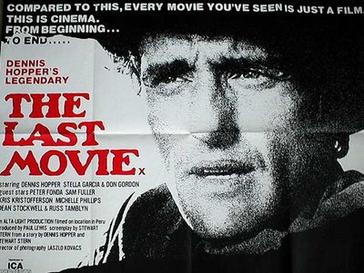
The story behind the making of 1971’s The Last Movie is legendary. It’s also a bit of a cautionary tale.
In 1969, Hollywood was stunned by the box office success of an independent, low-budget counter-culture film called Easy Rider. Easy Rider not only made a star out of Jack Nicholson but it was also the film that finally convinced the studios that the way to be relevant was not to continue to crank out big budget musical extravaganzas like Doctor Doolittle and Hello, Dolly! Instead, it was decided that the smart thing to do would be to hire young (or, at the very least, youngish) directors and basically just let them shoot whatever they wanted. The resulting films might not make much sense to the executives but, presumably, the kids would dig them and as long as the kids were paying money to see them, everyone would continue to get rich. Because Dennis Hopper had directed Easy Rider, he suddenly found himself very much in demand as a director.
Of course, almost everyone in Hollywood knew Dennis Hopper. Long before he became an icon of the counter-culture, Dennis Hopper had been a part of the studio system. John Wayne even referred to Hopper as being his “favorite communist.” Everyone knew that Dennis could be a bit arrogant. Everyone knew that Dennis was very much into drugs and that, as a result, he had a reputation for being a bit unstable. Everyone knew that Dennis Hopper deliberately cultivated an image of being a bit of a wild man and a revolutionary artist. But Dennis Hopper had just directed Easy Rider and Universal was willing to give Hopper some money to go down to Peru and direct his follow-up.
The Last Movie was a film that Hopper had been planning on making for a while. The film’s original script told the story of an aging and broken-down stuntman named Kansas who retires to Mexico and searches for a gold mine with a friend of his. Hopper first tried to get the film going in 1965, with Montgomery Clift in the lead role. After Clift died, Hopper tried to interest John Wayne in the starring role but, though Wayne enjoyed having Hopper in his films so that he could threaten to shoot him whenever Abbie Hoffman said something shocking, he had no interest in being directed by him. When Universal finally agreed to put up the money for the film, Hopper offered the lead role to Jack Nicholson. Nicholson turned it down and told Hopper that it was obvious that Dennis wanted to play the role himself. Dennis decided that he agreed with Nicholson and he cast himself as Kansas. Dennis also made the fateful decision to not only change the story’s setting to Peru but to also film on location.
Dennis and a group of friends flew down to Peru, which, at that time, was the cocaine capitol of the world. Drug use was rampant on the set, with Dennis reportedly being one of the main offenders. The cast and crew filmed during the day and partied at night and no one was particularly sure what the film was supposed to be about. Amazingly, Hopper finished filming on schedule and within budget but, much as he did with Easy Rider, he also overfilmed and ended up with 40 hours of footage. Not wanting to be bothered by the studios, Hopper edited the footage in his compound in Taos, New Mexico. Working slowly and continuing to consume a large amount of drugs and alcohol, Hopper still managed to put together a film that had a straightforward storyline. When Hopper showed his initial cut to filmmaker Alejandro Jodorowsky, the director of El Topo accused Hopper of being too conventional in his approach, which led to Hopper chopping up the film and reassembling it. Finally, after spending over a year working with the footage, Hopper turned in his final edit.
Universal had no idea what to make of the film that Hopper delivered to them. Still, they released it with the hope that the same crowd that loved Easy Rider would embrace The Last Movie. While the film did win an award at the Venice Film Festival, critics hated it and, even worse, audiences stayed away. The film’s reception was so overwhelmingly negative that Hopper found himself largely exiled from Hollywood, with only a few directors (like Francis Ford Coppola) willing to take the chance of working with him. It wasn’t until the 80s, when he finally got clean and sober, that Dennis Hopper was able to reestablish himself as a character actor and, ultimately, a beloved cultural institution.
But what about The Last Movie? Was is it really as bad as the critics claimed? Or was it, as some more recent reviewers have suggested, an unacknowledged masterpiece that was ahead of its time? I recently watched The Last Movie to find out for myself.
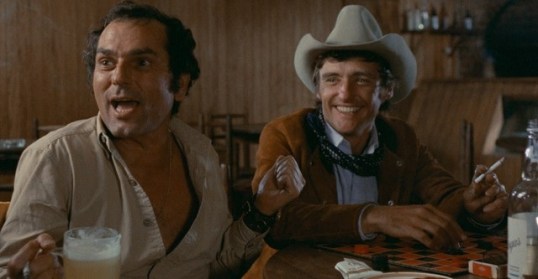
Despite its reputation, The Last Movie gets off to a pretty strong start. Samuel Fuller (playing himself) is directing a hilariously over-the-top and violent western in the mountains of Peru. Kansas (Dennis Hopper) is working as a stuntman. He’s fallen in love with a local sex worker named Maria (Stella Garcia). Kansas is meant to be an aging Hollywood veteran, someone who has broken a lot of bones and who carries a lot of aches as a result of his line of work. (One can see why Hopper initially imagined an actor like John Wayne in the role.) He knows that this is going to be his last job and, as we see over the first 25 minutes of the film, he feels alienated from the rest of the cast and crew. Admittedly, Hopper does appear to be a bit too young for the role. The ideal Kansas would have been someone like Ben Johnson, L.Q. Jones, or perhaps Warren Oates. But, still, Hopper does a good job of capturing Kansas’s mixed feelings about the western that’s being filmed around him.
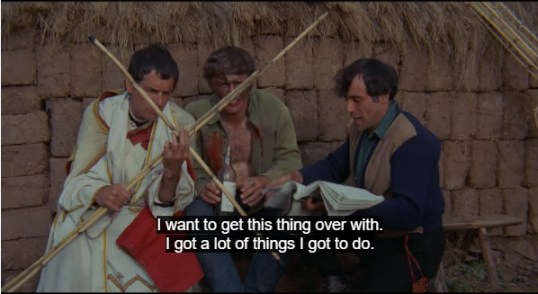
A lot of familiar faces pop up in the film’s fictional western. Dean Stockwell plays an outlaw. Jim Mitchum, Russ Tamblyn and Kris Kristofferson plays his associates. Peter Fonda is the youthful sheriff. Michelle Phillips is the daughter of the town’s banker and apparently, she’s also the girlfriend of one of the outlaws. We watch as the actors pretend to shoot guns and kill each other while the cameras are rolling, just to get up off the ground once “Cut” is yelled. When a local Indian who has been cast as an extra grows upset at the violence, an assistant director explains to him that no one really dies while the cameras are rolling. When shooting wraps, the film company goes home but Kansas stays behind with Maria. One day, the local priest (Tomas Milian) warns Kansas that the local indigenous people have moved into the abandoned film set and are trying to shoot their own movie. Kansas discovers that they have built wooden cameras and wooden boom mics and that their chief is giving orders in the style of Sam Fuller. They’re also firing the guns that the Americans left behind.
The first part of the film works quite well. Hopper’s camera captures the beautiful and isolated Peruvian landscape. The violent western is a pitch perfect and affectionate parody of a generic studio film. Though Hopper is a bit too young for the role, he still does a good job of capturing Kansas’s alienation from his fellow Americans. Even more importantly, the first part of the film seems to have an identifiable theme. The American film crew invaded an isolated part of Peru and changed the culture of the natives without even realizing it. Now, they’ve left but the natives are still dealing with the after effects of the American “invasion.” It’s easy to see, within that part of the story, a critique of both American culture and American foreign policy.
The second part of the film is where things start to fall apart. Kansas meets an old friend named Neville (Don Gordon). Neville has discovered a gold mine in the Peruvian mountains. With Kansas as his partner, he tries to get a businessman named Harry Anderson (Roy Engel) to invest in it. Kansas and Neville try to impress Harry and his wife (Julie Adams, best-known for being stalked by The Creature From The Black Lagoon). Kansas and Neville take the Andersons to a brothel and, in the process, Kansas offends Maria. Kansas then paws Mrs. Anderson’s fur coat and mentions that human beings are covered in hair. For all of their efforts, Harry will not invest, no matter how desperately Neville begs him to reconsider.
The second part of the film drags, with many of the scenes being obviously improvised between Hopper, Gordon, Garcia, Engel, and Adams. Unfortunately, the improved conversations aren’t particularly interesting and they tend to go on forever. Usually a reliable character actor, Don Gordon ferociously chews the scenery as Neville and it doesn’t take long before one grows tired of listening to him yell. (Gordon was far more impressive in Hopper’s Out of the Blue.) With the use of improvisation and overlapping dialogue, the second half of the film tries to feel naturalistic but instead, it’s a migraine-inducing method exercise gone wrong. It’s also during the second part of the film that a “scene missing” title card flashes on the screen, an indication that the discipline that Hopper showed as a director during the beginning of the film is about to be abandoned.
Finally, the third part of the film — well, who knows? The final 25 minutes of the film is collection of random scenes, some of which may be connected and some of which may not. The natives have decided that the only way to properly end their “film” is to kill Kansas. Kansas is shot several times and rides away on his horse. Suddenly, Kansas is back at his home and Maria is taunting him for getting shot. Then, Kansas is riding his horse again. Then suddenly, Dennis Hopper and Tomas Milian are laughing at the camera. A script supervisor tries to get Dennis to look at the shooting schedule while Dennis drinks. This happens:
Milian points out that the blood on Hopper’s shirt is dry. Hopper looks at his shoulder, where Kansas was previously shot, and says that someone needs to add his scar before he can shoot the scene. Ah! So, now we’re acknowledging that it’s all just a movie. Thanks, Dennis! Suddenly, Dennis is Kansas again and he’s collapsing over and over again in the dust. He appears to be dead but no, now he’s Dennis again and he’s standing up and smiling at the camera. And now, he’s singing Hooray for Hollywood. And now, suddenly, Kansas and Neville are talking about The Treasure of the Sierra Madre and then….
Well, let’s just say that it goes on and on before finally ending with a scrawled title card.
It’s a disjointed mess and it’s all the more frustrating because the first 30 minutes of the film is actually pretty good. But then, Dennis apparently remembered that he was supposed to be the voice of the counter-culture and he gave into his most pretentious impulses. Of course, just because a film is a mess, that doesn’t mean that it can’t be entertaining. And again, the first part of the film is entertaining and third part of the film is weird enough that it’ll hold most people’s attention for at least a few minutes. But the middle section of the film is so slow and pointless that it pretty much brings down the entire film.
In the end, what is The Last Movie about? In The American Dreamer(a documentary that was filmed while Hopper was editing The Last Movie in New Mexico), Hopper spends a lot of time talking about revolution and taking over Hollywood but The Last Movie is hardly a revolutionary film. The film is at its most alive when it is focused on the shooting of its fictional western. For all the satirical pokes that The Last Movie takes at the studio system, it’s obvious that Hopper had a lot of affection for Old Hollywood and for directors like Sam Fuller. Kansas may say “Far out,” but he’s hardly a hippie. Even the film’s jumbled finale seems to be saying, “It’s all Hollywood magic!” In the end, the film’s call for a new style of cinema is defeated by its love for the old style of cinema.
Instead, I think The Last Movie works best when viewed as a portrait of paranoia. Hopper himself admitted that he was naturally paranoid and the heavy amount of drugs that he was doing in the 70s didn’t help. One reason why Hopper filmed in Peru and edited in New Mexico was so the studios couldn’t keep track of him and, while directing, he worried about being arrested by the Peruvian secret police. As an actor, Hopper plays Kansas as being someone who views the world with caution and untrusting eyes. He doesn’t trust the other members of the film crew. He loves Maria but he’s still convinced that she’s going to betray him. Even the natives ultimately try to destroy him and the script supervisor tries to get him to stick to the shooting schedule. The film works best as a disjoined portrait of one man’s paranoid and fatalistic world view.
The Last Movie pretty much ended the studio’s attempts to harness the counter-culture by giving money to self-described revolutionaries. The new wave of directors — like Spielberg and Lucas — may have shared Hopper’s then-politics but they weren’t looking to burn down the system. (Hopper himself later became a Republican.) The Last Movie may not have been the literal last movie but it was, for a while at least, the last of its kind.





 Through the Shattered Lens