On the frontier, crooked lawyer Gabe Bowdre (Karl Hackett) is trying to secure all of the local water rights for himself and that means running off both the homesteaders and the ranchers. Bowdre and his men try to start a range war between the ranching Stocktown family and the homesteading Dawsons. Meanwhile, Dan Stockton (Bob Steele) has fallen in love with Gail Dawson (Louise Stanley) and marries her mere minutes before someone shoots his father in the back.
Gun Lords of Stirrup Basin has all the common elements that usually come with a B-western. I have lost track of how many times I have watched Karl Hackett play a crooked businessman who tries to start a range war to win either the water rights or the property deeds. Bob Steele spent a good deal of his career beating up Karl Hackett on screen.
What sets Gun Lords of Stirrup Basin apart is the Romeo and Juliet angle. While it’s predictable, the love story between Dan and Gail still adds more emotional depth than is usually found in these movies. The scene where all of the ranchers glare daggers at Dan’s new wife is powerful.
Bob Steele’s as good a hero as usual and Karl Hackett is a dastardly villain. Gun Lords of Stirrup Basin runs a little less than an hour, making it a good western for an afternoon break.
The world is ending and teacher Marty Anderson (Chiwetel Ejiofor) wonders why he keeps seeing signs that announce, “Charles Krantz: 39 Great Years! Thanks, Chuck!” Marty’s ex-wife (Karen Gillan) calls him and tells him that, at the hospital where she works, she and her co-workers have taken to calling themselves “the suicide squad.” It would be an effective moment if not for the fact that the film’s narration (somewhat predictably voiced by Nick Offerman) had already informed us of that fact. Everyone wonders why the world is falling apart. Why has the internet gone off-line? Why has California finally sunk into the ocean? Why are people rioting? Several characters say that it’s the end times before then adding that it’s not the same end time that the “religious fanatics” and “right-wing nuts” always talk about. Thanks for clarifying that! It’s nice to know that, at the end of the world, people will still talk like an aging Maine boomer.
Nine months earlier, a straight-laced banked named Chuck Krantz (Tom Hiddleston) comes across a busker playing her drums on a street corner and feels inspired to start dancing.
Years earlier, a young boy named Chuck Krantz is raised by his grandmother (Mia Sara) and his grandfather (Mark Hamill). Young Chuck (Jacob Tremblay) inherits a love of dance from his grandmother but, after she dies in a supermarket, his grandfather turns to drinking. His grandfather keeps one room in their house locked. (There’s even an absurdly huge lock on the door because The Life of Chuck is not a subtle one.) Eventually, Chuck discovers what is hidden away in the room and it shapes the rest of his life.
Occasionally, solid genre craftsmen will fill the need to prove that they’re actually deeper than people give them credit for. In 2020, Stephen King published a novella called The Life of Chuck. In October of 2023, director Mike Flanagan announced that he had begun filming on his adaptation of The Life of Chuck. Both King and Flanagan are better-known for their contributions to the horror gerne, though, around 2017, King apparently decided that he was also meant to be a political pundit. (No writer, with the possible exception of Joyce Carol Oates, has done more damage to their reputation by joining twitter than Stephen King.) There are elements of horror to be found in The Life of Chuck. There’s the world ending during Act One. There’s the locked rom in Act Three. There’s the terrible acting of the woman playing the drummer in Act Two. But this definitely is not a horror film. Instead, it’s King and Flanagan at their most sentimental, heartfelt, and ultimately simplistic.
It’s ultimately a bit too self-consciously quirky for its own good. Flanagan seems to be really concerned that we’ll miss the point of the film so he directs with a heavy-hand and, at times, he overexplains. Sometimes, you have to have some faith in your audience and their ability to figure out things on their own. The scenes of Chuck’s childhood are so shot through a haze of nostalgia that they feel as overly stylized as the scenes that don’t necessarily take place in our reality. For the most part, the narration could have been ditched without weakening the film. That said, the film is hardly a disaster. There are moments that work, like the joyous scene of Tom Hiddleston dancing. The film tries a bit too hard to be profound but there’s joy to be found in the performances of Hiddleston and Jacob Tremblay. Chucks seems like a nice guy.
1972’s Tomorrow opens up in rural Mississippi, in the early 40s. A man is on trial for shooting another man. The majority of the juror wants to acquit the shooter because it’s generally agreed that the victim was a no-account, someone who was never going to amount to anything and who the entire country is better off without. Only one juror votes to convict, a quiet and stoic-looking farmer named Fenty (Robert Duvall). Fenty refuses to go into much detail about why he’s voted to convict. Despite the efforts of the other jurors, Fenty refuses to change his vote and the end result is a hung jury.
The film flashes twenty years, to show why Fenty eventually voted the way that he did. Even in the past, Fenty is quiet and shy, a farmer who also works as a caretaker at another property that is several miles away. He walks to and from his home. Even on Christmas Eve, he says that he plans to walk the 30 miles back to his farm and then, on the day after Christmas, the 30 miles back to his caretaking job. Fenty is someone who keeps to himself, answering most questions with just a few words and revealing little about how he feels about anything.
When Fenty comes across a sickly and pregnant drifter named Sarah Eubanks (Olga Bellin), he takes her into his farm and he nurses her back to health. The film examines the bond that forms between Fenty and Sarah, two people who have been judged by society to be of little significance. It’s not an easy life but Fenty endures. Fenty’s decision to take in Sarah is a decision that will ultimately lead to Fenty’s guilty vote at the trial many years later.
Tomorrow is a film that is not as well-known as it should be. Adapted by Horton Foote from a William Faulkner short story, the black-and-white film is one that demands a little patience. Audiences looking for an immediate pay-off will be disappointed but those willing to give the film time to tell its story will be rewarded. The action unfolds at a gradual but deliberate pace, one that will seem familiar to anyone who has spent any time in the rural South. The film allows the audience the time to get to know both Fenty and Sarah and to truly understand the world in which the live. In the end, when the film’s narrator comes to realize that Fenty is not an insignificant bystander but instead a man of strong character and morals, the audience won’t be surprised because the audience already knows. Fenty has proven himself to the viewer.
Robert Duvall has described Tomorrow as being his favorite of the many films in which he’s appeared. (The film came out the same year that Duvall co-starred in The Godfather.) Indeed, Duvall does give one of his best performances as the quiet but strong Fenty. In many ways, the performance feels as if its descended from his film debut as Boo Radley in To Kill A Mockingbird. Duvall gives an excellent performance as a man who can hide his emotions but not his decency. Tomorrow is a film that requires patience but which still deserves to be better known.
1970’s The Revolutionary tells the story of a young man named A (Jon Voight).
When we first meet him, A is a college student who lives in the industrial town of Axton. A comes from a wealthy family but he chooses to live in a tiny and quite frankly repellent apartment. He has a girlfriend named Ann (Collin Wilcox). A and Ann don’t really seem to have much of a relationship. “We should make love,” A says in a flat tone of voice. Ann is willing to show her emotions while the self-serious A goes through life with everything under wraps. Ann and A are both members of a radical political group. The group spends a lot of time talking and discussing theory but they don’t really do much else.
A grows frustrated with the group. He gets a job at a factory, where he falls under the sway of a communist named Despard (Robert Duvall). Despard is a bit more active than A’s former comrades. Despard, for instance, is willing to call a general strike but, when that strike still fails, A, along with Despard and everyone else involved, goes underground. Suspended from the university, he soon finds himself being drafted into the Army. His father asks A if he wants to be drafted. A questions why only the poor should be drafted. His father looks at A as if he’s hopelessly naive and his father might be right.
A continues to wander around Axton in an idealistic daze, trying to get people to read the flyers that he spends his time passing out. Things change when A meets Leonard II (Seymour Cassel), a radical who recruits A into an apparent suicide mission….
The Revolutionary took me by surprise. On the one hand, it’s definitely very much a political film. The movie agrees with A’s politics. But, at the same time, the film is also willing to be critical of A and his self-righteous view of the world. One gets the feeling that A’s politics have less to do with sincere belief and more to do with his own need to be a part of something. Up until the film’s final few minute, A is something of a passive character, following orders until he’s finally forced to decide for himself what his next move is going to be. A’s father thinks he’s a fool. Despard views him as being an interloper. Even Leonard II seems to largely view A as being a pawn. A wanders through Axton, trying to find his place in the chaos of the times.
It’s not a perfect film, of course. The pace is way too slow. Referring to the lead character only as “A” is one of those 70s things that feels embarrassingly cutesy today. As was the case with many counterculture films of the early 70s, the film’s visuals often mistake graininess with authenticity. Seriously, this film features some of the ugliest production design that I’ve ever seen. But for every scene that doesn’t work or that plays out too slow, there’s one that’s surprisingly powerful, like when an army of heavily armored policemen break up a demonstration. The film itself is full of talented actors. Seymour Cassel is both charismatic and kind of frightening as the unstable Leonard II. Jon Voight and Robert Duvall are both totally convincing as the leftist revolutionary and his communist mentor. (In real life, of course, Voight and Duvall would become two of Hollywood’s most prominent Republicans.) In The Revolutionary, Duvall brings a certain working class machismo to the role of Despard and Voight does a good job of capturing both A’s intelligence and his growing detachment. A can be a frustrating and passive character but Voight holds the viewer’s interest.
The film works because it doesn’t try to turn A into some sort of hero. In the end, A is just a confused soul trying to figure out what his place is in a rapidly changing world. Thanks to the performance of Voight, Duvall, and Cassel, it’s a far more effective film than it perhaps has any right to be.
1969’s The Rain People tells the story of Natalie Ravenna (Shirley Knight), a Long Island housewife who, one morning, sneaks out of her house, gets in her station wagon, and leaves. She later calls her husband Vinny from a pay phone and she tells him that she’s pregnant. Vinny is overjoyed. Natalie, however, says that she needs time on her own.
Natalie keeps driving. In West Virginia, she comes upon a young man named Jimmy Kligannon (James Caan). She picks him up looking for a one-night stand but she changes her mind when she discover that Jimmy is a former college football player who, due to an injury on the field, has been left with severe brain damage. The college paid Jimmy off with a thousand dollars. The job that Jimmy had waiting for him disappears. Jimmy’s ex-girlfriend (Laura Crews) cruelly says that she wants nothing more to do with him. Natalie finds herself traveling with the child-like Jimmy, always trying to find a safe place to leave him but never quite being able to bring herself to do so.
Jimmy is not the only man that Natalie meets as she drives across the country. Eventually, she is stopped by Gordon (Robert Duvall), a highway motorcycle cop who gives her a speeding ticket and then invites her back to the trailer that he shares with his young daughter. (Gordon’s house previously burned down.) Natalie follows Gordon back to his trailer, where the film’s final tragic act plays out.
The Rain People was the fourth film to be directed Francis Ford Coppola. Stung by the critical and commercial failure of the big-budget musical Finian’s Rainbow, Coppola made a much more personal and low-key film with The Rain People. While the critics appreciated The Rain People, audiences stayed away from the rather downbeat film. Legendary producer Robert Evans often claimed that, when Coppola was first mentioned as a director for The Godfather, he replied, “His last movie was The Rain People, which got rained one.” Whether that’s true or not, it is generally acknowledged that the commercial failure of The Rain People set back Coppola’s directing career. (Indeed, at the time that The Godfather went into production, Coppola was better-known as a screenwriter than a director.) Of course, it was also on The Rain People that Coppola first worked with James Caan and Robert Duvall. (Duvall, who was Caan’s roommate, was a last-second replacement for Rip Torn.) Both Caan and Duvall would appear in The Godfather, as Sonny Corleone and Tom Hagen respectively. Both would be Oscar-nominated for their performances. (It would be Caan’s only Oscar nomination, which is amazing when you consider how many good performances James Caan gave over the course of his career.)
As for The Rain People, it may have been “rained on” but it’s still an excellent film. Shirley Knight, Robert Duvall, and James Caan all give excellent performances and, despite a few arty flashbacks, Coppola’s direction gives them room to gradually reveal their characters to us. The film sympathizes with Knight’s search for identity without ever idealizing her journey. (She’s not always nice to Jimmy and Jimmy isn’t always easy to travel with.) As for Caan and Duvall, they both epitomize two different types of men. Caan is needy but innocent, a former jock transformed into a lost giant. As for Duvall, he makes Gordon into a character who, at first, charms us and that later terrifies us. Gordon could have been a one-dimensional villain but Duvall makes him into someone who, in his way, is just as lost as Natalie and Jimmy.
The Rain People is a good film. It’s also a very sad film. It made my cry but that’s okay. It earned the tears.
David Hall (Matthew Faison) is an obnoxious horror writer who invites a group of associates and former friends to spend the night at a “haunted” hotel. He’s invited them because all of them are on the verge of suing him for writing about them in his latest book, The Resort. Over the course of the night, he plays cruel practical jokes on all of them. Finally, someone gets fed up and tosses him over a railing. The police arrest publisher Jordan White (Robert Stack) and charge him with the murder. It’s a good thing that Jordan’s best friend is Perry Mason (Raymond Burr).
Perry uses a cane in this movie and is not that active outside of the courtroom. That means that it’s up to Paul Drake, Jr. (William Katt) to do most of the investigating. As usual, Paul falls for an attractive, younger woman, in this case the hotel’s owner, Susan Warrenfield (Kim Delaney). Every movie features Paul falling for someone and then we never hear about them again. Does Paul have commitment issues?
I enjoyed this Perry Mason mystery. The hotel was a great location and I appreciated that the movie tried to add some horror elements to the story. The Perry Mason movies can be predictable so I always like it when they at least try to do something a little bit different. This was a fun entry in Perry Mason’s career.
Chevy Chase, Gregory Hines, and Wallace Shawn all play small-time arms dealers who get involved in a scheme to sell the “Peacemaker” drone to the dictatorship that has seized control of the Latin American country of San Miguel. After Shawn commits suicide, Chase and Hines are joined by his widow, who is played by Sigourney Weaver. Selling the Peacemaker should be easy except that Hines has a religious epiphany and becomes a pacifist and Chase himself is starting to have qualms about the way he makes a living. As his brother-in-law puts it, something bad seems to happen in every country that Chase visits.
Deal of the Century has the unique distinction of being one of the two films that director William Friedkin did not acknowledge in his autobiography, The Friedkin Connection. When Friedkin was asked why he left it out of his book, Friedkin said that he didn’t consider Deal of the Century to be a “Friedkin film.” He wanted to do a Dr. Strangelove-style satire while the studio wanted a board Chevy Chase comedy. The studio won, Friedkin was not given final cut, the movie bombed, and Friedkin didn’t see any reason to revisit the experience of making it.
Deal of the Century is a disjointed film. The best scenes are the one that are probably the closest to Friedkin’s original vision. These are the scenes set in weapons expos and that highlight the commercials designed to sell products of mass destruction. But those scenes are dwarfed by scenes of Chevy Chase being pursued by cartoonish guerillas in San Miguel and Gregory Hines overacting after getting baptized. Chase has a few good smartass scenes at the start of the film, some of which are reminiscent of his career-best work in Fletch. But he loses his way as the film goes on and his change-of-heart never feels convincing. The film ends with a burst of special effects that are unconvincing even for 1983.
Deal of the Century may have been directed by William Friedkin but he was correct to say that it is definitely not a Friedkin film.
In the closing days of the frontier, a group of Rangers in New Mexico receive a telegram telling them that it is time to disband and to turn law enforcement duties over to the local sheriff. However, there’s a viscous outlaw named Hashknife (George “Gabby” Hayes) on the loose so Bob Houston (Bob Steele) and Slim (Al St. John) pretend that they never received the telegram so that they can arrest him. Hashknife kidnaps Bob’s girl (Gertie Messenger) and that makes thing personal.
Riders of the Desert is an appropriate name for this film because the majority of its 50-minute running time really was just taken up with footage of men riding their horses from one location to another. Even though the film was less than an hour long, the story sill needed some filler.
Riders of the Desert is still a pretty good western, though. It’s definitely better than the average Poverty Row western. As always, Bob Steele look authentic riding a horse and Al St. John provides good support as Fuzzy. The disbanding of the Rangers gives the first half of the film an elegiac feel that would later show up in several of the westerns made during and after the 1960s. The old west is coming to an end and there’s less need for the Rangers. The second half of the film is almost all action and George “Gabby” Hayes is a surprisingly effective villain. Of course, this movie was made before he became Gabby.
As with most Poverty Row westerns, this is not the film to watch if you’re not already a fan of the genre. But for those who like westerns, Riders of the Desert is a good one.
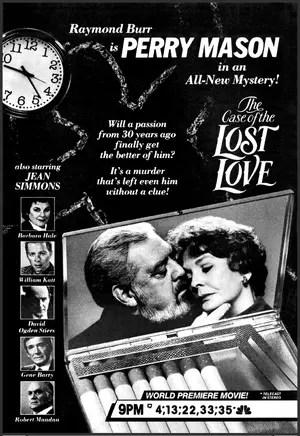
Perry Mason’s ex-girlfriend, Laura Robertson (Jean Simmons), is about to be appointed to the Senate when blackmailer Pete Dixon (Jonathan Banks) threatens to reveal that she once underwent shock treatment after having a nervous breakdown. When Dixon is murdered, Laura’s husband (Gene Barry) is arrested. Laura hires Perry (Raymond Burr) to serve as his attorney.
At first, this movie felt weird to me because it didn’t seem right for Perry to have an ex-girlfriend when we all know that he and Della (Barbara Hale) were in love. When Laura is at the office waiting to see Perry, she and Della have a conversation and it’s obvious that each is jealous of the other. When Laura asks, “What about you and Perry?,” Perry shows up before Della can answer. We all know what the answer was though. Della loves Perry and, probably because she was so upset over Perry dating Laura, she threw herself at Paul Drake, Sr. and that’s how we got Paul Drake, Jr.
As for Paul Drake, Jr. (William Katt), he flirts with two different women in this movie but he doesn’t get to do as much investigating as he did in the first few films. This movie is almost all Perry Mason interrogating people. Raymond Burr uses a cane in this movie and there’s a few scenes where it’s obvious that he was in pain but he still gives a very good performance. The movie is very talky but it also has the best courtroom confession scene yet and Raymond Burr really sells Perry’s ambivalent feelings. The identity of the killer actually took me by surprise!
It was weird to see Perry in love with someone oter than Della but this was still an excellent entry in the series.
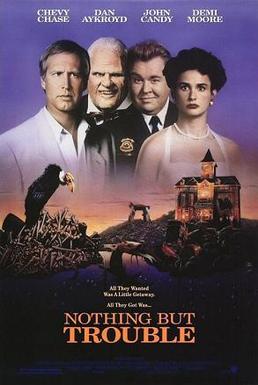
Publisher Chris Thorne (Chevy Chase) is eager to get to know lawyer Diane Lightson (Demi Moore) so he agrees to drive her and two Brazilian hangers-on from Manhattan to New Jersey. The Brazilians encourage Chris to take a detour, which leads to him running a stop sign, getting into a high-speed chase with chief of police Dennis Valkenheiser (John Candy), and being detained in the dilapidated village of Valkhenheiser. Dennis decides to leave town with the Brazilians, leaving Chris and Diane to face the wrath of 106 year-old Judge Alvin “J.P” Valkenheiser (Dan Aykroyd). Judge Valkenheiser has spent decades killing anyone who breaks the law in his village, though he also kills anyone who he just dislikes. The Judge assumes Chris is a banker (and he hates bankers) and is prepared to kill him unless he marries the Judge’s granddaughter, Eldona (John Candy, in drag). This town is nothing but trouble and Chris and Diane have to escape.
Nothing But Trouble was both the directorial debut and swan song for Dan Aykroyd. (Aykroyd also wrote the script, from a story that was written by his brother, Peter.) The film was an notorious box office bomb and watching, it’s easy to see why. The story is all over the place, awkwardly mixing humor and horror. Anyone who has seen the early seasons of Saturday Night Live knows that young Dan Aykroyd was one of the funniest people around but, when it comes to the movies, he’s always worked better with a collaborator than on his own. As a director, Aykroyd throws a little bit of everything into Nothing But Trouble and the movie feels overstuffed.
As an actor, though, Aykroyd is funny. Whatever laughs are to be found in Nothing But Trouble are largely the result of his performance as the Judge. Chevy Chase seems bored. Demi Moore actually gives a decent performance but she plays her role straight. John Candy is likable as Dennis but too cartoonish as Eldona. Aykroyd, however, so commits himself to playing the 106 year-old judge that he wrings laughs from even the weakest of lines. Criticize Aykroyd the director all you want, Aykroyd the actor delivers.
One final note: The rap group Digital Underground makes a cameo appearance as themselves, performing in the Judge’s courtroom after getting arrested for speeding. When I was watching Chevy Chase mugging for the camera and Dan Aykroyd walking around hunched over, I hardly expected to see a young Tupac Shakur suddenly show up but he did. Digital Underground’s cameo is one of the film’s better moments, even if they don’t perform The Humpty Dance.
 On the frontier, crooked lawyer Gabe Bowdre (Karl Hackett) is trying to secure all of the local water rights for himself and that means running off both the homesteaders and the ranchers. Bowdre and his men try to start a range war between the ranching Stocktown family and the homesteading Dawsons. Meanwhile, Dan Stockton (Bob Steele) has fallen in love with Gail Dawson (Louise Stanley) and marries her mere minutes before someone shoots his father in the back.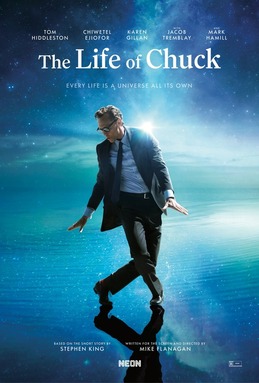


 Through the Shattered Lens