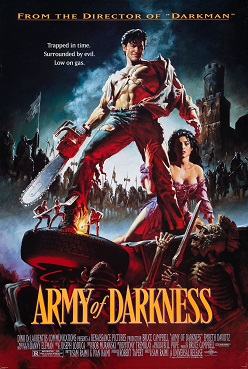
Horror Film Review: Army of Darkness (dir by Sam Raimi)


This is not going to be a traditional film review because let’s just state the obvious.  Army of Darkness is great.  Everyone knows that Army of Darkness is great.  Everyone loves Army of Darkness.  It’s not like you’re reading this review because you need to know whether or not Army of Darkness is a good film.

Now, interestingly enough, not everyone recognized just how good Army of Darkness was when it was first released.  A lot of reviewers were confused by director Sam Raimi’s mix of of horror (because the Deadites are scary under any circumstances) and slapstick comedy.  Today, we’re used to films and television shows that attempt to mix comedy and horror.  Ryan Murphy’s built an entire career out of mixing gore with camp and, as a result, he’s the favorite horror filmmaker of people who think they’re too good for horror.  In 1992, when Army of Darkness was first released, mixing horror and comedy caught critics and audiences off-guard.  What’s interesting is that 31 years later, Army of Darkness still feels fresh while many of the comedy horror films that followed feel tired.

I think one reason why the film continues to work is because it’s obvious that both Sam Raimi and Bruce Campbell were truly committed to bringing their demented vision to screen.  The film features Campbell as Ash Williams, the S-Mart clerk who, after a night of fighting the Deadites and losing his hand, has found himself in the Middle Ages, captured by Lord Arthur (Marcus Gilbert) and expected to live the life of a medieval slave.

Ash is often described as being one of the dumbest movie heroes of all time but, as this film shows, Ash’s stupidity is also his secret weapon.  While others heroes would probably get caught up trying to rationalize or understand the situation in which they’ve found themselves, Ash just accepts it.  While others heroes would strategize or try to figure out a clever way to get out of their situation, Ash simply fights back and runs straight into trouble.  “This is my boomstick!” Ash yells at one point and, while it establishes himself as being a great warrior, it’s also a case of Ash bragging on himself.  Ash is a big fan of bragging and it must be said that it usually works out for him..  When Ash is attacked by evil Ash and several miniature Ashes, the mindless delight that all of these different Ashes take in trying to destroy each other is infectious.

Of course, Ash’s stupidity can also be his biggest downfall.  For me, the best part of this film is when Ash tries to recover the Necronomicon from the haunted forest.  He is given three simple words that he needs to repeat before taking the book.  Before entering the forest, he practices by repeating the words twice but refuses to repeat them a third time because “I’ve got them!”  Of course, Ash doesn’t have them so he does what any of us would do.  He attempts to mumble the third world.  This, of course, raises an army of the dead.

(My second favorite part of the film is that the army of the dead is surprisingly talkative as they rise from their graves.  My third favorite part of the movie is Ted Raimi continually popping up as different supporting characters, occasionally even arguing with himself.  My fourth favorite part of the movie — well, I’ve got a lot of favorite parts of this movie.  Army of Darkness is one of those endlessly quotable movies about which you can spend hours saying, “Remember when….”)

“Shop smart, shop S-mart,” Ash says at one point and it’s tempting to laugh because Ash isn’t smart but he’s determined and his oddly confident and he manages to find a strange sort of joy in every situation that he finds himself.  He’s the ultimate blue collar hero and Army of Darkness is the ultimate celebration of Ash Williams, Bruce Campbell, and Sam Raimi.
Horror Film Review: The Giant Claw (dir by Fred Sears)


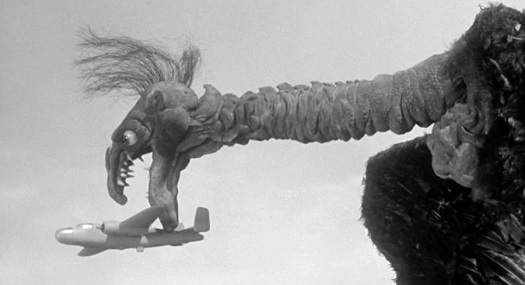
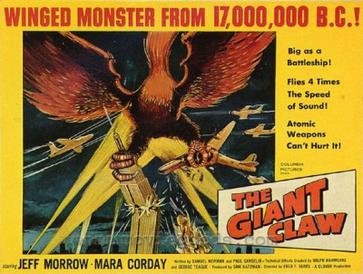
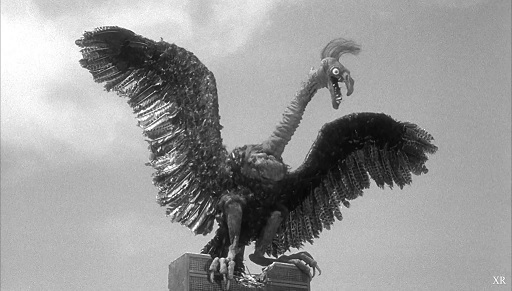
You know, a lot of people are a bit of dismissive of 1957’s The Giant Claw because they say that the monster — a big flying turkey from an anti-matter universe that has somehow slipped into our universe — is not convincing.

They make fun of the fact that, instead of hiring Ray Harryhausen like they were originally planning to do, the producers decided to save money by going for his non-union, Mexican equivalent.

They make fun of the scene in which a French-Canadian trapper announces that the Turkey Monster is actually a mythological beast that has the body of a woman, the head of a wolf, and the wings of a bat because the Turkey Monster certainly looks nothing like that.

They laugh at the scene where the Turkey Monster chases an airplane, even though I think that would be pretty terrifying if I was actually on the airplane.  I mean, the last time we were flying home from the UK, we hit a bit of turbulence and it traumatized me for days.  I can only imagine how I would feel if I looked out the window and I saw a giant flying turkey chasing after the plane.

Critics will even make fun of how the turkey sounds, mocking it for its weird “caw caw” noises.

Well, alright.  Let’s just admit it.  The turkey isn’t the most menacing monster in the world and yes, it does sometimes sound a bit hoarse and it could definitely stand to put on a little weight but seriously, how can you not love this thing?

As for the film itself, it not only features one of the greatest monster of all time but it’s also a love story!  Mitch MacAfee (Jeff Morrow) is a pilot who sees a UFO and who faces an attempt, by the government, to cover up what he’s seen.  As happened to so many of the people who saw UFOs in the 50s, he’s accused of being either mistaken or an outright hoaxer.  Meanwhile, Sally Caldwell (Mora Corday) is a mathematician who is originally skeptical of Mitch and his claims but who realizes that he was right when they’re attacked by the Turkey Monster.  Their plane crashes in Canada, where they are rescued by a French-Canadian trapper named Pierre Brousssard (Lou Merrill).  While the Turkey Monster is terrifying the world, Sally and Mitch are falling in love and since Jeff Morrow and Mara Corday are the most attractive people in the film, it only seems right.  They’re a cute couple, who cares if the script makes any sense?

Anyway, back to the Turkey Monster.  The Turkey Monster is protected by an anti-matter shield, which makes it impossible for it to be attacked by missiles and planes.  A high-ranking general is left repeating, “Missiles and bombs,” after realizing that they’re all useless against the turkey.

Eventually, the Turkey Monster makes its way to New York City and announces that it’s not going anywhere!

Well, you know what, Giant Turkey?  If you can make it there, you can make it anywhere!

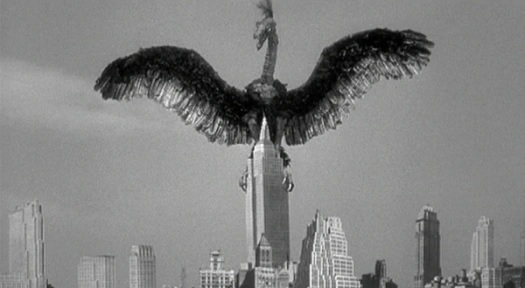
Sadly, the Turkey’s New York visit doesn’t end well and that’s a shame.  Benjamin Franklin famously suggested that America’s official bird should have been the turkey as opposed to the eagle.  Looking at the Giant Turkey sitting on the Empire State Building, how can you disagree?

Seriously, don’t listen to the critics.  The Turkey Monster is one of the most entertaining monsters of all time and The Giant Claw is tons of fun!

Horror On The Lens: Haunted House of Horror (dir by Michael Armstrong)


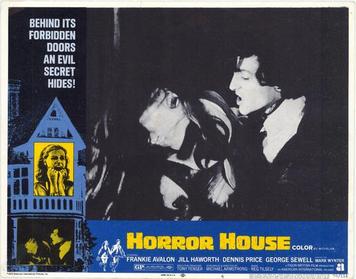
First released in 1969, The Haunted House of Horror features a group of 20-somethings who, bored with the usual parties, decide to that it might be a kick to hang out in a supposedly haunted mansion.  Once they’re in the mansion, they decide that it might be even more fun to hold a seance!

(Seriously, what is the deal with people holding séances in haunted mansions?  That really seems like the last place where you would want to mess with potentially malevolent spirits!)

The party becomes much less fun once someone starts killing off the group, one-by-one.

This film is notable for two reasons.  First off, it features Frankie Avalon in one of his attempts to break free of his Beach Party typecasting.  Secondly, the role of Richard, who is played by Julian Barnes, was originally offered to a young singer named David Bowie.  Reportedly, Bowie was quite excited about doing the film but, in the end, the producers worries that he and Frankie Avalon would not get along.  I’m not sure why.  David Bowie had a sense of humor and, judging from his Casino cameo, so does Frankie.

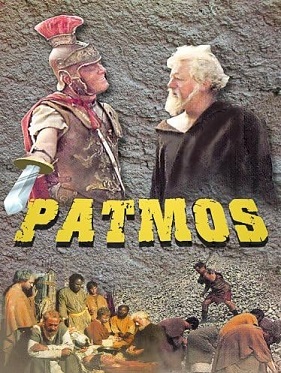
October Positivity: Patmos (dir by Jimmy Murphy)


First released in 1985, Patmos imagines the final days of St. John the Evangelist.

The film opens with John (Louis Rolston), the last surviving member of Jesus’s original disciples, having been arrested by the Romans and sentenced to the penal colony of Patmos.  At Patmos, he lives in a cave and, despite being an elderly man, he is expected to take part in hard manual labor.  The commandant of Patmos is Catalinus (Mark Mulholland), an arrogant centurion who is known for his temper.  For Catalinus, being assigned to Patmos is a bit of a demotion and he’s eager to take his anger out on John.

John, however, refuses to allow Catalinus to break him and his quiet dignity starts to impress some of the Roman centurions.  (“I’m not paid to think,” one centurion replies, when asked for his opinion on John.)  It also starts to impress John’s fellow prisoners.  When John starts to have visions of the eventual apocalypse, the other prisoners help him to record them.  When Catalinus starts to execute the other prisoners and demands that John renounce his religion and his visions,  John is faced with a difficult decision.  Should he claim to have rejected God or should he stand firm in his beliefs, even in the face of Catalinus’s cruelty?

Well, there’s never really any question as to what John is going to do.  This film was made to be shown in church basements and at religious camps so there’s no way that John is going to renounce his faith.  That said, the film deserves a good deal of credit for not making it appear as if John’s decision was an easy one.  Everyday, as John is led out of his cave, he has to pass the people who have been crucified in an attempt to intimidate him into silence.  His fellow prisoners soon start to demand that John give into Catalinus’s demands, even as John tries to explain why he cannot.  Catalinus’s cruelty is actually supported by what we know about the techniques that some Romans used to keep order in their prison colonies so the idea that he would execute everyone but John is not an outlandish one.  The cruelty, as the saying goes, is the point.

(Indeed, Catalinus’s arrogance and his anger at being defied should seem familiar to anyone who has ever had to deal with a middle management bureaucrat.)

That said, when a film is called Patmos and deals with the final years of St. John the Evangelist, most people are going to be watching because they want to see how the film portrays the visions of revelation.  Patmos, being a low-budget film, goes for a simple approach.  We see horsemen riding across Patmos, each bringing a plague to Earth.  There are occasional shots of people begging for food and there’s also a sepia-toned sequence that takes place in Heaven.  As I said, it’s simple and it’s obvious that the film’s low budget played a huge role in how the apocalypse was presented.  But that simplicity is actually rather effective.  After sitting through so many flamboyant and over-the-top portrayals of the end of the world, it’s hard not to appreciate the starkness of Patmos’s imagery.

The acting is a bit uneven but Louis Rolston is appropriately wise as John and Mark Mulholland is appropriately arrogant as Catalinus.  Patmos is an effectively done apocalypse film, one that makes good use of its low budget.

October Hacks: Sweet Sixteen (dir by Jim Sotos)


1983’s Sweet Sixteen takes place in a small town in Texas.

Sherriff Dan Burke (Bo Hopkins) does his best to try to maintain the peace but it’s not always easy.  Not when a good majority of the town is prejudiced against the Native Americans living on a nearby reservation.  There’s a major archeological dig happening on the reservation, headed up by Dr. John Morgan (Patrick Macnee), but the town doesn’t care about any of the artifacts that Dr. Morgan and his team might discover.  They’re too busy harassing local activist Jason Longshadow (Don Shanks) for stepping into the wrong bar.

However, a distraction from all of the casual racism has arrived in the form of Dr. Morgan’s daughter, Melissa (Aleisa Shirley).  Soon, it seems like every teenage boy and young man in town is lusting after Melissa.  Melissa, for her part, is only fifteen years old and is struggling to deal with all of the attention.  Sometimes, she enjoys the attention.  Sometimes, she just wants to be left alone.  (Believe me, as someone who had adults hitting on her when she was 13, I could relate.)  Melissa’s birthday is coming up and her mother (Susan Strasberg) is planning on throwing a big party and inviting the whole town to come over and celebrate.  Sheriff Burke thinks it’s a great idea.  “This town could use something to celebrate.”

The only problem is that any boy who so much as looks at Melissa ends up getting brutally murdered.  When an old Native American man named Greyfeather (Henry Wilcoxin) is spotted near the scene of one of the crimes, the local redneck blame him for the murders and tragedy ensues.  Sheriff Burke has to find the real murderer and, whether he likes it or not, he’s going to get some help from his kids, Hank (Steve Antin) and Marci (Dana Kimmel).

Hank and Marci really are this film’s secret weapons.  In the past, I’ve been pretty critical of Dana Kimmel’s performance in Friday the 13th Part 3 and her insistence that her character be re-written to reflect her own religious beliefs and desire to be a good role model.  However, Kimmel is really likable (and perhaps more appropriately cast) as the fiercely intelligent but still relatively innocent Marci, who reads murder mysteries and is totally excited about the prospect of getting to solve a real murder.  Hank is perhaps a bit less enthusiastic about about crime-solving than Marci but he still helps out his sister because she’s his sister.  Awwwwww!

Sweet Sixteen is a bit of an untraditional slasher film, one that is as concerned with social issues as is it was stalking and slashing teenagers.  Perhaps that explains why it has a slightly better cast than the typical 80s slasher, with veteran actors like Patrick McNee, Susan Stasberg, and Bo Hopkins acting opposite equally capable but younger actors like Kimmel, Antin, and Aleisa Shirley.  It’s also a surprisingly likable slasher film, due to the Dana Kimmel and Steve Antin’s engaging lead performances.  Honestly, I think it’s kind of a shame that there weren’t a series of films featuring Marci and Hank solving crimes.  Dana Kimmel and Steve Antin make quite a team in this above average slasher.

The TSL Horror Grindhouse: Blood Thirst (dir by Newt Arnold)


Filmed in 1965 but not released until 1971, Blood Thirst takes place in Manila.  Young women, many of whom work at or near the Bario Club, are turning up dead with all of their blood drained from their body.  Inspector Miguel Ramos (Vic Diaz) thinks that the crimes are the work of one homicidal maniac but there are whispers that the women are falling victim to a cult of devil worshippers.  Hoping to solve the case before a full-fledged panic breaks out, Ramos summons a friend of his from New York, Detective Adam Rourke (Robert Winston).

Detective Rourke, who is perhaps a bit too quick to smirk, thinks that it’s going to be easy to solve this case but it turns out the opposite is true.  He goes undercover as a visiting writer and starts to hang out at the Bario Club.  He gets to know the people who work there and he introduces himself to the club’s owner, Calderone (Vic Silayan).  Calderone is immediately suspicious of Rourke, something that he ascribes to his natural concern for his employees.  However, the club’s most popular dancer — the beautiful blonde Serena (Yvonne Nielsen) — informs Rourke that Calderone murdered his previous wife.

Both Detective Rourke and Miguel’s sister, Sylvia (Katherine Henryk), suspect that the killer is Calderone.  However, the viewers have a bit more information than Rourke and Sylvia.  We know that the killer is a horrifyingly disfigured monster who always seem to emerge from the shadows.  What is the monster and why is it obsessed with draining the blood of young, beautiful women?  That’s the mystery that Rourke will eventually have to solve.

Just from the plot description, Blood Thirst might not sound that impressive and I have to admit that I went into the film with low expectations.  But I was actually surprised to discover that the film was far more effective than I was expecting.  Visually, the stark black-and-white cinematography creates an appropriately ominous atmosphere and the scenes in the club feel like they could have been lifted from the best examples of film noir.  Characters literally emerge and occasionally disappear into the darkness, with shadows often obscuring half an actor’s face as if to remind us that any one of the characters could be the murderer (and, by that same token, any of them could actually be innocent).  When Serena performs in the club, her blonde hair and pale skin almost seem to glow in the darkness.  The monster itself is effectively frightening as it makes it way through the film, moving like a crazed animal that has found itself outside of its natural habitat.

Of course, it’s hardly a flawless film.  Rourke is a remarkably unlikable character, one who smirks his way through the entire film.  The scenes where he flirts with Sylvia are cringeworthy and redeemed only by Sylvia’s habit of both slapping him and kicking him out of her car.  There are a few moments of humor that don’t quite work.  The film is at its best when it focuses on atmosphere and shadows as opposed to the characters.  Blood Thirst works as a filmed dream, a vision of dark and disturbing things.

The Demolitionist (1995, directed by Robert Kurtzman)


In the future, America is overrun by crime.  Mad Dog Burne (Richard Grieco) and his brother, Little Henry (Randy Vasquez) escape from California death row.  Mayor Eleanor Grimbaum (Susan Tyrell) wants the Burne brothers captured and she wants to be able to show the voters that she’s tough on crime.  When brave police officer Alyssa Lloyd (Nicole Eggert) is killed by Mad Dog Burne’s gang, she is brought back to life in cyborg form by Prof. Crowley (Bruce Abbott) and, after a training montage, she is let loose on the streets as a police-backed vigiliante.

The Demolitionist owes an obvious debt to Robocop, with Nicole Eggert miscast as an expressionless cyborg who launches a one-woman/one-machine war on crime.  The main problem is that The Demolitionist has none of Robocop‘s wit or its subversive subtext.  Nicole Eggert is no substitute for Peter Weller and Richard Grieco is no Kurtwood Smith.  “Booker’s a good cop!” I said whenever Grieco showed up.

The only interesting this is about the cast, which is full of horror veterans.  Jack Nance plays the prison priest who counsels the Burne brothers before they escape their scheduled executions.  Reggie Bannister plays the warden.  Sarah Douglas plays  a surgeon.  Joseph Pilato is one of Mad Dog’s followers.  And playing Mad Dog’s second-in-command is none other than Tom Savini.  Finally, the city’s most popular journalist is played by Heather Langenkamp!

The Demolitionist demolishes almost the entire town but she still can’t come up with any way to make this stale Robocop rip-off feel fresh.


October True Crime: Party Monster (dir by Fenton Bailey and Randy Barbato)


Michael Alig!  He was the flamboyant, self-declared “King of the Club Kids.”  He was a club promoter in New York City in the late 80s and the 90s.  He had money.  He had fame.  He had a huge following.  He used to appear regularly on the daytime talk shows.  He was a regular feature in the gossip columns.  He also had a raging drug addiction and an ego that most people couldn’t stand.  He tried to position himself as the successor to Andy Warhol, overlooking the fact that Warhol himself actually had a bit of talent.  And, in 1996, he became a murderer.

He and his roommate killed his drug dealer, a fellow club kid who was known as Angel.  They hit him over the head and suffocated him before then dismembering him.  Everyone knew that Alig was responsible for Angel’s disappearance, largely because he wouldn’t shut up about killing him.  Alig even threw a party where the macabre and bloody decorations left little doubt that Alig had murder on his mind.  Eventually, a group of children found Angel’s remains and Alig and his roommate were arrested.  Due to a plea deal, Alig was sent to prison for manslaughter.  He served 14 years before being paroled.  Alig died of a heroin overdose in 2020.

Released in 2003 (while Alig was still in prison), Party Monster is a biopic of Michael Alig and also a look at New York club culture in the 90s.  The film got a bit of attention when it came out because it starred Macaulay Culkin and Seth Green as, respectively, Michael Alig and James St. John, who was Alig’s mentor-turned-friend-turned-enemy.  Unfortunately, the film itself isn’t very good and both Culkin and Green are lousy in their roles.  Both of them come across like middle American high school kids trying to score cheap laughs by acting as self-consciously flamboyant as possible.  At the time the film was made, Culkin did bear a passing a resemblance to Michael Alig but the same could have been said of Michael Pitt and, at the very least, we know that Pitt is capable of playing a character who is capable of murder.  Culkin, on the other hand, seems to be trying so hard to make us forget that he’s Macaulay Culkin that he instead continually reminds us that we’re watching the star of Home Alone snort cocaine and urinate in wine glasses.  (Ewwwww!)  That said, Culkin and Green aren’t the only two giving bad performances here.  I started giggling as soon as Dylan McDermott showed up wearing an eyepatch.  Only Wilson Cruz as Angel and Chloe Sevigny as one of Alig’s associates feel in any way convincing in their roles.

For a film about a group of people who claimed “fabulousness” as their defining aesthetic, Party Monster is a visually dull film.  Many scenes are overlit, to the extent that the performers look wan and washed out.  That may be a good look for the drug-addled Alig who killed Angel but, in this film, Alig looks and seems burned out from the minute he shows up in New York City.  The end result is a rather boring film that doesn’t offer up any insight into the Club Kids or the murders.

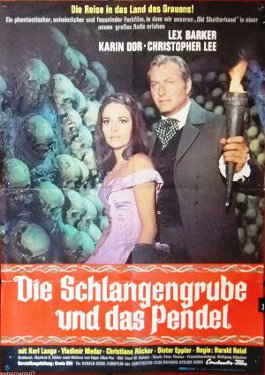
Horror Film Review: The Torture Chamber of Dr. Sadism (dir by Harald Reinl)


On Saturday night, I watched the 1967 German horror film, The Torture Chamber of Dr. Sadism.

I have to say that the film itself turned out to be quite a bit more entertaining than I was expecting it to be.  It was an entertaining and atmospheric horror film, the type where travelers rode in stage coaches to gothic castles and Christopher Lee showed up as the villain.  However, I was very disappointed to discover that, while the film did feature a torture chamber, there was not a character named Dr. Sadism anywhere to be found.  In fact, I don’t think that the word “Sadism” was even mentioned in the film.

Of course, The Torture Chamber of Dr. Sadism was not the only title by which this film was released.  As was typical of horror films in the 60s (especially international horror films), this film had many different titles.  In Germany, it was known as Die Schlangengrube und das Pendel.  It was also released under titles like The Blood Demon, The Crimson Demon, The Snake Pit and the Pendulum, and The Castle of the Walking Dead.  That’s a collection of good names.  It’s just too bad that they were all given to one film as opposed to being spread out amongst several films.

The Torture Chamber of Dr. Sadism (or whatever you want to call it) opens with a public execution.  Count Regula (Christopher Lee) has been found guilty of the murder of 12 virgins.  Regula is forced to wear a gold mask with a rather awkward smiley face on the front of it.  He is then forced to lie down in the town square and his wrists and his ankles are tied to four horses.  As the red-hooded executioner looks on, the horses run in four different directions and, though we don’t actually see it, Count Regular is ripped apart.  Agck!

35 years later, Baroness Lilian von Brabent (Karin Dior, wearing a purple gown that is simply to die for) and her lawyer, Roger Mont Elise (Lex Barker) are invited to pick up an inheritance that is due to the Baroness.  The only catch is that they’ll have to ride a stagecoach all the way to a forbidding castle that the locals refer to as being Blood Castle.  On the way to the castle, they are joined by a highwayman who is pretending to be a priest (Vladimer Medar) and the Baroness’s maid (Christiane Rucker).  They are ride through a forest where the trees are full of human limbs.  They battle some mysterious robbers.  They discover a burned out church and an apparent madman living inside the ruins.  Eventually, they reach the castle where the resurrected Count Regula waits for them, along with his undead, green-blooded servant, Anatol (Carl Lange).  Count Regula is eager to sacrifice a 13th virgin so that he can become immortal.  Apparently, this will grant Regula immortality, which he does not yet have despite the fact that he’s somehow recovered nicely from being dismembered and beheaded.  Regula announces that the Baroness will be his next virgin victim.

(See, there’s actually very real advantages to not waiting.)

The Torture Chamber of Dr. Sadism is one of those films that is described as being based on the writings of Edgar Allan Poe.  In this case, that means that Roger ends up in a pit with a pendulum swinging over him.  For a film with a title like The Torture Chamber of Dr. Sadism (or even The Blood Demon), there’s not really a lot of gore in this film.  Instead, the film focuses more on creating and maintaining a properly gothic atmosphere.  It’s surprisingly entertaining, largely due to the ominous design of the torture dungeon, Christopher Lee’s villainy, Vladimer Medar’s comedic relief, the beauty of Karin Dor, and the square-jawed heroism of Lex Barker.  Lee, in particular, deserves some credit for embracing the melodrama in his role as Regula.  Lee knows exactly the type of film in which he’s appearing and he appropriately modulates his performance.

Whatever title you see it under, The Torture Chamber of Dr. Sadism will keep you entertained.


Guilty Pleasure: Blood Harvest (dir by Bill Rebane)


In 1987’s Blood Harvest, college student Jill Robinson (Itonia Salochek) returns to her hometown in rural Wisconsin and discovers that there have been some changes.

For one thing, the local farmers are struggling and the bank is foreclosing on their land.  Since Jill’s father is the president of the bank, people are not particularly happy to see her in town.  (One farmer spits at her.)  When Jill arrives at her parents home, she discovers insulting graffiti on the exterior and a strawman hanging in the front corridor.  Even more upsetting, her parents are nowhere to be found!

Jill goes to see Sheriff Buckley (Frank Benson) about the graffiti but when they go back out to Jill’s house, both the graffiti and the strawman have vanished.  The sheriff tells Jill not both him anymore and then leaves her alone at her home.  Most people would probably panic about this but not Jill!  Instead, Jill hangs out with her childhood friend, Gary (Dean West).

Gary’s has had a tough time of it recently.  His parents recently died mysteriously and he now takes care of his brother, Mervon (played by 60s folk singer Tiny Tim).  Gary and Mervon are an oddly matched pair of siblings.  For one thing, Gary appears to be no older than 20 while Mervon is in his late 60s.  Gary looks like a fresh-faced jock.  Mervon has long stringy hair, speaks in a falsetto voice, and always wears clown makeup.  Mervon, who prefers to be called The Magnificent Merv, also likes to sing about how Gary and Jill went up the hill to fetch a pail of water.  As for Gary, he is disappointed to hear that Jill not only has a boyfriend at college but that she’s also engaged to him.  It doesn’t help that Jill keeps saying stuff like, “If my father hadn’t caught us that time, it could have been you and me getting married!”

While Jill’s parents remain missing, she is visited by her boyfriend (Peter Krause, making his film debut) and her best friend, Sarah (Lori Minnetti).  Because Jill isn’t particularly smart, she doesn’t notice when both her boyfriend and her BFF are dragged over to her family’s barn and brutally killed.  (Jill does eventually start to worry about the whereabouts of her boyfriend but it’s not like Sheriff Buckley is going to help her….)  Who is the person who is not only murdering Jill’s friend but also frequently drugging her and undressing her so he can take pictures?  Well, there’s only two suspects and the scare scenes are so clumsily staged that you’ll see the killer’s face long before you were probably meant to.

Blood Harvest was directed by Bill Rebane, the Wisconsin-based filmmaker behind The Giant Spider Invasion and The Demons of Ludlow.  (Ludlow even gets a shout-out.)  It’s a typical Rebane film, with all of the inconsistent acting and incoherent plotting that he is typically known for.  At the same time, it’s also a film that’s a bit more interesting that one might expect just from the plot description.  There’s an interesting political subtext to Jill’s father being the banker who is responsible for the decline of Jill’s hometown and one gets the feeling that Rebane shared the anger of the film’s famers when it came to banks foreclosing on people’s land.  One could never doubt Rebane’s love of rural Wisconsin and, even though the film itself is a bit grainy, the countryside looks lovely.  Finally, I have to admit that I could actually relate to Jill, both in her desire to escape country living and her dislike of wearing pants while at home.

That said, the main attraction for most people will be the very odd screen presence of Tiny Tim, who gives a surprisingly earnest performance as poor old Mervo.  Everyone may think Mervo’s crazy because of the makeup he wears but he is a clown who is definitely crying on the inside.

Previous Guilty Pleasures

  1. Half-Baked
  2. Save The Last Dance
  3. Every Rose Has Its Thorns
  4. The Jeremy Kyle Show
  5. Invasion USA
  6. The Golden Child
  7. Final Destination 2
  8. Paparazzi
  9. The Principal
  10. The Substitute
  11. Terror In The Family
  12. Pandorum
  13. Lambada
  14. Fear
  15. Cocktail
  16. Keep Off The Grass
  17. Girls, Girls, Girls
  18. Class
  19. Tart
  20. King Kong vs. Godzilla
  21. Hawk the Slayer
  22. Battle Beyond the Stars
  23. Meridian
  24. Walk of Shame
  25. From Justin To Kelly
  26. Project Greenlight
  27. Sex Decoy: Love Stings
  28. Swimfan
  29. On the Line
  30. Wolfen
  31. Hail Caesar!
  32. It’s So Cold In The D
  33. In the Mix
  34. Healed By Grace
  35. Valley of the Dolls
  36. The Legend of Billie Jean
  37. Death Wish
  38. Shipping Wars
  39. Ghost Whisperer
  40. Parking Wars
  41. The Dead Are After Me
  42. Harper’s Island
  43. The Resurrection of Gavin Stone
  44. Paranormal State
  45. Utopia
  46. Bar Rescue
  47. The Powers of Matthew Star
  48. Spiker
  49. Heavenly Bodies
  50. Maid in Manhattan
  51. Rage and Honor
  52. Saved By The Bell 3. 21 “No Hope With Dope”
  53. Happy Gilmore
  54. Solarbabies
  55. The Dawn of Correction
  56. Once You Understand
  57. The Voyeurs 
  58. Robot Jox
  59. Teen Wolf
  60. The Running Man
  61. Double Dragon
  62. Backtrack
  63. Julie and Jack
  64. Karate Warrior
  65. Invaders From Mars
  66. Cloverfield
  67. Aerobicide