“It’s not just the darkness out there… it’s the darkness in here.” — Sheriff Daniel Carter
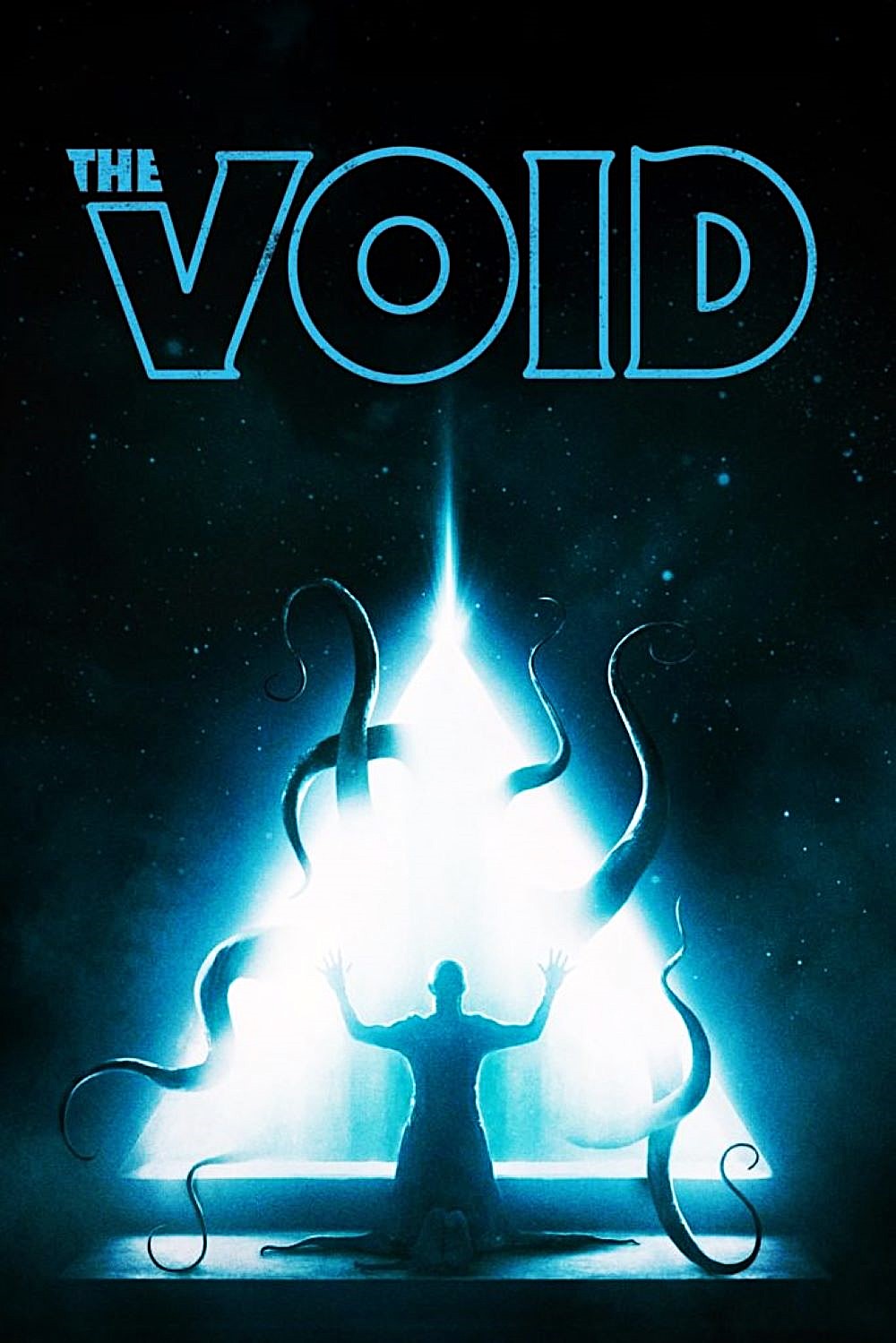
Steven Kostanski and Jeremy Gillespie’s The Void is a grisly, atmospheric plunge into Lovecraftian cosmic horror and John Carpenter-inspired body horror, set within a nearly abandoned rural hospital shrouded in eerie blue light and creeping shadows. The film expertly conjures anxiety and dread, as fragile boundaries between dimensions begin to dissolve, threatening to swallow all inside.
At the heart of the story is Deputy Sheriff Daniel Carter (Aaron Poole), whose weighty grief and fractured relationships drive his reluctant heroism. He stumbles upon a bloodied man and brings him to the hospital staffed by his estranged wife, Allison Fraser (Kathleen Munroe), a focused nurse haunted by their broken family. Dr. Richard Powell (Kenneth Welsh) looms as the villainous architect of the unfolding nightmare, his obsession with conquering death fueled by personal tragedy, twisting him into a leader of occult horrors.
The supporting characters—Vincent and Simon, survivors hardened by trauma; Maggie, a pregnant woman caught in the web of cosmic corruption; and Kim, a vulnerable young intern—saturate the siege narrative with survival-driven urgency. Though less developed than the leads, they embody the raw desperation and existential threat pervading the hospital.
The Void wears its influences on its sleeve, drawing heavily from the siege tension of John Carpenter’s Assault on Precinct 13 alongside the paranoia and isolation of The Thing. These classic Carpenter motifs—claustrophobic settings, unrelenting external threat, and mistrust among survivors—penetrate the film’s fabric, amplified by a synthesizer-driven score nodding to Carpenter’s sonic signature. The nightmarish body horror, occult elements, and grotesque practical effects owe much to Stuart Gordon’s work adapting Lovecraft’s stories, blending visceral horror with cosmic dread.
Yet, while the homage is clear and affectionate, the film sometimes falters by blending these iconic elements into a decoction that resists full cohesion. Instead of synthesizing the inspirations into an innovative whole, it assembles a patchwork—rich in style and atmosphere but struggling to commit to a coherent, fresh narrative. The mixture of Carpenter’s claustrophobic siege, Gordon’s visceral mythos, and the cultist horror trope occasionally feels like pastiche rather than a confident new voice.
The technical craftsmanship shines throughout. Practical effects—from mutated creatures to grotesque body transformations—are lovingly crafted and tactile, restoring a physicality often lost in digital horror. The cinematography and lighting accentuate the oppressive mood, favoring muted colors punctuated by blood-red and luminous blues, thinking as much about shadows as solid objects.
However, the film’s narrative and character work often leave something to be desired. While Carter’s arc of guilt and reluctant heroism is thematically resonant, key emotional beats suffer from underdevelopment, with his relationships, particularly with Allison, only superficially explored. Dialogue oscillates between exposition-heavy and clipped, hindering audience connection with the cast amid the unrelenting terror. The supporting characters serve primarily functional roles, their deeper motivations and backstories sacrificed for the sake of grim spectacle and escalating horror.
The climax descends into surreal, fragmented sequences that evoke fever dreams more than narrative resolution. This abstract finale, while visually striking, challenges viewers seeking clarity and can be polarizing: some will appreciate the cosmic horror tradition of unsolvable mysteries, while others may experience frustration with the loose plotting and ambiguity. Pacing reflects these shifts—building steadily in the opening act before devolving into frenetic, disjointed bursts that occasionally undermine tension.
Despite these narrative and pacing flaws, The Void remains a memorable experience for lovers of practical effects and cosmic horror texture. It’s a film rich with unsettling imagery and mood, capturing a form of existential terror that goes beyond cheap scares. The filmmakers’ love for classic horror runs deep, even if the resulting fusion occasionally feels like homage without full reinvention.
Ultimately, The Void is a dark, unsettling trip into the unknowable—a sonic and visual descent into a hellish siege where logic unravels and time shatters. It’s a film that prizes atmosphere and physical monstrosity over smooth storytelling, inviting viewers to surrender to dread rather than demand explanation. For fans of Carpenter’s minimalist tension, Gordon’s visceral adaptations, and the tactile nightmares of 80s horror, The Void offers a rewarding, though imperfect, journey into the cosmic abyss—an evocative invocation of terror where humanity is both survivor and prey.
“So it’s a fucking coin toss? That’s what 50 billion dollars buys us?” — Secretary of Defense Reid Baker
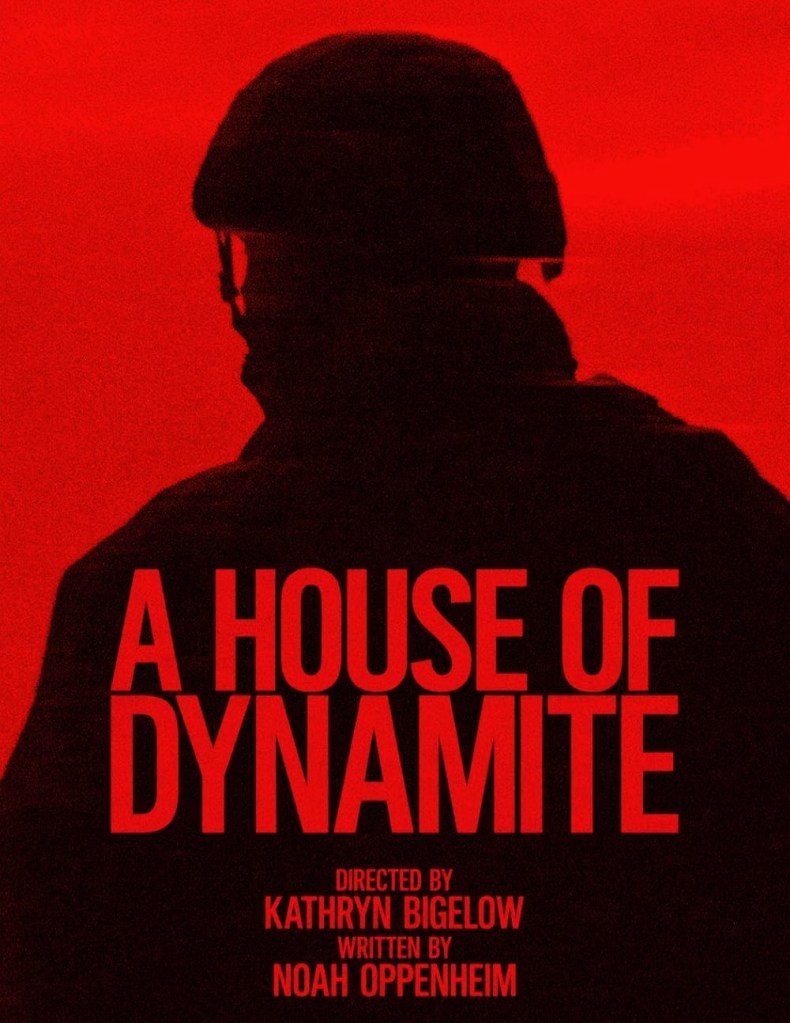
The end of the Cold War was supposed to close a chapter of fear. With the superpowers stepping back from the brink, the world briefly believed it had entered an era of stability. Yet that promise never held. The weapons remained, the rivalries adapted, and the global machinery of deterrence continued to hum beneath the surface. Kathryn Bigelow’s A House of Dynamite faces this reality head-on, transforming the mechanics of modern nuclear defense into something unnervingly human. On the surface, it plays as a high-tension political technothriller, but beneath that precision lies a deeply existential horror film—one built not on shadows or monsters, but on daylight, competence, and the narrow margins of human fallibility.
The premise is piercingly simple. An unidentified missile is detected over the Pacific. Analysts assume it’s a test or a glitch—another false alarm in a world overflowing with them. But within minutes, as conflicting data streams converge, what seemed routine begins to look real. The film unfolds in real time over twenty excruciating minutes, charting the reactions of those charged with interpreting and responding to the potential catastrophe. Bigelow divides the film into three interwoven perspectives: the White House Situation Room, the missile intercept base at Fort Greely, and the President’s mobile command aboard Marine One. The structure allows tension to grow from every direction at once, each perspective magnifying the other until the screen feels ready to collapse under its own pressure.
Capt. Olivia Walker (Rebecca Ferguson), commanding officer of the Situation Room, anchors the story with calm professionalism that gradually frays into disbelief. Ferguson’s performance is clear-eyed and tightly modulated—precise, disciplined, and quietly devastating. She stands as the rational center inside chaos, her composure the last gesture of control in a world that no longer follows reason.
Over her is Adm. Mark Miller (Jason Clarke), Director of the Situation Room, who represents the institutional embodiment of confidence. Clarke plays him with methodical restraint, a man who trusts procedure long after it stops earning trust. Miller’s authority is both comforting and horrifying: a portrait of leadership built on ritual rather than certainty.
At Fort Greely, Anthony Ramos brings an intimate immediacy as the officer charged with the missile intercept. His scenes hum with kinetic dread—the physical execution of decisions made thousands of miles away. Through him, the film captures the most primal kind of fear: acting when hesitation could mean extinction, knowing that success and failure are separated only by chance.
The President, portrayed by Idris Elba, spends much of the crisis in motion—first within the cocoon of the presidential limousine, and later, aboard Marine One as it carves through blinding daylight. Elba gives a performance of subtle, steady erosion. At first, he embodies unshakeable calm, a figure of poise and authority; but as the situation deepens, his steadiness wanes. Words become shorter, pauses longer. Every decision carries consequences too vast for resolution. It is a measured, understated portrait of power giving way to human uncertainty.
Bigelow’s direction is stripped of ornament and focused on precision. Barry Ackroyd’s cinematography heightens the claustrophobia of command centers—the sterile light, the reflective glass, the sense that every surface observes its occupants—while his exterior scenes pierce with harsh brightness, suggesting that no sanctuary exists under full exposure. Kirk Baxter’s editing maintains an unrelenting pulse, cutting with mathematical precision while preserving the eerie stillness of the moments where no one dares to speak.
A House of Dynamite also shows how even with the most competent experts—military, intelligence, and political—working to manage an escalating crisis, there is no path to victory. The professionals at every level stop seeking to prevent the worst and instead focus on saving what they can when the worst becomes inevitable. The film’s scariest revelation is not the potential for destruction, but the paralysis that intelligence creates. If the brightest, most disciplined people in the world cannot find an answer, what happens when power falls into the hands of those less prepared or less rational? In its quiet way, the film poses that question that we see more and more each day on the news and on social media and we are left with silence and realization of the horror of it all.
Despite its precision, the film isn’t without flaws. Bigelow’s triptych structure—cutting between the three perspectives—works brilliantly to escalate tension, yet the repetition of similar beats slightly blunts the impact. Each segment revisits the same crisis rhythms—a data discrepancy, an argument over authority, another uncertain update—sometimes slowing the natural momentum. While the repetition underlines the futility of bureaucratic systems in chaos, the transitions don’t flow as fluidly as the rest of the film’s airtight craftsmanship. The result is a film that is gripping overall, occasionally uneven in rhythm, but never less than absorbing.
When the final minutes arrive, Bigelow declines to deliver resolution. No mushroom clouds, no catharsis. The President sits in Marine One, head down with the weight of the world on his shoulders as he contemplates his options in the Black Book (options in how to retaliate) and knowing that he has no good choices in front of him. The world remains suspended between survival and oblivion, and the silence that follows feels heavier than sound. The ending resists closure because endings, in the nuclear age, are an illusion—the fear continues no matter what happens next.
In a year crowded with strong horror releases—Sinners, Weapons, The Long Walk and Frankenstein among them—A House of Dynamite stands apart. Dressed in the crisp realism of a technothriller, it’s a horror film defined by procedure, light, and silence. Bigelow builds terror from competence, from the steady voices and confident gestures of people trying to manage the unmanageable. This is not the chaos of fiction but the dread of reality, a reminder that the systems meant to preserve and protect might one day fail to deliver on its promise. For all its precision and restraint, A House of Dynamite shakes in the memory long after it ends—the year’s most quietly terrifying film.
Nuclear Close Calls: The situation and question brought up in the film has basis in history as there has been many instances of close calls and false alarms. The film itself doesn’t confirm that the missile detonated, but the implications in past confirmed events just shows how close the world has been to a completed catastrophe.
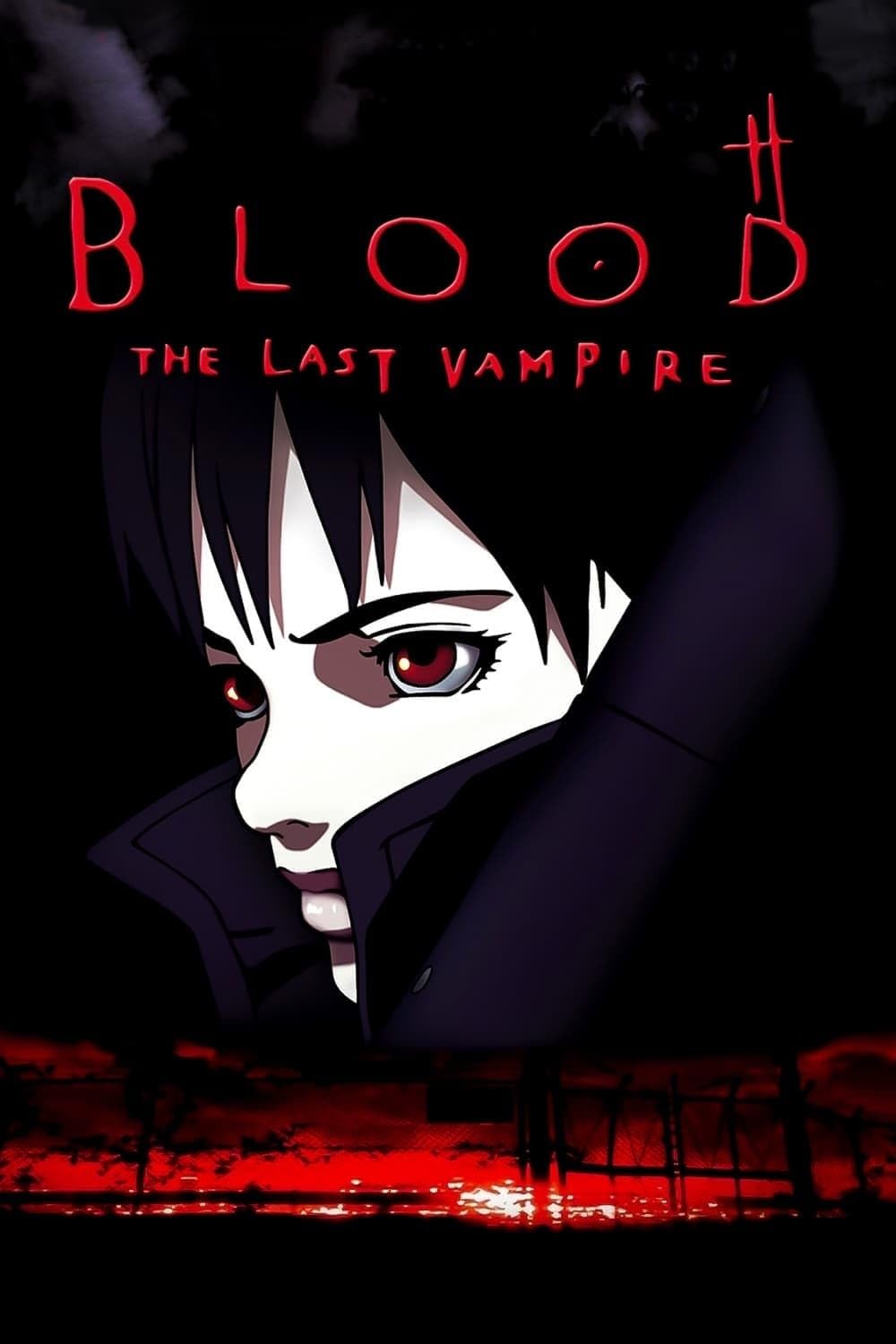
In 2000, Blood: The Last Vampire made quite an impact as a visually stunning and atmospherically intense anime horror film. It expertly combines military tension with supernatural thrills in a compact, sharply executed story. Directed by Hiroyuki Kitakubo and produced by Production I.G, this film helped define the vampire-action subgenre by delivering a haunting tale that’s as much about loneliness and identity as it is about monster hunting.
The story unfolds in 1966 at the Yokota U.S. Air Base in Japan, a setting infused with Cold War anxiety and the looming shadow of the Vietnam War. You follow Saya, a seemingly ordinary schoolgirl with a dark secret: she’s been enlisted by a secretive agency to hunt down bloodthirsty chiropterans—demons disguised as humans. Saya isn’t your typical vampire; she’s the last of her kind, wielding a katana with deadly precision while carrying the heavy burden of her immortal existence. Her cold, detached demeanor makes her an intriguing character, caught between humanity and monsterhood.
One of the film’s standout features is its incredible art and animation. Production I.G used a mix of traditional hand-drawn animation and early CGI to create a look that’s both detailed and immersive. In fact, James Cameron was an early fan, admiring the film’s innovative blend of 2D and 3D animation techniques that pushed technological boundaries to craft a visually striking experience. The backgrounds—military bases, grim hallways, and moody night scenes—feel tangible, while the fluid movements of the characters add grit and weight to every action sequence. The colors are muted but striking, with shadows dominating the frame and bold splashes of red that echo classic horror imagery.
While watching Blood: The Last Vampire, one can also spot clear influences from Western vampire horror, especially the live-action film Blade, which came out a few years prior, and the TV series Buffy the Vampire Slayer. The character of Saya shares traits with Buffy— a young, powerful woman wrestling with her role as a vampire hunter—melding gothic sensibilities with modern action heroine tropes. Director Hiroyuki Kitakubo has acknowledged in interviews that such Western influences, along with classic vampire literature like Dracula, shaped the film’s tone and character design. This fusion creates a uniquely cross-cultural vampire narrative that appeals broadly.
When it comes to horror, Blood goes for a raw, physical kind of fear rather than romanticized gothic vibes. Its monsters are grotesque and disturbing, bristling with sharp teeth and distorted faces. The fight scenes are swift and brutal, with blood sprayed in a way that’s more artful than gratuitous. The film wastes no time with filler; each moment serves to ramp up tension or deepen the mystery.
Saya herself is surprisingly well developed for such a short film. Her isolation and internal conflict give her depth beyond standard vampire tropes. You can sense the loneliness beneath her impassive exterior, along with a kind of weariness about her role as predator. Though the film leaves plenty unsaid, it effectively uses these shadows in the story to hint at a broader tragedy driving Saya on.
However, the film does have its drawbacks. Clocking in under 50 minutes, its brevity feels like a hindrance. The story’s short runtime leaves many threads underexplored, especially the wider world-building and deeper character background that fans of such a rich universe might crave. Some may find the pace hurried, with the narrative skimming over potentially fascinating lore and emotional beats. Additionally, Blood: The Last Vampire was mostly voiced in English, a decision by Production I.G. aimed at making the film more accessible to Western audiences. However, the English voice acting can be hit or miss, which may become distracting for anime viewers who prefer mostly Japanese voice acting with English subtitles.
Despite these flaws, the film’s soundtrack remains atmospheric and effective, supporting tension without overwhelming the visuals. The mix of Japanese and English dialogue fits the multicultural military setting, even if some performances falter.
Importantly, Blood: The Last Vampire served as a critical gateway for Western audiences at a time when anime was predominantly known through late-night broadcasts of child-friendly series like Sailor Moon and Dragon Ball Z. As one of the few adult-themed, violent anime films to achieve mainstream success in the West, it opened the door for a wider acceptance of mature anime stories. This paved the way for major franchises such as Attack on Titan and Demon Slayer, which have become some of the biggest and most influential anime series worldwide over the last 25 years.
Over time, Blood: The Last Vampire has gained a devoted cult following and inspired sequels like Blood+ and Blood-C, as well as live-action adaptations. Yet few have matched the original’s moody atmosphere and stylistic innovation.
All in all, Blood: The Last Vampire is a memorable and gripping piece of horror anime. It skillfully blends postwar unease, body horror, and existential themes into a sleek, powerful package that leaves a lasting impression. Whether you’re a fan of vampire tales, Japanese gothic horror, or intense animated action, this film proves that you don’t need hours to make a horror classic. It’s short, sharp, and packs a serious punch. It may not have delivered on every narrative promise, but its innovative visuals and haunting tone secure it as a must-watch for genre enthusiasts.
“You cannot win a nuclear war! Now just suppose the Russians win this war… What exactly would they be winning? All major centres of population and industry would have been destroyed. The Russians would have conquered a corpse of a country.” — Peace Speaker
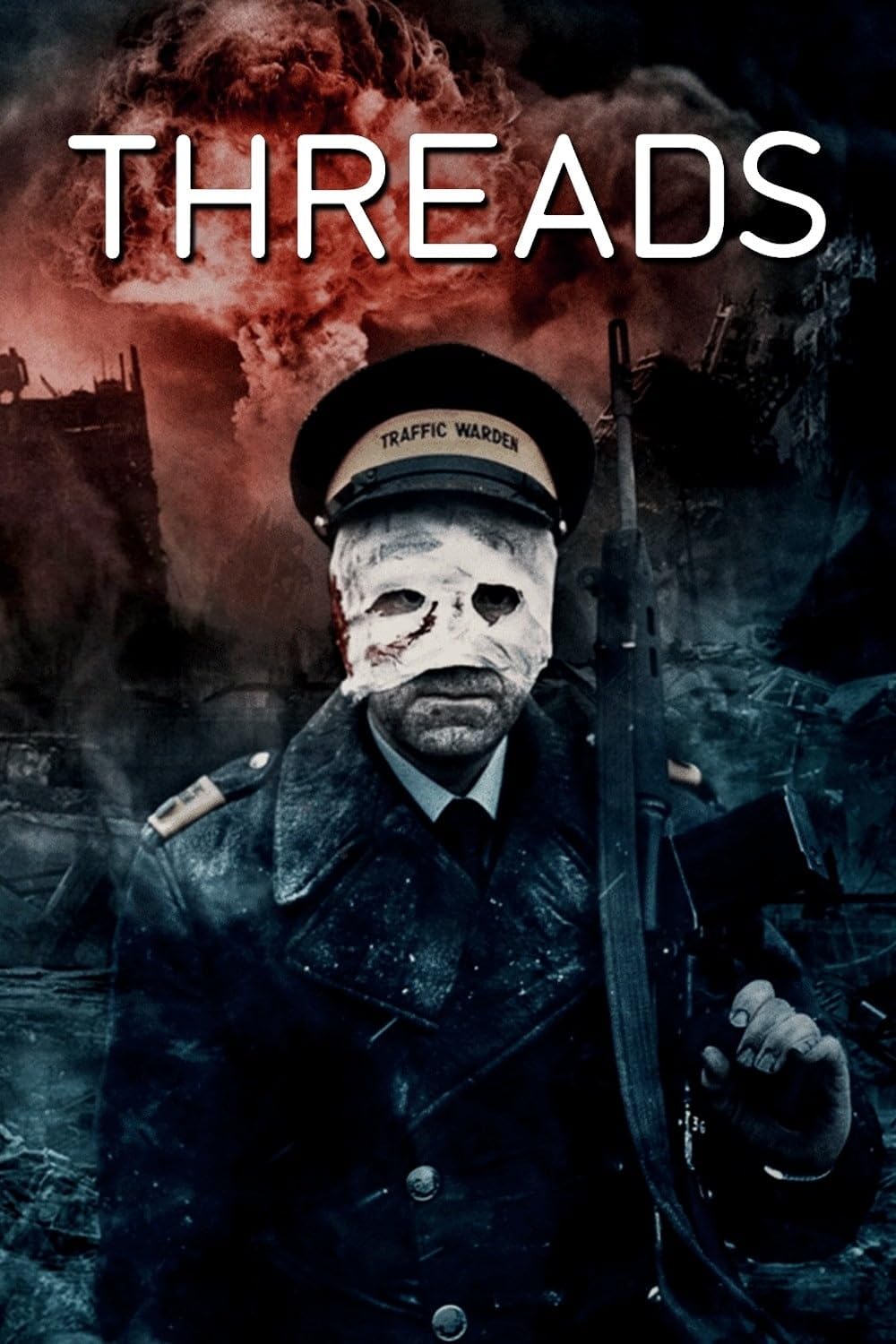
Mick Jackson’s Threads remains one of the most devastating and singular experiences in the history of horror cinema. Made for British television in 1984, it presents the end of the world without spectacle, sentiment, or escape. It is horror pared down to elemental truth—an autopsy of civilization staring directly into the void. What it reveals isn’t an invasion or a curse but something far more intimate and plausible. The apocalypse here is homemade.
The film’s dread begins in familiarity. Sheffield in the early 1980s looks ordinary, even dull. We meet young people planning families, moving furniture, going to work. Everyday life rolls forward in its small, reassuring cycles. But the news keeps playing in the background, and the background starts to change. Political tension builds quietly, buried inside the calm language of diplomacy and deterrence. The repetition of these news bulletins—so mundane at first—becomes unnerving because this is precisely how horror entered real life during the Cold War: through information, not imagination. The end of all things doesn’t announce itself with thunder or sirens. It arrives exactly the way it did in history—through headlines, warnings, updates, and comfortable denial.
What makes Threads so frightening is that it removes the supernatural shield that most horror films rely on. There are no vampires in the night, no zombies clawing at the door, no ancient curses waiting for foolish mortals to uncover. The threat here is invisible, mathematical, already built into the fabric of daily existence. The horror is bureaucratic and omnipresent: wires humming, missiles waiting, politicians rehearsing meaningless statements. Jackson’s approach traps viewers in the reality that haunted the Cold War decades—the understanding that extinction wasn’t a mythic event but a possibility hanging over breakfast tables and factory shifts alike. The monsters were human hands resting on launch buttons.
When the bombs finally fall, the destruction plays out without warning or beauty. The light is so intense it erases faces, streets, even color itself. There’s no music to prepare the viewer, nothing to stylize the moment. It looks less like cinema than an interference signal—white noise flooding the world. And when the noise fades, time stops. The air is grey and silent. This is where every cinematic idea of horror—jump scares, final girls, raging beasts—collapses. What’s left isn’t fiction but aftermath. Humanity’s extinction is not delivered by some otherworldly force. It’s the logical consequence of its own inventions.
In the post-blast silence, Sheffield turns into a landscape of wandering ghosts—ordinary people stripped of memory and meaning. The city becomes an enormous grave where speech and thought slowly decay. Threads spends the rest of its running time documenting how civilization erodes, not in minutes but in years. Crops fail, radiation poisons the newborn, and eventually language itself thins out until the survivors grunt out half-words. Watching it feels like witnessing evolution run backward. And all of it happens without villains or intent. The horror is simply that there’s no one left to blame, only ashes where institutions used to be.
That’s the heart of what makes Threads such a distinct kind of horror film. Its terror isn’t supernatural but logistical. The Cold War, for all its abstract politics, becomes the perfect horror setting because its apocalypse was designed, built, and maintained by bureaucrats and citizens who believed they were preserving peace. The film internalizes that historical anxiety and turns it against the viewer. Watching it now reveals how modern the fear remains—the quiet knowledge that our existence can still be undone by systems we built and barely understand.
This level of realism transforms ordinary images into nightmare language. The gray sky, the still streets, the cracked glass—all look completely real because they are. The production relied on weathered locations, handheld cameras, and non‑actors to erase any cinematic polish. That choice doesn’t just increase believability; it removes emotional distance. The audience isn’t safe behind the screen. It’s the same realism people felt in their bones during the Cold War years when the thought of nuclear annihilation hung above every ordinary activity—from going to school to buying groceries. Threads doesn’t invent horror; it recalls one that was already shared by millions, a psychological climate instead of a plot.
What follows after the detonation is not chaos in the traditional sense, but entropy. The world doesn’t explode; it unravels. Government collapses in slow motion, social order dissolves quietly, and hunger becomes the only law. By the time years have passed and humanity has regressed to primitive barter and suspicion, viewers understand that the true monster in Threads isn’t radiation or politics—it’s the continuity of existence stripped of meaning. The worst possible outcome is survival without civilization. Every journal entry and every voice-over that marks the passage of years feels like the universe keeping record of its own disappearance.
The film’s tone never changes. It stays cold, methodical, and precise, as if narrated by the last bureaucrat left alive. That neutrality becomes unbearable after a while, more suffocating than screaming terror. The dispassionate narration reporting the number of dead or the decline in literacy level is as unnerving as any demonic whisper. It’s the voice of civilization reduced to an algorithm, describing its own end with perfect grammar. That was perhaps the truest evocation of Cold War horror imaginable: the notion that when the world ended, it would sound exactly like a news broadcast.
For all its austerity, there’s also a strange poetry in Jackson’s imagery. The empty fields where ash falls like snow, the distant hum of wind through broken windows, the silhouettes trudging through a gray dusk—they linger like haunted photographs. It feels less like humanity has died than that it has become part of the landscape. The apocalypse in Threads isn’t theatrical fire but the slow bleaching of everything living. In a way, it makes the viewer complicit: this is what our collective imagination produced when fear became policy.
The final scene still carries the force of a psychological detonation. The young woman who has grown up in this ruin gives birth to a stillborn child, the last link of continuity severed. There’s no dialogue, no reaction—just a freeze-frame that seems to suspend time at its bleakest point. For a moment, the world stops existing altogether. Few films end so harshly, with no fade‑out or reflection, because Threads doesn’t need metaphor. It closes the loop on its own warning: the horror never came from outside, it came from within—from the quiet machinery of our collective choices and the weapons we built to enforce them.
Seen today, Threads remains deeply relevant because the foundation of its terror hasn’t disappeared. While new anxieties have replaced the Cold War, the sense of self-made extinction still lingers. Watching it feels like eavesdropping on a civilization rehearsing its own burial. Its power lies in showing that the apocalypse isn’t cinematic fantasy. It’s civic policy, historical precedent, and shared human guilt wrapped into the shape of a mushroom cloud. The film’s real horror is how close it remains.
Threads exposes the simplest and most terrifying truth of horror: that sometimes there is no invader, no contagion, no supernatural imbalance waiting for correction. There is only us. The apocalypse that consumed Sheffield was never distant or mythic. It was the reflection in the mirror, the sound on the news, the thing every citizen of that decade tried not to think about while going about ordinary life. That proximity—horror without distance—makes the film feel eternal. It tells us that the end of the world has always been near, not because of monsters waiting outside the window, but because of everything we’ve built inside it.
“You want to shoot me, go ahead. It won’t matter. I’ve seen things you wouldn’t believe.” — The Stranger
The Western Wound: Horror, History, and the Haunting of Frontier Mythology
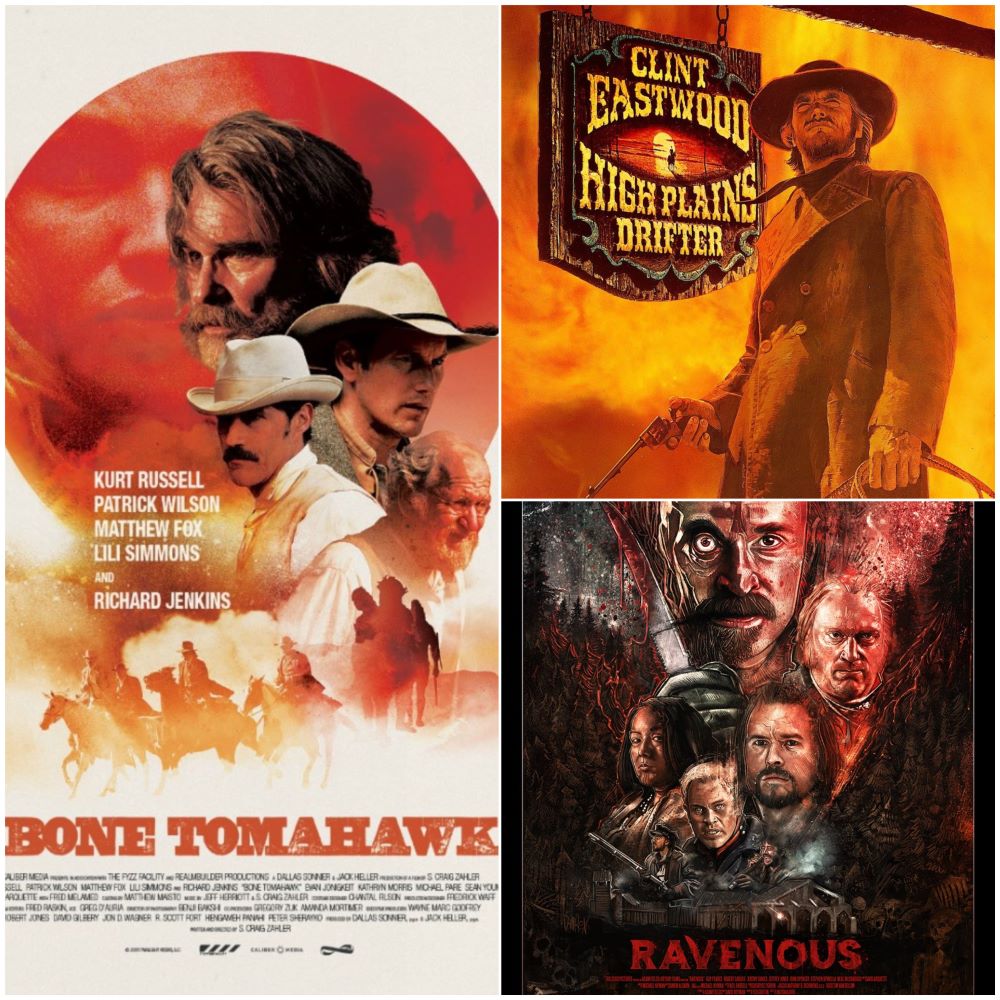
Horror profoundly shapes, distorts, and reframes the American Western, complicating familiar narratives of lawmen and outlaws with the uncanny specter of trauma, dread, and evil. Few films demonstrate this transformation more powerfully than Ravenous (1999), Bone Tomahawk (2015), and High Plains Drifter (1973). These three Westerns push beyond genre conventions, leveraging horror’s capacity to unsettle, destabilize, and haunt—creating experiences that are as philosophically provocative as they are viscerally unsettling. Rather than merely incorporating horror aesthetics into a Western setting, each film employs horror as a core thematic device to interrogate violence, community, morality, and the dark legacies of frontier expansion.
The Haunted Frontier: Atmosphere and the Specter of Evil
High Plains Drifter’s isolation in the arid Nevada desert is more than a physical setting; it externalizes the moral barrenness and guilt festering within the town of Lago. The oscillation between relentless sunlight and dense fog creates a hallucinatory space where natural laws are suspended, and supernatural retribution manifests. Central water imagery—the fog rolling off the lake, the lake itself—serves as a liminal zone, symbolizing the boundary between life and death, past and present, justice and vengeance. The Stranger’s spectral emergence from the desert heat haze hints at his otherworldly nature, turning the town’s landscape into a haunted battleground where redemption is elusive and suffering endemic.
Ravenous’s setting in the snowy Sierra Nevada mountains during the Mexican-American War imbues its horror with claustrophobic dread. Fort Spencer’s remoteness in the face of towering, hostile peaks and unrelenting winter transforms the natural environment into a gothic prison. This wilderness is both physical and psychological, oppressive in its vastness and merciless in its cold. The film uses this setting to amplify the existential terror wrought by cannibalism, suggesting an inescapable cycle of consumption where survival becomes monstrous. Deep shadows, filtered natural lighting, and long quiet scenes evoke dread as much as extreme violence.
In Bone Tomahawk, the stark, sunbaked deserts and towering rock formations of the American Southwest form an ominous landscape embodying ancient and unknowable horror. The frontier town is a fragile outpost at civilization’s edge, surrounded by a wild, menacing wilderness. The deep canyons serve as metaphorical gateways to past atrocities, echoing the silent histories of indigenous trauma and colonial violence. The oppressive silence and vastness underscore humanity’s diminutiveness and vulnerability, while the jagged terrain symbolizes the harshness of both nature and history’s brutal forces.
Monstrous Transformation: The Horror Within
The Stranger in High Plains Drifter manifests the blurring boundaries between justice and vengeance, heroism and monstrosity. His actions—including an unsettling rape scene—force a confrontation with the darkest aspects of human nature, showing how violence corrupts even those who claim righteousness. His ghostly status and ruthless methodology suggest he is a representation of collective guilt made tangible, punishing the town’s sins with otherworldly finality. The film invites viewers to question whether vengeance restores balance or merely perpetuates horror.
In Ravenous, cannibalism literalizes the primal urge to consume not only flesh but identity and sanity, transforming survivors into monsters. The character Ives, charismatic and terrifying, embodies this transformation, seducing others into a vortical descent of brutality. The film’s psychological horror arises from the contagion of hunger and madness, the breakdown of social and moral order amid desolation. It probes existential questions about survival, morality, and the dissolution of self.
Bone Tomahawk depicts transformation through the confrontation with an ancient, savage tribe whose brutality transcends ordinary human evil. The characters’ exposure to this primordial terror strips away civilized facades, forcing characters and viewers to acknowledge the latent barbarity within humanity. The film’s horror is both external—in the violent acts of the tribe—and internal—in the psychological unravelling of the rescue party. This duality highlights the wilderness as both physical terrain and psychic landscape of primal fear.
The Community and the Failures of Civilization
The communal failure in High Plains Drifter reveals how collective cowardice and betrayal corrupt society. Lago’s townsfolk enable the marshal’s murder and face the Stranger’s supernatural justice as a consequence. Their moral bankruptcy transforms the town into a cursed locus of horror, symbolizing how collective sin corrupts the social fabric and invites ruin.
Ravenous portrays community breakdown within the remote outpost, where isolation breeds paranoia, selfishness, and violence. The collapse of trust and order mirrors the broader failure of frontier society to contain human baseness under extreme conditions, suggesting society itself is a fragile construct vulnerable to collapse.
In Bone Tomahawk, the fragile rescue party embodies the precariousness of social cohesion facing profound evil. Their doomed mission stresses how thin the veneer of civilization is, shattering under pressure from ancient horrors. The film critiques assumptions of order and control, emphasizing the ease with which human society can crumble.
Violence, Justice, and the Ethical Horror
Violence in High Plains Drifter is unending, spectral, and morally ambiguous. The Stranger’s vengeance refuses neat closure, illustrating cycles of violence that leave deeper scars rather than justice. The film redefines violent retribution as torment, destabilizing conventional heroic narratives.
Ravenous entwines violence with survival horror and existential dread. The ritualistic cannibalism is a metaphor for moral and spiritual corrosion, forcing characters and audiences to face the horrors wrought by the primal fight for survival at civilization’s edge.
Bone Tomahawk presents violence as slow, ritualistic, and ancient—an elemental force indifferent to human ethics. Its stark, realistic depiction immerses viewers in fear and helplessness, rejecting conventional catharsis and highlighting the terror of primal brutality.
Subtext and Symbolism: Horror as the Depths of Humanity
High Plains Drifter blends ghostly and surreal imagery to explore unresolved sin and cultural guilt. The Stranger is both avenger and specter of collective trauma, with symbolic elements—such as the red-painted town and unmarked graves—that deepen the meditation on punishment and desolation.
Ravenous uses cannibalism and wilderness as symbols of consumption and destruction intrinsic to frontier expansion. Horror here reflects existential struggles with survival, cultural annihilation, and moral ambiguity, set against an environment of engulfing nature and history.
Bone Tomahawk evokes frontier horror as a metaphor for repressed histories and cultural erasure. The savage tribe symbolizes ancestral trauma, while the desolate landscapes underscore the lingering presence of buried horrors that haunt the Western imagination.
The Western Genre as a Wound Haunted by Horror
Ravenous, Bone Tomahawk, and High Plains Drifter deepen the Western genre’s reckoning with violence, morality, and civilization’s fragility. Ravenous allegorizes hunger and expansion’s destructive appetite through cannibalism, revealing survival’s costs to identity and culture. Bone Tomahawk exposes historical violence and trauma encoded in landscape and myth, demonstrating Western justice’s limits. High Plains Drifter dramatizes unresolved guilt and vengeance through spectral retribution, challenging sanitized Western heroism.
The films’ central horrors—the Stranger’s merciless vengeance, the cannibal’s transformative hunger, and the doomed rescue mission into darkness—serve as meditations on violence, communal complicity, and the absence of redemption. They unmask the American West and America itself as terrains haunted by deep, unresolved sins and moral ambiguity. In marrying supernatural and psychological horror, these films offer a complex, layered critique of frontier myth, turning the Western from a tale of conquest into a haunted narrative of trauma, survival, and moral reckoning.
Supernatural vs Psychological Readings
High Plains Drifter uniquely embodies ambiguity between supernatural revenge and psychological torment. The Stranger’s ghostlike qualities and resurrection to avenge his murder firmly anchor a supernatural interpretation. His eerie manifestations—such as the bullwhip’s sound triggering vivid nightmares and his mysterious appearance from the desert heat—signal a spectral force beyond human comprehension. Yet, on a psychological level, the Stranger can be viewed as the materialization of the town’s collective guilt and suppressed trauma. This duality enriches the narrative, allowing viewers to interpret the horror as either literal supernatural vengeance or a psycho-spiritual reckoning of internal moral collapse.
Ravenous blurs supernatural and psychological horror by mixing the tangible terror of cannibalism with metaphysical dread. The figure of Ives carries almost mythic qualities—his charismatic yet monstrous presence suggests an otherworldly evil, a contagion consuming the souls of men. The mountain wilderness functions as a liminal space transcending reality, where madness and primal urges surface. This ambiguity invites readings of the horror as both external supernatural curse and internal psychological disintegration, reflecting survival’s dehumanizing cost amidst isolation and guilt.
Bone Tomahawk grounds itself mostly in realistic terror but invokes mythic supernatural threads through the savage tribe’s almost fantastical menace. Their brutal, ritualized violence carries residues of ancestral curses and primal fears that exceed mere human malevolence. The film explores psychological horror through the characters’ terror and helplessness confronting an unknowable evil, making the wilderness and tribe a metaphor for the abyss of human and historical trauma. Thus, horror emerges as both a tangible threat and a psychological abyss threatening identity and sanity.
This interplay of supernatural and psychological horror amplifies these films’ thematic depth. By refusing to confine horror to one domain, they portray the Western frontier as a space haunted simultaneously by ghosts—whether spiritual, historical, or personal—and inner demons manifesting as guilt, fear, and madness.
Ultimately, horror in these Westerns is not merely a matter of frightening events but a profound engagement with unsettled histories and psyches. This dynamic makes their terror resonate long after the screen fades to black, marking the Western as a genre haunted not only by outlaws and the wilderness but by the specters within us all.
Horror profoundly alters the Western genre’s narrative, revealing it as a cultural wound, a landscape haunted by the ghosts of its own violent history and moral contradictions. By challenging sanitized myths and exposing the fragility beneath civilization’s veneer, Ravenous, Bone Tomahawk, and High Plains Drifter not only frighten but provoke deep reflection on the legacies of violence and the nature of justice itself—capturing the horror at the heart of the American story.
“Don’t count on me to make you feel safe.” — The Stranger
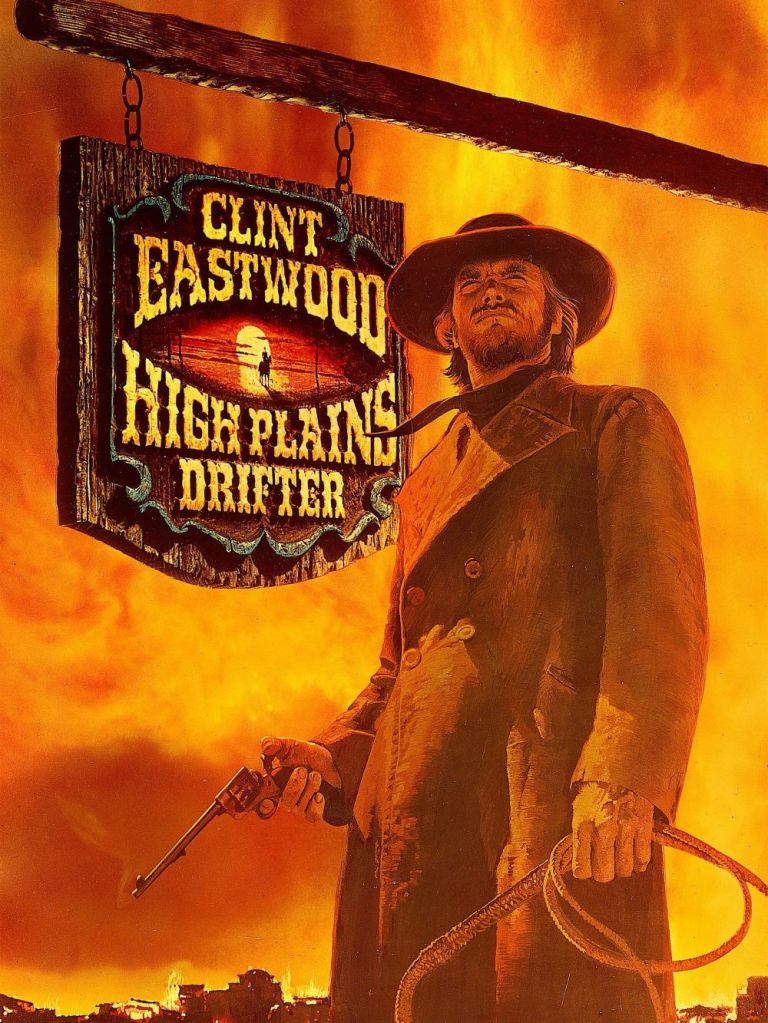
High Plains Drifter stands as one of the bleakest, most enigmatic entries in Clint Eastwood’s filmography—a Western that bleeds unmistakably into the realms of psychological and supernatural horror. This 1973 film is not just another dusty tale of lone gunfighters and frontier justice. It’s a nightmare set in broad daylight, a morality play whose hero is more monster than man.
Eastwood’s Stranger comes riding into the town of Lago from the shimmering desert, a silhouette both akin to and apart from his famed Man With No Name persona. The townsfolk are desperate, haunted by fear—less afraid of imminent violence, more of the sins they’ve half-buried. This is a place where a lawman was brutally murdered by outlaws while the townspeople looked away, their silence paid for with cowardice and greed. When the Stranger assumes command, he does so with often-gleeful sadism—kicking people out of their hotel rooms, replacing the mayor and sheriff with the dwarf Mordecai, and ordering that the entire town be painted red before putting “Hell” on its welcome sign.
There’s a surface plot: the Stranger is hired to protect Lago from the same three outlaws who once butchered its marshal. But he’s there for far more than that. The story unspools through dreamlike sequences, flashbacks that suggest the Stranger may well be an avenging spirit or a revenant—the dead lawman, spectral and merciless, returned to claim what the townsfolk owe to Hell itself.
The horror here isn’t about jump scares or gothic haunted houses. The supernatural lurks everywhere and yet nowhere. The Stranger moves with the implacable calm—and violence—of a slasher villain, transforming Lago into his personal stage for retribution. His nightmares, full of images of past atrocities, are painted with the same vivid brutality as the daytime violence. Eastwood’s use of silence, the squint of a face, the twitch of a pistol replaces musical cues in amplifying dread. The sound design evokes otherness—a howling wind, footsteps echoing across empty streets—that builds a shadow of terror around the Stranger’s presence.
This violence is hurried and brutal; its sexual politics unflinching. When the Stranger enacts revenge, he punishes not just the outlaws, but the townsfolk complicit in their crimes. There is little comfort in his sense of justice—the pleasures he takes border on sadistic. The film’s moral ambiguity cuts deeper than most Westerns or horrors: this is not a clear-cut tale of good versus evil, but a brutal reckoning of collective guilt, cowardice, and corruption.
Lago itself acts almost like a town stuck in purgatory—a holding pen between redemption and eternal damnation. The infamous “Welcome to Hell” sign the Stranger paints at the town’s entrance serves as a grim message. It’s no welcome to law and order, but a symbolic beacon to the very outlaws the Stranger is hired to confront, suggesting that Lago is a place where sin festers and punishes itself. The town’s dance with Hell is both literal and metaphorical. The inhabitants aren’t just awaiting judgment; they have invited it in their desperate attempts to hide their cowardice and greed under the guise of civilization.
This notion of Lago as purgatory stands in sharp contrast to other recent horror Westerns, which serve as prime examples of the genre’s thematic spectrum. These films tend to focus on the primal terror of nature barely held at bay by the fragile veneer of civilization the settlers claim. They pit human beings against the ancient, untamed forces of the wilderness—whether monstrous creatures or surreal phenomena—emphasizing that the supposed order and progress of the West remain fragile and constantly threatened. This dynamic symbolizes the uneasy balance between civilization’s reach and nature’s primal power, often revealing how thin and tenuous that barrier truly is.
Among these, Bone Tomahawk and Ravenous stand out as vivid examples. Bone Tomahawk confronts menacing cannibals lurking in the wild, reminding viewers that the West’s order is fragile and under perpetual threat from untamed wilderness. Ravenous uses cannibalism and survival horror as metaphors for nature’s savage predation hidden beneath the polite façade of civilization—nature’s horrors masked but not erased.
By contrast, High Plains Drifter directs its horror inward, exposing the corruption that manifest destiny imposed on settlers themselves. Instead of fearing nature as an external force, the film presents settlers as haunted by their own moral failures and complicity in violence and betrayal. The Stranger’s vengeance is a reckoning with the darkness festering inside the community, a brutal meditation on guilt, collective cowardice, and the price of greed disguised as progress.
Eastwood’s film strips away the mythic promises of the American West as a land of freedom and opportunity, revealing instead the brutal reality of communities locked in complicity, violence masquerading as justice, and the moral rot at the heart of manifest destiny. This moral ambiguity and psychological depth give High Plains Drifter a unique position in the horror Western subgenre, elevating it beyond simple scares to a profound exploration of American cultural myths.
The Stranger is not a traditional hero but a spectral judge, embodying divine or supernatural retribution. His calm yet ruthless punishment exposes the cruelty, cowardice, and malevolence within Lago’s population, meting out a justice that is neither neat nor forgiving. His supernatural aura and sadistic tendencies make him an unforgettable figure of terror and fate.
Visually, the film’s harsh daylight contrasts with the romanticized Western landscapes of earlier films. Instead of shadows hiding evil, blinding light exposes the town’s moral decay. Characters are reduced to symbols of greed, fear, and cruelty, highlighting that the true horror lies within human nature and the failure to uphold justice.
High Plains Drifter operates on multiple levels—a Western, a ghost story, a horror film, and a dark morality play. It is a relentless meditation on justice and punishment and a dismantling of the traditional Western hero myth. Through layered narrative, stark visuals, and Eastwood’s chilling performance, it remains an essential entry in the horror Western canon.
For those seeking a Western that doesn’t just entertain but unsettles and challenges, High Plains Drifter offers an unforgiving descent into darkness. It strips away the comforting myths of the frontier and exposes the raw, rotting core beneath. Unlike other modern horror Westerns such as Bone Tomahawk and Ravenous, which confront external terrors lurking in the wilderness, this film turns its gaze inward—on the moral decay, guilt, and violence festering within the settlers themselves. It’s a brutal, haunting reckoning, and Eastwood’s Stranger is the cold, relentless agent of that reckoning. This is a journey into a hell both literal and psychological, where justice is merciless and safety is a long-forgotten promise.
“What is sacred to a bunch of goddamned savages ain’t no concern of the civilized man! We got permission!” — Buddy
Bone Tomahawk (2015) begins in quiet dread. A still horizon, the whisper of wind across rock, a hint of bone under the dust—the American frontier looms like an unfinished thought. This silence sets the tone for S. Craig Zahler’s remarkable debut, a film that wears the form of a Western only to strip it down to nerve and marrow. It’s a story of decency under siege, of men pushing past the last borders of civilization and discovering that what lies beyond is not the unknown, but the origin of everything they thought they’d overcome.
At first glance, the premise seems familiar. When several townspeople vanish from the small settlement of Bright Hope, Sheriff Franklin Hunt (Kurt Russell) leads a rescue expedition into the desert. Riding with him are three others: the injured but determined Arthur O’Dwyer (Patrick Wilson), whose wife has been taken; his tender-hearted deputy, Chicory (Richard Jenkins), whose chatter and old-fashioned kindness soften the film’s bleak austerity; and the self-assured gunman John Brooder (Matthew Fox), a man equal parts gallant and cruel. Together, they represent the moral cross-section of a civilization still trying to define itself—duty, love, loyalty, arrogance.
Their journey outward becomes one of inward descent. Zahler’s script unfolds at a deliberate pace, steeped in stillness and exhaustion. The first half moves like ritual—meandering conversations, humor worn thin by weariness, the small comforts of campfire fellowship flickering against the vast emptiness around them. It’s here that Bone Tomahawk begins its slow transformation. What starts as a rescue Western gradually becomes something deeper and older. By stripping away the romance of exploration, Zahler reveals the frontier not as a space of discovery, but as a place of reckoning—a mirror of the instincts civilization pretends to have tamed.
The film’s most haunting element is its portrayal of the so-called “troglodytes,” the mysterious group believed to be responsible for the kidnappings. They are less a tribe than an incarnation of the wilderness itself—nameless, wordless, and utterly beyond cultural translation. Covered in ash, communicating through the eerie hum of bone instruments embedded in their throats, they seem less human than ancestral, as though the land itself had dragged them upward from its own depths. Zahler refuses to frame them anthropologically or politically; instead, they represent the primal truth the American frontier sought to bury under its myths of order and progress.
Western films, for more than a century, have mythologized the wilderness as an external force—something to conquer. But the “troglodytes” in Bone Tomahawk feel like the soil’s memory of what came before conquest: the savage necessity that built the very myths used to conceal it. They are the frontier’s unspoken ancestry—what remains after all the churches, taverns, and codes of decency are stripped away. Civilization needs them to remain hidden in the canyons, out of sight and unspoken, because their existence contradicts everything the polite narrative of the Old West stands for. They are what progress denies but cannot erase.
Zahler’s restraint strengthens this allegory. He shoots the desert not as backdrop but as evidence—a geographical wound extending beyond the horizon. The wilderness looks stunning but predatory, its stillness full of threat. Even when the posse’s odyssey is free of immediate danger, there’s the growing sense of being consumed: by the sun, by exhaustion, by the quiet knowledge that the world they’re riding into has no use for their notions of law and virtue. Civilization, here, is a pocket of light surrounded by something much older and hungrier.
That hunger, the need to conquer and consume, connects Bone Tomahawk to its spiritual predecessor, Antonia Bird’s Ravenous (1999). Bird’s film transformed the Donner Party’s historical ghosts into an allegory of Manifest Destiny, equating cannibalism with American expansion—the act of devouring land, life, and self under the guise of progress. Zahler continues that lineage with deliberate starkness. For him, violence in the frontier isn’t just literal; it’s foundational, the unacknowledged currency of civilization. Where Ravenous expressed its critique with mordant humor, Bone Tomahawk speaks in solemn tones, observing how every civilized act—the enforcement of law, the defense of home—rests upon the refusal to see what was consumed to create it.
The “troglodytes” embody that refusal incarnate. They are not villains in the traditional sense; Zahler grants them no ideology or explanation, only the primal fact of their survival. In doing so, he flips the Western’s moral equation: the barbarians at the edge of civilization are not invaders, but reminders of its origins. They are ghosts of the violence that founded the frontier, the unspoken proof that the West was never as far from savagery as it claimed. To look upon them is to glimpse the beginning—the raw, lawless reality America buried beneath the idea of itself.
Kurt Russell, magnificent in his restraint, anchors this tension. His Sheriff Hunt evokes a fading kind of decency: measured, fair, and unwavering even in futility. Russell plays him not as a Western hero but as a man committed to honor in a world that no longer rewards it. His calm authority softens only around those he loves and hardens in the face of what he doesn’t understand. In that measured decency lies the film’s aching question: what happens when morality meets something that does not recognize it?
Patrick Wilson’s O’Dwyer embodies faith’s physical agony—a man driven by devotion, limping through a landscape that punishes his determination. Richard Jenkins provides heart and subtle tragedy; his rambling, almost comical musings on aging and loneliness become the story’s moral texture, the sound of humanity scraping against extinction. And Matthew Fox, in his most precise performance, gives voice to the arrogance of the civilized killer—a man who fashions violence as virtue, believing his elegance excuses his cruelty.
Together, the four men form a living cross-section of the West’s moral mythos. Their journey exposes how fragile those ideals become once separated from the safety of town limits. They embody the dream of order confronting the truth of chaos—and the cost of looking too long into the void beyond it.
Zahler’s filmmaking is remarkably self-assured for a debut, and what stands out most is his willingness to trust stillness. There is no manipulated rhythm, no swelling score to guide emotion. The soundscape is shaped by wind, hoofbeats, crackling fires, and quiet voices rattled by exhaustion. The silence itself becomes a spiritual presence, pressing down on the travelers until conversation feels like resistance. Each scene builds tension not through action, but through waiting—the dread of what remains unseen, what civilization has pretended not to hear.
The violence, when it erupts, is unforgettable. Zahler does not linger voyeuristically, yet the weight of what happens lands with moral precision. The horror feels earned—an eruption of the primal into the civilized. Its purpose is not to shock, but to remind: the line between the men of Bright Hope and the people they fear is thinner than they want to believe. The frontier, as Zahler presents it, is not an untouched wilderness but the graveyard of an ongoing denial—the myth of progress stacked atop the bones of the devoured.
In that way, Bone Tomahawk moves beyond the idea of genre blending. It is not merely a “horror Western,” but a meditation on how those two sensibilities spring from the same source. Both depend on the confrontation between safety and the unknown, belief and disbelief. Both are rituals of fear, structured to reassure yet always at risk of unveiling the truth. Zahler’s greatest achievement is the way he strips away that reassurance. By the film’s final stretch, the promises of civilization—hope, faith, righteousness—have been exposed as fragile constructions built atop an ancient void.
And yet, through all its darkness, Zahler allows a flicker of grace. The film’s humanity endures in small gestures: a conversation interrupted by laughter, a hand extended in kindness, the stubborn persistence of dignity in impossible circumstances. Bone Tomahawk never preaches or offers catharsis, but it does something harder—it bears witness. It shows men maintaining decency not because it protects them, but because it defines them. In that endurance lies the film’s quiet heartbeat.
Like Ravenous before it, Bone Tomahawk reimagines cannibalism and frontier brutality not as aberrations, but as mirrors reflecting a truth about the American project: that every step westward demanded erasure, and that what was erased refuses to stay buried. The “troglodytes” linger not only in the canyons but within the culture that feared them—proof that civilization’s polish has always covered the rough, enduring shape of appetite.
By the end, what remains is not revelation or redemption, but silence—the kind that comes after myth collapses. Zahler’s film leaves its characters and viewers alike to confront the space where civilization ends and something older begins. The desert remains untouched, vast and timeless, holding the secret at the center of all Western stories: that progress has always been haunted by the primitive, that the world we built never left the wilderness—it merely disguised it.
Measured, brutal, and strangely tender, Bone Tomahawk stands as both a reclamation and an undoing of the Western myth. It listens to the echoes of the Old West and answers them not with triumph, but with reckoning. In its dust and silence lies a truth older than law or legend: civilization may light its fires, but there will always be something in the dark watching, waiting—the part of us it never truly left behind.
“Morality… is the last bastion of a coward.”— Colonel Ives
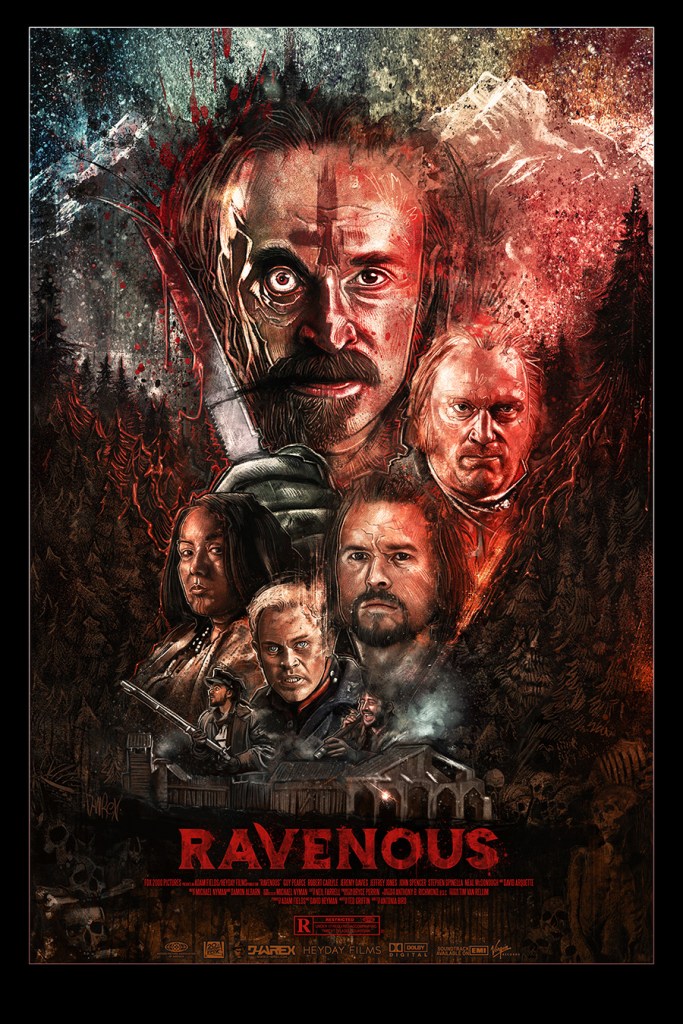
Ravenous remains one of the most fascinating and thematically daring horror films of the late 1990s—a layered meditation on hunger, morality, and the consuming appetite of empire disguised as a tale of survival. Set against the punishing winter backdrop of the Mexican-American War, the film centers on Lieutenant John Boyd, a soldier burdened by cowardice and guilt, sent to an isolated military outpost in the Sierra Nevadas. When a frostbitten stranger stumbles into camp with a horrifying tale of survival, the line between the living and the devoured—and between humanity and monstrosity—begins to blur.
At first glance, Ravenous is a dark horror film about cannibalism in a remote frontier fort. What distinguishes it is the way it transforms that premise into a meditation on civilization and consumption. The screenplay, written by Ted Griffin, draws inspiration from historical accounts such as the Donner Party and Alfred Packer—stories of pioneers who resorted to cannibalism to survive brutal winters. Griffin threads these historical horrors into a broader allegory about 19th-century American expansionism: a national hunger for land, power, and progress that consumes everything in its path, including its own humanity.
The mythological backbone of Ravenous lies in the inclusion of the wendigo, a spirit from Native American folklore. In Algonquin and Ojibwe tradition, the wendigo is born of greed and gluttony, a monstrous being that grows stronger and more grotesque with each act of consumption. The tale served as a warning against selfishness, warning that those who devour others—figuratively or literally—lose their humanity in return. Bird and Griffin seamlessly integrate this legend into the film’s themes, using the wendigo to mirror the psychological and cultural costs of empire. The story implies that the wendigo is not confined to mythic forests but lives in the blood of every nation that feeds on others to survive.
The fort where the story unfolds functions as both a stage and symbol: an outpost of civilization planted in the wilderness, claiming righteousness while sustained by exploitation. As starvation and moral decay take hold, the soldiers’ pretense of order crumbles. The isolated setting reflects the broader American project—civilization advancing through conquest yet losing its moral center in the process. The Native nations displaced and destroyed during expansion, reduced to resources or obstacles, become the unseen victims of this devouring drive. The film reframes cannibalism as a metaphor for Manifest Destiny itself—the act of consuming people, land, and spirit under the guise of progress.
That central metaphor gains power through the film’s performances. Guy Pearce delivers a subdued yet deeply expressive performance as Boyd, embodying the moral paralysis of a man trapped between guilt and survival. His silences, glances, and hesitations speak louder than any dialogue, conveying an internal conflict between virtue and instinct. Through him, the film explores how the will to endure can erode the boundaries of conscience.
Robert Carlyle, as Colonel Ives, stands in vivid contrast—charismatic, witty, and terrifyingly self-assured. He plays the role with the infectious energy of a man liberated by his own monstrosity, wearing sin as philosophy. For Ives, cannibalism is not horror but a revelation—a means to transcend weakness and embrace dominance. His eloquent justifications turn atrocity into ideology, echoing the rationalizations of expansionist politics. It is no coincidence that his confidence parallels Boyd’s doubt; the two men form mirror halves of a single corrupted ideal.
Director Antonia Bird’s touch elevates Ravenous from a historical thriller to a surreal moral fable. She handles violence and absurdity with equal precision, oscillating between grim horror and deadpan humor in a way that keeps viewers uneasy yet enthralled. Her direction never treats the horror as spectacle alone—every moment of gore carries weight, testing the limits of empathy and survival. Moments of unexpected humor punctuate the brutality, serving as a reminder that even atrocity can become ordinary when normalized by power.
While the fusion of dark comedy and horror lends the film its originality, it may also unsettle some viewers. The tonal shifts—helped by Michael Nyman and Damon Albarn’s strange, minimalist score—create an atmosphere that feels intentionally dissonant. This mix may challenge those expecting a traditional horror film, but it reinforces Bird’s vision of moral chaos. The unease generated by those shifts mirrors the absurdity of history itself: how horrors can coexist with banality, how laughter can accompany destruction.
The wendigo myth binds all these elements together. Bird portrays it less as a creature and more as a condition—one that spreads through ideology, greed, and the illusion of progress. The spirit of the wendigo thrives wherever ambition turns men into predators and justifies their violence as destiny. In this sense, every character becomes a reflection of national hunger, caught in a metaphorical cycle of consumption. The act of eating flesh becomes a stand-in for the broader devouring inherent in colonization: of land, of native culture, of moral identity.
By framing the frontier as an arena of both physical and spiritual starvation, Ravenous reimagines American history as a feast of self-destruction. It suggests that survival is often indistinguishable from conquest—both are rooted in the urge to consume. Even at its most surreal or ironic moments, the film refuses to let its viewers forget that the hunger at its center is not merely for sustenance but for dominion.
Though underappreciated upon release, Ravenous has since earned recognition as a rare film that wields gore and satire to expose deeper truths. Bird’s control of tone, Griffin’s allegorical writing, and the actors’ opposing energies fuse into something that transcends genre. The result is a story that both horrifies and compels, holding a cracked mirror to the myth of progress.
The wilderness of Ravenous is vast, beautiful, and pitiless—a perfect reflection of the American spirit it depicts. It is a land that promises renewal but demands devouring, a landscape haunted by the ghosts of all it has consumed. The film endures not simply as a parable of survival, but as a meditation on empire, appetite, and the fragile line separating civilization from savagery.
Both grotesque and profound, Ravenous gnaws not only at flesh but at the conscience, forcing us to confront what happens when hunger—whether for life, for power, or for victory—becomes the only morality left.
“You know nothing. Hell is only a word. The reality is much, much worse.” — Dr. Weir
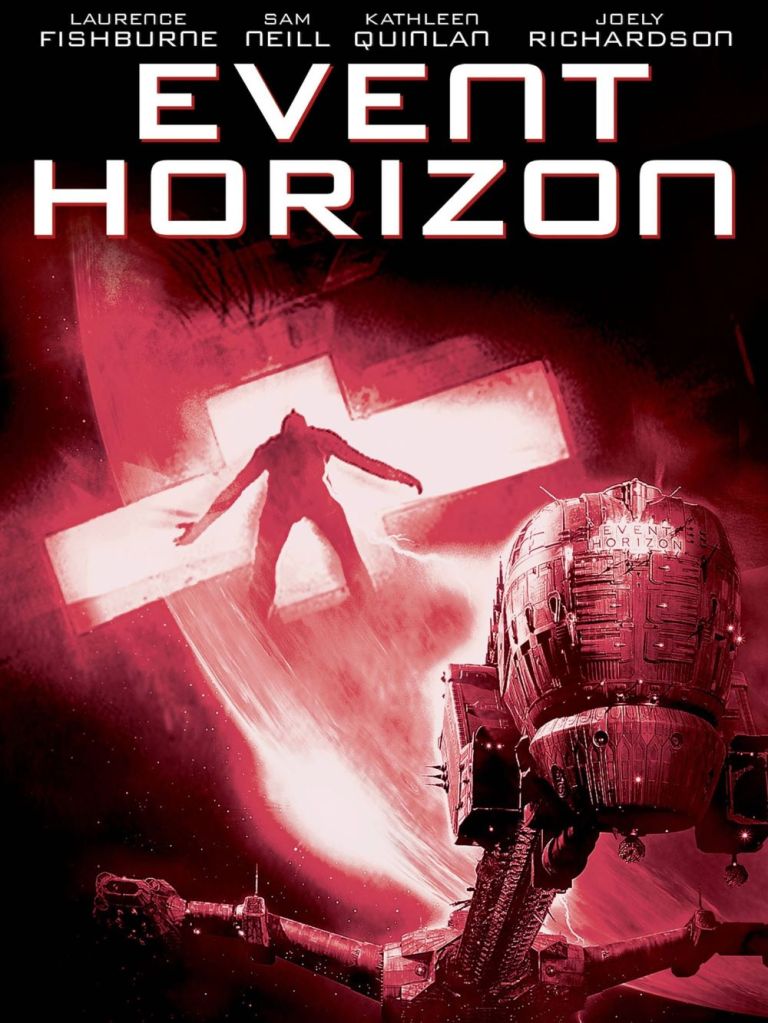
Paul W.S. Anderson’s 1997 film Event Horizon stands out as a memorable mix of science fiction and horror, remembered for its gripping atmosphere and disturbing visuals. The story is set in 2047: a rescue crew aboard the Lewis and Clark is sent out to recover the long-missing spaceship Event Horizon, a vessel built to test a new kind of faster-than-light travel. Onboard with them is Dr. William Weir, the Event Horizon’s creator, who explains that the ship vanished after first activating its “gravity drive,” which can fold space to allow for instant travel across vast cosmic distances.
Soon after reaching the drifting Event Horizon, the crew discovers signs of mass violence and horror. They recover a disturbing audio message and realize something traumatic happened to the original crew. As they search for survivors, they experience intense and personal hallucinations—memories and fears brought to life by the ship. It becomes clear that the Event Horizon didn’t just jump through space; it traveled to a place outside reality, a nightmarish interdimensional realm resembling hell.
What makes Event Horizon particularly unique is its concept of hell as an alternate dimension that can infect and corrupt whatever or whoever crosses into it. The ship’s gravity drive doesn’t simply facilitate faster travel—it accidentally opens a gateway to this chaotic, malevolent place. This portrayal of hell as a dangerous interdimensional reality that preys on minds and bodies echoes the idea found in the massive gaming property Warhammer 40K, where hell is depicted as the Warp, a dimension of chaos that corrupts and drives people insane. Like the Warp, the film’s hell is an unpredictable, hostile realm where sanity and physical form break down, infecting and warping everything that comes into contact.
Visually, the film relies on claustrophobic corridors, flickering lights, and unsettling sounds to keep the audience off-balance. The design of the ship itself—part gothic cathedral, part industrial nightmare—adds to the sense of unease and dread throughout. The use of practical effects and detailed sets grounds the sci-fi terror in something tangible, making it all feel more immediate and believable.
Event Horizon also hints at bigger philosophical questions: how far should science go, and what happens when the drive for knowledge is unchecked by ethics or humility? The gravity drive is a technological wonder, but it’s treated with little caution by its inventor, and the catastrophic results suggest that some discoveries may be better left unexplored. The ship becomes both a literal and figurative vehicle for exploring the limits of human ambition and the dangers of pushing beyond them.
As the movie builds toward its climax, the rescue crew faces increasingly desperate odds. The possessed Dr. Weir, now an outright villain, sees the hellish dimension the gravity drive visited as the next step for humanity—a place of chaos and suffering. Multiple characters die in gruesome ways, and the survivors have to fight their own fears and the haunted ship itself. The ending is chilling and ambiguous, leaving open the possibility that the ship’s evil has not been fully contained.
At release, Event Horizon divided critics and audiences. Some found the violence and nightmare imagery too intense or the story too messy to follow. Others praised its ambition and the way it blends psychological horror with cosmic sci-fi. Over the years, the film has developed a cult reputation, frequently cited as one of the more effective and original space horror movies. Its legacy can be seen in later media, especially in video games that tackle similar haunted spaceship scenarios.
However, the film is not without flaws. Many viewers and critics point out uneven pacing, especially in the second half where tension sometimes drains away. The characters often act inconsistently or make choices that feel unrealistic for trained astronauts, which undermines the suspense. The script’s tonal shifts—from serious psychological drama to moments that unintentionally verge on camp—can jolt the viewer out of the experience. The use of jump scares is sometimes predictable, and the film’s heavy reliance on loud, chaotic sequences instead of quiet suspense can feel overwhelming. Some CGI effects haven’t aged well, contrasting with the otherwise impressive practical effects and set design. Acting performances are mixed too; while Sam Neill and Laurence Fishburne are strong, some supporting cast members lack conviction, making emotional engagement uneven.
Importantly, Event Horizon represents Paul W.S. Anderson at his most subtle and effective in directing. Compared to many of his later films, where his style often becomes frenetic and unchecked—possibly due to a lack of producer control—Event Horizon is more controlled, atmospheric, and haunting. This balance between style and substance makes it one of Anderson’s better directorial works, if not his best to date. The film showcases his interest in spatial geography, the use of negative space, and claustrophobic production design, all elements he would expand on in his later work but never as effectively deployed as here. The haunting visual touches, combined with his ability to direct actors and maintain tension, set Event Horizon apart from his more bombastic, less focused later entries.
Despite its flaws, Event Horizon remains gripping and memorable. Its strengths lie in combining deeply personal psychological horror with the vast, terrifying unknown of space and alternate realities. The film explores not just external threats, but also how guilt, fear, and trauma can be weaponized by forces beyond human understanding. For viewers seeking more than a standard haunted spaceship story, Event Horizon offers a disturbing, thought-provoking glimpse into the dark frontier of science, faith, and madness. It stands as a cult classic of sci-fi horror that continues to inspire discussion about the dangers of pushing too far into the unknown.
“You’re diving deeper than any sane man ever should.” — Dr. Katherine McMichaels
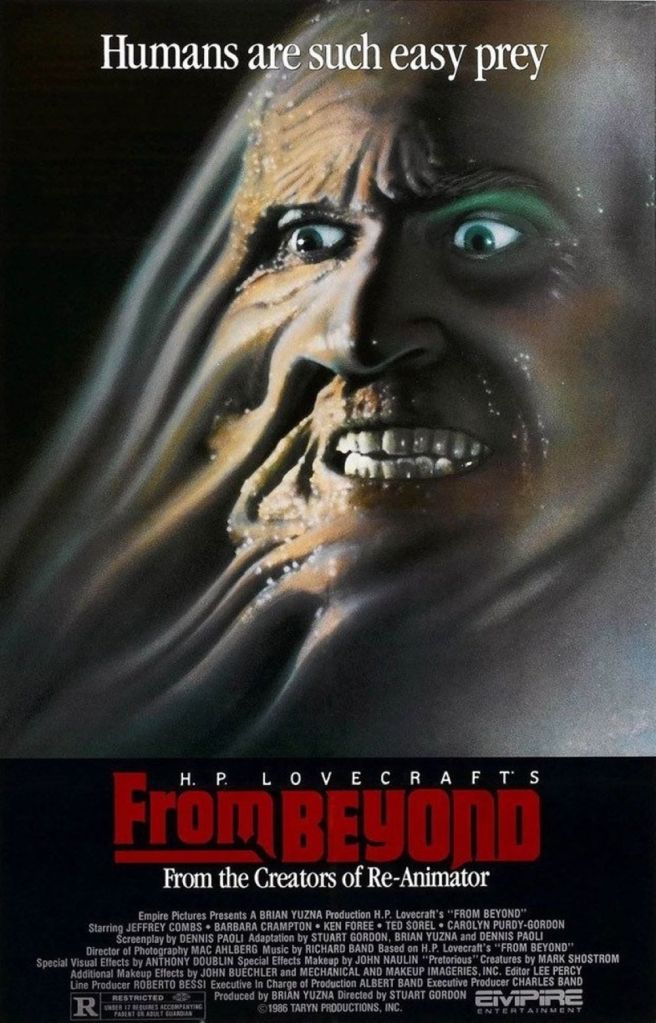
Stuart Gordon’s From Beyond (1986) stands as a darker, moodier follow-up to his breakout Lovecraft adaptation, Re-Animator (1985). At its core is the Resonator, a bizarre scientific contraption designed to stimulate the pineal gland—allowing its users to glimpse eerie creatures and dimensions normally invisible to the naked eye. When Dr. Crawford Tillinghast (Jeffrey Combs) activates the device, it unleashes horrors not just upon the world but also within the minds and bodies of those involved, blurring the line between reality and nightmare in a way both terrifying and hypnotic.
Just like with Re-Animator, Gordon used H.P. Lovecraft’s short story From Beyond as a foundation but expanded the narrative significantly by injecting his own creative vision and filling in what Lovecraft left unexplored. Lovecraft’s original story is a brief, eerie vignette about stimulating the pineal gland to perceive alternate dimensions and terrifying alien creatures—minimalistic and atmospheric, leaving much to the imagination. Gordon reimagines this premise into a fully fleshed-out narrative, adding complex characters like the obsessive Dr. Edward Pretorius and the rational yet vulnerable Dr. Katherine McMichaels. He enriches the story with body horror, psychological torment, and a deeper thematic exploration of sexuality, obsession, and the fragility of the mind. This creative expansion transforms the story into something far more personal and tangible, blending cosmic horror with primal human fears and desires.
This tonal shift stands in stark contrast to Re-Animator, which thrives on anarchic gore, slapstick comedy, and a playful mad-scientist energy. From Beyond trades much of the humor for a somber, unsettling atmosphere drenched in slime, grotesque transformations, and claustrophobic dread. The characters are more grounded in psychological trauma, and the film’s pacing emphasizes creeping unease rather than chaotic spectacle. Gordon’s use of stark, hallucinatory lighting and saturated colors enhances this otherworldly feeling, while practical effects bring a tactile horror to life that heightens the visceral and emotional impact. The horror isn’t just external—it’s internal, a fracture of reality and self.
One of the most notable ways From Beyond separates itself from Gordon’s earlier work is in its overt intertwining of sexuality and horror. The Resonator doesn’t just expose alien creatures; it unlocks primal lust and repressed desires in its users. Scenes imbued with uneasy erotic tension, especially involving Barbara Crampton’s character, make sexuality a core source of vulnerability and terror. This blend of eroticism and nightmare adds depth and psychological complexity, exploring how intimate human experiences can be distorted into something terrifying. It’s a thematic boldness that would become highly influential beyond Western cinema.
Indeed, the film’s fusion of sexual subtext, body horror, and psychological unease foreshadowed themes embraced by late 1980s and early 1990s Japanese horror hentai anime. Works such as Angel of Darkness (Injū Kyōshi) combined explicit eroticism, grotesque body transformations, and supernatural horror in ways reminiscent of From Beyond’s style and tone. This synergy helped define a subgenre of adult horror anime where the boundaries between pleasure and terror, desire and monstrosity, are constantly blurred—cementing From Beyond not only as a cult classic in horror but also as an inspirational bridge to pioneering adult animation in Japan.
Visually and atmospherically, the film is a masterpiece of practical effects and immersive storytelling. The slime-drenched creatures, anatomically warped bodies, and constant visual flow between nightmare and distorted reality create a hallucinatory experience. The climax offers a frenetic, visceral battle that embodies the film’s core themes of madness, transformation, and cosmic terror, leaving viewers with a lingering sense of unease and wonder.
Stuart Gordon’s direction also employs incredibly effective subjective perspectives, with many scenes shot from the characters’ points of view. This technique immerses viewers in the unfolding madness and heightens the sensory overload that defines the film’s experience. There is a famously unsettling point-of-view shot from the mutated Crawford as he perceives a brain inside a doctor’s head and gruesomely attacks. Such moments amplify the film’s exploration of altered perception and the treacherous expansion of human senses.
Despite these strengths, the film is not without flaws. Ken Foree’s character, Bubba Brownlee, while providing moments of grounded streetwise humor, sometimes comes off as a caricature that leans into stereotypical portrayals of Black men as taboo or outlier figures in horror cinema. This portrayal feels somewhat jarring against the film’s otherwise nuanced tone and may evoke discomfort.
Additionally, From Beyond can feel comparatively stiff and sluggish next to Re-Animator, lacking some of the earlier film’s darkly comic energy. The story often relies on a series of increasingly grotesque set pieces that feel more like shock showcases than a cohesive narrative arc. Some performances, including Jeffrey Combs’ lead, occasionally seem overly intense without sufficient emotional variation, and the film sometimes slips into melodrama that undercuts its impact. Furthermore, although ambitious in visualizing Lovecraftian horrors, budgetary constraints are occasionally evident, diminishing some of the awe those moments seek to inspire.
Ultimately, Gordon’s From Beyond is a significant Lovecraft adaptation that showcases the power of expanding upon source material with bold creativity. Moving beyond Lovecraft’s sparse prose, Gordon infuses the story with rich characters, psychological depth, explicit body horror, and mature explorations of sexuality. This results in a haunting, distinctly unsettling film that not only stands as a high point in Gordon’s career but also resonates far beyond its American horror roots, shaping international horror aesthetics and inspiring future genres. It is a disturbing, thrilling journey to the dark spaces just beyond human perception—a cinematic experience that lingers in the mind long after the screen fades to black.

 Through the Shattered Lens