Live Tweet Alert: Join #FridayNightFlix for Double Impact!


As some of our regular readers undoubtedly know, I am involved in a few weekly watch parties.  On Twitter, I host #FridayNightFlix every Friday and I co-host #ScarySocial on Saturday.  On Mastodon, I am one of the five hosts of #MondayActionMovie!  Every week, we get together.  We watch a movie.  We tweet our way through it.

Tonight, at 10 pm et, I will be hosting #FridayNightFlix!  The movie?  1991’s Double Impact!

If you want to join us this Friday, just hop onto twitter, find Double Impact on Prime, start the movie at 10 pm et, and use the #FridayNightFlix hashtag!  I’ll be there happily tweeting.  It’s a friendly group and welcoming of newcomers so don’t be shy.

See you there!
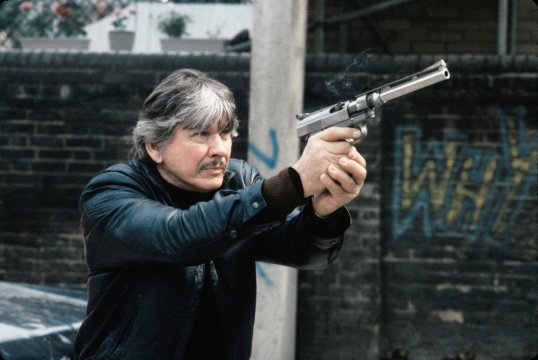
Film Review: Fort Apache, The Bronx (dir by Daniel Petrie)


Welcome to Fort Apache, The Bronx.

Shot on location, the 1981 film of the same name takes place in one of the toughest police precincts in New York City.  The film opens with a prostitute (Pam Grier) walking up to a police car in the middle of the night and promptly gunning down the two cops inside.  (The scene emphasis on the blood splattering in the squad car makes it all the more disturbing and frightening.)  As soon as the cops are dead, people come out of the shadows and immediately start going through their pockets, collecting everything that they can.

Why were the cops killed?  There is no real motive, beyond Grier’s prostitute being high on drugs and enjoying the kill.  Indeed, we know from the start that Grier is the killer but the cops investigating the case continually ignore her, despite the fact that she’s always wandering around in the background.  (Grier is perfectly frightening in the nearly silent role.)  The new captain of the precinct, a by-the-book type named Dennis Connolly (Ed Asner), assumes that the killing must have been an organized assassination and he is soon ordering his cops to arrest and interrogate almost anyone that they see.  If someone jaywalks, Connolly wants them in the back of a squad car so that they can be interrogated.  He offers to give the men two weeks of extra vacation time for every lead that they find.  When veteran detective John Joseph Vincent Murphy III (Paul Newman) says that the reward is going to do more damage than good, Connolly dismisses his concerns.  Connolly is convinced that he knows how to run the precinct.  He views the people who live in the Bronx as being enemies who have to be tamed and controlled.  Murphy, who comes from a long line of cops, believes in working with the community as opposed to going strictly by the book.

It’s an episodic film, following Murphy and his partner, Corelli (Ken Wahl), as they try to keep the peace in a neighborhood full of empty lots, abandoned buildings, and horrific poverty.  (The film is all the more effective for having actually been shot on location.  Looking at the scenery in which everyone is living and working, it’s easy to understand why tempers get so easily frayed.)  Corelli is ambitious.  Murphy is cynical.  When Murphy meets a nurse (Rachel Ticotin), it seems like love at first sight.  They’re both survivors of the toughest city in America.  But the nurse has a secret of her own.  There’s a lot of stories that are told in Fort Apache, The Bronx but few of them have a happy ending.

It’s an effective film, though the structure is occasionally a bit too loose and the generic “cop music” on the soundtrack sometimes makes it seem as if the viewer is watching a cop show on one of the nostalgia channels.  The film works because it allows the Bronx itself to be as important a character as the cops played by Newman, Asner, and Wahl.  There’s a grittiness to the film that overcomes even the occasional melodramatic moment.  In the end, the film suggests that, while cops come and go, the precinct will always remain the same.  Killing two drug dealers just allows two more to move in.  Reporting on a bad cop, like the one played in the film by Danny Aiello, will only lead to the ostracization of a good cop.  To the film’s credit, neither Newman nor Asner are portrayed as being totally correct or totally wrong in their different approaches to police work.  Newman is correct about Asner’s heavy-handed tactics creating mistrust and resentment in the community.  Asner, however, has a point when he says that a cop killer cannot be allowed to go unpunished.

Paul Newman gives a great performance as Murphy, a role that a lesser actor would have turned into a cliche.  Murphy is the latest in a long line of cops and he’s on the verge of abandoning the family business.  Newman does a good job of portraying not only Murphy’s burnout but also how his affair with the nurse briefly inspires him to believe that he still might actually be able to make a difference in the world.  The film ends on an ambiguous note, one that leaves you with the impression that Murphy couldn’t stop being a cop if he tried.  The job may be burning him out but it’s still the only thing he knows.

Fort Apache, The Bronx is not an easy movie to find.  Though it did well at the box office (and reportedly inspired shows like Hill Street Blues and NYPD Blue), the film was also controversial because of the way the Bronx was portrayed.  While it’s not currently streaming or even available to rent on any of the major sites, I did find a good, age-restricted upload on YouTube.  Look for it before someone takes it down.

Film Review: Winning (dir by James Goldstone)


In 1969’s Winning, Paul Newman plays a race car driver.

That’s certainly not a surprise.  Newman was very much a fan of racing and owned a few race cars himself.  In Winning, he looks totally comfortable and believable behind the wheel.  There’s not a moment that you look at Paul Newman and think to yourself that he couldn’t be exactly who he’s playing, a very successful and very ambitious race car driver.  At its best, the film is a visual love letter to the sport of racing and the thrill of driving fast.  When Newman is on that track, Winning is an exciting film.

Unfortunately, Winning doesn’t spend nearly enough time on the track.  Instead, we spend way too much time examining the bad marriage of Frank (Paul Newman) and Elora Capua (Joanne Woodward).  Frank meets Eulora at a car rental place, where she’s working behind the counter.  After a whirlwind romance, they get married and Frank becomes a stepfather to Elora’s annoyingly sensitive son, Charley (Richard Thomas).  (The film doesn’t necessarily mean for Charley to be annoying but he most definitely is.)  Still, Frank remains obsessed with winning.  He remains so obsessed with winning that Elora has an affair with Lou Erding (Robert Wagner), another race car driver.  With his marriage in shambles, Frank throws himself into preparing for the Indianapolis 500.

Winning is very much a film of the late 60s.  There’s really not much of a story so the film tries to get by on frequent jump cuts, intentionally skewed camera angles, and frequent montages.  It’s one of those American films that desperately wants to be mistaken for the type of movies that were coming out of Europe at the time.  I tried to count all of the jump cuts during the first few minutes of the film and I quickly gave up.  While there’s nothing wrong with a good jump cut, the frequent cuts in Winning feel more like an affectation than anything else.  Basically, someone in production said, “The kids like jump cuts so toss them in whether they’re necessary or not.”  The film’s attempt to be arty only further serve to remind us that there’s very little actually going on.

Paul Newman had charisma to burn and, in Winning, he looks like he’s enjoying himself whenever he’s behind the wheel.  The marriage of Newman and Woodward was one of Hollywood’s great love stories but that doesn’t come across in the marriage for Frank and Elora.  A lot of that is because there’s really not much that can be said about who Elora.  She’s a blank.  Paul Newman had the screen presence and the cool confidence to get away with playing an underwritten character.  Woodward, however, can’t overcome the shallow script.  (Though Robert Wagner was nowhere near as good an actor as either Newman or Woodward, he has the right look for the role and his stiff line delivery actually works well for the character.  For whatever reason, Wagner often seemed to do his best work in Paul Newman films.)

Really, I shouldn’t be surprised that Winning turned out to be stylish but empty.  The film was directed by James Goldstone, who also directed the painfully portentous Sidney Poitier-as-Jesus film, Brother John.  Eventually, Goldstone straightened up and gave us enjoyably bad films like Rollercoaster and When Time Ran Out.  Newman is in When Time Ran Out as well.  Just as with Winning, he’s the best thing in the movie.  That’s one of the benefits of being one of the great actors.  Even when they’re appearing in a less-than-impressive film, you just can’t stop watching them.


Film Review: Hud (dir by Martin Ritt)


In 1963’s Hud, Paul Newman plays a monster named Hud.

Hud Bannon is the son of rancher Homer Bannon (Melvyn Douglas).  Hud lives in a small Texas town, where he’s known for his pink Cadillac, his heavy-drinking, and his womanizing.  When we first meet him, he’s leaving the home of a married woman and narrowly escaping the rage of her husband.  Throughout the film, he mentions that he’s heading into town to meet “Mrs.” So-and-So.  Hud’s father fears that Hud might be incapable of caring about anyone but himself.  Hud’s nephew, Lonnie (Brandon deWilde), at first looks up to Hud but, over the course of the film, he comes to see his uncle for who he truly is.  Though Hud is quick to defend Homer from others, he himself views Homer with contempt and even plots to have the old man declared incompetent so that he can take over the ranch.  His flirtation with the family housekeeper, Alma (Patricia Neal), soon crosses the line into something much more dangerous.  Hud is charming and handsome in the way that only a 30-something Paul Newman could be.  But he’s also a complete monster.

In Hud, Newman gave one of his best performances and director Martin Ritt and cinematographer James Wong Howe captured some haunting images of the most barren parts of the Texas panhandle.  Howe’s black-and-white imagery not only captures the harsh landscape but also the harsh outlook of the people who live there.  Hud’s ruthless personality as is much a product of the demands of the land as his own narcissism.  The characters in Hud live in a land that doesn’t allow sentimentality.  It’s a land that’s allowed Hud to become the monster that he is.

At least, that’s the way that Paul Newman saw Hud.  That was also the way that the film’s director, Martin Ritt, viewed Hud.  They viewed him as being about as villainous and unlikable as a character could be but, to Newman’s surprise, audiences actually walked out of the film embracing the character and making excuses for him.  Newman was shocked to learn that teenagers were putting posters of him as Hud on their walls.

Why did viewers embrace Hud?

Some of it is due to the fact that Brandon deWilde gives a remarkably bland performance as Lonny.  We first see Hud through Lonny’s eyes and we are meant to share Lonny’s growing disillusionment with his uncle.  But Lonny comes across as being such an empty-headed character that it’s hard to really get emotionally invested in his coming-of-age.  When Hud eventually dismisses Lonny and his concerns, Lonny really can’t defend himself because there’s not much going on inside of Lonny.  On the other hand, Paul Newman gives such a charismatic performance as Hud that we find ourselves continually making excuses for his bad behavior.  When he talks about how he was raised and his difficult relationship with his father, we have sympathy for him even though we know we shouldn’t.  The viewer makes excuses for Hud because that’s what we tend to do when it comes to charismatic bad boys who don’t follow the rules.

Indeed, Hud is proof of the power of charisma and screen presence.  As a character, Hud does some truly terrible things and yet, because he’s Paul Newman, we want to forgive him.  We want to try to figure out why someone who is so handsome and so charismatic would also be so angry.  Lonny may be the “good” character but Hud is the one who we want to get to know.  When Lonny flips through a paperback to read the sex scenes, he comes across as being creepy.  When a drunk Hud flirts with a woman who he has just met, we ask ourselves what we would do if Hud ever tried that with us.  The truth is that we all know what we would do.  That’s what makes Hud both a dangerous and an intriguing character.

In the end, Hud is an excellent film that features Paul Newman at his best and which uses the downfall of Homer’s ranch as a metaphor for a changing American society.  Though Hud was  not nominated for Best Picture, it was nominated for almost everything else.  Melvyn Douglas and Patricia Neal won acting Oscars.  James Wong Howe’s cinematography was also honored.  Paul Newman was nominated and perhaps would have won if not for the fact that Sidney Poitier was nominated for playing the exact opposite of Hud in Lilies of the FieldHud was meant to be a picture about Lonny discovering his uncle was a monster.  Instead, the film became about Hud’s refusal to compromise.  It turns out that people like good-looking rebels who do what they want.

Even if viewers missed the point, Hud was one of the best films of the early 60s and Paul Newman’s powerful performance continues to intrigue.


Film Review: Paris Blues (dir by Martin Ritt)


1961’s Paris Blues tells the story of four Americans in Paris.

Ram (Paul Newman) and Eddie (Sidney Poitier) are expatriate jazz musicians.  Ram has come to Paris to try to find success as a musician.  He’s a little cocky.  He’s a little arrogant.  However, he’s talented and he believes enough in his talent that he takes it a little bit personally when he’s told that he should just focus on being a composer instead.  Eddie is Ram’s best friend and someone who has no interest in ever returning to America.  In America, he’s judged by the color of his skin.  In Paris, no one cares that he’s black.  In Paris, they just care about his talent.

Lillian (Joanne Woodward) and Connie (Diahann Carroll) are best friends who are spending two weeks in Paris.  They love jazz and eventually, Lillian comes to love Ram while Connie comes to love Eddie.  Connie tries to convince Eddie to marry her and come back to America with her but Eddie tells her that “the struggle” in America is not “my struggle.”  Ram also finds himself torn over whether he should stay in Paris or return to America with Lillian.  In the end, one man leaves and one man stays.  It’s not really much of a surprise who does what.

Paris Blues was directed by Martin Ritt, a director who had been blacklisted during the 50s and whose career was revived by several films that he made with Paul Newman.  (Newman and Joanne Woodward first met on the set of Ritt’s The Long Hot Summer.)  Ritt was one of those reliably liberal directors who made message films that dealt with political issues but were never quite radical.  Paris Blues features a lot of talk about the civil rights movement and it makes an attempt to be honest about why two Americans would chose to live in a different country.  And yet, as was so often the case with Martin Ritt’s films, the film presents itself as being far more daring than it actually is.  Yes, Ram initially hits on Connie but he loses interest once he sees Lillian.  Though the film is based on a novel that featured an interracial relationship, there’s never really any doubt that, in the film, Ram is going to end up with Lillian and Eddie is going to end up with Connie.  And while the film makes it clear that Ram and Lillian sleep together within hours of first meeting each other, the relationship between Connie and Eddie is romantic but chaste.  Paris Blues may be a mature film for 1961 but it’s still definitely a film of 1961.

That said, the music’s great (Louis Armstrong shows up to jam with Ram and Eddie) and Newman and Woodward’s chemistry is off the charts.  Ram is like a lot of the characters that Paul Newman played in the 50s and 60s.  He can be self-centered and he can be petulant and he can be self-destructive.  But he’s never less than honest and the fact that he refuses to compromise or give into self-doubt makes him very appealing.  While Poitier struggles with a script that refuses to allow him too much personality (he’s affably pleasant, even when he’s explaining why he doesn’t want to live in America), Newman dominates the film in the role of an artist determined to share his vision.

Paris Blues is never the masterpiece that it tries to be but Paul Newman makes it more than worth watching.

Miniseries Review: The Corner (dir by Charles S. Dutton)


Actor T.K. Carter died on January 9th.  He was 69 years old and his passing really didn’t get the notice that he deserved.

T.K. Carter may not have been a household name but I imagine that most people would recognize him if they saw him.  He appeared on a lot of television shows.  He did his share of movies.  He was usually cast in comedic roles, often playing the best friend who would inevitably provide some sort of gentle commentary on the problems of his friends or coworkers.  I just recently finished reviewing Good Morning, Miss Bliss, which featured Carter as Milo.  I’m not really sure what Milo did at John F. Kennedy Junior High but he was certainly more likable than Miss Bliss.

Carter appeared in some films as well.  Ironically, his two best-known films were not comedic at all.  He plays Nauls in John Carpenter’s The Thinga film that pretty much ends with Kurt Russell and Keith David freezing to death while wondering whether or not one of them is actually a killer alien.  And he also played Cribbs, a pot-smoking member of the National Guard who finds himself lost in the Louisiana bayou in Walter Hill’s Southern Comfort.  I have to admit that, after having watched both of those films more than once, it was a bit strange to see Carter exchanging jokes with Hayley Mills and Dennis Haskins on Good Morning Miss Bliss.

That said, if I had to pick Carter’s best performance, I would probably go with his work in the 2000 HBO miniseries, The Corner.  Based on a nonfiction book by David Simon, The Corner follows several characters over the course of one year in Baltimore.  Almost all of the characters are involved in the drug trade in some way or another.  DeAndre McCullough (Sean Nelson) is a fifteen year-old drug dealer who, despite his obvious intelligence, seems to be destined to become yet another statistic.  DeAndre’s parents are Fran (Khandi Alexander) and Gary (T.K. Carter).  At the start of the miniseries, both Fran and Gary are drug addicts and both of them make the effort to get clean.  Both have moments where their lives appear to be improving.  They both have moments where they relapse and have to start all over again.  Tragedy follows both of them.

The Corner is often described as being a forerunner to The Wire and indeed, there are definite similarities.  Like The Wire, The Corner was shot on location in Baltimore.  Like The Wire, The Corner emphasizes that futility of trying to wage a war on drugs.  As well, several members of The Corner‘s cast also appeared on The Wire.  Clarke Peters, Lance Reddick, Reg E. Cathey, Corey Parker Robinson, Delaney Williams, and Robert F. Chew are among the many Wire actors who appear in The Corner.  Interestingly enough, many of The Wire‘s cops and politicians appear as addicts in The Corner.  Clarke Peters and Reg E. Cathey play two long-time drug addicts who serve as a bit of a chorus for the neighborhood.  Lane Reddick appears as a recovering addict who tries to take advantage of Fran.

That said, The Corner doesn’t trust its audience in the same way that The Wire did.  That’s largely because The Corner was directed by Charles S. Dutton, who has never been a particularly subtle actor or director.  Dutton does a good job capturing the grit of Baltimore but he also includes “interviews” with various characters in which he asks questions while off-camera.  It feels a bit too on-the-nose, as if each episode of The Wire opened with a dramatic monologue from McNulty or Stringer Bell.  We don’t need the characters to look straight at the camera and tell us that things are bad.  We can see that for ourselves.

The entire cast does a good job but the best performance undoubtedly comes from T.K. Carter, who plays Gary as being an intelligent man, a good man, a hopeful man, but also a man who cannot escape his addiction.  With his gentle smile, his pleading eyes, and the almost shy way that he asks people to help him when he needs a fix, Carter gives a heart-breaking performance and one that shows that Gary truly is a prisoner of his addiction.  He doesn’t want to be an addict.  He wants to get clean.  But he also lives in a world where drugs are not only everywhere but they’re also the only escape that he and so many other people have from their oppressive existence.  With the government and the police treating the drug crisis as a war as opposed to a public health emergency, Gary’s two options really are either prison or the basement of his mother’s home.  The police view Gary as being nothing more than an criminal as opposed to someone with a sickness.  The dealers, meanwhile, view Gary as being a marketing opportunity.  T.K. Carter captures both Gary’s desperation and his sadness.  It’s a great performance and one that deserves to be remembered.  As played by T.K. Carter, Gary is the battered heart of The Corner.

T.K. Carter, RIP.


Guilty Pleasure #100: Ski Patrol (dir by Rich Correll)


First released in 1990, Ski Patrol is the story of a …. well, a ski patrol.

They’re not a very good ski patrol, not really.  Their martinet leader is short and annoying and he’s played by Leslie Jordan.  A young George Lopez is a member of the ski patrol and he keeps trying to do stuff that I assume was from his 1990 stand-up act.  Future director Paul Feig plays Stanley, who is nerdy but can dance and is willing to dress up like Tina Turner when the Ski Patrol needs to raise some fast money.  T.K. Cater is Iceman, who sings at every party and is a part of every prank.  Suicide (Sean Sullivan) wears a crazy mask and an evil mask as he debates which dangerous thing he should do.  And then there’s Jerry Cramer (Roger Rose), who is handsome and a great skier.  He’s technically the hero of the film but he’s kind of smarmy.  He does own a cute bulldog, though.

Eccentric or not, the ski patrol is dedicated to Pops (Ray Waltson), the fair-minded and kind-hearted owner of a mountain ski lodge.  Unfortunately, an evil developed named Maris (Martin Mull) wants Pops’s land so he and Lance (Corbin Timbrook) and Lance’s evil friends conspire to cause the lodge to fail its annual inspection.  Before you know it, mice are running loose, George Lopez is getting thrown in jail, and an avalanche causes a hot dog stands to careen out of control.  Since this movie was made in 1990, the solution to all of these problems is to party, party, and party some more!

This is not exactly a good movie.  It has its share of cringey moments and jokes that have not aged particularly well.  Roger Rose tries to pull off the whole charming smartass routine but he doesn’t really have the screen presence to do it.  One gets the feeling that filmmakers may have noticed that while filming because it’s hard not to notice that, despite being the film’s nominal star, Rose doesn’t really do much.  And yet, there’s enough odd little moments that the film itself is often more likable than it has any right to be.  These scenes might not add up to much but it’s hard not to smile when Paul Feig starts dancing or when Suicide starts arguing with himself.  There’s a lot of lovely scenery (the ski lodge really does look like a nice place to visit) and even the bulldog is genuinely cute.

As for T.K. Carter (whose passing earlier this month really didn’t get the attention that it deserved), this film was typical of the majority of the films in which he appeared and, as was often the case, he’s brings a lot of life to material that probably wouldn’t have worked without his energy.  Of course, it’s always interesting to see Carter in a silly comedy like this and then to consider his performances in The Thing and Southern Comfort, two excellent films that definitely were not comedies.  Indeed, after The Thing, it’s hard not to feel that Carter had earned a chance to appear in a film featuring snow in which everyone survives.

Previous Guilty Pleasures

  1. Half-Baked
  2. Save The Last Dance
  3. Every Rose Has Its Thorns
  4. The Jeremy Kyle Show
  5. Invasion USA
  6. The Golden Child
  7. Final Destination 2
  8. Paparazzi
  9. The Principal
  10. The Substitute
  11. Terror In The Family
  12. Pandorum
  13. Lambada
  14. Fear
  15. Cocktail
  16. Keep Off The Grass
  17. Girls, Girls, Girls
  18. Class
  19. Tart
  20. King Kong vs. Godzilla
  21. Hawk the Slayer
  22. Battle Beyond the Stars
  23. Meridian
  24. Walk of Shame
  25. From Justin To Kelly
  26. Project Greenlight
  27. Sex Decoy: Love Stings
  28. Swimfan
  29. On the Line
  30. Wolfen
  31. Hail Caesar!
  32. It’s So Cold In The D
  33. In the Mix
  34. Healed By Grace
  35. Valley of the Dolls
  36. The Legend of Billie Jean
  37. Death Wish
  38. Shipping Wars
  39. Ghost Whisperer
  40. Parking Wars
  41. The Dead Are After Me
  42. Harper’s Island
  43. The Resurrection of Gavin Stone
  44. Paranormal State
  45. Utopia
  46. Bar Rescue
  47. The Powers of Matthew Star
  48. Spiker
  49. Heavenly Bodies
  50. Maid in Manhattan
  51. Rage and Honor
  52. Saved By The Bell 3. 21 “No Hope With Dope”
  53. Happy Gilmore
  54. Solarbabies
  55. The Dawn of Correction
  56. Once You Understand
  57. The Voyeurs 
  58. Robot Jox
  59. Teen Wolf
  60. The Running Man
  61. Double Dragon
  62. Backtrack
  63. Julie and Jack
  64. Karate Warrior
  65. Invaders From Mars
  66. Cloverfield
  67. Aerobicide 
  68. Blood Harvest
  69. Shocking Dark
  70. Face The Truth
  71. Submerged
  72. The Canyons
  73. Days of Thunder
  74. Van Helsing
  75. The Night Comes for Us
  76. Code of Silence
  77. Captain Ron
  78. Armageddon
  79. Kate’s Secret
  80. Point Break
  81. The Replacements
  82. The Shadow
  83. Meteor
  84. Last Action Hero
  85. Attack of the Killer Tomatoes
  86. The Horror at 37,000 Feet
  87. The ‘Burbs
  88. Lifeforce
  89. Highschool of the Dead
  90. Ice Station Zebra
  91. No One Lives
  92. Brewster’s Millions
  93. Porky’s
  94. Revenge of the Nerds
  95. The Delta Force
  96. The Hidden
  97. Roller Boogie
  98. Raw Deal
  99. Death Merchant Series

Join #MondayMania For You May Now Kill The Bride!


Hi, everyone!  Tonight, on twitter, I will be hosting one of my favorite films for #MondayMania!  Join us for 2016’s You May Now Kill The Bride!

You can find the movie on Prime and Tubi and then you can join us on twitter at 9 pm central time!  (That’s 10 pm for you folks on the East Coast.)  See you then!

Song of the Day: Raindrops Keep Fallin’ On My Head, performed by BJ Thomas


Because today is Paul Newman’s birthday, I figured today’s song of the day should come from one of his films.  There’s a tendency amongst some critics to be dismissive of the use of Raindrops Keep Fallin’ On My Head in Butch Cassidy and the Sundance Kid and it’s true that it’s not really the type of song that brings to mind robbing trains and dying in South America.

(Though we all know that Butch Cassidy — and maybe the Sundance Kid, too — actually survived and eventually returned to America.  We all know that, right?)

But, you know what?  It’s a song that really gets stuck in your head and somehow, it just feels appropriate for Paul Newman, an actor whose life wasn’t always happy (his son overdosed in 1976) but who was still almost always described as being one of the nicest guys around.  Plus, look at Paul on that bicycle!  How can you dislike this song?