Lisa Marie Reviews The Oscar-Nominated Films: Mutiny on the Bounty (dir. by Lewis Milestone)


Mutiny_On_The_Bounty_1962_1

Previously, I reviewed the 1935 Best Picture winner Mutiny on the Bounty, a film that still stands as one of the best adventure films ever made.  However, this was not the only film made about the Bounty to be honored with several Oscar nominations.  In 1962, another version of Mutiny on The Bounty was released and, like its predecessor, received a nomination for Best Picture of the year.  However, while the 1935 Mutiny on the Bounty remains one of the most entertaining films ever made, the 1962 Mutiny on the Bounty is a mess.

As in the 1935 version of the story, we once again follow the HMS Bounty as it sails from England to Tahiti.  Again, the ship’s captain is the tyrannical Capt. Bligh (Trevor Howard) and again, the eventual mutiny is led by Fletcher Christian (Marlon Brando).  While the 1935 version presented Christian as the unquestioned leader of the mutiny, this version features an indecisive Christian who is goaded into leading the mutiny by a seaman named John Mills (Richard Harris).  Whereas the 1935 Fletcher Christian never regretted his decision, the 1962 version seems to regret the mutiny from the moment it occurs and literally spends the rest of the film trying to get the mutineers to agree to return to England with him.

Perhaps the biggest difference between the two versions of Mutiny on the Bounty is that the 1935 version was a 2-hour film that felt shorter while the 1962 remake lasts 3 hours and 15 minutes (including intermission) and feels even longer.  The 1962 version was made at a time when Hollywood was attempting to counteract the influences of European art films and American television by making films that were a thousand times bigger then they needed to be.  Whereas the 1935 Mutiny on The Bounty was all about telling the story as efficiently as possible, the 1962 Mutiny on the Bounty was about telling audiences, at every possible moment, that they couldn’t see anything like this on television or in some French art film.  Audiences in 1962 may very well have been amazed by the endless shots of Tahitians dancing and the Bounty rocking on the ocean but, for modern audiences, the entire film just feels incredibly slow and padded.

Another major difference between the two versions of Mutiny on the Bounty is that Marlon Brando, to be charitable, was no Clark Gable.  Much as Clark Gable could never have been a credible Stanley Kowalski or Vito Corleone, Brando could never have been a convincing Fletcher Christian.  Whereas Gable played Christian as the epitome of masculinity, Brando’s internalized, method approach serves to turn the character into something of a wimp.  It doesn’t help that Brando’s twangy attempt at an English accent sounds like every bad Monty Python impersonation that’s ever been heard in a college dorm room.

The 1962 Mutiny on the Bounty was a notoriously troubled production.  Marlon Brando was reportedly bored with the role of Fletcher Christian (which might explain why he gave such an eccentric performance) and he reportedly used his star status to demand and make constant changes in the script.  The film’s original director, Carol Reed, reportedly quit over frustration with Brando and was replaced by Lewis Milestone.  Milestone, a veteran director who had started his career during the silent era, proved just as ineffectual when it came to controlling Brando.  By the end of the film, Richard Harris was literally refusing to film any scenes opposite Brando.  The end result was that the film went wildly over schedule and over budget.

Despite being reviled by even contemporary critics, Mutiny on the Bounty received seven Oscar nominations, including Best Picture.  The nomination was a triumph for the studio system as MGM reportedly directed all of its employees to vote for the film. That may have been enough to win Mutiny a nomination for best picture but the actual Oscar went to Lawrence of Arabia.
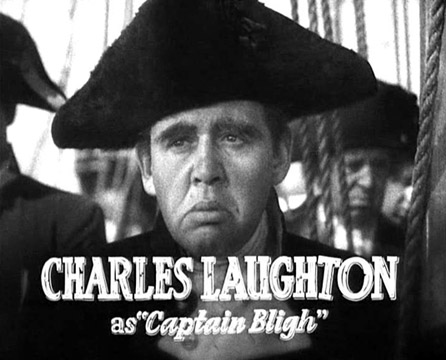
Lisa Marie Reviews The Oscar Winners: Mutiny on the Bounty (dir by Frank Lloyd)


Charles Laughton

It’s been a strange Oscar season and it could get even stranger.  Several critics and industry insiders are speculating that, on February 24th, Argo might win the Oscar for best picture without winning in any other category.  As strange as that may sound, Argo would not be alone in achieving this distinction.  In the past, 3 films have won best picture without winning anything else.

Mutiny on the Bounty, the best picture of 1935, is one of those films.

Based (rather loosely, according to many historians) on a true story, Mutiny on the Bounty tells the story of one of the most controversial events in maritime history.  The HMS Bounty leaves England in 1787 on a two-year voyage to Tahiti.  The Bounty is manned by a disgruntled crew (many of whom have been forced into Naval service) and is captained by a tyrant named William Bligh (Charles Laughton).  Bligh has little use for the majority of his crew and thinks nothing of having a man whipped until he is dead for even the pettiest of infractions.

Blight’s lieutenant is Fletcher Christian (Clark Gable), a compassionate man who disapproves of Bligh’s methods.  As the voyage continues, Christian grows more and more vocal with his disgust towards Bligh.  When the ship finally reaches Tahiti, Christian falls in love with a local Tahitian girl and defies Bligh’s direct orders so that he can spend time with her.

It’s only after the ship leaves Tahiti and Bligh’s tyranny leads to the death of an alcoholic crew member that Christian finally leads the mutiny of the film’s title. The rest of the film is divided between Bligh’s surprisingly heroic efforts to survive after being set adrift in a lifeboat and Christian’s attempts to avoid being captured by British authorities.  Caught up in the middle of all of this is Christian’s friend (and audience surrogate), Roger Byam (Franchot Tone).

Mutiny on the Bounty was one of the biggest box office hits of 1935 and it received 8 Academy Award nominations, including Best Picture, Best Director, and a record-setting 3 nods for Best Actor with Clark Gable, Charles Laughton, and Franchot Tone all receiving nominations.  However, out of those 8 nominations, Mutiny only won the award for Best Picture while John Ford’s The Informer took home the Oscars for Best Director and Actor.  Mutiny on the Bounty was the third (and, as of this writing, the last) best picture winner to fail to win any other categories.

For a film that lost dramatically more awards than it won, Mutiny on the Bounty still holds up pretty well.  Director Frank Lloyd keeps the film moving at a quick pace and perfectly captures not only the misery of the Bounty but the joyful paradise of Tahiti as well.  Lloyd is at his best during the short sequence of scenes that depict Bligh’s efforts to reach safety after being forced off of the Bounty.  During this sequence, the audience is forced to reconsider both Captain Bligh and everything that we’ve seen before.  It introduces an intriguing hint of ambiguity that is not often associated with films released in either the 1930s or today.

Of the three nominated actors, Clark Gable and Charles Laughton both give  performances that remain impressive today.  In the role of Fletcher Christian, Gable is the literal personification of masculinity and virility.  Meanwhile, in the role of Bligh, Laughton is hardly subtle but he is perfectly cast.  If Gable’s performance is epitomized by his charming smile than Laughton’s is epitomized by his constant glower.  Wisely, neither the film nor Laughton ever make Bligh out to be an incompetent captain.  As is shown after the mutiny, the film’s Bligh truly is as capable a navigator and leader as everyone initially believes him to be.  Unlike many cinematic tyrants, Blight’s tyranny is not the result of insecurity.  Instead, Bligh is simply a tyrant because he can be.  Laughton and Gable are both so charismatic and memorable that Franchot Tone suffers by comparison.  However, even Tone’s bland performance works to the film’s advantage.  By being so normal and boring, Roger Byam is established as truly being the sensible middle between Gable’s revolutionary and Laughton’s tyrant.

Mutiny on the Bounty remains an exciting adventure film and it certainly holds up better than some of the other films that were named best picture during the Academy’s early years.  If Argo only wins one Academy Award next Sunday, it’ll be in good company.

Guilty Pleasure No. 4: The Jeremy Kyle Show


Jeremy Kyle Wanker

I’ll just be honest about this.

I do not like Jeremy Kyle.

Jeremy Kyle is an English talk show host.  He hosts shows in both the United Kingdom and, since 2011, in the USA.  On both shows, he deals with the usual daytime television topics: infidelity, out-of-control teenagers, interventions, DNA tests, and lie detectors.  He is also perhaps the most unpleasant person that I have ever seen on television.

As opposed to other talk show hosts who pretend to be impartial, Jeremy Kyle is always quick to let us know that he hates his guests even more than we do.  When someone confesses to cheating on his or her spouse, Jeremy reacts as if he was the one being cheated on. With a permanent scowl on his face and speaking in a tone of voice that reeks of manufactured contempt, Jeremy Kyle repeatedly tells us that his main concern is the children and that he has no respect for anyone who he feels has put their own selfish desires first.

“In the UK,” he’ll find an excuse to shout during every episode, “we have a saying — keep it in your trousers, mate!”

In many cases, Kyle’s guests deserve to be yelled at but that doesn’t make Jeremy Kyle any less annoying.  For all of his shouting and his moral outrage, Jeremy Kyle is far too obvious a showman to be taken seriously as a sincere crusader for family values.  He’s made a career out of exploiting that which he claims to condemn and the fact that he seems so totally humorless about that fact makes him just as bad as the people he has on his show.  He’s a bully but he’s also a surprisingly ineffective one.  The main image that one retains from the Jeremy Kyle Show is the sight of a husband and wife screaming at each other while Jeremy impotently demands that they both be quiet.  The only time that Jeremy really has any control over his stage is when he has his ever present security team standing a few feet in front of him.

When I told my British friends that Jeremy Kyle now had a show in the States, they all had the same reaction.  They apologized.  As for me, I refused to sign that petition to deport Piers Morgan but if anyone starts a petition to deport Jeremy Kyle, I’ll be more than happy to put down my signature.

So, you may be asking, where does the pleasure from this guilty pleasure come from?

It comes from knowing that there’s always a possibility that one of Jeremy Kyle’s guests might lose it and punch Jeremy out.  Every time I’ve seen the Jeremy Kyle Show, I’ve always been struck by just how much everyone on the stage appears to hate Jeremy.  When I do watch this show, it’s because I’m waiting for those priceless moments when somebody will tell Jeremy to shut up and his face will briefly turn red.  I doubt that I’m alone in laughing whenever a guest unexpectedly jumps to his feet and Jeremy reacts by scurrying behind a security guard.  In those moments, Jeremy Kyle’s superior mask falls away and he’s revealed for the pathetic little martinet that he is.

On those rare occasions that I waste my time watching the Jeremy Kyle Show, I’m watching because something like this could happen:

That’s the real pleasure of The Jeremy Kyle Show.

Previous Guilty Pleasures:

  1. Half-Baked
  2. Save The Last Dance
  3. Every Rose Has Its Thorns

6 Trailers For The State Of Our Union


This Tuesday, while the rest of the America was watching President Obama give yet another speech, I was actually doing something important.  I was sending the trailer kitties out to gather 6 more trailers for the latest edition of Lisa Marie’s Favorite Grindhouse and Exploitation Film trailers.

Well, it took them a while but they’ve returned with 6 trailers that they think sum up the current state of the union.  Let’s see if they’re right.

(Before anyone gets offended by the last comment, please remember that they’re just a bunch of kitties.)

1) It Happened Here (1965)

2) Society (1989)

3) The Dentist (1996)

4) Edge of Sanity (1989)

5) Evil In The Deep (1975)

6) Parents (1989)

What do you think, Trailer Kitty?

Feirce Kitty

Dance Scenes That I Love: Hanging Out With My Family From Birdemic


Birdemic

Hi there!

As I sit here writing this, I am the most tired girl in the world but I could not let this day pass without sharing one of my favorite dance scenes.  In this romantic scene from the infamous environmental “horror” film Birdemic, our main characters end a perfect day by dancing to a song called Hanging Out With My Family.

My favorite part of this scene?

The invisible backup singers.

Enjoy and salud!

What Lisa Marie and the Snarkalecs Watched Last Night #69: Heebie Jeebies (dir by Thomas L. Callaway)


Last night, the Snarkalecs and I watched the world premiere SyFy movie Heebie Jeebies!  And wow — was it ever bad!

Seriously, how bad was Heebie Jeebies?  It’s so bad that I couldn’t even find a trailer for it on YouTube.  It’s as if the universe is trying to convince us that this film does not actually exist.  However, we know what we saw last night.

(As proof, here’s a picture of Michael Badalucco, whose over-the-top  performance as the gold-obsessed Billy Butler was one of the more commented upon aspects of the film.)

Why Were We Watching It?

That’s a question that many of us asked last night.

What Was It About?

Usually, low-budget monster movies on SyFy are a lot of fun but that’s because most low-budget monster movies on SyFy are made by the Asylum.  Unfortunately, Heebie Jeebies was not an Asylum film.

Instead, it’s a film about this monster that comes out of a mine and wanders around attacking people and eating gold.  You read that correctly.  This monster kills people and then eats their gold.   Will the town of Golderton survive?

What Worked?

Nothing.

What Did Not Work?

Everything.

“Oh my God!  Just like me!” Moments

I found myself relating to poor Veronica (Evie Thompson), the younger sister of a character that I named Deputy Dumbass (Robert Belushi).  All Veronica wanted to do was go out and have sex with her boyfriend but instead, she had to spend her entire night listening to her brother talk about how it wasn’t safe to go out just because of a little old monster that happened to be killing people.  Even worse, once she finally did what I would have done and sneaked out of the house, she and her boyfriend (who was kinda fugly, to be honest) ended up getting held hostage by two ex-convicts.

Lessons Learned

Only the Asylum should be allowed to make low-budget monster movies.

What Lisa and Evelyn Watched Last Night #68: California Dreams S3E17 “Tiffani’s Gold” (dir by Patrick Maloney)


On Wednesday night, my BFF Evelyn and I watched (via YouTube) an episode of the 90s sitcom California Dreams.  The name of this episode was Tiffani’s Gold and, needless to say, it’s a very special episode.

Why Were We Watching It?

As I wrote back in December, I was introduced to this show over Christmas by my sister Megan.  Ever since then, I’ll be regularly watching old episodes of California Dreams on YouTube.  I’ve seen the members of the Dreams deal with racism, eating disorders, gang violence, body issues, and environmental panic.  When I discovered that the episode Tiffani’s Gold dealt with drug abuse — well, how couldn’t I watch?

As for Evelyn, she insists that I make clear that the only reason she was watching it was because I insisted.

What Was It About?

Tiffani is stressed about making the national volleyball team so she starts taking steroids.  Tiffani makes the team but she also starts to snap at people, beat up her friends, and smash plates at the local hang-out.

Meanwhile, in a totally unrelated subplot, Mark, Sly, and Tony compete for the title of Mr. Stud and Jake continues to insist on wearing a heavy leather jacket to the beach.

What Worked?

As well-intentioned as it most certainly was, this episode had a definite Reefer Madness type of appeal to it.  California Dreams, much like my beloved Degrassi, presents us with a world where not only can the worst happen but the worst will end up happening within the next 10 minutes.  Seriously, how can you not be impressed by the fact that, after a week of taking steroids, Tiffani is literally picking Sly up and throwing him against a locker?

That said, I could relate to Tiffani’s anger in several scenes.  Seriously, sometimes, a girl just needs to be left alone!

Evelyn says the main thing that worked about this episode is that the California Dreams never actually performed.

What Did Not Work?

Evelyn and I totally disagreed with the results of the Mr. Stud contest.  Seriously, Mark looked good in that tuxedo and I didn’t believe Jake for a second when he claimed to have gotten choked up at the movies.  (Oh, and by the way, it’s okay for a guy to cry but he should never sob.  That’s the important thing.)

“OH MY GOD!  Just like me!” Moments

I have now been told, by five different people, that the character of Lorena reminds them of me and since two of these people were my sister and BFF, I’ll take their word for it.  Still, I have a hard time imagining that Lorena would ever have been a fan of Italian horror.

Lessons Learned

Well, duh!  Don’t do steroids!  Though, actually, it seems like the steroids accomplished their purpose.  I mean, Tiffani did make the national team and all.  In fact, it seems like Tiffani’s main problem is that people put too much pressure on her so I guess the real lesson here is that you shouldn’t put too much pressure on your friends when they’re using steroids.

Trailer: Big Ass Spider


PCAS

How can you not be excited about a film called Big Ass Spider?  The film, from director Mike Mendez, will be playing at the South By Southwest Film Festival and, to judge from the trailer, it looks like it’s going to be a lot of fun.  You have to love any film that features Greg Grunberg saying, “This is a big ass spider.”

Lisa Reviews The Oscar Winners: Disraeli (dir by Alfred E. Green)


One reason that I love February is because it’s during this month that TCM broadcasts 31 Days of Oscar.  Over the course of this month, TCM is devoting itself to showing Oscar-nominated films.  While this means that they are showing a lot of my favorite films, it also means that they’re showing some obscure films that I might otherwise never have had a chance to see.

Disraeli is one of those previously obscure films.  Released in 1929, Disraeli was an early sound film that starred a distinguished stage actor named George Arliss. Recreating a role that he had previously played on stage and in a silent film, Arliss was the first British actor to ever win the Academy Award for Best Actor.  Disraeli itself picked up a nomination for best picture but lost to All Quiet On The Western Front.

Disraeli tells the story of British Prime Minister Benjamin Disraeli (played, in a likable if overly theatrical performance, by Arliss).  Disraeli was the first (and, to date, only) person of Jewish descent to serve as prime minister.  A favorite of Queen Victoria, Disraeli held the office of prime minister several times during the late 19th century and remains one of the most influential leaders in British history.

Reflecting the fact that it was initially made at a time when its title character was still a well-known historical figure, Disraeli spends next to no time explaining how Benjamin Disraeli reached the office of prime minister or why he believed the things that he believed.  Indeed, the film tells us remarkably little about just what exactly Disraeli, as leader, did believe in.  Instead, it takes for granted that the audience will know who Benjamin Disraeli was and why he was important.  The film, focuses on one aspect of Disraeli’s career — his efforts to purchase the Suez Canal and allow Victoria to add “Empress of India” to her list of titles.  Along the way, he finds the time to encourage a tepid romance between his aide (Anthony Bushnell) and the young Lady Clarissa (played by Joan Bennett, who — nearly 50 years later — would play the sinister Madam Blanc in Dario Argento”s Suspiria).  While this approach may have worked for audiences in 1929, modern viewers will probably wonder just what exactly everyone’s going on about.

If you didn’t know that Disraeli was based on a stage play, you would be able to guess it from watching the movie.  It’s not just that this is an extremely talky film.  It’s also a very stagey film, a reminder that the initial introduction of sound resulted in American cinema taking a step back artistically.  Whereas silent films were free to experiment both visually and narratively, a film like Disraeli had to be shot in order to accommodate the limitations of the early sound era.  As a result, the camera rarely moves and scenes are made up of static shots of groups of people standing close together and delivering lengthy passages of exposition.  While this may not have been an issue for audiences who were still amazed by the very existence of talking pictures, modern audiences will probably find the film to be pretty dull.

Disraeli is a difficult film to recommend for a modern audience but it is interesting to watch from a historical point of view.   As I watched Disraeli, I was reminded of a current Oscar contender.  Much like Lincoln, Disraeli attempts to humanize a famous politician and is structured around the lead performance of an acclaimed British thespian.  Much like Disraeli, Lincoln is a fictionalized account of how a powerful and controversial leader manipulated a reluctant government into making history.  That Lincoln deals with the struggle to end American slavery while Disraeli celebrates British imperialism says a lot about the difference between 1929 and 2013.

6 Trailers From 2 Tired Trailer Kitties


The trailer kitties were still pretty tired from the Super Bowl (they got a little bit too hyper when all the lights went out in the stadium) but I still sent them out to gather six more trailers for this week’s edition of Lisa Marie’s Favorite Grindhouse and Exploitation Film Trailers.  Here’s what they returned with.

One quick note: As much as I love the trailer kitties, they occasionally bring me trailers for films that weren’t really grindhouse films.  However, the trailer for Pinocchio’s Birthday Party was just weird and creepy enough that I decided to include it anyway.

1) Pinocchio’s Birthday Party (1974)

2) Can I Do It … Til I Need Glasses (1979)

3) Karzan, Master of the Jungle (1972)

4) The Penthouse (1967)

5) Hog Wild (1980)

6) From Noon Til Three (1976)

What do you think, Trailer Kitties?

Trailer Kitty Bath