“It’s very simple what I want to be: totally happy; totally different; and totally in love.”
— Christine Adams (Jacqueline Bisset) in The Grasshopper (1970)
Seriously, is Christine asking for too much?
Total happiness? That may sound like a lot but trust me, it can be done.
Totally different? That’s a little bit more challenging because, to be honest, you’re either different or you’re not. If you have to make the effort to be different, then you definitely are not.
Totally in love? Well, it depends on how you define love…
At the start of The Grasshopper, Christine thinks that she’s heading to America to find love. While an oh-so late 60s/early 70s theme song plays in the background, Christine leaves her small hometown in Canada and she heads down to California. She’s planning on meeting up with her boyfriend Eddie (Tim O’Kelly) and taking a job as a bank teller.
Of course, it soon turns out that working in a bank isn’t as exciting as Christine originally assumed. Eddie expects Christine to just be a conventional girlfriend and that’s not what Christine is looking for. As well, it’s possible that Christine may have seen Targets, in which O’Kelly played an all-American boy who picks up a rifle and goes on a killing spree.
And so, Christine abandons Eddie and heads to Las Vegas. Since this movie was made in 1970 and Uber didn’t exist back then, Christine’s preferred method of traveling is hitchhiking. This gives her a chance to meet the usual collection of late 60s weirdos who always populate movies like this. One driver crosses herself when Christine says that she plans to have a baby before getting married. Another is a hacky Las Vegas comic.
In Vegas, Christine applies for a job as a showgirl. As she explains to sleazy casino owner Jack Benton (Ed Flanders), she “once did Little Women in school.”
Anyway, thing do get better once Christine meets and falls in love with Tommy Marcott (Jim Brown), a former football player who is now working as a door greeter in Jack’s casino. Everyone tells Christine not to get involved with Tommy. One of Jack’s men, a menacing hitman who looks just like Johnny from Night of the Living Death (he even wears glasses), warns Christine to watch herself.
Through a long series of events, Christine ends up on her own again. The usual collection of 70s events occur: murder, drugs, prostitution, and ultimately a stint as the mistress of a rich man played by Joseph Cotten. The important thing is that it all eventually leads to Christine and a skywriter getting stoned, stealing a plane, and deciding to write a message in the sky.
That’s when this happens:
Yes, it’s all very 1970!
Anyway, The Grasshopper is one of those films that tries to have it both ways. Establishment audiences could watch it and think, “Wow, those kids are really messed up.” Counterculture audiences could watch it and say, “Old people are such hypocrites.” Oddly enough, The Grasshopper was written by future director Garry Marshall and it’s an incredibly overwrought film. There’s not a subtle moment to be found in the entire film and the film’s direction is flashy but empty. However, for those of us who love history, it’s as close to 1970 as we’re going to get without hopping into a time machine.
My first thought when I came across 1994’s The Dallas Connection:
Oh my God, it’s a movie about my hometown!
And, just judging from the film’s poster, it appears that Dallas is blowing up! Look at all of those flames behind Reunion Tower!
(Whenever a film is set in Dallas, you know you’re going to see Reunion Tower in the background. Depending on when the film was made, you’ll probably also see Bank of America Plaza. That’s the green building.)
Of course, film posters are often inaccurate and it’s not really a spoiler for me to tell you that, at no point, does Reunion Tower blow up in this movie. Don’t get me wrong. A lot of stuff does blow up in The Dallas Connection. It’s a Sidaris film, produced by Andy Sidaris and directed by his son, Christian Drew Sidaris. The Sidaris name is pretty much synonymous with stuff blowing up.
That said, a good deal of The Dallas Connection does take place in Dallas and, unlike a lot of other films, it was actually filmed in Dallas. This wasn’t a case of something like Dallas Buyers Club or Killer Joe, where New Orleans was used as a Dallas stand-in. Nor was it like that terrible “Babylon” episode of The X-Files, where a bunch of Canadians in denim were awkwardly cast as Texans. It’s always fun to see building that you recognize when you watch a movie.
That said, The Dallas Connection opens in Paris. We know it’s supposed to be Paris because of all the French stock footage. Inside a Parisian mansion (which looks suspiciously like a house one would expect to find in the suburbs of Dallas), an assassin named Black Widow (Julie Strain) is murdering a scientist. Black Widow’s trademark is that she has rough sex with her targets before murdering them.
Meanwhile, Black Widow’s associates — Cobra (Julie K. Smith) and Scorpion (Wendy Hamilton) — are killing scientists in South Africa and Hong Kong. The South African scenes feature a lot of grainy stock footage that was probably lifted from a nature documentary. Meanwhile, in Hong Kong, death comes via an exploding golf ball.
Why are all the scientists being killed? Well, it turns out that they’re all due to attend a scientific conference in Dallas. (Woo hoo! Way to go, Dallas!) Apparently, they’ve developed some sort of missile defense system or something. The last remaining scientist, Morales (Rodrigo Obregon), needs to be protected from Black Widow and her assassins so it’s time to call in Chris Cannon (Bruce Penhall) and his team of incompetent government agents.
In typical Sidaris fashion, the plot is pretty much impossible to follow. That’s not because the story is especially complex or clever. This isn’t one of those films where you need to rewatch it to pick up on all the details or the clues or anything like that. Instead, The Dallas Connection’s incoherence feels as if it’s a result of everyone just making it all up as they went along. It’s a Sidaris film so you know that, inevitably, everyone’s going to end up in the bayous, blowing stuff up.
And yes, yet another remote control boat shows up and explodes. Of all of the Sidaris trademarks, the exploding remote controlled boats is perhaps the strangest. At the same time, it’s also the most amusing. Seriously, whenever anyone is standing near any body of water, you just know a tiny speedboat’s going to come along and blow him up.
In the end, The Dallas Connection is a typically incoherent Sidaris film but at least it features a lot of scenes shot in my hometown.
— The Bond Family Motto, as revealed in On Her Majesty’s Secret Service by Ian Fleming
First published in 1963, Ian Fleming’s 10th James Bond novel opens with Bond in a familiar situation. He is back at the Casino Royale, both to gamble and to visit Vesper Lynd’s grave. Much as he did after being tortured by Le Chiffre, Bond is considering resigning from Her Majesty’s Secret Service. However, in this case, Bond’s desire to quit is not motivated by petulance or wounded pride.
Instead, it’s due to frustration. Bond has spent the past year searching for any evidence that SPECTRE and Blofeld survived the events of Thunderball. Bond is convinced that SPECTRE no longer exists but M disagrees. Feeling that he’s wasting his time, Bond has even written out an official resignation letter. From the minute that we read Bond’s self-satisfactory resignation letter (along with Bond’s thoughts as to how M would react to each passage), we realize that, after two novels in which Ian Fleming seemed to be bored with his most famous creation, On Her Majesty’s Secret Service is going to be a return to form for both Bond and Fleming.
As opposed to continuing to search for Blofeld, Bond is much more interested in getting to know Contessa Teresa “Tracy” di Vicenzo. When Bond first sees Tracy, she’s boldly racing past him in her car. The second time, he rescues her from the social embarrassment of revealing that she doesn’t have the money to cover her gambling debts. The third time, he prevents her from committing suicide in the ocean. It’s only after all of this that Bond learns that Tracy is the daughter of Marc-Ange Draco, Europe’s biggest crime lord. Draco and Bond discover they have a lot in common. They both operate in the shadows and they both want to protect Tracy.
That’s right, James Bond is in love! Over the course of Fleming’s novels, James Bond falls in love three times. The first time was with Vesper Lynd in Casino Royale and it ended with Vesper’s suicide. The second time was with Tiffany Case in Diamonds are Forever and it ended when Tiffany left him for an American. The third, and final time, is with Tracy. Just as he did with Vesper, Bond eventually asks Tracy to marry him. This time, Bond and Tracy actually do get married but the marriage only lasts an hour before ending in tragedy. On Her Majesty’s Secret Service features Fleming’s darkest ending since From Russia With Love concluded with Bond seemingly dropping dead in a hotel room.
What makes the ending so shocking is that, up until those final few passages, On Her Majesty’s Secret Service is such an enjoyable and almost carefree adventure story, a throwback to Dr. No and Goldfinger. With the help of Draco, Bond discovers that Blofeld is currently hiding out in Switzerland. However, ultimately, it’s Blofeld’s own vanity that exposes him. Blofeld writes to the College of Arms, asking for confirmation that he is actually descended from royalty. Assuming the identity of genealogist Sir Hilary Bray, Bond travels to Switzerland and uncovers Blofeld’s latest plot. It’s actually a pretty silly scheme, one that involves brainwashing British girls to return home and destroy Britain’s agricultural economy.
But it doesn’t matter how silly Blofeld’s plot may be. Indeed, the plot is so over the top that it’s impossible not to enjoy it. In On Her Majesty’s Secret Service, Fleming seems to have rediscovered his passion for not the character of Bond but also for M. (One of the book’s best scenes occurs when Bond visits M on Christmas morning.) This is a fun read, without any of the slow spots that were present in Thunderball and The Spy Who Loved Me. Perhaps it had something to do with the fact that, while Fleming was writing his book in Jamaica, Dr. No was being filmed nearby. Not only does Fleming work a winking reference to Ursula Andress into On Her Majesty’s Secret Service but he also revealed that, like Sean Connery, Bond was Scottish.
All in all, On Her Majesty’s Secret Service is one of the best of Fleming’s original novels.
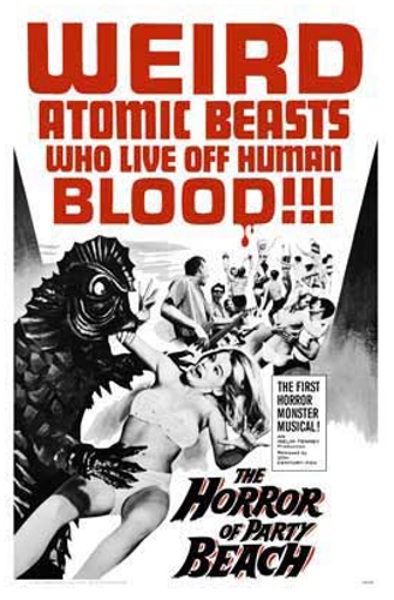
Can you believe that some people think that they didn’t know how to have fun in the early 60s?
Of course, you did have to look out for the monsters. I guess that was the only drawback…
(I should admit that I’m not really sure if this movie was supposed to be occurring during spring break but who cares? It’s got the zombie stomp! Add to that, I’d be worried about anyone who voluntarily spent their spring break on such a depressing-looking beach. Not when you can just go down to Galveston.)
More is such a film of the 60s that you can almost get a contact high from watching it.
It’s not just that the film was released in 1969. After all, there were a lot of films released in 1969 that don’t, in any way, feel like they belong in the 60s. (Just consider two of 1969’s Best Picture nominees, Anne of the Thousand Days and Hello, Dolly.) However, More is a film that seems to include every single thing that we think of when we think about the late 60s.
Drugs? Check.
Hitchhiking? Check.
Petty crime? Check.
Ennui? Check.
Weirdly out-of-place political bullshit? Check.
A fatalistic ending that suggests that nothing really matters? Check and double check.
More tells the story of a young German named Stefan (Klaus Grunberg). Stefan has just wrapped up his mathematics studies and now, he’s intent on exploring Europe and experiencing life! The first time we see Stefan, he’s hitchhiking and not having much luck. No one really wants to pick up Stefan and I really can’t blame them. Stefan is an incredibly boring character and Grunberg gives a remarkably dull performance in the lead role. Unfortunately, Stefan also narrates his story. I usually don’t like narrators in general but they especially get on my nerves whenever they appear in a movie that was made between 1966 and 1970.
Anyway, Stefan finally finds himself in Paris. He befriends Charlie (Michel Chanderil), who is a petty thief and who takes the naive Stefan under his wing. The movie picks up a bit whenever Charlie is on screen, largely because Chanderil has more screen presence than Grunberg. As I watched Charlie teach Stefan how to steal, I found myself wishing that the whole film could have been about Charlie.
But no. We’re stuck with boring old Stefan. Stefan eventually meets an American girl named Estelle (Mismy Farmer). Now, if Stefan was a fan of Godard, he would undoubtedly have seen Breathless and he would know better than to run off with an American girl. But, because Stefan is a dullard, he instead decides that he loves Estelle. When Estelle heads off for Ibiza, Stefan follows.
In Ibiza, Estelle is living with an enigmatic German named Dr. Wolf (Heinz Engelmann). Dr. Wolf is a former (and, it’s implied, current) Nazi. Stefan wins her away from Dr. Wolf. Stefan thinks that he’s rescuing her but Estelle really doesn’t seem to care one way or the other. Estelle introduces Stefan to the world of drugs and Stefan is soon hooked on heroin.
And it just goes on from there.
More probably could have probably been a really good film if Stefan wasn’t such a dull protagonist or if Grunberg had been in the least bit compelling in the lead role. From the minute I first saw him hitchhiking, my reaction was, “I do not care about this person” and that was pretty much the way I felt throughout the entire film.
The film does have its good points. The cinematographer was Nestor Almendros so Ibiza looks amazing and Pink Floyd provides an appropriately moody score. Mimsy Farmer, an American actress who later appeared in some of the best gialli to come out of Italy, is perfectly cast as the self-centered and casually destructive Estelle. But all the good points can’t make up for the film’s slow pace and Grunberg’s charisma-free performance.
More is probably best viewed as a cultural artifact. I’m a history nerd and I’m always fascinated by films like More that, regardless of their overall quality, are such obvious works of their time. More may reek of stale weed but watching it is definitely a chance to experience the 60s.
The 1993 film, Enemy Gold, actually gets off to a promising start, with a series of scenes that take place during the Civil War. Men in gray uniforms wander through the woods, looking for a place to hide their gold.
Now, you’ll notice that I said that it was a promising start. I didn’t necessarily say it was a good start. To be honest, when I first saw the soldiers, I thought they were supposed to be Civil War reenactors. The haircuts, the facial hair, even the relatively cleanliness of the uniforms; nothing that we see really suggests that we’ve been transported back to the 1860s.
That said, I’m a history nerd and I’ve always been fascinated with the Civil War. Even if it’s a totally unconvincing recreation, I’m always interested in seeing a movie about the period. I was even more interested when I discovered that the film’s Confederates were supposed to be members of Quantrill’s Raiders. William Quantrill was one of the more infamous sociopaths to come out of the Civil War and many of the famous outlaws of the Old West served with Quantrill. There’s always been rumors that, before he was killed by Union forces, Quantrill hid his gold in Texas. That rumors rests at the heart of Enemy Gold.
Of course, it takes a while to get around the gold. After the Civil War-set prologue, Enemy Gold jumps to the 1990s. A group of secret agents are preparing to attack a bunch of drug smugglers. One of the agents is played by an actor named Bruce Penhall, who previously played special agent Bruce Christian in the last few Andy Sidaris films. Despite the fact that Enemy Gold was directed by Sidaris’s son, Christian Drew Sidaris, it’s quickly established that Bruce Penhall is not playing Bruce Christian in this film. Instead, he’s playing Chris Cannon, a character who is exactly the same as Bruce Christian except that Cannon’s jokes are even worse than Christian’s. His two colleagues are named Mark Austin (Mark Barriere) and Suzi Midnite (Suzi Simpson).
(I was once tempted to change my name to Lisa Marie Midnite. I might still do it if I ever have to flee the country.)
Anyway, Chris, Mark, and Suzi manage to take down the drug smugglers. Great job, right? Wrong. It turns out that their boss, Dickson (Alan Abew), doesn’t appreciate them or their extreme methods. Dickson tells them that they’re suspended!
The three agents aren’t that upset about being suspended, though. It just means more time to hang out and maybe even go into the woods and search for Quantrill’s gold!
However, it turns out that they’re not the only ones who want the gold. An evil drug dealer, Santiago (Rodrigo Obregon), wants the gold and he’s hired a deadly assassin named Jewel Panther (Julie Strain) to help him get it. In case you were wondering why Dickson is such a jerk, it probably has something to do with the fact that he’s secretly working for Santiago!
Soon, everyone is in the woods, getting naked, and blowing stuff up. It’s a typical Sidaris film, right down to the reoccurring cast members and the terrible jokes. Actually, I take that back. The jokes in Enemy Gold are even worse than the typical Sidaris jokes.
A typical exchange from Enemy Gold:
“What’s up?”
“I am.”
I probably would have enjoyed Enemy Gold is the action had remained in the 19th century. The Civil War scenes may not have been convincing but at least they were dealing with an interesting period of time. Instead, the action jumped to the early 90s and the film got bogged down with drug smugglers and stuff like that.
Along with just being a generally dumb movie, Enemy Gold lacks the self-awareness that made films like Hard Ticket To Hawaii and Malibu Express somewhat enjoyable. The two best things about the film are Rodrigo Obregon and Julie Strain, who go totally overboard as the villains and provide the type of performances that a film like this needs. (At times, Obregon reminded me of Tommy Wiseau.) By contrast, our three heroes are remarkably dull.
If you’re a fan of stuff blowing up and Civil War trivia, Enemy Gold might occasionally hold your interest. Roberto Obregon, Otherwise, this is a film that you won’t regret missing.
First published in 1962, The Spy Who Loved Me is easily the most controversial of all of Ian Fleming’s Bond novels.
The Spy Who Loved Me was not the first of the Bond novels to keep James Bond off-stage for the majority of the story. From Russia With Love, one of the best of Fleming’s novels, keeps 007 offstage until about halfway through the book. The difference is that, even before he makes his first appearance, everyone else in From Russia With Love is obsessed with Bond. As well, From Russia With Love dealt with a world that Fleming knew well, the world of international intelligence operations.
The Spy Who Loved Me, on the other hand, is mostly about a young Canadian woman named Vivienne Michel who spends most of the novel discussing her background until, eventually, she finds herself being held prisoner by two cartoonish American gangsters named — I kid you not — Sluggsy and Horror. Fortunately, James Bond eventually shows up and rescues her. Vivienne not only narrates the novel but Ian Fleming even gave her co-writing credit on the title page.
In the book’s prologue, Fleming explains:
I found what follows lying on my desk one morning. As you will see, it appears to be the first person story of a young woman, evidently beautiful and not unskilled in the arts of love. According to her story, she appears to have been involved, both perilously and romantically, with the same James Bond whose secret service exploits I myself have written from time to time. With the manuscript was a note signed ‘Vivienne Michel’ assuring me that what she had written was ‘purest truth and from the depths of her heart’. I was interested in this view of James Bond, through the wrong end of the telescope so to speak, and after obtaining clearance for certain minor infringements of the Official Secrets Act I have much pleasure in sponsoring its publication.
So, The Spy Who Loved Me is a bit of an experiment. That Fleming often grew tired of Bond as a character is well-documented. Not only did Fleming have to come up with a new adventure every year but Bond himself couldn’t change from being who he had been since the early 50s, a serious-minded civil servant who occasionally saved the world. With this book, Fleming largely used Bond as a plot device, a deus ex machina.
Instead, the novel is dominated by Vivienne. Oddly, for someone who wants to tell us all about James Bond, Vivienne spends a good deal of time focusing on her life before she ended up at that hotel. We find out about her first boyfriend, an insincere British boy named Derek and also about her second boyfriend, an autocratic German named Karl. The scenes with Derek and Karl almost feel like a parody of the coming-of-age genre. That doesn’t mean that there aren’t compelling scenes to be found in The Spy Who Loved Me. Fleming was too good of a storyteller for anything that he wrote not to have some sort of value. But, at the same time, it’s still obvious that the story is being written by a British man in his 50s who is trying really, really hard to sound like a Canadian woman in her 20s.
And then — oh my God! Sluggsy and Horror show up! I’m sorry but there’s no way that you can take anyone named either Sluggsy or Horror seriously. They are, without a doubt, the weakest villains since Diamonds are Forever gave us the Spang Brothers.
On the plus side, Horror did apparently inspire Jaws, the henchman played by Richard Kiel in the film versions of both this book and Moonraker. And, even if the experiment didn’t quite work, it’s still interesting to see Bond through someone else’s eyes.
Fleming was so dissatisfied with this novel that, when he sold the film rights, he specifically required that the film not use any material from the book. While The Spy Who Loved Me may not be Fleming’s strongest work, he would follow it up with the last great Bond novel, On Her Majesty’s Secret Service.