Great Moments In Comic Book History #38: The Cover of Green Lantern/Green Arrow #85


“You always have all the answers, Green Arrow … well, what’s your answer to that!?”

Green Lantern and Green Arrow were always mismatched as friends.  Green Lantern was an upstanding citizen of the universe while Green Arrow was the former millionaire who now fighting for the working man.  In Green Lantern/Green Arrow #85 (August, 1971), they discovered that the Green Arrow’s arrows were being used by junkies to commit crimes so that they could pay for their habit.  They were buying the arrows from Speedy, who was the Green Arrow’s own sidekick!  Speedy had gotten hooked on heroin.

Along with a three-issue arc of The Amazing Spider-Man in which Harry Osborne developed a pill addiction, Green Lantern/Green Arrow #85 was one of the first comic books to deal with drug addiction and it featured one of its own heroes getting hooked on a very real drug.  Both artist Neal Adams and writer Denny O’Neil wanted to deal with the issue realistically.  Neal Adams’s cover, featuring not just paraphernalia but Speedy in the act of shooting up, was considered to be very risky in 1971.  Today, it’s the moment that DC finally made the move into exploring more mature storylines.

Previous Great Moments In Comic Book History:

  1. Winchester Before Winchester: Swamp Thing Vol. 2 #45 “Ghost Dance” 
  2. The Avengers Appear on David Letterman
  3. Crisis on Campus
  4. “Even in Death”
  5. The Debut of Man-Wolf in Amazing Spider-Man
  6. Spider-Man Meets The Monster Maker
  7. Conan The Barbarian Visits Times Square
  8. Dracula Joins The Marvel Universe
  9. The Death of Dr. Druid
  10. To All A Good Night
  11. Zombie!
  12. The First Appearance of Ghost Rider
  13. The First Appearance of Werewolf By Night
  14. Captain America Punches Hitler
  15. Spider-Man No More!
  16. Alex Ross Captures Galactus
  17. Spider-Man And The Dallas Cowboys Battle The Circus of Crime
  18. Goliath Towers Over New York
  19. NFL SuperPro is Here!
  20. Kickers Inc. Comes To The World Outside Your Window
  21. Captain America For President
  22. Alex Ross Captures Spider-Man
  23. J. Jonah Jameson Is Elected Mayor of New York City
  24. Captain America Quits
  25. Spider-Man Meets The Fantastic Four
  26. Spider-Man Teams Up With Batman For The Last Time
  27. The Skrulls Are Here
  28. Iron Man Meets Thanos and Drax The Destroyer
  29. A Vampire Stalks The Night
  30. Swamp Thing Makes His First Cover Appearance
  31. Tomb of Dracula #43
  32. The Hulk Makes His Debut
  33. Iron Man #182
  34. Tawky Tawny Makes His First Appearance
  35. Tomb of Dracula #49
  36. Marvel Publishes Star Wars #1
  37. MAD Magazine Plays Both Sides
Glass Jaw (2018, directed by Jeff Celentano)


When the daughter of his trainer dies of a drug overdose at his house, world light heavyweight champion Travis Austin (Lee Kholafai) takes the blame and goes to prison, even though the drugs were brought into his house by his sparring partner, Joe (Brandon Sklenar).

After four years of being incarcerated, Travis is released into a brand new world.  His wife (Korrina Rico), who waited for his release and only cheated on him once in a moment of weakness, now works as a waitress and lives in a small apartment.  Joe is now not only the light heavyweight champion but also refuses to help Travis get back on his feet.  Travis finally ends up working at a gym, owned by the cantankerous Frank Maloney (Mark Rolston).  It’s a tough life but an unexpected opportunity gives Travis a chance to win back his title.

Glass Jaw pretty much lost me as soon as Travis decided to take the rap and go to prison for something that Joe was responsible for.  Being loyal is one thing but being stupid is something else and, by taking the fall, Travis put his wife in a terrible position.  The film had all of the usual boxing cliches but the Big Fight at the end was strangely anti-climatic, even if both Kholafai and Sklenar looked credible while they were throwing punches at each other.

The best performance in the film was delivered by Jon Gries, who had a small role as Travis’s alcoholic father.  I would have liked for the entire movie to have been about his character.

It’s Elvis Presley’s Birthday!


Since today is Elvis Presley’s birthday, I’m going to share this photograph that my grandfather took in 1958, of Elvis reporting for his induction into the army.  As far as I know, this picture has never been published anywhere other than on this site and my own personal blog.

Photograph by Raymond Ellis, taken on March 24th, 1958 at Fort Chafee, Arkansas

Game Review: Get There On Time! (2024, Leticia Fox)


You’re awake!  Your day has just begun!  Can you get there on time!?

Get There On Time! is a game that I think everyone can relate to.  Each day, you wake up.  You are determined to get there on time.  Where is there?  It doesn’t matter.  You just have to get there on time.  Can you do it?

Get There On Time! is short and simple.  It’s a game in that you are given a selection of options but, just as in real life, some times it doesn’t matter how many options you are given.  This really is more of an existential joke than a traditional game, with each choice leading to the inevitable punchline.  But it’s a joke that everyone can relate to.

Click here to play Get There On Time!

The Challenger (2015, directed by Kent Moran)


Jaden Miller (Kent Moran, who also directed) is a former honor student who threw away his scholarship to a private school when he got into a fight while defending another student.  Having dropped out of high school, Jaden now works as an auto mechanic in the Bronx.  When he and his mother (S. Epatha Merkerson) are evicted from their crummy townhouse, Jaden tries to make extra money by becoming a professional boxer.  As the “Bronx Boy,” he becomes a local hero and eventually, he wins the chance to challenge the light heavyweight champion of the world (Justin Hartley).

A by-the-numbers boxing movie, The Challenger was the final film of Michael Clarke Duncan and he’s the best thing about the movie.  Duncan plays Duane Taylor, the former boxing trainer who dropped out of the spotlight after one of his boxer threw a fight.  Duane agrees to train Jaden because he has a secret connection to both Jaden and his adoptive mother.  Clarke, with his powerful voice and his infectious laugh, is close-to-perfect in the role and he keeps things interesting, even when the movie sinks into an ocean of cliches.  The Challenger was released thee years after Duncan’s tragic death and the end credits feature behind-the-scenes footage of a friendly Duncan smiling and laughing with the film’s crew.  The movie may be imperfect but it serves as a tribute to a talented actor who passed away too young.

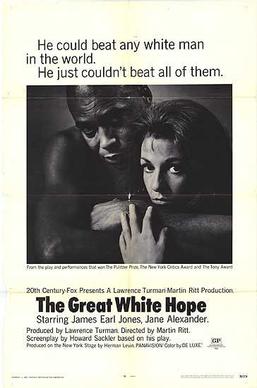
The Great White Hope (1970, directed by Martin Ritt)


The year is 1910 and the sports world is in a panic.  For the first time, a black man has won the title of the heavyweight champion of the world.  Jack Jefferson (James Earl Jones) had to go to Australia because no American city would agree to host the fight but he came out of it victorious.  The proud and outspoken Jefferson finds himself targeted by both the white establishment and black activists who claim that Jefferson has not done enough for his community.

It’s not just Jefferson’s success as a boxer that people find scandalous.  It’s also that the married Jefferson has a white mistress, a socialite named Eleanor Brachman (Jane Alexander, in her film debut).  While boxing promoters search for a “great white hope” who can take the title from Jefferson, the legal authorities attempt to arrest Jefferson for violating the Mann Act by supposedly taking Eleanor across state lines for “immoral purposes.”  Jefferson and Eleanor end up fleeing abroad but even then, their relationship is as doomed as Jefferson’s reign as the heavyweight champ.

Based on a Pulitzer-winning stage play by Howard Sackler, The Great White Hope features Jones and Alexander recreating the roles for which they both won Tonys.  Both Jones and Alexander would go on to receive Oscar nominations for their work in the film version.  It was the first nomination for Alexander and, amazingly, it was the only nomination that Jones would receive over the course of his career.  (It surprises me that he wasn’t even nominated for his work in Field Of Dreams.)  Both Jones and Alexander give powerful performances, with Jones dominating every scene as the proud, defiant, and often very funny Jack Jefferson.  Jones may not have had a boxer’s physique but he captured the attitude of a man who knew he was the best and who mistakenly believed that would be enough to overcome a racist culture.  (Speaking of racist, legendary recluse Howard Hughes reportedly caught the film on television and was so offended by the sight of Jones kissing Alexander that he thought about buying NBC to make sure that the movie would never be aired again.)  Hal Holbrook, Chester Morris, Moses Gunn, Marcel Dalio, and R.G. Armstrong all do good work in small roles.

Unfortunately, The Great White Hope still feels like a filmed stage play, despite the attempts made to open up the action.  Martin Ritt was a good director of actors but the boxing scenes are never feel authentic and the middle section of the film drags.  Jones and Alexander keep the film watchable but The Great White Hope is never packs as strong of a punch as its main character.

Game Review: Re-Election Campaign (2024, by Orange)


Re-Election Campaign is a Choose Your Own Adventure-style work of Interactive Fiction.  You are Jesse Jordan, the mayor of Cougar Valley, Washington.  You have been mayor for the last four years and you’re planning on being mayor for the next four and for a long time after that.

But first, can you win reelection?  Getting more votes than your friend Bob shouldn’t be a problem.  But what about Marie Eckles, the wealthy reform candidate who keeps highlighting what a terrible mayor you’ve been?  Do you do what you have to do to raise the money to out-advertise her?  Or do you just challenge her to a duel?  Or do you do something that is potentially even worse to secure your victory?

I don’t want to spoil the game but Re-Election Campaign has so many options and so many different outcomes that its one that you really do have to play over and over again to get the full story.  You can either play this quickly for fun (and I enjoyed seeing what would happen whenever I made an obviously bad decision) or you can do a deep dive and discover just how crazy things can get when politics and power are concerned.  I really enjoyed discovering a new aspect of the story every time that I played.  It takes more than a few run-throughs to really discover who Jesse Jordan really is.  Nothing is what it initially seems and I actually was taken by surprise when the truth was eventually revealed.  Well-written and frequently very funny, Re-Election Campaign is one of the best IF games that I’ve played in a while.

Click here to play Re-Election Campaign.

Chip of the Flying U (1939, directed by Ralph Staub)


In this B-western, Johnny Mack Brown plays Chip Bennett, the foreman of the Flying U Ranch.  The ranch is owned by J.G. Whitmore (Forrest Taylor) and his daughter (Doris Weston), who has just returned from college and who has eyes for Dusty (Bob Baker), a singing ranchhand.

Ed Duncan (Anthony Warde) and his gang are in the arms smuggling business.  To make their business a success, they need access to the ranch, which sits on the shore of a lake.  Knowing that Chip would never let them take over, Duncan tries to frame Chip for a bank robbery and murder.  Chip responds by kidnapping two of Duncan’s men, leading to a final and explosive shootout.

Chip of the Flying U is a western that doesn’t seem to know what era it’s supposed to be taking place in.  Chip, Duncan, and all of the other ranch hands dress like they’re in the late 1800s.  Doris Weston dresses like she’s just stepped out of a 1930s photoshoot.  Duncan is trying to smuggle hand grenades, which were invented in 1908 but not commonly used until World War I.  The movie’s time period is all over the place but that was frequently the case with the B-westerns of the 30s.  Shot on studio backlots and for a very low budget, these films were not concerned with historical accuracy.  Instead, they were about shootouts and a few songs.  Chip of the Flying U offers up both, along with Fuzzy Knight as the comedic sidekick who turns out to be very good with a rifle.

With lots of horse chases and bloodless shoot-outs and not too much romance, this movie may seem creaky by today’s standards but probably thrilled the kids who caught while spending an afternoon at the movies in 1939.  Today, the appeal of movies like this is that the good guys are unquestionably good and the bad guys are unquestionably bad.  They remind us of a simpler time that may have never existed but we all hope it did.

Scalplock (1966, directed by James Goldstone)


In this comedic western, gambler Benjamin Calhoun (Dale Robertson) wins big in a poker game.  Not only does he walk away with several thousand dollars but he also now owns his own railroad, the BP;S&D.  Calhoun celebrates the biggest win of his career by tossing ten dollar bills at the townspeople, recruiting a worshipful young assistant (Bob Random), and commandeering a private railcar that belongs to wealthy Burton Standish (John Anderson).  In the car, he finds Marta Grenier (Diana Hyland), a “working woman,” who has been hired to provide company for Standish.

Calhoun and Marta ride off to check out Calhoun’s new railroad.  What he discovers is that the railroad that he won is not only not completed but the workers are striking because they haven’t been paid in two weeks.  The quick-thinking Calhoun offers to make all of the workers part-owners of the railroad.  With construction once again starting, Calhoun tries to figure out how to keep his new business open.  He also meets a strong-headed storekeeper named Joanna Royce (Sandra Smith).

When Standish finally shows up, it turns out that he was originally planning on buying the BP;S&D.  Will Calhoun hold onto the railroad and honor the promise he made to the workers or will he sell out to Standish?

For all the talk about completing the railroad, Scalplock ends with most of the work undone.  That’s because Scalplock was a pilot for The Iron Horse, a television series that lasted for two seasons in the 60s.  Scalplock (and The Iron Horse) is mostly a showcase for Dale Robertson, a low-key but always convincing actor who specialized in westerns.  Usually, Robertson was cast as an upstanding citizen and law enforcement agent.  In Scalplock, he’s playing the type of genial rogue that James Garner played on Maverick and later in The Rockford Files.  Robertson is likable in Scalplock and even convinces us that Calhoun would choose his workers over a quick payday.  Fan of the genre will enjoy Scalplock, as long as they don’t get too invested in witnessing that last track of rail laid into the ground.

Dale Robertson, who started his career in the 40s, continued to act through the 90s, though usually as a guest star instead of a series lead.  Robertson eventually retired to Oklahoma where he owned a ranch that was home to over 200 horses.  He passed away in 2013 at the age of 89.

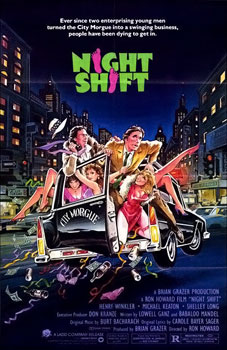
Night Shift (1982, directed by Ron Howard)


Chuck Lumley (Henry Winkler) was a Wall Street wizard until the stress of the job started to give him ulcers.  He dropped out of the rat race, got a less stressful job as an attendant at a New York City morgue, and eventually met and became engaged to Charlotte (Gina Hecht).  When Chuck’s supervisor decides to give Chuck’s day shift to his new guy, Chuck is promoted to the night shift.  “He has the same last name as you,” Chuck says when he learns the about the new employee.  “Yeah, I think he’s my nephew or something,” his supervisor replies.

Chuck finds himself working nights with “Billy Blaze” Blazejowski (Michael Keaton), a hyperactive “idea man,” who has so many brilliant plans that he has to carry around a tape recorder so he doesn’t forget them.  A typical Billy Blaze idea is to battle litter by creating edible paper.  Another one is to rent out the hearse as a limo and give rides to teenagers.  Chuck may not be happy about his new shift or coworker but he is happy that he shares his new work schedule with his upstairs neighbor, Belinda Keaton (Shelley Long).  Belinda is a high-class prostitute who first meets Chuck when she comes by the morgue to identify the body of her pimp.  When Chuck discovers that Belinda needs a new pimp, he and Billy take on the job themselves, which brings them into conflict with not only the vice cops but also with Pig (Richard Belzer) and Mustafa (Grand L. Bush).

Raunchy but good-hearted, Night Shift has always been one of my favorite comedies.  Along with being Ron Howard’s first movie for grown-ups, it also featured Michael Keaton in his first lead role.  Keaton is both funny and surprisingly poignant as Billy.  He’s hyperactive and impulsive and doesn’t think things through but his friendship with Chuck is real and later on in the movie, he reveals himself to have more depth than he lets on.  Also giving good performances are Henry Winkler and Shelley Long, two performers better-known for their television work than their film roles.  With his role here, Winkler proved that he was capable of playing more than just the Fonz.  Shelley Long has probably never been better (or sexier) than she was in this film.  The scene where she makes breakfast for Chuck is unforgettable.  Even though she’s playing a stock character, the prostitute with a heart of gold, Shelley Long brings her own unique charm to the role and makes Belinda seem like a real person.

Night Shift starts out strong but falters slightly during its second hour, when Chuck and Billy seem to magically go from being nerdy morgue attendants to successful pimps overnight.  Some of the violence feels out-of-place in what is essentially a buddy comedy with a dash of romance.  It’s still a funny movie that is full of memorable one liners and good performances.  As you might expect from Ron Howard, Night Shift is a surprisingly good-hearted look at the business of sex.  Ron Howard has directed a lot of films since but few of them are as much fun as Night Shift.