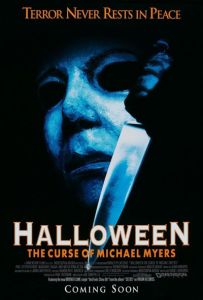
 Long before he was either Ant-Man or Judd Apatow’s favorite leading man, Paul Rudd was just another young actor looking for his first break. He got it in 1995 when he was cast in the latest entry in the Halloween franchise. Though Clueless was released first, the man who would be Brian Fantana got his introducing credit for Halloween: The Curse of Michael Myers. (He’s credited as Paul Stephen Rudd.)
Halloween: The Curse of Michael Myers was Miramax’s attempt to reboot the franchise by ignoring everything that made the first Halloween such a success in the first place. John Carpenter’s Halloween was the epitome of simplicity, with Michael Myers portrayed as being an almost entirely motiveless killing machine. One reason why Michael was scary was because he didn’t have any reason for killing other than he was evil. (It was not until Halloween II that Laurie was discovered to be Michael’s sister and Samhain came into play.)
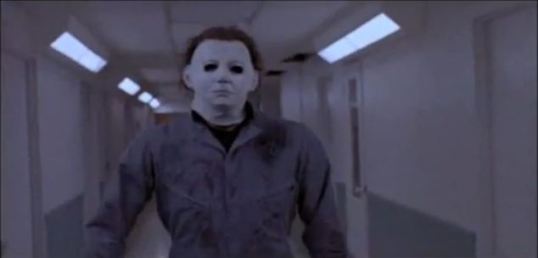
In Halloween 6, Michael (played by stuntman George P. Wilbur) is suddenly revealed to be afflicted with the Curse of the Thorn. Because of the curse, he is required to serve as some sort of indestructible hit man for a cult of Druids (!) who are operating out of the basement of Smith Grove’s Sanitarium (!!), the same mental hospital that Michael escaped from at the start of the first film. The head of the cult is Dr. Wynn (Mitchell Ryan), who was Sam Loomis’s boss in the first movie.
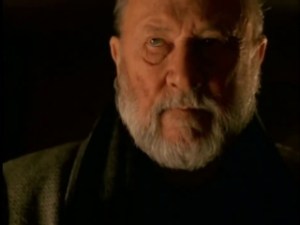 Donald Pleasence is back as Dr. Sam Loomis but it is not a happy return. This was Pleasence’s final film and, in his few scenes, it is obvious that he was not in good health and his famous voice had been reduced to a hoarse rasp. Pleasence died shortly after filming his scenes, which meant that he wasn’t available for the reshoots that Miramax demanded after the first cut of the film tested badly. Add that to the fact that director Joe Chapelle reportedly had not seen any of the previous Halloweens, did not find the Loomis character to be interesting, and cut him out of several scenes and Dr. Loomis is barely in The Curse of Michael Myers.
Instead, most of the film is centered around Tommy Doyle (Rudd). Yes, the same Tommy Doyle for whom Laurie babysat in the first Halloween. Tommy has figured out that, because of the curse, Michael has to kill his next of kin every Halloween. How did Tommy figure that out? I don’t know and the film doesn’t know. It’s like trying to figure out how Sean Connery knew where the Holy Grail was in Indiana Jones and The Last Crusade.
Michael’s next of kin was Jamie Lloyd but, at the end of Halloween 5, she was kidnapped by the Cult of Thorn and held prisoner for six years. For some reason, Michael did not kill her while she was being held captive. Instead, Jamie was impregnated, gave birth to a baby boy named Stephen, and then escaped. Though she was eventually killed by Michael, Tommy found the baby and has to protect the baby from Michael and the Cult.
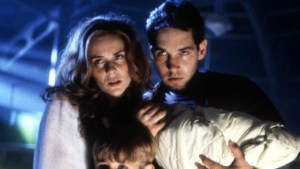 Why does the Cult want the baby? Why do birds suddenly appear whenever you are near? There is no explanation, it’s just something that happens.
Michael comes back to Haddonfield to track down his grandnephew. He also finds time to kill more members of the dysfunctional Strode family. Luckily, Kara Stroe (Marianne Hagan) and her son, Danny, survive. Danny is having dreams about killing people which would seem to suggest that he has inherited the Curse of the Thorn, except that the Strodes are not actually related to the Myers family so it doesn’t make any damn sense.

After six films, it not always easy to keep track of how everyone is related. Let’s see if I can do it:
Laurie Myers is the younger sister of Michael Myers and Judith Myers. In 1963, when Michael is 6 and Laurie is 2, Michael murders Judith. Michael goes to Smith’s Grove Sanitarium, where he is treated by Dr. Loomis and secretly raised by the Cult of the Thorn. Mr. and Mrs. Myers die in 1965 and Laurie is adopted by the Strodes. Laurie has no memory of being a Myers.
 In 1978, Michael “escapes” from Smith’s Grove and tries to kill Laurie. Both he and Dr. Loomis get blown up at the hospital.
Between 1978 and 1988, Laurie marries someone named Lloyd and they have a daughter named Jamie. But then Laurie and her husband die in a traffic accident and Jamie is raised by her foster family, the Carruthers. Except Laurie didn’t really die but instead faked her death and abandoned her daughter which seems like a shitty thing to do.
In 1988, it turns out that both Michael and Dr. Loomis survived being blown up and consumed by a raging inferno. Michael again escapes from custody and goes to Haddonfield. He tries to kill Jamie but instead ends up falling down a mine shaft. Jamie goes home and tries to kill her foster mother.
In 1989, Michael turns out to be alive again and tries to kill Jamie for a second time. The Man In Black, who is somehow connected to the the Cult of Thorn, shows up and breaks Michael out of jail and kidnaps Jamie.
Then, six years later, Jamie has a son named Stephen and is finally killed by Michael. Meanwhile, Laurie’s uncle, John Strode (Bradford English), has moved into the old Myers house because why not live in the house formerly inhabited by a serial killer who tried to murder your family? Living with them is Laurie’s cousins, Kara and Tim (Kieth Bogart) and Kara’s son, Danny.
Meanwhile, Laurie is in the witness protection program and teaching school but you don’t have to worry about that until Halloween: H20.
Got all that?
I haven’t even gotten to the sleazy radio DJ who wants to do a live Halloween broadcast from inside the old Myers House. There’s not much to say about him beyond noting that the role was originally offered to Howard Stern.
There are two versions of The Curse of Michael Myers floating around. There’s the producer’s cut, which goes into more detail about the druids and attempts to fill some of the continuity gaps in the franchise. Then there’s the theatrical edition, which was what Miramax released into theaters. I have only seen the theatrical cut, which is a confusing mess.
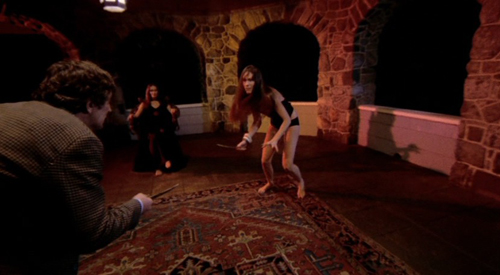
While the producer’s cut features Michael being defeated by Celtic magic (which sounds stupid but would actually go with what’s already been established in the movie), the theatrical cut ends with Michael, who has previously survived being shot six times by Dr. Loomis, falling down a mine shaft, and literally blowing up, somehow being beaten into submission by Paul Rudd and a lead pipe. Is there nothing that Paul Rudd cannot do?
Mr. Rudd, the town of Haddonfield owes you a debt of gratitude.
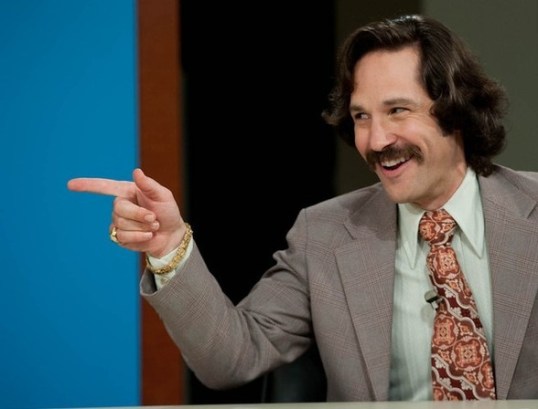
You stay classy, Haddonfield.
 A pair of immaculate white sneakers, being worn by the lead singer of The Talking Heads, David Byrne, walk out onto a bare stage while an unseen audience applauds. Byrne places a radio on the stage beside him and says, “I have a tape I want to play for you.” Accompanied only by a drum machine and an acoustic guitar, Byrne launches into a performance of Psycho Killer that ends with him lurching across the stage like a marionette that is losing its strings.

 A long time ago in a galaxy far, far away…



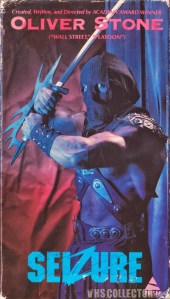 Everyone had to start somewhere and, long before he became one of the leading political provocateurs of American cinema, Oliver Stone was just another struggling film school grad who was looking for a chance to make a name for himself. Like many aspiring filmmakers, Stone made his directorial debut with a low-budget horror film.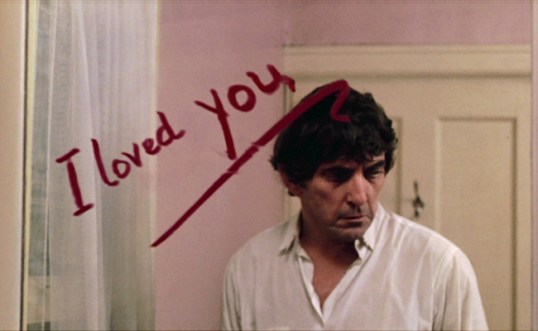
 Through the Shattered Lens