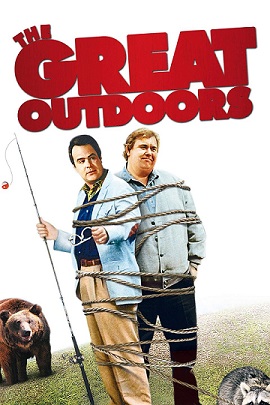
The Great Outdoors (1988, directed by Howard Deutch)


Chet Ripley (John Candy) wants to have a nice vacation up at the lake with his wife (Stephanie Faracy) and their two sons, Buck (Chris Young) and Ben (Ian Giatti).  Unfortunately, no sooner has he arrived than the vacation is crashed by Chet’s sister-in-law (Annette Bening, making her film debut) and her husband, Roman (Dan Aykroyd).  Roman represents everything that that the mild-mannered Chet hates.  Roman is loud, obnoxious, and obsessed with showing off his wealth.  Roman knows nothing about how to survive in the great outdoors and he treats Chet like he’s a loser but, for the sake of giving his family a good vacation, Chet tries to get along with Roman.  At first, it doesn’t work but eventually, Chet and Roman have to team up to find Roman’s daughters and deal with not only a bear but also talking raccoons.  Meanwhile, Buck falls in love with local girl, Cammie (Lucy Deakins).  I imagine the same can be said of a lot of people who caught this film on HBO when they were twelve.

The Great Outdoors is very much a comedy of the late 80s.  Roman may be a crass Yuppie but it doesn’t appear that Chet is suffering financially either.  The humor is broad and physical but the film never resorts to the gross-out style that has since come to define cinematic comedy.  It’s a film that makes fun of the obligations of family life while also celebrating them and you won’t be shocked to learn that the script was written by John Hughes.  John Candy is likable and Dan Aykroyd has a demented twinkle in his eye.

It’s not a bad movie but I just wish it had been funnier.  Don’t get me wrong.  When you’re a kid and you come across The Great Outdoors on cable, it’s hilarious because it’s got John Candy waterskiing and a bear and, of course, the talking raccoons.  Watching it as an adult, though, it’s easier to see just how much the material and the film’s family-safe approach holds back both Candy and especially Aykroyd.    Both of them were capable of being wild comedic performance but, in The Great Outdoors, the movie doesn’t let either one of them really go crazy and that’s too bad.  Instead of being a showcase for the best of SNL and SCTV, it becomes an amusing but ultimately very safe family comedy.  (Arguably, Hollywood never really figured out the best way to use Candy and Aykroyd’s comedic talents, though Candy’s films before his untimely death suggested that he was on the verge of a genuine breakthrough.)

I did laugh when I rewatched The Great Outdoors but I didn’t laugh as much as I did when I was a kid.  Now, I feel old and I’m thinking about how unfortunate it is that John Candy died before production could start on the biopic of Fatty Arbuckle that Candy was tentatively set to star in.  Much like Phil Hartman, it’s hard to watch John Candy today without thinking about how he was taken when he was on the verge of probably doing what would have been his best work.

Time to cheer myself up with What About Bob?

Montana Incident (1952, directed by Lewis D. Collins)


Whip Wilson (played, in a fortunate coincidence, by Whip Wilson) and his partner, Dave Conners (Rand Brooks) work for the railroad company as surveyors in the old west.  They’ve come to the town of Martinville to convince the citizens that the town would benefit from having a train station.  Mostly, they just want to go to the saloon, have a beer, and flirt with the local gals.

Albert Hawkins (WIlliam Fawcett) is the leader of the local homesteaders and he’s all for bringing the railroad to town.  Land baron Max Martin (Hugh Prosser) disagrees.  Martin is not really a bad person but his daughter, Clara (Peggy Stewart), is a greedy fanatic who doesn’t want to lose the water rights to the land.  With her boyfriend, outlaw Arnold Benson (Bruce Edwards), Clara rules the town with an iron fist.  Whip and Dave must defeat Arnold and Clara so that progress can come to the frontier.

Montana Incident is a standard western programmer but it is distinguished by having an evil female land baron instead of the usual male land baron.  Stewart tears into the world, proving that she can be just as dangerous as any man.  Fans of the old Adventures of Superman TV show will immediately recognize Noel Neill, playing the role of Clara’s much nicer sister.

If you’re a fan of B-westerns, Montana Incident is watchable enough.  Wilson and Brooks are bland heroes but Peggy Stewart is so good at being evil that she makes the movie worth watching.

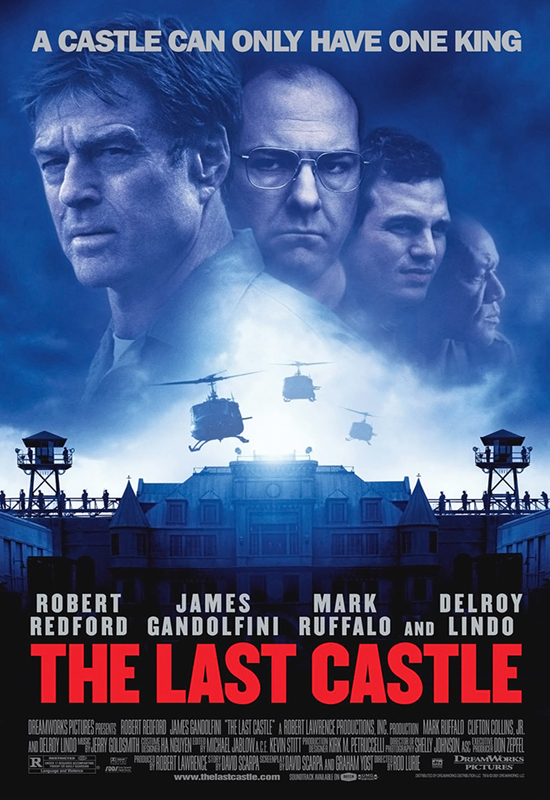
The Last Castle (2001, directed by Rod Lurie)


It’s Redford vs. Gandolfini in The Last Castle!

The last castle of the title is a United States Military Prison, one that was originally constructed during the Civil War and which resembles a castle, but with one big difference. Castles were originally designed to keep people from entering. The purpose of this castle is to keep people from leaving.

Colonel Ed Winter (James Gandolfini) is the prison’s commandant, a martinet who has never served in war but who keeps a collection of bullets and weapons in his office. Eugene Irwin (Robert Redford) is the newest inmate. Irwin was a highly respected general until he disobeyed a presidential order and eight of his men died as a result. Irwin has been stripped of his rank and sentenced to ten years. He tells Winter that he just wants to do his time and then go home. That’s fine with Winter, until he overhears Irwin disparaging his collection of battlefield memorabilia.

At first, Irwin tries to lay low.  Even when he sees firsthand that Winter is a sadist who manipulates the inmates and who isn’t above ordering his guards to kill an inmate in order to make a point, Irwin tries to stay uninvolved.  But eventually, Irwin’s natural military instincts kick in and he leads the prisoners in a revolt against Col. Winter.

The Last Castle requires a healthy suspension of disbelief.  Irwin brings the inmates together by reminding them that they were once soldiers and that, even when serving time in a military prison, they’re apart of a grand tradition of soldiers who have been court-martialed.  He soon has them saluting and standing at attention and walking in formation.  The movie overlooks the fact that most of the prisoners were sentenced to the prison by men much like General Irwin.  The idea that all of them are just waiting for someone to once again start barking orders at them just doesn’t seem plausible.  Instead, it seems more likely the Irwin, as a former general, would be the least popular inmate in a prison that’s full of enlisted men who feel that they were screwed over the army.  In the end, Irwin asks the prisoners to sacrifice a lot but, in the end, it doesn’t matter how heroically he’s framed in each scene or how much the music swells on the soundtrack, Iwin’s rebellion seems like its more about ego than anything else.  Even if it means getting rid of Col. Winter, would any of the inmates realistically be willing to die for Eugene Irwin?

At the same time, The Last Castle is worth watching just to see James Gandolfini face off against Robert Redford.  Gandolfini plays his role with the type of neurotic energy that only a method actor is capable of capturing while Redford is his typical move star self.  The contrast between their two styles of acting translates well into the contrast between Winter and Irwin’s philosophy of leadership.  Among the inmates, Mark Ruffalo and Clifton Collins, Jr. both have early roles.  Of the two, Ruffalo gets to play the only character in the film with a hint of moral ambiguity and he runs with it.  Clifton Collins, Jr., meanwhile, plays a character whose fate will be obvious to anyone who has ever seen a film before.  The Last Castle has its moment but it’s never a surprising movie.

The Last Castle ends with a spontaneous display of patriotism, one that is effective but also feels implausible and out-of-place.  It’s the perfect way to sum up this frustrating but occasionally diverting film. 


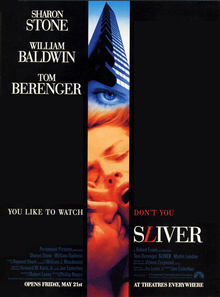
Sliver (1993, directed by Phillip Noyce)


Who here remembers Sliver?

It may be hard to believe it but Sliver was a big deal back in the day.  It was one of Robert Evans’s first producing gigs after getting out of rehab.  It was Sharon Stone’s first film after Basic Instinct.  The script was written by Basic Instinct‘s Joe Eszterhas, back when that was still something that people bragged about.  It featured Tom Berenger, back before he found himself relegated to character roles, and William Baldwin.  Remember William Baldwin?  He was Alec Baldwin’s younger brother.  He looked just like Alec but he never managed to project much of a personality whenever he was onscreen.  Even Stephen Baldwin was a more interesting actor than William.  Still, back in the day, William Baldwin was close to being a star.

William Baldwin’s lack of personality actually works for the role he plays in Sliver.  He’s Zeke, who owns an exclusive high-rise apartment building.  Zeke makes his money designing video games and he’s filled the building with secret video cameras so he can spend all day sitting in front of a wall of monitors and watching his tenants and experiencing their lives without having to get close to them.  Zeke’s a voyeur.  Back in the 90s, the surveillance thing was a big twist.  Today, we take it for granted.  We even applauded Batman for doing the same thing to all of the citizens of Gotham.

Sharon Stone plays Carly, the newest resident of the Sliver.  Carly is a recently divorced book editor snd is lonely and repressed despite being played by Sharon Stone.  She draws the attention of both Zeke and her neighbor, Jack (Tom Berenger).  Both are interested when they discover that Carly has a telescope on her balcony.  “She’s a voyeur!” Jack says.  When Carly gets involved with Zeke, Jack is obsessively jealous.  He insinuates that Zeke had something to do with the death of the previous tenant of Carly’s apartment.

After Basic Instinct, Sharon Stone made a series of films that were designed to show that she actually could act by casting her as characters who were meant to be sexually repressed.  The films never seemed to work because, at the height of Sharon Stone’s 90s stardom, there was nothing about her that suggested that she was repressed in any way.  What made her a star in the first place was that she was so uninhibited and not afraid to be as blunt about sex as any of her male co-stars.  In Sliver, she gives a performance that is somewhere between her vampish work in Basic Instinct and her terrible ice queen performance in Intersection.  At the start of the film, she feels miscast as a straight-laced book editor but her performance gets better once she starts hooking up with Zeke.  Sharon Stone tries, even if she doesn’t succeed.  That’s more than can be said for most of her co-stars.

“Get a life,” Sharon Stone says at the end of the movie and, as far as final lines go, it’s a bad one because it comes out of nowhere and her actions in the final scene don’t fit in with anything that she’s previously said or done in the film.  That’s because the ending was hastily reshot after test audiences disliked the original ending.  Test audiences often have the worst instincts.

Like many things, Sliver was big in the 90s but forgotten today.  It was a popular Blockbuster rental for a while.  VCRs were set for whenever it appeared on Cinemax.  When it first came out, it was all about Sharon Stone.  Today, it’s all about nostalgia.

A Gary Oldman Scene That I Love: The Hotel Scene From The Firm


The Firm (1989, directed by Alan Clarke)

Since today is Gary Oldman’s birthday, I decided to share a scene that I love from The Firm.

Directed by Alan Clarke, this 1989 film was originally made for the BBC and it stars Oldman as Bex Bissell.  During the week, Bex sells real estate.  During the weekend, he’s a football hooligan and the leader of his own firm.  Though The Firm is not as well-known in the States as some of his other films, I think that Gary Oldman’s performance here might very well be the best of his career.

In this scene, Bex and his firm meet with two other firms in a London hotel.  They’re arguing about who is going to be the “top boy” during the upcoming international football tournament in Holland.  Mostly, they’re just trying to out-intimidate and one-up each other.  Oldman controls the scene through pure attitude.

We leave you with the ICC motto — “we come in peace, we leave you in pieces.”

Music Video of the Day: Jump Around by House of Pain (1992, directed by David “Shadi” Perez)


Happy St. Patrick’s Day!

Ever since it was first released and this video first aired on MTV, Jump Around has been one of the unofficial anthems of St. Patrick’s Day.  The video was so popular that many people continue to associate both the song and House of Pain with Boston’s Irish community, despite the fact that the band was from Los Angeles and only two members were of Irish descent.

All together now: “I came to get down, I came to get down, jump around!”

Enjoy!

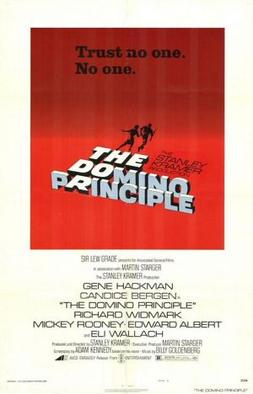
The Domino Principle (1977, directed by Stanley Kramer)


Roy Tucker (Gene Hackman) loyally served his country as a part of a “search and destroy” team in Vietnam but when he returned home, he discovered that America didn’t appreciate his sacrifice.  When he was convicted of murdering his wife’s abusive first husband, he was tossed in prison.  But now, two mysterious men (Richard Widmark and Edward Albert) have offered Tucker a chance to escape from prison and reunite with his wife (Candice Bergen) in Costa Rica.  The only catch is that they also expect Tucker to do a job for “the Organization” and assassinate an unidentified target.  As Tucker discovers, The Organization has been watching and manipulating him entire life, setting him up for this very moment.  Every small event in Tucker’s life led to another event that eventually sent him to both the war and to prison.  It’s almost like a game of dominos.  And we have a title!

The Domino Principle gets off to a good start, with a black-and-white montage of actual assassinations and then an opening credit sequence that features someone placing dominos over pictures of Roy Tucker at different ages.  (I am guessing that actual childhood photos of Gene Hackman were used because even the baby pictures feature the Hackman squint.)  However, the scene immediately following the credits features Gene Hackman and Mickey Rooney as cellmates and the film never really recovers.  Though they were both talented actors, Gene Hackman and Mickey Rooney don’t seem as if they belong on the same planet together, let alone sharing a prison cell in a grim and downbeat political thriller.  Hackman is his usual surly self, while Mickey seems like he’s going to try to get the entire prison to put on a show.  The film tries to do some unexpected things with Mickey’s character but it doesn’t change the fact that he’s Mickey Rooney and he just doesn’t belong here.

As for the rest of The Domino Principle, it’s slow and ponderous.  Best known for earnest social issue films like The Defiant Ones and Guess Whos’ Coming To Dinner, Stanley Kramer is the wrong director for a film that aspires to duplicate the conspiracy-themed atmosphere of other 70s thrillers like The Parallax View and Three Days of the Condor.  For all the time that film takes to build to its obvious conclusion, Kramer doesn’t even bother to identify who Tucker is supposed to kill or why the Organization wants him dead.  Though he seems like he should be a good choice for the lead role, Gene Hackman goes through the movie on autopilot.  Perhaps he was overwhelmed to be sharing a prison cell with Mickey Rooney or to be playing the husband of Candice Bergen, who the film unsuccessfully attempts to deglamorize.

Sadly, this would be one of Kramer’s last films.  He followed it up with The Runner Stumbles, which starred Dick Van Dyke (!) as a conflicted priest, and then went into semi-retirement.  (A few attempts to return to directing failed.)  Kramer spent his twilight years writing about movies for The Seattle Times.  Before his death in 2001, he also published a very entertaining autobiography, A Mad Mad Mad Mad World: A Life in Hollywood, which I recommend to anyone interested in the history of Hollywood.

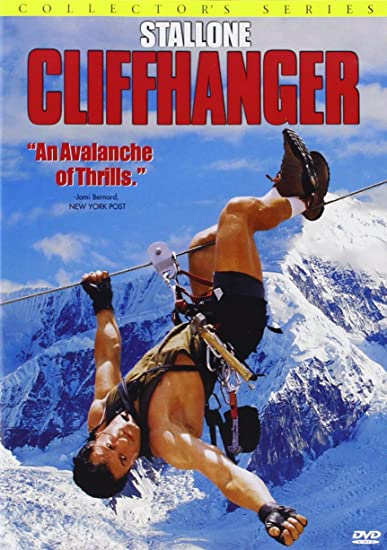
Cliffhanger (1993, directed by Renny Harlin)


Sylvester Stallone is Gabe, a mountain climber who also works as a rescue ranger.  Michael Rooker is Hal, Gabe’s colleague and former best friend.  Hal blames Gabe for the death of his girlfriend, Sarah.  Gabe also blames himself and is planning on getting out of the rescue game.  But before Gabe can quit, he’s got one last mission to perform.  Qualen (John Lithgow) is a psychotic former spy who has masterminded a multi-million dollar robbery.  A plane crash leads to the loot getting scattered in the mountains.  Qualen takes Hal and Gabe prisoner and tries to force them to help him track down the money.

Cliffhanger was made during one of the slower periods of Stallone’s career.  He had temporarily retired the roles of both Rocky Balboa and John Rambo and, as an action star, he was being overshadowed by Arnold Schwarzenegger.  Stallone had tried to reinvent himself as a comedic actor, with the result being Stop!  Or My Mom Will Shoot!  The former Oscar nominee was now only winning Razzies and he was running the risk of becoming better known for his messy divorce from Brigitte Nielsen than for his recent films.  Things weren’t looking good for Stallone but, fortunately, the box office success of Cliffhanger revived his career.

Seen today, Cliffhanger holds up well as an undemanding but enjoyable action film.  It’s a very much a film of its time, complete with John Lithgow hamming it up as a British villain and Northern Exposure’s Janine Turner playing Stallone’s loyal, helicopter-owning girlfriend.  Stallone’s best films are the ones where he is willing to surrender his ego and he does that in Cliffhanger.  It may be a Stallone film but the best lines go to Michael Rooker and the true stars of the film are the mountains and the scenes of Stallone and Rooker trying to climb them.  With Cliffhanger, Stallone was smart enough to stay out of the way and just trust that the image of him dangling above the Rockies would bring in the audience.  It was a smart decision.  Though Cliffhanger is often overshadowed by Stallone’s other 1993 hit, Demolition Man, it’s still an entertaining film in its own right.

Cliffhanger was directed by Renny Harlin, the Finnish action specialist whose promising career would subsequently take a hit and never really recover from directing Cutthroat Island.  Mountain climbing and Renny Harlin just seem to go together and Cliffhanger is one of his better films.  Here’s hope that, just as Stallone has done many times in the past, Renny Harlin will eventually his comeback as a director.

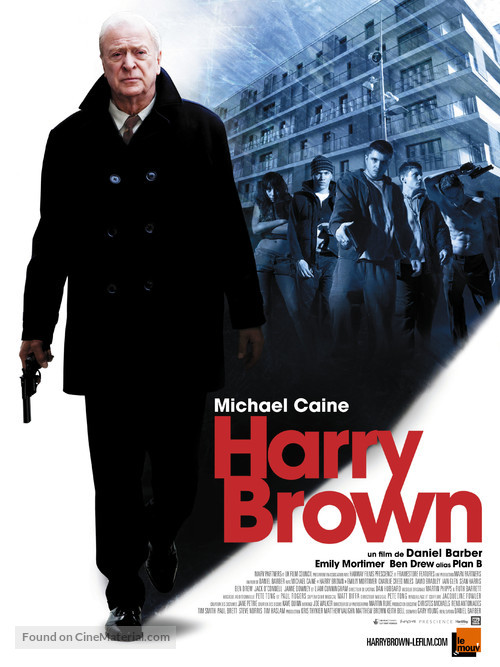
Harry Brown (2009, directed by Daniel Barber)


Today, we wish a happy 89th birthday to Michael Caine!

For longer than I’ve been alive, Michael Caine has been a star.  He’s one of the last surviving icons of the British cultural invasion of the 1960s, a venerable actor who went from being Alfie to being Carter to being Scrooge to being Alfred Pennywise without missing a step.  In many ways, he was the cockney Jack Nicholson, a working class actor with his own very identifiable style who still managed to play a wide variety of different characters.  Like Nicholson, there have been frequent reports that Caine has retired from acting and, if anyone has earned the right to enjoy their retirement, it’s Michael Caine.  Caine himself has said that he doesn’t ever see himself fully retiring from acting and he’s already proven that, even in his twilight years, he’s still as capable of giving a good performance as he was when he first started acting.

Take Harry Brown, for example.

Michael Caine was 76 when he played the title role in this violent British thriller.  Harry is a former Royal Marine who, now elderly and suffering from emphysema, lives on a London council estate that has been taken over by a gang of violent drug dealers.  The nearby underpass is so dangerous that even Harry is scared to walk under it.  Because Harry has to take an alternate route to the hospital to avoid all of the gangs, his wife dies without Harry being at her side.  When his only friend is then killed while trying to stand up to the dealers, Harry snaps.  Harry starts tracking down and killing the dealers and the gang members who have made retirement so unbearable for him.  Detective Frampton (Emily Mortimer) suspects that Harry is the vigilante but, before she can move to stop him, both she and Harry are targeted by the local drug lord, who turns out to be someone who Harry never suspected.

Harry Brown is really just an updated version of Death Wish, set in London instead of New York.  It has its share of good action scenes and director Daniel Barber does a good job making London look like the worst place on Earth but, ultimately, it’s as predictable and heavy-handed as any of the films Michael Winner made with Charles Bronson.  What makes Harry Brown special is not the script but instead the presence of Michael Caine, giving one of his best and most heartfelt performances and making the movie work, even when the story tries to sabotage him.  Caine brings an appropriate amount of righteous fury to the role but he also plays the role with a lot of heart.  Harry would much rather be enjoying his twilight years in peace but he feels that he was one last mission to pursue.  He would rather die protecting his friends and his neighbors than live his life in fear.  Harry also knows that, because he’s old, everyone underestimates him.  That’s a mistake that he uses to his advantage.

Harry Brown is like many Michael Caine films in that the main reason to watch it is because it’s a Michael Caine film.  At the time he made the film, he said that he expected Harry Brown would be his last lead role.  It wasn’t.  Just like Harry Brown, Michael Caine still has more to show the world.

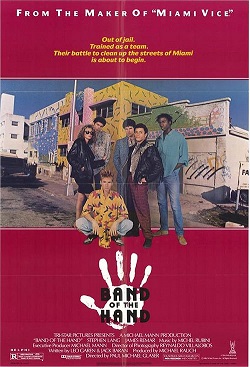
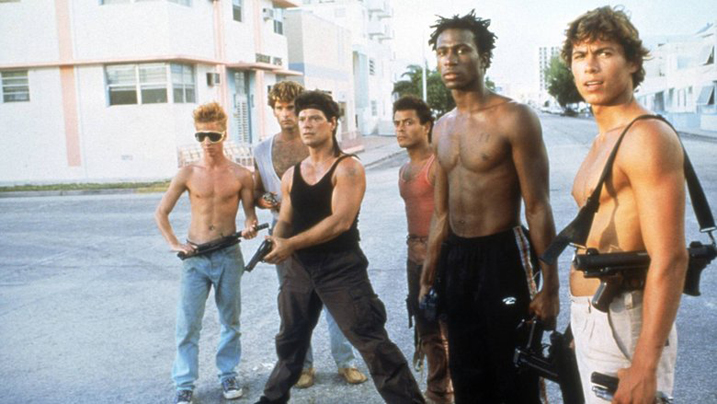
Band of the Hand (1986, directed by Paul Michael Glaser)


This place is Florida.  The time is the 80s.  Five juvenile delinquents have been given a chance to earn their freedom.  All they have to do is go down to the Everglades and train with Indian Joe (Stephen Lang), a no-nonsense Vietnam veteran who is determined to teach them not only survival sills but also how to work together as a team.  But Joe is interested in more than just reforming a group of youthful troublemakers.  He wants to turn them into a crime-fighting team who can help clean up the most dangerous neighborhood in Miami.  When Joe and delinquents move into and refurbish a previously condemned building, they get the attention of both the local drug kingpin (James Remar) and his main enforcer (Laurence Fishburne).

Band of the Hand is very much a film of its time, not only in its fashion and music choices but also in its full-on embrace of the war on drugs and the idea that the best way to clean up the streets is for vigilantes to do it on their own.  The film was produced by Michael Mann and, as directed by former Starsky and Hutch star Paul Michael Glaser, the film has the look of an episode of Miami Vice.  That might be because the film itself was originally meant to be a pilot for a television show.  When the networks passed on it, it was released to theaters instead and advertised as being “from the maker of Miami Vice.”    The movie never escapes its television origins.  Things start strong in the Everglades, with Lang proving himself to be a master of glowering and the young delinquents struggling to not only survive Lang’s training but also resist the temptation to kill each other.  It’s less interesting once the action moves to Miami and it becomes Death Wish 3 without the blood or Charles Bronson.  The scenes with the young men goofing around are an awkward fit with the scenes of Remar and Fishburne terrorizing the neighborhood.

Band of the Hand is still worth watching if you want to see some familiar faces early in their careers.  John Cameron Mitchell and Leon both score early roles as two of the delinquents-turned-crime fighters and Lauren Holly plays the romantic interest who is inevitably ends up with the bag guys.  James Remar was always a good villain and Laurence Fishburne channels both his previous performance in Death Wish II and his future performance in King of New York.  It’s a good cast, even if no one really breaks free from the production’s television origins.

The idea of creating a show about a special unit of young crime fighters who battle drug pushers was one that Mann didn’t abandon.  The final episode of Miami Vice was essentially an unsold pilot that followed many of the same plot beats as Band Of the Hand.  (It also didn’t lead to a television series, though some might argue that 21 Jump Street took the same idea and ran with it.)  As for director Paul Michael Glaser, he would later do a much better job with The Running Man.