Music Video of the Day: Breakout by Swing Out Sister (1986, directed by Nick Willing)


Some songs and videos just epitomize an era and that is certainly the case with Swing Out Sister’s Breakout.  Both the song and the video, with its fashion theme, are very much a part of the 80s.  The song itself was Swing Out Sister’s biggest hit in the United States.  Because lead singer Corinne Drewery originally moved to London in order to attend Central St. Martins College of Art and Design and initially planned to become a fashion designer, there’s an element of what if to this music video.

This video was directed by Nick Willing, who also did videos for Eurythmics, Bob Geldof, Debbie Gibson, Kirsty MacColl, Kim Appleby, Tony Banks, and Nik Kershaw.  Willing is still directing to this day.  In 2002, long before Stephen King wrote his sequel to the Shining, Willing wrote and directed a film called Doctor Sleep.  Willing’s most recent film was 2019’s Unstoppable. Sean Scully & The Art of Everything, a documentary about abstract painter, Sean Scully.

Enjoy!

Music Video of the Day: (She Was A) Hotel Detective by They Might Be Giants (1988, directed by Adam Bernstein)


This was the first in a series of “Hotel Detective” songs to be performed by They Might Be Giants.  The video was popular on MTV, though neither John Linnell nor John Flansburgh were reportedly happy with how it turned out.

The video is split between animated sequences and live action shots of Linnell and Flansburgh performing in a hotel room.  The performance clips were directed by Adam Bernstein, who also directed music videos for Public Enemy and Barenaked Ladies (now there’s a double bill) and who is a frequent television director.  (He also directed one of the worst SNL films, It’s Pat.  We won’t hold that against him because it’s doubtful anyone could have made a good It’s Pat film.)  The animated sequences were done by Joey Ahlbum.

According to this interview with Adam Bernstein, the video had a budget of $7,500.

Enjoy!

Music Video of the Day: (Forever) Live and Die by Orchestral Manoeuvres In the Dark (1986, directed by Leslie Libman and Larry Williams)


Today’s music video of the day is the video for one of OMD’s most underrated songs, (Forever) Live and Die.  It’s a performance clip, along with a few shots that incorporate the city and the beach.  The 80s were a good time for videos that featured the members of New Wave bands walking through seemingly deserted European cities.  A few years after the release of this video, INXS perfected the style with their video for Never Tear Us Apart.

There are two directors credited for this director.  Leslie Libman is still directing, though mostly for television shows like NCIS and Bull.  Larry Williams also directed the video for OMD’s Shame.

Enjoy!

Music Video of the Day: All She Wants Is by Duran Duran (1988, directed by Dean Chamberlain)


Today’s music video of the day is from the Golden Age of MTV, back when MTV still played music videos and when music videos themselves were more than just a clip of the band performing.  Admittedly, you can see the influence of Peter Gabriel’s Sledgehammer here, though All She Want Is would hardly be the first or the last video to be at least partially inspired by the look of Gabriel’s video.

The video was directed by the band’s favorite photographer, Dean Chamberlain and filming took nearly a month.  Because of the band’s schedule, they could only be present for a limited number of days.  Hence, masks were made of each band members and then those masks where placed on mannequins who stood in for the band.  Stop motion animation was used in several scenes.  

Needless to say, this video took a lot of time and effort but it was rewarded with the VMA for “Most Innovative” video.

Enjoy!

Music Video of the Day: Young Blood by Bruce Willis (1987, directed by ????)


I’m still taking in the news that Bruce Willis has retired from acting for health reasons.  When I was growing up, Bruce was the closest thing we had to an old fashioned movie star.  No one can beat the bad guys like Bruce Willis.  No one could deliver a stone cold perfect one liner like Bruce Willis.  No one could liven up a movie like Bruce Willis.  No one could surprise you with an unexpectedly sensitive and good performance like Bruce Willis.  As far as I’m concerned, he is still the epitome of cool..  Moonlighting, Die Hard, Pulp Fiction, 12 Monkeys, The Sixth Sense, Unbreakable, Sin City, Looper, and more, Bruce Willis had quite a career and I think that his reputation as an actor will only grow as his performance are rediscovered and reevaluated.

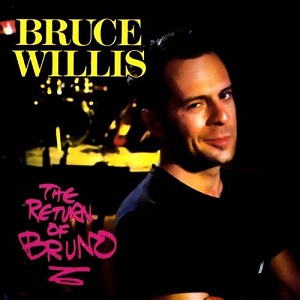
Bruce Willis was not only an actor but he also a singer.  In 1987, at the height of his Moonlighting fame, he released The Return of Bruno, an album the featured Bruce Willis covering several classic R&B tunes.  To support the album, he toured in the the character of veteran singer, Bruno.  Today’s music video of the day was originally a part of an HBO special that was designed to promote the album.  Bruno remembers performing at Woodstock and covers Young Blood, which was originally recorded by The Coasters in 1957.

Enjoy!

Hot Lead (1951, directed by Stuart Gilmore)


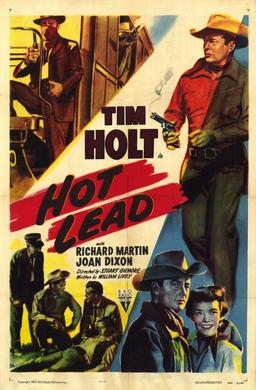
In this B-western programmer, Dave Collins (Ross Elliott) has just been released from prison.  Because he knows how to operate a telegraph, outlaw Turk Thorne (John Dehner) tries to force Dave to get a job at a local telegraph office so that Turk can use his skills to rob a train.

Despite wanting to go straight, Dave also doesn’t want to get full of hot lead.  He rides into town and gets a job at the ranch owned by Gail Martin (Joan Dixon).  He is befriended by Gail’s two ranchhands, serious cowboy Tim Holt (played, believe it or not, by Tim Holt) and his comedy relief sidekick, Chito Rafferty (Richard Martin).  Tim and Chito want revenge on Turk for killing one of their friends during a previous train robbery.  Working with Dave, they set a trap for Turk and his gang.  Meanwhile, Dave falls in love with Gail.

Hot Lead was one of the last of the 46 B-westerns that Tim Holt made for RKO Pictures.  Holt started out playing the type of prototypical happy, go-lucky cowboys who were popular in the 1930s.  At that time, he was unique as one of the few western stars to not play a continuing character who was named after him.  While the studios promoted other western stars as essentially playing themselves, Tim Holt was promoted as being a serious actor.  Holt’s films were popular with audiences but his career was put on hold while he served in World War II.  Post-war, Holt played characters who were far more world-weary than his earlier cowboys and he also started to play characters who were specifically named “Tim Holt.”

Even though most of Holt’s later films were uneven in quality, Hot Lead is one of the better examples of the genre.  Whether happy or serious, Tim Holt was always a convincing cowboy and he brings his natural gravitas to the role, playing his character as being the type of serious and no-nonsense cowboy that anyone would want in their corner.  John Dehner was always a good villain and Ross Elliott is equally good as the man struggling not to go back to his old ways.  The action scenes and the gunfights are well-directed and the story even carries an important message about giving people second chances.  Not bad for a B-western!

Great Moments in Television History #18: Frank Sinatra Wins An Oscar


On this date, 68 years ago, Frank Sinatra won his only Oscar when Mercedes McCambridge announced that he had won Best Supporting Actor for his role in From Here To Eternity. This is the role that some claimed the mob got for him, though the truth was that he was given the role after his-then wife, Ava Gardner, made an appeal to studio head, Harry Cohn. At that time, Gardner was actually a bigger star than Sinatra, whose career was considered to be in decline.

Sinatra in decline? The Academy disagreed! And so did the audiences who would make Sinatra a star for many decades to come.

Previous Moments In Television History:

  1. Planet of the Apes The TV Series
  2. Lonely Water
  3. Ghostwatch Traumatizes The UK
  4. Frasier Meets The Candidate
  5. The Autons Terrify The UK
  6. Freedom’s Last Stand
  7. Bing Crosby and David Bowie Share A Duet
  8. Apaches Traumatizes the UK
  9. Doctor Who Begins Its 100th Serial
  10. First Night 2013 With Jamie Kennedy
  11. Elvis Sings With Sinatra
  12. NBC Airs Their First Football Game
  13. The A-Team Premieres
  14. The Birth of Dr. Johnny Fever
  15. The Second NFL Pro Bowl Is Broadcast
  16. Maude Flanders Gets Hit By A T-Shirt Cannon
  17. Charles Rocket Nearly Ends SNL

Great Moments In Comic Book History #22: Alex Ross Captures Spider-Man


This is from the 4th issue of 1994’s Marvels, in which Kurt Busiek reimagined the early history of the Marvel Universe through the eyes of photographer, Phil Sheldon.  The artwork is by the amazing Alex Ross.

On this page, Spider-Man is climbing up the Daily Bugle.  That’s something that happened frequently in Spider-Man’s own comics but Marvels was the first comic to capture what it would be like for the ordinary people inside the building to suddenly look over and see Spider-Man, complete with a wrinkled suit, climbing up the outside windows.  Long before any of the movies were released or the PS4 game meticulously recreated New York, this page from Marvels made Spider-Man seem real.

Previous Great Moments In Comic Book History:

  1. Winchester Before Winchester: Swamp Thing Vol. 2 #45 “Ghost Dance” 
  2. The Avengers Appear on David Letterman
  3. Crisis on Campus
  4. “Even in Death”
  5. The Debut of Man-Wolf in Amazing Spider-Man
  6. Spider-Man Meets The Monster Maker
  7. Conan The Barbarian Visits Times Square
  8. Dracula Joins The Marvel Universe
  9. The Death of Dr. Druid
  10. To All A Good Night
  11. Zombie!
  12. The First Appearance of Ghost Rider
  13. The First Appearance of Werewolf By Night
  14. Captain America Punches Hitler
  15. Spider-Man No More!
  16. Alex Ross Captures Galactus
  17. Spider-Man And The Dallas Cowboys Battle The Circus of Crime
  18. Goliath Towers Over New York
  19. NFL SuperPro is Here!
  20. Kickers Inc. Comes To The World Outside Your Window
  21. Captain America For President

Game Review: Locked Door VII (2022, Cody Gaisser)


After taking a month off from playing the Locked Door games, I got back to them this week by playing Locked Door VII: Out of Line.

Again, you start out in the most boring room you’ve ever seen.  Bob is standing around and being useless.  Rex is your faithful companion.  Explore the area and, once again, you’ll find the shed and the stairs and the crate and all of the things that have been present in every Locked Door game.  You’ll also find a few new rooms and a some new puzzles to solve.  It may be because I was rusty after not playing the game for a month but I found the new puzzles to be challenging.  Some of that is because the game still occasionally suffers from the “Guess the Verb” syndrome but, at the same time, some of the puzzles actually are clever and require some thought.  The game is fun but it just needs a little bit of polish.

After I played the latest version, I glanced over the other Locked Door games.  As of right now, there’s a total of 11 episodes, each with its own tag line.  The tag line of Locked Door XI: The U.S. Theatrical Cut is “Can You Beta Test This Thing?”  That does intrigue me.  Could the game’s rough edges and guess the verb moments be intentional?  From the start, Locked Door has satirized the needlessly complicated locked door puzzles that seem to show up in almost every work of Interactive Fiction.  Could all of the Locked Door games be a part of an elaborate practical joke?

Maybe I’ll learn more when I played the eighth installment next week next week.

Play Locked Door VII.

Conspiracy: The Trial of the Chicago 8 (1987, directed by Jeremy Kagan)


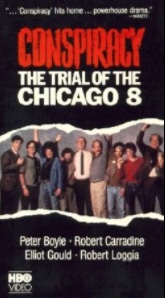
The year is 1969 and, in an Illinois courtroom, 8 political radicals stand accused of conspiring to disrupt the 1968 Democratic Convention.  The prosecution is putting the entire anti-war movement on trial while the defendants are determined to disrupt the system, even if it means being convicted.  The eight defendants come from all different sides of the anti-war movement.  Jerry Rubin (Barry Miller) and Abbie Hoffman (Michael Lembeck) represent the intentionally absurd Yippies.  Tom Hayden (Brian Benben) and Rennie Davis (Robert Carradine) are associated with the Students for a Democratic Society.  Bobby Seale (Carl Lumbly) is one of the founders of the Black Panthers while David Dellinger (Peter Boyle) is a longtime peace activist.  John Friones (David Kagan) and Lee Weiner (Robert Fieldsteel) represent the common activists, the people who traveled to Chicago to protest despite not being a leader of any of the various organizations.  Prosecuting  the Chicago 8 are Richard Schulz (David Clennon) and Tom Foran (Harris Yulin).  Defending the 8 are two radical lawyers, Leonard Wienglass (Elliott Gould) and William Kunstler (Robert Loggia).  Presiding over the trial is the fearsome and clearly biased Judge Julius Hoffman (David Opatoshu).

Conspiracy: The Trial of the Chicago 8 is a dramatization of the same story that inspired Aaron Sorkin’s The Trial of the Chicago 7 but, of the two films, it’s Jeremy Kagan’s The Trial of the Chicago 8 that provides a more valuable history lesson.  By setting all of the action in the courtroom and recreating only what was said during the trial, director Jeremy Kagan and his cast avoid the contrived drama that marred so much of Sorkin’s film.  Kagan trusts that the true story is interesting enough to stand on its own.  Kagan includes documentary footage from the convention protest itself and also interviews with the people who were actually there.  While Kagan may not have had the budget that Sorkin did, his film has the authenticity that Sorkin’s lacked.  Kagan also has the better cast, with Michael Lembeck and Barry Miller both making Abbie Hoffman and Jerry Rubin into something more than the mere caricatures that they are often portrayed as being.

The Trial of the Chicago 8 was a film that Jeremy Kagan spent a decade trying to make.  When he first tried to sell the idea behind the film to CBS in 1976, Kagan had Marlon Brando, Walter Matthau, George C. Scott, and Dustin Hoffman all willing to work for scale and take part in the production.  CBS still passed on the project, saying that no one was interested in reliving the 60s.  It wasn’t until 1987 that Jeremy Kagan was finally able to revive the film, this time with HBO.  It actually worked out for the best because, with HBO, there was no need to try to come up with a “clean” version for the language that was used in the courtroom or in the interviews with the actual participants.  The defendants could be themselves.

Though it has been overshadowed by Sorkin’s subsequent film, The Trial of the Chicago 8 is the definitive film about what happened in the aftermath of the the 1968 Democratic Convention.