Music Video of the Day: All of My Life by Phil Collins (1990, directed by Jim Yukich)


What sets All of My Life apart from all of the other adult contemporary, “easy listening” music that Phil Collins released in the 90s is that saxophone solo at the start of the song.  That sax solo almost makes up for all the bland Disney sons that Collins wrote in search of that first Oscar.

As for this video, it’s largely a performance clip but, mixed in, there are a few scenes of Phil Collins going about his everyday life.  Of course, for Phil, everyday life meant a private plane and a luxury tour bus.  What a likeable bloke!  Personally, I don’t care how Phil Collins spent his money.  As the saying goes, “If you’ve got it…”

This video was directed by Jim Yukich.  Yukich was one of those video directors who, if you were a successful musical artist in the late 80s or the 90s, you would probably end up making at least one video with Yukich.  Yukich directed videos for everyone from Iron Maiden to Genesis to REO Speedwagon.  He got around.

Enjoy!

Music Video of the Day: Me Myself and I by De la Soul


To understand this video, it is necessary to understand how Me Myself and I came to be written in the first place.  While recording their debut album, 3 Feet High and Rising, De La Soul was told that they needed to record a song that would serve as an “introduction” and which would also hopefully become a radio hit.  In other words, the label wanted at least one song that wasn’t, as Posdnous put it to Rolling Stone, “so over everyone’s head.”.  Me Myself and I was De La Soul’s way of letting listeners know that they were individuals but they also weren’t hippies.  The band was surprised when it went on to become their biggest hit off the album.

Me Myself and I finds the members of De La Soul as the students of Prof. Defbeat, who ridicules De La Soul for not conforming to the “traditional” hip hop image before the band is finally able to drop out of his class.  The video’s message is summed up by producer Prince Paul, who says, “If you take three glasses of water and put food coloring in them, you have many different colors, but it’s still the same old water. Make the connection?”

Enjoy!

Music Video of the Day: Bombers in the Sky by Thompson Twins (1990, directed by ????)


Like so many of the songs that were written in the 80s and the early 90s, Bombers in the Sky was inspired by the fear of the nuclear war that so many people assumed was, at the time, inevitable.  However, the song was better known for being included on the soundtrack of Gremlins 2.

There are actually two videos for Bombers in the Sky.  They’re both pretty much the same, except that the second video mixes in scenes from Gremlins 2 with the band performing the song.  The second version is the version featured in this post.

Three years after the release of the single, Thompson Twins changed their name to Babble and recorded for three more years before calling it quits.

Enjoy!

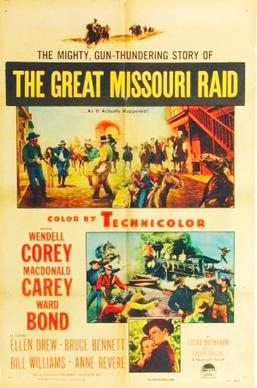
The Great Missouri Raid (1951, directed by Gordon Douglas)


During the Civil War, brothers Frank (Wendell Corey) and Jesse James (Macdonald Carey) leave the family farm and fight as Confederate guerillas under the leadership of the infamous William Quantrill.  When the war ends with the Confederacy’s defeat, Frank, Jesse, and their friend Cole Younger (Bruce Bennett) return home to Missouri and discover that their town is being ruled over the tyrannical Major Towbridge (Ward Bond).  With their farms in ruin and having little opportunity to make honest money, the James Brothers and the Younger Brothers soon resort to robbing banks and trains.  It’s their revenge against not only the soldier occupying their land but also the bankers and land barons who have been taking advantage of their friends and family members.  The James-Younger Gang become heroes to economically oppressed people everywhere.

From the minute that they arrive home, Towbridge is determined to imprison the James brothers.  Not only does he distrust them because of their past with Quantrill but he also blames them for the death of his own brother.  Towbridge becomes so obsessed that he even leaves the army so that he can pursue Frank and Jesse as a private detective.  Even as it appears that Jesse might be on the verge of settling down and abandoning his criminal life, he still has to deal with unexpected visitors like the Ford brothers.

The story of Frank and Jesse James inspired several films, some of which were better than others.  Directed with a good eye for detail by Gordon Douglas, The Great Missouri Raid tells the familiar story with enough skill to be watchable but it never reaches the classic status of Walter Hill’s The Long Riders. 

The main problem is that both Wendell Corey and Macdonald Carey come across as being almost too civilized as the James brothers.  The film is obviously sympathetic to the James brothers and, as westerns tended to do in the 50s, it ignores some of the less heroic details of their lives of outlaws.  (The film, for instance, doesn’t mention that the James brothers were probably already outlaws before the Civil War started and it’s doubtful that a modern film would be as sympathetic to two men who left home to fight for the Confederacy.)  Usually, though, even the most sympathetic film portrayals of the James brothers still portray them as being the type of people who you wouldn’t necessarily want to meet while riding the trail.  Wendell Corey and Macdonald Carey play Frank and Jesse as being so nice that it’s hard to believe that they could have even rode with Quantrill, let along the Younger brothers.  They’re the most reasonable outlaws this side of the Mississippi.  Bruce Bennett and Bill Williams are more believable as the rough and tough Cole and Jim Younger.

Not surprisingly, the film is stolen by Ward Bond.  Bond usually played reasonable authority figures for John Ford and Frank Capra.  As Major Towbridge, though, he’s cast as a martinet who allows his obsession with James brothers to turn him into a fanatic.  For those who are used to only seeing Bond cast as a fair cop or a tough-but-fair military officer, his performance in The Great Missouri Raid is a revelation.

The Long Riders is the best movie about the James Gang but, for western fans, The Great Missouri Raid should be entertaining if not definitive.

Music Video of the Day: Back to the Cave by Lita Ford (1989, directed by ????)


At the risk of getting called a nerd by our readers, when I came across this video and I saw that the song was called Back to the Cave and that the video was released in 1989, my initial thought was, “I didn’t know Lita Ford was on the Batman soundtrack.”

I didn’t know that because she’s not.  The song has nothing to do with Batman.  The title is Back To The Cave, not Back to the Batcave.  The Batman soundtrack was pretty much dominated by Prince and Danny Elfman.  All of this, I should have been able to figure out on my own without resorting to Google and Wikipedia.  Excuse me while I hang my head in shame.

No, this song isn’t in any ways connected to Batman.  Instead, it’s just Lita Ford doing what Lita Ford does best.  The video doesn’t need any gimmickry.  All it needs is Lita Ford being a guitar goddess.

Enjoy!

The Fighting Marshal (1931, directed by D. Ross Lederman)


The town of Silver City has a new marshal. He’s tough, no-nonsense, and an expert marksman. He is exactly what it needed to clean up the town and he is also a complete fraud. The marshal is actually Tim Benton (played by Tim McCoy), an escaped convict who was doing time after being framed for the murder of his father. Seeking revenge on the men who framed him and who stole his family’s silver mine, Tim escaped from prison with the help of Red Larkin (Matthew Betz), who actually was guilty of the crimes for which he was imprisoned. After Red kills the man who was actually appointed to serve as Silver City’s new marshal, Tim took the man’s identity.

Despite the years that he spent wrongly imprisoned, Tim really isn’t an outlaw at heart. He’s one of the good guys and he soon starts to settle into his role as town marshal. He even falls in love with Alice Wheeler (Dorothy Gulliver). However, Tim still has to get revenge for his father’s death and he is also going to have to deal with Red Larkin, who has no interest in going straight. Ironically, what Tim doesn’t know, is that he was only a day or two away from receiving a full pardon when he broke out of prison and went on the run.

The Fighting Marshal is an above average western programmer. Though the low-budget and rushed quality of the production is obvious (just check out the opening title card, which misspells Marshal), Tim McCoy is a credible western hero, looking credible on a horse and handling a gun with the skill of someone who started his career as a sharp shooter. The film’s mistaken identity plot is an interesting wrinkle on all of the usual western action and McCoy is convincing as he goes from being an escaped convict to being a man who truly cares about maintaining law and order in Silver City.

Of course, like many of the early western stars, McCoy was himself an authentic cowboy. He looked convincing with a gun because, in real life, McCoy was an expert marksman who was considered to be the best shooter in Hollywood. When he wasn’t making movies, McCoy served in the U.S. Army and he was also one of the first Hollywood actors to try to make the leap over to politics, running unsuccessfully for the U.S. Senate in Wyoming. Later, when his film career waned, McCoy hosted a children’s show where he would show his movies and discuss the history of the old west. He was nominated for a daytime Emmy but refused to attend the ceremony when he discovered he would be competing against a show featuring a talking duck. His exact words, when turning down the invitation to the ceremony, are often quoted as being; “I’ll be damned if I’m going to sit there and get beaten by a talking duck!”

One final note: According the IMDb, The Fighting Marashal was filmed over the course of a week in October in 1931. Less than a month later, it was released on November 25th. That’s the old Hollywood system for you. They didn’t waste anytime getting their movies into the theaters.
Music Video of the Day: Love In An Elevator (1988, directed by Marty Callner)


Lovin’ it up when I’m goin’ down

I don’t think anyone has ever accused Aerosmith of being a particularly subtle band when it comes to the subject matter of their songs.  That’s one reason why their fans love them.  Love In An Elevator is one of their least subtle songs and, not coincidentally, it’s also one of their most popular.

The elevator operator is played by Brandi Brandt, who was Playboy’s playmate of the month for October of 1987.  She had a brief acting career, one that largely consisted of this video and an appearance on Married With Children.  Many years later, in 2014, she pleaded guilty to smuggling cocaine into Sydney and she did some time in prison in Australia.  Fortunately, she received an early parole and is now safely back in California.

The video was directed by Marty Callner, who directed several videos for not only Aerosmith but almost every other popular band of the period as well.

Enjoy!

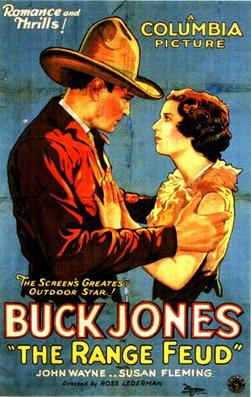
The Range Feud (1931, directed by D. Ross Lederman)


In a frontier town, two ranching families are at war.  The Turners claim that the Waltons have been stealing and reselling their cattle.  Even an attempt to hold a peace meeting at the local church just leads to more fighting.  Complicating things is that young Clint Turner (John Wayne) is in love with Judy Walton (Susan Fleming).  When someone shoots John Walton (Edward LeSaint) through the window of his office, Clint is the number one suspect.  Not helping is that Clint had an empty round in his gun.  Clint says that he fired at a coyote but he missed.  Everyone else in town says that its time to hang Clint without a trial.

Only Sheriff Buck Gordon (Buck Jones) stands between the mob and Clint.  Buck was raised by the Turner family and considers Clint to be his brother.  However, Buck still knows that Clint might be guilty but there’s no way that Buck is going to allow mob justice to rule his town!

The Range Feud was one of the many B-programmers that were released in the 30s.  Running less than 60 minutes, it is a briskly paced western that features a theme that was present in many westerns, the battle between mob justice and the law.  The townspeople who are eager to hang Clint without a trial represent the old ways of doing things while Buck represents the new way, in which everyone is innocent until proven guilty and entitled to a fair trial.

Buck Jones was one of the best of the early western heroes.  He played tough-but-fair men who could definitely handle themselves in a fight but who preferred to try to reason their way out of conflict.  Buck Jones served in a Calvary unit, worked as a cowboy, and started in the film business as a stunt man.  He had an authenticity that set him apart from others who merely pretended to be cowboys.  That authenticity serves him well in The Range Feud.  He may feel bad about having to arrest his stepbrother but any character played by Buck Jones can be guaranteed to follow the law.  In real life, Buck Jones died a hero.  In 1942, Buck Jones was at the Cocoanut Grove nightclub in Boston when a fire broke out.  Though Jones initially was able to get out of the nightclub, he subsequently reentered to help other people get out.  Severely burned, he died of his injuries two days later.

Of course, the main reason that people will track down this film is for a chance to see the young John Wayne playing a key  supporting role as Clint Turner.  It’s always a little bit strange to see Wayne playing a young man.  He’s one of those actors who you always assume was always in his 40s.  Wayne is likable as the free-spirited Clint, though it is again strange to see Wayne playing someone other than an authority figure.  For once, it’s Wayne who ends up in jail and who is dependent on someone else to save him.

The Range Feud is an entertaining and fast-moving western.  Fans of the genre and of Buck Jones and John Wayne will appreciate it.

Music Video of the Day: Always On My Mind, performed by Pet Shop Boys (1988, directed by Jack Bond)


In 1987, ITV commemorated the 10-year anniversary of the death of Elvis Presley by airing Love Me Tender, a special that featured popular British acts covering songs that were originally made famous by Elvis.  Pet Shop Boys’s synth-pop version of Always on My Mind proved to be the unexpected hit of the program and the band released the song as a single.  It went on to become the UK’s Christmas number one single for the year.

It was also featured in It Couldn’t Happen Here, a surreal film that starred Pet Shop Boys and which was directed by documentarian Jack Bond, who had started his career with a ground-breaking film about Salvador Dali and who later became famous for his work with The South Bank Show.  The subsequent music video was lifted from the film.  In the movie and the video, Chris Lowe and Neil Tennant are driving a taxi cab.  They stop to pick up a passenger, an older man played by Joss Ackland.  (In the movie, there’s an earlier scene in which Lowe and Tennant hear a news report about an escaped killed who matches their new passenger’s description.)  While their passenger rambles on, Lowe and Tennant turn on the radio and listen to the song, which leads to several other clips from the film.  And while the critics may not have cared much for It Couldn’t Happen Here, the band’s version of Always On My Mind remains a popular classic.

Enjoy!

Badlands of Dakota (1941, directed by Alfred E. Green)


This B-western takes place in the legendry frontier town of Deadwood.  It’s a town that’s patrolled by General George Custer (Addison Richards) and which is home to Wild Bill Hickok (Richard Dix) and Calamity Jane (Frances Farmer).  When outlaw Jack McCall (Lon Chaney, Jr.) and his gang start disguising themselves as Sioux and start robbing stagecoaches, young homesteader Jim Holliday (Robert Stack) is appointed town marshal.  Unfortunately, Jim’s older brother, Bob (Broderick Crawford), has gotten involved with McCall and his gang.  Bob has also never forgiven Jim for marrying Anne (Ann Rutherford), the woman that Bob loved.  Jim struggles to get the town to take him seriously.  When Jim tries to put out a fire that’s threatening to burn down several businesses, the citizens laugh at him and shoot a hole in the water hose.  No one said that the people of Deadwood were smart.  Ann wants to leave town but McCall and his gang are growing more brazen in their attacks and when one of Jim’ mentors is murdered, Jim has no choice but to get justice and revenge.  Meanwhile, the real Sioux grow tired of being blamed every time a stagecoach is robbed and they launch their own attack on the town.

Though the plot may be predictable, Badlands of Dakota is memorable for the cast that was assembled to bring its familiar story to life.  Along with those already mentioned, the cast also includes Andy Devine as a saloon owner, Hugh Hubert as the town drunk, Fuzzy Knight as the town’s stagecoach driver, and the folk band, The Jesters, as the town’s entertainment.  They all do their part to bring the town of Deadwood to life.  Frances Farmer steals the film with her tough and unsentimental portrayal of Calamity Jane and Lon Chaney, Jr. is an effectively hard-edged villain.  This was one of Robert Stack’s first films and he’s appropriately stiff and upright as Jim.  Jim is the only honest man in Deadwood, which also means that Jim is fairly boring when compared to everyone else around him.  It’s also difficult to accept him as being Broderick Crawford’s younger brother, though Crawford does a good job of portraying the personal betrayal that Bob feels when he discovers that Jim has married Anne.

Not surprisingly, Badlands of Dakota plays havoc with history.  This is especially true when it comes to Addison Richards’s sober and reasonable portrayal of a middle-aged General Custer.  (The real-life General Custer died when he was only 36 and could reportedly be slightly erratic.  Not to mention, Custer died the same year that Deadwood was founded so it’s doubtful that he ever visited the city, much less had a personal friendship with Wild Bill Hickok and Calamity Jane.)  Still, there’s a lot here to entertain fans of B-westerns.  Along with all of the familiar faces in the cast, there’s also a sequence with an out-of-control stage coach that makes good use of rear projection and the film’s final gun battle is exciting and well-directed.  It’s a quick 76 minutes, full of all the action and bad history that a western fan could hope for.