Warrior Strong (2023, directed by Shane Belcourt)


After high school basketball coach Schmidt (Andrew Dice Clay) has a heart attack, one of his former players, Bilal Irving (Jordan Johnson-Hines), returns to Ontario to replace him.  Bilal, a pro player who has developed a reputation for being a diva, thinks that it will mean some good publicity for him.  Instead, he discovers that coaching a group of scrappy underdogs to the province championship is far more satisfying than being a member of the Timberwolves.

There’s not a sports cliche that goes unused in Warrior Strong.  At first, no one gives the team a chance but then the team shows what they can do when they are properly motivated.  Bilal stop being selfish but then gets a chance to return to the NBA right before the championship game.  The team’s best player quits in disgust and the rest of the players have to prove themselves.  Since this is a Canadian film, there’s a lot of political and cultural content stuffed into the plot.  A local indigenous woman give the team permission to use the Warriors name.  One the team’s stars, Bettina (Macaulee Cassaday), worries about fitting in as a nonbinary person.  Some of it feels awkwardly forced into the story.  Some of it works.  I’ve never been a believer in the idea that “going work” automatically makes a film good or bad.  But there are times that the movie feels as if it was written by someone who was given a checklist of issues to include.

Most people who watch this film will probably be watching for Andrew Dice Clay, cast here as a plainspoken coach.  Clay is believable in the role, even if he doesn’t really do that much.  He plays a decent person who doesn’t curse or recite dirty limericks.  Watching films like this, you have to wonder what his career would be like now if he had never been the Diceman.


Music Video of the Day: Insane In The Brain by Cypress Hill (1993, directed by Josh Taft)


It’s the 20th day of the 4th month of the year so the music video of the day could only come from Cypress Hill.

This was directed by Josh Taft, who has also done several award-winning commercials and directed music videos for Pearl Jam, Tribe Called Quest, and Stone Temple Pilots, amongst others.

Enjoy!

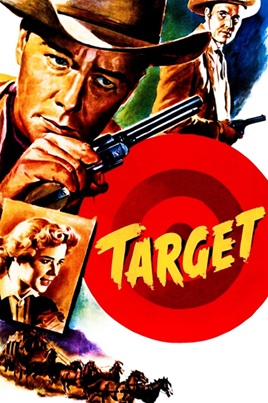
Target (1952, directed by Stuart Gilmore)


The frontier town of Pecos, Texas is without a marshal and Martin Conroy (Walter Reed) and his men are taking advantage of the situation by forcing people to sell their land for next to nothing.  A railroad’s coming and Conroy is looking to make a killing.  When landowner Bailey (John Hamilton) is targeted by Conroy, ranch hands Tim Holt (played by Tim Holt) and Rafferty (Richard Martin) are determined to stop him.  Federal marshal Terry Moran is summoned to the town to enforce the law.  Everyone is shocked when Moran’s daughter — also named Terry (Linda Douglas) — shows up and declares herself the new marshal.  “We don’t need no petticoat marshal!” the townspeople cry.

This is a by-the-book B-western, one of many that Tim Holt and Richard Martin made over the years.  In this one, neither Holt not Martin seems to be too invested in the familiar story.  (Holt was maybe wondering how he went from The Magnificent Ambersons and Treasure of the Sierra Madre to this.)  The only really interesting thing about this one is that the marshal is a woman but the movie doesn’t really do anything with the idea.  Tim Holt was the star here and no petticoat marshal was going to upstage him.

The thing that I find interesting about these B-westerns is how often the villain was someone looking to get rich by selling ill-gotten land to the railroad companies.  B-westerns always presented the railroads as being both the best and the worst thing about the west.  The railroads bring and connect civilization but they also attract villains like Martin Conroy.  In the American westerns, it was always made clear that the railroad company was as disgusted by men like Conroy as the townspeople.  However, in the spaghetti westerns that would come out in the 60s, it was always clear that the railroad didn’t care how they got their land as long as they got it.

This was Tim Holt’s second-to-last movie as a B-western star.  After his career ended in Hollywood, Holt relocated to Oklahoma and eventually became the manager of radio station.  He died in 1973.

Music Video of the Day: The One Thing by INXS (1982, directed by Soren Jensen)


This was one of INXS’s first videos to go into heavy rotation on MTV.

Director Soren Jensen was an assistant director on the Australian soap opera, The Young Doctors.  (Michael Hutchence’s mother was a makeup artist on the Young Doctors.)  The actresses who appear in the music video were also on The Young DoctorsThe Young Doctors remains largely unknown in the U.S.

Enjoy!

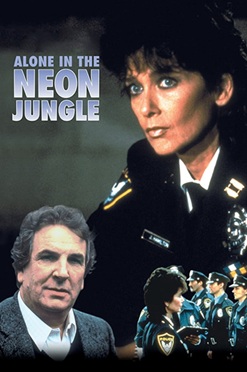
Alone In The Neon Jungle (1988, directed by Georg Stanford Brown)


Alone In The Neon Jungle takes place in a Pittsburgh police precinct that is supposedly so crime-ridden that it is called The Sewer.  After two cops are arrested while committing a burglary, the Chief of Police (Danny Aiello) sends tough Captain Jane Hamilton (Suzanne Pleshette) to take over the precinct.  Her mission?  To enforce discipline and root out police corruption!

There’s a lot of corruption to root out.  Crime boss Nahid (Tony Shalhoub) has half the precinct on his payroll and corrupt cops like Brad Stafowski (Jon Polito) are quick to to drag new transfers, like Todd Hansen (Jon Tennery), into the rackets.  Along with enforcing the dress code and cleaning up the streets, Jane also has to figure out who is responsible for the murder of one of her sergeants.

This made for TV movie was probably meant to be a pilot for a weekly television series.  It just has the sort of feel to it.  It features just about every cop cliche imaginable, from the weary detective who comes to respect the new boss to the crime lord who claims to be a respectable businessman.  The main problem is that the precinct never seems as bad as its described.  For a place called The Sewer, the streets are surprisingly clean.  The majority of the crimes committed seem to be burglary and prostitution.  If you’re a cop and that’s all you have to deal with in a big city like Pittsburgh, count yourself lucky.  The precinct never lives up to the title “Neon Jungle” and no one’s ever alone in it.

Suzanne Pleshette does a good enough job in the lead role.  By this point in her career, Pleshette’s voice was as deep as the voice of the toughest patrolman around.  It worked for her.

Music Video of the Day: Give To Live by Sammy Hagar (1987, directed by Gil Bettman)


This music video is one of Sammy Hagar’s best.  It shows how big deal MTV was in 1987 that Mark Goodman appeared as himself to introduce the video.  The message of the video seems to be that happy couples watch Sammy Hagar together.

Director Gill Bettman was primarily a television director but he also directed a few videos from Hagar and Chicago.

Eddie Van Halen plays bass in this song.  In fact, Eddie played bass for the entire album, I Never Said Goodbye.

Enjoy!

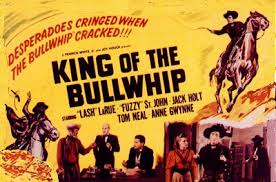
King of the Bullwhip (1950, directed by Ron Ormond)


Tioga City has a problem.  A masked outlaw known as El Azote keeps holding up James Kerrigan’s (Jack Holt) bank.  Because El Azote carries a bullwhip, the case is assigned to Marshal Lash LaRue (Humphrey Bogart lookalike Lash La Rue) and his loyal sidekick, Fuzzy Q. Jones (Al St. John).  Lash also always carries a bullwhip and because no one in town knows that Lash is actually a marshal, they all assume that he must be El Azote.  Shady bar owner Benson (Tom Neal) offers to make a deal with Lash and Fuzzy but then he betrays them the first chance that he gets.

This is one of Lash La Rue’s better movies, which may sound like faint praise when you consider the quality of the typical La Rue film but this is actually a fairly engrossing production.  Running under an hour, this Poverty Row western tells its story quickly and it ends with a genuinely exciting bullwhip battle.  La Rue may not have been the best actor amongst the B-western stars of the era but he knew how to whip it and to whip it good.

The main attraction here is Tom Neal, playing another shady character. Tom Neal was a tough character both off-screen and on and he brings an authentic edginess to his character, one that was missing from most Poverty Row westerns.   Tom Neal is best-known for starring in Detour.  A former amateur boxer who hung out with gangsters and dated their girlfriends, Neal was an up-and-coming star until one day in 1951, when he beat up actor Franchot Tone so severely that Tone spent weeks in the hospital with a concussion.  Neal’s career never recovered from the notoriety and he quit acting to become a landscaper.  In 1965, he was back in the headlines after he was charged with murdering his wife.  Convicted of involuntary manslaughter, he served six years in prison and died shortly after he was paroled.  He was 58 years old.

Finally, King of the Bullwhip was directed by Ron Ormond, who will always be best known for films such as Mesa Of Lost Women and the infamous If Footmen Tire You, What Will Horses Do?  It takes all types to make a B-western.


Music Video of the Day: A Lil’ Ain’t Enough by David Lee Roth (1991, directed by ????)


Love him or hate him, no one better epitomized an era than David Lee Roth.  There’s no one else like him and regardless of how he may sound or look now, he was one of the greatest frontmen in the history of rock and roll.

There’s no director credited for this video.  Peter Angelus seems like a good guess.

Enjoy!

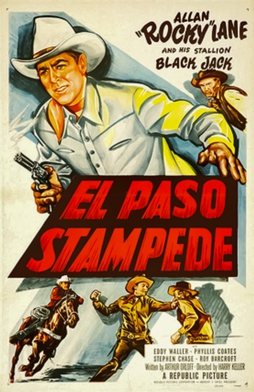
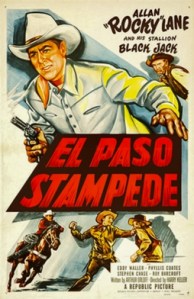
El Paso Stampede (1953, directed by Harry Keller)


With the country distracted by the Spanish-American war, someone is stealing cattle on the border between Mexico and the United States.  Federal marshal Rocky Lane (Allan Lane) is sent to investigate.  He gets a job with Nugget Clark (Eddy Waller), a local feed merchant, and gets to know Nugget’s daughter, Alice (Phyllis Coates).  As was usually the case with these B-westerns, it turns out that the band of onery outlaws is secretly being led by a villain who is an otherwise respectable member of society.  When it comes to the Old West in these films, the biggest threat was not from the outlaws but instead from the greedy and corrupt settlers who wanted to get their own piece of the action and who were willing to sell out their own neighbors and sometimes their own country to get it.  It falls to Rocky and Nugget to save the day, rescue Alice from the bad guys, and recover the cattle.

This was the last of the B-westerns to star Allan Lane as Rocky Lane and Eddy Waller as his sidekick.  Unfortunately, the arrival of television made short programmers like this one obsolete.  Kids could now just watch westerns on television instead of spending the day down at the theater.  This was not a bad western for the Rocky Lane character to go out on, though.  The plot is predictable but that’s to be expected for a 53-minute programmer like this one.  However, Rocky is an appropriately square-jawed hero.  He rides his horse, Black Jack, with authority and he looks convincing handling a gun and throwing a punch.  There are actually some good shots involving the outlaws’s hideout, which just happens to be hidden behind a waterfall.  For western fans, El Paso Stampede is a watchable and undemanding genre entry.

As I mentioned earlier, this was the last film to star Allan Lane.  He appeared in a few more westerns after El Paso Stampede but it was always in supporting roles.  Allan Lane appeared in 88 films, the majority of which were B-westerns like this one.  Today, though, Lane is best-remembered for a role for which he wasn’t even given onscreen credit, providing the voice of the talking horse, Mr. Ed.