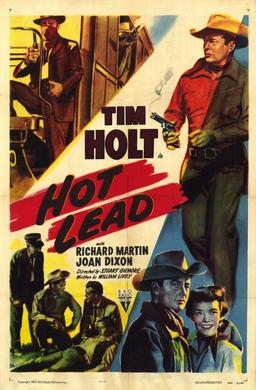
 The frontier town of Pecos, Texas is without a marshal and Martin Conroy (Walter Reed) and his men are taking advantage of the situation by forcing people to sell their land for next to nothing. A railroad’s coming and Conroy is looking to make a killing. When landowner Bailey (John Hamilton) is targeted by Conroy, ranch hands Tim Holt (played by Tim Holt) and Rafferty (Richard Martin) are determined to stop him. Federal marshal Terry Moran is summoned to the town to enforce the law. Everyone is shocked when Moran’s daughter — also named Terry (Linda Douglas) — shows up and declares herself the new marshal. “We don’t need no petticoat marshal!” the townspeople cry.
This is a by-the-book B-western, one of many that Tim Holt and Richard Martin made over the years. In this one, neither Holt not Martin seems to be too invested in the familiar story. (Holt was maybe wondering how he went from The Magnificent Ambersons and Treasure of the Sierra Madre to this.) The only really interesting thing about this one is that the marshal is a woman but the movie doesn’t really do anything with the idea. Tim Holt was the star here and no petticoat marshal was going to upstage him.
The thing that I find interesting about these B-westerns is how often the villain was someone looking to get rich by selling ill-gotten land to the railroad companies. B-westerns always presented the railroads as being both the best and the worst thing about the west. The railroads bring and connect civilization but they also attract villains like Martin Conroy. In the American westerns, it was always made clear that the railroad company was as disgusted by men like Conroy as the townspeople. However, in the spaghetti westerns that would come out in the 60s, it was always clear that the railroad didn’t care how they got their land as long as they got it.
This was Tim Holt’s second-to-last movie as a B-western star. After his career ended in Hollywood, Holt relocated to Oklahoma and eventually became the manager of radio station. He died in 1973.