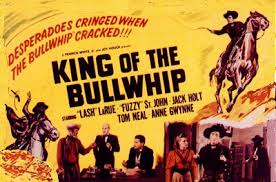
King of the Bullwhip (1950, directed by Ron Ormond)


Tioga City has a problem.  A masked outlaw known as El Azote keeps holding up James Kerrigan’s (Jack Holt) bank.  Because El Azote carries a bullwhip, the case is assigned to Marshal Lash LaRue (Humphrey Bogart lookalike Lash La Rue) and his loyal sidekick, Fuzzy Q. Jones (Al St. John).  Lash also always carries a bullwhip and because no one in town knows that Lash is actually a marshal, they all assume that he must be El Azote.  Shady bar owner Benson (Tom Neal) offers to make a deal with Lash and Fuzzy but then he betrays them the first chance that he gets.

This is one of Lash La Rue’s better movies, which may sound like faint praise when you consider the quality of the typical La Rue film but this is actually a fairly engrossing production.  Running under an hour, this Poverty Row western tells its story quickly and it ends with a genuinely exciting bullwhip battle.  La Rue may not have been the best actor amongst the B-western stars of the era but he knew how to whip it and to whip it good.

The main attraction here is Tom Neal, playing another shady character. Tom Neal was a tough character both off-screen and on and he brings an authentic edginess to his character, one that was missing from most Poverty Row westerns.   Tom Neal is best-known for starring in Detour.  A former amateur boxer who hung out with gangsters and dated their girlfriends, Neal was an up-and-coming star until one day in 1951, when he beat up actor Franchot Tone so severely that Tone spent weeks in the hospital with a concussion.  Neal’s career never recovered from the notoriety and he quit acting to become a landscaper.  In 1965, he was back in the headlines after he was charged with murdering his wife.  Convicted of involuntary manslaughter, he served six years in prison and died shortly after he was paroled.  He was 58 years old.

Finally, King of the Bullwhip was directed by Ron Ormond, who will always be best known for films such as Mesa Of Lost Women and the infamous If Footmen Tire You, What Will Horses Do?  It takes all types to make a B-western.
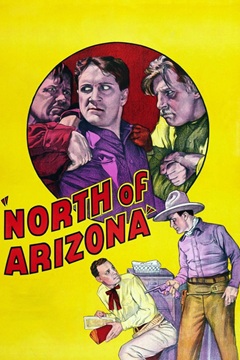
 

North of Arizona (1935, directed by Harry S. Webb)


Newly hired ranch foreman Jack Loomis (Jack Perrin) comes to the aid of two Indians who were nearly swindled out of their land during a card game.  The Indians inform Jack that his new boss, George Tully (Al Bridge), is actually a crook and the ranch is just a front for his criminal activities.  When Jack says he doesn’t want to be a part of Tully’s schemes, Tully and his men frame Jack for a robbery.

After you watch enough of these Poverty Row westerns, you start to get the feeling that anyone in the 30s could walk into a studio and star in a B-western.  Jack Perrin was a World War I veteran who had the right look to be the star of several silent films but once the sound era came along, his deficiencies as an actor became very apparent.  He could ride a horse and throw a punch without looking too foolish but his flat line delivery made him one of the least interesting of the B-western stars.  That’s the case here, where Perrin is a boring hero and the entire plot hinges on the villain making one really big and really stupid mistake.  John Wayne could have pulled this movie off but Jack Perrin was lost.

Jack Perrin’s career as a star ended just a few years after this film but not because he was a bad actor.  Instead, Perrin filed a lawsuit after a studio failed to pay him for starring in one of their films.  From 1937 until he retirement in 1960, Perrin was reduced to playing minor roles for which he often went uncredited.  Hollywood could handle a bad actor but not an actor who expected to be paid for his work.

The Desert Horseman (1946, directed by Ray Nazarro)


Steve Godfrey (Charles Starrett) is in trouble again.  He has been accused of stealing another payroll and the only man who can clear his name has just been murdered.  Steve thinks that he is being set up by outlaws who want to take control of the dead man’s ranch, which is now owned by Mary Ann Jarvis (Adele Roberts).

Luckily, Steve’s old friend, Smiley Burnette, is working as a cook at the Jarvis Ranch.  When Smiley isn’t singing songs with the Colorado Hillbillies, he tries to help Steve clear his name.  He explains that Mary Ann Jarvis won’t listen to Steve but maybe she’ll listen to Steve’s alter ego, The Durango Kid!

Durango rides again in this movie, though, the majority of the hour runtime is made up of Smiley Burnette singing songs and making jokes.  Smiley Burnette is not for everyone.  I enjoy the broad humor he brought to these films but I can understand why others might not.  Whenever Smiley sings a song, it does bring the action to a halt but that’s true of every Durango Kid film.  If you’re a fan of the series, you either like Smiley or you can at least tolerate him.  Smiley does do more than just sing in this movie.  He also throws black pepper in the eyes of one of the bad guys.

Even with all of the attention paid to Smiley, The Desert Horseman delivers all of the expected horse chases and gunfights.  The story is a little more interesting than usual.  Steve has been framed for not one but two crimes that he didn’t commit and that adds some urgency to the proceedings.  Charles Starrett, as always, is a believable western hero and he takes the role seriously.