This October, I’m going to be doing something a little bit different with my contribution to 4 Shots From 4 Films. I’m going to be taking a little chronological tour of the history of horror cinema, moving from decade to decade.
Today, we complete the 90s!
4 Shots From 4 Horror Films
I Know What You Did Last Summer (1997, dir by Jim Gillepsie)
Vampires (1998, dir by John Carpenter)
The Sixth Sense (1999, dir by M. Night Shyamalan)
The Blair Witch Project (1999, dir by Daniel Myrick and Eduardo Sanchez)
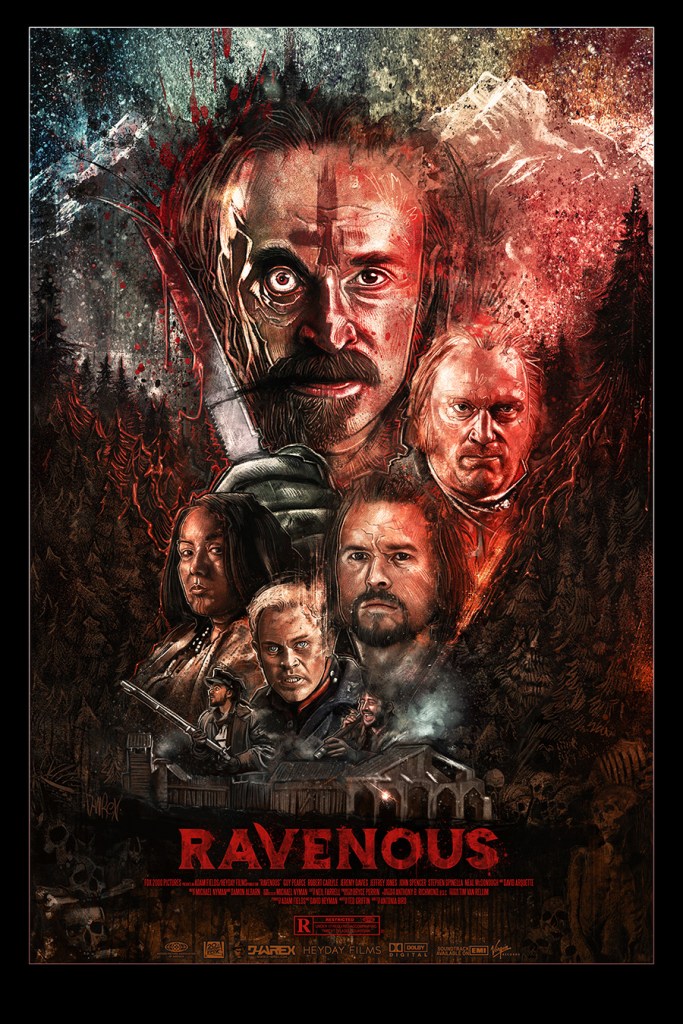
“Morality… is the last bastion of a coward.”— Colonel Ives
Ravenous remains one of the most fascinating and thematically daring horror films of the late 1990s—a layered meditation on hunger, morality, and the consuming appetite of empire disguised as a tale of survival. Set against the punishing winter backdrop of the Mexican-American War, the film centers on Lieutenant John Boyd, a soldier burdened by cowardice and guilt, sent to an isolated military outpost in the Sierra Nevadas. When a frostbitten stranger stumbles into camp with a horrifying tale of survival, the line between the living and the devoured—and between humanity and monstrosity—begins to blur.
At first glance, Ravenous is a dark horror film about cannibalism in a remote frontier fort. What distinguishes it is the way it transforms that premise into a meditation on civilization and consumption. The screenplay, written by Ted Griffin, draws inspiration from historical accounts such as the Donner Party and Alfred Packer—stories of pioneers who resorted to cannibalism to survive brutal winters. Griffin threads these historical horrors into a broader allegory about 19th-century American expansionism: a national hunger for land, power, and progress that consumes everything in its path, including its own humanity.
The mythological backbone of Ravenous lies in the inclusion of the wendigo, a spirit from Native American folklore. In Algonquin and Ojibwe tradition, the wendigo is born of greed and gluttony, a monstrous being that grows stronger and more grotesque with each act of consumption. The tale served as a warning against selfishness, warning that those who devour others—figuratively or literally—lose their humanity in return. Bird and Griffin seamlessly integrate this legend into the film’s themes, using the wendigo to mirror the psychological and cultural costs of empire. The story implies that the wendigo is not confined to mythic forests but lives in the blood of every nation that feeds on others to survive.
The fort where the story unfolds functions as both a stage and symbol: an outpost of civilization planted in the wilderness, claiming righteousness while sustained by exploitation. As starvation and moral decay take hold, the soldiers’ pretense of order crumbles. The isolated setting reflects the broader American project—civilization advancing through conquest yet losing its moral center in the process. The Native nations displaced and destroyed during expansion, reduced to resources or obstacles, become the unseen victims of this devouring drive. The film reframes cannibalism as a metaphor for Manifest Destiny itself—the act of consuming people, land, and spirit under the guise of progress.
That central metaphor gains power through the film’s performances. Guy Pearce delivers a subdued yet deeply expressive performance as Boyd, embodying the moral paralysis of a man trapped between guilt and survival. His silences, glances, and hesitations speak louder than any dialogue, conveying an internal conflict between virtue and instinct. Through him, the film explores how the will to endure can erode the boundaries of conscience.
Robert Carlyle, as Colonel Ives, stands in vivid contrast—charismatic, witty, and terrifyingly self-assured. He plays the role with the infectious energy of a man liberated by his own monstrosity, wearing sin as philosophy. For Ives, cannibalism is not horror but a revelation—a means to transcend weakness and embrace dominance. His eloquent justifications turn atrocity into ideology, echoing the rationalizations of expansionist politics. It is no coincidence that his confidence parallels Boyd’s doubt; the two men form mirror halves of a single corrupted ideal.
Director Antonia Bird’s touch elevates Ravenous from a historical thriller to a surreal moral fable. She handles violence and absurdity with equal precision, oscillating between grim horror and deadpan humor in a way that keeps viewers uneasy yet enthralled. Her direction never treats the horror as spectacle alone—every moment of gore carries weight, testing the limits of empathy and survival. Moments of unexpected humor punctuate the brutality, serving as a reminder that even atrocity can become ordinary when normalized by power.
While the fusion of dark comedy and horror lends the film its originality, it may also unsettle some viewers. The tonal shifts—helped by Michael Nyman and Damon Albarn’s strange, minimalist score—create an atmosphere that feels intentionally dissonant. This mix may challenge those expecting a traditional horror film, but it reinforces Bird’s vision of moral chaos. The unease generated by those shifts mirrors the absurdity of history itself: how horrors can coexist with banality, how laughter can accompany destruction.
The wendigo myth binds all these elements together. Bird portrays it less as a creature and more as a condition—one that spreads through ideology, greed, and the illusion of progress. The spirit of the wendigo thrives wherever ambition turns men into predators and justifies their violence as destiny. In this sense, every character becomes a reflection of national hunger, caught in a metaphorical cycle of consumption. The act of eating flesh becomes a stand-in for the broader devouring inherent in colonization: of land, of native culture, of moral identity.
By framing the frontier as an arena of both physical and spiritual starvation, Ravenous reimagines American history as a feast of self-destruction. It suggests that survival is often indistinguishable from conquest—both are rooted in the urge to consume. Even at its most surreal or ironic moments, the film refuses to let its viewers forget that the hunger at its center is not merely for sustenance but for dominion.
Though underappreciated upon release, Ravenous has since earned recognition as a rare film that wields gore and satire to expose deeper truths. Bird’s control of tone, Griffin’s allegorical writing, and the actors’ opposing energies fuse into something that transcends genre. The result is a story that both horrifies and compels, holding a cracked mirror to the myth of progress.
The wilderness of Ravenous is vast, beautiful, and pitiless—a perfect reflection of the American spirit it depicts. It is a land that promises renewal but demands devouring, a landscape haunted by the ghosts of all it has consumed. The film endures not simply as a parable of survival, but as a meditation on empire, appetite, and the fragile line separating civilization from savagery.
Both grotesque and profound, Ravenous gnaws not only at flesh but at the conscience, forcing us to confront what happens when hunger—whether for life, for power, or for victory—becomes the only morality left.
Case’s Confessions: I am not scared of werewolves, vampires, or climate change. I am scared real things: serial killers, disease, and big government.
This ad for Australian AIDS prevention was before my time, but I saw it in the 90s when it was shown as a compilation of the scariest ads ever. The ad featured a grim reaper knocking people over like pins. The randomness and the victim’s helplessness gave me nightmares for weeks.
The ad’s message was terrifyingly clear: do NOT have sex with Australian women because they will give you AIDS. The ad worked because, TO THIS DAY, I have never slept with an Australian girl. When I went to Australia, I never had even a slight temptation to have any congress with any Australian lady or as they are also called there- Sheila, which I suppose is a common name there like Jenny is in a normal country like America that is not ravaged with disease.
I knew that as long as I avoided those women, I could engage in all kinds of debauchery. Whether I did or not I think I will save for my exclusive patreon blog (if I make one). You can see the ad and an interview of the creators of the ad below.
Today’s horror on the lens is a 1978 made-for-TV movie that was directed by Wes Craven. Originally entitled Stranger In Our House, it was retitled Summer of Fear when it was released into theaters in Europe. Personally, I think Summer of Fear is a better title. It has a fun R.L. Stine feel to it.
As for the film itself, it tells the story of what happens when the recently orphaned Julia (Lee Purcell) moves in with her distant relations in California. At first, Julia fits right in with her new family but, slowly and surely, her cousin Rachel (Linda Blair) comes to suspect that Julia might be a witch. And hey, who can’t relate to that? Seriously, everyone has that one cousin…
“I have seen the dark universe yawning Where the black planets roll without aim, Where they roll in their horror unheeded, Without knowledge, or lustre, or name.” ― H.P. Lovecraft, Nemesis
This is one of two videos for Duran Duran’s Lonely In Your Nightmare. In this one, Simon Le Bon finds old photographs and remembers a past relationship that might have just been someone’s dream. Lonely In Your Nightmare appeared on Rio, one of the defining albums of the early 80s.
Before he made a little film called Highlander, director Russell Mulcahy was Duran Duran’s video director of choice in the early 80s and, of course, he worked with many other bands as well. His stylish music videos dominated MTV and set the template for which most subsequent videos would come.
Jon Moore (Matthew Utley) and his foster sister are fooling around with a Ouija board. Jon wants to contact the spirit of his little brother, Tommy (Jacob Pitoniak). Jon blames himself for his brother’s death and many of his subsequent problems can be linked back to the day that Tommy was killed in a mass shooting. The Ouija board seems to have a mind of its own, with the little pointer tool moving even when Jon takes his fingers off of it. Tommy’s face appear in a candle’s flame, blain Jon for his death and encouraging Jon to take his own life. Jon freaks out. Jon’s foster sister asks him if he’s stoned but otherwise, doesn’t seem to be too concerned about Jon’s suicidal tendences.
Jon’s subsequent attempt at suicide fails but it does lead to a both a huge fire and Jon getting sent to yet another foster family. Feeling lost and alienated and struggling to fit in with his religious community, Jon soon starts spending all of his time in the woods. Eventually, he meets a Native American girl named Isaka (Alexandra Sertik). At first, Jon fears that Isaka might be another demon sent to destroy him. Pastor Mark (Dean Cain) puts his mind at ease.
Jon is soon convinced that he’s in love with Isaka. He tells everyone about his new girlfriend and no one believes him. (That said, they’re rather tolerant of someone who claims to be spending all of his time with someone who they say doesn’t exist.) Jon starts to wonder why he never sees Isaka outside of the woods. Why has he never met Isaka’s parents? Why is Isaka always wearing the same clothes? Why does every picture that he takes of Isaka fail to develop? You can probably guess why. Isaka has a tragic story of her own and a lesson to teach Jon.
ForgivingGod is a faith-based film that has a lot in common with the horror genre, from the Ouija-dominated opening to Jon’s fear that Isaka might be an otherworldly being sent to lead him astray. It’s actually a fairly intriguing story and, compared to most faith-based films, it’s actually told pretty well. Yes, there’s a few moments of awkward humor (faith-based films always seem to have at least one scene of awkward adult-teen dialogue) and some of the performance feel more professional than others. (Dean Cain, it must be said, classes up the joint in his small role.) There’s a sequence set at “bible camp,” which really made me happy that, when I was growing up, my family never stayed long enough in one place for anyone to suggest that my sisters and I should go to camp. That said, the cinematography is impressive, Matthew Utley gives a good performance as Jon, and there’s a fairly effective scene involving a grizzly bear. As far as indie religious films go, ForgivingGod isn’t that bad at all. If anything, it continues Pennsylvania’s tradition of giving us independent cinema. George Romero gave us zombies. This film gives us bears and mysterious forest girls.
Welcome to Late Night Retro Television Reviews, a feature where we review some of our favorite and least favorite shows of the past! On Saturdays, I will be reviewing Saved By The Bell, which ran on NBC from 1989 to 1993. The entire show is currently streaming on Prime and Tubi!
This week, an important lesson is learned about credit cards.
Episode 1.2 “The Lisa Card”
(Dir by Don Barnhart, originally aired on August 28th, 1989)
Lisa’s father (Henry Brown) has given her his credit card and Lisa has charged way too much money on it! Now, she has to figure out how to raise the money to pay it off before he finds out.
I could relate to this episode. When I got my first credit card, I went crazy charging stuff to it. I’m still probably a little bit too quick to reach for it. To be honest, it wouldn’t be until I was 25 that I really came to understand that someone actually has to pay all that money back. I knew what Lisa was going through but I was still surprised at how all of her friends immediately came to her aid. What selfless friends! I can honestly say that, if a friend of mine needed that much money, I would probably not give it to them. Lisa got a job at the Max but Slater, Zach, Kelly, Jessie, and Screech ended up doing most of the work and they all did it for free. Maybe if they had all gotten a job at the Max (as opposed to just volunteering to help) they could have combined their paychecks and paid off that credit card. Zach also sells all of Lisa’s clothing, holding a sale in the middle of the school hallways. (“Closing them!” Zach shouts whenever Belding is nearby.) “Who wants this lingerie?” Zach asks. Screech pledges his life savings. Ummm, Lisa is like fourteen and Screech appears to be considerably younger. That’s kind of icky….
This episode was …. well, I was going to say it was dumb but every episode of Saved By The Bell is dumb. That said, it was dumb in a fun way. Lark Voorhees was always underused on Good Morning Miss Bliss but she really goes all out with this episode. Her nervous twitching when she learned all of her clothes had been given to charity (for free!) was something else to which I could relate.
In the end, Lisa’s father forgives her and Lisa gets upset because he’s not angrier. What? Lisa, you got away with it! Be happy!





 Through the Shattered Lens