Late Night Retro Television Review: Highway to Heaven 3.21 “Parents’ Day”


Welcome to Late Night Retro Television Reviews, a feature where we review some of our favorite and least favorite shows of the past!  On Thursdays, I will be reviewing Highway to Heaven, which aired on NBC from 1984 to 1989.  The entire show is currently streaming on Tubi and several other services!
This week, Mark and Jonathan become narcs!

Episode 3.21 “Parents’ Day”

(Dir by Michael Landon, originally aired on February 25th, 1987)

Robert Culp plays one of the worst characters ever in this week’s episode of Highway to Heaven.

Culp plays Ronald James, a news anchor who is known for his fiery anti-drug editorials.  His teenage son, David (Lance Wilson-White), is a student at an exclusive boarding school.  When a joint is found in David’s dorm room, Ronald comes down hard on his son.  Ronald says David should be ashamed of himself.  Ronald says that David has brought dishonor to the family.  Ronald grounds David for four weeks.

After attending an anti-drug lecture delivered by newly hired narcotics detective Mark Gordon, David decides to call the police and tell them about the cocaine that is hidden in his family’s garage.  The cocaine belongs to Ronald but, when Ronald is confronted by the police, he announces that it must belong to David.  When it becomes obvious that Ronald’s job is at risk, he tells David to take the blame.  David says he’ll do it if Ronald promises to stop using.  Ronald agrees.

David takes the blame….

….and Ronald keeps on using!

Seriously, what a scumbag!

While Ronald is disappointing everyone, Jonathan — who is also working as a narcotics detective — pressures the local boarding school drug dealer, Brad Dietrich (Bill Calvert), to stop dealing.  Brad laughs off Jonathan’s threat.  Come back with a warrant, Brad says.  Then Brad’s girlfriend overdoses on the cocaine that Brad gave her.

Finally, after David nearly drinks himself to death, Ronald goes on the news and admits that he’s a drug addict.  He then says that parents have to step up and do a better job.  That’s fine, Ronald, but you know what?  YOU’RE A DRUG ADDICT WHO FRAMED YOUR OWN SON!  You don’t get to be a moral authority!

As you can probably guess, there was not a subtle moment to be found in this episode.  On the one hand, the message was obviously heartfelt.  That’s kind of a given when it comes to Highway to Heaven.  With every episode, it’s obvious that Michael Landon was sincerely trying to make the world a better place.  On the other hand, this episode was so heavy-handed that it sometimes verged on camp.  Culp was very believable as someone who was totally coked up.  The kid playing his son, on the other hand, was considerably less convincing.  It also doesn’t help that there’s a massive hole in the middle of the plot.  If the police were really unsure about who had brought the cocaine into Ronald’s house, they could have just drug-tested both Ronald and David to see who was snorting.  As well, seen from a modern perspective, it’s hard to really buy into the show’s argument that parents and children should be constantly calling the police on each other.  Today we know that the attempt at a zero tolerance war on drugs made the situation even worse.  This episode’s suggestion that snitching on loved ones is the answer reminded me of the worst excesses of the COVID era.

As I mentioned earlier, the episode ends with Ronald making an impassioned plea to parents to get serious about teenage drug use.  Hopefully, he was arrested as soon as the cameras were turned off.


Brad’s “scene of the day” – Glenn Ford, Charles Bronson, Rod Steiger & Ernest Borgnine!


JUBAL (1956) is one of my favorite westerns. It’s set in the Grand Tetons and it stars some of my all time favorite actors, namely Bronson, Ford and Steiger. On what would have been his 109th birthday, I just wanted to take a moment to appreciate Glenn Ford. I visited the Tetons a couple of summers ago and I thought of these great actors often! Enjoy this scene from these icons of cinema!

Film Review: …. And Justice For All (Dir by Norman Jewison)


First released in 1979, ….And Justice For All will always be remembered for one scene.

Yell it with me, “YOU’RE OUT OF ORDER!  THE WHOLE TRIAL IS OUT OF ORDER!  THEY’RE OUT OF ORDER!”

When attorney Arthur Kirkland (Al Pacino) starts screaming in the middle of the courtroom, it’s a cathartic moment.  We’ve spent nearly two hours watching as Arthur deals with one insane situation after another.  One of Arthur’s partners, Warren (Larry Bryggman), cares more about his car than actually delivering the right documents to a judge.  Another of Arthur’s partners, Jay (Jeffrey Tambor), has a nervous breakdown and, after shaving his head, ends up throwing cafeteria plates at people in the courthouse.  Arthur has three clients, one of whom is indigent, one of whom is innocent, and one of whom is a wealthy and despised judge (John Forsythe) who has been accused of a rape that Arthur suspects he committed.  The system offers no mercy for Arthur’s innocent (or, at the very least, harmless) clients while going out of it’s way to defend the judge.  Meanwhile, another judge (Jack Warden), is driven to take suicidal risks, like flying a helicopter until it runs out of fuel and comes down in a nearby harbor.  The assistant district attorney (Craig T. Nelson) only cares about his political ambitions and finally, after one incident after another, Arthur snaps.  And it’s cathartic because we’re all on the verge of snapping as well.

That final moment, with its signature Al Pacino rant, is such a strong and iconic scene that it’s easy to forget that the film itself is actually rather uneven.  The script, by Barry Levinson and Valerie Curtin, owes a good deal to the work of Paddy Chayefsky.  Just as Chayefsky often wrote about men being driven mad by institutional failure, ….And Justice For All features character after character snapping when faced with the screwed-up realities of the American justice system.  The final “out of order” speech is obviously meant to be this film’s version of Howard Beale’s “I’m as mad as Hell and I’m not going to take it!” speech from Network and, much like George C. Scott in the Chayefsky-written The Hospital, Arthur spends a lot of time talking about what he doesn’t like about his job.  The thing that sets ….And Justice For All apart from the best works of Chayefsky is that Levinson, Curtin, and director Norman Jewison all take Arthur Kirkland at his word while one gets the feeling that Chayefsky would have been a bit more willing to call out Arthur on his self-righteousness.  Arthur has every right to be angry when Warren forgets to give a judge an important document while Warren is substituting for him in court.  At the same time, Arthur is the one who trusted Warren to do it.  In the end, the document was not about one of Warren’s client.  In fact, Warren knew absolutely nothing about the case or Arthur’s client.  The document was about Arthur’s client and Arthur was the one who decided trust someone who had consistently shown himself to not be particularly detailed-orientated.  One gets the feeling that Chayefsky would not have let Arthur off the hook as easily as Levinson, Curtin, and Jewison do.  Arthur’s perpetual indignation can sometimes be a little hard to take.

It’s a very episodic film.  Arthur goes from one crisis to another and sometimes, you do have to wonder if Arthur has ever had any human or legal interactions that haven’t ended with someone either going insane or dying.  There’s no gradual build-up to the film’s insanity, it’s right there from the beginning.  And while this means the narrative often feels heavy-handed, it also makes that final speech all the more cathartic.  It’s an uneven film and, of all of the characters that Pacino played in the 70s, Arthur is probably the least interesting.  But that final rant makes up for a lot and, fortunately, Pacino was just the actor to make it memorable.  For all it’s flaws, the final few minutes of ….And Justice For All make the film unforgettable.


Days of Paranoia: Serpico (dir by Sidney Lumet)


In 1973’s Serpico, Al Pacino plays a cop who doesn’t look like a cop.

Indeed, that’s kind of the start of Frank Serpico’s problems.  He’s a New York cop who doesn’t fit the stereotype.  When we see him graduating from the Academy, he’s clean-shaven and wearing a standard patrolman uniform and he definitely looks like a new cop, someone who is young and enthusiastic and eager to keep the streets safe.  However, Serpico is an outsider at heart.  The rest of the cops have their homes in the suburbs, where they spend all of their time with their cop buddies and where they go also go out of their way not to actually live among the people that they police.  Serpico has an apartment in Greenwich Village and, as a plainclothes detective, he dresses like a civilian.  He has a beard.  He has long hair.  He has a succession of girlfriends who don’t have much in common with the stereotypical (and there’s that word again) cop’s wife.  Serpico is an outsider and he likes it that way.  In a world and a career that demands a certain amount of conformity, Frank Serpico is determined to do things his own way.

However, the real reason why Serpico is distrusted is because he refuses to take bribes.  While he’s willing to silently accompany his fellow officers while they collect their payoffs from not only the people that they’re supposed to be arresting but also from the storeowners that they’re meant to be protecting, Serpico refuses to take a cut.  Serpico understands that the small, everyday corruption is a way of forcing his silence.  The corruption may help the cops to bond as a unit but it also ensures that no one is going to talk.  Serpico’s refusal to take part makes him untrustworthy in the eyes of his fellow cops.

Serpico and Bob Blair (Tony Roberts), a politically-connected detective, both turn whistleblower but it turns out that getting people to listen to the truth is not as easy as Serpico thought it would be.  The Mayor’s office doesn’t want to deal with the political fallout of a police conspiracy.  Serpico finds himself growing more and more paranoid, perhaps with good reason.  When words gets out that Serpico has attempted to turn into a whistleblower, his fellow cops start to turn on him and, during a drug bust, Serpico finds himself deserted and in danger.

Serpico opens with its title character being rushed to the hospital after having been shot in the face.  This actually happened to the real Serpico as well.  What the film leaves out is that hundreds of New York cops showed up at the hospital, offering to donate blood during Serpico’s surgery.  That’s left out of the film, which at times can be more than a little heavy-handed in its portrayal of Serpico as an honest cop surrounded by nonstop corruption.  Filmed just three years after Serpico testified before New York’s Knapp Commission (which was the five-man panel assigned to investigate police corruption in the city), Serpico the movie can sometimes seem a bit too eager to idealize its title character.  (Vincent J. Cannato’s excellent look at the mayorship of John V. Lindsay, The Ungovernable City, presents far more nuanced look at the NYPD corruption scandals of the early 70s and Serpico’s role as a whistleblower.)  Director Sidney Lumet later expressed some dissatisfaction with the film and even made other films about police corruption — The Prince of the City, Q & A, Night Falls On Manhattan — that attempted to take a less heavy-handed approach to the subject.

That said, as a film, Serpico works as a thriller and as a portrait of a man who, because he refuses to compromise his ideals, finds himself isolated and paranoid.  Al Pacino, fresh from playing the tightly-controlled Michael Corleone in The Godfather, gives an intense, emotional, and charismatic performance as Serpico.  (One can see why the image of a bearded, hippie-ish Pacino was so popular in the 1970s.)  Sidney Lumet brings the streets of New York to vibrant and dangerous life and he surrounds Pacino with an excellent supporting cast, all of whom bring an authentic grit to their roles.  Serpico may not be a totally accurate piece of history but it is a good work of entertainment, one that works as a time capsule of New York in the 70s and as a portrait of bureaucratic corruption.  It’s also the film in which Al Pacino announced that he wasn’t just a good character actor.  He was also a movie star.

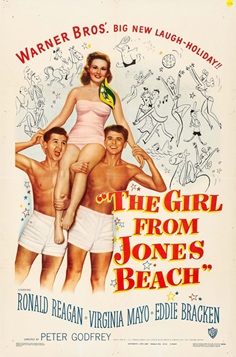
The Girl From Jones Beach (1949, directed by Peter Godfrey)


Painter Bob Randolph is famous for painting a beautiful woman who is known as “the Randolph Girl.”  Everyone wants to meet the model but they can’t because there is no one model.  Instead, there are a dozen models, each with a perfect feature that Bob uses in his paintings.  In need of money, Bob and his business partner, Chuck Donavon (Eddie Bracken) search for a woman who can be the real-life Randolph Girl.  Chuck thinks that he’s found her when he spots school teacher Ruth Wilson (Virginia Mayo) but Ruth has no interest in being a model.  She wants to be known for how she thinks and not how she looks.  Hoping to change her mind, Randolph pretends to be Czech immigrant and enrolls in Ruth’s citizenship class.

When a photograph of Ruth in a swimsuit is published without her prior knowledge, the school board decides that Ruth is not a good role model and they fire her.  With the support of Bob and Chuck, Ruth sues for reinstatement.  Bob ends up posing in the courtroom in his own swimsuit, the better to prove that there’s nothing wrong with  appearing in public in a swimsuit.

The role of Ruth was originally offered to Lauren Bacall, who turned it down because she didn’t think she could play a pin-up.  Not to knock Bacall but Virginia Mayo does seem like a better choice for the role of Ruth and she does a good job of bringing the role to life.  She proves to be a good match for Ronald Reagan, whose amiable nature allows him to get away with taking her class under a false pretext and speaking in a mangled approximation of a foreign accent.  The comedy is light and it fits well with Reagan’s affable screen presence.  The film is pleasant but ultimately lightweight and forgettable.  I can understand why, by this point in his career, Reagan was getting frustrated with the quality of scripts he was being sent.  The Girl From Jones Beach would be forgotten today if it didn’t star the future president of the United States.

Retro Television Review: Malibu, CA 2.10 “The Comeback”


Welcome to Retro Television Reviews, a feature where we review some of our favorite and least favorite shows of the past!  On Thursdays, I will be reviewing Malibu CA, which aired in Syndication in 1998 and 1999.  Almost the entire show is currently streaming on YouTube!

Yes, this is from the first season. I don’t care. I refuse to waste my time looking for a second season advertisement.

Will Scott make it to the Olympics?  Let’s try to find out.

Episode 2.10 “The Comeback”

(Dir by Gary Shimokawa, originally aired on December 11th, 1999)

Here’s what the imdb has to say about this episode:

Scott is excited about working with a new therapist, Ted from California University, and he believes against all odds that he will be in shape for the Olympic swim team trials. Trying to rush along his rehabilitation, he persuades Ted to let him get back in the water. Scott says he feels great and his comeback is progressing very rapidly, but he’s been taking medication to ease the pain his shoulder is causing him.

Yikes!  It sounds like Scott is hooked on drugs and, since this is a Peter Engel-produced sitcom, I think it’s safe to assume that Scott is not going to qualify for the Olympics.  Using drugs on any Peter Engel sitcom means that you surrender whatever you current dream may be.  We all remember what happened to Tiffani on California Dreams and Jessie on Saved By The Bell.

Oh well.  The idea of Scott just suddenly turning out to be a good enough swimmer to qualify for the Olympics never made much sense to begin with.  People spend their entire lives training for the Olympics.  Scott didn’t even know he was a fast swimmer until the second or third episode of this season.  Indeed, he should probably sue whoever gave him the false hope of thinking he could qualify in the first place.

This is yet another episode that has not been uploaded to YouTube so I can’t really do a proper review.  However, next week’s episode has been uploaded so, next Thursday, I will once again be watching Malibu, CA.  Yay, I guess.

Film Review: Patriots Day (dir by Peter Berg)


On April 15th, 2013, a terrible crime was committed.

Two brothers, Tamerlan and Dzokhar Tsarnaev, bombed the Boston Marathon.  I can remember the exact moment when I looked up at the television and I saw the footage of the bomb going off as a group of runners ran across the finish line.  Instinctively, I found myself hoping that the explosion looked worse than it actually was and that no one had been seriously injured.  However, I was then flooded with images of people running in fear while other lay injured and bleeding on the ground.  A photograph of  man who had lost his both his legs was seared into my mind, the nightmarish image of those exposed and shattered bones coming to represent the pure evil that was unleashed on that day.

At first, there was a lot of speculation about who was responsible for the bombing.  Despite the fact that it had all the earmarks of an al-Qaeda operation, many people on the news insisted that the bomb had been set by their favorite boogeymen, the right-wing militias.  (The initial theory was that it was a tax day protest, which is one of the dumbest things I’ve ever heard.)  Three days after the bombing, the first photographs of the Tsarnaev Brothers were released.  Looking at the security footage of Tamerlan placing a bomb on the ground right next to a child who was subsequently killed in the blast, I started to rethink my opposition to the death penalty.

Boston was shut down until the Tsarnaev brothers were tracked down and, along with hating the Tsarnaevs, I found myself fearing that the search for them would normalize the idea of suspending civil liberties.  Tamerlan was gunned down in a fight with police and hopefully, he felt each bullet.  Dzokhar was captured after he attempted to hide in a homeowner’s boat while whining like a little bitch.  Dzokhar is one of three people on the Federal Death Row.  He also has a truly creepy fan club online, though they haven’t been as active as they were in the past.

2016’s Patriots Day is about that tragic day and the subsequent manhunt for the Tsarnaev brothers.  This is another one of Peter Berg’s films about professional, no-nonsense men who have a job to do and who do it well.  Mark Wahlberg plays a cop.  Kevin Bacon plays the FBI agent who heads up the investigation.  John Goodman plays the Boston police commission while Michael Beach makes an appearance as Deval Patrick, the then-governor of Massachusetts who ran a bizarrely overlooked presidential campaign in 2020.  Just as he did with Deepwater Horizon, Berg emphasizes the human cost of the tragedy along with the official efforts to track down the men responsible.  The ensemble comes together impressively, recreating those scary few days and also paying tribute to a city that refused to allow itself to be defeated.  Patriots Day follows the common, blue collar citizens of Boston as they deal with a horrific act of evil.  Even though we all know how the story turned out, the film manages to create a decent amount of suspense as the authorities search for the Tsarnaevs.  As for the brothers themselves, the film portrays them as being initially cocky and eventually pathetic.  To the film’s credit, it doesn’t ask us to consider things from the point of view of the terrorists.  There’s no moral relativism here.  The film knows who deserves to be heard.

Patriots Day is a tribute to the first responders and the citizens of Boston who refused to allow the Tsarnaevs to win.  With so many people now making excuses for terrorism, Patriots Day is a powerful reminder of the human cost of such actions.  The Tsarnaevs through they were striking a blow for their ideology.  Instead, they just reminded us how strong people can be.


Guilty Pleasure No. 81: The Replacements (dir by Howard Deutch)


2000’s The Replacements finds America in crisis!

With the season already underway, football players are going on strike!  They want better contracts.  They want more money.  They want …. well, they want a lot of stuff.  Meanwhile, the fans just want to know who is going to make the playoffs.  There are only four games left in the season and the Washington Sentinels need to win three of them to make it into the playoffs.  The owner of the team (Jack Warden) recruits burned-out coach McGinty (Gene Hackman) to take over a team that will  be made up of replacement players.  McGinty says that he wants to pick his own players and he doesn’t want any interference from the team’s owner.  Anyone want to guess how long that’s going to last?

McGinty’s team is made up of the usual collection of quirky misfits who show up in movies like this.  Tight End Brian Murphy (David Denman, who later played Roy on The Office) is deaf.  One of the offensive linemen is a former SUMO wrestler.  Orlando Jones plays a receiver who has a day job at a grocery store.  The kicker (Rhys Ifan) is a Welsh soccer player.  (Okay, a footballer, I don’t care, call it whatever you want.)  Jon Favreau plays a berserk defender who is a member of the police force.  Leading them on the field is Shane Falco (Keanu Reeves), a quarterback with a confidence problem.  Cheering for them from the sidelines and falling in love with Shane is bar owner-turned-head-cheerleader Annabelle (Brooke Langton).  Backing up Annabelle is a cheer squad made up of former strippers, the better to distract the other teams.

It’s not often you see a film where the heroes cross a picket line but that’s what happens with The Replacements.  Then again, it’s not like the folks on strike are driving trucks or unloading freight for a living.  They’re multi-millionaires who want even more money and don’t even care about whether the team wins or loses.  When the replacement players actually start to win games and become beloved in the city, the striking players react by starting a bar brawl.  In the end, striking quarterback Eddie Martell (Brett Cullen) doesn’t even stick with his principles.  He crosses the picket line and creates a quarterback controversy, just in time for the last game of the season.

The Replacements is thoroughly predictable but also very likable.  The cast gels nicely, with Hackman especially standing out as the gruff but caring coach.  Keanu Reeves is not totally believable as a quarterback with a confidence problem.  You take one look at Reeves and you don’t believe he’s had an insecure day in his life.  But, as an actor, he’s so likable that it doesn’t matter.  The same goes for the entire cast, whether they’re on the playing field or singing I Will Survive in jail.  I don’t particularly care much about football but I did enjoy The Replacements.

Previous Guilty Pleasures

  1. Half-Baked
  2. Save The Last Dance
  3. Every Rose Has Its Thorns
  4. The Jeremy Kyle Show
  5. Invasion USA
  6. The Golden Child
  7. Final Destination 2
  8. Paparazzi
  9. The Principal
  10. The Substitute
  11. Terror In The Family
  12. Pandorum
  13. Lambada
  14. Fear
  15. Cocktail
  16. Keep Off The Grass
  17. Girls, Girls, Girls
  18. Class
  19. Tart
  20. King Kong vs. Godzilla
  21. Hawk the Slayer
  22. Battle Beyond the Stars
  23. Meridian
  24. Walk of Shame
  25. From Justin To Kelly
  26. Project Greenlight
  27. Sex Decoy: Love Stings
  28. Swimfan
  29. On the Line
  30. Wolfen
  31. Hail Caesar!
  32. It’s So Cold In The D
  33. In the Mix
  34. Healed By Grace
  35. Valley of the Dolls
  36. The Legend of Billie Jean
  37. Death Wish
  38. Shipping Wars
  39. Ghost Whisperer
  40. Parking Wars
  41. The Dead Are After Me
  42. Harper’s Island
  43. The Resurrection of Gavin Stone
  44. Paranormal State
  45. Utopia
  46. Bar Rescue
  47. The Powers of Matthew Star
  48. Spiker
  49. Heavenly Bodies
  50. Maid in Manhattan
  51. Rage and Honor
  52. Saved By The Bell 3. 21 “No Hope With Dope”
  53. Happy Gilmore
  54. Solarbabies
  55. The Dawn of Correction
  56. Once You Understand
  57. The Voyeurs 
  58. Robot Jox
  59. Teen Wolf
  60. The Running Man
  61. Double Dragon
  62. Backtrack
  63. Julie and Jack
  64. Karate Warrior
  65. Invaders From Mars
  66. Cloverfield
  67. Aerobicide 
  68. Blood Harvest
  69. Shocking Dark
  70. Face The Truth
  71. Submerged
  72. The Canyons
  73. Days of Thunder
  74. Van Helsing
  75. The Night Comes for Us
  76. Code of Silence
  77. Captain Ron
  78. Armageddon
  79. Kate’s Secret
  80. Point Break

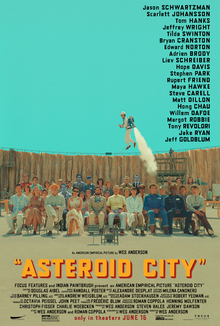
Song of the Day: A Bewildering and Bedazzling Celestial Mystery by Alexandre Desplat


Not surprisingly, Wes Anderson’s 2023 film, Asteroid City was released to mixed reviews.  It wasn’t everyone’s cup of tea.  Indeed, after many critics complained about The French Dispatch not being particularly accessible, Anderson decided to one up them by making a film that was even more enigmatic.  That said, I really enjoyed Asteroid City and I think history will be kind to it.  Today’s song of the day comes from the film’s haunting score.