Film Review: The Old Way (dir by Brett Donowho)


“Oh my God!  A Nicolas Cage western!?  This is going to be great!”

That was my initial reaction when I heard about The Old Way, a film in which Nicolas Cage plays a former gunslinger who returns to his old ways while seeking revenge for the murder of his wife.  Who knew which Nicolas Cage would show up for The Old Way?  Would we get the wild, unpredictable Cage?  Would we get the soulful and haunted Cage?  Would this be one of the films that Cage cared about or would this be one of the films that Cage clearly just made for the money?  Hearing that Nicolas Cage walked off the set because of an accident with one of the guns did not fill me with confidence.  (The armorer who worked on The Old Way was the same one who went on to work on Rust and again, that did not exactly fill me with confidence.)  Still, I was definitely curious to see The Old Way for myself.

Unfortunately, The Old Way is neither Cage at his best nor Cage at his most eccentric.  Instead, Cage gives a quiet and emotionally restrained performance as Colton Briggs.  When Briggs is first seen, he’s taking part in an extrajudicial execution and then coldly killing a man who first shoots him in the back.  Jump forward 20 years and, much like Clint Eastwood in Unforgiven, Colton Briggs is now a married man and a somewhat uptight shop owner who rarely shows a hint of emotion.  His 10 year-old daughter (Ryan Kiera Armstrong) is as rebellious as Colton once was and she has no idea about Colton’s past.  However, when the nephew of the man that Colton killed at the start of the film, murders Colton’s wife, Colton sets out for revenge.  His daughter follows him, along with Marshal Jarret (Nick Searcy, giving the film’s best performance).  Jarret is a former friend of Colton’s but both men make it clear that they will kill the other if they have to.  That’s the old way.

It’s a typical western and, on a purely technical level, it’s not a bad one.  The cinematography is frequently gorgeous and the members of the rival gang are made up of memorable character actors like Clint Howard and Abraham Benrubi.  Obviously, a certain amount of care went into recreating the old west.  As I said before, Nick Searcy is ideally cast as Marshal Jarret and he gives a performance that will keep you guessing as to whether or not Jarret should be trusted.  Nicolas Cage is adequate in the lead role, even if he’s never quite as eccentric as most of his fans would probably prefer him to be.  When he first shows up, he’s wearing an obviously fake mustache but that’s about as odd as his performance gets.

But, in the end, The Old Way just isn’t a particularly memorable film.  It’s one of those films that you watch with the hope that it will suddenly spring an unexpected detail or a bizarre moment on the audience but it never happens.  The Old Way is way too formulaic for its own good, borrowing liberally from True Grit and Unforgiven without ever really establishing its own identity.
AMV of the Day: Work Bitch (Kakegurui)


How about an AMV for Labor Day?  And how about an AMV featuring one of my favorite songs from one of my favorite singers?

Anime: Kakegurui

Song: Work Bitch by Britney Spears

Creator: Agness Shi (as always, please consider subscribing to the creator’s channel.  A lot of hard work goes into making an amv!)

Past AMVs of the Day

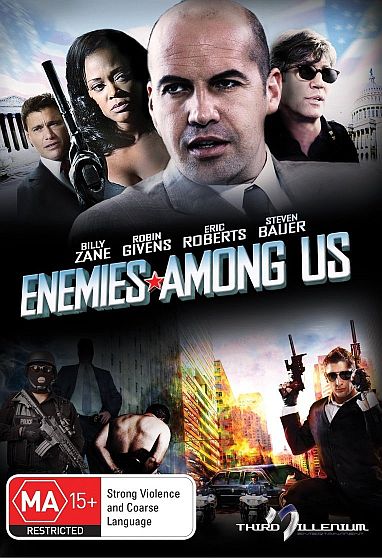
The Eric Roberts Collection: Enemies Among Us (dir by Dan Garcia)


Normally, I’d never celebrate the idea of the hero of a movie being wrongly sent to prison in a state that is rather aggressive in its use of the death penalty but Devin Taylor (Griffin Hood), the hero of 2010’s Enemies Among Us, was so annoying that I found myself hoping he would never get out of jail.

Enemies Among Us is a low-budget film about many different things.  Sen. Fred Edmonds (Steven Bauer) of North Carolina is about to accept his party’s presidential nomination and most of the polls show him far in the lead.  Senator Edmonds is planning on naming Louisiana Governor Chip Majors (James DuMont) as his running mate because this film takes place in a world where presidential nominees don’t try to balance their ticket by picking someone from a different region or from a swing state.  When we see Sen. Edmonds, he’s being interrogated by a journalist named Gretna (Tammi Arender), who is upset over campaign finance laws.  We’re meant to dislike Edmonds but Gretna is written and performed as being such a caricature of a shrill left-winger that we actually start to feel bad for Sen. Edmonds.  LEAVE HIM ALONE, GRETNA!

Meanwhile, Gov. Majors has just murdered the prostitute that he was visiting in the same hotel where, in a few hours, he’s supposed to host a major fundraiser.  The prostitute tried to kill the governor first but still, murder is murder.  However, the governor offers to pay off two members of his security details, Devin and Cobbs (Eric Roberts).  Cobbs is enthusiastic about the idea and seems to find them whole thing to be rather amusing.  Devin is conflicted but he goes with the plan …. for a while.

Meanwhile, Cobb’s ex-wife Goloria (Robin Givens) is a CIA interrogator who is torturing a terrorist named Jassim (Armando Leduc) in an effort to lean when the next big terrorist attack is planned.  Jassim taunts her, saying that Americans don’t understand why the rest of the world hates them.  The torture leads Jassim to have a bizarre hallucination, in which he makes out with Gloria and rambles on about the sorry state of humanity.

Meanwhile, Agent Graham (Billy Zane) hangs out in bars and …. well, he really doesn’t do much beyond act like Billy Zane.

Wow, what an annoying movie.  Enemies Among Us is one of those films that wants to tackle all of the important subjects but it approaches politics with all of the nuance and imagination of a college freshman who has just read Howard Zinn for the first time and is now convinced that he has all the answers.  There’s not a subtle moment to be found in Enemies Among Us and the scene where Devin starts yelling about how Americans deserve honesty is so clumsily handled that you’ll find yourself laughing more than nodding along.

That said …. Eric Roberts is in this!  Roberts doesn’t get a lot of screentime and his character is given an unceremonious exit from the film but he’s still the film’s highlight.  Roberts spends the entire film smiling.  Even the discovery that the governor has murdered the prostitute cannot wipe that smile off of Roberts’s face.  It’s a bizarre performance but at least it’s entertaining.  It’s the type of performance that will remind viewers of why they love Eric Roberts, even in films like this.

Previous Eric Roberts Films That We Have Reviewed:

  1. Star 80 (1983)
  2. Blood Red (1989)
  3. The Ambulance (1990)
  4. The Lost Capone (1990)
  5. Love, Cheat, & Steal (1993)
  6. Love Is A Gun (1994)
  7. Sensation (1994)
  8. Dark Angel (1996)
  9. Doctor Who (1996)
  10. Most Wanted (1997)
  11. Mr. Brightside (2004)
  12. Six: The Mark Unleased (2004)
  13. Hey You (2006)
  14. In The Blink of an Eye (2009)
  15. The Expendables (2010) 
  16. Sharktopus (2010)
  17. Deadline (2012)
  18. Miss Atomic Bomb (2012)
  19. Lovelace (2013)
  20. Self-Storage (2013)
  21. This Is Our Time (2013)
  22. Inherent Vice (2014)
  23. Road to the Open (2014)
  24. Rumors of War (2014)
  25. Amityville Death House (2015)
  26. A Fatal Obsession (2015)
  27. Stalked By My Doctor (2015)
  28. Joker’s Poltergeist (2016)
  29. Stalked By My Doctor: The Return (2016)
  30. The Wrong Roommate (2016)
  31. Stalked By My Doctor: Patient’s Revenge (2018)
  32. Monster Island (2019)
  33. Seven Deadly Sins (2019)
  34. Stalked By My Doctor: A Sleepwalker’s Nightmare (2019)
  35. The Wrong Mommy (2019)
  36. Free Lunch Express (2020)
  37. Her Deadly Groom (2020)
  38. Top Gunner (2020)
  39. Just What The Doctor Ordered (2021)
  40. Killer Advice (2021)
  41. The Poltergeist Diaries (2021)
  42. A Town Called Parable (2021)
  43. My Dinner With Eric (2022)

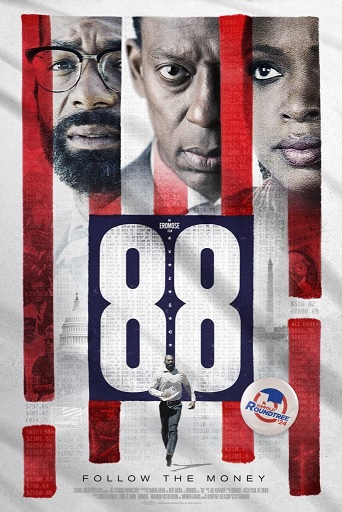
Icarus File No. 10: 88 (dir by Eromose)


Femi Jackson (Brandon Victor Dixon) is a recovering alcoholic with a pregnant wife and a past-due mortgage who totally and completely believes in a presidential candidate named Harold Roundtree (Orlando Jones).  A former baker-turned-politician, Roundtree is running for the 2024 Democratic presidential nomination on a platform of small government and personal responsibility.  That really doesn’t sound like a platform for success in a Democratic primary but whatever.  Let’s just go with it.

Femi has been hired as financial director for a SuperPAC that is raising money for the Roundtree campaign.  Femi notices that many of the donations are being submitted in numbers that add up to 88.  When he takes this news to his friend Ira Goldstein (Thomas Sadoski), Ira reveals that 88 is a code that Neo-Nazis use to identify each other.   Femi and Ira do more digging and they discover that, throughout his entire life, Roundtree has been receiving financial aide from various rich men, all of whom sent Roundtree’s sums of money that all add up to 88.  Femi questions why Neo-Nazis would do something that makes it so easy to identify them.  Ira replies that they’re marking their territory.

While Howard Roundtree records an interview with a left-wing commentator (William Fichtner), Femi tracks down and meets with an elderly and repentant Neo-Nazi (Jonathan Weir), who now needs an oxygen tank to breathe and who lives in an isolated house with his black wife.  Femi is later approached by a volunteer in the SuperPAC’s office, who informs him that the only way that White Supremacy can survive is by latching onto a black politician like Harold Roundtree.  Femi and Ira prepare to meet with Rountree, with Femi still convinced that he has no idea who is secretly funding his campaign.

While this is going on, Femi’s wife (Naturi Naughton) tries to help an ex-con achieve a bank loan despite the opposition of her sister (who also works for the bank) while Femi’s son, Ola (Jeremiah King), gets in trouble at school for showing his classmates a video of a school shooting.  It turns out that Femi’s brother-in-law is not only a cop but he’s also white and he agrees to drive Ola to school so that Ola can see that not all cops are bad.  Ola’s obvious fear as he walks out to the squad car indicates that the experiment, no matter how well-intentioned, is probably not going to work.

88 is certainly an ambitious film and the opening minutes, which features Femi’s wife explaining why Black Panther is not the empowering and progressive film that Femi believes it to be, suggest that the film has the potential to be interesting.  And throughout the film, there are little moments that do work, like the scene where Femi tells his son how to react if he’s ever pulled over by a cop.  Unfortunately, the majority of the film is a clumsily-acted and talky mix of melodrama and heavy-messaging, one that tries to duplicate the style of Spike Lee’s agitprop but instead ends up feeling more like a secular and politically progressive version of the God’s Not Dead films than anything else.  The film drags on for 2 full hours with Brandon Victor Dixon’s nerdy blandness failing to provide the narrative momentum to keep the action interesting.  As well, Orlando Jones is perhaps the least convincing presidential front runner that I’ve ever seen in a film, speaking a cadences that appear to be specifically patterned on Barack Obama but suggesting none of the charisma that would be necessary to captivate a nation.  Again, the film deserves some praise for having the ambition to actually be about something more than just selling toys and comic books but, in the end, it’s earnest dullness and heavy-handed messaging fails to hold one’s attention.

Previous Icarus Files:

  1. Cloud Atlas
  2. Maximum Overdrive
  3. Glass
  4. Captive State
  5. Mother!
  6. The Man Who Killed Don Quixote
  7. Last Days
  8. Plan 9 From Outer Space
  9. The Last Movie

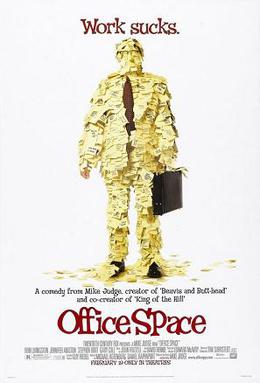
The Unnominated: Office Space (dir by Mike Judge)


Though the Academy of Motion Picture Arts and Sciences claim that the Oscars honor the best of the year, we all know that there are always worthy films and performances that end up getting overlooked.  Sometimes, it’s because the competition too fierce.  Sometimes, it’s because the film itself was too controversial.  Often, it’s just a case of a film’s quality not being fully recognized until years after its initial released.  This series of reviews takes a look at the films and performances that should have been nominated but were, for whatever reason, overlooked.  These are the Unnominated.

The other night, Erin and I started a new Labor Day weekend tradition of watching the 1999 comedy, Office Space.

As we watched Mike Judge’s first live-action film, it occurred to me that Office Space is a film that unites all of my friends.  It doesn’t matter whether they work in an office like Peter (Ron Livingston), Samir (Ajay Naidu), or Michael Bolton (David Herman) or if they work in a restaurant like Joanna (Jennifer Aniston) or even if they’re an independent contractor like Peter’s loud neighbor, Lawrence (Diedrich Bader).  It doesn’t matter if they would rather be fishing like Peter or watching reruns of Kung Fu like Joanna.  Everyone that I know has said that they can relate to Office Space.  Everyone has had to deal with a passive-aggressive jerk of a boss like Bill Lumbergh (Gary Cole).  Everyone has known a crazy co-worker like the red stapler-obsessed Milton (Stephen Root).  Everyone dreads the arrival of consultants like the Bobs (John C. McGinely and Paul Willson).  Everyone resents being told that doing the bare minimum is not enough, whether it’s just sitting in your cubicle or wearing 15 pieces of flair.  Everyone dreams of sleeping late and not stressing about TPS reports.  Everyone dreams of screwing over their company in a way that’s so clever that they’ll never be caught.  (And I think everyone secretly knows that they would screw it up by putting a decimal point in the wrong place.)  Everyone wants to destroy the oldest and least reliable piece of equipment at work.  Everyone wants to feel like they can just announce that they’re going to quit and spend the rest of their life doing what they would do if they had a million dollars.

Considering the fact that the film has now become universally beloved, it’s interesting that Office Space opened to mixed reviews and middling box office.  The studio wasn’t sure how to sell a live action film from the director of Beavis and Butt-Head and King of the Hill and many critics focused on the film’s rather loosely-constructed, episodic narrative and overlooked the fact that the film captured all of the small details that drive people crazy about their work.  Audiences, though, discovered the film on video and undoubtedly enjoyed watching it after a long day of dealing with their own annoying boss.  The film’s star, Ron Livingston, has said that many people have approached him and told him that he inspired them quit their jobs.  “That’s kind of a heavy-load to carry.”

For a film that centers around office workers updating data so that computer systems don’t cash in 2000, Office Space has aged remarkably well.  Ron Livingston, David Herman, and Ajay Naidu are an instantly sympathetic and likable trio of nerdy heroes.  Stephen Root’s panic as he realizes that he will be the only employee not to get a piece of cake remains both poignant and funny.  Gary Cole is still the boss from Hell.  I still laugh at John C. McGinley’s rage when his praise of Peter as a “straight-shooter with upper management potential” is dismissed by Peter’s boss.  We can all relate to Jennifer Aniston’s dislike of flair and her hatred for Brian (Todd Duffey).  The jump to conclusion mat would probably be even more popular today than back in 1999.

Of course, Office Space was not nominated for any Oscars.  That’s not really a shock.  It’s an episodic comedy that was directed by a Texas filmmaker who was, at the time, best-known for a cartoon about two brain-dead teenagers.  Obviously, it wasn’t going to be nominated for anything, even though I think more people have probably watched Office Space over the past few days than have watched American Beauty.  Oscars aren’t everything, though.  Office Space remains both a great work film and a great Texas film.

Previous entries in The Unnominated:

  1. Auto Focus 
  2. Star 80
  3. Monty Python and The Holy Grail
  4. Johnny Got His Gun
  5. Saint Jack

Retro Television Reviews: Hang Time 6.11 “High School Confidential” and 6.12 “Graduation on Three”


Welcome to Retro Television Reviews, a feature where we review some of our favorite and least favorite shows of the past!  On Mondays, I will be reviewing Hang Time, which ran on NBC from 1995 to 2000.  The entire show is currently streaming on YouTube!

Today, we finally say goodbye to Hang Time!

Episode 6.11 “High School Confidential”

(Dir by Miguel Higuera, originally aired on December 9th, 2000)

With graduation day approaching, the seniors class of Deering High is interviewed by Mary Beth and Kristy.  That’s right, it’s time for a clip show!  Interestingly, all of the clips come from seasons 5 and 6.  You would think that, after going to high school for 6 years, Julie and Mary Beth would have more memories.  No one even mentions Coach Fuller or any of the other basketball players that Julie went out with before meeting Michael.  Even for a clip show, this was a let down.

Episode 6.12 “Graduation on Three”

(Dir by Miguel Higuera, originally aired on December 16th, 2000)

It’s graduation time!  Because she’s the greatest player who has ever lived, the school officially retires Julie Connor’s number.  No one else will ever wear Number 34.  Hopefully, no one else will ever spend six years in high school as well.  Actually, if I remember correctly, Julie transferred to Deering from another school so it’s totally possible that it took Julie seven years to graduate high school.

Considering how long it took the rest of the characters to graduate high school, it’s not surprising that Kristy is the school’s valedictorian.  Kristy is especially concerned about giving a perfect graduation speech because she’s worried that she’ll never see her friends again after graduation.  I could relate to what Kristy was feeling because, when I graduated from high school, I also feared that I would never see my friends again.  Luckily, society now has Facebook so we can check in on all of our old friends from high school and discover that they’ve all become political cranks.

Kristy does eventually find the courage to give her valedictorian speech.  For some reason, Mary Beth hosts the graduation ceremony.  (Did Deering High not have a principal?)  After Coach K gets an award, Kristy gives her speech and breaks down into tears.  It was kind of sad but also pretty sweet.  Again, I could relate to how Kristy was feeling.

All that’s left is for everyone to throw their graduation caps into the air and then share one final group hug in the gym.  Awwww!

And that’s it for Hang Time!

Well, what is left to say about this show, one that I’ve spent a year reviewing?  Hang Time was a messy show, largely because the cast was constantly changing and everyone stayed in high school for way too long.  That said, the good episodes tended to be very good and the bad episodes were, for the most part, inoffensive.  The show probably should have ended when Reggie Theus left but Dick Butkus was a more than adequate replacement and, indeed, Coach K. was arguably the show’s best character during the final two seasons.  Even if the final seasons were a bit weak, Megan Parlen and Amber Barretto were a good comedic team.  The final episode ended with Kristy saying, “I’m going to miss this place,” and you know what?  So am I.

Next week: Retro Television Reviews leaves Indiana for ….. MIAMI!  Are you ready for a little Vice?

Film Review: Creed III (dir by Michael B. Jordan)


Creed 3 opens with Adonis “Donnie” Creed (Michael B. Jordan) on top of the world.

He has just retired, as the undisputed heavyweight champion of the world, from boxing.  Unlike other boxers (like Big George Foreman or Rocky Balboa or Creed’s father, Apollo), Donnie is not retiring because he’s been defeated or because his health is at risk.  Donnie is retiring because he has apparently worked out his anger and his issues with with his father’s legacy and now, he wants to spend some quality time with his wife (Tessa Thompson) and his daughter (Mila Davis-Kent).  Donnie, however, does remain in the world of boxing by managing the new world champion, Felix (Jose Benavidez, Jr.), and setting up a title fight between Felix and Donnie’s former rival, Viktor Drago (Florian Munteanu).  However, when Viktor is attacked by a mysterious assailant and left too injured to fight, Donnie has to find a new opponent for Felix and he has to do it quickly!

Interestingly enough, Dame Anderson (Jonathan Majors) has just returned to town.  Donnie and Dame were childhood friends.  When they were kids, Dame was the aspiring boxer who dreamed of going to the Olympics, turning pro, and then eventually becoming the world champion.  However, those plans changed when Dame went to prison.  While Donnie was becoming world champion, Dame was serving hard time and writing letters to Donnie, all of which were hidden from Donnie by Donnie’s well-meaning mother (Phylicia Rashad).  When Dame returns home, a guilt-stricken Donnie gives Dame a job as Felix’s sparring partner and even promises to help Dame out with his late-in-life boxing career.  (As just about everyone points out, boxing is a young person’s sport and Dame is even older than Donnie.)  When Dame asks Donnie to give him the title shot against Felix, Donnie ignores everyone else’s advice and gives it to him.  Donnie justifies his decision by reminding everyone that Apollo gave Rocky a shot.

Directed by Michael B. Jordan, Creed III is an exciting and intelligent sports film that also works as a deconstruction of some of the genre’s most beloved clichés.  Donnie himself points out that everyone loves an underdog story and that’s certainly true, from Rocky to this year’s Champions.  Dame uses the world’s love for the underdog to his advantage, just to turn out to be a vicious and self-destructive fighter.  This is the film that answers the question, “What if Rocky Balboa wasn’t such a nice guy?”  Dame also uses Donnie’s guilt about the past to his advantage.  If the previous two films were all about Donnie coming to peace with the legacy of Apollo Creed, this film is about Donnie (and, to an extent, Dame) coming to peace with the legacy of Adonis Creed.

And yet, Dame himself is not a one-dimensional villain.  For much of the film, he’s actually more likable than Donnie and, even after he nearly kills Felix in the ring, he still seems to be incapable of understanding why everyone’s so upset.  While the other characters treat boxing as a sport and ignore the violence at the center of it, Dame understands that boxing is just a fight with a bigger audience.  After twelve years in prison, the system has dumped Dame on the streets and ordered him to make something of his life without bothering to help him develop any of the skills necessary to do so.  Dame fights because that’s what he’s had to do his entire life.  Since he went to jail for a fight that Donnie could have just as easily been arrest for, Dame is who Donnie easily could have become.  While his performance has since been overshadowed by his own legal issues, Jonathan Majors is never less than compelling as Dame, perfectly capturing both Dame’s bitterness and his own need for approval.

This film is Michael B. Jordan’s directorial debut.  There are a few moments when Jordan falls victim to the first-time director’s trap of trying too hard to show off his artistic bona fides.  A sequence, during the final match, when the audience vanishes and Donnie and Dame dance around the ring and roar at each other like animals is occasionally effective and occasionally silly.  That said, Creed III is a hundred times more compelling and visually interesting than the more conventionally-directed Creed II.  Jordan gets good performances from his entire cast and shows himself to be a strong story teller.  I look forward to seeing what he does next as a director.

Finally, as everyone knows, Sylvester Stallone does not return as Rocky in this film, though the character is mentioned several times.  Stallone’s absence isn’t really felt.  That’s not a slight against Stallone, an actor who has gotten considerably more likable in his later years.  It’s just that there’s really not a place for Rocky Balboa in this film.  (Arguably, there really wasn’t much of a place for Rocky in the second film as well.)  Rocky Balboa has earned his retirement and hopefully, is still visiting his grandson in Canada.  This film belongs to Donnie and Dame.

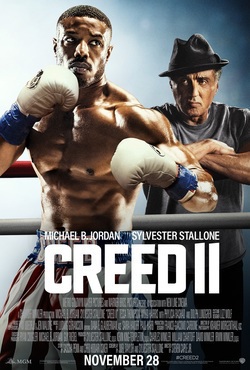
Film Review: Creed II (dir by Steve Caple, Jr.)


Yesterday, in anticipation of finally watching Creed III, I decided that I should first rewatch 2018’s Creed II.  I actually did see Creed II when it was originally released in theaters and I seem to remember that I enjoyed it but, the more I thought about it, the more I realized that I couldn’t remember much more about it.

In Creed II, Adonis “Donnie” Creed (Michael B. Jordan) finally becomes heavyweight champion of the world and immediately finds himself being taunted by Viktor Drago (Florian Munteanu), the son of Ivan Drago (Dolph Lundgren).  To be honest, Donnie really does have more to think about then some other boxer demanding that Donnie give him a fight.  Donnie has finally married his girlfriend, Bianca Taylor (Tessa Thompson), and she’s pregnant.  However, Donnie cannot get Viktor out of his mind because Viktor is the son of the man who killed Donnie’s father in the ring.  Ivan Drago has not only raised his son to be a fearsome fighter but he’s also Viktor’s trainer.

Have you ever wondered if Ivan Drago ever felt guilty about causing the death of Apollo Creed?  This film suggests that he does not and that he instead blames Apollo’s friend, Rocky Balboa (Sylvester Stallone), for not stopping the fight.  In Creed II, Ivan and Viktor fly to Philadelphia to try to get their fight with Donnie.  Ivan goes to Rocky’s restaurant by himself and he explains that, after losing to Rocky in Russia, he lost everything.  Rocky went home a hero while Ivan went home with nothing.  By turning his son into a fearsome boxer, Ivan is vicariously getting the career that he feels he deserved.  Ivan wants Donnie to fight Viktor and Donnie wants to fight Viktor.  However, Rocky wants nothing to do with it and, when you consider how big Viktor is compared to Donnie, it’s easy to understand why.

Donnie recruits Little Duke (Wood Harris, who co-starred with Jordan on The Wire) to serve as his new manager and trainer.  The fight between Donnie and Viktor is a disaster, with Donnie letting his emotions get the better of him.  Donnie is nearly killed in the ring but Viktor proves to be such an aggressive fighter that he loses by disqualification.  Will Donnie survive the inevitable rematch with Viktor and will that rematch be fought in Moscow?  Will Rocky finally agree to train Donnie and also find the courage to travel up to Canada to see his son and meet his grandson?  Will Ivan realize that he’s pushing his son too hard?  Even if you haven’t seen the film, you can probably guess the answers to all of those questions.

As opposed to the first film, there aren’t many surprises to be found in Creed II.  It’s a well-made but thoroughly conventional boxing movie and it lacks both the grit and the attention to detail that Ryan Coogler brought to the first Creed.  Running over two hours, Creed II has a few too many slow spots and even the big training montage drags a bit.  That said, Creed II works wonderfully well as an epilogue to Rocky IV.  The most ridiculed of the Rocky sequels actually provides a poignant backdrop to this film as both Donnie and Viktor struggle to both live up to and make peace with the complicated legacies of their fathers.  Donnie finally feels worthy of his family name while Viktor shows the same type of raw courage that Rocky Balboa showed in his earlier films.  Perhaps most surprisingly, Ivan Drago finally reveals his humanity.  The scene where Ivan finally realizes that he’s turning his son into a machine who will not stop fighting until he is thoroughly broken is surprisingly powerful and Dolph Lundgren truly seems to be happy to have the chance to finally show that Ivan Drago is a human being after all.

Interestingly enough, Rocky Balboa spends much of the film sidelined and, even more so than in the first film, the emphasis is on Donnie’s emotional growth.  It’s always good to see Stallone and he’s as likable as always as Rocky but, re-watching this film, it was easy to understand how a sequel could be made without the character’s presence.  In the end, the best thing about the Creed films is that Donnie himself is a strong enough character that he can be compelling both with or without Rocky Balboa’s help.

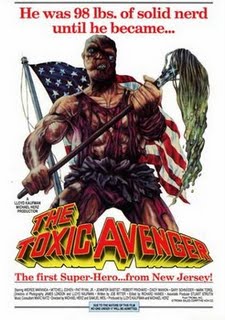
The TSL’s Grindhouse: The Toxic Avenger (dir by Michael Herz and Lloyd Kaufman)


First released in 1984, The Toxic Avenger takes place in Tromaville, New Jersey, which is perhaps the ugliest city in …. well, honestly, it’s probably the ugliest city in the world.  The streets are strewn with trash.  The walls are covered in graffiti.  The majority of the citizens are either bullies or idiots.  The mayor is corrupt and totally willing to sell out his city to anyone willing to cut him a big enough check.  Is it a surprise that Tromaville is also the “toxic waste capitol of the world?”

(“Forget it, Lisa.  It’s New Jersey.”  Hey, I hear you, Paulie.)

Tromaville is also the home of Melvin Ferd Junko III (Mark Torgl), who is so nerdy that even I was immediately annoyed by him.  Melvin has a job working as a janitor at the local health club.  Melvin doesn’t want to bother anyone but four members of the gym still decide to trick him into wearing a pink tutu and nearly having sex with a sheep.  In typical Troma fashion, this leads to Melvin falling out of a second story window and into a vat of toxic waste.  Melvin bursts into flames and jumps into a bathtub to douse the fire.  However, when he emerges from the bathtub, he is no longer Melvin.  Now, he is a grotesque and muscular mutant (and he’s now played by Mitch Cohen).

It’s time to get some justice!

Of course, since this is a Troma film, Melvin’s idea of justice may not be everyone’s idea of justice.  Yes, Melvin does stop a lot of muggings and he does break up a drug ring.  Of course, he does that by killing those criminals and allowing their guts to graphically splatter all over the street.  (Cheap as this film is, it’s obvious that some care was put into creating the gore.)  However, Melvin also stalks the bullies who were responsible for transforming him into the Toxic Avenger and he murders them with a sadism that is equal to their own.  And again, it’s not like the bullies don’t deserve to suffer.  I mean, one of the bullies is actually named Slug and he lives up to the name!  (That said, you’re kind of dooming your child to a certain fate when you give him a name like Slug.)  But still, it’s hard not to notice that The Toxic Avenger is a super hero who is as destructive as the villains he’s taking down.  It’s a good thing that Tromaville seems to be exclusively populated by scumbags.

Actually, there are two good people in Tromaville.  One is Marisa Tomei, who appears for a split second in one of her earliest roles.  I simply can’t imagine that Marisa Tomei would have supported bullying Melvin.  The other good person is Sara (Andree Maranda), who is blind.  After the Toxic Avenger saves her from a rapist, she falls in love with him.  Eventually, Sara even touches his deformed face and declares him to be beautiful.  The city may be worshipping their new hero and the corrupt mayor (played by Pat Ryan Jr.) may be desperately trying to take the Avenger down but ultimately, The Toxic Avenger just wants to escape the city and be with Sara.  Indeed, the saving grace of The Toxic Avenger is that Sara and the former Melvin really are a sweet couple and you really do hope things work out for them.

The Toxic Avenger, with its mix of comedy, horror, and gore, was one Troma’s first big hits and it remains one of their most popular films.  (Macon Blair has directed a remake, which should be opening soon.)  Personally, for me, the film is a bit too repetitive and the humor is pretty much hit-and-miss.  There’s a lot of scenes, especially in the health club, that were obviously only included to pad out the film’s running time and, as such, the film takes a while to really get going.  It may better than the average Troma film but that’s not exactly a hard bar to clear.  That said, I did like the relationship between Sara and The Toxic Avenger.  For all the crudeness and gore, the movie works best when its sentimental.

Documentary Review: Back to the Drive-In (dir by April Wright)


When I was 11 years old, I spent about a month and a half living in a motel with my mom and my sisters.

We were between homes and, since my mom didn’t really have the money to pay for our rooms, she and my two oldest sisters would work as maids during the day while my sister Erin and I stayed in our own room and watched stuff on the television that we probably shouldn’t have been watching.  (“What are you watching!?” mom would say as either Erin or I grabbed the remote and tried to get the TV off of HBO as quickly as possible.)  In retrospect, I know that all probably sound very dramatic and traumatic but I have to admit that, at the time, it just felt like an adventure.  I was jealous of my mom and my sisters getting to wear uniforms every day and basically go anywhere they wanted to go in the motel.  I would ask my mom and sisters about what they found in the rooms that they had to clean and I would beg for a chance to go with them because I figured it had to be fun to see how other people lived.  They always refused and years later, my sister Megan would tell me that they usually just found discarded underwear, used condoms, and half-eaten fast food.  Sometimes, I would sit in the front lobby, bothering whoever was working behind the desk and trying to overhear conversations.  I would love watching the various people who checked in and out of the motel and I would imagine amazing identities and life stories for them.  At night, I would listen for sounds coming from other rooms.  One time, the police were called because the people below us were fighting and I remember watching the reflection of the red lights flashing across the walls of my room.

That said, I think my main memory of living at that motel was that there was a creek right next to the hotel (though I always envision it as being a raging river whenever I think back to those days) and, on the other side of that creek, there was a drive-in movie theater.  Every night, I would go out on the balcony and look into the distance, at the silent images flickering across the giant screens.  The fact that I couldn’t actually hear what Stallone and Schwarzenegger were saying only made the experience more enjoyable.  I could make up my own stories to go along with the images.  Watching those movies became a bit of a ritual for me.  I had to watch every night and at the same time and if anyone tried to keep me from doing so, I would throw a fit.  Though I didn’t fully realize it at the time, for me, that drive-in came to represent stability.

I found myself thinking about that drive-in as I watched the documentary Back To The Drive-In.  Shot in 2021 and 2022, Back To The Drive-In cut backs and forth to tell the stories of drive-ins around the country and how they dealt with the pandemic.  Every owner has their own reason for owning and loving their drive-in.  Some of them are friendly eccentrics.  Some of them are full of nostalgia and recreating the past.  Some of them are hard-nosed businessmen who make sure to enforce the rules.  My favorite was the guy who decided to that his backyard was the perfect location for a drive-in.  (He calls it The Field of Dreams.)  However, they all have the same basic story.  Business was suddenly good during the Pandemic because their competition was closed down.  However, in the post-Pandemic world, they’re facing an uncertain future.

The documentary, of course, was made before box office successes of Top Gun: Maverick, Oppenheimer, and Barbie proved that people are willing to return to theaters but the fate of America’s drive-ins are still up in the air.  And that’s a shame because, as this funny and wonderfully humanistic documentary shows, the drive-in is more than just a theater.  It’s an experience and once they go away, our culture is going to be just a little bit more dull.  As I watched the documentary, I made note of which drive-ins are within driving distance of my home.  I’ll do my part to support these temples of Americana and I hope everyone else will as well.

Save the Drive-In!