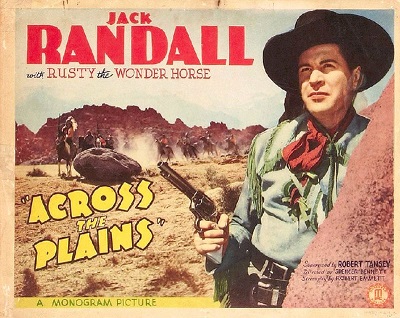
In the old west, a group of outlaws attack a wagon train, killing a husband and wife but sparing their two children. One child is taken by the outlaws, who tell him that they have saved him from an Indian attack. He grows up to be The Kansas Kid (Dennis Moore), a wagon master who still works for Gordon (Bob Card), the outlaw who raised him. The other child is adopted by a Native tribe and grows up to be known as Cherokee (Jack Randall). Cherokee has been hired to protect a gold shipment that Kansas and Gordon are determined to steal. How long until the brothers come into conflict?
Across The Plains is a pretty good programmer. Dennis Moore and Jack Randall are convincing as two men on opposite sides of the law who don’t realize that they’re brothers and director Spencer Gordon Bennett captures the scenery of the old west. This is a western where the frontier really feels and looks like an untouched frontier! The gunfights are effectively choreographed and directed and the family aspect is a good spin on a simple story. For fans of westerns, Across The Plains is an enjoyable example of the genre.
Dennis Moore and Jack Randall were both B-western mainstays. Moore occasionally played a hero but was usually cast as a villain. Across The Plans gives him a chance to play a more complex role than usual and he takes full advantage of the opportunity. The Kansas Kid may be an outlaw but he’s not so much bad as just misguided. Jack Randall was one of the many stage names used by actor Addison Randall. He started out as a singing cowboy before playing more traditional heroes, like in this film. In Across The Plans, Randall was as tough and convincing a western hero as he always was. Tragically, he died six years after making this film when he fell off a horse while filming a Universal serial called The Royal Mounted Ride Again. He was only 39 years old.
Has Aaron Sorkin ever met anyone who doesn’t sound like Aaron Sorkin?
That was the question that I found myself considering as I watched Sorkin’s latest film, Being the RIcardos. The film may present itself as being a film about Lucille Ball (Nicole Kidman) and Desi Arnaz (Javier Bardem) but neither Lucy nor Desi ever come across as being actual human beings or even celebrities trying to be human. Instead, they both come across as Sorkin stock characters. Lucy is the socially maladjusted genius who demands a lot from the people working for her and who struggles with apologizing. Desi is irresponsible but a hard worker, a man who makes a lot of mistakes but who should never be underestimated. They speak in quips and they instinctively understand what the people in their audience want to see. Who can keep up with Lucy and Desi? Certainly not the suits from the network! Trial of the Chicago 7 had Tom Hayden and Abbie Hoffman taking on the military industrical complex. Being the Ricardos has Lucy and Desi taking on both the entertainment industry and the McCarthy era.
The film claims to tell the story of the week that Lucy and Desi’s show, I Love Lucy, was nearly destroyed. The week started with columnist Walter Winchell revealing that, when she was in her 20s, Lucy was briefly registered as a member of the Communist Party. (Lucy explains that she did it as a favor for her grandfather, who “cared about the working man.”) The day after learning that her subversive past has been exposed, Lucy and Desi tell the show’s writing staff that Lucy is pregnant and they expect the writers to write her pregnancy into the show regardless of what the uptight studio execs declare. Meanwhile, Lucy has to deal with rumors of Desi’s infidelity while Desi struggles with being overshadowed by his wife. Lucy’s co-star, Vivian Vance (Nina Arianda), resents having to play a frumpy character while her other co-star, William Frawley (J.K. Simmons), spends most of the movie drunk off his ass. If anything Frawley and Vance come across as being more interesting than either Lucy or Desi but, just as in real life, this is the Lucy show. Frawley makes a few drunken comments about a seven year-old communist. Vance sits in her dressing room and fumes. In real life, when she learned Lucy was pregnant, she reportedly yelled, “I’d tell you to go fuck yourself but apparently Desi already did that!” That line isn’t in the film, which is a shame.
The film skips around in time. There’s an odd framing device, taking place in what I presume is meant to be the 80s and featuring the surviving members of the production staff are being interviewed for a documentary. Why Sorkin decided to use this documentary device is odd. It seems like he could have just used real archival footage if he wanted to go for a documentary approach as opposed to staging a fake documentary where older actors playing real people still sound like relentlessly quippy supporting characters in a Sorkin film. We also get the occasional flashback to the early days of Lucy and Desi’s relationship, none of which are particularly interesting. One of the people being interviewed for the documentary tells us that, before she met Desi, Lucy was being groomed to become a serious dramatic actress. “She could have starred in All About Eve and blown the doors off!” we’re told and that’s great but is that the opinion on the fictionalized person being interviewed for the documentary or is that something that Aaron Sorkin came up with to try to create some dramatic tension? I mean, saying that Lucy would have been the equal of Bette Davis is quite a statement but the film doesn’t show us any scenes of Lucy being a particularly skilled dramatic actress so it just comes across as being kind of overly dramatic thing to say.
We do get several scenes of Lucy explaining why jokes are funny. Nicole Kidman gets a very serious look on her face while Sorkin shows us what’s happening inside her mind. Lucy pictures herself, in black-and-white, stepping on grapes in Italy. Dramatic music swells as we snap back to Lucy declaring what the scene needs to truly be funny. (“I lose an earring,” she says, as if she’s just figured out how to resolve Gatsby’s obsession with Daisy.) It’s the sort of thing that makes you wonder if Aaron Sorkin has ever actually told a joke that he didn’t spend a few hours thinking about ahead of time. The film’s portrayal of what went on behind-the-scenes of I Love Lucy is so portentous and overdramatic that it really only makes sense if you accept the idea of creating television being some sort of religious ritual, with showrunners and producers taking the place of God. God needed 6 days to create the world but Lucy only needs 5 to create classic television comedy. Take that, God!
Aaron Sorkin is a writer who desperately needs a cynical collaborator. With The Social Network and Moneyball, Sorkin was fortunate to be paired with David Fincher and Bennett Miller, two directors with notably dark views of humanity and who served to temper Sorkin’s sanguine excesses. When Sorkin directs his own material, the audience ends up with scenes like Joseph Gordon-Levitt standing in protest at the end of The Trial of the Chicago 7 or Desi Arnaz calling J. Edgar Hoover from the set of I Love Lucy in Being The Ricardos. These are deeply silly scenes that did not happen in real life and which, even more importantly, should never have gotten past a first draft. Sorkin’s need to end everything with a “big hero” moment is his most glaring flaw as both a writer and a director.
For the record, Lucille Ball did register as a communist when she was younger. And, indeed, it is true that she did it as a favor for her grandfather. It was briefly a news story but Lucy was quickly cleared. Before shooting that week’s episode, Desi told the audience that “The only thing red about Lucy is her hair and even that is not legitimate.” That was a good line and no, Desi didn’t need the help of J. Edgar Hoover to sell it.
Poor Adi Ulmansky! She definitely deserves better and she should also be careful about having that many candles lit at once. Seriously, I’m looking at all of those flames and just kind of freaking out. Don’t get me wrong. Candles are atmospheric and they’re romantic and it’s nice to use a few to set the mood but I think when you’ve got a 1,000 lit at once, you’re pressing your luck.
My best friend Evelyn introduced me to Adi’s music a few years ago. I’ve loved the sound of her voice ever since.
Yes, the song is in Hebrew. No, I do not speak Hebrew. However, the emotions of the song are universal. Adi and the music video both get the point across.
Admittedly, I’m not a close follower of the mainstream comics scene and so can’t speak with any authority on what may or may not be happening in it now, but unless there’s been some sort of below-the-radar (like, way below-the-radar) resurgence of which I’m entirely unaware, it’s safe to say that the “swords and sandals” genre reached its apex in this little medium we all love (most of the time) back in the 1970s, when a bevy of four-color “floppies” and full-sized black and white magazines regaled readers month in and month out with the exploits of Conan the Barbarian, Red Sonja, Kull the Conqueror, and too many also-ran imitators to count. As newsstand distribution gave way to the direct market, though, super-hero readers found their tastes increasingly catered to while fans of Robert E. Howard-esque fantasy were nudged further and further to the sidelines, ultimately being relegated to “afterthought” status.
I’ve heard that Conan is back at Marvel these days after a long hiatus that saw the character wandering through a series of smaller publishers, but his exploits appear to be confined to only standard-format comic books now, with the “mature readers” (as in, they can show boobs and butts) B&W mag apparently a thing of the past — and while that probably makes all kinds of sense from a financial and commercial perspective, it still leaves the grizzled nostalgist out in the cold, stuck poring over dusty back issue bins to find PG-13- and R-rated tales of the Hyperborean Age. Or does it?
Art abhors a vacuum every bit as much as nature does, so leave it to our always-intrepid friends at Strangers Fanzine to fill this particular one with the late-2021 release of cartoonist Brian McCray’s Krania, a magazine-formatted collection of short-form yarns centered around the exploits of a female barbarian warrior that hews a fine line between respectful homage and revisionist re-interpretation with just enough wink-and-nod pastiche thrown in to keep readers who find this sort of crap inherently ridiculous (I’ll take the fifth on whether or not that includes me) reasonably amused and enthralled, as well. It’s hardly revolutionary stuff by any means, but it’s not designed to be : McCray has set himself a fairly specific task with this project, and he proceeds to tackle it with energy and aplomb.
All of which is to say, don’t expect anything particularly taxing here, but do expect to be entertained. McCray’s cartooning is solid, stylish, and dynamic — his villainous creatures are imaginatively designed, his protagonist looks like a tough warrior woman should, and his fight scenes are fluidly paced with the appropriate emphasis given to impact in relation to action. He’s not overly concerned with details, relying on what appears to be the digital equivalent of zip-a-tone to do a lot of the heavy lifting in that regard, but he’s got all the basics of composition down pat and isn’t afraid to get creative with perspective and placement. Throw in a smattering of entirely unsubtle hat-tips to Jack Kirby’s Kamandi, and it’s awfully hard not to like what’s being served up here.
Okay, in fairness, this is about as self-aware a comic as you’re likely to find, but it doesn’t approach its subject matter with an eye toward narratively “cashing in” on easily-arrived-at irony — rather, as the title of this review suggests, there is some delicious (if obvious) subversion going on here with regards to traditional gender roles in so-called “heroic fantasy” that’s probably long (as in decades) overdue. I get the feeling McCray has plenty to say, but that he would rather say it through his stories than in his stories, and if that sounds like a distinction without a difference on its face, rest assured that if you decide to take the plunge and read this book — as well you should — you’ll understand what I’m (perhaps clumsily) getting at more or less immediately.
Count me in as a believer in what McCray is doing here, then, and also as someone who will almost certainly be on the lookout for more of his stuff. And if I were an actual fan of this genre, who knows? I’d have probably enjoyed this comic even more than I did — which, in case you hadn’t sussed it out already, was quite a bit indeed.
Also, this review is “brought to you” by my Patreon site, where I serve up exclusive thrice-weekly rants and ramblings on the worlds of comics, films, television, literature, and politics for as little as a dollar a month. Subscribing is the best way to support my continuing work, so I’d be very appreciative if you’d take a moment to give it a look by directing your kind attention to https://www.patreon.com/fourcolorapocalypse
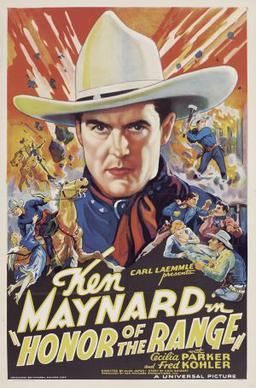
In an old west town, Sheriff Ken Bellamy (Ken Maynard) is an honest and upright lawman who thinks that he is trusted and respected by all. His brother, Clem (also played by Ken Maynard), is a storeowner who is less respected and very jealous of his brother. When Ken is asked to store some money in a safe, Clem decides to help the local outlaw, Rawhide (Fred Kohler), steal the money. Clem gives Rawhide the combination but Rawhide then betrays Clem and takes him hostage. Meanwhile, the townspeople think that Ken must has stolen the money so they toss him in jail and appoint a man named Boots (Frank Hageny) as the new sheriff. Now, Ken has to not only figure out how to escape from jail and the townspeople but also how to defeat Rawhide’s gang.
Ken Maynard and his white horse Tarzan were two of the biggest western stars of the pre-code era. Most of them were routine programmers but Honor of the Range stands out because it allows Maynard to step out of his usual heroic role by having him also play Clem. Maynard could be a stiff actor when he was playing a traditional hero but here he seems to be enjoying playing the untrustworthy Clem. Maynard actually produced Honor of the Range himself and it’s much more serious than the typical Ken Maynard western. The town’s betrayal of the sheriff is played straight, as is Clem’s resentment of his brother. With higher production values than usual and Maynard looking credible whenever he was holding a gun or riding his horse, Honor of the Range is one of the better westerns to be distributed by Universal during the pre-code era.
The American Society of Cinematographers have announced their nominees for the best cinematography of 2021!
I’d say that the big surprise here is the lack of a nomination for West Side Story as this seems like a place where you would normally expect to see a big Spielberg production nominated. That could indicate a bit of weakness for West Side Story. (Though, let’s face it — I think we all know that West Side Story isn’t going to be the big Oscar powerhouse that many initially assumed.) That said, there’s now ten best picture nominees and I’d still be surprised if one of the slots didn’t go to West Side Story.
Anyway, here’s the nominees:
Feature Film
Bruno Delbonnel (ASC, AFC) for THE TRAGEDY OF MACBETH
Greig Fraser (ASC, ACS) for DUNE
Dan Laustsen (ASC, DFF) for NIGHTMARE ALLEY
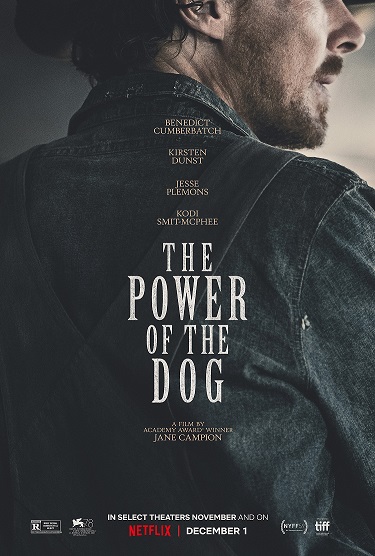
Ari Wegner (ACS) for THE POWER OF THE DOG
Haris Zambarloukos (BSC, GSC) for BELFAST
Spotlight
Ruben Impens (SBC) for TITANE
Pat Scola for PIG
Adolpho Veloso (ABC) for JOCKEY
Documentary
Jessica Beshir for FAYA DAYI
Isabel Bethencourt and Parker Hill for CUSP
Daniel Schönauer for THE HIDDEN LIFE OF TREES
Today, the Music City Film Critics Association (that’s Nashville) became the latest group to name The Power of the Dog as the best film of 2021!
Here are all the winners from Nashville!
BEST FILM
Belfast
C’mon C’mon
CODA
Dune
Licorice Pizza
The French Dispatch
The Harder They Fall The Power of the Dog
Tick, Tick…Boom!
West Side Story
BEST DIRECTOR
Denis Villeneuve – Dune Jane Campion – The Power of the Dog
Kenneth Branagh – Belfast
Paul Thomas Anderson – Licorice Pizza
Steven Spielberg – West Side Story
BEST ACTRESS
Alana Haim – Licorice Pizza Jessica Chastain – The Eyes of Tammy Faye
Kristen Stewart – Spencer
Lady Gaga – House of Gucci
Olivia Colman – The Lost Daughter
BEST ACTOR
Andrew Garfield – Tick, Tick…Boom!
Benedict Cumberbatch – The Power of the Dog
Denzel Washington – The Tragedy Of Macbeth Nicolas Cage – Pig
Simon Rex – Red Rocket
Will Smith – King Richard
BEST SUPPORTING ACTRESS Ann Dowd – Mass
Ariana DeBose – West Side Story
Caitriona Balfe – Belfast
Kathryn Hunter – The Tragedy Of Macbeth
Kirsten Dunst – The Power of the Dog
BEST SUPPORTING ACTOR
Bradley Cooper – Licorice Pizza
Colman Domingo – Zola
Jason Isaacs – Mass Kodi Smit-McPhee – The Power of the Dog
Troy Kotsur – CODA
BEST YOUNG ACTRESS Emilia Jones – CODA
McKenna Grace – Ghostbusters: Afterlife
Millicent Simmonds – A Quiet Place Part II
Rachel Zegler – West Side Story
Saniyya Sidney – King Richard
BEST YOUNG ACTOR
Cooper Hoffman – Licorice Pizza Jude Hill – Belfast
Noah Jupe – A Quiet Place Part II
Reyn Doi – Barb & Star Go To Vista Del Mar
Woody Norman – C’mon C’mon
BEST ACTING ENSEMBLE
Belfast
CODA
Don’t Look Up
Mass The Harder They Fall
BEST ANIMATED FEATURE
Encanto
Flee
Luca The Mitchells vs. The Machines
Raya and the Last Dragon
BEST DOCUMENTARY
Flee Summer Of Soul
The First Wave
The Rescue
Val
BEST FOREIGN LANGUAGE FILM Drive My Car
Flee
The Hand Of God
Titane
The Worst Person In The World
BEST SCREENPLAY
Belfast
The French Dispatch
Licorice Pizza
Mass The Power of the Dog
BEST SONG
“Dos Oruguitas” – Encanto
“Guns Go Bang” – The Harder They Fall
“Just Look Up” – Don’t Look Up “No Time to Die” – No Time To Die
”So May We Start” – Annette
BEST SCORE
Germaine Franco – Encanto Hans Zimmer – Dune
Jonny Greenwood – The Power of the Dog
Jonny Greenwood – Spencer
Nicholas Britell – Don’t Look Up
BEST SOUND
A Quiet Place Part II Dune
No Time To Die
Spider-Man: No Way Home
The Power of the Dog
BEST CINEMATOGRAPHY
Belfast
Dune
The Power of the Dog The Tragedy Of Macbeth
West Side Story
BEST PRODUCTION DESIGN Dune
Last Night In Soho
Nightmare Alley
The French Dispatch
The Tragedy Of Macbeth
BEST EDITING
Belfast
Dune Last Night In Soho
Licorice Pizza
The Power of the Dog
BEST MUSIC FILM
In The Heights
Respect
Summer Of Soul Tick, Tick…Boom!
West Side Story
BEST COMEDY FILM
Barb & Star Go To Vista Del Mar
Don’t Look Up
Free Guy Licorice Pizza
Red Rocket
BEST HORROR FILM A Quiet Place Part II
Lamb
Last Night In Soho
Malignant
The Night House
BEST ACTION FILM
Dune
No Time To Die
Nobody
Shang-Chi And The Legend Of The Ten Rings Spider-Man: No Way Home
For all of your Oscar watchers who are currently trying to make your predictions for which films will be nominated for Best Sound, here are the 2021 nominations of the Cinema Audio Society!
(Also, judging from these nominations and the Golden Reel nominations, I would suggest going with Dune, West Side Story, No Time To Die, and two Marvel films. If you only want to include on Marvel film, then maybe go with Power of the Dog, depending on whether or not you expect that the Academy membership is going to be as crazy about it as the critics. Maybe Belfast, too, depending on how popular it is with the members of the Academy. If you want to include at least one shot so you can at least brag if it picks up a nomination, I recommend Summer of Soul. But definitely, include Dune.)
MOTION PICTURE – LIVE ACTION Dune
Production Mixer: Mac Ruth CAS
Re-Recording Mixer: Ron Bartlett CAS
Re-Recording Mixer: Douglas Hemphill CAS
Scoring Mixer: Alan Meyerson CAS
ADR Mixer: Tommy O’Connell
Foley Mixer: Don White No Time To Die
Production Mixer: Simon Hayes CAS
Re-Recording Mixer: Paul Massey CAS
Re-Recording Mixer: Mark Taylor
Scoring Mixer: Stephen Lipson
ADR Mixer: Mark Appleby
Foley Mixer: Adam Mendez CAS Spider-Man: No Way Home
Production Mixer: Willie Burton CAS
Re-Recording Mixer: Kevin O’Connell CAS
Re-Recording Mixer: Tony Lamberti CAS
Scoring Mixer: Warren Brown
ADR Mixer: Howard London CAS
Foley Mixer: Randy K. Singer CAS The Power of the Dog
Production Mixer: Richard Flynn
Re-Recording Mixer: Robert Mackenzie
Re-Recording Mixer: Tara Webb
Scoring Mixer: Graeme Stewart
Foley Mixer: Steve Burgess West Side Story
Production Mixer: Tod Maitland CAS
Re-Recording Mixer: Andy Nelson CAS
Re-Recording Mixer: Gary Rydstrom CAS
Scoring Mixer: Shawn Murphy
ADR Mixer: Doc Kane CAS
Foley Mixer: Frank Rinella
MOTION PICTURE—ANIMATED Encanto
Original Dialogue Mixer: Paul McGrath CAS
Re-Recording Mixer: David E. Fluhr CAS
Re-Recording Mixer: Gabriel Guy CAS
Re-Recording Mixer: David Boucher CAS
Scoring Mixer: Alvin Wee
ADR Mixer: Doc Kane CAS
Foley Mixer: Scott Curtis Luca
Original Dialogue Mixer: Vince Caro CAS
Re-Recording Mixer: Christopher Scarabosio CAS
Re-Recording Mixer: Tony Villaflor
Scoring Mixer: Greg Hayes
Foley Mixer: Jason Butler
Foley Mixer: Richard Duarte Raya and the Last Dragon
Original Dialogue Mixer: Paul McGrath CAS
Re-Recording Mixer: David E. Fluhr CAS
Re-Recording Mixer: Gabriel Guy CAS
Scoring Mixer: Alan Meyerson CAS
ADR Mixer: Doc Kane CAS
Foley Mixer: Scott Curtis Sing 2
Original Dialogue Mixer: Edward Sutton
Re-Recording Mixer: Gary A. Rizzo CAS
Re-Recording Mixer: Juan Peralta
Scoring Mixer: Alan Meyerson CAS
ADR Mixer: Robert Edwards
Foley Mixer: Frank Rinella The Mitchells vs. The Machines
Original Dialogue Mixer: Howard London CAS
Original Dialogue Mixer: Aaron Hasson
Re-Recording Mixer: Tony Lamberti CAS
Re-Recording Mixer: Michael Semanick CAS
Foley Mixer: Sanacore CAS
MOTION PICTURE—DOCUMENTARY Becoming Cousteau
Re-Recording Mixer: Tony Volante CAS Summer of Soul (…Or, When the Revolution Could Not Be Televised)
Re-Recording Mixer: Paul Hsu
Re-Recording Mixer: Roberto Fernandez CAS
Re-Recording Mixer: Paul Massey CAS The Velvet Underground
Production Mixer: Juliana Henao Mesa
Re-Recording Mixer: Leslie Shatz Tina
Production Mixer: Caleb A. Mose
Re-Recording Mixer: Lawrence Everson CAS
Scoring Mixer: Phil McGowan CAS Val
Production Mixer: Michael Haldin
Re-Recording Mixer: John Bolen
Scoring Mixer: Garth Stevenson
ADR Mixer: Mitch Dorf
Yesterday, the Online Film Critics Society announced their picks for the best of 2021! And here they are:
BEST PICTURE 1. The Power of the Dog
2. Drive My Car
3. Licorice Pizza
4. Dune
5. The Green Knight
6. Pig
7. The Worst Person in the World
8. Titane
9. West Side Story
10. Belfast
BEST ANIMATED FEATURE
Encanto
Flee
Luca The Mitchells vs. the Machines
Raya and the Last Dragon
BEST DIRECTOR
Paul Thomas Anderson – Licorice Pizza Jane Campion – The Power of the Dog Ryusuke Hamaguchi – Drive My Car
Steven Spielberg – West Side Story
Denis Villeneuve – Dune
BEST LEAD ACTOR
Nicolas Cage – Pig Benedict Cumberbatch – The Power of the Dog Andrew Garfield – tick, tick…BOOM!
Oscar Isaac – The Card Counter
Hidetoshi Nishijima – Drive My Car
BEST LEAD ACTRESS Olivia Colman – The Lost Daughter Alana Haim – Licorice Pizza
Renate Reinsve – The Worst Person in the World
Agathe Rousselle – Titane
Kristen Stewart – Spencer
BEST SUPPORTING ACTOR
Mike Faist – West Side Story
Ciaran Hinds – Belfast
Troy Kotsur – CODA Kodi Smit-McPhee – The Power of the Dog Jeffrey Wright – The French Dispatch
BEST SUPPORTING ACTRESS
Ariana DeBose – West Side Story
Ann Dowd – Mass Kirsten Dunst – The Power of the Dog Aunjanue Ellis – King Richard
Ruth Negga – Passing
BEST ORIGINAL SCREENPLAY
Belfast
A Hero
Licorice Pizza
Mass Pig
BEST ADAPTED SCREENPLAY
Drive My Car
Dune
The Lost Daughter
Passing The Power of the Dog
BEST EDITING
Belfast
Dune
Licorice Pizza The Power of the Dog
West Side Story
BEST CINEMATOGRAPHY
Dune
The Green Knight The Power of the Dog
The Tragedy of Macbeth
West Side Story
BEST ORIGINAL SCORE
Dune
Encanto
The French Dispatch The Power of the Dog
Spencer
BEST PRODUCTION DESIGN
Dune The French Dispatch
The Green Knight
Nightmare Alley
West Side Story
BEST COSTUME DESIGN
Cruella Dune
The French Dispatch
Spencer
West Side Story
BEST VISUAL EFFECTS Dune
The Green Knight
The Matrix Resurrections
Shang-Chi and the Legend of the Ten Rings
Spider-Man: No Way Home
BEST DEBUT FEATURE Maggie Gyllenhaal – The Lost Daughter Rebecca Hall – Passing
Fran Kranz – Mass
Michael Sarnoski – Pig
Emma Seligman – Shiva Baby
BEST FILM NOT IN THE ENGLISH LANGUAGE Drive My Car
Flee
A Hero
Titane
The Worst Person in the World
BEST DOCUMENTARY
Flee
Procession
The Rescue Summer of Soul (…Or, When the Revolution Could Not Be Televised) The Velvet Underground
TECHNICAL ACHIEVEMENT AWARDS: “Dune” for Sound Design
“In the Heights for Choreography
“Memoria” for Sound Design
“No Time to Die” for Stunt Coordination
“West Side Story” for Choreography
BEST NON-US RELEASE: “1970” – Poland
“Bank Job” – United Kingdom
“Benediction” – United Kingdom
“The Girl and the Spider” – Switzerland
“The Medium” – Thailand
“Ninjababy” – Norway
“Petite Maman” – France
“Pleasure” – Sweden
“The Tsugua Diaries” – Portugal
“Vengeance Is Mine, All Others Pay Cash” – Indonesia
LIFETIME ACHIEVEMENT AWARDS: John Carpenter
Tony Leung Chiu-Wai
Sheila Nevins
Paul Schrader
John Williams
SPECIAL ACHIEVEMENT AWARDS: IATSE Workers, for bringing attention to labor issues in the film industry and fighting for better standards.
Turner Classic Movies (TCM) for providing worldwide access to classic films, including silent movies.
The Association of Moving Image Archivists (AMIA) is an important non-profit organization devoted to the preservation of film.
 In the old west, a group of outlaws attack a wagon train, killing a husband and wife but sparing their two children. One child is taken by the outlaws, who tell him that they have saved him from an Indian attack. He grows up to be The Kansas Kid (Dennis Moore), a wagon master who still works for Gordon (Bob Card), the outlaw who raised him. The other child is adopted by a Native tribe and grows up to be known as Cherokee (Jack Randall). Cherokee has been hired to protect a gold shipment that Kansas and Gordon are determined to steal. How long until the brothers come into conflict?