Have More Fun With A Second Dose Of A “Major Bummer”


Ryan C. (fourcolorapocalypse)'s avatarRyan C.'s Four Color Apocalypse

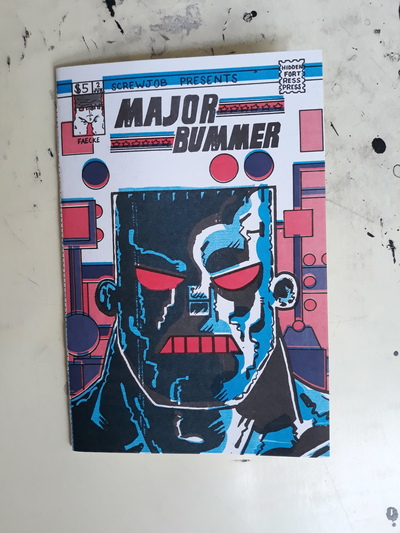
Everything about Minneapolis-based cartoonist Peter Faecke’s Major Bummer #2 is painfully obvious — but the same was also true of the first issue (published, as this one is, by Hidden Fortress Press), and it’s rather the point. I’ve never known Faecke to do subtle, but is that some great artistic sin? Kirby didn’t either, after all, and would you really have wanted him to?

So, yeah, Major Dick Bummer, the US government’s deadliest weapon (living or otherwise) is back to kick more ass, and speaking of kicking ass, this offset-printed mini on heavy cardstock paper features a pleasingly limited and appropriate garish color palette that does precisely that, accentuating the visceral, vaguely Panter-esque impact of Faekce’s deliberately “crude” cartooning with a blast of blue, red, and black gradations that kick you in the eyeballs as surely as the drawings themselves kick you in the — well, let’s be equal-opportunity here…

View original post 483 more words

Kelly Froh’s “The Downed Deer” : A Solid Argument For Cartoonists To Step Outside Their Comfort Zones


Ryan C. (fourcolorapocalypse)'s avatarRyan C.'s Four Color Apocalypse

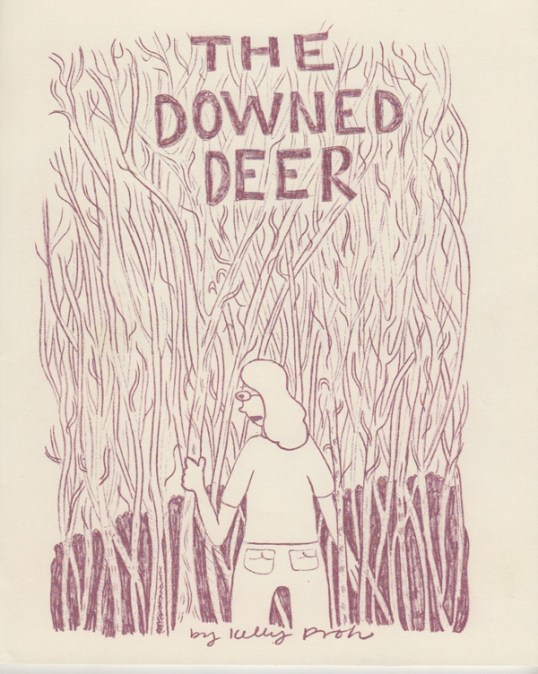
When you think Kelly Froh, you generally think of superbly-constructed and heartfelt memoir and autobio comics, either short-form or long, but with her latest self-published ‘zine, The Downed Deer, she blows that perception right out of the water — and the results are quietly, and frighteningly, glorious.

One of the best Short Run debuts I picked up this past November, this handsomely-formatted comic is riso-printed in rich burgundy ink on thick cream-colored paper, so it’s a pleasure to look at before you’ve even looked at it good and proper, but I should probably warn you : don’t give this even a cursory glance-though prior to reading it or you’ll “spoil” the whole damn thing. There’s a key surprise toward the end that is best left exactly that, so I’ll refrain from giving too detailed a plot recap here.

What I will say is that the fluidity of Froh’s cartooning…

View original post 543 more words

City on Fire (1979, directed by Alvin Rakoff)


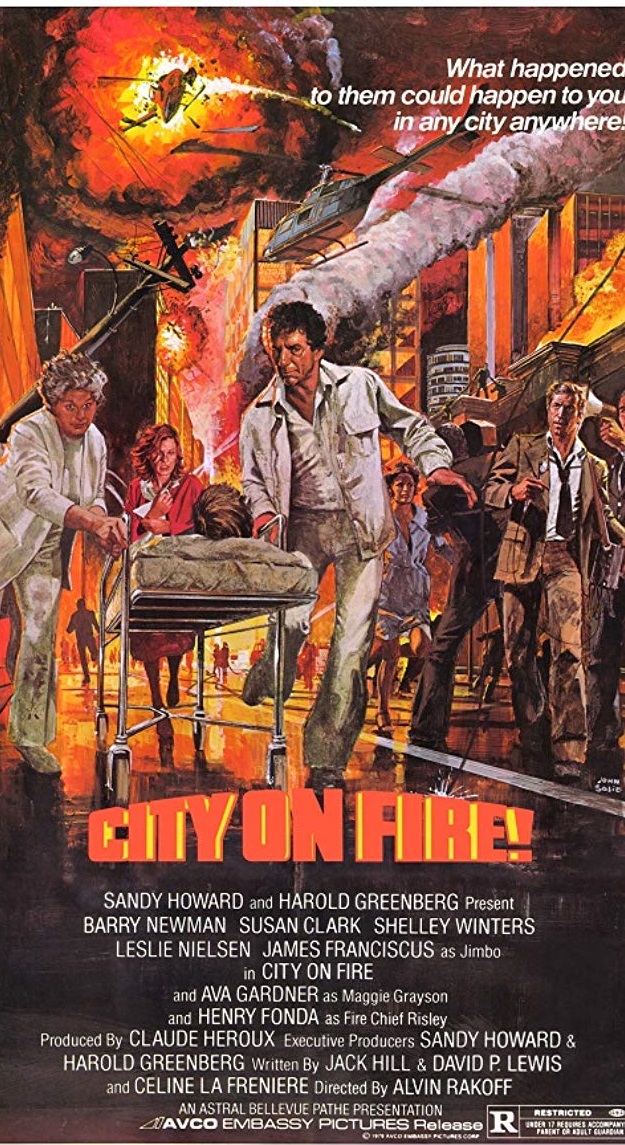
In an unnamed city somewhere in the midwest, Herman Stover (Jonathan Welsh) is fired from his job at an oil refinery.  Herman does what any disgruntled former employee would do.  He runs around the refinery and opens up all the valves and soon, the entire location is covered in a combustible mix of oil and chemicals.  One spark is all it takes for the refinery to explode and the entire city to turn into a raging inferno.

While Fire Chief Risley (Henry Fonda, getting a special “And starring” credit for doing what probably amounted to a few hours of work) sits in his office and gives orders to his subordinates, Dr. Frank Whitman (Barry Newman) cares for the injured at the city’s new hospital.  Also at the hospital is Mayor William Dudley (Leslie Nielsen) and local celebrity Diana Brockhurst-Lautrec (Susan Clark), who is having an affair with the mayor.  Diana also went to high school with Herman and he still has a crush on her.  When he shows up at the hospital to try to hit on her, he’s roped into working as a paramedic.  Also helping out at the hospital is Nurse Shelley Winters.  (The character may be named Andrea Harper but she’s played by Shelley Winters and therefore, she is Shelley Winters.)  At the local television station, news producer Jimbo (James Franciscus) tries to keep his anchorwoman, Maggie Grayson (Ava Gardner), sober enough to keep everyone up to date on how much longer the city is going to be on fire.

Mostly because it was featured on an early pre-Comedy Central episode of Mystery Science Theater 3000, City on Fire has a reputation for being a terrible movie but, as far as 70s disaster films are concerned, it’s not that bad.  The special effects are actually pretty impressive, especially during the first half of the film and there’s really not a weak link to be found in the cast.  It’s always strange to see Leslie Nielsen playing a serious role but, before Airplane! gave him a chance to display his skill for deadpan comedy, he specialized in playing stuffy and boring authority figures.  He actually does a good job as Mayor Dudley and it’s not the film’s fault that, for modern audiences, it’s impossible to look at Leslie Nielsen without instinctively laughing.  Of course, there is a scene towards the end where Leslie Nielsen picks up a fire hose and starts spraying people as they come out of the hospital and it was hard not to laugh at that because it felt like a scene straight from The Naked Gun.

What the film does suffer from is an overabundance of cliches and bad dialogue.  From the minute the movie starts, you know who is going to live and who isn’t and sometimes, City on Fire tries too hard to give everyone a connection.  It’s believable that Herman would be stupid enough to start a fire because we all know that happens in the real world.  What’s less believable is that, having started the fire, Herman would then go to the hospital and keep asking Diana if she remembers him from high school.  It’s not asking too much to believe that Diana, as wealthy local celebrity, would be invited to the opening of a new hospital.  It’s stretching things, though, to then have her deliver a baby while the hospital is in flames around her.

Coming out at the tail end of the disaster boom, City on Fire didn’t do much at the box office and would probably be forgotten if not for the MST 3K connection.  A year after City on Fire was released, Airplane! came out and, through the power of ridicule, put a temporary end to the entire disaster genre.

Music Video of the Day: Leave Behind Your Ego by Junkie XL, feat. Timothy Leary (2013, dir by John Pina)


It’s not bad advice, leaving behind your ego.  I don’t know if it’s something I’m currently capable of doing but who knows?  Maybe when I’m in my 50s, it’ll be easier.

Timothy Leary, of course, is a well-known name in the history of America’s counter culture.  He’s often credited as being the person who brought LSD into the mainstream, or at least as close to the mainstream as LSD could get during Leary’s lifetime.  Among Leary’s accomplishments was giving LSD to Cary Grant.  Tim Leary also once ran from governor of California.  The oft-repeated story is that John Lennon wrote Come Together to serve as a campaign song for Leary’s run.  Whether that’s true or not is anyone’s guess.  Needless to say, Tim Leary was never governor of California.  In fact, because he ended up going to prison in January of 1970, he never even got to file for the primary.

Junkie XL, of course, also did the score for Mad Max: Fury Road, which is like one of the greatest scores ever.

Enjoy!


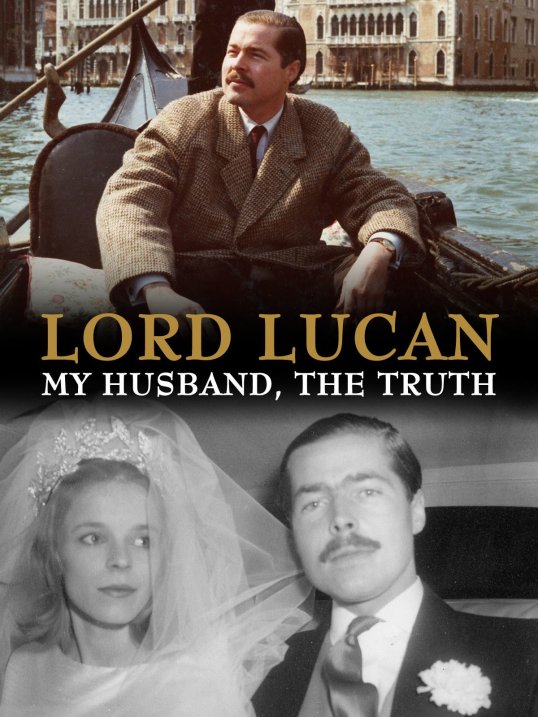
Documentary Review: Lord Lucan: My Husband, The Truth (dir by David O’Neill)


Who was Lord Lucan?

He was a British aristocrat, born not only wealthy but also with all the right connections.  His birth name was John Bingham but he eventually inherited the title of Lord Lucan when his father died in 1964.  At the time, the new Lord Lucan was 30 years and had been married for less than a year.  Lord Lucan was handsome and charming, so much so that Cubby Broccoli considered him for the role of James Bond in On Her Majesty’s Secret Service.  Lucan had no formal acting experience but he had the right look.  Nothing, of course, ever came of the idea of casting Lucan as Bond.  It’s rumored that he may have done a screen test but nothing can be said for sure.  Would Lord Lucan have had better luck with the role than George Lazenby?  Well, it’s hard to imagine how he possible could have had worst luck.

Like James Bond, Lord Lucan loved to gamble.  Unlike Bond, who was rarely seen to lose a hand whenever he sat down at the poker table, Lucan was not a particularly good gambler.  In fact, he lost so often that he was often broke.  Fortunately, his rich friends usually took care of him whenever he needed money or someone to testify as to his courage whenever he was accused of neglecting his wife, Lady Lucan.  When Lord and Lady Lucan separated in 1972, it forced the members of British high society to pick sides and most of them sided with Lord Lucan.  That remained true even in 1974 when Lord Lucan was accused of murdering his children’s nanny, Sandra Rivett.  Rivett, who bore a superficial resemblance to Lady Lucan, was bludgeoned to death with a piece of lead pipe while making a cup of tea in Lady Lucan’s home.  Lady Lucan claimed that she came across Lord Lucan in the house and that he admitted to having attacked Sandra in a case of mistaken identity.  Meanwhile, shortly after the murder, Lord Lucan reportedly called his mother and told her that he had just happened to be driving by his old home when he saw an unidentified man fighting with his wife.

The same night that Sandra Rivett was murdered, Lord Lucan vanished.  Both the police and Lady Lucan speculated that Lord Lucan had committed suicide by drowning himself in the Thames.  However, for years after Sandra Rivett’s murder, there were regular sightings of Lord Lucan around the world.  While many of those sightings were undoubtedly due to hysteria caused by the extensive press coverage surrounding the case, there were other sightings that seemed to be a bit more credible.  There was much speculation that Lucan’s powerful friends had helped him escape from Britain and he had relocated to either southern Africa or Australia.  As late as 2012, sightings of Lord Lucan were still being investigated.  If Lucan were still alive, he would be 86 years old today.

The story of Lord Lucan and the murder of Sandra RIvett is a fascinating one and the 2017 documentary, Lord Lucan: My Husband, The Truth, is a must-see for everyone interested in the case.  Produced for British television, this documentary is essentially an hour-long interview with Lady Lucan, during which she discusses not only her abusive marriage but also her feelings about the question of whether or not Lucan was still alive.  (For the record, she felt that he committed suicide “as a nobleman would do.”)  The documentary also features video that was shot by Lucan himself in the 60s, showing himself, his wife, and their wealthy friends touring Europe and basically acting like members of the idle rich.  Lady Lucan discusses how the notoriety surrounding the case affected her own life, leading to her becoming estranged from her children.  When asked if she was a “cold” towards her children, Lady Lucan chillingly replies, “All of my relationships are cold.”  When asked why she once claimed that Lord Lucan was still alive and hiding out somewhere in either Europe or Africa, Lady Lucan replies that she was “drugged up” when she said it and, as such, had no control over anything she said.  The documentary than shares a clip of a very stoned-looking Lady Lucan being interviewed in 1981 and saying that her former husband was still alive.

It’s an interesting story and a rather sad one.  Lord Lucan: My Husband, the Truth is a documentary that should appeal to anyone who is interested in true crime, missing fugitives, and the scandals of the very rich.  Despite the rumors of him still being alive, Lord Lucan was declared dead in 2016 so that his son could inherit his title and his place in the House of Lords.  As for Lady Lucan, she committed suicide shortly after being interviewed for this documentary.

Lord Lucan: My Husband, The Truth can be viewed on Amazon Prime.


Enlist Immediately In The “Yellow Flag Intelligence Squadron”


Ryan C. (fourcolorapocalypse)'s avatarRyan C.'s Four Color Apocalypse

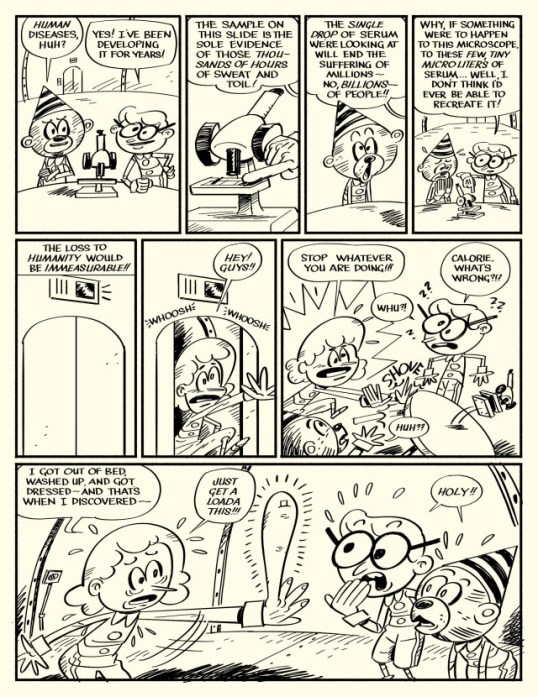
Some comics you hate. Some you’re indifferent to. Others you like. And then there are those, all too rare it seems, that you absolutely fall in love with.

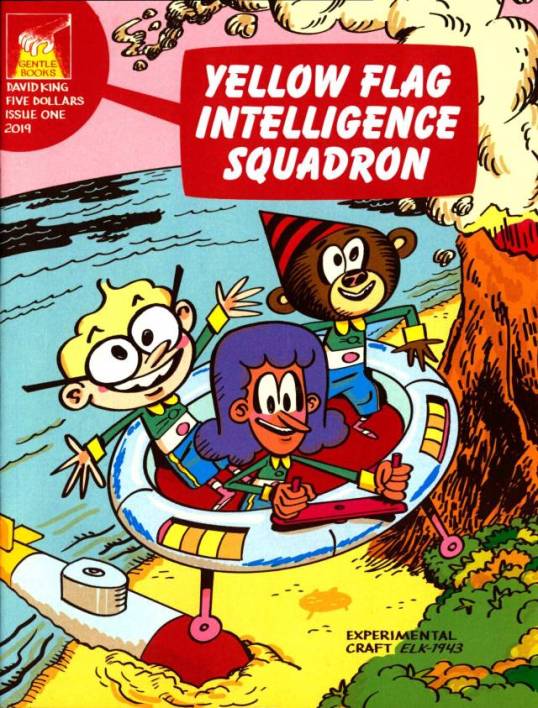
Let me introduce you to the latest object of my unbridled affection, David King’s Yellow Flag Intelligence Squadron #1.

Published under the auspices of King’s own Gentle Books imprint at the tail end of last year, this is pure cartoony “eye candy” from start to finish, expressive and engaging and inherently humorous drawings in service of an endlessly creative story that pits our trio of instantly-adorable heroes (Calorie, Brainer, and Killer Bear — even their names just make you wanna give ’em all a hug) that make up the legendary Earth-based Division 0001.0 of the titular squadron against their only real foe, namely themselves. Their mission to “protect all sentient life” seems pretty somber and serious, but when you’re not getting…

View original post 502 more words

Better Late Than Never : “Stubb & Leski’s Catsmas”


Ryan C. (fourcolorapocalypse)'s avatarRyan C.'s Four Color Apocalypse

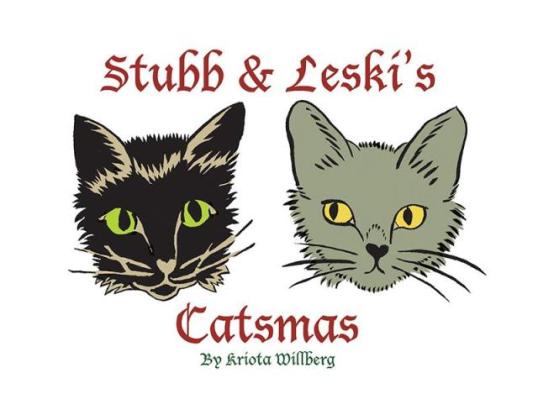
Such is the life of a jobbing freelance critic that I sometimes don’t get around to things in a timely manner, so my sincere apologies to cartoonist Kriota Willberg for not reviewing her late-2019 (and, it should be added, self-published) mini Stubb & Leski’s Catsmas during the holiday season, which would have made a lot more sense than doing so in February. In my (admittedly tepid) defense, one only has so many hours in a day and the stack of books I “owe” a review to is fairly large, but still — I feel bad for not being more “Johnny on the spot” with this one.

The good news, however, is that this is such an utterly unforced and charming little book in its own singular way that it reads well at any time of the year, and you should avail yourself of the opportunity to just that as soon…

View original post 538 more words

Smash-Up On Interstate 5 (1976, directed by John Llewellyn Moxey)


Smash-Up On Interstate 5 begins with ominous shots of a crowded California interstate.  It’s the 4th of July weekend and old people are returning home, young people are looking for a party, and Sergeant Sam Marcum (Robert Conrad) of the California Highway Patrol is looking for a killer.  When one car swerves into the next lane and hits another, it leads to a chain reaction as hundreds of cars, trucks, and one motorcycle crash into each other.  While the vehicles crash, we see the people inside of them.  There’s Buddy Ebsen!  There’s Vera Miles!  There’s Sue Lyon (of Lolita fame) on the back of a motorcycle!  In a voice-over, Sam tells us that the accident will be classified as being due to “mechanical failure” and that 14 people are going to die as a result.  He might be one of them.

Smash-Up On Interstate 5 is a 70s disaster film so, after the pile-up, the movie flashed back 48 hours and we get to know everyone whose lives are going to eventually collide on Interstate 5.  Erica (Vera Miles) is recently divorced and trying to get back into the dating scene.  Albert (Buddy Ebsen) is trying to bring some joy to his terminally ill wife’s final days.  Lee (Scott Jacoby) and Penny (Bonnie Ebsen) are the hippies who are trying to get to Big Sur without getting arrested.  Burnsey (Sue Lyon) loves her biker boyfriend.  Some of them will survive the pile-up.  Some of them will not.

Smash-Up On Interstate 5 is an above average made-for-TV movie.  It’s got a notable cast and the movie does a good job of mixing together’s everyone’s subplots.  For instance, Burnsey and a group of bikers show up in the background of several scenes and harass Erica at one point long before the crash on the interstate.  It’s only a 100-minute film so the film doesn’t go into too much detail about everyone’s past but we learn just enough to make everyone stand out.  The crash itself is intense, even when seen today.  Made before the days of CGI, this is a film where the stunt crew definitely earned their paycheck.

Tommy Lee Jones plays a patrolman who is also Sam’s brother-in-law.  I was surprised when I first saw him but as soon as I saw the strained smile and heard the accent, I knew it was him.  Jones’s role is small and probably could have been played by anyone but the mere presence of Tommy Lee Jones definitely makes this film cooler than it would have been otherwise.

One final note: This film was directed by the made-for-TV horror specialist, John Llewellyn Moxey.  Be sure to read Gary Loggins’s tribute to this often underrated director.

The Covers of Saucy Movie Tales


From 1935 to 1939, Saucy Movie Tales kept readers apprised of the glamour and danger of Hollywood.  This pulp magazine, which is eagerly sought after by collectors, told the stories of naive starlets who made their way to California and learned that the film industry was a place where dreams came true but sometimes, those dreams were nightmares.

The covers of Saucy Movie Tales were considered to be racy even by the standards of the pulps.  Below are just a few of them.

by George Quintana

by Norman Saunders

by Norman Saunders

by Norman Saunders

by Norman Saunders

by Norman Saunders

by Norman Saunders

by Norman Saunders

by Raymond Albert Burley

Unknown Artist