
Artist Unknown
Artist Unknown
What’s an Insomnia File? You know how some times you just can’t get any sleep and, at about three in the morning, you’ll find yourself watching whatever you can find on cable? This feature is all about those insomnia-inspired discoveries!
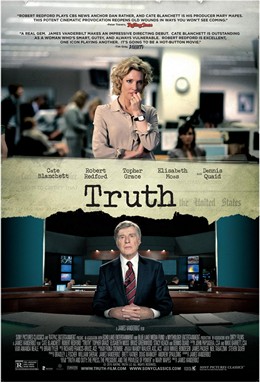
If, last night, you found yourself awake at three in the morning, you could have turned over to Starz and watched the 2015 film, Truth.
I can’t say for sure whether or not Truth would have put you to sleep. It kept me awake, largely because I was in a state of shock that any movie could be as bad as what I was watching. Without running the risk of hyperbole, I can say that Truth is one of the worst fucking movies that I’ve ever seen in my entire life. It’s not just that the film is poorly scripted, inconsistently acted, and directed in the most heavy-handed way possible. No, the problems with Truth went far beyond mere execution. Truth is a film with an agenda, one that I kind of agree with, but it’s such a total misfire that it ends up doing more damage to its cause than good. Truth is meant to be a defense of the much maligned mainstream media but it’s so poorly put together that it’s easy to imagine it being one of Donald Trump’s guilty pleasures. Remember how all of us musical theater nerds used to hatewatch Smash? I imagine that the White House staff does the same thing with Truth.
Truth is ostensibly based on a true story. In 2004, veteran anchorman Dan Rather (played by Robert Redford) reported a story that then-President George W. Bush got preferential treatment while he was serving in the Air National Guard. This story was considered to be especially big because 1) the Iraq War was deeply unpopular, 2) Bush was in a tight race for reelection, 3) his opponent, John F. Kerry, didn’t have much to offer beyond having served in Vietnam, and 4) questions were being raised about what Kerry actually did in Vietnam.
One of the most important pieces of evidence in Rather’s story were four memos that had been provided by a retired Lieutenant Colonel from the Air National Guard, a veteran Bush-hater named Bill Burkett (played, in the film, by Stacy Keach). Shortly after the story aired, conservative bloggers claimed that the memos were obvious forgeries. After spending weeks defending the story and haughtily dismissing anyone who didn’t collect an eight-figure paycheck from CBS, Rather admitted on air that the authenticity of the memos could not be verified. In the wake of the scandal, Rather’s longtime producer, Mary Mapes (Cate Blanchett), was fired. Rather retired a year earlier than expected and went on to become one of those reliably dull commentators who occasionally emerges to complain about how the world hasn’t been the same since Adlai Stevenson died. Mapes later wrote a book, which argued that 1) the memos were authentic and 2) it didn’t actually matter whether they were authentic, even though they like so totally were.
With all the current talk about fake news and whether both the media and Hollywood exist in a bubble, Truth is a film that should be especially relevant but, as previously stated, it’s so clumsy and heavy-handed that it actually does more harm than good. About halfway through the film, there’s a hilarious scene in which literally the entire country is shown watching 60 Minutes with awe-struck expression on their face. Children are watching. Customers in a bar are watching. The cooking staff in the kitchen pauses in their work to watch the report. Heroic music rises on the soundtrack. This scene, with all of its self-important grandeur, pretty much sums up everything that’s wrong with Truth. It’s one thing to argue that the news media does, should, and must play an important role in American life. It’s another thing to make your argument by constructing a fantasy world where the entire country plots their lives around watching 60 Minutes. But that’s the way Vanderbilt directs the entire film. He’s so high on the fumes of his good intentions that he doesn’t realize his film basically comes across like a parody of those intentions.
Especially in the second half of the film, there’s a lot of speeches about why journalism is important. And those speeches may actually make a great point but the problem is that none of them convince us that Mary Mapes and Dan Rather didn’t get fooled by some painfully obvious forgeries. In its laudable effort to defend journalism, Truth makes the mistake of excusing shoddy journalism. When, towards the end of the film, Mapes exclaims that the memos were only a minor part of the overall story and not necessary to prove that Bush got preferential treatment, you want someone to ask her, “If you could prove the story without them, then why did you include these unverifiable documents in the first place, especially considering that they were received from a questionable source?” But nobody does because none of the film’s saintly characters have been written or portrayed with the nuance necessary to be able to survive a question like that. Truth‘s problem is that it wants to have it both ways. “It doesn’t matter that this story was based on obviously fake documents,” Truth says, “And, because Mary Mapes and Dan Rather were sent by God to tell the truth, the obviously fake documents were completely real.”
And then there’s the film’s performers. Stacy Keach is great as Burkitt and his eccentric performance suggests the film that Truth could have been if it wasn’t so concerned with trying to portray its lead characters as saints. But then there’s Robert Redford, whose portrayal of Dan Rather has all the nuance and personality of a wax figure. (Redford wears suspenders. That’s the extent of his performance.) As Mary Mapes, Cate Blanchett is totally wasted. She doesn’t really have a character to play, beyond her male director’s conception of what a professional woman is supposed to be like. (She also has a traumatic back story of abuse, which the film trots out in such a klutzy manner that it’s actually incredibly insulting to real-life abuse victims.) Dennis Quaid, Topher Grace, and Elisabeth Moss all show up as members of Mapes’s team. Quaid is playing a military man so he gets to salute in slow motion. Grace is playing a hipster with a beard so he gets this embarrassing scene where he rants about how he’s being targeted not because of sloppy reporting but because of a corporate conspiracy. (This was obviously meant to be a huge applause moment but, like a lot of the movie, it doesn’t explain how the progressive cause is helped by shoddy journalism.) Moss doesn’t get to do anything, other than sit in the background. To waste a cast of this quality is a crime.
So why did this mostly terrible film get respectful reviews? Why did Sasha Stone and Jeff Wells insist that Truth was destined to be an Oscar contender? Call it confirmation bias. Truth plays to mainstream liberals (which includes the majority of film reviewers) in much the same way that God’s Not Dead 2 plays to Christians. But just because you agree with a film’s ideology, that doesn’t make it an example of good filmmaking. While artistic films are often political, it’s rare that political films are ever art. If every anti-Bush film was an artistic masterpiece, we would be living in a cinematic golden age.
Here’s the thing. We live in a time when the media is under attack and being used a convenient scapegoat for every bad thing in America. Donald Trump largely won in 2016 by portraying the media as being biased and that’s a charge that will undoubtedly be repeated many times over the next four years. A heavy-handed mess like Truth doesn’t help anything.
Previous Insomnia Files:

A part of ESPN’s 30 for 30 documentary series, Small Potatoes: Who Killed the USFL? tells the story of the United States Football League. The USFL was not the first American football league to try to take on the NFL but, arguably, it was one of the most successful. Playing a spring/summer schedule, the USFL lasted for three seasons, from 1983 to 1985. During that time, the USFL introduced many rules that would later be adopted by the NFL, including the two-point conversion and the coach’s challenge. Several future NFL superstars, like Herschel Walker and Steve Young, got their start in the USFL.
So, why is the USFL nearly forgotten today? This documentary largely lays the blame at the feet of none other than Donald Trump. Long before he was President or even a reality TV star, Trump wanted to own a football team. When it became obvious that he wasn’t going to be able to buy an NFL team, Trump purchased the USFL’s New Jersey Generals. Trump not only decided that the USFL needed to switch to a fall schedule and compete directly with the NFL but, under his direction, the USFL also filed an antitrust lawsuit against the NFL. Ironically, the USFL won that lawsuit but were only awarded $3.75 in damages. With the league’s financial resources depleted by the lawsuit, the USFL suspended the 1986 season and never came back.
For all the legitimate criticism that can be directed towards ESPN, the 30 for 30 documentaries have been consistently excellent. While Small Potatoes features plenty of exciting game footage and interviews with former USFL players, it’s not surprising that the most interesting thing about it is listening to Trump revealingly discuss his time as a USFL team owner with the same mix of self-aggrandizement and defensive posturing that he uses to discuss the size of the crowd at his inauguration. Unlike the majority of the players and former owners interviewed in Small Potatoes (including Burt Reynolds, who was one of the owners of the Tampa Bay Bandits), Trump still appears to take it personally that he was never taken seriously as the owner of a football team.
I did not know anything about the USFL before I watched Small Potatoes. My only complaint is that I wish it had been longer. The story of the USFL was too interesting to be confined to just one hour.

Artist Unknown
Well, we can add Funkadelic to the list of groups that made groundbreaking music videos in 1970s. We’ve had numerous ones from ABBA doing all sorts of stuff. We had AC/DC taking what would otherwise be a simple stage performance and making it feeling intimate. We had Hall & Oates making the anti-video. We had Alice Cooper foreshadowing all kinds of things that would become staples of music videos, but most notably, the quick editing. Now we have Funkadelic, before becoming part of Parliament-Funkadelic, also doing location shooting and integrating the filmmaking into the song the way Elected by Alice Cooper did. Whereas that one called for a lot of quick cuts, this song lends itself to more laid back long takes. Also like Elected, they aren’t performing the song. You do see a couple of them with instruments, but it doesn’t seem into tie to the song you are hearing. The instruments are just there. The focus is on the trippy visuals. I can’t help but look at it and think: “Funkadelic Takes NYC”. I have to imagine this was fun to film.
Sit back and enjoy!
(SPOILERS BELOW!)
This weekend, I will be seeing Rings, the second sequel to the 2002 film, The Ring. (Of course, The Ring itself is a remake of the Japanese film, Ringu.) Since it’s been a while since we’ve had a new installment in the Ring franchise, I decided to rewatch the first film tonight.
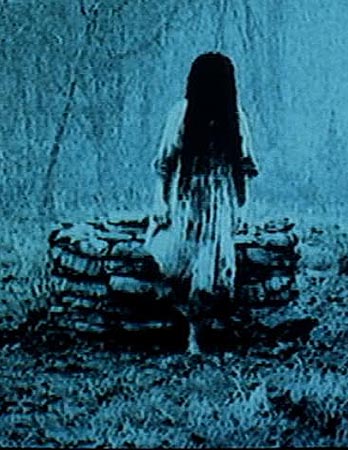
I have to admit that I had a few concerns before I rewatched The Ring. When I first saw The Ring, it scared me to the extent that I actually had nightmares afterward. Even after all these years, the image of that little girl emerging from the well and then crawling out of the television still makes me shiver. But even with that in mind, I still found myself wondering if The Ring would live up to my vivid memories.
After all, it’s been 14 years since The Ring was released and, since that time, it’s been copied and imitated by literally hundreds of other PG-13 rated horror movies. Would the shocks still be effective, now that I knew they were coming and that I would no longer be surprised to learn that the little girl in the well was actually evil?
Add to that, there was the question of technology. In 2002, it seemed all too plausible that people could be trading back and forth a cursed VHS tape. The Ring was made at a time when DVDs were still considered to be exotic. When The Ring first came out, YouTube didn’t even exist. But today, both VHS tapes and VCRs are artifacts of another era. DVDs have been replaced by Blu-rays and Blu-rays are in the process of being replaced by streaming services. For The Ring to work, you had to be able to relate to people watching a VHS tape. Today, all of these people would be too busy watching cute cat videos on YouTube to fall into The Ring‘s trap.
In short, would The Ring still work in the age of Netflix? And would the film still be as scary as it was when it was first released? These were the question that I found myself wondering as I sat down to rewatch The Ring.
And the answer to both questions is … for the most part, yes.
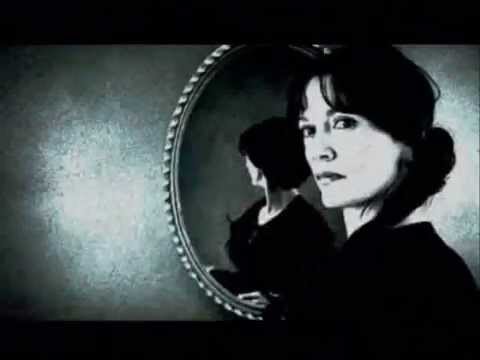
Here’s the good news. All the important things still work. The performances of Martin Henderson, David Dorfman, Amber Tamblyn, and especially Naomi Watts hold up well. Gore Verbinski’s direction is still effective and, as I rewatched the film, I was surprised to see how many odd and quirky details that Verbinski managed to work into the film. (I especially enjoyed the magic-obsessed desk clerk.) The cursed video was still creepy and compulsively watchable and I still felt uneasy while watching Anna Morgan (played by Shannon Cochran) comb her hair in that mirror. Even more importantly, the little girl in the well, Samara Morgan (Daveigh Chase), was still incredibly frightening.
Admittedly, The Ring is dated and some of its effectiveness has been diluted by imitation. Unfortunately, that’s something that happens with any financially successful horror film. Beyond that, as effective as the entire film was, there were parts of The Ring that did feel undeniably silly. There’s a lengthy scene in which Naomi Watts, while on a ferry, attempts to talk to a horse and the horse reacts by jumping into the ocean. I understand that the scene was probably meant to establish that, as a result of watching that videotape, Watts was now cursed. But, still, I kept wondering why Watts was bothering the horse in the first place. I mean, I love horses too but I know better than to disturb one while on a ferry. As well, the film’s opening sequence — in which Amber Tamblyn is menaced and ultimately killed by Samara — no longer felt as effective as it did when I first saw it, largely due to the fact that it’s been copied by so many other horror films. Imitation may be the ultimate compliment but it does tend to dilute the effectiveness of horror.
But, in the end, The Ring held up well enough. The film’s storyline — characters watch a cursed video tape and then, seven days later, are killed by Samara — was simple but enjoyable. And, when David Dorfman delivered his classic line: “No. You weren’t supposed to help her,” I still felt a chill run down my spine.
Will Rings hold up as well as The Ring?
I’ll find out this weekend!

For the longest time, I thought that Two-Minute Warning was a movie about a gang of art thieves who attempt to pull off a heist by hiring a sniper to shoot at empty seats at the Super Bowl. As planned by a master criminal known as The Professor (Rossano Brazzi), the sniper will cause a riot and the police will be too busy trying to restore order to notice the robbery being committed at an art gallery that happens to be right next to the stadium.
I believed that because that was the version of Two-Minute Warning that would sometimes show up on television. Whenever I saw the movie, I always through it was a strange plan, one that had too many obvious flaws for any halfway competent criminal mastermind to ignore them. What if the sniper was captured before he got a chance to start shooting? What if a riot didn’t break out? The sniper spent the movie aiming at empty seats but, considering how many people were in the stadium, it was likely that he would accidentally shoot someone. Were the paintings really worth the risk of a murder charge?
Even stranger was that Two-Minute Warning was not only a heist film but it was also a 1970s disaster film. Spread out throughout the stadium were familiar character actors like Jack Klugman, John Cassevetes, David Janssen, Martin Balsam, Gena Rowlands, Walter Pidgeon, and Beau Bridges. It seemed strange that, once the shots were fired and Brazzi’s men broke into the gallery, all of those familiar faces vanished. When it comes to disaster movies, it is an ironclad rule that at least one B-list celebrity has to die. It seemed strange that Two-Minute Warning, with all those characters, would feature a sniper shooting at only empty seats. For that matter, why would there be empty seats at the Super Bowl?
That wasn’t the strangest thing about Two-Minute Warning, though. The strangest thing was that Charlton Heston was in the film, playing a police captain. In most of his scenes, he had dark hair. But, in the scenes in which he talked about the art gallery, Heston’s hair was suddenly light brown.
Recently, I watched Two-Minute Warning on DVD and I was shocked to discover that the movie on the DVD had very little in common with the movie that I had seen on TV. For instance, the television version started with the crooks discussing their plan to rob the gallery. The DVD version opened with the sniper shooting at a couple in the park. In the DVD version, there was no art heist. The sniper had no motive and no personality. He was just a random nut who opened fire on the Super Bowl. And, in the DVD version, he did not shoot at empty seats. Several of the characters who survived in the version that I saw on TV did not survive in the version that I saw on DVD.
What happened?
The theatrical version of Two-Minute Warning was exactly what I saw on the DVD. A nameless sniper opens fire and kills several people at the Super Bowl. In 1978, when NBC purchased the television broadcast rights for Two-Minute Warning, they worried that it was too violent and too disturbing. There was concern that, if the film was broadcast as it originally was, people would actually think there was a risk of some nut with a gun opening fire at a crowded event. (In 1978, that was apparently considered to be implausible.) So, 40 minutes of new footage was shot. Charlton Heston even returned to film three new scenes, which explains his changing hair color. The new version of Two-Minute Warning not only gave the sniper a motive (albeit one that did not make much sense) but it also took out all of the violent death scenes.
Having seen both versions of Two-Minute Warning, neither one is very good, though the theatrical version is at least more suspenseful than the television version. (It turns out that it was better to give the sniper no motive than to saddle him with a completely implausible one.) But, even in the theatrical version, the potential victims are too one-dimensional to really care about. Ultimately, the most interesting thing about Two-Minute Warning is that, at one time, an art heist was considered more plausible than a mass shooting.

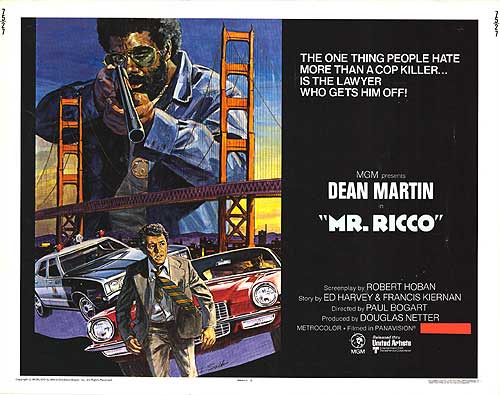
It’s an older, more world-weary Dean Martin we see in MR. RICCO, a fairly gritty but ultimately unfulfilling 70’s flick that would’ve made a decent pilot for a TV series (maybe in the NBC MYSTERY MOVIE rotation with Columbo and McCloud), but as a feature was best suited for the bottom half of a double bill. This was Dino’s last starring role, though he did appear in two more movies (THE CANNONBALL RUN and it’s sequel), and this attempt to change his image from footloose swinger to a more *gasp!* sober Martin doesn’t really cut it.
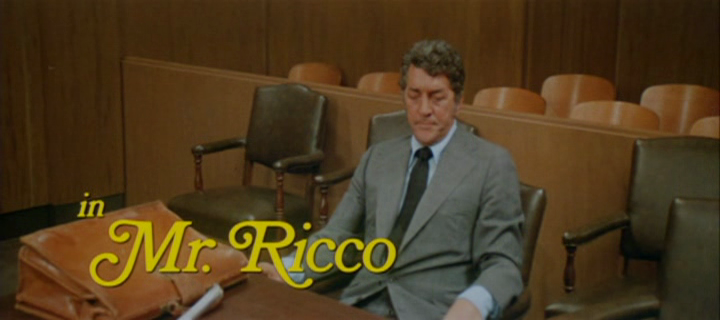
Dean’s a defense lawyer, a “lily white liberal” who gets black militant Frankie Steele (Thalmus Rasulala ) off a murder rap. When two cops are blown away in an ambush, the witness provides a description of Steele, causing friction between Ricco and the police, especially his friend Detective Captain Cronyn (Eugene Roche, an underrated character actor who’s really good here). The…
View original post 432 more words
It sure is Groundhog Day. I won’t make the joke that I am sure you’ll hear all day.
As for this video, I had a different one planned originally. I was going to go with another duet that Cher did for a love song. Then I thought it would be worth checking to see if she had ever done a music video for this song before I started writing. Yep! This exists. Why does this exist? Apparently Cher did this for the album The Beavis and Butt-Head Experience. I think I may be traumatized for life now that I’ve heard Cher ask Butt-Head if he feels lucky. Why did she do this? I don’t know. Maybe it was for a comeback after the 1980s were over.
This was co-directed by Tamra Davis and Yvette Kaplan. Davis directed around 40 music videos. She’s also directed numerous films and episodes of TV Shows. Kaplan has mainly worked in animation. She’s done work on other things, but the majority was as a supervising director for the run of Beavis and Butt-Head. She also worked on the movie Beavis and Butt-Head Do America (1996).
Enjoy this bizarre trip down memory lane. I swear I didn’t pick this out in advance. It fell into my lap at the last minute.

Artist Unknown

 Through the Shattered Lens