A Movie A Day #80: The Palermo Connection (1990, directed by Francesco Rosi)


Carmine Bonavia (James Belushi) is an idealistic New York City councilman who wants to be mayor.  Despite an easily understood slogan — “Make A Difference!” — his reform campaign is running behind in the polls.  Having nothing to lose, Carmine announces that he supports the legalization of drugs.  By taking out the profit motive, the Sicilian Mafia will no longer have any incentive to sell drugs in the inner city.  Carmine shoots to top of the polls.  Now leading by 11%, Carmine marries his campaign manager (Mimi Rogers) and returns to his ancestral home of Sicily for a combination honeymoon and fact-finding tour.  The Mafia, realizing that Carmine is serious about legalizing drugs, conspires to frame him for the murder of a flower boy.  If that doesn’t work, they are willing to resort to other, more permanent, methods to prevent Carmine from ever becoming mayor.

The Palermo Connection is an unfairly overlooked film from Francesco Rosi, an Italian director who specialized in political controversy.  Though The Palermo Connection was sold as a thriller, Rosi was more interested in showing how organized crime, big business, government corruption, the war on drugs, and the poverty of the inner cities are all intricately connected.  When Carmine arrives in Palermo, Rosi contrasts the outer beauty of Sicily with the desperate lives of the junkies living there.  The pace may be too slow for action movie fans but Rosi gives the audience much to think about.  This is probably the last film you would ever expect to star James Belushi but he gives a strong and committed performance as Carmine.

The Palermo Connection, which was co-written by Gore Vidal, is a good film that predates The Wire in its examination of how greed, drugs, poverty, and racism all come together to victimize the most marginalized members of society.

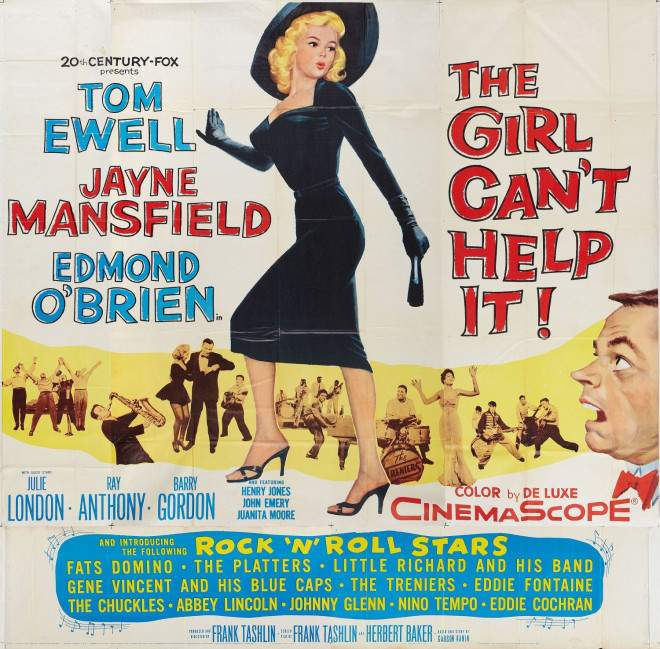
Rockin’ in the Film World #10: THE GIRL CAN’T HELP IT (20th Century Fox 1956)


gary loggins's avatarcracked rear viewer

Frank Tashlin  combines two of 50’s America’s favorite obsessions, sex & rock’n’roll, in THE GIRL CAN’T HELP IT, Jayne Mansfield’s first headlight headlining role. When Jayne sashays across the screen, turning heads, melting ice, boiling milk, and cracking eyeglasses a star is born, in CinemaScope and gorgeous DeLuxe color. But the film is stacked with more than just Jayne’s Twin Peaks; it features performances from rock royalty like Little Richard, Fats Domino, Eddie Cochran, Gene Vincent, The Platters, and a host of others.

The plot is very simple (and very familiar): a goony gangster (broadly played by a hilarious Edmond O’Brien ) hires a down-on-his-luck agent (Tom Ewell of THE SEVEN YEAR ITCH) to make a singing star out of his honey (our girl Jayne). Only problem is, Jayne can’t carry a tune in a bucket, shattering lightbulbs whenever she starts to warble. Seems she doesn’t want to be a star…

View original post 468 more words

Trailer: Spider-Man: Homecoming


Marvel released the 2nd full trailer for Spider-Man: Homecoming, which is looking pretty good. It seems that having proved himself to Tony Stark (Robert Downey Jr.), Peter Parker (Tom Holland) has received some cool upgrades to his Spider-Man suit. While Peter appears to want to join the Avengers, Stark would have him just keep an eye on New York City and some of the more low-level stuff. When The Vulture (Michael Keaton) threatens the city, Spider-Man may be the only one to stop him. Then again, it does look like there’s an Iron-Man team up here, which is sweet. This trailer is feeling like some of Brian Michael Bendis’ Ultimate Spider-Man line.

The film comes out on July 7th. Enjoy.

Music Video of the Day: Balls To The Wall by Accept (1984, dir. Julien Temple)


It doesn’t matter how many times I watch this music video. The headbangers in front of the wall will always be funny to me.

According to Wikipedia, this was filmed in London during January of 1984. I’m not sure if that meant in a studio or not because if you look carefully at the left-hand side at the beginning, you’ll see what looks like car headlights going past. Maybe they did film this outside. That really is lead-singer Udo Dirkschneider riding the wrecking ball. Here’s a quote from him about it taken from Songfacts:

“It was very cold in London, near the airport,” Udo told us. “It was very cold, and especially when I had to step on this wrecking ball. That was something else. I said, ‘Please, no, I don’t want to do this!’ But in the end, I was young, so I said, ‘Okay, here we go.’ But it was freezing like hell.”

It would explain what looks like rain on the lens near the end of the video. There also appears to be wind since it does knock over something onstage and you can see their hair blowing to the right. It could be simulated, but given the quote from Dirkschneider, I’m not sure.

If you’re curious, and the video wasn’t clear about it, here is a quote from guitarist Wolf Hoffmann about the meaning of the song:

“We’ve always been interested in politics and in human rights and things like that, so a lot of the lyrics that we had in those days, and to the end actually, were dealing with human rights, for instance, and that’s really what ‘Balls To The Wall’ is all about. ‘One day the tortured will stand up and kick some ass!'”

In other words, it’s their version of We’re Not Gonna Take It by Twisted Sister. Makes sense that Julien Temple directed this video seeing as he also did Breaking The Law for Judas Priest. It would be fun to go through a retrospective of Julien Temple’s music videos. You wanna see him do ABC? You can. How about some Stray Cats? Yep! Dexy’s Midnight Runners? Absolutely. Sade? No problem. Kenny Rogers? Of course. Janet Jackson? Sure! It goes on and on. In the meantime, enjoy this video.

A Movie A Day #79: Blindman (1971, directed by Ferdinando Baldi)


In the old west, a professional gunman (played by Tony Anthony) has been hired to escort 50 women to a Texas mining town.  The gunman is known as Blindman, precisely because he is a blind man.  He is also a fast and deadly with a gun and has an apparent psychic connection with his horse.  Unfortunately, for Blindman, it turns out that his partners double crossed him and sold the 50 women to a Mexican bandit.  Blindman must go to Mexico to rescue the women from the ruthless Domingo (Lloyd Battista) and his crazy younger brother, Candy (Ringo Starr).

You read that correctly.  This is not only a Spaghetti western about a blind gunslinger who owns a seeing-eye horse.  It’s also a Spaghetti western that co-stars the man who replaced Pete Best.  Of the four Beatles, Ringo was always the best actor and he is surprisingly convincing as a psychotic Mexican bandit.  As for the rest of Blindman, it can not compare to the best Spaghetti westerns but there’s enough novelty in the idea of a blind gunman that it is still interesting to watch.  Tony Anthony may have been one of the lesser known Spaghetti western stars but he probably gave the best performance of his career as Blindman.  Along with being a violent, bloody, and nudity-filled western, Blindman is also a comedy.  Most of the jokes are delivered by Tony Anthony, who spends a lot of time talking to himself and who, despite being blind, stares straight at the camera while doing so.  (Most of the jokes were also written by Tony Anthony.  He’s one of the credited screenwriters.)

Why does Blindman do what he does?  As he puts it in the movie, “To be blind, with no money, now that’s a bitch!”


Artist Profile: Verne Tossey (1920–2002)


Like many of the artists that have been featured on this site, Verne Tossey got his start as a student at the Art Student’s League in New York.  As an illustrator, he’s probably best known for his western covers but he worked in all genres.  I like the energy of Tossey’s covers.  His covers are exciting and realistic at the same time.

A small sampling of Verne Tossey’s work can be found below:

Lisa Cleans Out Her DVR: The Silver Chalice (dir by Victor Saville)


If you ever needed proof that everyone has to start somewhere, look no further than the 1954 biblical epic, The Silver Chalice.

The Silver Chalice features the film debut of Paul Newman, who later proved himself to be a legitimately great actor.  It’s true that, unlike a lot of actors, Newman made his debut in a starring role.  He never had to humiliate himself with any one-line roles or walk-on bits.  No, Paul got to humiliate himself with a starring role.

Paul Newman was 29 years old when he played Basil, a former slave turned sculptor.  Not only did Newman bear a disconcerting resemblance to Ben Savage (of Boy Meets World fame) but he gave a performance that was so bad that it’s kind of a shock that he ever worked again.  Basil is a passionate artist, one who survived being betrayed by his adopted family and slavery.  Newman comes across like a nice, young man from Iowa.  Usually, Newman looks miserable but occasionally, he flashes a somewhat weak smile.  When Basil gets mad, Newman speaks in a squeaky voice.  When Basil is feeling reverent, Newman furrows his brow like a hungover Russell Brand staring straight into the sun.

“But me and Topanga are soul mates…”

Then again, I’m not sure that any actor could have given a good performance as Basil.  The Silver Chalice has a terrible script, one that was written by Lesser Samuels.  (I’ll avoid the obvious joke about whether or not The Silver Chalice would have been better if written by Greater Samuels.)  Apparently, before Newman was cast, the producers pursued James Dean for the role.  I’m sure we all would have enjoyed seeing Dean slouch his way through the film but I doubt that even he could have done much with The Silver Chalice.

The Silver Chalice is based on a novel, which perhaps explains why there’s so many characters and so many unnecessary subplots.  Basil follows a path that will be familiar to anyone who has seen a 1950s biblical epic.  He’s a young Greek who is adopted into a noble Roman family.  When his kindly stepfather dies, Basil’s stepsiblings sell him into slavery.  It’s not an easy life but Basil is a talented sculptor so Joseph of Arimathea commissions him to make a silver chalice for the Holy Grail.  Basil goes from poor to rich to poor again to rich again to ultimately saved by grace.  He even gets to do the same walking towards Heaven thing that Richard Burton did at the end of The Robe.

Meanwhile, Simon Magus (Jack Palance) is wowing the citizenry with his magic tricks and claiming to be the risen Messiah.  Simon’s assistant just happens to be Helena, who knew Basil when he was younger.  Young Helena is played by dark-haired Natalie Wood.  Grown-up Helena is played by blonde Virgina Mayo.  They were both good actresses but there’s seriously no way that Natalie Wood would have ever grown up to be Virginia Mayo.

Jack Palance pretty much steals the movie, mostly because he gets to wear the silliest costumes:

Poor Paul Newman has to settle for a tunic and a miniskirt, while Jack Palance gets to wear this:

Personally, I’ve always enjoyed the story of Simon Magus.  He tried to show off by flying over the Roman Forum so St. Peter said a prayer and Simon promptly plunged to his death.  Take that, you Gnostic!

Another interesting thing about The Silver Chalice is that the sets are very deliberately fake.  I don’t mean that they look cheap.  I mean, much as in the style of German Expressionism, the sets are specifically designed to remind you that you’re watching a movie.

For instance, look at the wall behind Palance:

Look at this pleasure palace:

Look at Rome at night:

The sets are extremely dream-like and yet everything else about the film is extremely slow and conventional.  One wonders if director Victor Saville was trying to make an art film, though there’s nothing else in his long filmography that would suggest that Saville was anything other than a workmanlike director.  In fact, most biblical epics of the time took a lot of pride in looking as expensive and “accurate” as possible.  Major studios in the 1950s were not known for artistic experimentation, especially when it came to Biblical epics.  It’s hard to know what to make of The Silver Chalice‘s artistic flourishes, which is why it’s easier to just focus on what a terrible performance Paul Newman gives.

That’s certainly what Paul did!  In 1966, when The Silver Chalice finally premiered on TV, Newman took out a newspaper ad in which he apologized for his performance and then asked people not watch.  Apparently, he also used to show the movie during parties on the condition that his guests mock the film while watching it.

I don’t really blame him.  It’s an amazingly dull film and Newman looks absolutely miserable in nearly every other scene.  However, because it did star Paul Newman, The Silver Chalice will always have a life on TCM.

Speaking of TCM, they last broadcast this film on February 24th as part of their 31 Days of Oscar.  (It was nominated for both its sets and its score.)  That is when I recorded it.  And, after watching it yesterday, I was more than happy to erase it.
Music Video of the Day: Eagle by ABBA (1978, dir. Lasse Hallström)


The 1980s are coming for ABBA. You can tell because Frida is beginning to transform into her Pat Benatar look.

At the same time, this video is ahead of the 1980s. It’s playing with the kind of effects I wouldn’t expect to see in music videos till the late-80s with Kevin Kerslake directed music videos, such as the one for Shadow Of A Doubt by Sonic Youth.

According to Wikipedia, the version above is the official music video for the song. However, assuming it is still up, there is another music video for the song that is within ABBA: The Movie (1977), which I have included below.

I prefer the one done for the single because it is more primitive.

Enjoy!

ABBA retrospective:

  1. Bald Headed Woman by The Hep Stars (1966, dir. ???)
  2. En Stilla Flirt by Agnetha & ??? (1969, dir. ???) + 8 Hootenanny Singers Videos From 1966
  3. Tangokavaljeren by Björn (1969, dir. ???)
  4. Vårkänslor (ja, de’ ä våren) by Agnetha & Björn (1969, dir. ???)
  5. Titta in i men lilla kajuta by Björn (1969, dir. ???)
  6. Nu Ska Vi Vara Snälla by Björn & Agnetha (1969, dir. ???)
  7. Finns Det Flickor by Björn & Sten Nilsson (1969, dir. ???)
  8. Nu Ska Vi Opp, Opp, Opp by Agnetha (1969, dir. ???)
  9. Det Kommer En Vår by Agnetha (1969, dir. ???)
  10. Beate-Christine by Björn (1969, dir. ???)
  11. En Stilla Flirt by Agnetha & ??? (1969, dir. ???) + 8 Hootenanny Singers Videos From 1966
  12. Att Älska I Vårens Tid by Frida (1970, dir. ???)
  13. Min Soldat by Frida (1970, dir. ???)
  14. Söderhavets Sång by Frida (1970, dir. ???)
  15. Ring, Ring by ABBA (1973, dir. Lasse Hallström)
  16. Ring, Ring by ABBA (1973, dir. ???)
  17. Love Isn’t Easy (But It Sure Is Hard Enough) by ABBA (1973, dir. ???)
  18. Waterloo by ABBA (1974, dir. Lasse Hallström)
  19. Hasta Mañana by ABBA (1974, dir. ???)
  20. I Do, I Do, I Do, I Do, I Do by ABBA (1975, dir. Lasse Hallström)
  21. I Do, I Do, I Do, I Do, I Do by ABBA (1975, dir. ???)
  22. Bang-A-Boomerang by ABBA (1975, dir. Lasse Hallström)
  23. SOS by ABBA (1975, dir. Lasse Hallström)
  24. Mamma Mia by ABBA (1975, dir. Lasse Hallström)
  25. Knowing Me, Knowing You by ABBA (1976, dir. ???)
  26. Tropical Loveland by ABBA (1976, dir. ???)
  27. When I Kissed The Teacher by ABBA (1976, dir. ???)
  28. Tiger by ABBA (1976, dir. ???)
  29. Money, Money, Money by ABBA (1976, dir. ???)
  30. Money, Money, Money by ABBA (1976, dir. Lasse Hallström)
  31. Fernando by ABBA (1976, dir. Lasse Hallström) + Spanish Version
  32. Dancing Queen by ABBA (1976, dir. Lasse Hallström)
  33. That’s Me by ABBA (1977, dir. Lasse Hallström)
  34. Knowing Me, Knowing You by ABBA (1977, dir. Lasse Hallström)
  35. The Name Of The Game by ABBA (1977, dir. Lasse Hallström)
  36. Thank You For The Music/Gracias Por La Música by ABBA (1977/1978, dir. Lasse Hallström)
  37. One Man, One Woman by ABBA (1978, dir. Lasse Hallström)
  38. Take A Chance On Me by ABBA (1978, dir. Lasse Hallström)