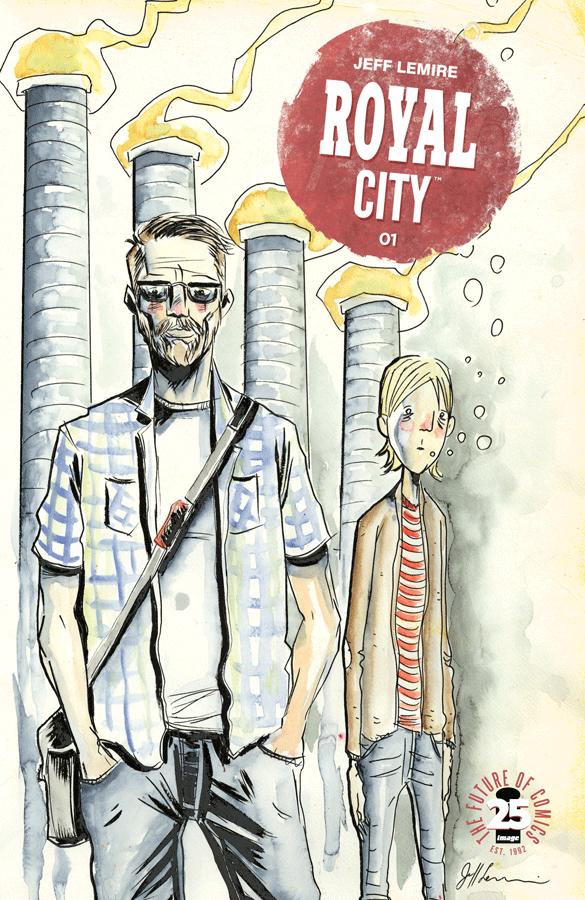
Once upon a time, Jeff Lemire was one of the most interesting up-and-coming cartoonists around. Essex County landed with a bang — rather surprising considering its slow-burn, quiet pace — and seemed to announce the arrival of a major new talent with a highly personal, indiosyncratic vision. His career seemed poised to take off, and take off it did — although perhaps not in the direction many (most?) of us expected.
Enter “The Big Two.” Lemire’s wistful, free-flowing art style was never going to be seen in a Superman or Spider-Man comic, to be sure, but his writing was another matter, and while for a time he was able to balance his more personal, nominally “independent” projects such as Sweet Tooth and Trillium with “corporate comics” like Animal Man, once he signed on with Marvel, he started writing damn near everything in sight — with decidedly mixed results. His…
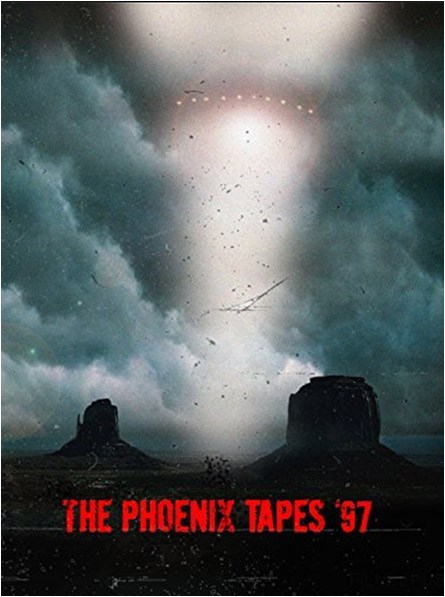
As far as modern UFO “flaps” go, none are more well-known than the so-called “Phoenix Lights” incident of 1997, and while I’m not sure we’ve ever gotten anything like an “official explanation” as to what went down, I’ll guarantee you this much — the reality of the situation, whatever it may be, is probably far more interesting than 2016’s “found footage” indie micro-budgeter The Phoenix Tapes ’97. Even if all it was all just swamp gas or reflections of the planet Venus.
The authorship behind this particular piece of garbage is difficult to ascertain — the film has no credits, but that’s par for the course with these things. What’s far less common is the fact that this flick has no IMDB page, and that its official website lists none of the names of the people involved in its production, either. It does, however, make the more-than-dubious claim…
If you read yesterday’s post on the Flapper Dress version of Money, Money, Money; then you might want to go back to that post. I messed up. I have since found the actual Flapper Dress version and added it to the end of the post.
According to Wikipedia, this was based on Cabaret (1972), which explains the Flapper Dress version. But I found that out at the last minute, so let’s talk about this version as if I didn’t know that fact.
The video starts off by reminding us that while international in appeal, they are a Swedish band.
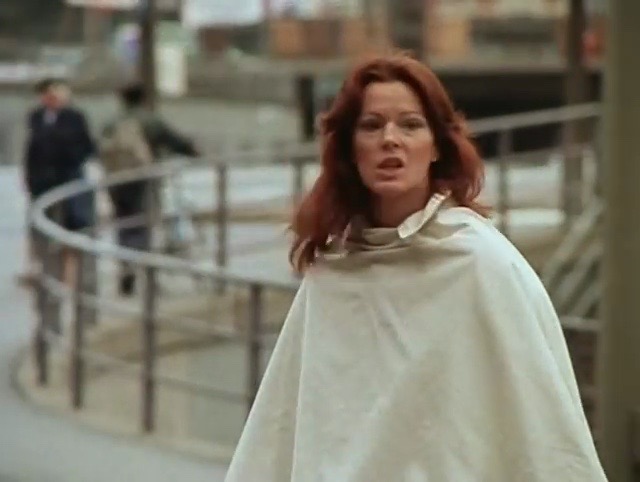
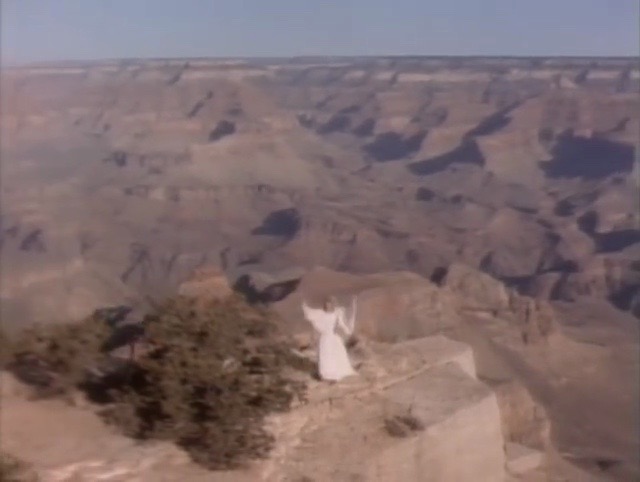
Then we cut to Frida working hard for the money in white with the sun out on location in order…
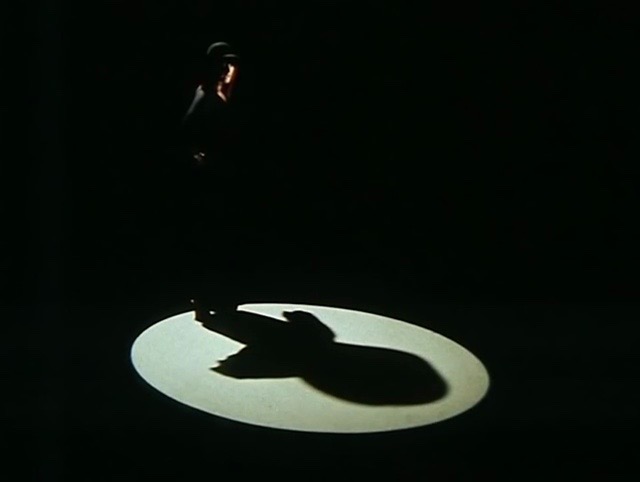
to contrast with the next shot of her in black on the edge of a spotlight in a studio.
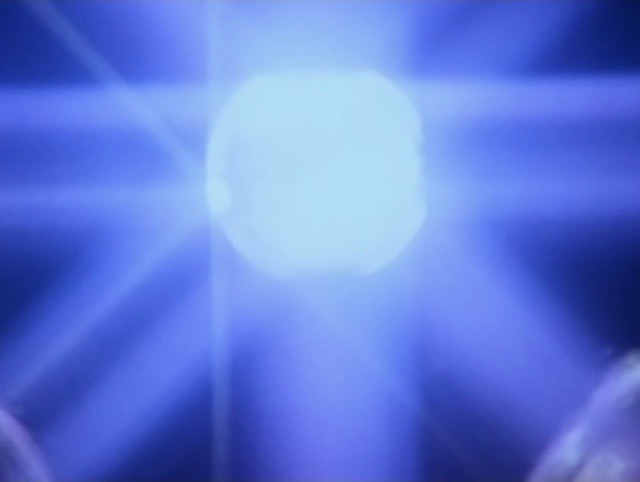
The spotlight showing Frida standing on the edge of stardom if you will. Note that the music video never shows Frida like that again as if it is a state to which she can’t or never will let herself return to again.
By the way, this might look familiar for two reasons. The first one is that the shot above is what Dancing In The Dark by Bruce Springsteen was originally supposed to look like.
That was the version that was going to be directed by Jeff Stein who came to fame directing The Who rockumentary The Kids Are Alright (1979).
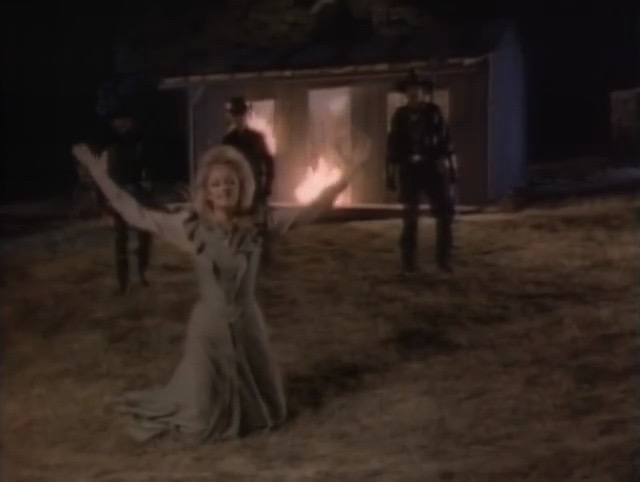
The other reason is that Holding Out For A Hero by Bonnie Tyler would use contrast between location shooting and a studio set. One where she is free, and the other where she is in the dark waiting for the hero of the title.
That music video was directed by Doug Dowdle who started in music videos as an editor for Australian director Russell Mulcahy. While Mulcahy didn’t direct Holding Out For A Hero like he did Total Eclipse Of The Heart, it was written by Keith Williams who wrote the treatment for many of Russell Mulcahy’s music videos. I know I already said it in a previous post, but the Sailboat version of Knowing Me, Knowing You has parts that remind one of Rio by Duran Duran–which Mulcahy directed. ABBA was huge enough in Australia that ABBA: The Movie (1977) takes place there. No wonder music video director Kevin Kerslake once commented about how much music video directors borrowed from each other. Even if those connections are superficial, you probably could bring all music videos into some sort of Lasse Hallström universe, like the Tommy Westphall universe that apparently ties just about every TV Show after St. Elsewhere together. Moving on.
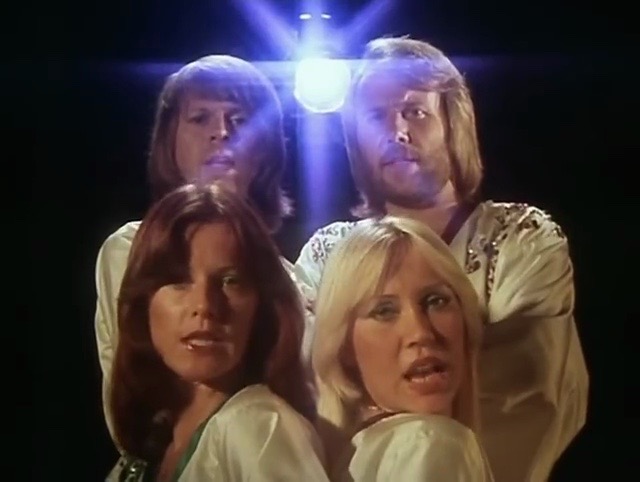
The camera now gives us a head-on shot of Frida where we can see her face has been divided into shadow and light.
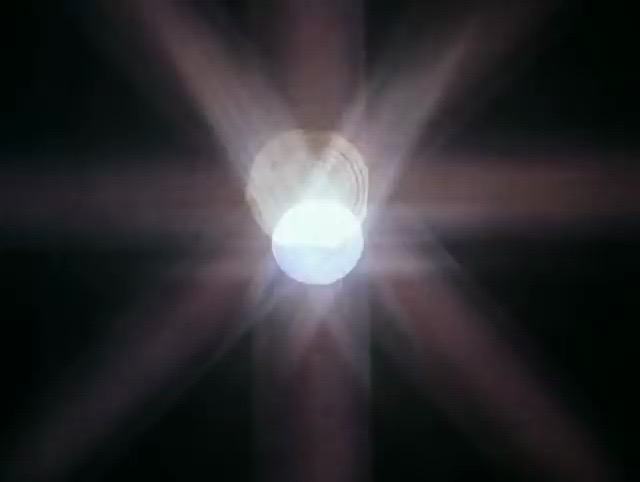
Now the chorus kicks in where we see Hallström timing shots of the band to the song. My favorite part here is how the coin and the spotlight are shown to be the same thing.
Notice that this money is Swedish because that will soon change. You might also notice the poses of the band. It’s noteworthy that they shot this upwards with the guys behind Agnetha and Frida considering the chorus of the song.
You’ll only see the guys and girls together in this shot, and when they are driving in the car.
The entire video seems to be drawing a parallel between the song’s story of a woman fascinated with being rich to escape the normal grind and ABBA’s career.
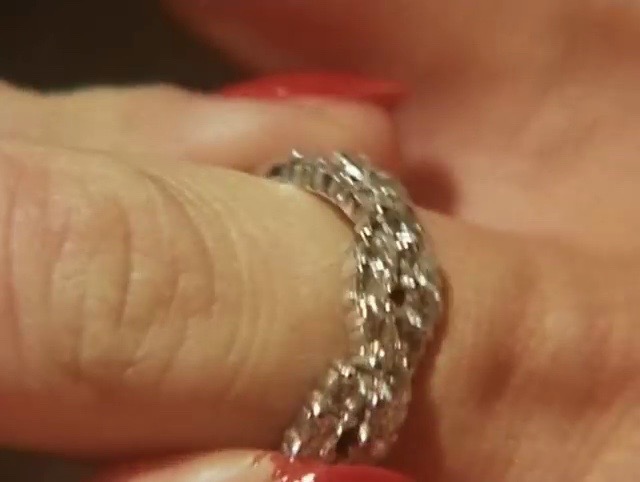
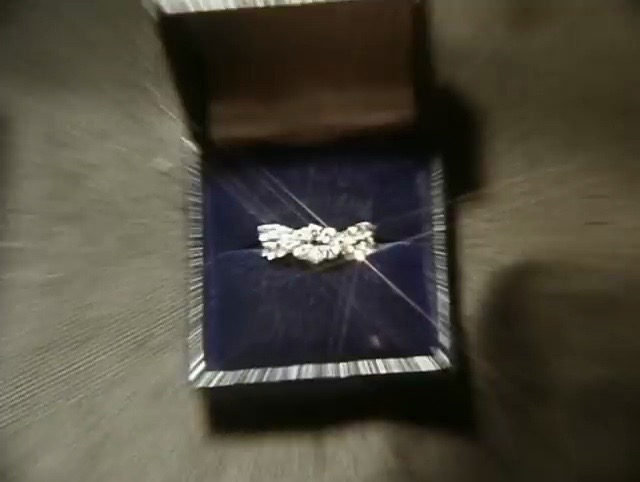
At about the halfway mark, we see the woman of the story appear to start coming into money as she puts on a ring. Marriage? I don’t know. Of course the fact that ABBA are Swedish, but sing in English in order to have international appeal, can be seen as a marriage to wealth by singing in someone else’s more well-known language. Most of the times that was English, but there are Spanish versions of some of their songs as well. Frida even did a version Fernando in Swedish. This ties in with the change of the kind of money later in the video. Today we have examples of this kind of thing in The Hives and PewDiePie.
The lyrics now change to the woman going away somewhere to make money. Note that the ring is no longer on her finger.
I don’t know if that means she isn’t married, or if it means she can buy the ring herself seeing as that is followed by riches and champagne, which includes more jewelry. You can see that she is the one who puts the ring on her finger. In addition, the money is now American dollars.
They’ve gone international at this point. Pay attention to how she takes the money here because after some closeups, we’ll see her grab the cash.
Why the closeups of their mouths? It was 1976. I wouldn’t be surprised if Hallström was going for a Deep Throat (1972) reference, which was still fresh in people’s minds having popped up in The Rocky Horror Picture Show (1975) and even Dirty Duck (1974). Seeing as Agnetha and Frida made money with their voices, whereas Benny and Björn did it by writing the songs, it’s not that much of a stretch. Everyone saw that movie back then. Even Jackie Kennedy saw it.
That, and Sweden’s ties to adult films during the 1970s. Their Linda Lovelace of the time probably being Christina Lindberg who returned to Sweden in the mid-1970s when she didn’t want to do hardcore sex scenes. It’s worth noting that Lindberg worked with director Joe Sarno on Swedish Wildcats (1972) because Sarno would go to direct the sequel to Deep Throat in 1974. Also, if Wikipedia is to be believed, then it was Gerard Damiano (director of Deep Throat) who urged Lindberg to return to Sweden because he knew she wouldn’t be comfortable with the direction the film they were making together was going.
Perhaps she is supposed to have been married seeing as the video shortly follows up the money grab with an intimidating shot of Björn…
and cuts to Agnetha’s eye which appears to wink before cutting to her face. I say that because they were married in real life.
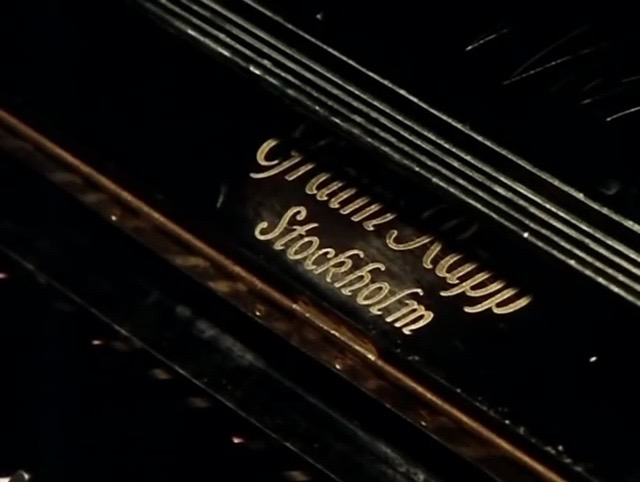
The video does eventually come back around to the Stockholm piano before taking us into the spotlight ourselves.
I can see why Hallström once said this is the best ABBA music video he ever directed. I still prefer the Snow version of Knowing Me, Knowing You–but I get it. You can even read into the use of the colors of the spotlight. The women share both the blue and red spotlight solo, and with the guys. The guys only have the blue light when they are with the girls posing as the band. In the solo shots of them, it is the red light.
Yes, I did notice that Agnetha and Frida nearly kiss in the video before turning towards the camera. I wonder how many times it took before they could nail that without bumping into each other or stopping short.
Finally, I do know about the ties to royalty that most likely go along with showing the face of the Swedish coin and the American dollar. ABBA sang Dancing Queen at a special party in tribute to the new Swedish queen Silvia Sommerlath, whom married the King of Sweden in 1976. That king being the son of the man featured on the coin–Gustaf VI Adolf.
I can see why they would compare Martha Washington–who married into wealth–and Silvia Sommerlath–who married into royalty–by also zooming in on George Washington.
I’m sure there’s more in there having to do with Sommerlath, but the Wikipedia article runs up a lot of red flags, so something like her supposedly working as a flight attendant before marrying the king is not something I feel comfortable stating as fact. There’s probably also something to do with Louise Mountbatten who had married Gustaf VI Adolf, thus becoming Queen of Sweden before dying in 1965. Her husband died in 1973, at which point Carl XVI Gustaf became king and married Sommerlath three years later. They are still the King and Queen of Sweden to this day.
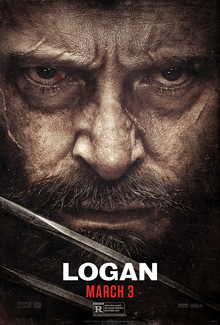
Hey, bub! Before you read this, Lisa already has an awesome review for Logan. Start there first, and if you feel like it, double back here.
The short of it:
+ Might be Jackman and Stewart’s best turn in their roles since X-2:X-Men United.
+ Logan’s well written, with some good characterization, particularly among the leads. There’s a vulnerability here.
+ It’s brutal. Logan is the bloody version of Wolverine we all hoped for.
+ Moves like the best of Westerns. Just about as cool as 3:10 to Yuma.
+ Though changed from her comic book origins Laura (X-23) is awesome on screen.
– The film feels long. For a film that’s just a hair over 2 hours, it feel almost like 3.
– Some of the action scenes may be a little quick for the camera.
– There isn’t an answer/explanation for everything (nor should there be).
The long of it:
I was 25 when I saw the original X-Men in the cinema. While everyone was excited to see their favorite mutants show up on screen (no Nightcrawler for me – that would take the sequel), it was Wolverine that caused the most buzz. When Hugh Jackman first stepped into the role, there was a great deal of skepticism. He wasn’t short and stocky nor big and bulky, and there was only so much one could do to give him that Wolverine look. Yet, he made the role his own and despite a few stutter-steps (such as X-Men: The Last Stand, X-Men Origins: Wolverine), it’s hard to fathom any X-Men film without him.
The same can also be said of Patrick Stewart. Just about the easiest first pick for Charles Xavier anyone could have, his time with the X-Men is only slightly shorter as he wasn’t really needed for X-Men: First Class.
It’s been roughly 17 years for them both. That’s longer than any single actor’s run of James Bond. Longer than any superhero portrayal – Christopher Reeve only had a decade as Superman. Robert Downey Jr. Has about 9 years under his belt as Iron Man. It’s about time that their stories come to a close.
There was a bit of yawning and exaggerated sighing in my screening of Logan, which leads me to believe the audience was really expecting a faster paced film. I didn’t get the outright snoring that occurred during a Manhattan showing of the Robocop remake, if that’s any consolation. Usually the Midnight crowd are the liveliest bunch of patrons, particularly when it comes to superhero or action films. At its heart, Logan is a drama piece peppered with action sequences. It honestly felt like a really good Western, with an old cowboy that wants nothing more than to hang up his guns, yet finds their peace constantly challenged. The film has a lot of exposition through dialogue, and for some, this could make the story feel really slow at times. It’s not a superhero action film, even though it has its moments.
The Western angle is of no real surprise here, given that Logan reunites 3:10 to Yuma and The Wolverine director James Mangold with both Hugh Jackman and Patrick Stewart. It flows in the same fashion as Yuma, but with mutants.
Logan takes place in a future timeline where no new mutants have appeared in nearly 20 years (which is very similar to Alfonso Cuaron’s Children of Men). James Howlett is a broken individual working as a limo driver. Time has taken its toll on The Wolverine. He doesn’t heal as well as he used to and he struggles with the Adamantium in his bones. Adding to Logan’s troubles is an ailing Charles Xavier. Forced to take care of him both out of friendship and the possible danger he poses, I felt it added a great level of vulnerability to both individuals. They’re both nearing their end and they can’t count on their abilities to rescue them as well as it once could. The conversations between them speak of regrets and/or just keeping afloat, though Xavier is still hopeful that there’s some good on the horizon. Their long term friendship also adds to the banter between the two, with a few comical quips throughout the film.
The audience never truly learns how this timeline occurred, but it doesn’t truly matter. This is a character driven film, not so much a plot driven one. The story amps up a little once Laura (Dafne Keen, in her first role) enters the mix. Those familiar with her comic origins will spot the connection, though it’s been changed in a number of ways to fit Mangold’s screenplay. Both Keen and Laura match up so well here that you could disregard the comic altogether in favor of this cinematic origin. Laura is being chased by a group of mercenaries led by Pierce (Brad Holbrook – Netflix’s Narcos), and her protector asks Logan to take her to a designated place.
Taking a cue from Deadpool’s success, Logan went with a R rating and makes the most of it. There’s profanity abound, and when the claws come out, there’s major bloodshed. Heads are skewered, limbs are lost and it’s a beautiful sight to behold. Did the movie have to have the blood? Perhaps not, but it doesn’t really detract from the story. If anything, it might come as a surprise when you first witness it all on screen. The only drawback to this is that some of the fight sequences are so quick that you could miss some of the movements. It’s not a terrible thing at all, but it may warrant a second viewing to catch everything.
In the end, Logan a perfect final chapter for one of the most popular X-Men out there.We’ve all grown with both the character and the actors involved.
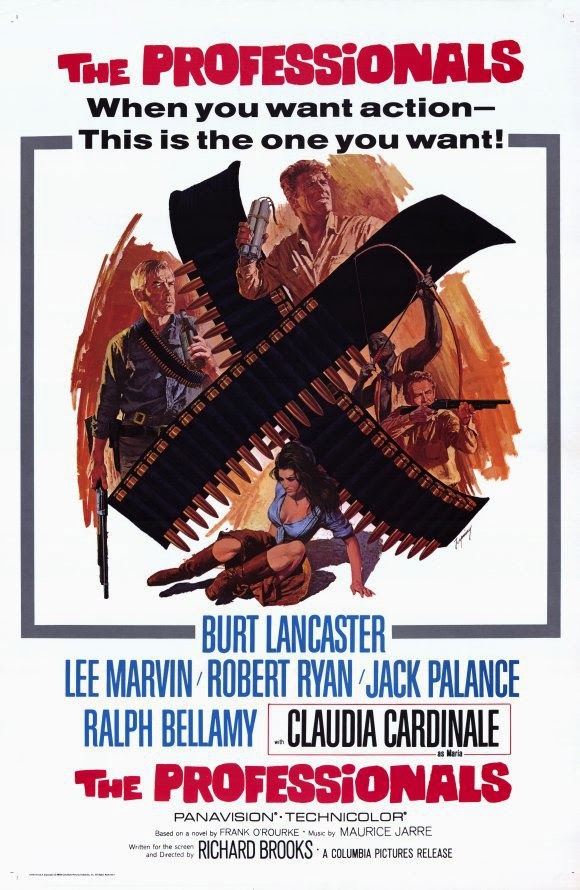
A quartet of macho mercenaries – Lee Marvin , Burt Lancaster , Robert Ryan , and Woody Strode – cross the dangerous Mexican desert and attempt to rescue a rich man’s wife kidnapped by a violent revolutionary in writer/director Richard Brooks’ THE PROFESSIONALS, an action-packed Western set in 1917. The film’s tone is closer to Sergio Leone’s Spaghetti Westerns than the usual Hollywood oater, though Leone’s trilogy wouldn’t hit American shores until a year later.
Rich rancher J.W.Grant (screen vet Ralph Bellamy ) hires the quartet to retrieve wife Maria (Claudia Cardinale) from Jesus Raza (Jack Palance ), formerly a captain in Pancho Villa’s army, now a wanted bandito. Marvin is the stoic leader, a weapons expert who once rode with Raza for Villa, as did Lancaster’s explosives whiz. Ryan plays a sympathetic part (for a change) as the horse wrangling expert, while Strode is a former scout and bounty hunter adept…
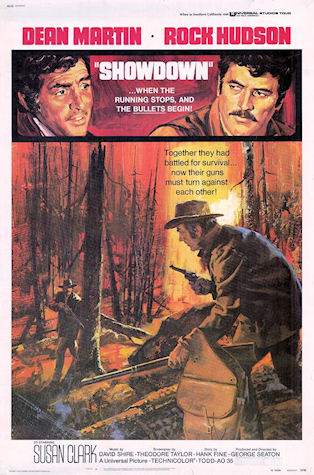
The time and the place is the old west. Growing up, Chuck Jarvis (Rock Hudson) and Billy Massey (Dean Martin) were best friends. When the lovely Kate (Susan Clark) chose Chuck over Billy, the two of them go their separate ways. Billy becomes a notorious train robber. Chuck becomes the sheriff of their hometown. After Billy returns home, it is up to Chuck to not only capture him but to also protect him from not only his former partners but a gang of vigilantes as well.
There’s nothing surprising about Showdown, a strictly by the numbers western that, if not for a few bloody gunshot wounds and some dialogue about cattle “humping,” could have just as easily been released in 1953 as 1973. The only thing that makes Showdown special is that it was the last western made by both Rock Hudson and Dean Martin. Dino is his usual fun-loving, half-soused self but Rock Hudson looks absolutely miserable here. If Rock’s role had been played by Frank Sinatra (or even Peter Lawford), Showdown would probably be remembered as a minor classic. As it is, it’s for Dean Martin completists only.
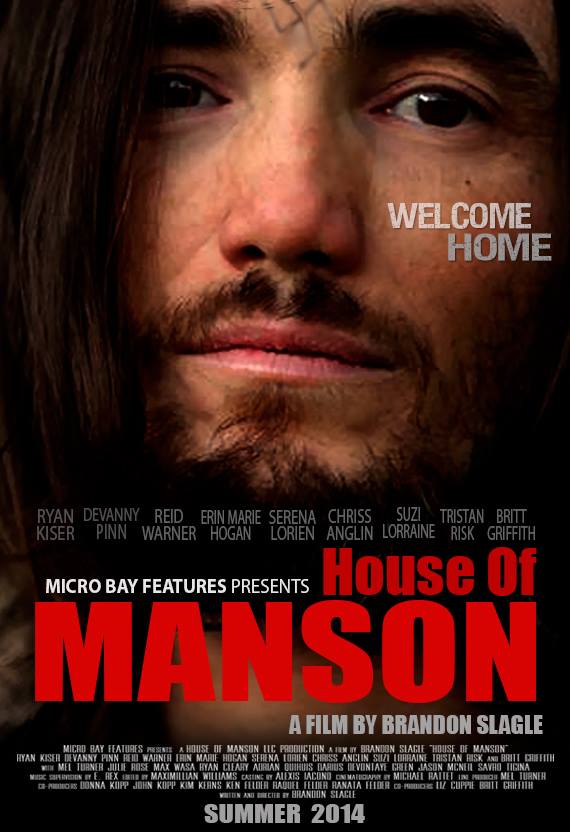
If I had the energy, ambition, or desire, I would begin this review with a lengthy preamble about the reasons why Charles Manson and his so-called “family” continue to hold such a grim fascination for so many of us, but you know what? The internet is chock full of thoughtful and articulate (as well as a number of hopelessly dull and derivative) essays on that very subject already,to the point where there’s literally nothing I can say about it all that hasn’t been said already. Suffice to say that even now, nearly a half-century after the Tate-LaBianca murders sent shock waves through the nation (and, indeed, the world), those waves continue to reverberate in ways both expected and unexpected and the very word “Manson” has become firmly ensconced as the brand name of choice for murder, madness, and mayhem. No amount of haughty proclamations about the killings associated with him marking…
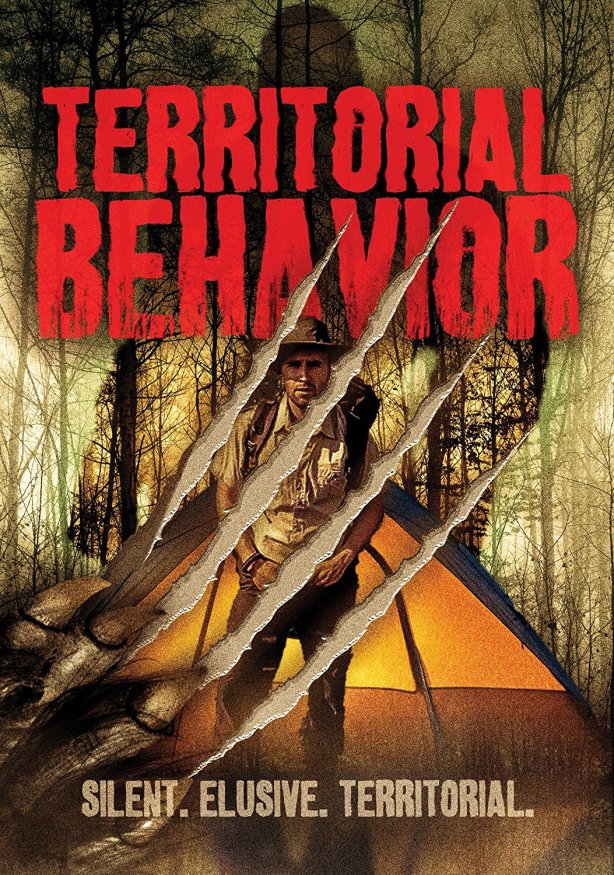
One of these days, I’ll learn to resist new micro-budget “found footage” horror flicks added to the Amazon Prime streaming queue, but today wasn’t that day, and you know what? I’m kind of glad for that fact, because the latest one that I watched — Irish writer/director Peter Bergin’s 2015 offering, TerritorialBehavior (which is apparently also available on Blu-ray and DVD, if you’re so inclined) — turned out to be, while admittedly wholly unoriginal, pretty fun, well-executed, suspenseful stuff.
What Bergin is aiming for here is the classic bait-and-switch : outdoor survival instructor Bailey Rhodes (played with something more than competence but less than actual charisma by Ronan Murphy) heads out to the Montana (by way of Ireland) wilderness to film a tutorial video for prospective students/clients, but he soon finds himself squarely in the cross-hairs of a group of violent poachers who seem, shall we say, overly…









 Hey, bub! Before you read this, Lisa already has

 Through the Shattered Lens