I grew up during the 1980’s and I do remember how it was a decade dominated by martial arts films and cop action films. Even looking back through rose-tinted goggles, I will admit that for a majority of films released under those two genres most were quite bad. Yet, they were bad and enjoyable in their own clumsy and low-budget way.
The short comedy action film Kung Fury arrives on the web today. Why a short film and not a full-length? Well, while it’s kickstarter campaign more than passed it’s goal of $200,000 dollars it failed to reach a stretch goal of $1,000,000 to turn the film into a full-length feature film. While I believe a full-length film would’ve been nice to see, I think this film works best in it’s short film format.
Kung Fury (written, directed and starring David Sandberg) is a pastiche of all the over-the-top action beats action film fans love about the genre during the 1980’s. It throws everything it could think of onto the screen and blends them together with no thought in mind of how ridiculous and insane it turned out. It’s a film that’s a homage and a parody of those very 80’s action and martial arts films that we know and love so much.
Yet, for all the insanity that occurs in the film there’s actually a weird logic to the film’s narrative that reaches a nice pay-off in the end that screams and begs for a sequel. What better way to end a film that’s a love letter to all things 1980’s action than making sure it ends in a blatant cliffhanger that screams sequel and franchise building.
If there’s one film you should see this weekend that doesn’t involve costumed superheroes, post-apocalyptic marauders, acapella throwdowns, and the next disaster porn then it should be the 30-minutes of insane martial arts, time-traveling, police action film called Kung Fury.
The dream has to end somewhere. Science fiction seems to agree on that. Futuristic technology produces what biology could not: logic-based systems so functional and adept at survival that humanity becomes obsolete. Whether we assimilate into a borg colony or a zerg hive mind, imagination is pretty screwed. Our best bet might be something like The Matrix. Perhaps some utility will compel our robot overlords to spare the sheep who spawned them. Yay!
I cannot say what it must feel like to be enslaved by a post-human species, but I fancy it would sound a lot like the 777 trilogy by Blut Aus Nord. Between 2011 and 2012, these French black metal legends offered up a journey through a world that was beyond dystopian. Discordant melodies and unorthodox rhythms taken to the extreme are usually a recipe for disaster–the tools of technically proficient but creatively deprived math rock and avant-garde musicians I would only listen to under duress. Blut Aus Nord masterfully avoided that pitfall by envisioning a coherent aesthetic framework and driving the music forward as a consistent conceptual progression across 18 tracks. Radical experimentation joins forces with dark industrial grooves to place the listener in a futuristic, post-human world where mechanical gods rule apathetic over mortals bred in gestation crates.
The trilogy does not actually offer any textual insight into what its world is supposed to be. The minimal lyrics are highly esoteric, and Blut Aus Nord ultimately leave it to the instrumentation to tell their tale. You might not experience it as a futuristic world at all, but rather as some bleak corner of hell from which a lost soul digs through the madness and witnesses his overlord. But as far as it speaks to me, the 777 trilogy is the vision of a feckless human slave awakening from his dream into terrifying, incomprehensible world. He slowly comes to understand his master and, perhaps, ultimately assimilates into the hive mind. The final track, “Epitome XVIII”, is a grim, cold trance in which a soulless machine reigns on triumphant.
Yeah, even I’m not gonna drag this blog down to the furthest depths. I’ll leave that up to Lisa Marie, with her most recent review of Showgirls! I really should link that, but been drinking, so that’s way too much work. But yeah, she watched it, reviewed it, seriously, go read it. Terrible movie, but I’ll bet she made it sound better than it was. She’s awesome like that.
No, what I’m trying to write about is the genre of movie known as disaster porn. The first example that most people have been aware of is most likely the movie The Day After Tomorrow. While a fun disaster porn flick, it was incredibly heavy handed with its environmental bullcrap message. But all disaster porn movies have that.
Why am I talking about this at all? Well, tomorrow (or really tonight if you’re one of thems that watches movies on their early night showings) is the premier of San Andreas, starring The Rock. If he doesn’t wind up punching the earthquake and saving California by flexing a lot, then I’ll be sorely disappointed.
Anyways, I’m gonna go see that tomorrow, and I know that my usual movie guy, site founder Arleigh, isn’t going to have seen it by then. Since it’s unlikely to have been reviewed, I feel that it’s really required to share a spoof of the disaster porn movies with everyone. I know for sure that Arleigh has posted this parody trailer, but with his urging, I am going to repost it.
This trailer is done to spoof the disaster porn of all disaster porn movies, 2012. In fact, it’s called 2012: It’s a Disaster!!! I’d honestly say that this trailer is better than the actual movie, and I think many people would agree with me. At any rate, Arleigh posted this very same trailer several years ago, but we both agreed that it’s worth reposting in anticipation of the Rock’s very own disaster porn movie. So, please enjoy this video, with it’s plane disaster, train disaster, whole city disaster, landmark disaster, rolling buildings, yay spaceships? YAY SPACESHIPS! Flying Bentleys, jumbo jet surfing, hell we’ll even forgive the ridiculousness of seeing a black president. Because that’s just plain lunacy! For sure, let’s celebrate awesome disaster porn with this trailer, and look forward to seeing the Rock grab an earthquake by the neck and plant it into the turf. ROCK BOTTOM! ROCK BOTTOM!!!
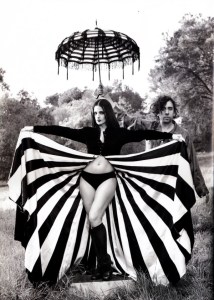
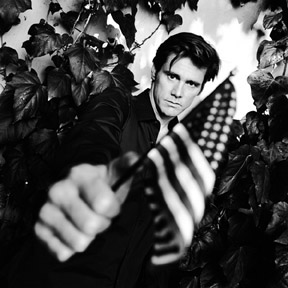
On Monday, photojournalist Mary Ellen Mark passed away in New York City. Over the course of her 40 year career, Mark photographed everyone from street kids to circus performances to mental patients to celebrities. Along the way, she produced some unforgettable images and influenced generations of future photographers. As you can see in the photographs below, it didn’t matter who Mary Ellen Mark was photographing. Whether it was a celebrity or a teenage prostitute, Mark photographed them all with the same compassion and dignity. You can view more of her work here. Mary Ellen Mark, RIP.
I can’t say that any entertainment franchise has given me more cause to think than Ghost in the Shell. It presents a mid-21st century post-apocalyptic earth in which society has more or less stabilized. Events revolve around Public Security Section 9, a counter-terrorism agency focused on investigating cyberterrorism, which is rather interesting because the original manga by Masamune Shirow launched in 1989, before cyberterrorism actually existed (or the modern internet, for that matter). Throughout their investigations, the team deals with the social and philosophical issues that arise in an age where society is fully integrated across a world-wide network and technology has been integrated directly into the body, rendering people intimately vulnerable to hacks and computer viruses.
I am as guilty as most of having never read the original manga. I became acquainted with Shirow’s world through Ghost in the Shell (1995) and Ghost in the Shell 2: Innocence (2004), both directed by Mamoru Oshii, and the 2002 anime series Ghost in the Shell: Stand Alone Complex, by Kenji Kamiyama. While the two directors take rather different aesthetic approaches–the movies present Section 9 as a harsh, disenchanted unit in a somewhat dystopian world, whereas the television series is lively and a bit cartoonish–both remain dedicated to questioning the impact of highly integrated technology.
Stand Alone Complex lies much closer to the root of my music series, because some of the key issues it tackles have since arisen online in the real world. Everyone is well familiar with the use of V for Vendetta-styled Guy Fawkes masks in protests originating from the internet, but there is a decent chance you have also caught a glimpse of an odd blue smiley face among the rabble. The Laughing Man image originates from Stand Alone Complex, where it functions as a mask employed anonymously by individuals taking public action independently of each other. At first, an advocate for social justice uses it to disguise himself while committing a ‘terrorist’ act, but the image quickly overreaches his motives. Others commit unrelated political sabotage under the guise. Corporations employ it to discredit their competitors. Pranksters use it as a sort of meme, forming the shape with chairs on a rooftop and cutting it into a field as a crop circle, for instance. The image has no concrete meaning, and everyone who uses it essentially ‘stands alone’, but the public perceive the Laughing Man as a single individual.
The actual anime gives a fairly shallow interpretation of this. The creator of the image, Aoi, explains that he never intended the mask to become a social phenomenon, and that its arbitrary usage dislodged the image from its original meaning. He sums this up by asking “Who knew that copies could still be produced despite the absence of an originator?” The ‘profoundness’ of this ties back to a long history of bad philosophy which assumes that signs have universal objective meaning in some sort of fundamental way which mystically transcends subjectivity of the mind. Basically, certain Greek ideas saw a resurgence of popularity in the late 19th and early 20th centuries, probably as a consequence of high society’s fascination with antiquities at the time. The plethora of ready-at-hand counterexamples to these archaic notions provided easy meat for countless grad students to earn their PhDs, so long as they did not throw the baby out with the bath water and ruin the game for everybody else.
But I digress. While the intended idea behind “Stand Alone Complex” is a bit naive, the Laughing Man does represent a unique sort of game that can only be played in the information age. To the public, the Laughing Man was a single individual, or at most a closely coordinated group, but the participants knew better. They knew that there was no real ‘Laughing Man’, but their independent actions were performed under the expectation that they would be written into ‘his’ public profile. The game was exclusive; you had to be aware of the mask in order to dawn it. The game also had rules; an action totally out of line with the Laughing Man’s pattern of behavior would be perceived as a fraud. (You could not, for instance, reveal the truth behind the Laughing Man.) By playing, you added a little piece of yourself to the puzzle, and it might slowly assimilate you in turn.
Ghost in the Shell has remained a uniquely relevant franchise in science fiction because it got so many ideas right. In 1989, at a time when internet was still a novelty of college libraries, the manga offered a world of total connectivity, where every human and device belonged to a global network. In 2002, Stand Alone Complex introduced the Laughing Man, and shortly afterwards the real world knew an equivalent. Whether this bodes well for the franchise’s dabblings into cyborg technology, only time can tell, but history has certainly made an inherently fascinating fictional world all the more compelling. In the Ghost in the Shell universe, science has fully bridged the gap between computers and neural systems, allowing electronic implants to directly convert wireless digital information into stimuli compatible with the senses. The average citizen possesses visual augmentations which allow them to directly browse the internet via voice command. More complex technology delves deeper, creating a sort of sixth sense whereby users can engage a network through thought command. Some individuals, especially accident victims with the means to afford it, might have their entire bodies replaced by neurally triggered machine components.
The 1995 Ghost in the Shell film gets especially creative in tackling this–enough that it became the chief inspiration for The Matrix four years later. It revolves around brain-mapping technology and its implications regarding sentience and identity. From the start of the film, the ability to copy and read brain data appears to be common. Presumably, these digital copies would remain stagnant until encoded back into a neural network, but as the government develops better software for interpreting and editing the massive content at its disposal, funny things start to happen. The software gains a sort of temporary sentience while performing its complex tasks, and eventually it uploads itself to a cyborg body in an act of self-preservation. This new entity possesses the capacity to read other augmented brains and incorporate them into its internal network. At least, that is how I’ve interpreted it. The movie does leave a lot to the imagination. Perhaps it is recycled from earlier science fiction, and far-fetched besides–I wouldn’t really know–but Ghost in the Shell presents it all as if it were right around the corner, not lost in a distant galaxy of Star Trek.
Ghost in the Shell is so steeped in ideas that it’s a wonder I don’t forget it is a collection of animations, not a book series. Stand Alone Complex is presented as rather typical–and relatively forgettable–anime, but the 1995 movie definitely denies dismissal. It is a real work of art. The city is dirty and a bit washed-out without feeling downright destitute; the masses still lead normal lives. Emptiness expands upward; the characters are perpetually surrounded by massive, sort of dusty-looking structures that feel vacant despite signs of life. The music is simultaneously vast and minimalistic. Generally, the artistic direction projects a feeling that the protagonists are isolated–cut off from the massive world surrounding them–perhaps by the knowledge they possess.
The score Kenji Kawai (川井憲次) crafted for Ghost in the Shell ranks among the best soundtracks I’ve ever encountered. Without it, the film might easily unravel. The plot really does take a lot of creative liberties. What amount of entertainment value could convince people to open up their brains to potential hacking? Or, if they are doing it to maintain memory backups, why is a brain hack so devastating? Can’t you just resume from your last save? Why would a hacker go to the trouble of replacing an entire memory system in the first place, if they could just encode an impulse into an existing one? To these questions, I say “shhhh!”, because Kawai has so utterly convinced me that my cyborg brain will be shipping in from Japan any day now. The music shrouds the film in imminent mystery. It is a moment of quiet awe, before the very foundations of human experience become uprooted and replaced by a higher state of computer-enhanced perception.
‘Interesting’ nerd note on Kawai: while the majority of his discography appears in anime and film, he is credited with arranging the TurboGrafx-16 port of Sorcerian, one of Yuzo Koshiro and Takahito Abe’s better 1980s NEC PC-8801 projects. I am pretty excited to dig that one up. Aren’t you? …Bueller?
Showgirls in the 1995 film that, 20 years after it was first released, is still held up as the standard by which all subsequent bad films are judged. The story behind the production is legendary. Screenwriter Joe Ezsterhas was paid a then-record sum to write a script that ripped off All About Eve and featured lines like, “Come back when you’ve fucked some of that baby fat off,” and “You’re the only who can get my tits poppin’ right!” (And let’s not forget the heroine’s oft-repeated catch phrase, “It doesn’t suck.”) A major studio specifically hired Paul Verhoeven with the understanding that he was going to give them an NC-17 rated film. And finally, the lead role was given to Elizabeth Berkley, an actress whose previous experience amounted to co-starring on Saved By The Bell.
(And, let’s be honest, the only reason Jessie Spano was a tolerable character was because she wasn’t Screech.)
Berkley plays Nomi Malone, a sociopath who wants to be a star. She hitchhikes her way to Las Vegas where, as is destined to happen to anyone who shows up in Vegas or New York with a clunky suitcase, she is promptly robbed of all of her possessions. “Fuck! Fuck! Fuck! Fuck!” she yells, showing off the very expensive dialogue that was written for her by Joe Ezsterhas. Eventually, Nomi starts to take her frustration out on a random car. The car, it turns out, belongs to sweet-natured Molly (Gina Revara), who is a seamstress for a tacky Vegas show called Goddess.
(Seriously, Goddess makes Satan’s Alley from Staying Alive look like a work of quiet genius.)
Soon, Nomi is living in Molly’s trailer and working as a stripper at the Cheetah Club. The Cheetah Club is owned by Al, who is amazingly sleazy but who is also played by Robert Davi. Robert Davi is one of those actors who knows how to make terrible dialogue interesting and it’s instructive to watch him perform opposite Elizabeth Berkley and the rest of the cast. Whereas the majority of the cast always seems to be desperately trying to convince themselves that their dialogue is somehow better than it actually is, Davi knows exactly what he’s saying. Watching his performance, it’s obvious that Davi understood that he was appearing in a bad film so he figured that he might as well enjoy himself.
The same can be said of Gina Gershon, who plays Cristal Connors, the star of Goddess. Sexually voracious Cristal is basically a male fantasy of what it means to be bisexual. Cristal hires Nomi to give a lapdance to her sleazy boyfriend, Zack (Kyle MacLachlan, giving a good performance despite having to spend the entire film with hair in his eyes) and then arranges for her to be cast in the chorus of Goddess. There’s absolutely nothing subtle about Gershon’s performance and that’s why it’s perfect for Showgirls. It’s been argued that Showgirls is essentially meant to be a huge in-joke and, out of the huge cast, only Gershon, Davi, and occasionally MacLachlan seem to be in on it.
Certainly, it’s apparent that nobody bothered to tell Elizabeth Berkley. Berkley gives a performance of such nonstop (and misdirected) intensity that you end up feeling sorry for her. She’s just trying so hard and she really does seem to think that she can somehow make Nomi into a believable character. And it’s actually a bit unfair that Elizabeth is always going to be associated with this film because I doubt any actress could have given a good performance in a role as inconsistently written as Nomi. One second, Nomi is a wide-eyed innocent who is excited about living in Las Vegas. The next second, she’s screaming, “FUCK OFF!” and threatening strangers with a switch blade. She may be a survivor (and I imagine that’s why we’re supposed to root for her) but she’s also humorless, angry, and apparently clinically insane.
Hilariously, we’re also continually told, by literally everyone else in the movie, that she’s a great dancer, despite the fact that we see absolutely no evidence of this fact. Check out this scene below, where Nomi dances with a lot of enthusiasm and little else.
Once Nomi is cast in Goddess, she promptly sets out to steal both the starring role and Zack from Cristal. Nomi’s cunning plan, incidentally, amounts to fucking Zack in his pool and shoving Cristal down a flight of stairs. Nomi’s finally a star but when a Satanic rock star named Andrew Carver (William Shockley) comes to town, Nomi is confronted with the sordid truth about Las Vegas and, because this long film has to end at some point, Nomi must decide whether to take a stand or…
Well, you can guess the rest.
(Incidentally, I like to assume that Andrew Carver was meant to be a distant cousin of the great short story writer Raymond Carver.)
There seems to be two schools of thought when it comes to Showgirls.
Some critics claim to Showgirls is just crap. They say that it’s a terrible film with bad dialogue, bad acting, and terrible direction. These critics view Joe Eszterhas as being the villain of this tale, a misogynist who conned the studios into paying two million dollars for a terrible script.
And then other critics claim that Showgirls is crappy on purpose. They claim that Verhoeven meant for the film to be a satire of both American culture and Hollywood showbiz dramas. For these critics, Verhoeven used Eszterhas’s terrible script and Elizabeth Berkley’s inexperience to craft a subversive masterpiece.
Myself, I fall somewhere in between. Based on Verhoeven’s other films — Starship Troopers comes immediately to mind — I think his intent with Showgirls probably was meant to be satirical and subversive. But, at the same time, I would argue that Verhoeven’s intent doesn’t change the fact that Showgirls is a surprisingly boring film. For all the sex and the nudity and the opulent costumes and sets and all of the over-the-top dialogue, Showgirls is never really that interesting of a film. It barely even manages to reach the level of being so-bad-that-it’s-good. Instead, it’s slow, it’s draggy, and — satiric or not — the bad performance, the bad dialogue, and the nonstop misogyny get a bit grating after a few minutes.
Of course, that’s why you should never watch Showgirls alone. Showgirls is a film that you have to watch as a part of a group of friends so that you can all laugh together and shout out snarky comments. The first time I ever saw Showgirls was at a party and it was a lot of fun. But, for this review, I rewatched the film on Netflix and I was surprised by how much of a chore it was to sit through the entire running time. This is one of those films — like Birdemic and The Room — that you have to watch with a group. You watch for the experience, not the film.
When I first started to watch the 1994 film Legends of the Fall on Encore, I was a little bit concerned when I discovered that it was directed by Ed Zwick. After all, Zwick also directed Love and Other Drugs, which is one of the worst and most insulting films of all time. In fact, I nearly stopped watching when I saw Zwick’s name. But, largely because I want to finish up this series of melodramatic film reviews at some point in the near future, I decided to go ahead and watch the film.
And it turned out that Legends of the Fall is not a bad film. I probably would have enjoyed it more if I had seen it in a movie theater as opposed to on television but, considering that it was directed by Ed Zwick, Legends of the Fall is definitely watchable. If nothing else, it’s better than Love and Other Drugs.
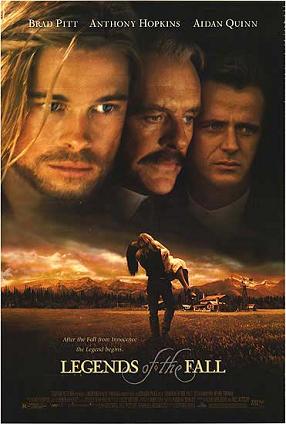
Legends of the Fall tells the story of the Ludlows, a family that lives on a Montana ranch at the start of the 2oth Century. Starting with the final days of the Indian wars and proceeding through World War I and prohibition, Legends of the Fall covers a lot of historical events but does so in a very Hollywood way, which is to say that all of the main characters dress like they’re from the past but they all have very modern social attitudes. In this case, Col. William Ludlow (Anthony Hopkins) may be a wealthy white military veteran but he’s also totally pro-Native American. And, of course, all the local Native Americans love him, despite the fact that he’s a representative of the institutions that have destroyed their way of life.
Anyway, Col. Ludlow has three sons. The oldest, Alfred (Aidan Quinn), is serious and responsible. The youngest, Samuel (Henry Thomas), is naive and idealistic. And the middle child is Tristan (Brad Pitt), who is wild and rebellious and looks like Brad Pitt. You have to wonder how the same gene pool could produce both Aidan Quinn and Brad Pitt.
As the film begins, Samuel has returned from studying at Harvard. With him is his fiancée, Susannah (Julia Ormond, who has really pretty hair in this movie). Though she loves Samuel, Susannah finds herself attracted to Tristan, largely because Tristan looks like Brad Pitt. Tristan is also attracted to Susannah but he would never betray his younger brother. In fact, when Samuel announces that he’s enlisted in the Canadian army so that he can fight in World War I, Tristan and Alfred soon do the exact same thing.
War is Hell, which is something that Samuel discovers when he’s gunned down by a bunch of German soldiers. Tristan responds by cutting Samuel’s heart out of his body and sending it back to Montana. He then proceeds to go a little crazy and when we next see Tristan, he’s uniform is decorated with the scalps of dead Germans.
Meanwhile, Alfred has been wounded in battle and is sent back to Montana. Eventually, he ends up married to Susannah. And then Tristan comes back home and…
Well, a lot of stuff happens after Tristan returns. In fact, you could even argue that too much happens. Zwick obviously set out to try to make Legends of the Fall into an old school Hollywood epic but far too often, it seems like he’s mostly just copying scenes from other films. There’s a hollowness at the center of Legends of the Fall and the end result is a film that’s visually gorgeous and thematically shallow.
And yet, you should never underestimate the importance of looking good. Legends of the Fall is a beautiful film to look at and so is Brad Pitt. I wouldn’t necessarily say that Brad gives a particularly good performance here because, to be honest, Tristan is such an idealized character that I doubt anyone could really make him believable. But the Brad Pitt of 1994 looked so good and had such a strong screen presence that it didn’t matter that he wasn’t as good an actor as the Brad Pitt of 2015. Legends of The Fall is one of those movies that can get by on pure charisma and fortunately, Brad Pitt is enough of a movie star to make the film work.
Legends of the Fall is not a great film but it’s still not a bad way to waste 120 minutes. (Of course, the film itself lasts 133 minutes but still…)
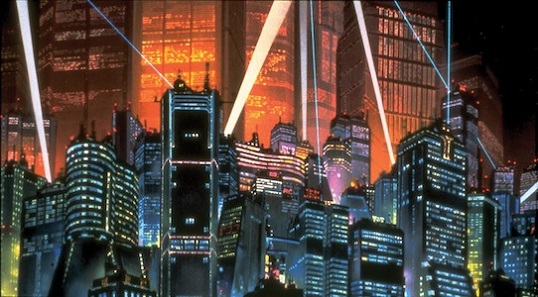
If you are looking for a careful plot showcasing the new challenges of a technologically advanced, post-apocalyptic earth, then Katsuhiro Otomo’s 1988 classic Akira is not a great option. The film does not try to raise any questions, the story is vague, and it revolves around characters who are empowered supernaturally, not enhanced through technology. Akira‘s legacy lies in its music, art, and shock value.
Set in a dystopian Neo-Tokyo in 2019, 31 years after the ubiquitous cataclysm uproots every tenet of modern society, Akira displays a violent, futuristic world where law and order amounts to little more than brute force. The military police force is ruthless. Suspects are executed in public spaces with no concern for who might get caught in the cross-fire. When protests turn to riots, machine guns and tanks bulldoze down all opposition to the state. In one memorable scene, a group of protesters is bombarded with tear gas, and a choking helpless civilian staggers into an unclouded space that happens to be occupied by a policeman. After a moment’s pause, he blasts him in the stomach with a smoke grenade at point blank range. The incessant violence permeates everything. Within the first ten minutes, the hero, Kaneda, has murdered a half dozen members of a rival gang for entering his turf. The antagonist, Tetsuo, while certainly not evil, does not think twice about slaughtering the millenarian following attracted to his psychic powers.
Akira keeps you attentive with an endless escalation of weirdness and destruction. At every turn, events outpace your expectations, culminating in a transformation sequence that is not even worth trying to explain. I suppose it does raise one question, and only one: “What the fuck did I just watch?” It only works, though, because the art is so distinct that it leaves little to the imagination. Akira is a visual tour through everything that the most dystopian, vulgar cyberpunk city is supposed to be.
The soundtrack, composed by Tsutomu Ōhashi of Geinoh Yamashirogumi (芸能山城組), is inescapable throughout the film. It’s a bit of a counterbalance to the grim, futuristic visuals, relying heavily on Japanese and Indonesian traditional instrumentation and avant-garde vocals. It focuses more on capturing Akira‘s supernatural side, both in style and in strangeness. The opening track, “Kaneda”, does this while racing full speed into the heart of a towering metropolis.
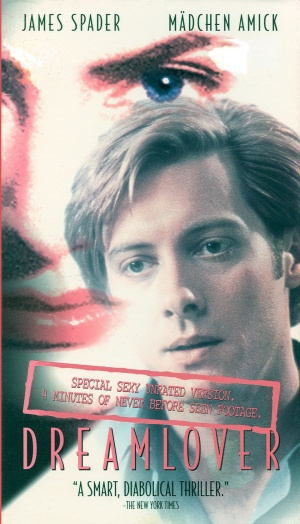
The 1994 film Dream Lover is almost as strange as Zandalee.
Dream Lover opens with Roy Reardon (James Spader, giving a very James Spaderish performance) in the process of getting divorced. Sitting in court, he announces that he’s fired his attorney and that he’s no longer contesting the divorce. The judge informs him that, if he did contest the divorce, the final judgment would be in his favor. Roy says that doesn’t matter. He doesn’t want to contest the divorce.
In the next scene, Roy’s ex-wife tells him that he’s a great guy and that it’s too bad that they couldn’t make the marriage work. They agree that they were just too different. She apologizes for cheating on him. Roy apologizes for hitting her. They agree that Roy has trust issues.
Over the next few minutes of the film, we follow Roy over the course of his new single life. We discover that Roy is a successful architect who is always attracted to brunette artists with troubled backstories. We also discover that Roy’s best friend is an obnoxious yet strangely likable guy named Norman (Larry Miller, who brings some unexpected depth to an obnoxious character). Norman begs Roy for money. Roy refuses to give it to him. Norman invites Roy to an art gallery and offers to set him up with a woman he knows. Roy agrees. And, seriously, the first 20 minutes of the film are so dominated by Norman that you’re kind of surprised when the film moves on and he’s no longer in every scene.
(But then again, that’s the type of film that Dream Lover is. Characters appear and vanish at random. Plot points are raised and then abandoned.)
Anyway, Roy’s date is disastrous. (“You don’t like me,” the woman says as tears stream down her face.) However, during the date, Roy meets Lena (Madchen Amick). When first they meet, they fight. Then they run into each other again at the grocery store and they hit it off. They go to dinner and, despite having a good time, Lena makes a point of not inviting Roy up to her apartment. The next night, Roy shows up unannounced and Lena does invite him up. At first, she’s cold towards him. Then they’re making love. And then they’re getting married. And then the clowns show up…
Oh yes, there are clowns in this movie. Roy is haunted by visions, where he’s at a carnival and random clowns pop up and say cryptic things to him. “How’s the family?” one asks. Another one continually reminds him that he doesn’t know much about Lena.
Years pass by. Lena and Roy have two children but it continues to nag at Roy that he doesn’t know anything about her. He worries that she’s cheating on him. He fears that the children are not his. Roy’s friends tell him that he’s being paranoid. Roy argues that paranoia is just a heightened form of consciousness.
Roy starts to investigate Lena’s past and here’s where I really laughed out loud. Roy finds out that Lena is from North Texas and goes down to her hometown. As Roy arrives in this tiny country town, the camera reveals a huge mountain in the background. Really, Dream Lover? A mountain in North Texas?
Anyway, for me, this film never really recovered from that mountain but, if you can overlook that geographic mistake, Dream Lover is occasionally enjoyable because it is such a weird film. James Spader is hot, Madchen Amick is beautiful, and the entire film features one of those huge and improbable twists that you simply have to see for yourself.
And you can see it because it’s currently available on Netflix!
Seriously, he’s just one of those actors. He’s appeared in a countless number of films and he’s played a lot of different characters. He was a psycho vampire in Near Dark. He was the underwater explorer who got stuck with all of the worst lines in Titanic. In Frailty, he was a father who was driven to murder by heavenly visions. He was the sleaziest of sleazes in Nightcrawler. And, of course, in Big Love, he was an unrepentant polygamist. In all of these roles, Paxton showed the quirkiness that has made him so beloved to film lovers like me. Much like Kevin Bacon, it doesn’t matter what role Bill Paxton is playing. You’re going to like him and you’re going to be happy to see him onscreen.
And yet, considering just how many popular films that he’s appeared in, it’s interesting to note that Bill Paxton’s best performance can be found in a film about which not many people seem to have heard. That film is the 1992 Southern crime drama, One False Move.
Actually, it does the film a disservice to refer to it as merely being a crime drama. I mean, it is a drama and it even has a properly dark ending to prove that fact. And it is about criminals and police officers. But ultimately, the film’s plot is just a starting point that the film uses to examine issues of culture, race, and guilt. In the end, One False Movie is an unexpectedly poignant and penatrating character study of 5 very different people.
We start out with three criminals. Ray (played by Billy Bob Thornton, who also co-wrote the script) is a career criminal, a white trash redneck who is not particularly smart but who is dangerous because he’s ruthless and he’s willing to whatever he need to do to survive. (If you’ve lived in the country, you will recognize Ray’s type as soon as you see him.) Ray’s girlfriend is Fantasia (Cynda Williams), a beautiful but insecure woman. And finally, there’s Ray’s partner and former cellmate, Pluto (Michael Beach). Of the three of them, Pluto is the most menacing, a knife-wielding sociopath with an IQ of 150. Even though he’s working with Ray and Fantasia, Pluto always makes it clear that he considers himself to be both separate from and better than both of them.
Ray, Pluto, and Fantasia have just brutally murdered 6 people in Los Angeles, all of whom were friends of Fantasia’s. Now, they’re making their way to Houston, planning on selling stolen cocaine. Pursuing them are two LAPD detective, Cole (Jim Metzler) and McFeeley (Earl Billings). When Cole and McFeeley come across evidence that the three criminals might have a connection with the tiny town of Star City, Arkansas, they call up the local sheriff.
And that’s where Bill Paxton shows up.
Paxton plays Sheriff Dale Dixon. Dale’s nickname is Hurricane and it’s soon obvious why. Like a hurricane, Dale never stops moving. He’s a well-meaning but hyperactive good old boy who has a talent for saying exactly the wrong thing. When he first talks to Cole and McFeeley over the phone, he amuses them with his enthusiastic bragging and briefly offends them with his casual racism.
Cole and McFeeley eventually end up taking a trip to Star City, so that they can investigate how the three criminals are connected to this tiny town. When Dixon meets up with them, he asks them if they could help him get a job with the LAPD. The two cops initially humor Dixon and laugh at him behind his back. When Dixon’s wife (a wonderful performance from Natalie Canerday) asks Cole to keep Dixon safe, Cole assures her that Ray, Fantasia, and Pluto are probably not even going to come anywhere near Star City.
However, Dixon soon reveals to the two cops that Fantasia’s name is Lila and that her family lives in Star City. What he doesn’t tell them, however, is that he and Lila have a personal connection of their own…
One False Move is a twisty and intense thriller, one that’s distinguished by strong performances from the entire cast. (Even Metzler and Billings bring unexpected shadings to Cole and McFeeley, who, in any other film, would have been portrayed as being stock characters.) But the film is truly dominated by Bill Paxton. When we first meet Dixon, he seems like a joke. We’re sure that he’ll somehow end up being the film’s hero (because that’s what happens in movies about small town sheriffs being underestimated by big city cops) but what we’re not expecting is that Dale is going to turn out to be such a multi-layered and fascinating character. Just as Dale eventually starts to lower his defenses and reveal who he truly is, Paxton also starts to reign in his initially overwhelming performance and reveals himself to be a subtle and perceptive actor. It’s a great performance that elevates the entire film. Al Pacino won the 1992 Oscar for Best Actor for his performance in Scent of a Woman. That award should have gone to the unnominated Bill Paxton.
It wouldn’t be fair to reveal One False Move‘s secrets. It’s a film that you really should see for yourself.
 The Insanely Glorious Action That Is Kung Fury

















 Stand Alone Complex lies much closer to the root of my music series, because some of the key issues it tackles have since arisen online in the real world. Everyone is well familiar with the use of V for Vendetta-styled Guy Fawkes masks in protests originating from the internet, but there is a decent chance you have also caught a glimpse of an odd blue smiley face among the rabble. The Laughing Man image originates from Stand Alone Complex, where it functions as a mask employed anonymously by individuals taking public action independently of each other. At first, an advocate for social justice uses it to disguise himself while committing a ‘terrorist’ act, but the image quickly overreaches his motives. Others commit unrelated political sabotage under the guise. Corporations employ it to discredit their competitors. Pranksters use it as a sort of meme, forming the shape with chairs on a rooftop and cutting it into a field as a crop circle, for instance. The image has no concrete meaning, and everyone who uses it essentially ‘stands alone’, but the public perceive the Laughing Man as a single individual.
 Ghost in the Shell has remained a uniquely relevant franchise in science fiction because it got so many ideas right. In 1989, at a time when internet was still a novelty of college libraries, the manga offered a world of total connectivity, where every human and device belonged to a global network. In 2002, Stand Alone Complex introduced the Laughing Man, and shortly afterwards the real world knew an equivalent. Whether this bodes well for the franchise’s dabblings into cyborg technology, only time can tell, but history has certainly made an inherently fascinating fictional world all the more compelling. In the Ghost in the Shell universe, science has fully bridged the gap between computers and neural systems, allowing electronic implants to directly convert wireless digital information into stimuli compatible with the senses. The average citizen possesses visual augmentations which allow them to directly browse the internet via voice command. More complex technology delves deeper, creating a sort of sixth sense whereby users can engage a network through thought command. Some individuals, especially accident victims with the means to afford it, might have their entire bodies replaced by neurally triggered machine components.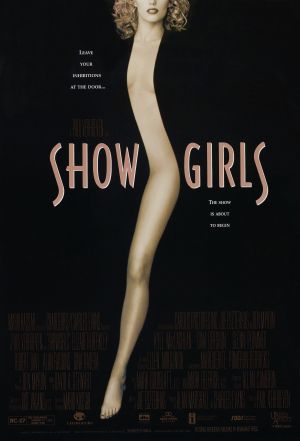

 Through the Shattered Lens