Lisa Watches An Oscar Winner: The French Connection (dir by William Friedkin)


TheFrenchConnection

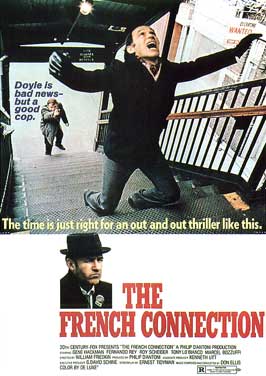
Earlier today, thanks to Netflix, I watched the 1971 best picture winner, The French Connection.

Based on a true incident, The French Connection is the story of two NYPD detectives, the reasonable and serious Buddy Russo (Roy Scheider) and his far more hyperactive partner, Popeye Doyle (Gene Hackman).  When we first see them, Doyle is dressed as Santa Claus and they’re both chasing a drug dealer through the streets of New York.  When they eventually catch up with the dealer, Russo plays good cop while Doyle plays batshit insane cop.  That’s a pattern that plays out repeatedly over the course of the film.  Russo suggests caution.  Doyle blindly fires his gun into the shadows.  Russo is sober.  Doyle is frequently drunk.  Russo is careful with his words.  Doyle is a casual racist who never seems to stop talking.  The one thing that Russo and Doyle seem to have in common is that they’re both obsessed with catching criminals.

The French Connection is also the story of Alain Charnier (Fernando Rey), a suave and always impeccably dressed French businessman.  Charnier has a plan to smuggle several millions of dollars of heroin into the United States by hiding it in a car that will be driven by an unsuspecting (and rather vacuous) French actor named Henri Devereaux (Frederic de Pasquale).  Working with Charnier is a low-level mafia associate named Sal Boca (Tony Lo Bianco) and a lawyer named Joel Weinstock (Harold Gray).

(Incidentally, Weinstock’s chemist is played by an actor named Patrick McDermott, who also played Susan Sarandon’s abusive hippie boyfriend in Joe.  The French Connection was McDermott’s third film and also his last.  I point this out because McDermott totally steals his one scene in The French Connection.  When one considers both his performance here and his work in Joe, it’s strange and unfortunate that McDermott’s cinematic career ended after just three films.  According to a comment left on the imdb, he later ran a health food store in Nebraska.)

When Doyle and Russo just happen to spy Sal hanging out with a group of mobsters at a local club, they decide (mostly on a whim) to investigate what Sal’s up to.  They notice that Sal drives a car that he shouldn’t be able to afford.  Will they discover how Sal is making his money and will they be able to stop Charnier from smuggling his heroin into the United States?

Well…let’s just say that The French Connection was made in 1971.  That’s right, this is one of those films where everything is ambiguous.  Neither Russo nor Doyle are traditional heroes.  Neither one of them is foolish enough to believe that their actions will make a difference.  Instead, they seem to view it all as a game, with Doyle and Russo as the win-at-any-cost good guys and the French as the bad guys.  And, indeed, it’s interesting to note that, when the police do make their move against Charnier, it’s the people who work for him who suffer the worst punishments.

I have to admit that, as a civil libertarian, Doyle is the type of cop who should make my skin crawl.  He’s an obsessive bigot, the type who runs into the shadows with his gun drawn and blindly firing.  When I watched The French Connection, a part of me wanted to get offended and say, “It’s none of your business why Sal has an expensive car!”  But I didn’t.  In fact, I was rooting for Doyle the whole time.  The French Connection is probably one of the best cast films of all time.  Hackman gives such a good performance that, while you can’t overlook Doyle’s flaws, you can accept them.  Meanwhile, Rey is so sleazy and smug in the role of Charnier that you really don’t care about his rights.  You just want to see him taken down.

(That said, if I ever got hold of a time machine and went back to New York in 1971, I’d rather be arrested by Russo than Doyle.  Doyle seems like he’d be the type to grope while frisking.)

Seen today, it’s a bit odd to think of The French Connection as being a best picture winner.  It has nothing to do with the film’s quality.  The film’s performances remain strong.  William Friedkin’s documentary-style direction is still compelling and he makes the decay of 1970s New York oddly beautiful.  Instead, it’s the fact that The French Connection essentially tells a very simple story that, when seen today, feels very familiar.  It’s a cop film and it includes every single cliché that we’ve come to associate with cop films.  (Russo and Doyle even have a supervisor who yells at them for not doing things by the book.)  But, what you have to realize is that the majority of those clichés were invented by The French Connection. If imitation is the sincerest form of flattery, then The French Connection is probably one of the most flattered film ever made.

And what better way to end this review than by sharing The French Connection‘s most influential scene?  In the scene below, Doyle chases a commuter train that happens to be carrying one of Charnier’s associates.

Apprecier le film!

Lisa Watches an Oscar Nominee: The Hustler (dir by Robert Rossen)


Hustler_1961_original_release_movie_posterFor my final Oscar-nominated film of the night, I watched the 1961 film The Hustler.

Filmed in harsh black-and-white and featuring characters who live on the fringes of conventional society, The Hustler is one of those films that’s so unremittingly bleak that it would probably be so depressing as to be unwatchable if not for the talented cast.  Paul Newman plays “Fast Eddie” Felson, a pool hustler who is talented but cocky, a guy who has the talent of a winner and the self-centered, self-pitying personality of a loser.  When we first meet Eddie, he and his manager, Charlie (Myron McCormick) have traveled all the way from Oakland to New York, all so Eddie can challenge and hopefully beat the legendary pool player Minnesota Fats (Jackie Gleason).  Eddie does get his chance to challenge Minnesota (or perhaps I should call him Mr. Fats?) and comes close to winning.  However, in the end, Eddie is too arrogant and impulsive and he ends up losing to Mr. Fats.

Defeated and humiliated, Eddie is hiding his meager possessions in a storage locker at the local bus station when he first meets Sarah Packard (Piper Laurie).  Sarah is an alcoholic and an aspiring writer.  She claims to be a part-time student but we never actually see her in class.  She walks with a pronounced limp and she has a habit of declaring the world to be “perverted, twisted, and crippled.”  Soon, she and Eddie are living together, two lost souls who support and destroy each other at the same time.  When Sarah attempts to write a short story about Eddie, Eddie responds by destroying the page and ordering her to never write about him again.  Charlie views Sarah as a destructive influence and decides that he doesn’t want to have anything else to do with Eddie.

However, Eddie soon finds a new manager.  Bert Gordon (a demonic George C. Scott) is a gambler who says that if Eddie sticks with him, Eddie will not only get rich but he’ll defeat Minnesota Fats as well.  At first, Eddie wants nothing to do with Bert but, when his own attempts at hustling lead to him getting his thumbs broken, Eddie has a change of heart.  Under Bert’s guidance, Eddie find success but he does so at the expense of what little decency that he had to begin with…

Eddie is an interesting character, one who most viewers will probably have mixed feelings about.  On the one hand, he’s a jerk.  He’s an arrogant, cocky jerk who thinks that he’s the best and who either uses or allows himself to be used by almost everyone that he meets.  Though he definitely ends up being exploited by Bert, Eddie knew what he was getting into when he made his deal with the devil.  Though he loves Sarah and she loves him, Eddie still treats her poorly.  There are just so many reasons to dislike Eddie Felson.

Except, of course, Eddie Felson is played by Paul Newman.

Seriously, it is possible to dislike a character played by Paul Newman?  As an actor, Newman was so charismatic and projected an innate goodness that came through even when he was playing a character who didn’t always do nice things.  As written, the character of Eddie spends the majority of the movie acting like a louse.  But, as played by Newman, Eddie becomes a wounded anti-hero, the bad boy that every girl dreams of somehow redeeming.

Ultimately, there are many reasons to see The Hustler.  Gleason and Laurie both give good performances.  George C. Scott, meanwhile, is like a force of nature.  Just listen to him as he shouts, “You owe me money!”  Director Robert Rossen finds an odd beauty in some of the sleaziest parts of New York City.  But, in the end, the main reason to see The Hustler is for Paul Newman’s amazing performance in the title role.  It’s a great performance that elevates the entire film.

I have to admit that I don’t know much about pool.  During my first college semester, I lived in a dorm that had a pool table in the front lobby.  There was always a large group of people gathered around that table, playing pool and generally looking like a bunch of hipster douchebags.  Sitting in the lobby meant having to listen to a constant soundtrack of balls clacking against each other, followed by people saying, “Such-and-such in the corner pocket” or whatever the Hell it is people say when they’re playing pool.  (To be honest, though I could hear the voices, I rarely listened to what they were actually saying.)  I don’t know if the people playing pool in the lobby were any good.  But, after seeing The Hustler, I can say that Eddie Felson would have beaten all of them.


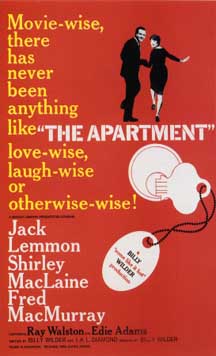
Lisa Watches The Oscar Winners: The Apartment (dir by Billy Wilder)


Apartment_60

After the Nun’s StoryI continued to experience TCM’s 31 Days of Oscar by watching the 1960 best picture winner, The Apartment.  The Apartment is unique among Oscar winners in that it’s one of the few comedies to win best picture.  (Though, in all honesty, it would probably be more appropriate to call The Apartment a dramedy.)  It was also, until the victory of The Artist, the last completely black-and-white film to win best picture.

(And, as long as we’re sharing trivia, it was also the first best picture winner to feature a character watching a previous best picture winner.  At the start of the film, Jack Lemmon deals with insomnia by watching Grand Hotel.)

The Apartment tells the story of C.C. “Bud” Baxter (Jack Lemmon), an anonymous officer worker who is determined to climb the corporate ladder despite not being very good at his job.  However, Baxter does have one advantage over his co-workers.  He’s single and therefore, his apartment has become the place to go for corporate executives who need a place where they can safely cheat on their wives.  Bud spends his day trying to coordinate who is going to be in his apartment and when.  Meanwhile, he spends his nights exiled from his own home and wandering around New York.  In fact, the only beneficial thing about this arrangement is that all of Bud’s supervisors have been giving him good evaluations in return for using his apartment.  (Well, that and Bud’s neighbor, played by Jack Kruschen, is convinced, based on the thinness of the apartment walls, that Bud must be a great lover.)

When Bud finally does get his promotion, it’s only because the personnel director, Jeff D. Sheldrake (an amazingly sleazy Fred MacMurray), wants to use Bud’s apartment.  Bud celebrates his promotion by finally working up the courage to ask out Fran (Shirley MacClaine), an elevator operator who works in the office.  What Bud doesn’t realize is that Fran is also the woman who Sheldrake wants to bring to the apartment….

Fran is convinced that Sheldrake is going to leave his wife for her.  What she doesn’t realize — and what Fred MacMurray’s performance makes disturbingly clear — is that Jeff Sheldrake is basically just a guy having a midlife crisis.  He’s the type of middle-aged guy that every woman has had to deal with at some point, the guy who pulls up next to you in a red convertible and stares at you from behind his sunglasses, attempting his best to entice you into helping him relive the youth that he never had.  When Fran eventually learns the truth about Sheldrake, it leads both to near tragedy and to Bud having to decide whether he wants to be a decent human being or if he wants to keep climbing the corporate ladder.

When one looks over a chronological list of all of the best picture winners, it’s a bit strange to see The Apartment listed in between Ben-Hur and West Side Story.  As opposed to those two grandly produced and vibrantly colorful films, The Apartment is a rather low-key film, one that devotes far more time to characterization than to spectacle.  And while both Ben-Hur and West Side Story are ultimately very idealistic films, The Apartment is about as cynical as a film can get.  The Apartment may be a comedy but the laughs come from a place of profound sadness.

Because it’s more interested in people than in spectacle, The Apartment holds up better than many past best picture winners.  We’ve all known someone like Bud.  We’ve all had to deal with men like Sheldrake.  And, in one way or another, we all know what it’s like to be someone like Fran.  The Apartment remains a truly poignant and relevant film.

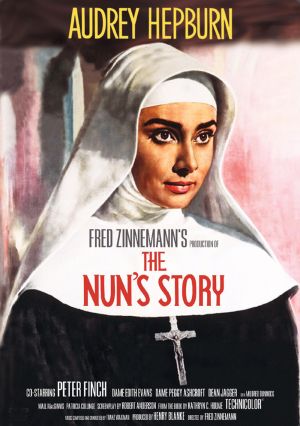
Lisa Watches An Oscar Nominee: The Nun’s Story (dir by Fred Zinnemann)


Nun_story

Happy Ash Wednesday!

So, earlier today, I got off work early so I could go to Noon Mass with my sister and we both got our ashes.  And I’m sure that will take some people by surprise because I’m not exactly the most faithful or devout of Catholics.  But what can I say?  I love the ornate ritual of it all.

And, as a part of my own personal ritual, I washed my forehead before I left the church.  Erin and I had a great vegetarian lunch at Cafe Brazil and then we came home and I turned on the TV and what should be finishing up on TCM but the 1959 best picture nominee, The Nun’s Story.  Fortunately, I had already set the DVR to record The Nun’s Story and so, on this most Catholic of days, I was able to watch this most Catholic of best picture nominees.

The Nun’s Story tells the story of Gaby (Audrey Hepburn), the daughter of a famous Belgian doctor (Dean Jagger).  At the start of the film, Gaby has entered a convent because she wants to become a missionary nursing sister in the Belgian Congo.  However, before Gaby can go to the Congo, she has to learn to give up her own rebellious streak and individual independence.  Taking the name Sister Luke, she excels at her medical training but, because it is felt that she is still too independently minded, she is not sent to the Congo but instead assigned to work in a mental hospital.  It’s there that her independent streak nearly gets her killed when she is fooled by a dangerous patient who claims to be the Archangel Gabriel.  It is only after she takes her final vows that Sister Luke is finally sent to the Congo and it is there that she’s forced to work with the abrasive agnostic Dr. Fortunati (Peter Finch).  Of course, as Sister Luke goes through her own spiritual struggles, the world inches closer and closer to the start of a second world war.  When war does break out, Sister Luke finds herself torn between her vow of obedience (which includes remaining political neutral) and the realities of living in a country that’s been occupied by the Nazis.

1959 was apparently a good year for religious films.  Not only did Ben-Hur win best picture, but The Nun’s Story also received 8 nominations.  Reportedly, The Nun’s Story was the most financially successful film to be released by Warner Bros, up to that point.  If Wikipedia is to be believed, it was also Audrey Hepburn’s personal favorite of the many movies that she made.

When seen today, probably the first thing that people notice about The Nun’s Story is that it’s extremely long and occasionally rather slow.  The film follows Gaby from the minute she enters the convent to the moment that she makes her final choice about whether to be obedient to herself or to her vows and, during that time, it examines every single detail of her life in glorious Technicolor.  A lot of emphasis is put on the rituals that Sister Luke goes through on her way to taking her final vows.  Now, if you’re like me, all of the rituals are fascinating to watch and produce a whole host of conflicting emotions.  Even as I found myself admiring Sister Luke’s dedication and her sacrifice, I still kept wondering — much as she did —  if it was all really worth giving up her independence.  But, I also have to admit that I found myself wondering if someone from a Protestant background would feel the same way.

To a certain extent, I really hate to say that you probably have to come from a Catholic background to truly enjoy any film.  But I certainly think that’s the case with The Nun’s Story.  But, even Protestants and skeptics will appreciate Audrey Hepburn’s wonderful lead performance.  She keeps this film grounded and makes her mostly internal conflict of faith compelling.  In a career that was full of great performance, this is one of Audrey’s best.

Scenes I Love: Gladiator


GladiatorBattle

“ROMA VICTOR!”

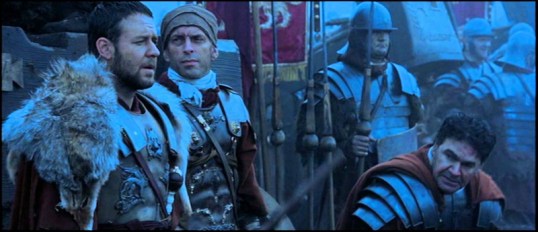
While Lisa Marie watches Ben-Hur on TCM I decided to revisit one of my favorite films to start of the new millenium. This was a film that helped resurrect sword and sandals epic that had burnt out during the late 60’s. From the late 50’s and throughout most of the 1960’s we had such classic epics as Spartacus, Quo Vadis and Ben-Hur. Then we have the Italian-produced peplum films which ranged from memorable to awful.

In 2000, Ridley Scott released the film that would finally win Russell Crowe an Oscar for Best Actor (one he should’ve won for The Insider in the previous year). Gladiator was a return to the old-school epic-scale filmmaking that we hadn’t seen in decades and audiences ate it all up as it won in the box-office and charmed critics.

I wasn’t sure about Gladiator leading up to it’s release, but I was always up for some hacking and slashing in my entertainment. What changed my mind from just being interested to buying fully into the film was when I first saw it and the opening scene which I dub the Battle of Germania. This opening sequence appealed to my sense of adventure as a viewer and also as a student of history (especially military history). While the scene itself wasn’t as accurate as I would’ve liked it got enough of how the Roman Legions fought as an army correct that I was able to forgive Sir Ridley for some dramatic flourishes that wasn’t historically accurate.

In this scene we see the Legions form up in square ranks with their recognizable scutum (Roman shield) into their typical shield wall formation. There are also the auxiliries acting as long-range support such as archers, catapults and ballista (though the last two were rarely, if ever used outside of sieges). Then there were the Roman cavalry led by Maximus himself (a unit seen less as an elite formation as we see later in the Medieval era). Scott was able to combine all these elements and create a scene that probably was as close as we’d get to seeing how war was waged between the Roman Empire and the so-called barbarian hordes of Germania.

I think this scene would’ve been perfect if the Roman Legion formations remained cohesive and just meat-grinded their enemy in front instead of breaking apart and turning the fight into a free-for-all. Other than that misstep this scene was what I loved about Gladiator.

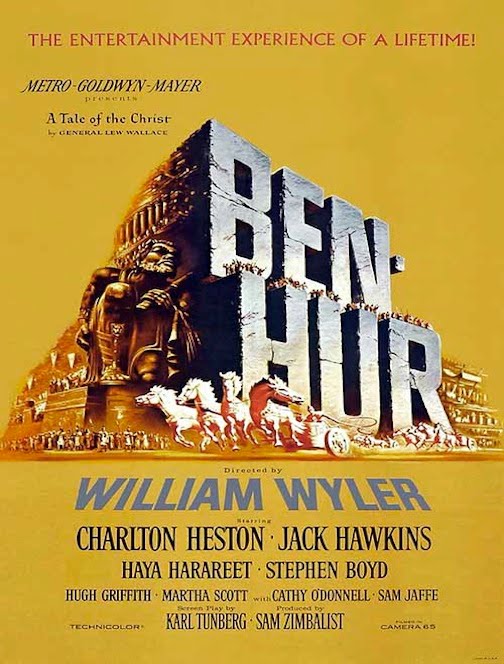
Lisa Watches An Oscar Winner: Ben-Hur (dir by William Wyler)


Ben-Hur

I’m actually kind of upset with myself because, at one point, I was planning on spending all of February watching TCM’s 31 Days of Oscars and reviewing all of the best picture nominees that showed up on the channel.  Unfortunately, I ended up getting busy with other things (like Shattered Politics, for instance) and it was only tonight that I finally got a chance to sit down and watch TCM.  Oh well, maybe next year! But for now, I’m just going to watch and review as much as I can before the month ends.

With that in mind, I just spent four hours watching the 1959 best picture winner Ben-Hur.

In many ways, Ben-Hur feels like a prototypical best picture winner.  It’s a big epic film that obviously cost a lot to produce and which features a larger-than-life star surrounded by a bunch of a memorable character actors.  It features two spectacular set pieces and some human drama that’s effective without being particularly challenging.  It’s a film that deals with big themes but does so in a rather safe way.  Perhaps not surprisingly, it’s a film that, today, is often dismissed as being old-fashioned and simplistic and yet it’s still a lot of fun to watch.

Opening with no less of an event than the birth of Jesus, Ben-Hur tells the story of Judah Ben-Hur (Charlton Heston), a wealthy Jewish aristocrat who, as a young man, was best friends with a Roman named Messala (Stephen Boyd).  When Messala is named as the new commander of the local Roman garrison, he is upset to discover that Ben-Hur is more loyal to his religion than to the Roman Empire.  Feeling personally rejected by his best friend (and perhaps more, as there are a lot of theories about the subtext of their relationship), Massala frames Ben-Hur for the attempted assassination of Judea’s governor.

Over the next 220 minutes, we watch as Ben-Hur goes from being a prisoner to a galley slave to the adopted son of a Roman general (Jack Hawkins) and finally one of the best chariot racers in ancient Rome.  Throughout it all, he remembers a mysterious man who once attempted to give him a sip of water.  Meanwhile, Ben-Hur’s family has been imprisoned and afflicted with leprosy.  Appropriately, for a film that opened with the Nativity, it ends with the Crucifixion, during which Ben-Hur’s struggle to save his family also comes to a climax.

Ben-Hur is undoubtedly flawed film.  (Among the film that were nominated for best picture of 1959, my favorite remains Anatomy of Murder.)  The film runs about an hour too long, some of the supporting actors give performances that are a bit too over-the-top, and the entire film is so reverential that in can be difficult for modern audiences, especially in this age of nonstop irony, to take it seriously.  In the lead role, Charlton Heston is always watchable and has a strong physical presence but you never quite believe that he’s the thinker that the script insists that he is.  There’s nothing subtle about Heston’s performance but, then again, there’s nothing subtle about the film itself.

And yet, if the film struggles to connect on a human level, Ben-Hur still works as a spectacle.  The gigantic sets and the ornate costumes are still impressive to look at.  The film’s two big action sequences — a shipwreck and the chariot race — are still exciting and thrilling to watch.  Ben-Hur may be dated but you can still watch it and understand why it was so popular with audiences in 1959 and, though I may not agree with a lot of the decisions, I can see why the Academy honored Ben-Hur with a record 11 Oscars.  It’s the type of spectacle that, in 1959, could only have been found on the big screen.  By honoring Ben-Hur, the Academy was honoring the relevance of the Hollywood establishment.

In the end, Ben-Hur may not hold up as well as some best picture winners but it’s still worth watching.

What Lisa Watched Last Night #113: Back to School Mom (dir by Christopher Erskin)


Last night, I watched the latest Lifetime original film, Back to School Mom.Back To School Mom

Why Was I Watching It?

Well, first off, it was the latest Lifetime film and I’m making it a point to see all of 2015’s Lifetime films.  However, I also watched it because the title — Back to School Mom — made the film sound like it would be something that would totally bring out my snarky side.

(Amazingly enough, it turned out I was wrong…)

What Was It About?

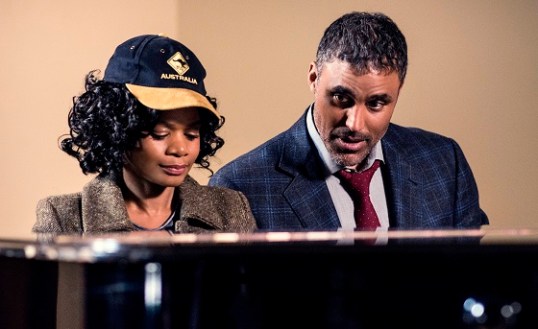
This is the type of movie that, had it been made in the 1950s, probably would have starred Lana Turner and Tab Hunter.  Mary Thomas (Kimberly Elise) is a singer who has performed all over the world but she’s haunted by the fact that, 21 years ago, she dropped out of college and abandoned her newborn son.  When Mary returns to school to finish up her degree, she is shocked to discover that her tutor, aspiring lawyer Noah (Denzel Whitaker), is also her son.  Without revealing the truth about how they’re related, Mary befriends Noah and is soon encouraging him to defy his father (Harry Lennix) and pursue a career in music.

What Worked?

To be honest, I was surprised by how well this movie worked.  Snarkable name aside, Back To School Mom turned out to be a very nice and very sweet movie.  Kimberly Elise was very sympathetic in the lead role and she had a lot of chemistry with the entire cast.  Denzel Whitaker’s multi-layered performance shows that he deserves to be a huge star.

What Did Not Work?

They probably could have come up with a better title but otherwise, the entire film worked.

“Oh my God!  Just like me!” Moments

None, but that’s okay.  Not every movie has to be about me.

Lessons Learned

Sometimes, you can’t judge a movie by its title.

Film Review: Fifty Shades of Grey (dir by Sam Taylor-Johnson)


FSG_31_5_Promo_BW_3F.indd

If there’s anything that’s obvious from looking over some of the reviews of Fifty Shades of Grey, it’s that only after you’ve read the book can you properly appreciate the film.

If you haven’t read the book, you’ll probably watch the film and dismiss it as being a draggy film that has some truly terrible dialogue and which features two actors who look good naked but who have absolutely no chemistry.  You might appreciate that fact that Dakota Jonson, at the very least, appears to be trying to give a good performance.  You might even acknowledge that director Sam Taylor-Johnson manages to capture a few pretty images.  You might even be happy that she resisted the temptation to cast her husband, Aaron Taylor-Johnson (a.k.a., the least interesting bankable actor working today), in the role of Christian Grey.  But, even with all of that, you’ll probably still probably watch the film and, even with its artfully composed and shot sex scenes, think to yourself, “That was two hours of my life that I’ll never get back.”

However, if you have read the book, then you will be capable of watching the film and understanding that, as flawed as it may be, 50 Shades of Grey probably should have been a thousand times worse.  It may seem weird to praise Sam Taylor-Johnson for managing to create a below average film but, considering her source material, below average is probably the best that could be hoped for.

Both the film and the book tell the same basic story.  Anastasia Steele (Dakota Johnson) is a 21 year-old English lit major.  We know that she’s intelligent because she knows the difference between Thomas Hardy the writer and Tom Hardy the actor.  We know that she’s innocent because, the first time that she interviews Christian Grey, she wears a sweater.

As for Christian Grey (Jamie Dornan), he’s a 28 year-old multibillionaire.  We are constantly assured that he’s the most interesting man in the world, despite the fact that he actually seems to be rather dull.  He likes Ana.  She likes him.  But Christian doesn’t do the relationship thing.  Instead, he explains, “I fuck.  Hard.”  (As opposed to doing so limp…)  He’s not interested in having a “vanilla” relationship with Ana.  Instead, he wants her to sign a contract in which she’ll agree to be his submissive.

That’s right — Christian claims to be into BDSM.  And, in order to prove that point, he has a red dungeon that’s full of stuff that he apparently picked up at a BDSM yard sale.  The dungeon’s red, of course.  In both the book and the film, a good deal of time is spent attempting to explain BDSM and, in both cases, you’re left with the feeling that Christian got most of his knowledge from reading Wikipedia.  In many ways, Christian comes across like someone who has never had a drink pretending to be drunk.  He tries really hard but … no.

Anyway, a lot of the film comes down to Christian trying to get Ana to sign a contract.  Ana agrees to give up her freedom.  When she asks what she gets in return, Christian replies, “Me.”  Which, if Christian was being played by Ryan Gosling or Michael Fassbender, might be an incentive.  But instead, he’s being played by Jamie Dornan who, quite frankly, looks embarrassed to be there.

Those who have read the book will be pleased to discover that Christian’s immortal line of “I’m fifty shades of fucked up!” has been included in the film.  Dornan delivers it like an actor who has given up and who can blame him?  To her credit, Dakota Johnson manages to keep a straight face.

Here’s the main problem.  Christian Grey is a stalker asshole.  He’s an obsessive control freak who is basically using the BDSM lifestyle as a way to cover up the fact that he’s a sociopath.  Though that was not author E.L. James’s intention when she wrote the book, that’s who Christian Grey ultimately turns out to be.  And that’s the way that Jamie Dornan plays the character.  It’s not that Dornan is a bad actor.  Just watch him in The Fall and you’ll see that Dornan is capable of giving a very good performance.  Instead, you just get the feeling that he looked at the 50 Shades script, saw that Christian was an impossible character to play sympathetically, and decided to give the most literal performance possible.  When you were reading the book, you could always imagine some redeeming features for Christian.  But, when you watch the movie, you’re forced to accept this very literal interpretation of the character and it quickly becomes apparent that the only reason why anyone would possible love Christian is because he’s rich.

Meanwhile, in the role of Ana, Dakota Johnson actually does a pretty good job.  Fortunately, the film jettisons Ana’s narration and we don’t have to hear any details about what her inner goddess is doing while being ordered around by Christian.  As a result, Johnson’s interpretation of Ana is far different from how the character was portrayed in the book.  Whereas the book’s Ana seems to be desperate to be loved by Christian, Johnson’s Ana often seems to be struggling to keep a straight face.  Whereas the book’s Ana took the whole contract thing very seriously, Johnson’s Ana always seems to be on the verge of rolling her eyes.  It gives the film an interesting subtext in that you never quite believe that Johnson’s Ana could be as intrigued by Christian Grey as both the book and the film insist that she is. Instead, she mostly seems to put up with him and his kinks because he buys her expensive gifts.

And, since Christian is such a jerk, you really don’t mind the possibility that Ana’s main motivation might be materialistic.

(Another great thing about Dakota Johnson is that she seems to be sincerely embarrassed whenever she has to tell anyone that her name is “Anastasia Steele.”)

Finally, a word about Sam Taylor-Johnson.  On the basis of Nowhere Boy, she’s a talented director and, as far as 50 Shades of Grey goes, I think she does the best that she could possibly do.  At the very least, she seems to realize that the film is a bit ludicrous and she wisely plays some of the book’s worst moments for subversive laughter.  Considering that 50 Shades of Grey is one of the worst books ever written (and, by that, I mean that the book’s prose is so clunky and overdone that it’s damn near unreadable), Sam Taylor-Johnson probably does deserve some credit for making a movie that’s only below average as opposed to disastrous.  At the very least, I hope that 50 Shades of Grey will not damage her career in the way that Twilight damaged the equally talented Catherine Hardwicke’s.

I forced my boyfriend to see it with my on Valentine’s and there were a lot of couples in the theater.  But, for all the talk of how 50 Shades of Grey launched a thousand fantasies, it’s not a particularly erotic film.  The sex scenes are well shot but, since Jamie and Dakota have no chemistry, they also feel very clinical and detached.  (Add to that, for a film that’s being identified as being a chick flick, the camera spent a lot more time lingering on Dakota’s naked body than on Jamie’s.)  All the sex that followed couples viewing 50 Shades on Saturday night had more to do with the romance of Valentine’s Day and the glory of being in love than with the film itself.

(That, of course, is one of the huge differences between 50 Shades of Grey and Magic Mike.)

50 Shades of Grey apparently made a lot of money this weekend and, if you’re reading this review, chances are that you’ve already seen the film.  So, I’ll just conclude by saying that the film is not as bad as most people were expecting.  It’s just not particularly any good either.  I’ll be looking forward to seeing what Dakota and Sam Taylor-Johnson do in the future but Christian Grey can just stay in his red room for all I care.

(And now that you’ve read the review, why not have some real fun and check out the Fifty Shades of Grey text generator!?  Click on refresh a few times and you’ll have an erotic best seller of your own, ready to be published and to make you rich!)

Review: The Walking Dead S5E10 “Them”


TheWalkingDeadS510

“We are the walking dead.” — Rick Grimes”

[spoilers within]

The Walking Dead has been a show that has always recycled basic themes throughout. From the very beginning of the series the characters have always been confronted by some very basic notions of humanity and survival. At times, the writers have done some great work exploring these themes and there has been times when they’ve been very heavy-handed and miss the mark.

Tonight’s episode takes it’s time to explore how the deaths of Beth and Tyreese has begun to affect the group as a whole. The first half of the season began with such hope as everyone believed Eugene’s story that a cure was possible if they could get to Washington, D.C. As we’ve now learned that story turned out to be a lie. Yet, despite that punch to the gut the group still remained hopeful. They had just escaped Terminus. They were able to defeat Gareth’s Hunters in quick order.

Then the first half of the season ended with the death of one of the group’s symbols for hope. Beth’s death was roundly seen as pointless and a waste by fans and critics, but it also showed what this show has been all about right from the beginning. It’s a show that shows promises and hints that there’s hope for the future when it’s really just a mirage in the desert of this new post-apocalyptic world. Last week’s death of Tyreese further cemented this. His death on top of Beth’s just seem to have worn down Rick and company.

We seem them tired, dejected and looking like the very zombies they’ve been surviving against. Food and water has now become scarce. The very real problem of being “truly hungry” as Gareth pointed out to Rick has now hit the group. We see Daryl scrabbling in the forest soil for earthworms to eat. Even Abraham would rather drink the bottle of booze just to not feel the thirst and hunger. This is a group that’s nearing it’s breaking point. Even the most hardened survivor must have food and water. Gareth and the people at Terminus went through this crucible and came out insane on the other side. Tonight we saw just how close the group came to finding out for themselves if they had what it took to remain sane and humane as thirst and hunger ate away at them.

We also found the group grieving for those they have just lost. The episode concentrated on Daryl, Maggie and Sasha in exploring the grieving process in this new world. These three lost the most this season. Maggie lost her father in the previous season. She had thought Beth lost to her after the flight from the prison, but found out she was alive only to lose her again before being reunited. Daryl loses in Beth a close friend and someone he allowed to get emotionally close to him. Then there’s Sasha who didn’t just lose her lover Bob, but also her older brother Tyreese in a span of a week or so.

All three grieved (or didn’t) in their own way. Maggie seemed lost and just tired of the day-to-day survival. She’s begun to question whether going on was worth the energy (physically and emotionally). She sees this world and life as having taken everyone last one of her immediate family and it’s begun to weigh on her, if not, breaking her down. her own survivor’s guilt finally comes out as she talks to Glenn about how she had thought Beth was already dead after leaving the prison. How she didn’t allow herself to dwell on the prospect that her little sister was gone. She focused on finding Glenn. Viewers had wondered why Maggie never once worried if Beth was alive and tonight’s episode seemed like the writers giving a sort of explanation as to why.

Maggie has become one of the ultimate survivors in this new world. She has learned to compartmentalize what was done to what needs to be doing better than anyone. Beth being dead or alive after the prison was an unknown. Moving forward to finding the rest of the group was a goal that kept her moving forward. This forward motion became even more prominent when she realized Glenn was still alive. It’s this survivor’s mentality which has also made her unable to grieve properly for the loss of her father and sister. As we neared the end of the episode we finally see a glimmer of Maggie accepting and grieving over who she has lost and looking to move on forward towards an unknown future.

Sasha hasn’t reached that point of grieving. She has lost two very close men in her life and both to the very inevitability of the walking dead around them. This world has hardened her too fast where reckless behavior and anger fuels her instead of guilt. She plans to take it out on the very things that took Bob and Tyreese from her, but she doesn’t see how her need for revenge puts the group at risk. While the episode seems to end with her pushing herself back from the brink of the abyss she was heading in there’s still a danger that her inability to grieve properly could make her not just a danger to herself but to the very people who has accepted her as family.

Now, the very notion that Daryl should even grieve openly goes against the very badassness that fans have heaped upon the character. Seeing Daryl cry was tantamount to losing whatever hope there was in the world. The fandom which has grown around this character wants him to remain a badass who eats nails and shoots lightning from his ass, but at the same time swoons at the notion of him showing a gentler side. The younger Dixon doesn’t allow himself to grieve or feel Beth’s death because he thinks he can’t afford to allow himself to lower his emotional guard down once again. He sees how getting too attached to anyone means heartache in the future. It happened when his older brother died, when Sophie was found dead instead of alive and now with Beth.

We see Daryl finally breakdown, but only in private when he knows no one is looking. Even then it’s not a full release but just enough to alleviate the emotional pressure within him. The very need to distance himself from those who remain has begun as he twice declined Carol’s (the one he feels closest to) offer to accompany him on a scouting mission. It has been great to see Daryl the character become an integral part of the group. To see him accept the fact that he need not be alone in surviving this new world. But as the show likes to do it throws a major obstacle in his path that makes him question whether he would be better off emotionally if he returned to being a lone wolf. No attachments to anyone means to need to grieve when he loses them.

The Walking Dead doesn’t truly allow it’s characters to grieve, but tonight’s episode does a great job in showing how they all find ways to handle loss in the family. It showed that the grief and loss is there, but the need to continue surviving has taken precedent over everything else. It makes for an unhealthy group of people, but unlike the Terminus, Claimers and the Governor, they try to find little ways and moments to grieve. Even if for just a moment they try to find some solace in what they’ve accomplished and how they’ve survived this long. They see how others have slipped back beyond the pale of what’s acceptable behavior in trying to stay alive one more day. The group is still not there, but this season has shown that they’re close to breaking and unless they find another hopeful goal to focus on they would end up resembling the very walking dead that they’ve been avoiding and fighting against.

Notes

  • Tonight’s episode, “Them”, was directed by Julius Ramsay and written by series writer Heather Bellson.
  • It’s always surprising to notice how customized the rifles that Rick and his group carries. One of the most custom rifles being the AR-15 carried by Sasha which looks to be a Seekins Precision custom AR-15 with a built-in suppressor. I will hazard a guess and say that this particular AR is of the 300 Blackout variety which when paired with the suppressor does cut down on the sound though not in the level shown during tonight’s episode.
  • Sasha’s comment to Noah about “Don’t think, Just eat” was a nice bookend to Rick mentioning to the group how they are the walking dead.
  • We see the zombies finally look like the very natural disaster they’re an analogue for when they attack the barn and sound as if they’re a tornado (which seems like was the case in the end as a sort of tornado his the area and did away with the small herd of zombies).
  • A new character makes an appearance in tonight’s episode, Aaron (played by Ross Marquand), who should be familiar to readers of the comic. His appearance might have started the countdown that will lead to a shocking death from Rick’s group.
  • Talking Dead guests tonight are the series’ own Maggie Greene (Lauren Cohan) and Father Gabriel (Seth Gilliam) plus Robin Lord Taylor (The Walking Dead, Gotham)

Season 5

AMV of the Day: Can Can Pantsu (Various) NSFW


The following AMV of the Day is decidedly NSFW, unless you work at a place that is very lenient with what they allow their employees to watch.  Which you probably don’t.  So don’t watch this at work.  Seriously, it’s not porn but it’s still very NSFW.  Not sure if I’ve stressed this enough, but this is NSFW, and Through the Shattered Lens takes no responsibility for any discipline handed out for those that still haven’t paid close enough attention to what I’ve said.

Now, with that disclaimer out of the way, this is an AMV that I first saw when I was at Another Anime Convention back in October.  They had the great idea of having a room dedicated solely to the showing of various AMVs all day every day of the convention.  It was great to be able to relax and catch a few AMVs in between various panels that caught my interest.  It was typically broken up into blocks that specialized in certain themes, and one of their late night themes was for various ecchi, or racy but not full blown porn AMVs. (They had a block for hentai, or porn AMVs, but that’s another story)  The one thing I wish they had done different was that they didn’t always list the name and creator of the AMVs they were showing, so while I was aware that this one existed for some time, I didn’t have any luck finding it until Arleigh found it and showed it to me.

While I have seen a lot of ecchi anime in my day, this is made up of some 35 different anime, some of which I haven’t seen, and even further surprising to me was that there were even two that I had never heard of before.  After viewing this AMV, I believe that’s an oversight I’ll have to correct.  One wouldn’t necessarily think that the Can Can would work for this, but it is so perfectly done with just a rapid fire string of panty shots that I can only hope that someday the creator decides to do another like this except with boob shots.  I was a little confused as to who the creator is, since at the end of the AMV it says it was made by Potato, but according to animemusicvideos.org, which is pretty much THE authority on AMVs, the creator’s name is FlamingMangos.  Due to the racy nature of the AMV (did I mention this is NSFW?) I don’t believe that it’s been featured in any formal AMV contests.  It’s too much for a general audience AMV contest, but not really bad enough to be in a hentai AMV contest.  Still, its lack of awards is in no means a measure of it’s fun qualities.  At the very least, I doubt you’ll be able to hear the Can Can and not have this AMV come to mind.

Anime: Akane-Iro Ni Somaru Saka, Bludgeoning Angel Dokuro-chan, Bludgeoning Angel Dokuro-chan 2, Demon King Daimao, Freezing, Freezing Vibration, Green Green, Gundam Seed Destiny, Hagure Yuusha no Estetica, Heaven’s Lost Property Forte, High School DxD, High School DxD New, Kanokon, Kyou no Asuka Show, Ladies Versus Butlers!, Maji de Watashi Ni Koi Shinasai!! S, Majimoji Rurumo, Manyuu Hiken-chou, Onī-chan dakedo Ai sae Areba Kankei Nai yo ne!, R-15, Rosario + Vampire, Rosario + Vampire Capu2, Samurai Girls, Seikon no Qwaser, Sekirei, Sekirei: Pure Engagement, Shuffle!, Shukufuku no Campanella, Sora no Otoshimono Final: Eternal My Master, To Love-RU (OAV), To Love-RU (TV), To Love-RU – Darkness, Tonagura!, Watashi ga Motenai no wa dō Kangaetemo Omaera ga Warui!, We Without Wings

Song: “The Infernal Galop” by Jacques Offenbach

Creator: FlamingMangos

Past AMVs of the Day