Film Review: Lincoln (dir. by Steven Spielberg)


I am a history nerd.

If you’ve read my previous reviews here on the Shattered Lens, that’s not necessarily a major revelation.  Still, before I talk about Steven Spielberg’s latest film, the sure-to-be Oscar nominated Lincoln, you should know where I’m coming from as a reviewer.  Cinema may be my number one love but history, and especially political history, runs a close second.  To me, there is nothing more fascinating than learning how those in the past both viewed and dealt with the issues that we still face in the present.  Whereas some people take pride in being able to name every player that’s ever played for the Dallas Cowboys, I take pride in the fact that I can not only name every President and Vice President in order but I can also tell you exactly who they had to defeat in order to serve in those offices.

I love history and therefore, it was hard for me not to feel as if Lincoln was a film that was made specifically for me.  Covering the final four months of the life of the 16th president, this film tells the story of Lincoln’s struggle to pass the 13th Amendment and to bring an end to the U.S. Civil War.  The film also documents Lincoln’s troubled marriage to the unstable Mary and his son’s decision to enlist in the Union Army.  Even though Spielberg and screenwriter Tony Kushner don’t include any vampires*, there’s still a lot going on in Lincoln and it is to their credit that the film remains compelling despite the fact that everyone already knows how the story is going to end.

Daniel Day-Lewis is getting a lot of critical acclaim for his performance in the title role and, for once, I actually have to agree with the critics.  Abraham Lincoln is one of the most iconic figures in American history.  He is such an icon that, at times, it’s hard to believe that this larger-than-life figure, with his stove-pipe hat and his homely face, was an actual human being who lived and breathed and died like any other human being.  It’s easier to think of him in the same way that Jesus Christ used to be represented in films like Ben-Hur, as an inspiring character who is always standing just a little bit off-camera.  The brilliance of Day-Lewis’s performance is that he makes us believe that this legendary figure could actually exist with all the rest of history’s mortals.  For lack of a better term, Day-Lewis humanizes Lincoln.  His performance contains all the bits of the Lincoln legend: the fatalistic melancholy, the steely resolve, the quick humor, and occasional flashes of self-doubt.  The genius of the performance is the way that it takes all the legendary pieces and arranges them to create a portrait of a very believable man.

Though the film is dominated by Day-Lewis’s lead performance, the film’s supporting cast does a good job at bringing to life the people around Lincoln.  Whenever one film can manage to find roles for Hal Holbrook, David Strathairn, Jared Harris, James Spader, John Hawkes, and Jackie Earle Haley, you’ve got good reason to be optimistic about what you’re about to see.  Probably the film’s showiest supporting role goes to Tommy Lee Jones, who plays the firebrand abolitionist Thaddeus Stevens.  Admittedly, Tommy Lee Jones gives a standard Tommy Lee Jones performance here but, especially when paired with Day-Lewis’s more internal acting style, the end result is still fun to watch.  Also giving a good performance is Sally Field, who plays Lincoln’s mentally unstable wife.  Historians have rarely been kind (or fair) to Mary Lincoln but Field makes her into a difficult but sympathetic figure.  Finally, even though the role of Lincoln’s son is not a challenging one, I’m always happy whenever Joseph Gordon-Levitt shows up onscreen.

Ultimately, however, Lincoln is a Steven Spielberg film.  Spielberg is a very good director but he’s also a very safe one.  The same can be said of Lincoln as a film.  The film’s cinematography, art design, and costume design are all brilliantly done and award-worthy but it’s still hard not to occasionally wish that Spielberg would have enough faith in his audience that he wouldn’t feel the need to have John Williams provide constant musical cues to let us know what we are supposed to be feeling about what we’re experiencing.  If you’re looking for hints of moral ambiguity, an unflinching examination of the rivers of blood that flowed on the Civil War battlefield, or for an in-depth portrait of Lincoln’s personal demons (and most historians agree that he had a few), you might want to look elsewhere.  This is not Martin Scorsese’s Lincoln.  This is Steven Spielberg’s Lincoln.  This is a film that is meant to be inspiring (as opposed to thought-provoking) and, for the most part, it succeeds.

I have to admit that I went into Lincoln expecting to be disappointed.  Ever since the film first went into production in 2011, websites like Awards Daily have been hyping this film to death.  Before many of them had even seen the completed film, online critics were announcing that both the film and Daniel Day-Lewis were the clear front-runners for the Oscars in 2013.  As anyone who has read my previous reviews on this site knows, nothing turns me off more than the bandwagon mentality of the critical establishment.  Often times, when a film is embraced as vehemently and as early as Lincoln has been, I feel almost honor-bound to be a hundred times more critical of it than I would be of a film like Step Up Revolution.

However, Lincoln is a rarity.  It’s a film that, for the most part, actually lives up to all the hype.

—-

*I imagine that little joke will cause a lot of confusion to anyone who, ten years in the future, happens to stumble across this review.  To you, future reader who has forgotten all about Abraham Lincoln: Vampire Hunter, I can only apologize.

Review: The Walking Dead S3E06 “Hounded”


“Eat. Drink. Be Merry. Tomorrow we die.” — Phillip “The Governor” Blake

We’re now over a third of the way throughseason 3 of The Walking Dead. The season began in such a fast pace that it almost as if the writers were trying to exorcise the demons of the very deliberate and pastorial season 2. The question that now arose was whether the writers will be able to keep the fast pace going through most of the season. There was bound to be some slow spots through the 16-episode run for this season, but the series seems to have avoided it, so far.

“Hounded” marks the sixth episode this season. Last week’s episode was a break from the action and this break continues with tonight’s episode. We get a pre-credits opening of Merle leading a small group of Woodbury tough guys on a hunt to find newcomer and resident badass Michonne. It would seem her suspicions about the Governor and the “idyllic” Woodbury was right on the nose. Before we can say “look it’s Evil Glenn” the Merle quartet was suddenly down two men, but Michonne gets winged by a Merle shot for her troubles.

After the intro credits we find ourselves back in the prison with Rick as he’s speaking to the voice on the phone which ended last week’s episode in a cliffhanger. Everything Rick ever wanted since the first season he hears from the female voice on the phone. A haven that’s safe from zombies, raiders and internal struggles. It’s a call from paradise that Rick has wanted for his family since he reunited with them midway through season 1.

The episode concentrates on these two paralleling storylines with some visits back in Woodbury to see how Andrea continues to fall under the Governor’s spell and just reminding everyone why she’s now the most hated character on the show now that Lori has exited. It’s these Andrea scenes that seem to slow tonight’s episode even more than it already has. It doesn’t help that the writers haven’t been able to find a way to course-correct the character after two season’s worth of a bungled job. Maybe it’s a character that’s broken beyond fixing or the actress portraying her (Laurie Holden) who always comes off in every scene as being too cocky for her own good. There’s still time to get this character turned around, but with Mazzara and company already making good on correcting the show’s past season mistakes both in it’s storytelling and in underused and underdeveloped character I don’t see much hope that Andrea will survive the season (plus she seems to be the last of the original Darabont veteran troupe hired for the show initially).

We find that the hounding of Michonne by Merle mirrors the hounding of Rick by those on the other side of the phone. While the former was one storyline that was a literal hounding the latter was a psychological one as Rick realizes that those he has been speaking to were not as he thought they were. We see Rick finally have the proper breakdown into grief at Lori’s death that the previous episode didn’t even attempt to do. We hear him confess his regret for not being able to keep his family safe and finally admitting that he still loved his wife and would do anything to get her back to tell her that.

It’s a lot to process and the episode suffered because of it. The scenes back in Woodbury did nothing other than make Andrea look even worst as she finally succumbs to the Governor’s charms. It’s this inconsistency in her character that has made her such a frustrating character to believe in. One moment she’s regretting not listening to Michonne then the next moment she’s in with the Governor. These scenes took away from the two storylines that dominated tonight’s episode. With just those two the episode was already stretched thin as it was.

So, tonight’s episode might have been a lot of set-up for what looks to be the long-awaited confrontation between Team Rick and Team Governor, but it also looks like it’s the third season’s first truly weak episode. We don’t learn anything new about any of the character old and new. We do get reminded that some of the show’s past mistakes still linger and keeps it from really taking off. So, the question about whether the writers will be able to keep season 3’s pace of quality tv has been answered. It’s just one episode but it highlighted just how much improvement the show still has to go. Fortunately, we’re not getting a sense that the writers intend to keep subplots from dragging along (the Sophia and Greene Farm being great examples of pacing killers). Now it’s time to see if the Mazzara Crew can get back on track with the final two episode of the season before it goes on a winter break.

Notes

  • Tonight’s episode was directed by series newcomer Dan Attias and written by series regular Scott M. Gimple.
  • Evil Glenn, we hardly knew you and now you’re gone.
  • Andrea just will continue to be the new target of hate for fans of the show. She just seems to always have smug look on her face even when she has no reason to be smug about.
  • Her skill in killing the zombie outside the wall did show that she’s probably one of the better killers in Woodbury outside of Merle and the Governor himself.
  • Hershel looks to be taking over as the voice of conscience for Rick. He looks to be taking on the role in the show that was originally taken by our dear departed Dale Horvath.
  • Rick must’ve really gone on a major killpocalypse in the prison in the previous episode if things were clear enough for Hershel to limp his way through safely.
  • Merle builds the kid’s courage up and just as easily takes it away with a bullet.
  • The Maggie and Glenn duo continue to be a very cute thing in a show that’s very lacking in the cute department.
  • Maggie continues to be this show’s version of the comic book Andrea which means she’s the team’s female badass until Michonne comes along.
  • Interesting how the show continues to deviate from the comic book’s narrative but still manages to create new scenes reminiscent of what was on that path not taken.
  • Nice how Glenn stays consistent with how he treats outsiders after mentioning in last week’s episode that the group should be very wary of anyone that’s not part of the group.
  • It seems like the show is setting things up to have a Dixon Brother showdown.
  • Nice to see the writers making sure that subplots introduced this season that has a chance to slow things down considerably get some sort of resolution: missing Carol and mysterious phone call.
  • Not many zombie kills this week, but the magicians over at KNB EFX still managed to make what kills there were memorable: zombie stomach sliced open and out slides out the goods.
  • Zombie Kill Count of tonight’s episode: 5

Past Season 3 Episode Review

  1. Episode 1: “Seed”
  2. Episode 2: “Sick”
  3. Episode 3: “Walk With Me”
  4. Episode 4: “Killer Within”
  5. Episode 5: “Say the Word”

Rozen Maiden Manga to Get More Anime, Desu


When I first returned to watching anime and reading manga a little over 4 years ago one of the series that I really enjoyed and continue to enjoy since has been the series from the art duo of Peach-Pit. This series about living dolls and one hikikomori boy named Jun Sakurada reminded me that anime wasn’t just cute and disposable entertainment with simple writing. This series wasn’t just cute to look at, but had writing that struck a balance between comedy, drama and, for a series about dolls, it was dark and melancholy.

Rozen Maiden is the name of the series.

Now comes word that the manga that is still on-going will be receiving a new series (already two seasons and two OVA’s have been released) after almost 6 years of no new anime content. There’s no word of when the new Rozen Maiden series will premiere in Japan and whether it’ll get licensed for a release in North America, but just the news that the project has been green-lit should delight fans of the series. For one thing it’ll mean more desu.

Source: Anime News Network

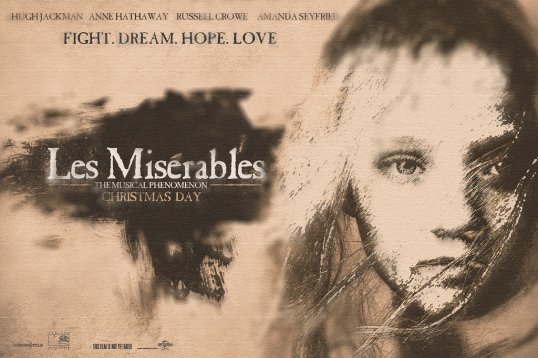
Trailer: Les Misérables (International)


With all my attention on horror-theme last October I had forgotten that the latest trailer for this holiday season’ upcoming feature-length film adaptation of the musical Les Misérables has already come out.

The film will be directed by Academy Award-winning director Tom Hooper (fresh off his win for The King’s Speech) he leads a star-studded ensemble cast in putting on the big screen the much-beloved musical that dominated the 80’s and most of the 90’s. I don’t know any kid growing up during that decade who didn’t get dragged to see the musical in the big cities it entrenched itself in. Instead of hating the experience most kids ended up loving the musical. I know that I was one such highschooler who ended up loving it and musicals in general.

This international trailer shows more of the story compared to the teaser which arrived 5 months earlier. We get to see snippets of Crowe singing as Javert and Seyfried as Cosette. Whilethe West End and Broadway productions have come to an end or at the very least not as popular as they used to be) hopefully this film adaptation will introduce this classic to a new generation of kids. Show them that there’s more to music than the pop hits that dominates the radio waves and internet radio sites.

Les Misérables is set for a December 25, 2012 release date.

Image Source: JWoodhams Deviantart

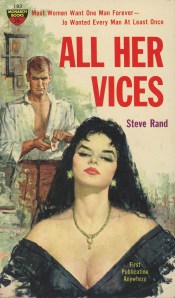
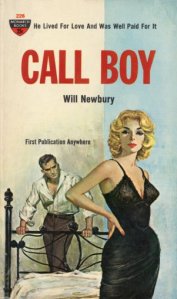
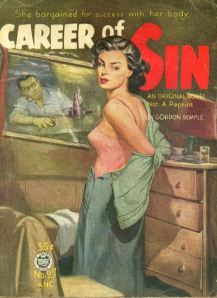
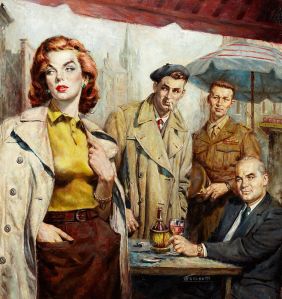
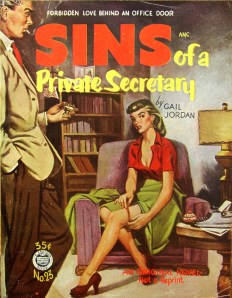
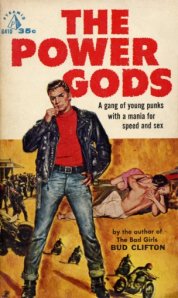
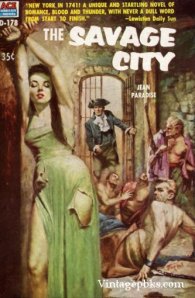
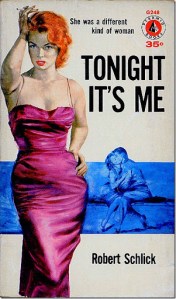
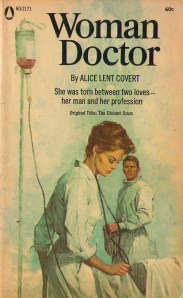
Artist Profile: Lou Marchetti (1920–1992)


Louis Marchetti was born in Fondi, Italy and immigrated to the United States at an early age.  He studied art for five years at the Art Students League of New York.  As a freelance illustrator, he created numerous paperback book covers for Dell Books, Pocket Books, Lancer Books, Paperback Library, and Popular Library.

A selection of his work can be found below.

VGM Entry 65: Follin in the 90s


VGM Entry 65: Follin on the SNES
(Thanks to Tish at FFShrine for the banner)

The average quality of Tim Follin’s compositions seemed to progressively decline with every new improvement to technology. A sort of daredevil musician accustomed to breaking barriers and pushing boundaries, I think the relative freedom of SNES composition forced him to find new forms of inspiration. Sometimes the muses moved him, and quite often they did not. When it did click for him, he showcased the same level of creative aptitude he’d been stirring up the gaming music world with since 1985.

http://www.youtube.com/watch?v=aRarpk3WaR0

Plok (developed by Software Creations, first published by Tradewest, 1993) was an instance in which Follin most certainly did rise to the challenge. For a goofy little game, here was a simultaneously ridiculous and wonderful score.

Tim and Geoff collaborated on this one, as they had often times before (I may well have falsely credited Tim with Geoff’s work on occasion), and it all came together exceptionally well in this instance. The track beginning at 1:48, “Venge Thicket”, especially exhibits precisely the sort of upbeat prog rock for which Tim excels, with a definite Ghouls’n Ghosts vibe. The track at 5:00, “Cotton Island”, does a delightful job of busting out in trademark over-the-top Follin style while remaining entirely within the corny and fun setting of the game it represents. “Akrillic“, not featured in the above compilation, is more of a smooth, relaxing jazz-prog ride that far exceeds the game for which it was written.

Plok was not the first great Super Nintendo soundtrack by the Follin brothers. Tim and Geoff also collaborated for Spider-Man and the X-Men in Arcade’s Revenge, another Software Creations development, published by LJN in 1992. It was, as it turns out, the only Follin game I actually owned as a kid, and its music was the leading cause in my purchasing it after playing a rental. Tim has supposedly cited Guns N’ Roses as a musical influence, but it’s only on the Arcade’s Revenge title theme that you can clearly hear it.

The whole rock and roll approach to composition was not a one-time go for the Follin brothers, though it was fairly foreign to their pre-SNES games. They would employ a much heavier rock influence throughout most of their SNES catalogue, most obviously on Rock n’ Roll Racing (Interplay, 1993). But it didn’t always work. Arcade’s Revenge was more the exception than the rule. In any case, it was not strictly rock, and the music of the Gambit stages in particular exhibit a wide variety of electronic beats intermixed with rock and prog.

The music to the Spider-Man stages was perhaps the most memorable of the game for me, and not merely because they were the only ones I could consistantly beat. It’s definitely the most diverse song in the game, intermingling prog and classical with some funk and jazz in a subdued sort of way that matched the cool vibe of the opening level, where you infiltrate a high security facility with a smoggy night sky as your backdrop. It made an otherwise tedious game well worth playing. . . . With a Game Genie.

The Follin brothers were mostly committed to the SNES throughout the 1990s, but at least one incursion was made into the world of the Genesis/Mega Drive. To the best of my knowledge Tim is responsible for the title screen music to Time Trax, and he probably wrote it in 1993 or 1994. Its extension from the Arcade’s Revenge sound should be fairly apparent. Unfortunately neither the game itself nor any other songs from it are available. Malibu Games released a SNES version with an entirely different score in 1994, but the Mega Drive version was dropped prior to publishing.

A Blast From The Past: The Snob (1958)


I love watching the old educational films from the 1950s.  Whether they are dealing with the threat of outside agitators, the need for families to eat dinner together, or the importance of obsessive grooming, these films often provide an interesting view into the past.

(Though, as far as I’m concerned, obsessive grooming is a theme that will never get old.)

Two weeks ago, I first came across The Snob on YouTube.  In the days since I first saw it, this 13-minute educational film has become something of an obsession of mine.  Some of this is because this film deals with a universal subject.  Though I don’t think I’ve ever been a snob, I’ve certainly known a few.  Even more importantly, everyone in this film is just so intense.  If Edward Albee wrote an educational film, it would have been a lot like The Snob.

Also, is it just me or is the kitchen scene between Sarah and her father kind of creepy?

AMV of the Day: Dead End (Mirai Nikki)


Time for a new “AMV of the Day” and the first one that features the recently licensed supernatural horror (w/ some romance) anime series Mirai Nikki aka Future Diary.

“Dead End” is the title of the AMV and it features the two leads of the series. There’s the loner Yuki Amano and Yuno Gasai. The latter being the pink-haired girl who seems to be quite smitten with the quieter Yuki. The video itself doesn’t spoil much about the main story in the series, but it does give a hint as to the peculiar relationship between these two people. The loner (not hikikomori-level but getting there) and the slightly unhinged yandere.

This video would’ve been perfect for the horror-themed October, but alas I had just recently found this little gem which uses the song “You Make Me Feel” by trip hop group Archive. The song itself fits in well with the scenes chosen and edited together for the video. It really highlights the soft and extreme nature of Yuki and Yuno’s relationship as the song goes from hard trip hop bass line beats to the band’s frontwoman’s ethereal-sounding vocals.

So, much props to the video’s creator, Himura Kenshin, for this well-made AMV and for creating a video that could easily act like a trailer for the series.

Anime: Mirai Nikki

Song: “You Make Me Feel” by Archive

Creator: Himura Kenshin

Past AMVs of the Day

Song of the Day: Green and Blue from Halo 4 (by Neil Davidge)


The latest “Song of the Day” comes from the Halo 4 soundtrack. I have just finished playing the campaign and for a first-person shooter the story is what makes the game great. The song from the soundtrack I’ve ended up loving through my first listen through the album is track 15 with the simple title of “Green and Blue”.

The past Halo titles while it was under the development of it’s originators over at Bungie Studios had Martin O’Donnell composing all the music. His Halo theme as become one of the most iconic and recognizable piece of video game music. One doesn’t even have to be a fan of the series to recognize O’Donnell’s theme. When Bungie finally ended their work on the series and Microsoft’s in-house game studio created to take over with 343 Industries fans of the series were concerned that any future Halo titles wouldn’t be able to stand up to O’Donnell’s work under the original regime.

For Halo 4 a new composer was hired to create the appropriate score for the title. In comes Massive Attack’s Neil Davidge to follow in the huge foot steps of O’Donnell. The track I chose is just one piece of a huge orchestral score that Davidge (with assistance from Kazuma Jinnouichi) ended up creating for the title. It’s not just my favorite but also the one piece of music in the entire score that best describes the themes and emotional content of the narrative created for the campaign of Halo 4.

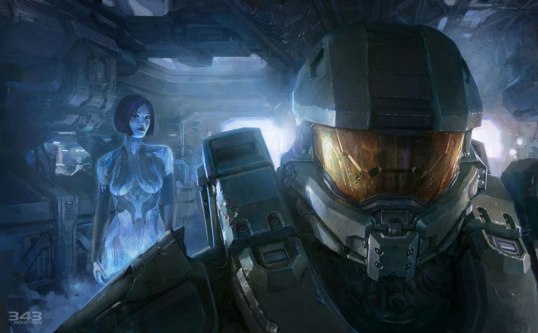
The song begins with a subtle opening that speaks of the revival of the game’s two leads in Master Chief and his A.I. companion, Cortana. They are the Green and Blue of the title. From their revival, to a ethereal lament that then moves moves into a growing, rousing section that best describes the two characters’ relationship and feelings for each other. These are two individuals who have been through hell and back and going into the breach once again and there’s a chance that one or both won’t be back.

As a fan of O’Donnell’s work on the series I was one of those who had concerns about whether Davidge could handle being the new musical caretaker for the Halo franchise. With this example from the game’s orchestral score my concerns have been alleviated and now have another Halo score to enjoy.

VGM Entry 64: Star Fox and Turrican


VGM Entry 64: Star Fox and Turrican
(Thanks to Tish at FFShrine for the banner)

Fantasy genre gaming alone did not define the Super Nintendo, and it’s time to look again at what was transpiring in more action-oriented fields. Star Fox was probably the most well-known action game of 1993. Super Turrican was perhaps one of the least.

http://www.youtube.com/watch?v=qg2Uxm491lA

Star Fox launched yet another major Nintendo series still being marketed today, and it was a novel game in many ways. It was the flagship title for Argonaut Games’ new Super FX chip, and as such featured a style of graphics never before seen on the system. It was the must have non-RPG of the year, and I can safely say the music had no factor in selling the game. It was just a wonderful added bonus.

Hajime Hirasawa is not a significant figure in game music composition generally. As best I can tell he only ever scored two games: Time Twist: Rekishi no Katasumi de… (Nintendo, 1991) for the Family Computer Disk System (FDS) peripheral to the Famicom, and Star Fox. (The former, as you might quickly notice, is pretty bad.) Hirasawa left Nintendo upon the completion of Star Fox and, a few small arrangement jobs aside, doesn’t seem to have had any further involvement in the gaming industry. He ranks alongside Yukihide Takekawa as one of the greatest one-hit wonders of the era.

http://www.youtube.com/watch?v=kwaTdxHU4l8

Super Turrican (Seika, 1993) on the other hand marked the Super Nintendo debut (to the best of my knowledge) of a video game music legend. The Turrican series has a long and convoluted history, throughout which Chris Hülsbeck did the grand bulk of the composing, and it is for the first SNES installment that he is most remembered.

There were, as best I understand it, six distinct Turrican games in all, but many of these were ported to wildly different systems and must have underwent some drastic changes. Turrican (Rainbow Arts, 1990) and Turrican II (Rainbow Arts, 1991) were both designed for the Commodore 64 originally, by Manfred Trenz, that dubious developer of The Great Giana Sisters. In the span of about one year–to give you some idea of the wide variety of versions here–Turrican was ported to the Amiga 500 and Atari ST (by Factor 5), the Amstrad CPC and ZX Spectrum (by Probe Software), and the Sega Mega Drive/Genesis, PC Engine, and Game Boy (by Code Monkeys and Accolade.) It would be nice to at least know which of them Chris Hülsbeck was directly involved in, because not all of their music is good. The Game Boy port is especially terrible.

Super Turrican was one of three installments of the series developed in 1993. The first, Mega Turrican, had to be shelved for year for lack of a publisher on the Mega Drive, but it did make it to the Amiga as Turrican 3: Payment Day, resulting in the odd consequence of a port of the game being released a year ahead of the original. The other two were, confusingly, both called Super Turrican. Manfred Trenz and Rainbow Arts developed the Nintendo Super Turrican, based loosely around the original two C64 titles, and got the game published through Imagineer. Factor 5 in the meantime developed the Super Nintendo Super Turrican on the model of the Sega Mega Drive version, which was published by Seika as well as, according to Wikipedia, Hudson Soft and Tonkin House. Whatever all confusion must have surrounded this game, they didn’t forget to bring back the series’ main composer, and Chris Hülsbeck’s Super Turrican stands among the best on the SNES today.